subslength = 28 subs = [{"id":"1321205","name":"3 Waters","href":"http://www.dunedin.govt.nz/services/3-waters","assetType":"page_standard","openType":"_self","titleText":"","children":[{"id":"655837","name":"Stormwater and water drainage ","href":"http://www.dunedin.govt.nz/services/3-waters/stormwater","assetType":"page_standard","openType":"_self","titleText":"","children":[{"name":"Catchment management","href":"http://www.dunedin.govt.nz/home-and-property/stormwater/integrated-catchment-management-plans","assetType":"page_standard","openType":"_self","titleText":"","children":[]},{"name":"Minimising stormwater runoff","href":"http://www.dunedin.govt.nz/home-and-property/stormwater/minimising-stormwater-runoff","assetType":"page_standard","openType":"_self","titleText":"","children":[]},{"name":"Preventing stormwater pollution","href":"http://www.dunedin.govt.nz/home-and-property/stormwater/preventing-stormwater-pollution","assetType":"page_standard","openType":"_self","titleText":"","children":[]},{"name":"Stormwater monitoring","href":"http://www.dunedin.govt.nz/home-and-property/stormwater/stormwater-monitoring","assetType":"page_standard","openType":"_self","titleText":"","children":[]},{"name":"Stormwater quality","href":"http://www.dunedin.govt.nz/home-and-property/stormwater/stormwater-quality","assetType":"page_standard","openType":"_self","titleText":"","children":[]},{"name":"Stormwater responsibilities","href":"http://www.dunedin.govt.nz/services/3-waters/stormwater/stormwater-responsibilities","assetType":"page_standard","openType":"_self","titleText":"","children":[]},{"name":"Watercourses","href":"http://www.dunedin.govt.nz/home-and-property/stormwater/watercourses","assetType":"page_standard","openType":"_self","titleText":"","children":[]}]},{"id":"655849","name":"Wastewater","href":"http://www.dunedin.govt.nz/services/3-waters/wastewater","assetType":"page_standard","openType":"_self","titleText":"","children":[{"name":"Allanton Wastewater Scheme","href":"http://www.dunedin.govt.nz/home-and-property/wastewater/allanton-wastewater-scheme","assetType":"page_standard","openType":"_self","titleText":"","children":[]},{"name":"Beach water quality","href":"http://www.dunedin.govt.nz/services/3-waters/wastewater/beach-water-quality","assetType":"page_standard","openType":"_self","titleText":"","children":[]},{"name":"Environmental monitoring ","href":"http://www.dunedin.govt.nz/services/3-waters/wastewater/environmental-monitoring","assetType":"page_standard","openType":"_self","titleText":"","children":[]},{"name":"Network overflows","href":"http://www.dunedin.govt.nz/services/3-waters/wastewater/network-overflows","assetType":"page_standard","openType":"_self","titleText":"","children":[]},{"name":"Odours ","href":"http://www.dunedin.govt.nz/home-and-property/wastewater/odours","assetType":"page_standard","openType":"_self","titleText":"","children":[]},{"name":"Trade waste","href":"http://www.dunedin.govt.nz/services/3-waters/wastewater/tradewaste","assetType":"page_standard","openType":"_self","titleText":"","children":[]},{"name":"Wastewater treatment plants","href":"http://www.dunedin.govt.nz/services/3-waters/wastewater/wastewater-treatment-plants","assetType":"page_standard","openType":"_self","titleText":"","children":[]},{"name":"Whose pipe is that?","href":"http://www.dunedin.govt.nz/services/3-waters/wastewater/whose-pipe-is-that","assetType":"page_standard","openType":"_self","titleText":"","children":[]}]},{"id":"655853","name":"Water supply","href":"http://www.dunedin.govt.nz/services/3-waters/water-supply","assetType":"page_standard","openType":"_self","titleText":"","children":[{"name":" Integrated System Plan – Planning for the Next 50 Years","href":"http://www.dunedin.govt.nz/services/3-waters/water-supply/integrated-system-plan","assetType":"page_standard","openType":"_self","titleText":"","children":[]},{"name":"Boundary backflow prevention – keeping our drinking water safe","href":"http://www.dunedin.govt.nz/home-and-property/water-supply/backflow","assetType":"page_standard","openType":"_self","titleText":"","children":[]},{"name":"Deep Stream Water Supply Catchment","href":"http://www.dunedin.govt.nz/services/3-waters/water-supply/deep-stream-water-supply-catchment","assetType":"page_standard","openType":"_self","titleText":"","children":[]},{"name":"Dunedin water supply system","href":"http://www.dunedin.govt.nz/services/3-waters/water-supply/dunedin-water-supply-system","assetType":"page_standard","openType":"_self","titleText":"","children":[]},{"name":"History","href":"http://www.dunedin.govt.nz/home-and-property/water-supply/history","assetType":"page_standard","openType":"_self","titleText":"","children":[]},{"name":"New water connections","href":"http://www.dunedin.govt.nz/services/3-waters/water-supply/new-water-connections","assetType":"page_standard","openType":"_self","titleText":"","children":[]},{"name":"Paying your water account","href":"http://www.dunedin.govt.nz/services/3-waters/water-supply/paying-your-water-account","assetType":"page_standard","openType":"_self","titleText":"","children":[]},{"name":"Restricted water schemes","href":"http://www.dunedin.govt.nz/services/3-waters/water-supply/restricted-water-schemes","assetType":"page_standard","openType":"_self","titleText":"","children":[]},{"name":"Saving water tips","href":"http://www.dunedin.govt.nz/services/3-waters/water-supply/saving-water-tips","assetType":"page_standard","openType":"_self","titleText":"","children":[]},{"name":"Servicing Assessment: Drinking water, wastewater and stormwater","href":"http://www.dunedin.govt.nz/home-and-property/water-supply/servicing-assessment","assetType":"page_standard","openType":"_self","titleText":"","children":[]},{"name":"Treatment","href":"http://www.dunedin.govt.nz/home-and-property/water-supply/treatment","assetType":"page_standard","openType":"_self","titleText":"","children":[]},{"name":"Waikouaiti/Karitane/Hawksbury Village water supply contamination information","href":"http://www.dunedin.govt.nz/services/3-waters/water-supply/water-supply-contamination-information","assetType":"page_standard","openType":"_self","titleText":"","children":[]},{"name":"Water charges","href":"http://www.dunedin.govt.nz/home-and-property/water-supply/water-charges","assetType":"page_standard","openType":"_self","titleText":"","children":[]},{"name":"Water pressure","href":"http://www.dunedin.govt.nz/services/3-waters/water-supply/water-pressure","assetType":"page_standard","openType":"_self","titleText":"","children":[]}]},{"id":"1321213","name":"Local Water Done Well ","href":"http://www.dunedin.govt.nz/services/3-waters/local-water-done-well","assetType":"page_standard","openType":"_self","titleText":"","children":[{"name":"Local Water Done Well reform","href":"http://www.dunedin.govt.nz/services/3-waters/local-water-done-well/local-water-done-well-reform","assetType":"page_standard","openType":"_self","titleText":"","children":[{"name":"Comparing the water services delivery models","href":"http://www.dunedin.govt.nz/services/3-waters/local-water-done-well/local-water-done-well-reform/comparing-the-water-services-delivery-models","assetType":"page_standard","openType":"_self","titleText":""},{"name":"Financial assessment ","href":"http://www.dunedin.govt.nz/services/3-waters/local-water-done-well/local-water-done-well-reform/financial-assessment","assetType":"page_standard","openType":"_self","titleText":""},{"name":"Frequently asked questions","href":"http://www.dunedin.govt.nz/services/3-waters/local-water-done-well/local-water-done-well-reform/lwdw-faqs-page-1","assetType":"page_standard","openType":"_self","titleText":""},{"name":"The water services delivery models","href":"http://www.dunedin.govt.nz/services/3-waters/local-water-done-well/local-water-done-well-reform/the-water-services-delivery-models","assetType":"page_standard","openType":"_self","titleText":""},{"name":"What is a water services Council-Controlled Organisation (CCO)?","href":"http://www.dunedin.govt.nz/services/3-waters/local-water-done-well/local-water-done-well-reform/what-is-a-water-services-council-controlled-organisation-cco","assetType":"page_standard","openType":"_self","titleText":""},{"name":"What is Local Water Done Well?","href":"http://www.dunedin.govt.nz/services/3-waters/local-water-done-well/local-water-done-well-reform/what-is-local-water-done-well","assetType":"page_standard","openType":"_self","titleText":""},{"name":"What water services do we deliver?","href":"http://www.dunedin.govt.nz/services/3-waters/local-water-done-well/local-water-done-well-reform/what-water-services-do-we-deliver","assetType":"page_standard","openType":"_self","titleText":""}]}]},{"id":"1321267","name":"Reporting and disclosures","href":"http://www.dunedin.govt.nz/services/3-waters/reporting-and-disclosures","assetType":"page_standard","openType":"_self","titleText":"","children":[]},{"id":"711911","name":"3 Waters Projects","href":"http://www.dunedin.govt.nz/services/3-waters/3-waters-projects","assetType":"page_standard","openType":"_self","titleText":"","children":[]}]},{"id":"655817","name":"Alcohol licensing","href":"http://www.dunedin.govt.nz/services/licensing","assetType":"page_standard","openType":"_self","titleText":"","children":[{"id":"1132920","name":"Alcohol licensing regulation and compliance","href":"http://www.dunedin.govt.nz/services/licensing/alcohol-licensing-regulation-and-compliance","assetType":"page_standard","openType":"_self","titleText":"","children":[]},{"id":"683762","name":"Applying or renewing an alcohol licence","href":"http://www.dunedin.govt.nz/services/licensing/applying-or-renewing-an-alcohol-licence","assetType":"page_standard","openType":"_self","titleText":"","children":[]},{"id":"683754","name":"Alcohol licensing fees","href":"http://www.dunedin.govt.nz/services/licensing/alcohol-licensing-fees","assetType":"page_standard","openType":"_self","titleText":"","children":[]},{"id":"683778","name":"Applying for a manager's licence","href":"http://www.dunedin.govt.nz/services/licensing/applying-for-a-managers-licence","assetType":"page_standard","openType":"_self","titleText":"","children":[]},{"id":"683790","name":"Licence holder responsibilities","href":"http://www.dunedin.govt.nz/services/licensing/licence-holder-responsibilities","assetType":"page_standard","openType":"_self","titleText":"","children":[]},{"id":"684714","name":"Publicly notified licence applications","href":"http://www.dunedin.govt.nz/services/licensing/alcohol-licence-applications","assetType":"page_standard","openType":"_self","titleText":"","children":[]},{"id":"683774","name":"Objecting to an alcohol licence application","href":"http://www.dunedin.govt.nz/services/licensing/objecting-to-an-alcohol-licence-application","assetType":"page_standard","openType":"_self","titleText":"","children":[]},{"id":"549241","name":"Alcohol licence application decisions","href":"http://www.dunedin.govt.nz/services/licensing/alcohol-licence-application-decisions","assetType":"page_standard","openType":"_self","titleText":"","children":[]}]},{"id":"697876","name":"Arts and culture - Ara Toi","href":"http://www.dunedin.govt.nz/services/arts-and-culture","assetType":"page_standard","openType":"_self","titleText":"","children":[{"id":"1055263","name":"Ōtepoti Dunedin Community Gallery","href":"http://www.dunedin.govt.nz/services/arts-and-culture/community-gallery","assetType":"page_redirect","openType":"_self","titleText":"","children":[]},{"id":"1028451","name":"Arts grants","href":"http://www.dunedin.govt.nz/services/arts-and-culture/arts-grants","assetType":"page_redirect","openType":"_self","titleText":"","children":[]},{"id":"726705","name":"Ara Toi Creative - registration of interest","href":"http://www.dunedin.govt.nz/services/arts-and-culture/ara-toi-creative-registration-of-interest","assetType":"page_redirect","openType":"_self","titleText":"","children":[]},{"id":"1033721","name":"Ōtepoti Live Music Action Plan","href":"http://www.dunedin.govt.nz/services/arts-and-culture/otepoti-live-music-action-plan","assetType":"page_standard","openType":"_self","titleText":"","children":[]},{"id":"772252","name":"Public Artwork","href":"http://www.dunedin.govt.nz/services/arts-and-culture/public-artwork","assetType":"page_standard","openType":"_self","titleText":"","children":[{"name":"All From Water","href":"http://www.dunedin.govt.nz/services/arts-and-culture/public-artwork/all-from-water","assetType":"page_standard","openType":"_self","titleText":"","children":[]},{"name":"Ko te Tūhono","href":"http://www.dunedin.govt.nz/services/arts-and-culture/public-artwork/ko-te-tuhono","assetType":"page_standard","openType":"_self","titleText":"","children":[]}]},{"id":"1306904","name":"Ōtepoti Hou music compilation","href":"http://www.dunedin.govt.nz/services/arts-and-culture/otepoti-hou","assetType":"page_standard","openType":"_self","titleText":"","children":[]},{"id":"1050505","name":"Toi Oho – Ara Toi newsletter","href":"http://www.dunedin.govt.nz/services/arts-and-culture/ara-toi-toi-oho-issue-18","assetType":"page_redirect","openType":"_self","titleText":"","children":[]},{"id":"782140","name":"Performing arts feasibility study","href":"http://www.dunedin.govt.nz/services/arts-and-culture/performing-arts-feasibility-study","assetType":"page_standard","openType":"_self","titleText":"","children":[]}]},{"id":"655780","name":"Building services","href":"http://www.dunedin.govt.nz/services/building-services","assetType":"page_standard","openType":"_self","titleText":"","children":[{"id":"1136347","name":"Building forms, guides and fees","href":"http://www.dunedin.govt.nz/services/building-services/forms-guides-and-fees","assetType":"page_standard","openType":"_self","titleText":"","children":[{"name":"Building consent fees and charges ","href":"http://www.dunedin.govt.nz/services/building-services/forms-guides-and-fees/fees-and-charges","assetType":"page_standard","openType":"_self","titleText":"","children":[]},{"name":"Building forms and guidance","href":"http://www.dunedin.govt.nz/services/building-services/forms-guides-and-fees/forms-and-checksheets","assetType":"page_standard","openType":"_self","titleText":"","children":[]},{"name":"Building general fees and charges","href":"http://www.dunedin.govt.nz/services/building-services/forms-guides-and-fees/building-services-charges","assetType":"page_standard","openType":"_self","titleText":"","children":[]},{"name":"Building infringement offences and fees","href":"http://www.dunedin.govt.nz/services/building-services/forms-guides-and-fees/building-infringement-offences-and-fees","assetType":"page_standard","openType":"_self","titleText":"","children":[]},{"name":"Drainage fees and charges ","href":"http://www.dunedin.govt.nz/services/building-services/forms-guides-and-fees/drainage-fees-and-charges","assetType":"page_standard","openType":"_self","titleText":"","children":[]}]},{"id":"975332","name":"The building basics","href":"http://www.dunedin.govt.nz/services/building-services/the-building-basics","assetType":"page_standard","openType":"_self","titleText":"","children":[]},{"id":"1136367","name":"Planning your project","href":"http://www.dunedin.govt.nz/services/building-services/planning-your-project","assetType":"page_standard","openType":"_self","titleText":"","children":[{"name":"Advice on back yard sheds","href":"http://www.dunedin.govt.nz/services/building-services/planning-your-project/sheds","assetType":"page_standard","openType":"_self","titleText":"","children":[]},{"name":"Alterations to existing buildings","href":"http://www.dunedin.govt.nz/services/building-services/planning-your-project/alterations-to-existing-buildings","assetType":"page_standard","openType":"_self","titleText":"","children":[]},{"name":"Carrying out drainage work involving Council land or infrastructure ","href":"http://www.dunedin.govt.nz/services/building-services/planning-your-project/carrying-out-drainage-work-involving-council-land-or-infrastructure","assetType":"page_standard","openType":"_self","titleText":"","children":[]},{"name":"Earthquake prone buildings ","href":"http://www.dunedin.govt.nz/services/building-services/planning-your-project/earthquake-prone-buildings","assetType":"page_standard","openType":"_self","titleText":"","children":[]},{"name":"Eco design","href":"http://www.dunedin.govt.nz/services/building-services/planning-your-project/eco-design","assetType":"page_redirect","openType":"_self","titleText":"","children":[]},{"name":"HAIL and lead from paint","href":"http://www.dunedin.govt.nz/services/building-services/planning-your-project/hail-and-lead-from-paint","assetType":"page_redirect","openType":"_self","titleText":"","children":[]},{"name":"Liquefaction-prone land","href":"http://www.dunedin.govt.nz/services/building-services/planning-your-project/liquefaction-prone-land","assetType":"page_standard","openType":"_self","titleText":"","children":[]},{"name":"Minimum floor levels","href":"http://www.dunedin.govt.nz/services/building-services/planning-your-project/minimum-floor-levels","assetType":"page_standard","openType":"_self","titleText":"","children":[]},{"name":"Residential pools/spa barriers","href":"http://www.dunedin.govt.nz/services/building-services/planning-your-project/pool-fencing","assetType":"page_standard","openType":"_self","titleText":"","children":[]},{"name":"Short term visitor accommodation – compliance considerations","href":"http://www.dunedin.govt.nz/services/building-services/planning-your-project/short-term-visitor-accommodation","assetType":"page_standard","openType":"_self","titleText":"","children":[]}]},{"id":"1136351","name":"Before you start","href":"http://www.dunedin.govt.nz/services/building-services/before-you-start","assetType":"page_standard","openType":"_self","titleText":"","children":[{"name":"Before you begin","href":"http://www.dunedin.govt.nz/services/building-services/before-you-start/before-you-begin","assetType":"page_standard","openType":"_self","titleText":"","children":[]},{"name":"Building Services general information","href":"http://www.dunedin.govt.nz/services/building-services/before-you-start/general-information","assetType":"page_standard","openType":"_self","titleText":"","children":[]},{"name":"Consumer protection measures","href":"http://www.dunedin.govt.nz/services/building-services/before-you-start/consumer-protection-measures-for-homeowners-building-and-renovating","assetType":"page_standard","openType":"_self","titleText":"","children":[]},{"name":"Do you need consent","href":"http://www.dunedin.govt.nz/services/building-services/before-you-start/do-you-need-consent","assetType":"page_standard","openType":"_self","titleText":"","children":[]}]},{"id":"1136355","name":"Apply for a building consent","href":"http://www.dunedin.govt.nz/services/building-services/apply-for-a-building-consent","assetType":"page_standard","openType":"_self","titleText":"","children":[{"name":"How to complete an application form ","href":"http://www.dunedin.govt.nz/services/building-services/apply-for-a-building-consent/how-to-complete-an-application-form","assetType":"page_standard","openType":"_self","titleText":"","children":[]},{"name":"Making an application for building consent","href":"http://www.dunedin.govt.nz/services/building-services/apply-for-a-building-consent/making-an-application-for-building-consent","assetType":"page_standard","openType":"_self","titleText":"","children":[]},{"name":"Submit building applications online","href":"http://www.dunedin.govt.nz/do-it-online/apply/building-consent-applications","assetType":"page_standard","openType":"_self","titleText":"","children":[]}]},{"id":"1136359","name":"Processing applications","href":"http://www.dunedin.govt.nz/services/building-services/processing-applications","assetType":"page_standard","openType":"_self","titleText":"","children":[{"name":"Building consent process","href":"http://www.dunedin.govt.nz/services/building-services/processing-applications/consent-process","assetType":"page_standard","openType":"_self","titleText":"","children":[]},{"name":"Making changes to a building consent","href":"http://www.dunedin.govt.nz/services/building-services/processing-applications/making-changes-to-a-building-consent","assetType":"page_standard","openType":"_self","titleText":"","children":[]}]},{"id":"683118","name":"Starting work and inspections","href":"http://www.dunedin.govt.nz/services/building-services/inspections","assetType":"page_standard","openType":"_self","titleText":"","children":[]},{"id":"1136363","name":"Compliance and certifying","href":"http://www.dunedin.govt.nz/services/building-services/compliance-and-certifying","assetType":"page_standard","openType":"_self","titleText":"","children":[{"name":"Code compliance certificate","href":"http://www.dunedin.govt.nz/services/building-services/compliance-and-certifying/code-compliance-certificate","assetType":"page_standard","openType":"_self","titleText":"","children":[]},{"name":"Compliance schedule and building warrant of fitness","href":"http://www.dunedin.govt.nz/services/building-services/compliance-and-certifying/compliance-schedule-and-specified-system-information","assetType":"page_standard","openType":"_self","titleText":"","children":[]}]},{"id":"683230","name":"Amusement devices","href":"http://www.dunedin.govt.nz/services/building-services/amusement-devices","assetType":"page_standard","openType":"_self","titleText":"","children":[]},{"id":"797420","name":"Southern Building Controls Group (SBCG)","href":"http://www.dunedin.govt.nz/services/building-services/southern-building-controls-group","assetType":"page_standard","openType":"_self","titleText":"","children":[]},{"id":"683236","name":"Building Services newsletter","href":"http://www.dunedin.govt.nz/do-it-online/subscribe/building-services-newsletter","assetType":"page_standard","openType":"_self","titleText":"","children":[]},{"id":"1136371","name":"Complaints","href":"http://www.dunedin.govt.nz/services/building-services/complaints","assetType":"page_standard","openType":"_self","titleText":"","children":[]}]},{"id":"655804","name":"Business support","href":"http://www.dunedin.govt.nz/services/business-support","assetType":"page_standard","openType":"_self","titleText":"","children":[{"id":"679626","name":"DCC rules that might affect your business","href":"http://www.dunedin.govt.nz/services/business-support/council-rules-that-might-affect-your-business","assetType":"page_standard","openType":"_self","titleText":"","children":[]},{"id":"680891","name":"Commercial use of footpaths","href":"http://www.dunedin.govt.nz/services/business-support/commercial-use-of-footpaths","assetType":"page_standard","openType":"_self","titleText":"","children":[]},{"id":"679634","name":"Employing newcomers","href":"http://www.dunedin.govt.nz/services/business-support/moving-here-or-employing-newcomers","assetType":"page_standard","openType":"_self","titleText":"","children":[]},{"id":"1083774","name":"Good Food Dunedin","href":"http://www.dunedin.govt.nz/services/business-support/good-food-dunedin","assetType":"page_standard","openType":"_self","titleText":"","children":[]}]},{"id":"658056","name":"Cemeteries","href":"http://www.dunedin.govt.nz/services/cemeteries","assetType":"page_standard","openType":"_self","titleText":"","children":[{"id":"680167","name":"Ash burials","href":"http://www.dunedin.govt.nz/services/cemeteries/ash-burials","assetType":"page_standard","openType":"_self","titleText":"","children":[]},{"id":"680195","name":"Book of Remembrance","href":"http://www.dunedin.govt.nz/services/cemeteries/book-of-remembrance","assetType":"page_standard","openType":"_self","titleText":"","children":[]},{"id":"680137","name":"Burials","href":"http://www.dunedin.govt.nz/services/cemeteries/burials","assetType":"page_standard","openType":"_self","titleText":"","children":[]},{"id":"680141","name":"Burial and related fees","href":"http://www.dunedin.govt.nz/services/cemeteries/burial-and-related-fees","assetType":"page_standard","openType":"_self","titleText":"","children":[]},{"id":"790366","name":"Cemeteries Booking","href":"http://www.dunedin.govt.nz/services/cemeteries/cemeteries-booking","assetType":"page_redirect","openType":"_self","titleText":"","children":[]},{"id":"700083","name":"Cemeteries search","href":"http://www.dunedin.govt.nz/do-it-online/search/cemeteries-search","assetType":"page_remote_content","openType":"_self","titleText":"","children":[]},{"id":"680163","name":"Cemetery locations","href":"http://www.dunedin.govt.nz/services/cemeteries/cemetery-locations","assetType":"page_standard","openType":"_self","titleText":"","children":[]},{"id":"680171","name":"Crematorium fees","href":"http://www.dunedin.govt.nz/services/cemeteries/crematorium-fees","assetType":"page_standard","openType":"_self","titleText":"","children":[]},{"id":"680187","name":"Memorials","href":"http://www.dunedin.govt.nz/services/cemeteries/memorials","assetType":"page_standard","openType":"_self","titleText":"","children":[]},{"id":"680191","name":"Natural burials","href":"http://www.dunedin.govt.nz/services/cemeteries/natural-burials","assetType":"page_standard","openType":"_self","titleText":"","children":[]},{"id":"680203","name":"Queen Elisabeth Medal recipients","href":"http://www.dunedin.govt.nz/services/cemeteries/queen-elisabeth-medal-recipients","assetType":"page_standard","openType":"_self","titleText":"","children":[]}]},{"id":"658060","name":"City safety","href":"http://www.dunedin.govt.nz/services/city-safety","assetType":"page_standard","openType":"_self","titleText":"","children":[]},{"id":"658064","name":"Community support","href":"http://www.dunedin.govt.nz/services/community-support","assetType":"page_standard","openType":"_self","titleText":"","children":[{"id":"680775","name":"Community directories","href":"http://www.dunedin.govt.nz/services/community-support/community-directories","assetType":"page_standard","openType":"_self","titleText":"","children":[]},{"id":"699797","name":"Enviroschools","href":"http://www.dunedin.govt.nz/services/community-support/enviroschools","assetType":"page_standard","openType":"_self","titleText":"","children":[]},{"id":"681264","name":"Refugee support","href":"http://www.dunedin.govt.nz/services/new-to-dunedin/refugee-support","assetType":"page_standard","openType":"_self","titleText":"","children":[]},{"id":"355561","name":"Keep Dunedin Beautiful","href":"http://www.dunedin.govt.nz/services/community-support/keep-dunedin-beautiful","assetType":"page_standard","openType":"_self","titleText":"","children":[]},{"id":"680785","name":"Ōtepoti Youth Vision","href":"http://www.dunedin.govt.nz/services/community-support/young-people","assetType":"page_standard","openType":"_self","titleText":"","children":[]},{"id":"842394","name":"Pāsifika Communities in Ōtepoti Dunedin - Directory","href":"http://www.dunedin.govt.nz/services/community-support/pasifika-communities-in-otepoti-dunedin-directory","assetType":"page_standard","openType":"_self","titleText":"","children":[]},{"id":"1277293","name":"Dunedin Youth Council","href":"http://www.dunedin.govt.nz/services/community-support/dunedin-youth-council","assetType":"page_standard","openType":"_self","titleText":"","children":[]},{"id":"1308748","name":"Task Force Green","href":"http://www.dunedin.govt.nz/services/community-support/task-force-green","assetType":"page_standard","openType":"_self","titleText":"","children":[]},{"id":"1310678","name":"Helping homeless in Ōtepoti Dunedin","href":"http://www.dunedin.govt.nz/services/community-support/helping-homeless-in-otepoti-dunedin","assetType":"page_standard","openType":"_self","titleText":"","children":[]}]},{"id":"658068","name":"Council archives","href":"http://www.dunedin.govt.nz/services/council-archives","assetType":"page_standard","openType":"_self","titleText":"","children":[]},{"id":"699366","name":"Dunedin Heritage","href":"http://www.dunedin.govt.nz/services/dunedin-heritage","assetType":"page_standard","openType":"_self","titleText":"","children":[{"id":"699370","name":"Heritage Buildings and Archaeological Sites","href":"http://www.dunedin.govt.nz/services/dunedin-heritage/heritage-buildings-and-archaeological-sites","assetType":"page_standard","openType":"_self","titleText":"","children":[]},{"id":"699377","name":"Owning heritage buildings","href":"http://www.dunedin.govt.nz/services/dunedin-heritage/owning-heritage-buildings","assetType":"page_standard","openType":"_self","titleText":"","children":[{"name":"Adaptive Re-use","href":"http://www.dunedin.govt.nz/services/dunedin-heritage/owning-heritage-buildings/economic-re-use","assetType":"page_standard","openType":"_self","titleText":"","children":[]},{"name":"Heritage Buildings Maintenance Checklist","href":"http://www.dunedin.govt.nz/services/dunedin-heritage/owning-heritage-buildings/heritage-buildings-maintenance-checklist","assetType":"page_standard","openType":"_self","titleText":"","children":[]},{"name":"Heritage resource consents","href":"http://www.dunedin.govt.nz/services/dunedin-heritage/owning-heritage-buildings/heritage-resource-consents","assetType":"page_standard","openType":"_self","titleText":"","children":[]}]},{"id":"699410","name":"Dunedin Heritage Fund","href":"http://www.dunedin.govt.nz/services/dunedin-heritage/heritage-fund","assetType":"page_standard","openType":"_self","titleText":"","children":[]},{"id":"699393","name":"Heritage Awards","href":"http://www.dunedin.govt.nz/services/dunedin-heritage/awards","assetType":"page_standard","openType":"_self","titleText":"","children":[]},{"id":"699381","name":"Dunedin Thematic Study","href":"http://www.dunedin.govt.nz/services/dunedin-heritage/thematic-study","assetType":"page_standard","openType":"_self","titleText":"","children":[]},{"id":"981616","name":"Heritage Action Plan","href":"http://www.dunedin.govt.nz/services/dunedin-heritage/heritage-action-plan","assetType":"page_standard","openType":"_self","titleText":"","children":[]}]},{"id":"685114","name":"Eco-design advisor service ","href":"http://www.dunedin.govt.nz/services/eco-house-design","assetType":"page_standard","openType":"_self","titleText":"","children":[]},{"id":"720140","name":"Fees and charges","href":"http://www.dunedin.govt.nz/services/fees-and-charges","assetType":"page_standard","openType":"_self","titleText":"","children":[{"id":"720220","name":"Administration and Information Services ","href":"http://www.dunedin.govt.nz/services/fees-and-charges/administration-services","assetType":"page_standard","openType":"_self","titleText":"","children":[]},{"id":"720248","name":"Alcohol Licensing","href":"http://www.dunedin.govt.nz/services/fees-and-charges/alcohol-licensing","assetType":"page_standard","openType":"_self","titleText":"","children":[]},{"id":"720301","name":"Aquatic Services","href":"http://www.dunedin.govt.nz/services/fees-and-charges/aquatic-services","assetType":"page_standard","openType":"_self","titleText":"","children":[]},{"id":"720319","name":"Building Services","href":"http://www.dunedin.govt.nz/services/fees-and-charges/building-services","assetType":"page_standard","openType":"_self","titleText":"","children":[]},{"id":"720335","name":"Cemeteries and Crematorium","href":"http://www.dunedin.govt.nz/services/fees-and-charges/cemeteries-and-crematorium","assetType":"page_standard","openType":"_self","titleText":"","children":[]},{"id":"720343","name":"Galleries museums and gardens","href":"http://www.dunedin.govt.nz/services/fees-and-charges/chinese-garden","assetType":"page_standard","openType":"_self","titleText":"","children":[]},{"id":"720252","name":"Dogs and other animals","href":"http://www.dunedin.govt.nz/services/fees-and-charges/animal-services","assetType":"page_standard","openType":"_self","titleText":"","children":[]},{"id":"720386","name":"Environmental Health","href":"http://www.dunedin.govt.nz/services/fees-and-charges/environmental-health","assetType":"page_standard","openType":"_self","titleText":"","children":[]},{"id":"720378","name":"Filming in Dunedin","href":"http://www.dunedin.govt.nz/services/fees-and-charges/economic-development","assetType":"page_standard","openType":"_self","titleText":"","children":[]},{"id":"720402","name":"Housing","href":"http://www.dunedin.govt.nz/services/fees-and-charges/housing","assetType":"page_standard","openType":"_self","titleText":"","children":[]},{"id":"720418","name":"Libraries","href":"http://www.dunedin.govt.nz/services/fees-and-charges/libraries","assetType":"page_standard","openType":"_self","titleText":"","children":[]},{"id":"720450","name":"Parking ","href":"http://www.dunedin.govt.nz/services/fees-and-charges/parking","assetType":"page_standard","openType":"_self","titleText":"","children":[]},{"id":"1280260","name":"Parking infringements","href":"http://www.dunedin.govt.nz/services/fees-and-charges/parking-infringements","assetType":"page_standard","openType":"_self","titleText":"","children":[]},{"id":"720434","name":"Reserves and facilities","href":"http://www.dunedin.govt.nz/services/fees-and-charges/parks-and-recreation-facilities","assetType":"page_standard","openType":"_self","titleText":"","children":[]},{"id":"720351","name":"Resource consents","href":"http://www.dunedin.govt.nz/services/fees-and-charges/city-planning","assetType":"page_standard","openType":"_self","titleText":"","children":[]},{"id":"720474","name":"Roads and footpaths","href":"http://www.dunedin.govt.nz/services/fees-and-charges/transport","assetType":"page_standard","openType":"_self","titleText":"","children":[]},{"id":"720482","name":"Rubbish and recycling","href":"http://www.dunedin.govt.nz/services/fees-and-charges/waste-and-environmental-solutions","assetType":"page_standard","openType":"_self","titleText":"","children":[]},{"id":"720442","name":"Sportsgrounds","href":"http://www.dunedin.govt.nz/services/fees-and-charges/parks-and-recreation-sportsgrounds","assetType":"page_standard","openType":"_self","titleText":"","children":[]},{"id":"720494","name":"Trade waste and wastewater","href":"http://www.dunedin.govt.nz/services/fees-and-charges/wastewater","assetType":"page_standard","openType":"_self","titleText":"","children":[]},{"id":"720502","name":"Water Supply","href":"http://www.dunedin.govt.nz/services/fees-and-charges/water-supply","assetType":"page_standard","openType":"_self","titleText":"","children":[]},{"id":"708104","name":"Paying your DCC accounts","href":"http://www.dunedin.govt.nz/services/fees-and-charges/paying-your-dcc-accounts","assetType":"page_standard","openType":"_self","titleText":"","children":[]}]},{"id":"878158","name":"Food for sale","href":"http://www.dunedin.govt.nz/services/food-for-sale","assetType":"page_standard","openType":"_self","titleText":"","children":[]},{"id":"658120","name":"Funding and grants","href":"http://www.dunedin.govt.nz/services/funding-and-grants","assetType":"page_standard","openType":"_self","titleText":"","children":[{"id":"681957","name":"Arts grants","href":"http://www.dunedin.govt.nz/services/funding-and-grants/arts-funding","assetType":"page_standard","openType":"_self","titleText":"","children":[{"name":"Arts Capability Funding (Otago Community Trust/DCC funded)","href":"http://www.dunedin.govt.nz/services/funding-and-grants/arts-funding/arts-capability-funding-otago-community-trustdcc-funded","assetType":"page_redirect","openType":"_blank","titleText":"title=\"Arts Capability Funding (Otago Community Trust/DCC funded) - Opens in a new window.\"","children":[]},{"name":"City service and city projects grants","href":"http://www.dunedin.govt.nz/services/funding-and-grants/arts-funding/city-service-and-city-projects-grants","assetType":"page_redirect","openType":"_self","titleText":"","children":[]},{"name":"Creative Communities funding","href":"http://www.dunedin.govt.nz/services/funding-and-grants/arts-funding/creative-communities-funding","assetType":"page_standard","openType":"_self","titleText":"","children":[]},{"name":"DCC Arts Grants ","href":"http://www.dunedin.govt.nz/services/funding-and-grants/arts-funding/dcc-arts-grants","assetType":"page_standard","openType":"_self","titleText":"","children":[]},{"name":"Professional theatre fund","href":"http://www.dunedin.govt.nz/services/funding-and-grants/arts-funding/professional-theatre-fund","assetType":"page_standard","openType":"_self","titleText":"","children":[]},{"name":"Small Arts Grants","href":"http://www.dunedin.govt.nz/services/funding-and-grants/arts-funding/small-arts-grants2","assetType":"page_standard","openType":"_self","titleText":"","children":[]}]},{"id":"705035","name":"Biodiversity funding","href":"http://www.dunedin.govt.nz/services/funding-and-grants/biodiversity-funding","assetType":"page_standard","openType":"_self","titleText":"","children":[{"name":"Dunedin Biodiversity Fund guide for applicants","href":"http://www.dunedin.govt.nz/services/funding-and-grants/biodiversity-funding/dunedin-biodiversity-fund-guide-for-applicants","assetType":"page_standard","openType":"_self","titleText":"","children":[]}]},{"id":"681961","name":"City service and city project grants","href":"http://www.dunedin.govt.nz/services/funding-and-grants/city-service-and-city-project-grants","assetType":"page_standard","openType":"_self","titleText":"","children":[{"name":"City Projects grants criteria","href":"http://www.dunedin.govt.nz/services/funding-and-grants/city-service-and-city-project-grants/city-projects-grants","assetType":"page_standard","openType":"_self","titleText":"","children":[]},{"name":"City Service grants criteria","href":"http://www.dunedin.govt.nz/services/funding-and-grants/city-service-and-city-project-grants/city-service-grants","assetType":"page_standard","openType":"_self","titleText":"","children":[]},{"name":"Funding Strategic Criteria","href":"http://www.dunedin.govt.nz/services/funding-and-grants/events-funding/funding-strategic-criteria","assetType":"page_standard","openType":"_self","titleText":"","children":[]}]},{"id":"681965","name":"Community funding and grants","href":"http://www.dunedin.govt.nz/services/funding-and-grants/funding-and-grants","assetType":"page_standard","openType":"_self","titleText":"","children":[]},{"id":"681979","name":"Electricity fund","href":"http://www.dunedin.govt.nz/services/funding-and-grants/electricity-fund","assetType":"page_standard","openType":"_self","titleText":"","children":[{"name":"Dunedin City Council Consumers Electricity Fund criteria","href":"http://www.dunedin.govt.nz/services/funding-and-grants/electricity-fund/electricity-and-healthy-homes-grants","assetType":"page_standard","openType":"_self","titleText":"","children":[]}]},{"id":"681983","name":"Events funding","href":"http://www.dunedin.govt.nz/services/funding-and-grants/events-funding","assetType":"page_standard","openType":"_self","titleText":"","children":[{"name":"Community Event grants criteria","href":"http://www.dunedin.govt.nz/services/funding-and-grants/events-funding/community-event-grants","assetType":"page_standard","openType":"_self","titleText":"","children":[]},{"name":"Funding Strategic Criteria","href":"http://www.dunedin.govt.nz/services/funding-and-grants/events-funding/funding-strategic-criteria","assetType":"page_standard","openType":"_self","titleText":"","children":[]}]},{"id":"788621","name":"Hapori Māori Fund and Pāsifika Development Fund","href":"http://www.dunedin.govt.nz/services/funding-and-grants/hapori-maori-fund-and-pasifika-development-fund","assetType":"page_standard","openType":"_self","titleText":"","children":[]},{"id":"681997","name":"Heritage Fund","href":"http://www.dunedin.govt.nz/services/funding-and-grants/heritage-fund2","assetType":"page_redirect","openType":"_self","titleText":"","children":[]},{"id":"682002","name":"Neighbourhood matching grant","href":"http://www.dunedin.govt.nz/services/funding-and-grants/neighbourhood-matching-grant","assetType":"page_standard","openType":"_self","titleText":"","children":[{"name":"Neighbourhood Matching grant criteria","href":"http://www.dunedin.govt.nz/services/funding-and-grants/neighbourhood-matching-grant/4.6-neighbourhood-matching-grant","assetType":"page_standard","openType":"_self","titleText":"","children":[]}]},{"id":"682006","name":"Rates relief for community groups and organisations","href":"http://www.dunedin.govt.nz/services/funding-and-grants/rates-relief","assetType":"page_standard","openType":"_self","titleText":"","children":[]},{"id":"682010","name":"Place-based community grants fund ","href":"http://www.dunedin.govt.nz/services/funding-and-grants/place-based-community-grants-fund","assetType":"page_standard","openType":"_self","titleText":"","children":[{"name":"Place-based community grants fund criteria","href":"http://www.dunedin.govt.nz/services/funding-and-grants/place-based-community-grants-fund/place-based-community-grants-fund-criteria","assetType":"page_standard","openType":"_self","titleText":"","children":[]}]},{"id":"749884","name":"Dunedin Puaka Matariki Festival 2026","href":"http://www.dunedin.govt.nz/services/funding-and-grants/puaka-matariki","assetType":"page_standard","openType":"_self","titleText":"","children":[]},{"id":"682016","name":"Small project grants ","href":"http://www.dunedin.govt.nz/services/funding-and-grants/small-project-grants","assetType":"page_standard","openType":"_self","titleText":"","children":[{"name":"Small project grant criteria","href":"http://www.dunedin.govt.nz/services/funding-and-grants/small-project-grants/4.5-small-project-grant","assetType":"page_standard","openType":"_self","titleText":"","children":[]}]},{"id":"705374","name":"Waste minimisation funds","href":"http://www.dunedin.govt.nz/services/funding-and-grants/waste-minimisation-funds","assetType":"page_standard","openType":"_self","titleText":"","children":[]},{"id":"437618","name":"Capital Loan Guarantees","href":"http://www.dunedin.govt.nz/services/funding-and-grants/other-assistance","assetType":"page_standard","openType":"_self","titleText":"","children":[]}]},{"id":"655812","name":"Keeping dogs","href":"http://www.dunedin.govt.nz/services/dogs","assetType":"page_standard","openType":"_self","titleText":"","children":[{"id":"997623","name":"Dog Control Bylaw and Dog Control Policy","href":"http://www.dunedin.govt.nz/services/dogs/dog-control-bylaw-and-policy","assetType":"page_standard","openType":"_self","titleText":"","children":[]},{"id":"679038","name":"Desexing your dog","href":"http://www.dunedin.govt.nz/services/dogs/desexing-your-dog","assetType":"page_standard","openType":"_self","titleText":"","children":[]},{"id":"679044","name":"Where you can walk your dog","href":"http://www.dunedin.govt.nz/services/dogs/dog-exercise-areas","assetType":"page_standard","openType":"_self","titleText":"","children":[]},{"id":"679048","name":"Dog ownership records ","href":"http://www.dunedin.govt.nz/services/dogs/dog-owner-details","assetType":"page_standard","openType":"_self","titleText":"","children":[]},{"id":"679052","name":"Dog registration information","href":"http://www.dunedin.govt.nz/services/dogs/dog-registration","assetType":"page_standard","openType":"_self","titleText":"","children":[]},{"id":"910662","name":"Dog refunds and updates","href":"http://www.dunedin.govt.nz/services/dogs/dog-refunds-and-updates","assetType":"page_standard","openType":"_self","titleText":"","children":[]},{"id":"679060","name":"Animal Services fees and charges","href":"http://www.dunedin.govt.nz/services/dogs/fees","assetType":"page_standard","openType":"_self","titleText":"","children":[]},{"id":"679066","name":"Wandering dogs and animals","href":"http://www.dunedin.govt.nz/services/dogs/found","assetType":"page_standard","openType":"_self","titleText":"","children":[]},{"id":"679070","name":"Impounded dogs","href":"http://www.dunedin.govt.nz/services/dogs/impoundings","assetType":"page_standard","openType":"_self","titleText":"","children":[]},{"id":"679074","name":"Lost dogs and other animals","href":"http://www.dunedin.govt.nz/services/dogs/lost","assetType":"page_standard","openType":"_self","titleText":"","children":[]},{"id":"679080","name":"Legislation to keep you and your pet safe","href":"http://www.dunedin.govt.nz/services/dogs/legislation-and-bylaws","assetType":"page_standard","openType":"_self","titleText":"","children":[]},{"id":"679084","name":"Microchipping your dog","href":"http://www.dunedin.govt.nz/services/dogs/microchipping","assetType":"page_standard","openType":"_self","titleText":"","children":[]},{"id":"679088","name":"Paying Animal Services infringement notices","href":"http://www.dunedin.govt.nz/services/dogs/paying-animal-control-infringement-notices","assetType":"page_standard","openType":"_self","titleText":"","children":[]},{"id":"679094","name":"Permits and Responsible Dog Owner status","href":"http://www.dunedin.govt.nz/services/dogs/licences-and-selected-owners","assetType":"page_standard","openType":"_self","titleText":"","children":[]},{"id":"679098","name":"Dog behaviour","href":"http://www.dunedin.govt.nz/services/dogs/dog-behaviour","assetType":"page_standard","openType":"_self","titleText":"","children":[]},{"id":"679102","name":"Dog safety education ","href":"http://www.dunedin.govt.nz/services/dogs/dog-safety-education","assetType":"page_standard","openType":"_self","titleText":"","children":[]},{"id":"1026131","name":"Best Friend, Best Behaviour: Tips for Dog Owners","href":"http://www.dunedin.govt.nz/services/dogs/dog-behaviour-tips","assetType":"page_standard","openType":"_self","titleText":"","children":[]}]},{"id":"655825","name":"Keeping other animals","href":"http://www.dunedin.govt.nz/services/other-animals","assetType":"page_standard","openType":"_self","titleText":"","children":[]},{"id":"699815","name":"Mobile trading","href":"http://www.dunedin.govt.nz/services/mobile-trading","assetType":"page_standard","openType":"_self","titleText":"","children":[]},{"id":"699242","name":"New to Dunedin","href":"http://www.dunedin.govt.nz/services/new-to-dunedin","assetType":"page_standard","openType":"_self","titleText":"","children":[{"id":"733619","name":"Mayor’s welcome","href":"http://www.dunedin.govt.nz/services/new-to-dunedin/mayors-welcome","assetType":"page_standard","openType":"_self","titleText":"","children":[]},{"id":"730940","name":"Annual holidays and other regular events","href":"http://www.dunedin.govt.nz/services/new-to-dunedin/annual-holidays-and-other-regular-events2","assetType":"page_standard","openType":"_self","titleText":"","children":[]},{"id":"699470","name":"Banking","href":"http://www.dunedin.govt.nz/services/new-to-dunedin/banking","assetType":"page_standard","openType":"_self","titleText":"","children":[]},{"id":"680822","name":"Education","href":"http://www.dunedin.govt.nz/services/new-to-dunedin/education","assetType":"page_standard","openType":"_self","titleText":"","children":[]},{"id":"680826","name":"Employment","href":"http://www.dunedin.govt.nz/services/new-to-dunedin/employment","assetType":"page_standard","openType":"_self","titleText":"","children":[]},{"id":"714642","name":"Getting around Dunedin","href":"http://www.dunedin.govt.nz/services/new-to-dunedin/getting-around-dunedin","assetType":"page_redirect","openType":"_self","titleText":"","children":[]},{"id":"699246","name":"Housing","href":"http://www.dunedin.govt.nz/services/new-to-dunedin/housing","assetType":"page_standard","openType":"_self","titleText":"","children":[{"name":"Buying a house","href":"http://www.dunedin.govt.nz/services/new-to-dunedin/housing/buying-a-house","assetType":"page_standard","openType":"_self","titleText":"","children":[]},{"name":"Renting a house","href":"http://www.dunedin.govt.nz/services/new-to-dunedin/housing/renting-a-house","assetType":"page_standard","openType":"_self","titleText":"","children":[]},{"name":"Your new house","href":"http://www.dunedin.govt.nz/services/new-to-dunedin/housing/your-new-house","assetType":"page_standard","openType":"_self","titleText":"","children":[]}]},{"id":"734900","name":"Keeping safe and healthy in Dunedin","href":"http://www.dunedin.govt.nz/services/new-to-dunedin/keeping-safe-and-healthy-in-dunedin","assetType":"page_standard","openType":"_self","titleText":"","children":[{"name":"Family violence","href":"http://www.dunedin.govt.nz/services/new-to-dunedin/keeping-safe-and-healthy-in-dunedin/family-violence","assetType":"page_standard","openType":"_self","titleText":"","children":[]},{"name":"Health care","href":"http://www.dunedin.govt.nz/services/new-to-dunedin/keeping-safe-and-healthy-in-dunedin/health-care","assetType":"page_standard","openType":"_self","titleText":"","children":[]},{"name":"How to prepare for an emergency in Dunedin","href":"http://www.dunedin.govt.nz/services/new-to-dunedin/keeping-safe-and-healthy-in-dunedin/how-to-prepare-for-an-emergency-in-dunedin","assetType":"page_redirect","openType":"_self","titleText":"","children":[]},{"name":"New Zealand Police","href":"http://www.dunedin.govt.nz/services/new-to-dunedin/keeping-safe-and-healthy-in-dunedin/new-zealand-police","assetType":"page_standard","openType":"_self","titleText":"","children":[]},{"name":"Travelling safely in cars with children","href":"http://www.dunedin.govt.nz/services/new-to-dunedin/keeping-safe-and-healthy-in-dunedin/travelling-safely-with-children","assetType":"page_standard","openType":"_self","titleText":"","children":[]}]},{"id":"680834","name":"English language skills","href":"http://www.dunedin.govt.nz/services/new-to-dunedin/language-skill","assetType":"page_standard","openType":"_self","titleText":"","children":[]},{"id":"733580","name":"Māori in Ōtepoti Dunedin","href":"http://www.dunedin.govt.nz/services/new-to-dunedin/maori-in-otepoti-dunedin","assetType":"page_standard","openType":"_self","titleText":"","children":[]},{"id":"681264","name":"Refugee support","href":"http://www.dunedin.govt.nz/services/new-to-dunedin/refugee-support","assetType":"page_standard","openType":"_self","titleText":"","children":[]},{"id":"733544","name":"Local media, TV and radio","href":"http://www.dunedin.govt.nz/services/new-to-dunedin/local-media,-tv-and-radio","assetType":"page_standard","openType":"_self","titleText":"","children":[]},{"id":"680838","name":"Shopping info","href":"http://www.dunedin.govt.nz/services/new-to-dunedin/shopping-info","assetType":"page_standard","openType":"_self","titleText":"","children":[]},{"id":"699272","name":"Social and sporting connections","href":"http://www.dunedin.govt.nz/services/new-to-dunedin/social-life","assetType":"page_standard","openType":"_self","titleText":"","children":[]},{"id":"699466","name":"More information sources","href":"http://www.dunedin.govt.nz/services/new-to-dunedin/information-centres","assetType":"page_standard","openType":"_self","titleText":"","children":[]}]},{"id":"655821","name":"Noise control","href":"http://www.dunedin.govt.nz/services/noise-control","assetType":"page_standard","openType":"_self","titleText":"","children":[]},{"id":"655829","name":"Parking","href":"http://www.dunedin.govt.nz/services/parking","assetType":"page_standard","openType":"_self","titleText":"","children":[{"id":"680873","name":"Where you can park","href":"http://www.dunedin.govt.nz/services/parking/where-you-can-park","assetType":"page_standard","openType":"_self","titleText":"","children":[{"name":"Map of different parking options around Dunedin","href":"http://www.dunedin.govt.nz/services/parking/where-you-can-park/map-of-different-parking-controls-around-dunedin","assetType":"page_standard","openType":"_self","titleText":"","children":[]},{"name":"Motorcycle parking","href":"http://www.dunedin.govt.nz/services/parking/where-you-can-park/motorcycle-parking","assetType":"page_standard","openType":"_self","titleText":"","children":[]},{"name":"Off-street car parking options","href":"http://www.dunedin.govt.nz/services/parking/where-you-can-park/off-street-car-parking-options","assetType":"page_standard","openType":"_self","titleText":"","children":[]},{"name":"On-street parking spaces","href":"http://www.dunedin.govt.nz/services/parking/where-you-can-park/on-street-parking-spaces","assetType":"page_standard","openType":"_self","titleText":"","children":[]},{"name":"Parking at sportsgrounds","href":"http://www.dunedin.govt.nz/services/parking/where-you-can-park/parking-at-sportsgrounds","assetType":"page_standard","openType":"_self","titleText":"","children":[]},{"name":"Parking on clearways","href":"http://www.dunedin.govt.nz/services/parking/where-you-can-park/clearways","assetType":"page_standard","openType":"_self","titleText":"","children":[]},{"name":"Parking on footpaths","href":"http://www.dunedin.govt.nz/services/parking/where-you-can-park/parking-on-footpaths","assetType":"page_standard","openType":"_self","titleText":"","children":[]},{"name":"PayMyPark","href":"http://www.dunedin.govt.nz/services/parking/where-you-can-park/pay-my-park","assetType":"page_standard","openType":"_self","titleText":"","children":[]}]},{"id":"752822","name":"Pay By Plate","href":"http://www.dunedin.govt.nz/services/parking/pay-by-plate","assetType":"page_standard","openType":"_self","titleText":"","children":[]},{"id":"680915","name":"Parking permits","href":"http://www.dunedin.govt.nz/services/parking/parking-permits","assetType":"page_standard","openType":"_self","titleText":"","children":[{"name":"75+ Parking Vehicle Permit","href":"http://www.dunedin.govt.nz/services/parking/parking-permits/75-parking-permit","assetType":"page_standard","openType":"_self","titleText":"","children":[]},{"name":"Authorised Vehicle Permit","href":"http://www.dunedin.govt.nz/services/parking/parking-permits/authorised-vehicle-permit","assetType":"page_standard","openType":"_self","titleText":"","children":[]},{"name":"Construction Zone Permits and permits for a skip or shipping container","href":"http://www.dunedin.govt.nz/services/parking/parking-permits/construction-zone-permit","assetType":"page_standard","openType":"_self","titleText":"","children":[]},{"name":"Mobility Parking Permit","href":"http://www.dunedin.govt.nz/services/parking/parking-permits/mobility-scheme","assetType":"page_standard","openType":"_self","titleText":"","children":[]},{"name":"Resident Parking Permit ","href":"http://www.dunedin.govt.nz/services/parking/parking-permits/residents-parking","assetType":"page_standard","openType":"_self","titleText":"","children":[]},{"name":"Short-term and temporary parking permits","href":"http://www.dunedin.govt.nz/services/parking/parking-permits/short-term-and-temporary-parking-permits","assetType":"page_standard","openType":"_self","titleText":"","children":[]}]},{"id":"680899","name":"Lease a car park","href":"http://www.dunedin.govt.nz/services/parking/lease-a-car-park","assetType":"page_standard","openType":"_self","titleText":"","children":[]},{"id":"680879","name":"Report a parking issue","href":"http://www.dunedin.govt.nz/services/parking/report-a-parking-issue","assetType":"page_standard","openType":"_self","titleText":"","children":[]},{"id":"680919","name":"Parking infringements","href":"http://www.dunedin.govt.nz/services/parking/parking-infringements","assetType":"page_standard","openType":"_self","titleText":"","children":[]},{"id":"1032396","name":"Licence Plate Recognition (LPR)","href":"http://www.dunedin.govt.nz/services/parking/licence-plate-recognition","assetType":"page_standard","openType":"_self","titleText":"","children":[]},{"id":"873621","name":"Parking regulations","href":"http://www.dunedin.govt.nz/services/parking/regulation","assetType":"page_standard","openType":"_self","titleText":"","children":[]}]},{"id":"655768","name":"Rates information","href":"http://www.dunedin.govt.nz/services/rates-information","assetType":"page_standard","openType":"_self","titleText":"","children":[{"id":"699884","name":"Rates by street address","href":"http://www.dunedin.govt.nz/do-it-online/search/rates","assetType":"page_remote_content","openType":"_self","titleText":"","children":[]},{"id":"681181","name":"Search by map","href":"http://www.dunedin.govt.nz/services/rates-information/search-by-map","assetType":"page_standard","openType":"_self","titleText":"","children":[]},{"id":"700050","name":"Search by valuation reference","href":"http://www.dunedin.govt.nz/services/rates-information/search-by-valuation-ref","assetType":"page_remote_content","openType":"_self","titleText":"","children":[]},{"id":"681191","name":"General revaluation 2025","href":"http://www.dunedin.govt.nz/services/rates-information/general-valuations","assetType":"page_standard","openType":"_self","titleText":"","children":[]},{"id":"681195","name":"Information we hold in our rates database","href":"http://www.dunedin.govt.nz/services/rates-information/information-we-hold","assetType":"page_standard","openType":"_self","titleText":"","children":[]},{"id":"681199","name":"Paying your rates","href":"http://www.dunedin.govt.nz/services/rates-information/paying-your-rates","assetType":"page_standard","openType":"_self","titleText":"","children":[]},{"id":"681203","name":"Pay rates by direct debit","href":"http://www.dunedin.govt.nz/services/rates-information/direct-debit-payment","assetType":"page_standard","openType":"_self","titleText":"","children":[]},{"id":"797823","name":"Email my rates","href":"http://www.dunedin.govt.nz/services/rates-information/email-my-rates","assetType":"page_standard","openType":"_self","titleText":"","children":[]},{"id":"681209","name":"Rates instalment dates","href":"http://www.dunedin.govt.nz/services/rates-information/rates-instalment-dates","assetType":"page_standard","openType":"_self","titleText":"","children":[]},{"id":"1124977","name":"Solicitor Portal","href":"http://www.dunedin.govt.nz/services/rates-information/solicitor-portal","assetType":"page_standard","openType":"_self","titleText":"","children":[]},{"id":"681227","name":"Rates rebate","href":"http://www.dunedin.govt.nz/services/rates-information/rates-rebate","assetType":"page_standard","openType":"_self","titleText":"","children":[]},{"id":"1322281","name":"Rates relief for community groups and organisations","href":"http://www.dunedin.govt.nz/services/rates-information/rates-relief-for-community-groups-and-organisations","assetType":"page_redirect","openType":"_self","titleText":"","children":[]},{"id":"1307302","name":"Rates remission and postponement","href":"http://www.dunedin.govt.nz/services/rates-information/rates-remission-and-postponement","assetType":"page_standard","openType":"_self","titleText":"","children":[]}]},{"id":"655772","name":"Recycling and rubbish","href":"http://www.dunedin.govt.nz/services/rubbish-and-recycling","assetType":"page_standard","openType":"_self","titleText":"","children":[{"id":"1025214","name":"Recycling and rubbish collection","href":"http://www.dunedin.govt.nz/services/rubbish-and-recycling/recycling-and-rubbish","assetType":"page_standard","openType":"_self","titleText":"","children":[]},{"id":"1001343","name":"Green Island landfill and transfer stations","href":"http://www.dunedin.govt.nz/services/rubbish-and-recycling/green-island-landfill-and-transfer-stations","assetType":"page_standard","openType":"_self","titleText":"","children":[]},{"id":"692329","name":"Landfill and transfer station charges","href":"http://www.dunedin.govt.nz/services/rubbish-and-recycling/landfill-charges-and-prices","assetType":"page_standard","openType":"_self","titleText":"","children":[]},{"id":"692305","name":"E-waste and batteries","href":"http://www.dunedin.govt.nz/services/rubbish-and-recycling/e-waste","assetType":"page_standard","openType":"_self","titleText":"","children":[]},{"id":"692195","name":"Rural recycling hubs","href":"http://www.dunedin.govt.nz/services/rubbish-and-recycling/community-recycling-facilities","assetType":"page_standard","openType":"_self","titleText":"","children":[]},{"id":"692207","name":"CBD recycling collection services","href":"http://www.dunedin.govt.nz/services/rubbish-and-recycling/recycling-collection-services-in-dunedins-central-activity-areas","assetType":"page_standard","openType":"_self","titleText":"","children":[]},{"id":"1046372","name":"CBD residential recycling hubs","href":"http://www.dunedin.govt.nz/services/rubbish-and-recycling/central-business-district-cbd-residential-recycling-hubs","assetType":"page_standard","openType":"_self","titleText":"","children":[]},{"id":"692265","name":"Public recycling and litter bins and Litter Compliance Policy","href":"http://www.dunedin.govt.nz/services/rubbish-and-recycling/public-place-recycling-stations","assetType":"page_standard","openType":"_self","titleText":"","children":[]},{"id":"729850","name":"Waste Futures","href":"http://www.dunedin.govt.nz/services/rubbish-and-recycling/waste-futures","assetType":"page_redirect","openType":"_self","titleText":"","children":[]},{"id":"655845","name":"Waste minimisation and education","href":"http://www.dunedin.govt.nz/services/rubbish-and-recycling/waste-minimisation","assetType":"page_standard","openType":"_self","titleText":"","children":[{"name":"Business waste minimisation","href":"http://www.dunedin.govt.nz/services/rubbish-and-recycling/waste-minimisation/business-waste-minimisation","assetType":"page_standard","openType":"_self","titleText":"","children":[{"name":"Agrecovery","href":"http://www.dunedin.govt.nz/services/rubbish-and-recycling/waste-minimisation/business-waste-minimisation/ruralrecycling","assetType":"page_standard","openType":"_self","titleText":""},{"name":"Construction and demolition waste","href":"http://www.dunedin.govt.nz/services/rubbish-and-recycling/waste-minimisation/business-waste-minimisation/construction-and-demolition-waste","assetType":"page_standard","openType":"_self","titleText":""},{"name":"Sustainable living and working","href":"http://www.dunedin.govt.nz/services/rubbish-and-recycling/waste-minimisation/business-waste-minimisation/sustainable-living-and-working","assetType":"page_standard","openType":"_self","titleText":""}]},{"name":"Community, household and event waste minimisation","href":"http://www.dunedin.govt.nz/services/rubbish-and-recycling/waste-minimisation/community-household-and-event-waste-minimisation","assetType":"page_standard","openType":"_self","titleText":"","children":[{"name":"Composting","href":"http://www.dunedin.govt.nz/services/rubbish-and-recycling/waste-minimisation/community-household-and-event-waste-minimisation/composting","assetType":"page_standard","openType":"_self","titleText":""},{"name":"Love Food Hate Waste","href":"http://www.dunedin.govt.nz/services/rubbish-and-recycling/waste-minimisation/community-household-and-event-waste-minimisation/love-food-hate-waste","assetType":"page_standard","openType":"_self","titleText":""},{"name":"Plastic Free July ","href":"http://www.dunedin.govt.nz/services/rubbish-and-recycling/waste-minimisation/community-household-and-event-waste-minimisation/plastic-free-july","assetType":"page_standard","openType":"_self","titleText":""},{"name":"Slow fashion","href":"http://www.dunedin.govt.nz/services/rubbish-and-recycling/waste-minimisation/community-household-and-event-waste-minimisation/slow-fashion","assetType":"page_standard","openType":"_self","titleText":""},{"name":"Sustainability education","href":"http://www.dunedin.govt.nz/services/rubbish-and-recycling/waste-minimisation/community-household-and-event-waste-minimisation/waste-minimisation-and-sustainable-education","assetType":"page_standard","openType":"_self","titleText":""},{"name":"Waste audit","href":"http://www.dunedin.govt.nz/services/rubbish-and-recycling/waste-minimisation/community-household-and-event-waste-minimisation/waste-audit","assetType":"page_standard","openType":"_self","titleText":""},{"name":"Waste minimisation at events","href":"http://www.dunedin.govt.nz/services/rubbish-and-recycling/waste-minimisation/community-household-and-event-waste-minimisation/waste-minimisation-at-events","assetType":"page_redirect","openType":"_self","titleText":""}]},{"name":"Waste Minimisation and Management Plan","href":"http://www.dunedin.govt.nz/services/rubbish-and-recycling/waste-minimisation/waste-minimisation-and-management-plan","assetType":"page_redirect","openType":"_self","titleText":"","children":[]},{"name":"Waste minimisation grants","href":"http://www.dunedin.govt.nz/services/rubbish-and-recycling/waste-minimisation/waste-minimisation-funds","assetType":"page_redirect","openType":"_self","titleText":"","children":[]}]}]},{"id":"699834","name":"Registered premises","href":"http://www.dunedin.govt.nz/services/registered-premises","assetType":"page_standard","openType":"_self","titleText":"","children":[]},{"id":"655784","name":"Resource consents","href":"http://www.dunedin.govt.nz/services/resource-consents","assetType":"page_standard","openType":"_self","titleText":"","children":[{"id":"695344","name":"Pre-application consultation","href":"http://www.dunedin.govt.nz/services/resource-consents/pre-application-consultation","assetType":"page_standard","openType":"_self","titleText":"","children":[]},{"id":"695348","name":"Making a planning application","href":"http://www.dunedin.govt.nz/do-it-online/apply/apply","assetType":"page_standard","openType":"_self","titleText":"","children":[]},{"id":"695391","name":"Planning fees and charges ","href":"http://www.dunedin.govt.nz/services/resource-consents/fees","assetType":"page_standard","openType":"_self","titleText":"","children":[]},{"id":"695368","name":"Resource consent processing time","href":"http://www.dunedin.govt.nz/services/resource-consents/process-application","assetType":"page_standard","openType":"_self","titleText":"","children":[]},{"id":"695376","name":"Resource consent decision making","href":"http://www.dunedin.govt.nz/services/resource-consents/decisions","assetType":"page_standard","openType":"_self","titleText":"","children":[]},{"id":"695372","name":"After a resource consent decision has been made","href":"http://www.dunedin.govt.nz/services/resource-consents/after-a-decision","assetType":"page_standard","openType":"_self","titleText":"","children":[]},{"id":"695364","name":"Have your say in the resource consent process","href":"http://www.dunedin.govt.nz/services/resource-consents/have-your-say","assetType":"page_standard","openType":"_self","titleText":"","children":[]},{"id":"695352","name":"Assessment of environmental effects","href":"http://www.dunedin.govt.nz/services/resource-consents/environmental-effects","assetType":"page_standard","openType":"_self","titleText":"","children":[]},{"id":"695360","name":"About affected persons","href":"http://www.dunedin.govt.nz/services/resource-consents/affected-persons","assetType":"page_standard","openType":"_self","titleText":"","children":[]},{"id":"695356","name":"Notified or non-notified?","href":"http://www.dunedin.govt.nz/services/resource-consents/notified-or-non-notified","assetType":"page_standard","openType":"_self","titleText":"","children":[]},{"id":"695331","name":"Boundary activity information","href":"http://www.dunedin.govt.nz/services/resource-consents/boundary-activity-information","assetType":"page_standard","openType":"_self","titleText":"","children":[]},{"id":"695336","name":"Marginal or temporary activity information","href":"http://www.dunedin.govt.nz/services/resource-consents/marginaltemporary-activity-information","assetType":"page_standard","openType":"_self","titleText":"","children":[]},{"id":"1057612","name":"HAIL and lead from paint","href":"http://www.dunedin.govt.nz/services/resource-consents/hail-and-lead-from-paint","assetType":"page_standard","openType":"_self","titleText":"","children":[]},{"id":"695387","name":"Planning forms and guides","href":"http://www.dunedin.govt.nz/services/resource-consents/forms-and-guides","assetType":"page_standard","openType":"_self","titleText":"","children":[]},{"id":"1122881","name":"Residential consent activities","href":"http://www.dunedin.govt.nz/services/resource-consents/residential-consent-activities","assetType":"page_standard","openType":"_self","titleText":"","children":[{"name":"Building a fence on a residential-zoned property","href":"http://www.dunedin.govt.nz/services/resource-consents/residential-consent-activities/building-a-fence-on-a-residential-zoned-property","assetType":"page_standard","openType":"_self","titleText":"","children":[]},{"name":"Detached Minor Residential Units (DMRUs) – National Direction (2025)","href":"http://www.dunedin.govt.nz/council/district-plan/2nd-generation-district-plan/detached-minor-residential-units","assetType":"page_standard","openType":"_self","titleText":"","children":[]},{"name":"Working from home","href":"http://www.dunedin.govt.nz/services/resource-consents/residential-consent-activities/working-from-home","assetType":"page_standard","openType":"_self","titleText":"","children":[]}]},{"id":"695407","name":"Search all resource consent decisions","href":"http://www.dunedin.govt.nz/do-it-online/search/search-all-decisions","assetType":"page_standard","openType":"_self","titleText":"","children":[]},{"id":"684680","name":"Current notified applications","href":"http://www.dunedin.govt.nz/services/resource-consents/notified-resource-consents","assetType":"page_standard","openType":"_self","titleText":"","children":[]},{"id":"695413","name":"Browse non-notified consent decisions","href":"http://www.dunedin.govt.nz/services/resource-consents/browse-non-notified-decisions","assetType":"page_standard","openType":"_self","titleText":"","children":[]},{"id":"695427","name":"Browse notified consent decisions","href":"http://www.dunedin.govt.nz/services/resource-consents/browse-notified-decisions","assetType":"page_standard","openType":"_self","titleText":"","children":[{"name":"Browse notified consents pre 2015","href":"http://www.dunedin.govt.nz/services/resource-consents/browse-notified-decisions/browse-notified-consents-pre-2015","assetType":"page_standard","openType":"_self","titleText":"","children":[]}]},{"id":"964921","name":"Scheduled trees","href":"http://www.dunedin.govt.nz/services/resource-consents/scheduled-trees","assetType":"page_redirect","openType":"_self","titleText":"","children":[]},{"id":"1320030","name":"Lodged City Planning applications","href":"http://www.dunedin.govt.nz/services/resource-consents/lodged-city-planning-applications","assetType":"page_redirect","openType":"_self","titleText":"","children":[]}]},{"id":"715504","name":"Street Banners","href":"http://www.dunedin.govt.nz/services/dunedin-city-street-banners","assetType":"page_standard","openType":"_self","titleText":"","children":[]},{"id":"699802","name":"Street performing (Busking) in Dunedin","href":"http://www.dunedin.govt.nz/services/busking-in-dunedin","assetType":"page_standard","openType":"_self","titleText":"","children":[]},{"id":"655833","name":"Transport","href":"http://www.dunedin.govt.nz/services/roads-and-footpaths","assetType":"page_standard","openType":"_self","titleText":"","children":[{"id":"683543","name":"Getting around Dunedin","href":"http://www.dunedin.govt.nz/services/roads-and-footpaths/getting-around-dunedin","assetType":"page_standard","openType":"_self","titleText":"","children":[{"name":"Carpooling","href":"http://www.dunedin.govt.nz/services/roads-and-footpaths/getting-around-dunedin/carpooling","assetType":"page_standard","openType":"_self","titleText":"","children":[]},{"name":"Cycling","href":"http://www.dunedin.govt.nz/services/roads-and-footpaths/getting-around-dunedin/cycling","assetType":"page_redirect","openType":"_self","titleText":"","children":[]},{"name":"Getting to school","href":"http://www.dunedin.govt.nz/services/roads-and-footpaths/getting-around-dunedin/getting-to-school","assetType":"page_standard","openType":"_self","titleText":"","children":[{"name":"Crossing safety","href":"http://www.dunedin.govt.nz/services/roads-and-footpaths/getting-around-dunedin/getting-to-school/crossing-safety","assetType":"page_redirect","openType":"_self","titleText":""},{"name":"Move It! Schools programme","href":"http://www.dunedin.govt.nz/services/roads-and-footpaths/getting-around-dunedin/getting-to-school/move-it-schools-programme","assetType":"page_standard","openType":"_self","titleText":""},{"name":"School patrols","href":"http://www.dunedin.govt.nz/services/roads-and-footpaths/getting-around-dunedin/getting-to-school/school-patrols","assetType":"page_standard","openType":"_self","titleText":""},{"name":"School travel plans","href":"http://www.dunedin.govt.nz/services/roads-and-footpaths/getting-around-dunedin/getting-to-school/school-travel-plans","assetType":"page_standard","openType":"_self","titleText":""}]},{"name":"Getting to work","href":"http://www.dunedin.govt.nz/services/roads-and-footpaths/getting-around-dunedin/getting-to-work","assetType":"page_standard","openType":"_self","titleText":"","children":[]},{"name":"Road safety","href":"http://www.dunedin.govt.nz/services/roads-and-footpaths/getting-around-dunedin/road-safety","assetType":"page_redirect","openType":"_self","titleText":"","children":[]},{"name":"Scootering","href":"http://www.dunedin.govt.nz/services/roads-and-footpaths/getting-around-dunedin/scooting","assetType":"page_standard","openType":"_self","titleText":"","children":[]},{"name":"Sustainable travel events","href":"http://www.dunedin.govt.nz/services/roads-and-footpaths/getting-around-dunedin/events","assetType":"page_standard","openType":"_self","titleText":"","children":[]},{"name":"Taking the bus","href":"http://www.dunedin.govt.nz/services/roads-and-footpaths/getting-around-dunedin/taking-the-bus","assetType":"page_standard","openType":"_self","titleText":"","children":[]},{"name":"Work travel planning","href":"http://www.dunedin.govt.nz/services/roads-and-footpaths/getting-around-dunedin/work-travel-planning","assetType":"page_standard","openType":"_self","titleText":"","children":[]}]},{"id":"683535","name":"Streets, roads and roadsides","href":"http://www.dunedin.govt.nz/services/roads-and-footpaths/streets,-roads-and-roadsides","assetType":"page_standard","openType":"_self","titleText":"","children":[{"name":"Dust suppression","href":"http://www.dunedin.govt.nz/services/roads-and-footpaths/streets,-roads-and-roadsides/dust-suppression","assetType":"page_standard","openType":"_self","titleText":"","children":[]},{"name":"Encroachments","href":"http://www.dunedin.govt.nz/services/roads-and-footpaths/streets,-roads-and-roadsides/encroachments","assetType":"page_standard","openType":"_self","titleText":"","children":[]},{"name":"Maintaining our roads, verges and vegetation","href":"http://www.dunedin.govt.nz/services/roads-and-footpaths/streets,-roads-and-roadsides/maintenance","assetType":"page_standard","openType":"_self","titleText":"","children":[]},{"name":"Mudtanks","href":"http://www.dunedin.govt.nz/services/roads-and-footpaths/streets,-roads-and-roadsides/mudtanks","assetType":"page_standard","openType":"_self","titleText":"","children":[{"name":"How a mudtank works","href":"http://www.dunedin.govt.nz/services/roads-and-footpaths/streets,-roads-and-roadsides/mudtanks/how-a-mudtank-works","assetType":"page_standard","openType":"_self","titleText":""}]},{"name":"Road naming","href":"http://www.dunedin.govt.nz/services/roads-and-footpaths/streets,-roads-and-roadsides/road-naming","assetType":"page_standard","openType":"_self","titleText":"","children":[{"name":"Road name register","href":"http://www.dunedin.govt.nz/services/roads-and-footpaths/streets,-roads-and-roadsides/road-naming/road-name-register","assetType":"page_standard","openType":"_self","titleText":""}]},{"name":"Street and traffic lights","href":"http://www.dunedin.govt.nz/services/roads-and-footpaths/streets,-roads-and-roadsides/street-lighting","assetType":"page_standard","openType":"_self","titleText":"","children":[]},{"name":"Street signs and markings","href":"http://www.dunedin.govt.nz/services/roads-and-footpaths/streets,-roads-and-roadsides/street-marking-and-signs","assetType":"page_standard","openType":"_self","titleText":"","children":[]}]},{"id":"683547","name":"Road safety","href":"http://www.dunedin.govt.nz/services/roads-and-footpaths/road-safety","assetType":"page_standard","openType":"_self","titleText":"","children":[{"name":"Crossing safety","href":"http://www.dunedin.govt.nz/services/roads-and-footpaths/road-safety/crossing-safety","assetType":"page_standard","openType":"_self","titleText":"","children":[]},{"name":"Cycle safety","href":"http://www.dunedin.govt.nz/services/roads-and-footpaths/road-safety/cycle-safety","assetType":"page_redirect","openType":"_self","titleText":"","children":[]},{"name":"Driver distraction","href":"http://www.dunedin.govt.nz/services/roads-and-footpaths/road-safety/driver-distraction","assetType":"page_standard","openType":"_self","titleText":"","children":[]},{"name":"Intersection safety","href":"http://www.dunedin.govt.nz/services/roads-and-footpaths/road-safety/intersection-safety","assetType":"page_standard","openType":"_self","titleText":"","children":[]},{"name":"School safety","href":"http://www.dunedin.govt.nz/services/roads-and-footpaths/road-safety/school-safety","assetType":"page_standard","openType":"_self","titleText":"","children":[{"name":"Getting to school","href":"http://www.dunedin.govt.nz/services/roads-and-footpaths/road-safety/school-safety/getting-to-school","assetType":"page_redirect","openType":"_self","titleText":""},{"name":"Move It! Programme","href":"http://www.dunedin.govt.nz/services/roads-and-footpaths/road-safety/school-safety/move-it!-programme","assetType":"page_redirect","openType":"_self","titleText":""},{"name":"School patrols","href":"http://www.dunedin.govt.nz/services/roads-and-footpaths/road-safety/school-safety/school-patrols","assetType":"page_redirect","openType":"_self","titleText":""},{"name":"School travel plans","href":"http://www.dunedin.govt.nz/services/roads-and-footpaths/road-safety/school-safety/school-travel-plans","assetType":"page_redirect","openType":"_self","titleText":""}]},{"name":"Shared Path Guidelines","href":"http://www.dunedin.govt.nz/services/roads-and-footpaths/road-safety/shared-path-guidelines","assetType":"page_standard","openType":"_self","titleText":"","children":[]},{"name":"Winter travel","href":"http://www.dunedin.govt.nz/services/roads-and-footpaths/road-safety/winter-driving","assetType":"page_standard","openType":"_self","titleText":"","children":[]}]},{"id":"683539","name":"What's happening on our roads","href":"http://www.dunedin.govt.nz/services/roads-and-footpaths/whats-happening-on-our-roads","assetType":"page_standard","openType":"_self","titleText":"","children":[{"name":"Current road conditions and unplanned road closures","href":"http://www.dunedin.govt.nz/services/roads-and-footpaths/whats-happening-on-our-roads/current-road-conditions-and-unplanned-road-closures","assetType":"page_redirect","openType":"_self","titleText":"","children":[]},{"name":"Planned road closures","href":"http://www.dunedin.govt.nz/services/roads-and-footpaths/whats-happening-on-our-roads/notified-road-closures","assetType":"page_redirect","openType":"_self","titleText":"","children":[]},{"name":"Roadworks schedule (updated weekly)","href":"http://www.dunedin.govt.nz/news-and-events/public-notices/roadworks-schedule","assetType":"page_standard","openType":"_self","titleText":"","children":[]},{"name":"Transport and roading projects","href":"http://www.dunedin.govt.nz/council/council-projects/transport-and-roading-projects","assetType":"page_redirect","openType":"_self","titleText":"","children":[]}]},{"id":"683551","name":"Working on our roads","href":"http://www.dunedin.govt.nz/services/roads-and-footpaths/working-on-our-roads","assetType":"page_standard","openType":"_self","titleText":"","children":[{"name":"Construction Zone Permits and permits for a skip or shipping container","href":"http://www.dunedin.govt.nz/services/parking/parking-permits/construction-zone-permit","assetType":"page_standard","openType":"_self","titleText":"","children":[]},{"name":"Corridor access request","href":"http://www.dunedin.govt.nz/services/roads-and-footpaths/working-on-our-roads/corridor-access-request","assetType":"page_standard","openType":"_self","titleText":"","children":[]},{"name":"Oversize vehicles","href":"http://www.dunedin.govt.nz/services/roads-and-footpaths/working-on-our-roads/oversize-vechicles","assetType":"page_standard","openType":"_self","titleText":"","children":[]},{"name":"Temporary traffic management","href":"http://www.dunedin.govt.nz/services/roads-and-footpaths/working-on-our-roads/temporary-traffic-management","assetType":"page_standard","openType":"_self","titleText":"","children":[]},{"name":"Vehicle crossings - moving, repairing and changing","href":"http://www.dunedin.govt.nz/services/roads-and-footpaths/working-on-our-roads/driveways","assetType":"page_standard","openType":"_self","titleText":"","children":[]}]},{"id":"694187","name":"Transport projects","href":"http://www.dunedin.govt.nz/services/roads-and-footpaths/projects","assetType":"page_standard","openType":"_self","titleText":"","children":[]},{"id":"1313497","name":"Ōtepoti Pathways Strategy ","href":"http://www.dunedin.govt.nz/services/roads-and-footpaths/otepoti-pathways-strategy","assetType":"page_standard","openType":"_self","titleText":"","children":[]}]},{"id":"655841","name":"Trees maintenance","href":"http://www.dunedin.govt.nz/services/trees","assetType":"page_standard","openType":"_self","titleText":"","children":[]}]
subslength = 7 subs = [{"name":"Comparing the water services delivery models","href":"http://www.dunedin.govt.nz/services/3-waters/local-water-done-well/local-water-done-well-reform/comparing-the-water-services-delivery-models","assetType":"page_standard","openType":"_self","titleText":""},{"name":"Financial assessment ","href":"http://www.dunedin.govt.nz/services/3-waters/local-water-done-well/local-water-done-well-reform/financial-assessment","assetType":"page_standard","openType":"_self","titleText":""},{"name":"Frequently asked questions","href":"http://www.dunedin.govt.nz/services/3-waters/local-water-done-well/local-water-done-well-reform/lwdw-faqs-page-1","assetType":"page_standard","openType":"_self","titleText":""},{"name":"The water services delivery models","href":"http://www.dunedin.govt.nz/services/3-waters/local-water-done-well/local-water-done-well-reform/the-water-services-delivery-models","assetType":"page_standard","openType":"_self","titleText":""},{"name":"What is a water services Council-Controlled Organisation (CCO)?","href":"http://www.dunedin.govt.nz/services/3-waters/local-water-done-well/local-water-done-well-reform/what-is-a-water-services-council-controlled-organisation-cco","assetType":"page_standard","openType":"_self","titleText":""},{"name":"What is Local Water Done Well?","href":"http://www.dunedin.govt.nz/services/3-waters/local-water-done-well/local-water-done-well-reform/what-is-local-water-done-well","assetType":"page_standard","openType":"_self","titleText":""},{"name":"What water services do we deliver?","href":"http://www.dunedin.govt.nz/services/3-waters/local-water-done-well/local-water-done-well-reform/what-water-services-do-we-deliver","assetType":"page_standard","openType":"_self","titleText":""}]
subslength = 7 subs = [{"name":"Comparing the water services delivery models","href":"http://www.dunedin.govt.nz/services/3-waters/local-water-done-well/local-water-done-well-reform/comparing-the-water-services-delivery-models","assetType":"page_standard","openType":"_self","titleText":""},{"name":"Financial assessment ","href":"http://www.dunedin.govt.nz/services/3-waters/local-water-done-well/local-water-done-well-reform/financial-assessment","assetType":"page_standard","openType":"_self","titleText":""},{"name":"Frequently asked questions","href":"http://www.dunedin.govt.nz/services/3-waters/local-water-done-well/local-water-done-well-reform/lwdw-faqs-page-1","assetType":"page_standard","openType":"_self","titleText":""},{"name":"The water services delivery models","href":"http://www.dunedin.govt.nz/services/3-waters/local-water-done-well/local-water-done-well-reform/the-water-services-delivery-models","assetType":"page_standard","openType":"_self","titleText":""},{"name":"What is a water services Council-Controlled Organisation (CCO)?","href":"http://www.dunedin.govt.nz/services/3-waters/local-water-done-well/local-water-done-well-reform/what-is-a-water-services-council-controlled-organisation-cco","assetType":"page_standard","openType":"_self","titleText":""},{"name":"What is Local Water Done Well?","href":"http://www.dunedin.govt.nz/services/3-waters/local-water-done-well/local-water-done-well-reform/what-is-local-water-done-well","assetType":"page_standard","openType":"_self","titleText":""},{"name":"What water services do we deliver?","href":"http://www.dunedin.govt.nz/services/3-waters/local-water-done-well/local-water-done-well-reform/what-water-services-do-we-deliver","assetType":"page_standard","openType":"_self","titleText":""}]
subslength = 7 subs = [{"name":"Comparing the water services delivery models","href":"http://www.dunedin.govt.nz/services/3-waters/local-water-done-well/local-water-done-well-reform/comparing-the-water-services-delivery-models","assetType":"page_standard","openType":"_self","titleText":""},{"name":"Financial assessment ","href":"http://www.dunedin.govt.nz/services/3-waters/local-water-done-well/local-water-done-well-reform/financial-assessment","assetType":"page_standard","openType":"_self","titleText":""},{"name":"Frequently asked questions","href":"http://www.dunedin.govt.nz/services/3-waters/local-water-done-well/local-water-done-well-reform/lwdw-faqs-page-1","assetType":"page_standard","openType":"_self","titleText":""},{"name":"The water services delivery models","href":"http://www.dunedin.govt.nz/services/3-waters/local-water-done-well/local-water-done-well-reform/the-water-services-delivery-models","assetType":"page_standard","openType":"_self","titleText":""},{"name":"What is a water services Council-Controlled Organisation (CCO)?","href":"http://www.dunedin.govt.nz/services/3-waters/local-water-done-well/local-water-done-well-reform/what-is-a-water-services-council-controlled-organisation-cco","assetType":"page_standard","openType":"_self","titleText":""},{"name":"What is Local Water Done Well?","href":"http://www.dunedin.govt.nz/services/3-waters/local-water-done-well/local-water-done-well-reform/what-is-local-water-done-well","assetType":"page_standard","openType":"_self","titleText":""},{"name":"What water services do we deliver?","href":"http://www.dunedin.govt.nz/services/3-waters/local-water-done-well/local-water-done-well-reform/what-water-services-do-we-deliver","assetType":"page_standard","openType":"_self","titleText":""}]
subslength = 7 subs = [{"name":"Comparing the water services delivery models","href":"http://www.dunedin.govt.nz/services/3-waters/local-water-done-well/local-water-done-well-reform/comparing-the-water-services-delivery-models","assetType":"page_standard","openType":"_self","titleText":""},{"name":"Financial assessment ","href":"http://www.dunedin.govt.nz/services/3-waters/local-water-done-well/local-water-done-well-reform/financial-assessment","assetType":"page_standard","openType":"_self","titleText":""},{"name":"Frequently asked questions","href":"http://www.dunedin.govt.nz/services/3-waters/local-water-done-well/local-water-done-well-reform/lwdw-faqs-page-1","assetType":"page_standard","openType":"_self","titleText":""},{"name":"The water services delivery models","href":"http://www.dunedin.govt.nz/services/3-waters/local-water-done-well/local-water-done-well-reform/the-water-services-delivery-models","assetType":"page_standard","openType":"_self","titleText":""},{"name":"What is a water services Council-Controlled Organisation (CCO)?","href":"http://www.dunedin.govt.nz/services/3-waters/local-water-done-well/local-water-done-well-reform/what-is-a-water-services-council-controlled-organisation-cco","assetType":"page_standard","openType":"_self","titleText":""},{"name":"What is Local Water Done Well?","href":"http://www.dunedin.govt.nz/services/3-waters/local-water-done-well/local-water-done-well-reform/what-is-local-water-done-well","assetType":"page_standard","openType":"_self","titleText":""},{"name":"What water services do we deliver?","href":"http://www.dunedin.govt.nz/services/3-waters/local-water-done-well/local-water-done-well-reform/what-water-services-do-we-deliver","assetType":"page_standard","openType":"_self","titleText":""}]
subslength = 7 subs = [{"name":"Comparing the water services delivery models","href":"http://www.dunedin.govt.nz/services/3-waters/local-water-done-well/local-water-done-well-reform/comparing-the-water-services-delivery-models","assetType":"page_standard","openType":"_self","titleText":""},{"name":"Financial assessment ","href":"http://www.dunedin.govt.nz/services/3-waters/local-water-done-well/local-water-done-well-reform/financial-assessment","assetType":"page_standard","openType":"_self","titleText":""},{"name":"Frequently asked questions","href":"http://www.dunedin.govt.nz/services/3-waters/local-water-done-well/local-water-done-well-reform/lwdw-faqs-page-1","assetType":"page_standard","openType":"_self","titleText":""},{"name":"The water services delivery models","href":"http://www.dunedin.govt.nz/services/3-waters/local-water-done-well/local-water-done-well-reform/the-water-services-delivery-models","assetType":"page_standard","openType":"_self","titleText":""},{"name":"What is a water services Council-Controlled Organisation (CCO)?","href":"http://www.dunedin.govt.nz/services/3-waters/local-water-done-well/local-water-done-well-reform/what-is-a-water-services-council-controlled-organisation-cco","assetType":"page_standard","openType":"_self","titleText":""},{"name":"What is Local Water Done Well?","href":"http://www.dunedin.govt.nz/services/3-waters/local-water-done-well/local-water-done-well-reform/what-is-local-water-done-well","assetType":"page_standard","openType":"_self","titleText":""},{"name":"What water services do we deliver?","href":"http://www.dunedin.govt.nz/services/3-waters/local-water-done-well/local-water-done-well-reform/what-water-services-do-we-deliver","assetType":"page_standard","openType":"_self","titleText":""}]
subslength = 7 subs = [{"name":"Comparing the water services delivery models","href":"http://www.dunedin.govt.nz/services/3-waters/local-water-done-well/local-water-done-well-reform/comparing-the-water-services-delivery-models","assetType":"page_standard","openType":"_self","titleText":""},{"name":"Financial assessment ","href":"http://www.dunedin.govt.nz/services/3-waters/local-water-done-well/local-water-done-well-reform/financial-assessment","assetType":"page_standard","openType":"_self","titleText":""},{"name":"Frequently asked questions","href":"http://www.dunedin.govt.nz/services/3-waters/local-water-done-well/local-water-done-well-reform/lwdw-faqs-page-1","assetType":"page_standard","openType":"_self","titleText":""},{"name":"The water services delivery models","href":"http://www.dunedin.govt.nz/services/3-waters/local-water-done-well/local-water-done-well-reform/the-water-services-delivery-models","assetType":"page_standard","openType":"_self","titleText":""},{"name":"What is a water services Council-Controlled Organisation (CCO)?","href":"http://www.dunedin.govt.nz/services/3-waters/local-water-done-well/local-water-done-well-reform/what-is-a-water-services-council-controlled-organisation-cco","assetType":"page_standard","openType":"_self","titleText":""},{"name":"What is Local Water Done Well?","href":"http://www.dunedin.govt.nz/services/3-waters/local-water-done-well/local-water-done-well-reform/what-is-local-water-done-well","assetType":"page_standard","openType":"_self","titleText":""},{"name":"What water services do we deliver?","href":"http://www.dunedin.govt.nz/services/3-waters/local-water-done-well/local-water-done-well-reform/what-water-services-do-we-deliver","assetType":"page_standard","openType":"_self","titleText":""}]
subslength = 7 subs = [{"name":"Comparing the water services delivery models","href":"http://www.dunedin.govt.nz/services/3-waters/local-water-done-well/local-water-done-well-reform/comparing-the-water-services-delivery-models","assetType":"page_standard","openType":"_self","titleText":""},{"name":"Financial assessment ","href":"http://www.dunedin.govt.nz/services/3-waters/local-water-done-well/local-water-done-well-reform/financial-assessment","assetType":"page_standard","openType":"_self","titleText":""},{"name":"Frequently asked questions","href":"http://www.dunedin.govt.nz/services/3-waters/local-water-done-well/local-water-done-well-reform/lwdw-faqs-page-1","assetType":"page_standard","openType":"_self","titleText":""},{"name":"The water services delivery models","href":"http://www.dunedin.govt.nz/services/3-waters/local-water-done-well/local-water-done-well-reform/the-water-services-delivery-models","assetType":"page_standard","openType":"_self","titleText":""},{"name":"What is a water services Council-Controlled Organisation (CCO)?","href":"http://www.dunedin.govt.nz/services/3-waters/local-water-done-well/local-water-done-well-reform/what-is-a-water-services-council-controlled-organisation-cco","assetType":"page_standard","openType":"_self","titleText":""},{"name":"What is Local Water Done Well?","href":"http://www.dunedin.govt.nz/services/3-waters/local-water-done-well/local-water-done-well-reform/what-is-local-water-done-well","assetType":"page_standard","openType":"_self","titleText":""},{"name":"What water services do we deliver?","href":"http://www.dunedin.govt.nz/services/3-waters/local-water-done-well/local-water-done-well-reform/what-water-services-do-we-deliver","assetType":"page_standard","openType":"_self","titleText":""}]
subslength = 3 subs = [{"name":"Agrecovery","href":"http://www.dunedin.govt.nz/services/rubbish-and-recycling/waste-minimisation/business-waste-minimisation/ruralrecycling","assetType":"page_standard","openType":"_self","titleText":""},{"name":"Construction and demolition waste","href":"http://www.dunedin.govt.nz/services/rubbish-and-recycling/waste-minimisation/business-waste-minimisation/construction-and-demolition-waste","assetType":"page_standard","openType":"_self","titleText":""},{"name":"Sustainable living and working","href":"http://www.dunedin.govt.nz/services/rubbish-and-recycling/waste-minimisation/business-waste-minimisation/sustainable-living-and-working","assetType":"page_standard","openType":"_self","titleText":""}]
subslength = 3 subs = [{"name":"Agrecovery","href":"http://www.dunedin.govt.nz/services/rubbish-and-recycling/waste-minimisation/business-waste-minimisation/ruralrecycling","assetType":"page_standard","openType":"_self","titleText":""},{"name":"Construction and demolition waste","href":"http://www.dunedin.govt.nz/services/rubbish-and-recycling/waste-minimisation/business-waste-minimisation/construction-and-demolition-waste","assetType":"page_standard","openType":"_self","titleText":""},{"name":"Sustainable living and working","href":"http://www.dunedin.govt.nz/services/rubbish-and-recycling/waste-minimisation/business-waste-minimisation/sustainable-living-and-working","assetType":"page_standard","openType":"_self","titleText":""}]
subslength = 3 subs = [{"name":"Agrecovery","href":"http://www.dunedin.govt.nz/services/rubbish-and-recycling/waste-minimisation/business-waste-minimisation/ruralrecycling","assetType":"page_standard","openType":"_self","titleText":""},{"name":"Construction and demolition waste","href":"http://www.dunedin.govt.nz/services/rubbish-and-recycling/waste-minimisation/business-waste-minimisation/construction-and-demolition-waste","assetType":"page_standard","openType":"_self","titleText":""},{"name":"Sustainable living and working","href":"http://www.dunedin.govt.nz/services/rubbish-and-recycling/waste-minimisation/business-waste-minimisation/sustainable-living-and-working","assetType":"page_standard","openType":"_self","titleText":""}]
subslength = 7 subs = [{"name":"Composting","href":"http://www.dunedin.govt.nz/services/rubbish-and-recycling/waste-minimisation/community-household-and-event-waste-minimisation/composting","assetType":"page_standard","openType":"_self","titleText":""},{"name":"Love Food Hate Waste","href":"http://www.dunedin.govt.nz/services/rubbish-and-recycling/waste-minimisation/community-household-and-event-waste-minimisation/love-food-hate-waste","assetType":"page_standard","openType":"_self","titleText":""},{"name":"Plastic Free July ","href":"http://www.dunedin.govt.nz/services/rubbish-and-recycling/waste-minimisation/community-household-and-event-waste-minimisation/plastic-free-july","assetType":"page_standard","openType":"_self","titleText":""},{"name":"Slow fashion","href":"http://www.dunedin.govt.nz/services/rubbish-and-recycling/waste-minimisation/community-household-and-event-waste-minimisation/slow-fashion","assetType":"page_standard","openType":"_self","titleText":""},{"name":"Sustainability education","href":"http://www.dunedin.govt.nz/services/rubbish-and-recycling/waste-minimisation/community-household-and-event-waste-minimisation/waste-minimisation-and-sustainable-education","assetType":"page_standard","openType":"_self","titleText":""},{"name":"Waste audit","href":"http://www.dunedin.govt.nz/services/rubbish-and-recycling/waste-minimisation/community-household-and-event-waste-minimisation/waste-audit","assetType":"page_standard","openType":"_self","titleText":""},{"name":"Waste minimisation at events","href":"http://www.dunedin.govt.nz/services/rubbish-and-recycling/waste-minimisation/community-household-and-event-waste-minimisation/waste-minimisation-at-events","assetType":"page_redirect","openType":"_self","titleText":""}]
subslength = 7 subs = [{"name":"Composting","href":"http://www.dunedin.govt.nz/services/rubbish-and-recycling/waste-minimisation/community-household-and-event-waste-minimisation/composting","assetType":"page_standard","openType":"_self","titleText":""},{"name":"Love Food Hate Waste","href":"http://www.dunedin.govt.nz/services/rubbish-and-recycling/waste-minimisation/community-household-and-event-waste-minimisation/love-food-hate-waste","assetType":"page_standard","openType":"_self","titleText":""},{"name":"Plastic Free July ","href":"http://www.dunedin.govt.nz/services/rubbish-and-recycling/waste-minimisation/community-household-and-event-waste-minimisation/plastic-free-july","assetType":"page_standard","openType":"_self","titleText":""},{"name":"Slow fashion","href":"http://www.dunedin.govt.nz/services/rubbish-and-recycling/waste-minimisation/community-household-and-event-waste-minimisation/slow-fashion","assetType":"page_standard","openType":"_self","titleText":""},{"name":"Sustainability education","href":"http://www.dunedin.govt.nz/services/rubbish-and-recycling/waste-minimisation/community-household-and-event-waste-minimisation/waste-minimisation-and-sustainable-education","assetType":"page_standard","openType":"_self","titleText":""},{"name":"Waste audit","href":"http://www.dunedin.govt.nz/services/rubbish-and-recycling/waste-minimisation/community-household-and-event-waste-minimisation/waste-audit","assetType":"page_standard","openType":"_self","titleText":""},{"name":"Waste minimisation at events","href":"http://www.dunedin.govt.nz/services/rubbish-and-recycling/waste-minimisation/community-household-and-event-waste-minimisation/waste-minimisation-at-events","assetType":"page_redirect","openType":"_self","titleText":""}]
subslength = 7 subs = [{"name":"Composting","href":"http://www.dunedin.govt.nz/services/rubbish-and-recycling/waste-minimisation/community-household-and-event-waste-minimisation/composting","assetType":"page_standard","openType":"_self","titleText":""},{"name":"Love Food Hate Waste","href":"http://www.dunedin.govt.nz/services/rubbish-and-recycling/waste-minimisation/community-household-and-event-waste-minimisation/love-food-hate-waste","assetType":"page_standard","openType":"_self","titleText":""},{"name":"Plastic Free July ","href":"http://www.dunedin.govt.nz/services/rubbish-and-recycling/waste-minimisation/community-household-and-event-waste-minimisation/plastic-free-july","assetType":"page_standard","openType":"_self","titleText":""},{"name":"Slow fashion","href":"http://www.dunedin.govt.nz/services/rubbish-and-recycling/waste-minimisation/community-household-and-event-waste-minimisation/slow-fashion","assetType":"page_standard","openType":"_self","titleText":""},{"name":"Sustainability education","href":"http://www.dunedin.govt.nz/services/rubbish-and-recycling/waste-minimisation/community-household-and-event-waste-minimisation/waste-minimisation-and-sustainable-education","assetType":"page_standard","openType":"_self","titleText":""},{"name":"Waste audit","href":"http://www.dunedin.govt.nz/services/rubbish-and-recycling/waste-minimisation/community-household-and-event-waste-minimisation/waste-audit","assetType":"page_standard","openType":"_self","titleText":""},{"name":"Waste minimisation at events","href":"http://www.dunedin.govt.nz/services/rubbish-and-recycling/waste-minimisation/community-household-and-event-waste-minimisation/waste-minimisation-at-events","assetType":"page_redirect","openType":"_self","titleText":""}]
subslength = 7 subs = [{"name":"Composting","href":"http://www.dunedin.govt.nz/services/rubbish-and-recycling/waste-minimisation/community-household-and-event-waste-minimisation/composting","assetType":"page_standard","openType":"_self","titleText":""},{"name":"Love Food Hate Waste","href":"http://www.dunedin.govt.nz/services/rubbish-and-recycling/waste-minimisation/community-household-and-event-waste-minimisation/love-food-hate-waste","assetType":"page_standard","openType":"_self","titleText":""},{"name":"Plastic Free July ","href":"http://www.dunedin.govt.nz/services/rubbish-and-recycling/waste-minimisation/community-household-and-event-waste-minimisation/plastic-free-july","assetType":"page_standard","openType":"_self","titleText":""},{"name":"Slow fashion","href":"http://www.dunedin.govt.nz/services/rubbish-and-recycling/waste-minimisation/community-household-and-event-waste-minimisation/slow-fashion","assetType":"page_standard","openType":"_self","titleText":""},{"name":"Sustainability education","href":"http://www.dunedin.govt.nz/services/rubbish-and-recycling/waste-minimisation/community-household-and-event-waste-minimisation/waste-minimisation-and-sustainable-education","assetType":"page_standard","openType":"_self","titleText":""},{"name":"Waste audit","href":"http://www.dunedin.govt.nz/services/rubbish-and-recycling/waste-minimisation/community-household-and-event-waste-minimisation/waste-audit","assetType":"page_standard","openType":"_self","titleText":""},{"name":"Waste minimisation at events","href":"http://www.dunedin.govt.nz/services/rubbish-and-recycling/waste-minimisation/community-household-and-event-waste-minimisation/waste-minimisation-at-events","assetType":"page_redirect","openType":"_self","titleText":""}]
subslength = 7 subs = [{"name":"Composting","href":"http://www.dunedin.govt.nz/services/rubbish-and-recycling/waste-minimisation/community-household-and-event-waste-minimisation/composting","assetType":"page_standard","openType":"_self","titleText":""},{"name":"Love Food Hate Waste","href":"http://www.dunedin.govt.nz/services/rubbish-and-recycling/waste-minimisation/community-household-and-event-waste-minimisation/love-food-hate-waste","assetType":"page_standard","openType":"_self","titleText":""},{"name":"Plastic Free July ","href":"http://www.dunedin.govt.nz/services/rubbish-and-recycling/waste-minimisation/community-household-and-event-waste-minimisation/plastic-free-july","assetType":"page_standard","openType":"_self","titleText":""},{"name":"Slow fashion","href":"http://www.dunedin.govt.nz/services/rubbish-and-recycling/waste-minimisation/community-household-and-event-waste-minimisation/slow-fashion","assetType":"page_standard","openType":"_self","titleText":""},{"name":"Sustainability education","href":"http://www.dunedin.govt.nz/services/rubbish-and-recycling/waste-minimisation/community-household-and-event-waste-minimisation/waste-minimisation-and-sustainable-education","assetType":"page_standard","openType":"_self","titleText":""},{"name":"Waste audit","href":"http://www.dunedin.govt.nz/services/rubbish-and-recycling/waste-minimisation/community-household-and-event-waste-minimisation/waste-audit","assetType":"page_standard","openType":"_self","titleText":""},{"name":"Waste minimisation at events","href":"http://www.dunedin.govt.nz/services/rubbish-and-recycling/waste-minimisation/community-household-and-event-waste-minimisation/waste-minimisation-at-events","assetType":"page_redirect","openType":"_self","titleText":""}]
subslength = 7 subs = [{"name":"Composting","href":"http://www.dunedin.govt.nz/services/rubbish-and-recycling/waste-minimisation/community-household-and-event-waste-minimisation/composting","assetType":"page_standard","openType":"_self","titleText":""},{"name":"Love Food Hate Waste","href":"http://www.dunedin.govt.nz/services/rubbish-and-recycling/waste-minimisation/community-household-and-event-waste-minimisation/love-food-hate-waste","assetType":"page_standard","openType":"_self","titleText":""},{"name":"Plastic Free July ","href":"http://www.dunedin.govt.nz/services/rubbish-and-recycling/waste-minimisation/community-household-and-event-waste-minimisation/plastic-free-july","assetType":"page_standard","openType":"_self","titleText":""},{"name":"Slow fashion","href":"http://www.dunedin.govt.nz/services/rubbish-and-recycling/waste-minimisation/community-household-and-event-waste-minimisation/slow-fashion","assetType":"page_standard","openType":"_self","titleText":""},{"name":"Sustainability education","href":"http://www.dunedin.govt.nz/services/rubbish-and-recycling/waste-minimisation/community-household-and-event-waste-minimisation/waste-minimisation-and-sustainable-education","assetType":"page_standard","openType":"_self","titleText":""},{"name":"Waste audit","href":"http://www.dunedin.govt.nz/services/rubbish-and-recycling/waste-minimisation/community-household-and-event-waste-minimisation/waste-audit","assetType":"page_standard","openType":"_self","titleText":""},{"name":"Waste minimisation at events","href":"http://www.dunedin.govt.nz/services/rubbish-and-recycling/waste-minimisation/community-household-and-event-waste-minimisation/waste-minimisation-at-events","assetType":"page_redirect","openType":"_self","titleText":""}]
subslength = 7 subs = [{"name":"Composting","href":"http://www.dunedin.govt.nz/services/rubbish-and-recycling/waste-minimisation/community-household-and-event-waste-minimisation/composting","assetType":"page_standard","openType":"_self","titleText":""},{"name":"Love Food Hate Waste","href":"http://www.dunedin.govt.nz/services/rubbish-and-recycling/waste-minimisation/community-household-and-event-waste-minimisation/love-food-hate-waste","assetType":"page_standard","openType":"_self","titleText":""},{"name":"Plastic Free July ","href":"http://www.dunedin.govt.nz/services/rubbish-and-recycling/waste-minimisation/community-household-and-event-waste-minimisation/plastic-free-july","assetType":"page_standard","openType":"_self","titleText":""},{"name":"Slow fashion","href":"http://www.dunedin.govt.nz/services/rubbish-and-recycling/waste-minimisation/community-household-and-event-waste-minimisation/slow-fashion","assetType":"page_standard","openType":"_self","titleText":""},{"name":"Sustainability education","href":"http://www.dunedin.govt.nz/services/rubbish-and-recycling/waste-minimisation/community-household-and-event-waste-minimisation/waste-minimisation-and-sustainable-education","assetType":"page_standard","openType":"_self","titleText":""},{"name":"Waste audit","href":"http://www.dunedin.govt.nz/services/rubbish-and-recycling/waste-minimisation/community-household-and-event-waste-minimisation/waste-audit","assetType":"page_standard","openType":"_self","titleText":""},{"name":"Waste minimisation at events","href":"http://www.dunedin.govt.nz/services/rubbish-and-recycling/waste-minimisation/community-household-and-event-waste-minimisation/waste-minimisation-at-events","assetType":"page_redirect","openType":"_self","titleText":""}]
subslength = 4 subs = [{"name":"Crossing safety","href":"http://www.dunedin.govt.nz/services/roads-and-footpaths/getting-around-dunedin/getting-to-school/crossing-safety","assetType":"page_redirect","openType":"_self","titleText":""},{"name":"Move It! Schools programme","href":"http://www.dunedin.govt.nz/services/roads-and-footpaths/getting-around-dunedin/getting-to-school/move-it-schools-programme","assetType":"page_standard","openType":"_self","titleText":""},{"name":"School patrols","href":"http://www.dunedin.govt.nz/services/roads-and-footpaths/getting-around-dunedin/getting-to-school/school-patrols","assetType":"page_standard","openType":"_self","titleText":""},{"name":"School travel plans","href":"http://www.dunedin.govt.nz/services/roads-and-footpaths/getting-around-dunedin/getting-to-school/school-travel-plans","assetType":"page_standard","openType":"_self","titleText":""}]
subslength = 4 subs = [{"name":"Crossing safety","href":"http://www.dunedin.govt.nz/services/roads-and-footpaths/getting-around-dunedin/getting-to-school/crossing-safety","assetType":"page_redirect","openType":"_self","titleText":""},{"name":"Move It! Schools programme","href":"http://www.dunedin.govt.nz/services/roads-and-footpaths/getting-around-dunedin/getting-to-school/move-it-schools-programme","assetType":"page_standard","openType":"_self","titleText":""},{"name":"School patrols","href":"http://www.dunedin.govt.nz/services/roads-and-footpaths/getting-around-dunedin/getting-to-school/school-patrols","assetType":"page_standard","openType":"_self","titleText":""},{"name":"School travel plans","href":"http://www.dunedin.govt.nz/services/roads-and-footpaths/getting-around-dunedin/getting-to-school/school-travel-plans","assetType":"page_standard","openType":"_self","titleText":""}]
subslength = 4 subs = [{"name":"Crossing safety","href":"http://www.dunedin.govt.nz/services/roads-and-footpaths/getting-around-dunedin/getting-to-school/crossing-safety","assetType":"page_redirect","openType":"_self","titleText":""},{"name":"Move It! Schools programme","href":"http://www.dunedin.govt.nz/services/roads-and-footpaths/getting-around-dunedin/getting-to-school/move-it-schools-programme","assetType":"page_standard","openType":"_self","titleText":""},{"name":"School patrols","href":"http://www.dunedin.govt.nz/services/roads-and-footpaths/getting-around-dunedin/getting-to-school/school-patrols","assetType":"page_standard","openType":"_self","titleText":""},{"name":"School travel plans","href":"http://www.dunedin.govt.nz/services/roads-and-footpaths/getting-around-dunedin/getting-to-school/school-travel-plans","assetType":"page_standard","openType":"_self","titleText":""}]
subslength = 4 subs = [{"name":"Crossing safety","href":"http://www.dunedin.govt.nz/services/roads-and-footpaths/getting-around-dunedin/getting-to-school/crossing-safety","assetType":"page_redirect","openType":"_self","titleText":""},{"name":"Move It! Schools programme","href":"http://www.dunedin.govt.nz/services/roads-and-footpaths/getting-around-dunedin/getting-to-school/move-it-schools-programme","assetType":"page_standard","openType":"_self","titleText":""},{"name":"School patrols","href":"http://www.dunedin.govt.nz/services/roads-and-footpaths/getting-around-dunedin/getting-to-school/school-patrols","assetType":"page_standard","openType":"_self","titleText":""},{"name":"School travel plans","href":"http://www.dunedin.govt.nz/services/roads-and-footpaths/getting-around-dunedin/getting-to-school/school-travel-plans","assetType":"page_standard","openType":"_self","titleText":""}]
subslength = 1 subs = [{"name":"How a mudtank works","href":"http://www.dunedin.govt.nz/services/roads-and-footpaths/streets,-roads-and-roadsides/mudtanks/how-a-mudtank-works","assetType":"page_standard","openType":"_self","titleText":""}]
subslength = 1 subs = [{"name":"Road name register","href":"http://www.dunedin.govt.nz/services/roads-and-footpaths/streets,-roads-and-roadsides/road-naming/road-name-register","assetType":"page_standard","openType":"_self","titleText":""}]
subslength = 4 subs = [{"name":"Getting to school","href":"http://www.dunedin.govt.nz/services/roads-and-footpaths/road-safety/school-safety/getting-to-school","assetType":"page_redirect","openType":"_self","titleText":""},{"name":"Move It! Programme","href":"http://www.dunedin.govt.nz/services/roads-and-footpaths/road-safety/school-safety/move-it!-programme","assetType":"page_redirect","openType":"_self","titleText":""},{"name":"School patrols","href":"http://www.dunedin.govt.nz/services/roads-and-footpaths/road-safety/school-safety/school-patrols","assetType":"page_redirect","openType":"_self","titleText":""},{"name":"School travel plans","href":"http://www.dunedin.govt.nz/services/roads-and-footpaths/road-safety/school-safety/school-travel-plans","assetType":"page_redirect","openType":"_self","titleText":""}]
subslength = 4 subs = [{"name":"Getting to school","href":"http://www.dunedin.govt.nz/services/roads-and-footpaths/road-safety/school-safety/getting-to-school","assetType":"page_redirect","openType":"_self","titleText":""},{"name":"Move It! Programme","href":"http://www.dunedin.govt.nz/services/roads-and-footpaths/road-safety/school-safety/move-it!-programme","assetType":"page_redirect","openType":"_self","titleText":""},{"name":"School patrols","href":"http://www.dunedin.govt.nz/services/roads-and-footpaths/road-safety/school-safety/school-patrols","assetType":"page_redirect","openType":"_self","titleText":""},{"name":"School travel plans","href":"http://www.dunedin.govt.nz/services/roads-and-footpaths/road-safety/school-safety/school-travel-plans","assetType":"page_redirect","openType":"_self","titleText":""}]
subslength = 4 subs = [{"name":"Getting to school","href":"http://www.dunedin.govt.nz/services/roads-and-footpaths/road-safety/school-safety/getting-to-school","assetType":"page_redirect","openType":"_self","titleText":""},{"name":"Move It! Programme","href":"http://www.dunedin.govt.nz/services/roads-and-footpaths/road-safety/school-safety/move-it!-programme","assetType":"page_redirect","openType":"_self","titleText":""},{"name":"School patrols","href":"http://www.dunedin.govt.nz/services/roads-and-footpaths/road-safety/school-safety/school-patrols","assetType":"page_redirect","openType":"_self","titleText":""},{"name":"School travel plans","href":"http://www.dunedin.govt.nz/services/roads-and-footpaths/road-safety/school-safety/school-travel-plans","assetType":"page_redirect","openType":"_self","titleText":""}]
subslength = 4 subs = [{"name":"Getting to school","href":"http://www.dunedin.govt.nz/services/roads-and-footpaths/road-safety/school-safety/getting-to-school","assetType":"page_redirect","openType":"_self","titleText":""},{"name":"Move It! Programme","href":"http://www.dunedin.govt.nz/services/roads-and-footpaths/road-safety/school-safety/move-it!-programme","assetType":"page_redirect","openType":"_self","titleText":""},{"name":"School patrols","href":"http://www.dunedin.govt.nz/services/roads-and-footpaths/road-safety/school-safety/school-patrols","assetType":"page_redirect","openType":"_self","titleText":""},{"name":"School travel plans","href":"http://www.dunedin.govt.nz/services/roads-and-footpaths/road-safety/school-safety/school-travel-plans","assetType":"page_redirect","openType":"_self","titleText":""}]
subslength = 17 subs = [{"id":"791884","name":"A guide to building your own home","href":"http://www.dunedin.govt.nz/home-and-property/a-guide-to-building-your-own-home","assetType":"page_standard","openType":"_self","titleText":"","children":[]},{"id":"655796","name":"Biodiversity","href":"http://www.dunedin.govt.nz/home-and-property/biodiversity","assetType":"page_standard","openType":"_self","titleText":"","children":[]},{"id":"655780","name":"Building services","href":"http://www.dunedin.govt.nz/services/building-services","assetType":"page_standard","openType":"_self","titleText":"","children":[{"id":"1136347","name":"Building forms, guides and fees","href":"http://www.dunedin.govt.nz/services/building-services/forms-guides-and-fees","assetType":"page_standard","openType":"_self","titleText":"","children":[{"name":"Building consent fees and charges ","href":"http://www.dunedin.govt.nz/services/building-services/forms-guides-and-fees/fees-and-charges","assetType":"page_standard","openType":"_self","titleText":"","children":[]},{"name":"Building forms and guidance","href":"http://www.dunedin.govt.nz/services/building-services/forms-guides-and-fees/forms-and-checksheets","assetType":"page_standard","openType":"_self","titleText":"","children":[]},{"name":"Building general fees and charges","href":"http://www.dunedin.govt.nz/services/building-services/forms-guides-and-fees/building-services-charges","assetType":"page_standard","openType":"_self","titleText":"","children":[]},{"name":"Building infringement offences and fees","href":"http://www.dunedin.govt.nz/services/building-services/forms-guides-and-fees/building-infringement-offences-and-fees","assetType":"page_standard","openType":"_self","titleText":"","children":[]},{"name":"Drainage fees and charges ","href":"http://www.dunedin.govt.nz/services/building-services/forms-guides-and-fees/drainage-fees-and-charges","assetType":"page_standard","openType":"_self","titleText":"","children":[]}]},{"id":"975332","name":"The building basics","href":"http://www.dunedin.govt.nz/services/building-services/the-building-basics","assetType":"page_standard","openType":"_self","titleText":"","children":[]},{"id":"1136367","name":"Planning your project","href":"http://www.dunedin.govt.nz/services/building-services/planning-your-project","assetType":"page_standard","openType":"_self","titleText":"","children":[{"name":"Advice on back yard sheds","href":"http://www.dunedin.govt.nz/services/building-services/planning-your-project/sheds","assetType":"page_standard","openType":"_self","titleText":"","children":[]},{"name":"Alterations to existing buildings","href":"http://www.dunedin.govt.nz/services/building-services/planning-your-project/alterations-to-existing-buildings","assetType":"page_standard","openType":"_self","titleText":"","children":[]},{"name":"Carrying out drainage work involving Council land or infrastructure ","href":"http://www.dunedin.govt.nz/services/building-services/planning-your-project/carrying-out-drainage-work-involving-council-land-or-infrastructure","assetType":"page_standard","openType":"_self","titleText":"","children":[]},{"name":"Earthquake prone buildings ","href":"http://www.dunedin.govt.nz/services/building-services/planning-your-project/earthquake-prone-buildings","assetType":"page_standard","openType":"_self","titleText":"","children":[]},{"name":"Eco design","href":"http://www.dunedin.govt.nz/services/building-services/planning-your-project/eco-design","assetType":"page_redirect","openType":"_self","titleText":"","children":[]},{"name":"HAIL and lead from paint","href":"http://www.dunedin.govt.nz/services/building-services/planning-your-project/hail-and-lead-from-paint","assetType":"page_redirect","openType":"_self","titleText":"","children":[]},{"name":"Liquefaction-prone land","href":"http://www.dunedin.govt.nz/services/building-services/planning-your-project/liquefaction-prone-land","assetType":"page_standard","openType":"_self","titleText":"","children":[]},{"name":"Minimum floor levels","href":"http://www.dunedin.govt.nz/services/building-services/planning-your-project/minimum-floor-levels","assetType":"page_standard","openType":"_self","titleText":"","children":[]},{"name":"Residential pools/spa barriers","href":"http://www.dunedin.govt.nz/services/building-services/planning-your-project/pool-fencing","assetType":"page_standard","openType":"_self","titleText":"","children":[]},{"name":"Short term visitor accommodation – compliance considerations","href":"http://www.dunedin.govt.nz/services/building-services/planning-your-project/short-term-visitor-accommodation","assetType":"page_standard","openType":"_self","titleText":"","children":[]}]},{"id":"1136351","name":"Before you start","href":"http://www.dunedin.govt.nz/services/building-services/before-you-start","assetType":"page_standard","openType":"_self","titleText":"","children":[{"name":"Before you begin","href":"http://www.dunedin.govt.nz/services/building-services/before-you-start/before-you-begin","assetType":"page_standard","openType":"_self","titleText":"","children":[]},{"name":"Building Services general information","href":"http://www.dunedin.govt.nz/services/building-services/before-you-start/general-information","assetType":"page_standard","openType":"_self","titleText":"","children":[]},{"name":"Consumer protection measures","href":"http://www.dunedin.govt.nz/services/building-services/before-you-start/consumer-protection-measures-for-homeowners-building-and-renovating","assetType":"page_standard","openType":"_self","titleText":"","children":[]},{"name":"Do you need consent","href":"http://www.dunedin.govt.nz/services/building-services/before-you-start/do-you-need-consent","assetType":"page_standard","openType":"_self","titleText":"","children":[]}]},{"id":"1136355","name":"Apply for a building consent","href":"http://www.dunedin.govt.nz/services/building-services/apply-for-a-building-consent","assetType":"page_standard","openType":"_self","titleText":"","children":[{"name":"How to complete an application form ","href":"http://www.dunedin.govt.nz/services/building-services/apply-for-a-building-consent/how-to-complete-an-application-form","assetType":"page_standard","openType":"_self","titleText":"","children":[]},{"name":"Making an application for building consent","href":"http://www.dunedin.govt.nz/services/building-services/apply-for-a-building-consent/making-an-application-for-building-consent","assetType":"page_standard","openType":"_self","titleText":"","children":[]},{"name":"Submit building applications online","href":"http://www.dunedin.govt.nz/do-it-online/apply/building-consent-applications","assetType":"page_standard","openType":"_self","titleText":"","children":[]}]},{"id":"1136359","name":"Processing applications","href":"http://www.dunedin.govt.nz/services/building-services/processing-applications","assetType":"page_standard","openType":"_self","titleText":"","children":[{"name":"Building consent process","href":"http://www.dunedin.govt.nz/services/building-services/processing-applications/consent-process","assetType":"page_standard","openType":"_self","titleText":"","children":[]},{"name":"Making changes to a building consent","href":"http://www.dunedin.govt.nz/services/building-services/processing-applications/making-changes-to-a-building-consent","assetType":"page_standard","openType":"_self","titleText":"","children":[]}]},{"id":"683118","name":"Starting work and inspections","href":"http://www.dunedin.govt.nz/services/building-services/inspections","assetType":"page_standard","openType":"_self","titleText":"","children":[]},{"id":"1136363","name":"Compliance and certifying","href":"http://www.dunedin.govt.nz/services/building-services/compliance-and-certifying","assetType":"page_standard","openType":"_self","titleText":"","children":[{"name":"Code compliance certificate","href":"http://www.dunedin.govt.nz/services/building-services/compliance-and-certifying/code-compliance-certificate","assetType":"page_standard","openType":"_self","titleText":"","children":[]},{"name":"Compliance schedule and building warrant of fitness","href":"http://www.dunedin.govt.nz/services/building-services/compliance-and-certifying/compliance-schedule-and-specified-system-information","assetType":"page_standard","openType":"_self","titleText":"","children":[]}]},{"id":"683230","name":"Amusement devices","href":"http://www.dunedin.govt.nz/services/building-services/amusement-devices","assetType":"page_standard","openType":"_self","titleText":"","children":[]},{"id":"797420","name":"Southern Building Controls Group (SBCG)","href":"http://www.dunedin.govt.nz/services/building-services/southern-building-controls-group","assetType":"page_standard","openType":"_self","titleText":"","children":[]},{"id":"683236","name":"Building Services newsletter","href":"http://www.dunedin.govt.nz/do-it-online/subscribe/building-services-newsletter","assetType":"page_standard","openType":"_self","titleText":"","children":[]},{"id":"1136371","name":"Complaints","href":"http://www.dunedin.govt.nz/services/building-services/complaints","assetType":"page_standard","openType":"_self","titleText":"","children":[]}]},{"id":"729411","name":"Eco design","href":"http://www.dunedin.govt.nz/home-and-property/eco-design","assetType":"page_redirect","openType":"_self","titleText":"","children":[]},{"id":"800063","name":"Housing in Dunedin","href":"http://www.dunedin.govt.nz/home-and-property/housing-in-dunedin","assetType":"page_standard","openType":"_self","titleText":"","children":[]},{"id":"655812","name":"Keeping dogs","href":"http://www.dunedin.govt.nz/services/dogs","assetType":"page_standard","openType":"_self","titleText":"","children":[{"id":"997623","name":"Dog Control Bylaw and Dog Control Policy","href":"http://www.dunedin.govt.nz/services/dogs/dog-control-bylaw-and-policy","assetType":"page_standard","openType":"_self","titleText":"","children":[]},{"id":"679038","name":"Desexing your dog","href":"http://www.dunedin.govt.nz/services/dogs/desexing-your-dog","assetType":"page_standard","openType":"_self","titleText":"","children":[]},{"id":"679044","name":"Where you can walk your dog","href":"http://www.dunedin.govt.nz/services/dogs/dog-exercise-areas","assetType":"page_standard","openType":"_self","titleText":"","children":[]},{"id":"679048","name":"Dog ownership records ","href":"http://www.dunedin.govt.nz/services/dogs/dog-owner-details","assetType":"page_standard","openType":"_self","titleText":"","children":[]},{"id":"679052","name":"Dog registration information","href":"http://www.dunedin.govt.nz/services/dogs/dog-registration","assetType":"page_standard","openType":"_self","titleText":"","children":[]},{"id":"910662","name":"Dog refunds and updates","href":"http://www.dunedin.govt.nz/services/dogs/dog-refunds-and-updates","assetType":"page_standard","openType":"_self","titleText":"","children":[]},{"id":"679060","name":"Animal Services fees and charges","href":"http://www.dunedin.govt.nz/services/dogs/fees","assetType":"page_standard","openType":"_self","titleText":"","children":[]},{"id":"679066","name":"Wandering dogs and animals","href":"http://www.dunedin.govt.nz/services/dogs/found","assetType":"page_standard","openType":"_self","titleText":"","children":[]},{"id":"679070","name":"Impounded dogs","href":"http://www.dunedin.govt.nz/services/dogs/impoundings","assetType":"page_standard","openType":"_self","titleText":"","children":[]},{"id":"679074","name":"Lost dogs and other animals","href":"http://www.dunedin.govt.nz/services/dogs/lost","assetType":"page_standard","openType":"_self","titleText":"","children":[]},{"id":"679080","name":"Legislation to keep you and your pet safe","href":"http://www.dunedin.govt.nz/services/dogs/legislation-and-bylaws","assetType":"page_standard","openType":"_self","titleText":"","children":[]},{"id":"679084","name":"Microchipping your dog","href":"http://www.dunedin.govt.nz/services/dogs/microchipping","assetType":"page_standard","openType":"_self","titleText":"","children":[]},{"id":"679088","name":"Paying Animal Services infringement notices","href":"http://www.dunedin.govt.nz/services/dogs/paying-animal-control-infringement-notices","assetType":"page_standard","openType":"_self","titleText":"","children":[]},{"id":"679094","name":"Permits and Responsible Dog Owner status","href":"http://www.dunedin.govt.nz/services/dogs/licences-and-selected-owners","assetType":"page_standard","openType":"_self","titleText":"","children":[]},{"id":"679098","name":"Dog behaviour","href":"http://www.dunedin.govt.nz/services/dogs/dog-behaviour","assetType":"page_standard","openType":"_self","titleText":"","children":[]},{"id":"679102","name":"Dog safety education ","href":"http://www.dunedin.govt.nz/services/dogs/dog-safety-education","assetType":"page_standard","openType":"_self","titleText":"","children":[]},{"id":"1026131","name":"Best Friend, Best Behaviour: Tips for Dog Owners","href":"http://www.dunedin.govt.nz/services/dogs/dog-behaviour-tips","assetType":"page_standard","openType":"_self","titleText":"","children":[]}]},{"id":"655825","name":"Keeping other animals","href":"http://www.dunedin.govt.nz/services/other-animals","assetType":"page_standard","openType":"_self","titleText":"","children":[]},{"id":"655776","name":"LIMS","href":"http://www.dunedin.govt.nz/home-and-property/lims-pims","assetType":"page_standard","openType":"_self","titleText":"","children":[]},{"id":"655821","name":"Noise control","href":"http://www.dunedin.govt.nz/services/noise-control","assetType":"page_standard","openType":"_self","titleText":"","children":[]},{"id":"655768","name":"Rates information","href":"http://www.dunedin.govt.nz/services/rates-information","assetType":"page_standard","openType":"_self","titleText":"","children":[{"id":"699884","name":"Rates by street address","href":"http://www.dunedin.govt.nz/do-it-online/search/rates","assetType":"page_remote_content","openType":"_self","titleText":"","children":[]},{"id":"681181","name":"Search by map","href":"http://www.dunedin.govt.nz/services/rates-information/search-by-map","assetType":"page_standard","openType":"_self","titleText":"","children":[]},{"id":"700050","name":"Search by valuation reference","href":"http://www.dunedin.govt.nz/services/rates-information/search-by-valuation-ref","assetType":"page_remote_content","openType":"_self","titleText":"","children":[]},{"id":"681191","name":"General revaluation 2025","href":"http://www.dunedin.govt.nz/services/rates-information/general-valuations","assetType":"page_standard","openType":"_self","titleText":"","children":[]},{"id":"681195","name":"Information we hold in our rates database","href":"http://www.dunedin.govt.nz/services/rates-information/information-we-hold","assetType":"page_standard","openType":"_self","titleText":"","children":[]},{"id":"681199","name":"Paying your rates","href":"http://www.dunedin.govt.nz/services/rates-information/paying-your-rates","assetType":"page_standard","openType":"_self","titleText":"","children":[]},{"id":"681203","name":"Pay rates by direct debit","href":"http://www.dunedin.govt.nz/services/rates-information/direct-debit-payment","assetType":"page_standard","openType":"_self","titleText":"","children":[]},{"id":"797823","name":"Email my rates","href":"http://www.dunedin.govt.nz/services/rates-information/email-my-rates","assetType":"page_standard","openType":"_self","titleText":"","children":[]},{"id":"681209","name":"Rates instalment dates","href":"http://www.dunedin.govt.nz/services/rates-information/rates-instalment-dates","assetType":"page_standard","openType":"_self","titleText":"","children":[]},{"id":"1124977","name":"Solicitor Portal","href":"http://www.dunedin.govt.nz/services/rates-information/solicitor-portal","assetType":"page_standard","openType":"_self","titleText":"","children":[]},{"id":"681227","name":"Rates rebate","href":"http://www.dunedin.govt.nz/services/rates-information/rates-rebate","assetType":"page_standard","openType":"_self","titleText":"","children":[]},{"id":"1322281","name":"Rates relief for community groups and organisations","href":"http://www.dunedin.govt.nz/services/rates-information/rates-relief-for-community-groups-and-organisations","assetType":"page_redirect","openType":"_self","titleText":"","children":[]},{"id":"1307302","name":"Rates remission and postponement","href":"http://www.dunedin.govt.nz/services/rates-information/rates-remission-and-postponement","assetType":"page_standard","openType":"_self","titleText":"","children":[]}]},{"id":"655772","name":"Recycling and rubbish","href":"http://www.dunedin.govt.nz/services/rubbish-and-recycling","assetType":"page_standard","openType":"_self","titleText":"","children":[{"id":"1025214","name":"Recycling and rubbish collection","href":"http://www.dunedin.govt.nz/services/rubbish-and-recycling/recycling-and-rubbish","assetType":"page_standard","openType":"_self","titleText":"","children":[]},{"id":"1001343","name":"Green Island landfill and transfer stations","href":"http://www.dunedin.govt.nz/services/rubbish-and-recycling/green-island-landfill-and-transfer-stations","assetType":"page_standard","openType":"_self","titleText":"","children":[]},{"id":"692329","name":"Landfill and transfer station charges","href":"http://www.dunedin.govt.nz/services/rubbish-and-recycling/landfill-charges-and-prices","assetType":"page_standard","openType":"_self","titleText":"","children":[]},{"id":"692305","name":"E-waste and batteries","href":"http://www.dunedin.govt.nz/services/rubbish-and-recycling/e-waste","assetType":"page_standard","openType":"_self","titleText":"","children":[]},{"id":"692195","name":"Rural recycling hubs","href":"http://www.dunedin.govt.nz/services/rubbish-and-recycling/community-recycling-facilities","assetType":"page_standard","openType":"_self","titleText":"","children":[]},{"id":"692207","name":"CBD recycling collection services","href":"http://www.dunedin.govt.nz/services/rubbish-and-recycling/recycling-collection-services-in-dunedins-central-activity-areas","assetType":"page_standard","openType":"_self","titleText":"","children":[]},{"id":"1046372","name":"CBD residential recycling hubs","href":"http://www.dunedin.govt.nz/services/rubbish-and-recycling/central-business-district-cbd-residential-recycling-hubs","assetType":"page_standard","openType":"_self","titleText":"","children":[]},{"id":"692265","name":"Public recycling and litter bins and Litter Compliance Policy","href":"http://www.dunedin.govt.nz/services/rubbish-and-recycling/public-place-recycling-stations","assetType":"page_standard","openType":"_self","titleText":"","children":[]},{"id":"729850","name":"Waste Futures","href":"http://www.dunedin.govt.nz/services/rubbish-and-recycling/waste-futures","assetType":"page_redirect","openType":"_self","titleText":"","children":[]},{"id":"655845","name":"Waste minimisation and education","href":"http://www.dunedin.govt.nz/services/rubbish-and-recycling/waste-minimisation","assetType":"page_standard","openType":"_self","titleText":"","children":[{"name":"Business waste minimisation","href":"http://www.dunedin.govt.nz/services/rubbish-and-recycling/waste-minimisation/business-waste-minimisation","assetType":"page_standard","openType":"_self","titleText":"","children":[{"name":"Agrecovery","href":"http://www.dunedin.govt.nz/services/rubbish-and-recycling/waste-minimisation/business-waste-minimisation/ruralrecycling","assetType":"page_standard","openType":"_self","titleText":""},{"name":"Construction and demolition waste","href":"http://www.dunedin.govt.nz/services/rubbish-and-recycling/waste-minimisation/business-waste-minimisation/construction-and-demolition-waste","assetType":"page_standard","openType":"_self","titleText":""},{"name":"Sustainable living and working","href":"http://www.dunedin.govt.nz/services/rubbish-and-recycling/waste-minimisation/business-waste-minimisation/sustainable-living-and-working","assetType":"page_standard","openType":"_self","titleText":""}]},{"name":"Community, household and event waste minimisation","href":"http://www.dunedin.govt.nz/services/rubbish-and-recycling/waste-minimisation/community-household-and-event-waste-minimisation","assetType":"page_standard","openType":"_self","titleText":"","children":[{"name":"Composting","href":"http://www.dunedin.govt.nz/services/rubbish-and-recycling/waste-minimisation/community-household-and-event-waste-minimisation/composting","assetType":"page_standard","openType":"_self","titleText":""},{"name":"Love Food Hate Waste","href":"http://www.dunedin.govt.nz/services/rubbish-and-recycling/waste-minimisation/community-household-and-event-waste-minimisation/love-food-hate-waste","assetType":"page_standard","openType":"_self","titleText":""},{"name":"Plastic Free July ","href":"http://www.dunedin.govt.nz/services/rubbish-and-recycling/waste-minimisation/community-household-and-event-waste-minimisation/plastic-free-july","assetType":"page_standard","openType":"_self","titleText":""},{"name":"Slow fashion","href":"http://www.dunedin.govt.nz/services/rubbish-and-recycling/waste-minimisation/community-household-and-event-waste-minimisation/slow-fashion","assetType":"page_standard","openType":"_self","titleText":""},{"name":"Sustainability education","href":"http://www.dunedin.govt.nz/services/rubbish-and-recycling/waste-minimisation/community-household-and-event-waste-minimisation/waste-minimisation-and-sustainable-education","assetType":"page_standard","openType":"_self","titleText":""},{"name":"Waste audit","href":"http://www.dunedin.govt.nz/services/rubbish-and-recycling/waste-minimisation/community-household-and-event-waste-minimisation/waste-audit","assetType":"page_standard","openType":"_self","titleText":""},{"name":"Waste minimisation at events","href":"http://www.dunedin.govt.nz/services/rubbish-and-recycling/waste-minimisation/community-household-and-event-waste-minimisation/waste-minimisation-at-events","assetType":"page_redirect","openType":"_self","titleText":""}]},{"name":"Waste Minimisation and Management Plan","href":"http://www.dunedin.govt.nz/services/rubbish-and-recycling/waste-minimisation/waste-minimisation-and-management-plan","assetType":"page_redirect","openType":"_self","titleText":"","children":[]},{"name":"Waste minimisation grants","href":"http://www.dunedin.govt.nz/services/rubbish-and-recycling/waste-minimisation/waste-minimisation-funds","assetType":"page_redirect","openType":"_self","titleText":"","children":[]}]}]},{"id":"722655","name":"Rental housing issues","href":"http://www.dunedin.govt.nz/home-and-property/housing-issues","assetType":"page_standard","openType":"_self","titleText":"","children":[]},{"id":"741464","name":"Resource consents","href":"http://www.dunedin.govt.nz/home-and-property/resource-consents","assetType":"page_redirect","openType":"_self","titleText":"","children":[]},{"id":"655837","name":"Stormwater and water drainage ","href":"http://www.dunedin.govt.nz/services/3-waters/stormwater","assetType":"page_standard","openType":"_self","titleText":"","children":[{"id":"803378","name":"Stormwater quality","href":"http://www.dunedin.govt.nz/home-and-property/stormwater/stormwater-quality","assetType":"page_standard","openType":"_self","titleText":"","children":[]},{"id":"692343","name":"Stormwater responsibilities","href":"http://www.dunedin.govt.nz/services/3-waters/stormwater/stormwater-responsibilities","assetType":"page_standard","openType":"_self","titleText":"","children":[]},{"id":"692347","name":"Catchment management","href":"http://www.dunedin.govt.nz/home-and-property/stormwater/integrated-catchment-management-plans","assetType":"page_standard","openType":"_self","titleText":"","children":[]},{"id":"692351","name":"Preventing stormwater pollution","href":"http://www.dunedin.govt.nz/home-and-property/stormwater/preventing-stormwater-pollution","assetType":"page_standard","openType":"_self","titleText":"","children":[]},{"id":"692355","name":"Minimising stormwater runoff","href":"http://www.dunedin.govt.nz/home-and-property/stormwater/minimising-stormwater-runoff","assetType":"page_standard","openType":"_self","titleText":"","children":[]},{"id":"692359","name":"Stormwater monitoring","href":"http://www.dunedin.govt.nz/home-and-property/stormwater/stormwater-monitoring","assetType":"page_standard","openType":"_self","titleText":"","children":[]},{"id":"692367","name":"Watercourses","href":"http://www.dunedin.govt.nz/home-and-property/stormwater/watercourses","assetType":"page_standard","openType":"_self","titleText":"","children":[]}]},{"id":"964886","name":"Trees maintenance","href":"http://www.dunedin.govt.nz/home-and-property/tree-maintenance","assetType":"page_redirect","openType":"_self","titleText":"","children":[]},{"id":"655849","name":"Wastewater","href":"http://www.dunedin.govt.nz/services/3-waters/wastewater","assetType":"page_standard","openType":"_self","titleText":"","children":[{"id":"692371","name":"Wastewater treatment plants","href":"http://www.dunedin.govt.nz/services/3-waters/wastewater/wastewater-treatment-plants","assetType":"page_standard","openType":"_self","titleText":"","children":[]},{"id":"692375","name":"Allanton Wastewater Scheme","href":"http://www.dunedin.govt.nz/home-and-property/wastewater/allanton-wastewater-scheme","assetType":"page_standard","openType":"_self","titleText":"","children":[]},{"id":"692381","name":"Whose pipe is that?","href":"http://www.dunedin.govt.nz/services/3-waters/wastewater/whose-pipe-is-that","assetType":"page_standard","openType":"_self","titleText":"","children":[]},{"id":"692385","name":"Trade waste","href":"http://www.dunedin.govt.nz/services/3-waters/wastewater/tradewaste","assetType":"page_standard","openType":"_self","titleText":"","children":[]},{"id":"692389","name":"Network overflows","href":"http://www.dunedin.govt.nz/services/3-waters/wastewater/network-overflows","assetType":"page_standard","openType":"_self","titleText":"","children":[]},{"id":"692393","name":"Environmental monitoring ","href":"http://www.dunedin.govt.nz/services/3-waters/wastewater/environmental-monitoring","assetType":"page_standard","openType":"_self","titleText":"","children":[]},{"id":"692397","name":"Beach water quality","href":"http://www.dunedin.govt.nz/services/3-waters/wastewater/beach-water-quality","assetType":"page_standard","openType":"_self","titleText":"","children":[]},{"id":"692401","name":"Odours ","href":"http://www.dunedin.govt.nz/home-and-property/wastewater/odours","assetType":"page_standard","openType":"_self","titleText":"","children":[]}]},{"id":"655853","name":"Water supply","href":"http://www.dunedin.govt.nz/services/3-waters/water-supply","assetType":"page_standard","openType":"_self","titleText":"","children":[{"id":"693087","name":"Dunedin water supply system","href":"http://www.dunedin.govt.nz/services/3-waters/water-supply/dunedin-water-supply-system","assetType":"page_standard","openType":"_self","titleText":"","children":[]},{"id":"658378","name":"Treatment","href":"http://www.dunedin.govt.nz/home-and-property/water-supply/treatment","assetType":"page_standard","openType":"_self","titleText":"","children":[]},{"id":"658387","name":"Water pressure","href":"http://www.dunedin.govt.nz/services/3-waters/water-supply/water-pressure","assetType":"page_standard","openType":"_self","titleText":"","children":[]},{"id":"658391","name":"New water connections","href":"http://www.dunedin.govt.nz/services/3-waters/water-supply/new-water-connections","assetType":"page_standard","openType":"_self","titleText":"","children":[]},{"id":"1131091","name":" Integrated System Plan – Planning for the Next 50 Years","href":"http://www.dunedin.govt.nz/services/3-waters/water-supply/integrated-system-plan","assetType":"page_standard","openType":"_self","titleText":"","children":[]},{"id":"1305202","name":"Servicing Assessment: Drinking water, wastewater and stormwater","href":"http://www.dunedin.govt.nz/home-and-property/water-supply/servicing-assessment","assetType":"page_standard","openType":"_self","titleText":"","children":[]},{"id":"693100","name":"Water charges","href":"http://www.dunedin.govt.nz/home-and-property/water-supply/water-charges","assetType":"page_standard","openType":"_self","titleText":"","children":[]},{"id":"658407","name":"Paying your water account","href":"http://www.dunedin.govt.nz/services/3-waters/water-supply/paying-your-water-account","assetType":"page_standard","openType":"_self","titleText":"","children":[]},{"id":"1306192","name":"Deep Stream Water Supply Catchment","href":"http://www.dunedin.govt.nz/services/3-waters/water-supply/deep-stream-water-supply-catchment","assetType":"page_standard","openType":"_self","titleText":"","children":[]},{"id":"658423","name":"History","href":"http://www.dunedin.govt.nz/home-and-property/water-supply/history","assetType":"page_standard","openType":"_self","titleText":"","children":[]},{"id":"658442","name":"Saving water tips","href":"http://www.dunedin.govt.nz/services/3-waters/water-supply/saving-water-tips","assetType":"page_standard","openType":"_self","titleText":"","children":[]},{"id":"689647","name":"Boundary backflow prevention – keeping our drinking water safe","href":"http://www.dunedin.govt.nz/home-and-property/water-supply/backflow","assetType":"page_standard","openType":"_self","titleText":"","children":[]},{"id":"693222","name":"Restricted water schemes","href":"http://www.dunedin.govt.nz/services/3-waters/water-supply/restricted-water-schemes","assetType":"page_standard","openType":"_self","titleText":"","children":[]},{"id":"828140","name":"Waikouaiti/Karitane/Hawksbury Village water supply contamination information","href":"http://www.dunedin.govt.nz/services/3-waters/water-supply/water-supply-contamination-information","assetType":"page_standard","openType":"_self","titleText":"","children":[]}]}]
subslength = 3 subs = [{"name":"Agrecovery","href":"http://www.dunedin.govt.nz/services/rubbish-and-recycling/waste-minimisation/business-waste-minimisation/ruralrecycling","assetType":"page_standard","openType":"_self","titleText":""},{"name":"Construction and demolition waste","href":"http://www.dunedin.govt.nz/services/rubbish-and-recycling/waste-minimisation/business-waste-minimisation/construction-and-demolition-waste","assetType":"page_standard","openType":"_self","titleText":""},{"name":"Sustainable living and working","href":"http://www.dunedin.govt.nz/services/rubbish-and-recycling/waste-minimisation/business-waste-minimisation/sustainable-living-and-working","assetType":"page_standard","openType":"_self","titleText":""}]
subslength = 3 subs = [{"name":"Agrecovery","href":"http://www.dunedin.govt.nz/services/rubbish-and-recycling/waste-minimisation/business-waste-minimisation/ruralrecycling","assetType":"page_standard","openType":"_self","titleText":""},{"name":"Construction and demolition waste","href":"http://www.dunedin.govt.nz/services/rubbish-and-recycling/waste-minimisation/business-waste-minimisation/construction-and-demolition-waste","assetType":"page_standard","openType":"_self","titleText":""},{"name":"Sustainable living and working","href":"http://www.dunedin.govt.nz/services/rubbish-and-recycling/waste-minimisation/business-waste-minimisation/sustainable-living-and-working","assetType":"page_standard","openType":"_self","titleText":""}]
subslength = 3 subs = [{"name":"Agrecovery","href":"http://www.dunedin.govt.nz/services/rubbish-and-recycling/waste-minimisation/business-waste-minimisation/ruralrecycling","assetType":"page_standard","openType":"_self","titleText":""},{"name":"Construction and demolition waste","href":"http://www.dunedin.govt.nz/services/rubbish-and-recycling/waste-minimisation/business-waste-minimisation/construction-and-demolition-waste","assetType":"page_standard","openType":"_self","titleText":""},{"name":"Sustainable living and working","href":"http://www.dunedin.govt.nz/services/rubbish-and-recycling/waste-minimisation/business-waste-minimisation/sustainable-living-and-working","assetType":"page_standard","openType":"_self","titleText":""}]
subslength = 7 subs = [{"name":"Composting","href":"http://www.dunedin.govt.nz/services/rubbish-and-recycling/waste-minimisation/community-household-and-event-waste-minimisation/composting","assetType":"page_standard","openType":"_self","titleText":""},{"name":"Love Food Hate Waste","href":"http://www.dunedin.govt.nz/services/rubbish-and-recycling/waste-minimisation/community-household-and-event-waste-minimisation/love-food-hate-waste","assetType":"page_standard","openType":"_self","titleText":""},{"name":"Plastic Free July ","href":"http://www.dunedin.govt.nz/services/rubbish-and-recycling/waste-minimisation/community-household-and-event-waste-minimisation/plastic-free-july","assetType":"page_standard","openType":"_self","titleText":""},{"name":"Slow fashion","href":"http://www.dunedin.govt.nz/services/rubbish-and-recycling/waste-minimisation/community-household-and-event-waste-minimisation/slow-fashion","assetType":"page_standard","openType":"_self","titleText":""},{"name":"Sustainability education","href":"http://www.dunedin.govt.nz/services/rubbish-and-recycling/waste-minimisation/community-household-and-event-waste-minimisation/waste-minimisation-and-sustainable-education","assetType":"page_standard","openType":"_self","titleText":""},{"name":"Waste audit","href":"http://www.dunedin.govt.nz/services/rubbish-and-recycling/waste-minimisation/community-household-and-event-waste-minimisation/waste-audit","assetType":"page_standard","openType":"_self","titleText":""},{"name":"Waste minimisation at events","href":"http://www.dunedin.govt.nz/services/rubbish-and-recycling/waste-minimisation/community-household-and-event-waste-minimisation/waste-minimisation-at-events","assetType":"page_redirect","openType":"_self","titleText":""}]
subslength = 7 subs = [{"name":"Composting","href":"http://www.dunedin.govt.nz/services/rubbish-and-recycling/waste-minimisation/community-household-and-event-waste-minimisation/composting","assetType":"page_standard","openType":"_self","titleText":""},{"name":"Love Food Hate Waste","href":"http://www.dunedin.govt.nz/services/rubbish-and-recycling/waste-minimisation/community-household-and-event-waste-minimisation/love-food-hate-waste","assetType":"page_standard","openType":"_self","titleText":""},{"name":"Plastic Free July ","href":"http://www.dunedin.govt.nz/services/rubbish-and-recycling/waste-minimisation/community-household-and-event-waste-minimisation/plastic-free-july","assetType":"page_standard","openType":"_self","titleText":""},{"name":"Slow fashion","href":"http://www.dunedin.govt.nz/services/rubbish-and-recycling/waste-minimisation/community-household-and-event-waste-minimisation/slow-fashion","assetType":"page_standard","openType":"_self","titleText":""},{"name":"Sustainability education","href":"http://www.dunedin.govt.nz/services/rubbish-and-recycling/waste-minimisation/community-household-and-event-waste-minimisation/waste-minimisation-and-sustainable-education","assetType":"page_standard","openType":"_self","titleText":""},{"name":"Waste audit","href":"http://www.dunedin.govt.nz/services/rubbish-and-recycling/waste-minimisation/community-household-and-event-waste-minimisation/waste-audit","assetType":"page_standard","openType":"_self","titleText":""},{"name":"Waste minimisation at events","href":"http://www.dunedin.govt.nz/services/rubbish-and-recycling/waste-minimisation/community-household-and-event-waste-minimisation/waste-minimisation-at-events","assetType":"page_redirect","openType":"_self","titleText":""}]
subslength = 7 subs = [{"name":"Composting","href":"http://www.dunedin.govt.nz/services/rubbish-and-recycling/waste-minimisation/community-household-and-event-waste-minimisation/composting","assetType":"page_standard","openType":"_self","titleText":""},{"name":"Love Food Hate Waste","href":"http://www.dunedin.govt.nz/services/rubbish-and-recycling/waste-minimisation/community-household-and-event-waste-minimisation/love-food-hate-waste","assetType":"page_standard","openType":"_self","titleText":""},{"name":"Plastic Free July ","href":"http://www.dunedin.govt.nz/services/rubbish-and-recycling/waste-minimisation/community-household-and-event-waste-minimisation/plastic-free-july","assetType":"page_standard","openType":"_self","titleText":""},{"name":"Slow fashion","href":"http://www.dunedin.govt.nz/services/rubbish-and-recycling/waste-minimisation/community-household-and-event-waste-minimisation/slow-fashion","assetType":"page_standard","openType":"_self","titleText":""},{"name":"Sustainability education","href":"http://www.dunedin.govt.nz/services/rubbish-and-recycling/waste-minimisation/community-household-and-event-waste-minimisation/waste-minimisation-and-sustainable-education","assetType":"page_standard","openType":"_self","titleText":""},{"name":"Waste audit","href":"http://www.dunedin.govt.nz/services/rubbish-and-recycling/waste-minimisation/community-household-and-event-waste-minimisation/waste-audit","assetType":"page_standard","openType":"_self","titleText":""},{"name":"Waste minimisation at events","href":"http://www.dunedin.govt.nz/services/rubbish-and-recycling/waste-minimisation/community-household-and-event-waste-minimisation/waste-minimisation-at-events","assetType":"page_redirect","openType":"_self","titleText":""}]
subslength = 7 subs = [{"name":"Composting","href":"http://www.dunedin.govt.nz/services/rubbish-and-recycling/waste-minimisation/community-household-and-event-waste-minimisation/composting","assetType":"page_standard","openType":"_self","titleText":""},{"name":"Love Food Hate Waste","href":"http://www.dunedin.govt.nz/services/rubbish-and-recycling/waste-minimisation/community-household-and-event-waste-minimisation/love-food-hate-waste","assetType":"page_standard","openType":"_self","titleText":""},{"name":"Plastic Free July ","href":"http://www.dunedin.govt.nz/services/rubbish-and-recycling/waste-minimisation/community-household-and-event-waste-minimisation/plastic-free-july","assetType":"page_standard","openType":"_self","titleText":""},{"name":"Slow fashion","href":"http://www.dunedin.govt.nz/services/rubbish-and-recycling/waste-minimisation/community-household-and-event-waste-minimisation/slow-fashion","assetType":"page_standard","openType":"_self","titleText":""},{"name":"Sustainability education","href":"http://www.dunedin.govt.nz/services/rubbish-and-recycling/waste-minimisation/community-household-and-event-waste-minimisation/waste-minimisation-and-sustainable-education","assetType":"page_standard","openType":"_self","titleText":""},{"name":"Waste audit","href":"http://www.dunedin.govt.nz/services/rubbish-and-recycling/waste-minimisation/community-household-and-event-waste-minimisation/waste-audit","assetType":"page_standard","openType":"_self","titleText":""},{"name":"Waste minimisation at events","href":"http://www.dunedin.govt.nz/services/rubbish-and-recycling/waste-minimisation/community-household-and-event-waste-minimisation/waste-minimisation-at-events","assetType":"page_redirect","openType":"_self","titleText":""}]
subslength = 7 subs = [{"name":"Composting","href":"http://www.dunedin.govt.nz/services/rubbish-and-recycling/waste-minimisation/community-household-and-event-waste-minimisation/composting","assetType":"page_standard","openType":"_self","titleText":""},{"name":"Love Food Hate Waste","href":"http://www.dunedin.govt.nz/services/rubbish-and-recycling/waste-minimisation/community-household-and-event-waste-minimisation/love-food-hate-waste","assetType":"page_standard","openType":"_self","titleText":""},{"name":"Plastic Free July ","href":"http://www.dunedin.govt.nz/services/rubbish-and-recycling/waste-minimisation/community-household-and-event-waste-minimisation/plastic-free-july","assetType":"page_standard","openType":"_self","titleText":""},{"name":"Slow fashion","href":"http://www.dunedin.govt.nz/services/rubbish-and-recycling/waste-minimisation/community-household-and-event-waste-minimisation/slow-fashion","assetType":"page_standard","openType":"_self","titleText":""},{"name":"Sustainability education","href":"http://www.dunedin.govt.nz/services/rubbish-and-recycling/waste-minimisation/community-household-and-event-waste-minimisation/waste-minimisation-and-sustainable-education","assetType":"page_standard","openType":"_self","titleText":""},{"name":"Waste audit","href":"http://www.dunedin.govt.nz/services/rubbish-and-recycling/waste-minimisation/community-household-and-event-waste-minimisation/waste-audit","assetType":"page_standard","openType":"_self","titleText":""},{"name":"Waste minimisation at events","href":"http://www.dunedin.govt.nz/services/rubbish-and-recycling/waste-minimisation/community-household-and-event-waste-minimisation/waste-minimisation-at-events","assetType":"page_redirect","openType":"_self","titleText":""}]
subslength = 7 subs = [{"name":"Composting","href":"http://www.dunedin.govt.nz/services/rubbish-and-recycling/waste-minimisation/community-household-and-event-waste-minimisation/composting","assetType":"page_standard","openType":"_self","titleText":""},{"name":"Love Food Hate Waste","href":"http://www.dunedin.govt.nz/services/rubbish-and-recycling/waste-minimisation/community-household-and-event-waste-minimisation/love-food-hate-waste","assetType":"page_standard","openType":"_self","titleText":""},{"name":"Plastic Free July ","href":"http://www.dunedin.govt.nz/services/rubbish-and-recycling/waste-minimisation/community-household-and-event-waste-minimisation/plastic-free-july","assetType":"page_standard","openType":"_self","titleText":""},{"name":"Slow fashion","href":"http://www.dunedin.govt.nz/services/rubbish-and-recycling/waste-minimisation/community-household-and-event-waste-minimisation/slow-fashion","assetType":"page_standard","openType":"_self","titleText":""},{"name":"Sustainability education","href":"http://www.dunedin.govt.nz/services/rubbish-and-recycling/waste-minimisation/community-household-and-event-waste-minimisation/waste-minimisation-and-sustainable-education","assetType":"page_standard","openType":"_self","titleText":""},{"name":"Waste audit","href":"http://www.dunedin.govt.nz/services/rubbish-and-recycling/waste-minimisation/community-household-and-event-waste-minimisation/waste-audit","assetType":"page_standard","openType":"_self","titleText":""},{"name":"Waste minimisation at events","href":"http://www.dunedin.govt.nz/services/rubbish-and-recycling/waste-minimisation/community-household-and-event-waste-minimisation/waste-minimisation-at-events","assetType":"page_redirect","openType":"_self","titleText":""}]
subslength = 7 subs = [{"name":"Composting","href":"http://www.dunedin.govt.nz/services/rubbish-and-recycling/waste-minimisation/community-household-and-event-waste-minimisation/composting","assetType":"page_standard","openType":"_self","titleText":""},{"name":"Love Food Hate Waste","href":"http://www.dunedin.govt.nz/services/rubbish-and-recycling/waste-minimisation/community-household-and-event-waste-minimisation/love-food-hate-waste","assetType":"page_standard","openType":"_self","titleText":""},{"name":"Plastic Free July ","href":"http://www.dunedin.govt.nz/services/rubbish-and-recycling/waste-minimisation/community-household-and-event-waste-minimisation/plastic-free-july","assetType":"page_standard","openType":"_self","titleText":""},{"name":"Slow fashion","href":"http://www.dunedin.govt.nz/services/rubbish-and-recycling/waste-minimisation/community-household-and-event-waste-minimisation/slow-fashion","assetType":"page_standard","openType":"_self","titleText":""},{"name":"Sustainability education","href":"http://www.dunedin.govt.nz/services/rubbish-and-recycling/waste-minimisation/community-household-and-event-waste-minimisation/waste-minimisation-and-sustainable-education","assetType":"page_standard","openType":"_self","titleText":""},{"name":"Waste audit","href":"http://www.dunedin.govt.nz/services/rubbish-and-recycling/waste-minimisation/community-household-and-event-waste-minimisation/waste-audit","assetType":"page_standard","openType":"_self","titleText":""},{"name":"Waste minimisation at events","href":"http://www.dunedin.govt.nz/services/rubbish-and-recycling/waste-minimisation/community-household-and-event-waste-minimisation/waste-minimisation-at-events","assetType":"page_redirect","openType":"_self","titleText":""}]
subslength = 25 subs = [{"id":"695728","name":"Beaches around Dunedin","href":"http://www.dunedin.govt.nz/community-facilities/beaches-around-dunedin","assetType":"page_standard","openType":"_self","titleText":"","children":[]},{"id":"658056","name":"Cemeteries","href":"http://www.dunedin.govt.nz/services/cemeteries","assetType":"page_standard","openType":"_self","titleText":"","children":[{"id":"680167","name":"Ash burials","href":"http://www.dunedin.govt.nz/services/cemeteries/ash-burials","assetType":"page_standard","openType":"_self","titleText":"","children":[]},{"id":"680195","name":"Book of Remembrance","href":"http://www.dunedin.govt.nz/services/cemeteries/book-of-remembrance","assetType":"page_standard","openType":"_self","titleText":"","children":[]},{"id":"680137","name":"Burials","href":"http://www.dunedin.govt.nz/services/cemeteries/burials","assetType":"page_standard","openType":"_self","titleText":"","children":[]},{"id":"680141","name":"Burial and related fees","href":"http://www.dunedin.govt.nz/services/cemeteries/burial-and-related-fees","assetType":"page_standard","openType":"_self","titleText":"","children":[]},{"id":"790366","name":"Cemeteries Booking","href":"http://www.dunedin.govt.nz/services/cemeteries/cemeteries-booking","assetType":"page_redirect","openType":"_self","titleText":"","children":[]},{"id":"700083","name":"Cemeteries search","href":"http://www.dunedin.govt.nz/do-it-online/search/cemeteries-search","assetType":"page_remote_content","openType":"_self","titleText":"","children":[]},{"id":"680163","name":"Cemetery locations","href":"http://www.dunedin.govt.nz/services/cemeteries/cemetery-locations","assetType":"page_standard","openType":"_self","titleText":"","children":[]},{"id":"680171","name":"Crematorium fees","href":"http://www.dunedin.govt.nz/services/cemeteries/crematorium-fees","assetType":"page_standard","openType":"_self","titleText":"","children":[]},{"id":"680187","name":"Memorials","href":"http://www.dunedin.govt.nz/services/cemeteries/memorials","assetType":"page_standard","openType":"_self","titleText":"","children":[]},{"id":"680191","name":"Natural burials","href":"http://www.dunedin.govt.nz/services/cemeteries/natural-burials","assetType":"page_standard","openType":"_self","titleText":"","children":[]},{"id":"680203","name":"Queen Elisabeth Medal recipients","href":"http://www.dunedin.govt.nz/services/cemeteries/queen-elisabeth-medal-recipients","assetType":"page_standard","openType":"_self","titleText":"","children":[]}]},{"id":"697868","name":"Coastal structures","href":"http://www.dunedin.govt.nz/community-facilities/coastal-structures","assetType":"page_standard","openType":"_self","titleText":"","children":[]},{"id":"878465","name":"Community facilities/venues in Dunedin","href":"http://www.dunedin.govt.nz/community-facilities/community-facilitiesvenues-in-dunedin","assetType":"page_standard","openType":"_self","titleText":"","children":[]},{"id":"658076","name":"Community housing","href":"http://www.dunedin.govt.nz/community-facilities/community-housing","assetType":"page_standard","openType":"_self","titleText":"","children":[]},{"id":"658080","name":"Cycling","href":"http://www.dunedin.govt.nz/community-facilities/cycling","assetType":"page_standard","openType":"_self","titleText":"","children":[{"id":"694790","name":"Cycle facilities in Dunedin","href":"http://www.dunedin.govt.nz/community-facilities/cycling/cycle-facilities","assetType":"page_standard","openType":"_self","titleText":"","children":[]},{"id":"694814","name":"Cycle safety","href":"http://www.dunedin.govt.nz/community-facilities/cycling/cycle-safety","assetType":"page_standard","openType":"_self","titleText":"","children":[]},{"id":"694818","name":"Cycling routes","href":"http://www.dunedin.govt.nz/community-facilities/cycling/cycling-routes","assetType":"page_standard","openType":"_self","titleText":"","children":[]},{"id":"714630","name":"Electric bikes","href":"http://www.dunedin.govt.nz/community-facilities/cycling/electric-bikes","assetType":"page_standard","openType":"_self","titleText":"","children":[]},{"id":"804214","name":"Dunedin cycle rides to try","href":"http://www.dunedin.govt.nz/community-facilities/cycling/cycleridestotry","assetType":"page_standard","openType":"_self","titleText":"","children":[]},{"id":"714634","name":"New to cycling in Dunedin","href":"http://www.dunedin.govt.nz/community-facilities/cycling/new-to-cycling-in-dunedin","assetType":"page_standard","openType":"_self","titleText":"","children":[]},{"id":"694794","name":"Cycling and mountain biking contacts","href":"http://www.dunedin.govt.nz/community-facilities/cycling/cycling-contacts","assetType":"page_standard","openType":"_self","titleText":"","children":[]},{"id":"1052375","name":"Report a cycle hazard or incident","href":"http://www.dunedin.govt.nz/community-facilities/cycling/report-a-cycle-hazard-or-incident","assetType":"page_standard","openType":"_self","titleText":"","children":[]},{"id":"1058753","name":"Bike security","href":"http://www.dunedin.govt.nz/community-facilities/cycling/bike-security","assetType":"page_standard","openType":"_self","titleText":"","children":[]},{"id":"1150004","name":"Cycle Counter Dashboard","href":"http://www.dunedin.govt.nz/community-facilities/cycling/cycle-counter-dashboard","assetType":"page_standard","openType":"_self","titleText":"","children":[]}]},{"id":"680037","name":"Dunedin Botanic Garden","href":"http://www.dunedin.govt.nz/community-facilities/dunedin-botanic-garden","assetType":"page_redirect","openType":"_blank","titleText":"title=\"Dunedin Botanic Garden - Opens in a new window.\"","children":[]},{"id":"680038","name":"Dunedin Centre","href":"http://www.dunedin.govt.nz/community-facilities/dunedin-centre","assetType":"page_redirect","openType":"_blank","titleText":"title=\"Dunedin Centre - Opens in a new window.\"","children":[]},{"id":"680039","name":"Dunedin Chinese Garden","href":"http://www.dunedin.govt.nz/community-facilities/dunedin-chinese-garden","assetType":"page_redirect","openType":"_blank","titleText":"title=\"Dunedin Chinese Garden - Opens in a new window.\"","children":[]},{"id":"680040","name":"Dunedin Public Art Gallery","href":"http://www.dunedin.govt.nz/community-facilities/dunedin-public-art-gallery","assetType":"page_redirect","openType":"_blank","titleText":"title=\"Dunedin Public Art Gallery - Opens in a new window.\"","children":[]},{"id":"680041","name":"Dunedin Public Libraries","href":"http://www.dunedin.govt.nz/community-facilities/dunedin-public-libraries","assetType":"page_redirect","openType":"_blank","titleText":"title=\"Dunedin Public Libraries - Opens in a new window.\"","children":[]},{"id":"742860","name":"Dunedin Town Belt","href":"http://www.dunedin.govt.nz/community-facilities/dunedin-town-belt","assetType":"page_redirect","openType":"_self","titleText":"","children":[]},{"id":"692484","name":"Freedom camping","href":"http://www.dunedin.govt.nz/community-facilities/freedom-camping","assetType":"page_standard","openType":"_self","titleText":"","children":[]},{"id":"658088","name":"Mountain biking","href":"http://www.dunedin.govt.nz/community-facilities/mountain-biking","assetType":"page_standard","openType":"_self","titleText":"","children":[{"id":"692539","name":"Chain Hills road track","href":"http://www.dunedin.govt.nz/community-facilities/mountain-biking/chain-hills-road-track","assetType":"page_standard","openType":"_self","titleText":"","children":[]},{"id":"692543","name":"Government track","href":"http://www.dunedin.govt.nz/community-facilities/mountain-biking/government-track","assetType":"page_standard","openType":"_self","titleText":"","children":[]},{"id":"692547","name":"Jubilee Park","href":"http://www.dunedin.govt.nz/community-facilities/mountain-biking/jubilee-park","assetType":"page_standard","openType":"_self","titleText":"","children":[]},{"id":"692551","name":"Mt Allan - Pulpit Rock","href":"http://www.dunedin.govt.nz/community-facilities/mountain-biking/mt-allan-pulpit-rock","assetType":"page_standard","openType":"_self","titleText":"","children":[]},{"id":"692555","name":"Otago Central Rail Trail","href":"http://www.dunedin.govt.nz/community-facilities/mountain-biking/otago-rail-trail","assetType":"page_standard","openType":"_self","titleText":"","children":[]},{"id":"692559","name":"Signal Hill reserve","href":"http://www.dunedin.govt.nz/community-facilities/mountain-biking/signal-hill-reserve","assetType":"page_standard","openType":"_self","titleText":"","children":[]},{"id":"692565","name":"Swampy Summit circuit","href":"http://www.dunedin.govt.nz/community-facilities/mountain-biking/swampy-summit-circuit","assetType":"page_standard","openType":"_self","titleText":"","children":[]},{"id":"692569","name":"Whare Flat","href":"http://www.dunedin.govt.nz/community-facilities/mountain-biking/whare-flat","assetType":"page_standard","openType":"_self","titleText":"","children":[]}]},{"id":"680042","name":"Olveston Historic Home","href":"http://www.dunedin.govt.nz/community-facilities/olveston-historic-home","assetType":"page_redirect","openType":"_blank","titleText":"title=\"Olveston Historic Home - Opens in a new window.\"","children":[]},{"id":"658092","name":"Parks and reserves","href":"http://www.dunedin.govt.nz/community-facilities/parks-and-reserves","assetType":"page_standard","openType":"_self","titleText":"","children":[{"id":"795567","name":"Management plan reviews","href":"http://www.dunedin.govt.nz/community-facilities/parks-and-reserves/management-plan-reviews","assetType":"page_standard","openType":"_self","titleText":"","children":[{"name":"Completed management plan reviews","href":"http://www.dunedin.govt.nz/community-facilities/parks-and-reserves/management-plan-reviews/completed-management-plan-reviews","assetType":"page_standard","openType":"_self","titleText":"","children":[{"name":"Dunedin sports facilities review","href":"http://www.dunedin.govt.nz/community-facilities/parks-and-reserves/management-plan-reviews/completed-management-plan-reviews/dunedin-sports-facilities-review","assetType":"page_standard","openType":"_self","titleText":""},{"name":"Mosgiel Recreation Area management plan review","href":"http://www.dunedin.govt.nz/community-facilities/parks-and-reserves/management-plan-reviews/completed-management-plan-reviews/mosgiel-recreation-area-management-plan-review","assetType":"page_standard","openType":"_self","titleText":""},{"name":"Otago Harbour Reserve Management Plan","href":"http://www.dunedin.govt.nz/community-facilities/parks-and-reserves/management-plan-reviews/completed-management-plan-reviews/otago-harbour-reserve-management-plan-review","assetType":"page_standard","openType":"_self","titleText":""},{"name":"Reserves Management Plan General Policies","href":"http://www.dunedin.govt.nz/community-facilities/parks-and-reserves/management-plan-reviews/completed-management-plan-reviews/reserves-management-plan-general-policies-review","assetType":"page_standard","openType":"_self","titleText":""},{"name":"Signal Hill Management Plan","href":"http://www.dunedin.govt.nz/community-facilities/parks-and-reserves/management-plan-reviews/completed-management-plan-reviews/signal-hill-management-plan-review","assetType":"page_standard","openType":"_self","titleText":""},{"name":"Town Belt Reserve Management Plan","href":"http://www.dunedin.govt.nz/community-facilities/parks-and-reserves/management-plan-reviews/completed-management-plan-reviews/town-belt-reserve-management-plan-review","assetType":"page_standard","openType":"_self","titleText":""}]},{"name":"Dunedin Botanic Garden Plan review","href":"http://www.dunedin.govt.nz/community-facilities/parks-and-reserves/management-plan-reviews/dunedin-botanic-garden-plan-review","assetType":"page_standard","openType":"_self","titleText":"","children":[]},{"name":"Hereweka Harbour Cone Management Plan review","href":"http://www.dunedin.govt.nz/community-facilities/parks-and-reserves/management-plan-reviews/hereweka-harbour-cone-management-plan-review","assetType":"page_standard","openType":"_self","titleText":"","children":[]},{"name":"Logan Park Management Plan","href":"http://www.dunedin.govt.nz/community-facilities/parks-and-reserves/management-plan-reviews/logan-park-recreation-reserve-management-plan-review","assetType":"page_standard","openType":"_self","titleText":"","children":[]},{"name":"Sports Ground Management Plan review","href":"http://www.dunedin.govt.nz/community-facilities/parks-and-reserves/management-plan-reviews/sports-ground-management-plan-review","assetType":"page_standard","openType":"_self","titleText":"","children":[]}]},{"id":"1273822","name":"Town Belt Active Travel Trial","href":"http://www.dunedin.govt.nz/community-facilities/parks-and-reserves/town-belt-active-travel-trial","assetType":"page_standard","openType":"_self","titleText":"","children":[]},{"id":"692480","name":"Dunedin Care Code","href":"http://www.dunedin.govt.nz/community-facilities/parks-and-reserves/dunedin-care-code","assetType":"page_standard","openType":"_self","titleText":"","children":[]},{"id":"692492","name":"Parks and reserves fees","href":"http://www.dunedin.govt.nz/community-facilities/parks-and-reserves/parks-and-reserves-fees","assetType":"page_standard","openType":"_self","titleText":"","children":[]},{"id":"692506","name":"Reserves and Beaches Bylaw 2017","href":"http://www.dunedin.govt.nz/community-facilities/parks-and-reserves/reserves-and-beaches-bylaw-2017","assetType":"page_standard","openType":"_self","titleText":"","children":[]},{"id":"692510","name":"Pest control","href":"http://www.dunedin.govt.nz/community-facilities/parks-and-reserves/pest-control","assetType":"page_standard","openType":"_self","titleText":"","children":[]},{"id":"692514","name":"Drones information","href":"http://www.dunedin.govt.nz/community-facilities/parks-and-reserves/permission-to-operate-a-remotely-piloted-aircraft-system","assetType":"page_standard","openType":"_self","titleText":"","children":[]},{"id":"589448","name":"Volunteer in Dunedin","href":"http://www.dunedin.govt.nz/community-facilities/parks-and-reserves/volunteer-in-dunedin","assetType":"page_standard","openType":"_self","titleText":"","children":[{"name":"Conservation Groups: Dunedin City","href":"http://www.dunedin.govt.nz/community-facilities/parks-and-reserves/volunteer-in-dunedin/conservation-groups-dunedin-city","assetType":"page_standard","openType":"_self","titleText":"","children":[]},{"name":"Conservation Groups: Further afield","href":"http://www.dunedin.govt.nz/community-facilities/parks-and-reserves/volunteer-in-dunedin/conservation-groups-further-afield","assetType":"page_standard","openType":"_self","titleText":"","children":[]},{"name":"Conservation Groups: Otago Harbour/Coastline","href":"http://www.dunedin.govt.nz/community-facilities/parks-and-reserves/volunteer-in-dunedin/conservation-groups-otago-harbour-coastline","assetType":"page_standard","openType":"_self","titleText":"","children":[]},{"name":"Conservation Groups: Otago Peninsula ","href":"http://www.dunedin.govt.nz/community-facilities/parks-and-reserves/volunteer-in-dunedin/conservation-groups-otago-peninsula","assetType":"page_standard","openType":"_self","titleText":"","children":[]},{"name":"Conservation Groups: Strath Taieri","href":"http://www.dunedin.govt.nz/community-facilities/parks-and-reserves/volunteer-in-dunedin/conservation-groups-strath-taieri","assetType":"page_standard","openType":"_self","titleText":"","children":[]},{"name":"Conservation Groups: Waikouaiti ","href":"http://www.dunedin.govt.nz/community-facilities/parks-and-reserves/volunteer-in-dunedin/conservation-groups-waikouaiti","assetType":"page_standard","openType":"_self","titleText":"","children":[]},{"name":"Setting up a volunteer group","href":"http://www.dunedin.govt.nz/community-facilities/parks-and-reserves/volunteer-in-dunedin/setting-up-a-volunteer-group","assetType":"page_standard","openType":"_self","titleText":"","children":[]}]},{"id":"707380","name":"Driving on the beach","href":"http://www.dunedin.govt.nz/community-facilities/parks-and-reserves/driving-on-the-beach","assetType":"page_standard","openType":"_self","titleText":"","children":[]},{"id":"850160","name":"Open Spaces Plan","href":"http://www.dunedin.govt.nz/community-facilities/parks-and-reserves/open-spaces-plan","assetType":"page_standard","openType":"_self","titleText":"","children":[]}]},{"id":"658096","name":"Playgrounds","href":"http://www.dunedin.govt.nz/community-facilities/playgrounds","assetType":"page_standard","openType":"_self","titleText":"","children":[]},{"id":"658100","name":"Public toilets","href":"http://www.dunedin.govt.nz/community-facilities/public-toilets","assetType":"page_standard","openType":"_self","titleText":"","children":[]},{"id":"658104","name":"Skateboarding","href":"http://www.dunedin.govt.nz/community-facilities/skateboarding","assetType":"page_standard","openType":"_self","titleText":"","children":[]},{"id":"658108","name":"Sportsgrounds","href":"http://www.dunedin.govt.nz/community-facilities/sportsgrounds","assetType":"page_standard","openType":"_self","titleText":"","children":[{"id":"1278505","name":"Bathgate Park","href":"http://www.dunedin.govt.nz/community-facilities/sportsgrounds/new-redirect-pages/bathgate-park","assetType":"page_redirect","openType":"_self","titleText":"","children":[]},{"id":"1278506","name":"Bayfield Park","href":"http://www.dunedin.govt.nz/community-facilities/sportsgrounds/new-redirect-pages/bayfield-park","assetType":"page_redirect","openType":"_self","titleText":"","children":[]},{"id":"1278509","name":"Bishopscourt","href":"http://www.dunedin.govt.nz/community-facilities/sportsgrounds/new-redirect-pages/bishopscourt","assetType":"page_redirect","openType":"_self","titleText":"","children":[]},{"id":"1278510","name":"Bland Park","href":"http://www.dunedin.govt.nz/community-facilities/sportsgrounds/new-redirect-pages/bland-park","assetType":"page_redirect","openType":"_self","titleText":"","children":[]},{"id":"1278511","name":"Brighton Domain","href":"http://www.dunedin.govt.nz/community-facilities/sportsgrounds/new-redirect-pages/brighton-domain","assetType":"page_redirect","openType":"_self","titleText":"","children":[]},{"id":"1278512","name":"Brockville Park","href":"http://www.dunedin.govt.nz/community-facilities/sportsgrounds/new-redirect-pages/brockville-park","assetType":"page_redirect","openType":"_self","titleText":"","children":[]},{"id":"1278513","name":"Brooklands","href":"http://www.dunedin.govt.nz/community-facilities/sportsgrounds/new-redirect-pages/brooklands","assetType":"page_redirect","openType":"_self","titleText":"","children":[]},{"id":"1278514","name":"Caledonian Ground","href":"http://www.dunedin.govt.nz/community-facilities/sportsgrounds/new-redirect-pages/caledonian-ground","assetType":"page_redirect","openType":"_self","titleText":"","children":[]},{"id":"1278515","name":"Caledonian Gymnasium","href":"http://www.dunedin.govt.nz/community-facilities/sportsgrounds/new-redirect-pages/caledonian-gymnasium","assetType":"page_redirect","openType":"_self","titleText":"","children":[]},{"id":"1278517","name":"Chingford Park","href":"http://www.dunedin.govt.nz/community-facilities/sportsgrounds/new-redirect-pages/chingford-park","assetType":"page_redirect","openType":"_self","titleText":"","children":[]},{"id":"1278518","name":"Corstorphine Park","href":"http://www.dunedin.govt.nz/community-facilities/sportsgrounds/new-redirect-pages/corstorphine-park","assetType":"page_redirect","openType":"_self","titleText":"","children":[]},{"id":"1278519","name":"Culling Park","href":"http://www.dunedin.govt.nz/community-facilities/sportsgrounds/new-redirect-pages/culling-park","assetType":"page_redirect","openType":"_self","titleText":"","children":[]},{"id":"1278520","name":"De Carle Park","href":"http://www.dunedin.govt.nz/community-facilities/sportsgrounds/new-redirect-pages/de-carle-park","assetType":"page_redirect","openType":"_self","titleText":"","children":[]},{"id":"1278521","name":"Ellis Park","href":"http://www.dunedin.govt.nz/community-facilities/sportsgrounds/new-redirect-pages/ellis-park","assetType":"page_redirect","openType":"_self","titleText":"","children":[]},{"id":"1278523","name":"Emerson Park","href":"http://www.dunedin.govt.nz/community-facilities/sportsgrounds/new-redirect-pages/emerson-park","assetType":"page_redirect","openType":"_self","titleText":"","children":[]},{"id":"1278524","name":"Forrester Park","href":"http://www.dunedin.govt.nz/community-facilities/sportsgrounds/new-redirect-pages/forrester-park","assetType":"page_redirect","openType":"_self","titleText":"","children":[]},{"id":"1278525","name":"Gardens Ground","href":"http://www.dunedin.govt.nz/community-facilities/sportsgrounds/new-redirect-pages/gardens-ground","assetType":"page_redirect","openType":"_self","titleText":"","children":[]},{"id":"1278526","name":"Hancock Park","href":"http://www.dunedin.govt.nz/community-facilities/sportsgrounds/new-redirect-pages/hancock-park","assetType":"page_redirect","openType":"_self","titleText":"","children":[]},{"id":"1278527","name":"Jubilee Park","href":"http://www.dunedin.govt.nz/community-facilities/sportsgrounds/new-redirect-pages/jubilee-park","assetType":"page_redirect","openType":"_self","titleText":"","children":[]},{"id":"1278528","name":"Kettle Park","href":"http://www.dunedin.govt.nz/community-facilities/sportsgrounds/new-redirect-pages/kettle-park","assetType":"page_redirect","openType":"_self","titleText":"","children":[]},{"id":"1278529","name":"Littlebourne","href":"http://www.dunedin.govt.nz/community-facilities/sportsgrounds/new-redirect-pages/littlebourne","assetType":"page_redirect","openType":"_self","titleText":"","children":[]},{"id":"1278530","name":"Logan Park","href":"http://www.dunedin.govt.nz/community-facilities/sportsgrounds/new-redirect-pages/logan-park","assetType":"page_redirect","openType":"_self","titleText":"","children":[]},{"id":"1278531","name":"Memorial Park","href":"http://www.dunedin.govt.nz/community-facilities/sportsgrounds/new-redirect-pages/memorial-park","assetType":"page_redirect","openType":"_self","titleText":"","children":[]},{"id":"1278532","name":"Miller Park","href":"http://www.dunedin.govt.nz/community-facilities/sportsgrounds/new-redirect-pages/miller-park","assetType":"page_redirect","openType":"_self","titleText":"","children":[]},{"id":"1278533","name":"Moller Park","href":"http://www.dunedin.govt.nz/community-facilities/sportsgrounds/new-redirect-pages/moller-park","assetType":"page_redirect","openType":"_self","titleText":"","children":[]},{"id":"1278534","name":"Montecillo Park","href":"http://www.dunedin.govt.nz/community-facilities/sportsgrounds/new-redirect-pages/montecillo-park","assetType":"page_redirect","openType":"_self","titleText":"","children":[]},{"id":"1278535","name":"Mornington Park","href":"http://www.dunedin.govt.nz/community-facilities/sportsgrounds/new-redirect-pages/mornington-park","assetType":"page_redirect","openType":"_self","titleText":"","children":[]},{"id":"1278536","name":"Nairn Street","href":"http://www.dunedin.govt.nz/community-facilities/sportsgrounds/new-redirect-pages/nairn-street","assetType":"page_redirect","openType":"_self","titleText":"","children":[]},{"id":"1278537","name":"North Ground","href":"http://www.dunedin.govt.nz/community-facilities/sportsgrounds/new-redirect-pages/north-ground","assetType":"page_redirect","openType":"_self","titleText":"","children":[]},{"id":"1278539","name":"Ocean Grove","href":"http://www.dunedin.govt.nz/community-facilities/sportsgrounds/new-redirect-pages/ocean-grove","assetType":"page_redirect","openType":"_self","titleText":"","children":[]},{"id":"1278540","name":"Opoho Park","href":"http://www.dunedin.govt.nz/community-facilities/sportsgrounds/new-redirect-pages/opoho-park","assetType":"page_redirect","openType":"_self","titleText":"","children":[]},{"id":"1278541","name":"Outram Reserve","href":"http://www.dunedin.govt.nz/community-facilities/sportsgrounds/new-redirect-pages/outram-reserve","assetType":"page_redirect","openType":"_self","titleText":"","children":[]},{"id":"1278542","name":"Peter Johnstone Park","href":"http://www.dunedin.govt.nz/community-facilities/sportsgrounds/new-redirect-pages/peter-johnstone-park","assetType":"page_redirect","openType":"_self","titleText":"","children":[]},{"id":"1278543","name":"Portobello","href":"http://www.dunedin.govt.nz/community-facilities/sportsgrounds/new-redirect-pages/portobello","assetType":"page_redirect","openType":"_self","titleText":"","children":[]},{"id":"1278544","name":"Prospect Park","href":"http://www.dunedin.govt.nz/community-facilities/sportsgrounds/new-redirect-pages/prospect-park","assetType":"page_redirect","openType":"_self","titleText":"","children":[]},{"id":"1278545","name":"Roberts Park","href":"http://www.dunedin.govt.nz/community-facilities/sportsgrounds/new-redirect-pages/roberts-park","assetType":"page_redirect","openType":"_self","titleText":"","children":[]},{"id":"1278546","name":"Robin Hood Park","href":"http://www.dunedin.govt.nz/community-facilities/sportsgrounds/new-redirect-pages/robin-hood-park","assetType":"page_redirect","openType":"_self","titleText":"","children":[]},{"id":"1278547","name":"Rotary Park","href":"http://www.dunedin.govt.nz/community-facilities/sportsgrounds/new-redirect-pages/rotary-park","assetType":"page_redirect","openType":"_self","titleText":"","children":[]},{"id":"1278548","name":"Seddon Park","href":"http://www.dunedin.govt.nz/community-facilities/sportsgrounds/new-redirect-pages/seddon-park","assetType":"page_redirect","openType":"_self","titleText":"","children":[]},{"id":"1278549","name":"St Leonards Park","href":"http://www.dunedin.govt.nz/community-facilities/sportsgrounds/new-redirect-pages/st-leonards-park","assetType":"page_redirect","openType":"_self","titleText":"","children":[]},{"id":"1278550","name":"Sunnyvale","href":"http://www.dunedin.govt.nz/community-facilities/sportsgrounds/new-redirect-pages/sunnyvale","assetType":"page_redirect","openType":"_self","titleText":"","children":[]},{"id":"1278551","name":"Tahuna Park","href":"http://www.dunedin.govt.nz/community-facilities/sportsgrounds/new-redirect-pages/tahuna-park","assetType":"page_redirect","openType":"_self","titleText":"","children":[]},{"id":"1278554","name":"The Oval","href":"http://www.dunedin.govt.nz/community-facilities/sportsgrounds/new-redirect-pages/the-oval","assetType":"page_redirect","openType":"_self","titleText":"","children":[]},{"id":"1278555","name":"Tonga Park","href":"http://www.dunedin.govt.nz/community-facilities/sportsgrounds/new-redirect-pages/tonga-park","assetType":"page_redirect","openType":"_self","titleText":"","children":[]},{"id":"1278556","name":"Unity Park","href":"http://www.dunedin.govt.nz/community-facilities/sportsgrounds/new-redirect-pages/unity-park","assetType":"page_redirect","openType":"_self","titleText":"","children":[]},{"id":"1278557","name":"University Oval","href":"http://www.dunedin.govt.nz/community-facilities/sportsgrounds/new-redirect-pages/university-oval","assetType":"page_redirect","openType":"_self","titleText":"","children":[]},{"id":"1278558","name":"Waikouaiti Park","href":"http://www.dunedin.govt.nz/community-facilities/sportsgrounds/new-redirect-pages/waikouaiti-park","assetType":"page_redirect","openType":"_self","titleText":"","children":[]},{"id":"1278559","name":"Walton Park","href":"http://www.dunedin.govt.nz/community-facilities/sportsgrounds/new-redirect-pages/walton-park","assetType":"page_redirect","openType":"_self","titleText":"","children":[]},{"id":"1278560","name":"Watson Park","href":"http://www.dunedin.govt.nz/community-facilities/sportsgrounds/new-redirect-pages/watson-park","assetType":"page_redirect","openType":"_self","titleText":"","children":[]}]},{"id":"658112","name":"Swimming pools","href":"http://www.dunedin.govt.nz/community-facilities/swimming-pools","assetType":"page_standard","openType":"_self","titleText":"","children":[{"id":"1304265","name":"Hāpai Access Card scheme ","href":"http://www.dunedin.govt.nz/community-facilities/swimming-pools/hapai-access-card-scheme","assetType":"page_standard","openType":"_self","titleText":"","children":[]},{"id":"694845","name":"Moana Pool","href":"http://www.dunedin.govt.nz/community-facilities/swimming-pools/moana-pool","assetType":"page_standard","openType":"_self","titleText":"","children":[{"name":"Aqua fitness at Moana Pool","href":"http://www.dunedin.govt.nz/community-facilities/swimming-pools/moana-pool/aqua-fitness-at-moana-pool","assetType":"page_standard","openType":"_self","titleText":"","children":[]},{"name":"Casual rates at Moana Pool","href":"http://www.dunedin.govt.nz/community-facilities/swimming-pools/moana-pool/casual-rates-at-moana-pool","assetType":"page_standard","openType":"_self","titleText":"","children":[]},{"name":"Hire rates","href":"http://www.dunedin.govt.nz/community-facilities/swimming-pools/moana-pool/hire-rates","assetType":"page_standard","openType":"_self","titleText":"","children":[]},{"name":"History of Moana Pool","href":"http://www.dunedin.govt.nz/community-facilities/swimming-pools/moana-pool/history-of-moana-pool","assetType":"page_standard","openType":"_self","titleText":"","children":[]},{"name":"Kids' stuff at the pools","href":"http://www.dunedin.govt.nz/community-facilities/swimming-pools/moana-pool/kids-stuff-at-the-pools","assetType":"page_standard","openType":"_self","titleText":"","children":[]},{"name":"Leisure activities at Moana Pool","href":"http://www.dunedin.govt.nz/community-facilities/swimming-pools/moana-pool/leisure-activities-at-moana-pool","assetType":"page_standard","openType":"_self","titleText":"","children":[]},{"name":"Moana Pool facilities","href":"http://www.dunedin.govt.nz/community-facilities/swimming-pools/moana-pool/moana-pool-facilities","assetType":"page_standard","openType":"_self","titleText":"","children":[]},{"name":"Moana Pool gym","href":"http://www.dunedin.govt.nz/community-facilities/swimming-pools/moana-pool/moana-pool-gym","assetType":"page_standard","openType":"_self","titleText":"","children":[]},{"name":"Moana Pool opening hours","href":"http://www.dunedin.govt.nz/community-facilities/swimming-pools/moana-pool/moana-pool-opening-hours","assetType":"page_standard","openType":"_self","titleText":"","children":[]},{"name":"Moana Pool redevelopment","href":"http://www.dunedin.govt.nz/community-facilities/swimming-pools/moana-pool/moana-pool-redevelopment","assetType":"page_redirect","openType":"_self","titleText":"","children":[]},{"name":"Moana Pool swim shop","href":"http://www.dunedin.govt.nz/community-facilities/swimming-pools/moana-pool/moana-pool-swim-shop","assetType":"page_standard","openType":"_self","titleText":"","children":[]},{"name":"Moana Pool timetable","href":"http://www.dunedin.govt.nz/community-facilities/swimming-pools/moana-pool/moana-pool-timetable","assetType":"page_standard","openType":"_self","titleText":"","children":[]},{"name":"Multi visit passes and memberships to Moana Pool","href":"http://www.dunedin.govt.nz/community-facilities/swimming-pools/moana-pool/multi-visit-passes-to-moana-pool","assetType":"page_standard","openType":"_self","titleText":"","children":[]},{"name":"Pools","href":"http://www.dunedin.govt.nz/community-facilities/swimming-pools/moana-pool/pools","assetType":"page_standard","openType":"_self","titleText":"","children":[]},{"name":"Rules for different pool areas","href":"http://www.dunedin.govt.nz/community-facilities/swimming-pools/moana-pool/rules-for-different-pool-areas","assetType":"page_standard","openType":"_self","titleText":"","children":[]}]},{"id":"694859","name":"Te Puna o Whakaehu","href":"http://www.dunedin.govt.nz/community-facilities/swimming-pools/te-puna-o-whakaehu","assetType":"page_standard","openType":"_self","titleText":"","children":[{"name":"Te Puna o Whakaehu - Aqua Fitness","href":"http://www.dunedin.govt.nz/community-facilities/swimming-pools/te-puna-o-whakaehu/te-puna-o-whakaehu-aqua-fitness","assetType":"page_standard","openType":"_self","titleText":"","children":[]},{"name":"Te Puna o Whakaehu - Construction Project","href":"http://www.dunedin.govt.nz/community-facilities/swimming-pools/te-puna-o-whakaehu/te-puna-o-whakaehu-construction-project","assetType":"page_standard","openType":"_self","titleText":"","children":[]},{"name":"Te Puna o Whakaehu - Facilities","href":"http://www.dunedin.govt.nz/community-facilities/swimming-pools/te-puna-o-whakaehu/te-puna-o-whakaehu-facilities","assetType":"page_standard","openType":"_self","titleText":"","children":[]},{"name":"Te Puna o Whakaehu - Fees and charges","href":"http://www.dunedin.govt.nz/community-facilities/swimming-pools/te-puna-o-whakaehu/te-puna-o-whakaehu-fees-and-charges","assetType":"page_standard","openType":"_self","titleText":"","children":[]},{"name":"Te Puna o Whakaehu – Pool rules","href":"http://www.dunedin.govt.nz/community-facilities/swimming-pools/te-puna-o-whakaehu/te-puna-o-whakaehu-pool-rules","assetType":"page_standard","openType":"_self","titleText":"","children":[]}]},{"id":"694887","name":"Port Chalmers Pool","href":"http://www.dunedin.govt.nz/community-facilities/swimming-pools/port-chalmers-pool","assetType":"page_standard","openType":"_self","titleText":"","children":[]},{"id":"694913","name":"St Clair Hot Salt Water Pool","href":"http://www.dunedin.govt.nz/community-facilities/swimming-pools/st-clair-pool","assetType":"page_standard","openType":"_self","titleText":"","children":[]},{"id":"694933","name":"Policies at the pools","href":"http://www.dunedin.govt.nz/community-facilities/swimming-pools/policies-at-the-pool","assetType":"page_standard","openType":"_self","titleText":"","children":[]},{"id":"694947","name":"Just Swim","href":"http://www.dunedin.govt.nz/community-facilities/swimming-pools/just-swim","assetType":"page_redirect","openType":"_blank","titleText":"title=\"Just Swim - Opens in a new window.\"","children":[]}]},{"id":"680043","name":"Toitū Otago Settlers Museum","href":"http://www.dunedin.govt.nz/community-facilities/toit-otago-settlers-museum","assetType":"page_redirect","openType":"_blank","titleText":"title=\"Toitū Otago Settlers Museum - Opens in a new window.\"","children":[]},{"id":"1318896","name":"Walking tracks","href":"http://www.dunedin.govt.nz/community-facilities/walking-tracks","assetType":"page_standard","openType":"_self","titleText":"","children":[{"id":"1303105","name":"Track Directory ","href":"http://www.dunedin.govt.nz/community-facilities/walking-tracks/track-directory","assetType":"page_standard","openType":"_self","titleText":"","children":[]},{"id":"1318576","name":"Top Tracks","href":"http://www.dunedin.govt.nz/community-facilities/walking-tracks/top-tracks","assetType":"page_standard","openType":"_self","titleText":"","children":[]},{"id":"1318917","name":"Track Maps","href":"http://www.dunedin.govt.nz/community-facilities/walking-tracks/track-maps","assetType":"page_standard","openType":"_self","titleText":"","children":[]},{"id":"1318912","name":"Mountain biking tracks","href":"http://www.dunedin.govt.nz/community-facilities/walking-tracks/mountain-biking-tracks","assetType":"page_standard","openType":"_self","titleText":"","children":[]},{"id":"1318905","name":"Accessible Tracks","href":"http://www.dunedin.govt.nz/community-facilities/walking-tracks/accessible-tracks","assetType":"page_standard","openType":"_self","titleText":"","children":[]},{"id":"1318592","name":"DOC Tracks","href":"http://www.dunedin.govt.nz/community-facilities/walking-tracks/doc-tracks","assetType":"page_standard","openType":"_self","titleText":"","children":[]},{"id":"1319066","name":"Pram Tracks","href":"http://www.dunedin.govt.nz/community-facilities/walking-tracks/pram-tracks","assetType":"page_standard","openType":"_self","titleText":"","children":[]},{"id":"1319057","name":"Track Volunteers","href":"http://www.dunedin.govt.nz/community-facilities/walking-tracks/track-volunteers","assetType":"page_redirect","openType":"_self","titleText":"","children":[]}]},{"id":"679044","name":"Where you can walk your dog","href":"http://www.dunedin.govt.nz/services/dogs/dog-exercise-areas","assetType":"page_standard","openType":"_self","titleText":"","children":[]},{"id":"758062","name":"Ōtepoti Dunedin Community Gallery","href":"http://www.dunedin.govt.nz/community-facilities/community-gallery","assetType":"page_standard","openType":"_self","titleText":"","children":[]}]
subslength = 6 subs = [{"name":"Dunedin sports facilities review","href":"http://www.dunedin.govt.nz/community-facilities/parks-and-reserves/management-plan-reviews/completed-management-plan-reviews/dunedin-sports-facilities-review","assetType":"page_standard","openType":"_self","titleText":""},{"name":"Mosgiel Recreation Area management plan review","href":"http://www.dunedin.govt.nz/community-facilities/parks-and-reserves/management-plan-reviews/completed-management-plan-reviews/mosgiel-recreation-area-management-plan-review","assetType":"page_standard","openType":"_self","titleText":""},{"name":"Otago Harbour Reserve Management Plan","href":"http://www.dunedin.govt.nz/community-facilities/parks-and-reserves/management-plan-reviews/completed-management-plan-reviews/otago-harbour-reserve-management-plan-review","assetType":"page_standard","openType":"_self","titleText":""},{"name":"Reserves Management Plan General Policies","href":"http://www.dunedin.govt.nz/community-facilities/parks-and-reserves/management-plan-reviews/completed-management-plan-reviews/reserves-management-plan-general-policies-review","assetType":"page_standard","openType":"_self","titleText":""},{"name":"Signal Hill Management Plan","href":"http://www.dunedin.govt.nz/community-facilities/parks-and-reserves/management-plan-reviews/completed-management-plan-reviews/signal-hill-management-plan-review","assetType":"page_standard","openType":"_self","titleText":""},{"name":"Town Belt Reserve Management Plan","href":"http://www.dunedin.govt.nz/community-facilities/parks-and-reserves/management-plan-reviews/completed-management-plan-reviews/town-belt-reserve-management-plan-review","assetType":"page_standard","openType":"_self","titleText":""}]
subslength = 6 subs = [{"name":"Dunedin sports facilities review","href":"http://www.dunedin.govt.nz/community-facilities/parks-and-reserves/management-plan-reviews/completed-management-plan-reviews/dunedin-sports-facilities-review","assetType":"page_standard","openType":"_self","titleText":""},{"name":"Mosgiel Recreation Area management plan review","href":"http://www.dunedin.govt.nz/community-facilities/parks-and-reserves/management-plan-reviews/completed-management-plan-reviews/mosgiel-recreation-area-management-plan-review","assetType":"page_standard","openType":"_self","titleText":""},{"name":"Otago Harbour Reserve Management Plan","href":"http://www.dunedin.govt.nz/community-facilities/parks-and-reserves/management-plan-reviews/completed-management-plan-reviews/otago-harbour-reserve-management-plan-review","assetType":"page_standard","openType":"_self","titleText":""},{"name":"Reserves Management Plan General Policies","href":"http://www.dunedin.govt.nz/community-facilities/parks-and-reserves/management-plan-reviews/completed-management-plan-reviews/reserves-management-plan-general-policies-review","assetType":"page_standard","openType":"_self","titleText":""},{"name":"Signal Hill Management Plan","href":"http://www.dunedin.govt.nz/community-facilities/parks-and-reserves/management-plan-reviews/completed-management-plan-reviews/signal-hill-management-plan-review","assetType":"page_standard","openType":"_self","titleText":""},{"name":"Town Belt Reserve Management Plan","href":"http://www.dunedin.govt.nz/community-facilities/parks-and-reserves/management-plan-reviews/completed-management-plan-reviews/town-belt-reserve-management-plan-review","assetType":"page_standard","openType":"_self","titleText":""}]
subslength = 6 subs = [{"name":"Dunedin sports facilities review","href":"http://www.dunedin.govt.nz/community-facilities/parks-and-reserves/management-plan-reviews/completed-management-plan-reviews/dunedin-sports-facilities-review","assetType":"page_standard","openType":"_self","titleText":""},{"name":"Mosgiel Recreation Area management plan review","href":"http://www.dunedin.govt.nz/community-facilities/parks-and-reserves/management-plan-reviews/completed-management-plan-reviews/mosgiel-recreation-area-management-plan-review","assetType":"page_standard","openType":"_self","titleText":""},{"name":"Otago Harbour Reserve Management Plan","href":"http://www.dunedin.govt.nz/community-facilities/parks-and-reserves/management-plan-reviews/completed-management-plan-reviews/otago-harbour-reserve-management-plan-review","assetType":"page_standard","openType":"_self","titleText":""},{"name":"Reserves Management Plan General Policies","href":"http://www.dunedin.govt.nz/community-facilities/parks-and-reserves/management-plan-reviews/completed-management-plan-reviews/reserves-management-plan-general-policies-review","assetType":"page_standard","openType":"_self","titleText":""},{"name":"Signal Hill Management Plan","href":"http://www.dunedin.govt.nz/community-facilities/parks-and-reserves/management-plan-reviews/completed-management-plan-reviews/signal-hill-management-plan-review","assetType":"page_standard","openType":"_self","titleText":""},{"name":"Town Belt Reserve Management Plan","href":"http://www.dunedin.govt.nz/community-facilities/parks-and-reserves/management-plan-reviews/completed-management-plan-reviews/town-belt-reserve-management-plan-review","assetType":"page_standard","openType":"_self","titleText":""}]
subslength = 6 subs = [{"name":"Dunedin sports facilities review","href":"http://www.dunedin.govt.nz/community-facilities/parks-and-reserves/management-plan-reviews/completed-management-plan-reviews/dunedin-sports-facilities-review","assetType":"page_standard","openType":"_self","titleText":""},{"name":"Mosgiel Recreation Area management plan review","href":"http://www.dunedin.govt.nz/community-facilities/parks-and-reserves/management-plan-reviews/completed-management-plan-reviews/mosgiel-recreation-area-management-plan-review","assetType":"page_standard","openType":"_self","titleText":""},{"name":"Otago Harbour Reserve Management Plan","href":"http://www.dunedin.govt.nz/community-facilities/parks-and-reserves/management-plan-reviews/completed-management-plan-reviews/otago-harbour-reserve-management-plan-review","assetType":"page_standard","openType":"_self","titleText":""},{"name":"Reserves Management Plan General Policies","href":"http://www.dunedin.govt.nz/community-facilities/parks-and-reserves/management-plan-reviews/completed-management-plan-reviews/reserves-management-plan-general-policies-review","assetType":"page_standard","openType":"_self","titleText":""},{"name":"Signal Hill Management Plan","href":"http://www.dunedin.govt.nz/community-facilities/parks-and-reserves/management-plan-reviews/completed-management-plan-reviews/signal-hill-management-plan-review","assetType":"page_standard","openType":"_self","titleText":""},{"name":"Town Belt Reserve Management Plan","href":"http://www.dunedin.govt.nz/community-facilities/parks-and-reserves/management-plan-reviews/completed-management-plan-reviews/town-belt-reserve-management-plan-review","assetType":"page_standard","openType":"_self","titleText":""}]
subslength = 6 subs = [{"name":"Dunedin sports facilities review","href":"http://www.dunedin.govt.nz/community-facilities/parks-and-reserves/management-plan-reviews/completed-management-plan-reviews/dunedin-sports-facilities-review","assetType":"page_standard","openType":"_self","titleText":""},{"name":"Mosgiel Recreation Area management plan review","href":"http://www.dunedin.govt.nz/community-facilities/parks-and-reserves/management-plan-reviews/completed-management-plan-reviews/mosgiel-recreation-area-management-plan-review","assetType":"page_standard","openType":"_self","titleText":""},{"name":"Otago Harbour Reserve Management Plan","href":"http://www.dunedin.govt.nz/community-facilities/parks-and-reserves/management-plan-reviews/completed-management-plan-reviews/otago-harbour-reserve-management-plan-review","assetType":"page_standard","openType":"_self","titleText":""},{"name":"Reserves Management Plan General Policies","href":"http://www.dunedin.govt.nz/community-facilities/parks-and-reserves/management-plan-reviews/completed-management-plan-reviews/reserves-management-plan-general-policies-review","assetType":"page_standard","openType":"_self","titleText":""},{"name":"Signal Hill Management Plan","href":"http://www.dunedin.govt.nz/community-facilities/parks-and-reserves/management-plan-reviews/completed-management-plan-reviews/signal-hill-management-plan-review","assetType":"page_standard","openType":"_self","titleText":""},{"name":"Town Belt Reserve Management Plan","href":"http://www.dunedin.govt.nz/community-facilities/parks-and-reserves/management-plan-reviews/completed-management-plan-reviews/town-belt-reserve-management-plan-review","assetType":"page_standard","openType":"_self","titleText":""}]
subslength = 6 subs = [{"name":"Dunedin sports facilities review","href":"http://www.dunedin.govt.nz/community-facilities/parks-and-reserves/management-plan-reviews/completed-management-plan-reviews/dunedin-sports-facilities-review","assetType":"page_standard","openType":"_self","titleText":""},{"name":"Mosgiel Recreation Area management plan review","href":"http://www.dunedin.govt.nz/community-facilities/parks-and-reserves/management-plan-reviews/completed-management-plan-reviews/mosgiel-recreation-area-management-plan-review","assetType":"page_standard","openType":"_self","titleText":""},{"name":"Otago Harbour Reserve Management Plan","href":"http://www.dunedin.govt.nz/community-facilities/parks-and-reserves/management-plan-reviews/completed-management-plan-reviews/otago-harbour-reserve-management-plan-review","assetType":"page_standard","openType":"_self","titleText":""},{"name":"Reserves Management Plan General Policies","href":"http://www.dunedin.govt.nz/community-facilities/parks-and-reserves/management-plan-reviews/completed-management-plan-reviews/reserves-management-plan-general-policies-review","assetType":"page_standard","openType":"_self","titleText":""},{"name":"Signal Hill Management Plan","href":"http://www.dunedin.govt.nz/community-facilities/parks-and-reserves/management-plan-reviews/completed-management-plan-reviews/signal-hill-management-plan-review","assetType":"page_standard","openType":"_self","titleText":""},{"name":"Town Belt Reserve Management Plan","href":"http://www.dunedin.govt.nz/community-facilities/parks-and-reserves/management-plan-reviews/completed-management-plan-reviews/town-belt-reserve-management-plan-review","assetType":"page_standard","openType":"_self","titleText":""}]
subslength = 8 subs = [{"id":"657624","name":"About Dunedin","href":"http://www.dunedin.govt.nz/dunedin-city/about-dunedin","assetType":"page_standard","openType":"_self","titleText":"","children":[]},{"id":"683878","name":"Civil Defence Emergency Management","href":"http://www.dunedin.govt.nz/dunedin-city/civil-defence-emergency-management","assetType":"page_redirect","openType":"_blank","titleText":"title=\"Civil Defence Emergency Management - Opens in a new window.\"","children":[]},{"id":"734363","name":"Climate change","href":"http://www.dunedin.govt.nz/dunedin-city/climate-change","assetType":"page_standard","openType":"_self","titleText":"","children":[{"id":"879565","name":"Zero Carbon","href":"http://www.dunedin.govt.nz/dunedin-city/climate-change/zero-carbon","assetType":"page_standard","openType":"_self","titleText":"","children":[{"name":"Business support","href":"http://www.dunedin.govt.nz/dunedin-city/climate-change/zero-carbon/business-support","assetType":"page_standard","openType":"_self","titleText":"","children":[]},{"name":"Dunedin City Council's emissions","href":"http://www.dunedin.govt.nz/dunedin-city/climate-change/zero-carbon/dccs-emissions","assetType":"page_standard","openType":"_self","titleText":"","children":[]},{"name":"Dunedin's emissions","href":"http://www.dunedin.govt.nz/dunedin-city/climate-change/zero-carbon/dunedins-emissions","assetType":"page_standard","openType":"_self","titleText":"","children":[]},{"name":"Dunedin's Zero Carbon vision","href":"http://www.dunedin.govt.nz/dunedin-city/climate-change/zero-carbon/our-vision","assetType":"page_standard","openType":"_self","titleText":"","children":[]},{"name":"Living low carbon","href":"http://www.dunedin.govt.nz/dunedin-city/climate-change/zero-carbon/living-low-carbon","assetType":"page_standard","openType":"_self","titleText":"","children":[]},{"name":"The Zero Carbon Plan","href":"http://www.dunedin.govt.nz/dunedin-city/climate-change/zero-carbon/the-zero-carbon-plan","assetType":"page_redirect","openType":"_self","titleText":"","children":[]},{"name":"Zero Carbon Alliance","href":"http://www.dunedin.govt.nz/dunedin-city/climate-change/zero-carbon/zero-carbon-alliance","assetType":"page_standard","openType":"_self","titleText":"","children":[]}]},{"id":"1318581","name":"Climate adaptation and resilience","href":"http://www.dunedin.govt.nz/dunedin-city/climate-change/climate-adaptation-and-resilience","assetType":"page_standard","openType":"_self","titleText":"","children":[]},{"id":"879592","name":"South Dunedin Future","href":"http://www.dunedin.govt.nz/dunedin-city/climate-change/south-dunedin-future","assetType":"page_redirect","openType":"_self","titleText":"","children":[]}]},{"id":"657591","name":"Dunedin isite Visitor Centre","href":"http://www.dunedin.govt.nz/dunedin-city/visitors-centre-isite","assetType":"page_standard","openType":"_self","titleText":"","children":[]},{"id":"679523","name":"Events calendar","href":"http://www.dunedin.govt.nz/dunedin-city/events","assetType":"page_standard","openType":"_self","titleText":"","children":[]},{"id":"657951","name":"Traffic cameras","href":"http://www.dunedin.govt.nz/dunedin-city/traffic-cameras","assetType":"page_standard","openType":"_self","titleText":"","children":[]},{"id":"684781","name":"Weather information","href":"http://www.dunedin.govt.nz/dunedin-city/weather-information","assetType":"page_redirect","openType":"_blank","titleText":"title=\"Weather information - Opens in a new window.\"","children":[]},{"id":"658052","name":"Webmaps","href":"http://www.dunedin.govt.nz/do-it-online/maps-and-photos","assetType":"page_standard","openType":"_self","titleText":"","children":[{"id":"680221","name":"Street map","href":"http://www.dunedin.govt.nz/do-it-online/maps-and-photos/street-map","assetType":"page_standard","openType":"_self","titleText":"","children":[]},{"id":"680229","name":"Water shut off ","href":"http://www.dunedin.govt.nz/dunedin-city/maps-and-photos/water-shut-off","assetType":"page_standard","openType":"_self","titleText":"","children":[]},{"id":"680233","name":"Tracks and trails around Dunedin","href":"http://www.dunedin.govt.nz/do-it-online/maps-and-photos/tracks-and-trails-around-dunedin","assetType":"page_standard","openType":"_self","titleText":"","children":[]},{"id":"680259","name":"Stormwater catchment boundaries","href":"http://www.dunedin.govt.nz/dunedin-city/maps-and-photos/stormwater-catchment-boundaries","assetType":"page_standard","openType":"_self","titleText":"","children":[]},{"id":"680265","name":"Gritting and CMA map","href":"http://www.dunedin.govt.nz/do-it-online/maps-and-photos/gritting-and-cma-map","assetType":"page_standard","openType":"_self","titleText":"","children":[]},{"id":"680251","name":"Water services map","href":"http://www.dunedin.govt.nz/do-it-online/maps-and-photos/water-services-map-and-wws-work-in-progress","assetType":"page_standard","openType":"_self","titleText":"","children":[]},{"id":"680287","name":"Water pressure map","href":"http://www.dunedin.govt.nz/do-it-online/maps-and-photos/water-pressure-map","assetType":"page_standard","openType":"_self","titleText":"","children":[]},{"id":"705773","name":"Rates map","href":"http://www.dunedin.govt.nz/dunedin-city/maps-and-photos/ratesmap","assetType":"page_standard","openType":"_self","titleText":"","children":[]},{"id":"759609","name":"Native planting in Dunedin","href":"http://www.dunedin.govt.nz/do-it-online/maps-and-photos/native-planting-in-dunedin","assetType":"page_standard","openType":"_self","titleText":"","children":[]}]}]
subslength = 12 subs = [{"id":"655742","name":"Apply","href":"http://www.dunedin.govt.nz/do-it-online/apply","assetType":"page_standard","openType":"_self","titleText":"","children":[{"id":"681954","name":"Apply for jobs","href":"http://www.dunedin.govt.nz/do-it-online/apply/apply-for-jobs","assetType":"page_redirect","openType":"_blank","titleText":"title=\"Apply for jobs - Opens in a new window.\"","children":[]},{"id":"733548","name":"Funding and grants","href":"http://www.dunedin.govt.nz/do-it-online/apply/funding-and-grants2","assetType":"page_redirect","openType":"_self","titleText":"","children":[]},{"id":"1307147","name":"Email my rates","href":"http://www.dunedin.govt.nz/do-it-online/apply/email-my-rates","assetType":"page_redirect","openType":"_self","titleText":"","children":[]},{"id":"1307148","name":"Rates rebate application","href":"http://www.dunedin.govt.nz/do-it-online/apply/rates-rebate-application","assetType":"page_redirect","openType":"_self","titleText":"","children":[]},{"id":"994063","name":"Permit for commercial filming","href":"http://www.dunedin.govt.nz/do-it-online/apply/permit-for-filming","assetType":"page_redirect","openType":"_self","titleText":"","children":[]},{"id":"533168","name":"Freedom Camping Discretionary Consent Application","href":"http://www.dunedin.govt.nz/do-it-online/apply/freedom-camping-discretionary-consent-application","assetType":"page_custom_form","openType":"_self","titleText":"","children":[]},{"id":"1309157","name":"Deep Stream Water Supply Catchment Approval Application","href":"http://www.dunedin.govt.nz/do-it-online/apply/deep-stream-water-supply-catchment-approval-application","assetType":"page_redirect","openType":"_self","titleText":"","children":[]},{"id":"877285","name":"Application to register a new dog","href":"http://www.dunedin.govt.nz/do-it-online/apply/application-to-register-a-dog","assetType":"page_redirect","openType":"_self","titleText":"","children":[]},{"id":"1053502","name":"Apply for kennel permit","href":"http://www.dunedin.govt.nz/do-it-online/apply/apply-for-kennel-permit","assetType":"page_redirect","openType":"_self","titleText":"","children":[]},{"id":"1053503","name":"Apply for Responsible Dog Owner status","href":"http://www.dunedin.govt.nz/do-it-online/apply/apply-for-responsible-dog-owner-status","assetType":"page_redirect","openType":"_self","titleText":"","children":[]},{"id":"1053504","name":"Apply for a kennel permit and Responsible Dog Owner status","href":"http://www.dunedin.govt.nz/do-it-online/apply/apply-for-a-kennel-permit-and-responsible-dog-owner-status","assetType":"page_redirect","openType":"_self","titleText":"","children":[]},{"id":"1020113","name":"Dog update form","href":"http://www.dunedin.govt.nz/do-it-online/apply/dog-update-form","assetType":"page_redirect","openType":"_self","titleText":"","children":[]},{"id":"672530","name":"Application For Registration Under Food Act 2014","href":"http://www.dunedin.govt.nz/do-it-online/apply/application-for-registration-under-food-act-2014","assetType":"page_custom_form","openType":"_self","titleText":"","children":[]},{"id":"695348","name":"Making a planning application","href":"http://www.dunedin.govt.nz/do-it-online/apply/apply","assetType":"page_standard","openType":"_self","titleText":"","children":[]},{"id":"683094","name":"Submit building applications online","href":"http://www.dunedin.govt.nz/do-it-online/apply/building-consent-applications","assetType":"page_standard","openType":"_self","titleText":"","children":[]},{"id":"1019371","name":"Licensed Building Practitioner Updates","href":"http://www.dunedin.govt.nz/do-it-online/apply/licensed-building-practitioner-updates","assetType":"page_redirect","openType":"_self","titleText":"","children":[]},{"id":"749408","name":"Application for memorials","href":"http://www.dunedin.govt.nz/do-it-online/apply/memorials-form","assetType":"page_custom_form","openType":"_self","titleText":"","children":[]},{"id":"799856","name":"Touting permit application","href":"http://www.dunedin.govt.nz/do-it-online/apply/touting-permit-application","assetType":"page_custom_form","openType":"_self","titleText":"","children":[]},{"id":"800554","name":"Application to Environmental Health for a Mobile trading permit","href":"http://www.dunedin.govt.nz/do-it-online/apply/mobile-trading-permit-application","assetType":"page_custom_form","openType":"_self","titleText":"","children":[]},{"id":"800713","name":"Application for a Street performing permit","href":"http://www.dunedin.govt.nz/do-it-online/apply/application-for-a-street-performing-permit","assetType":"page_custom_form","openType":"_self","titleText":"","children":[]},{"id":"800593","name":"Application to Parks and Recreation to operate mobile trading on DCC owned or administered land","href":"http://www.dunedin.govt.nz/do-it-online/apply/application-to-operate-mobile-trading-on-dcc-land","assetType":"page_custom_form","openType":"_self","titleText":"","children":[]},{"id":"926329","name":"Road name application form","href":"http://www.dunedin.govt.nz/do-it-online/apply/road-name-application-form","assetType":"page_custom_form","openType":"_self","titleText":"","children":[]},{"id":"1073939","name":"Application for financial assistance for work on significant tree","href":"http://www.dunedin.govt.nz/do-it-online/apply/application-for-financial-assistance-for-work-on-significant-tree","assetType":"page_custom_form","openType":"_self","titleText":"","children":[]},{"id":"1121519","name":"Apply for a permit for a skip/container","href":"http://www.dunedin.govt.nz/do-it-online/apply/apply-for-a-permit-for-a-skip-container","assetType":"page_redirect","openType":"_self","titleText":"","children":[]},{"id":"1082699","name":"Apply for a parking area to be zoned for construction vehicles and other items","href":"http://www.dunedin.govt.nz/do-it-online/apply/apply-for-a-parking-area-to-be-zoned-for-construction-vehicles","assetType":"page_redirect","openType":"_self","titleText":"","children":[]},{"id":"1082723","name":"Apply for a residents parking permit","href":"http://www.dunedin.govt.nz/do-it-online/apply/apply-for-a-residents-parking-permit","assetType":"page_redirect","openType":"_self","titleText":"","children":[]},{"id":"1089282","name":"Apply for a Commercial use of Footpath Permit","href":"http://www.dunedin.govt.nz/do-it-online/apply/apply-for-a-commercial-use-of-footpath-permit","assetType":"page_redirect","openType":"_self","titleText":"","children":[]},{"id":"1089322","name":"Apply for a Mobility Parking Exemption Permit","href":"http://www.dunedin.govt.nz/do-it-online/apply/apply-for-a-mobility-parking-exemption-permit","assetType":"page_redirect","openType":"_self","titleText":"","children":[]},{"id":"219808","name":"Registration of interest","href":"http://www.dunedin.govt.nz/do-it-online/apply/registration-of-interest","assetType":"page_custom_form","openType":"_self","titleText":"","children":[]},{"id":"212482","name":"Street Fundraising Appeal Application","href":"http://www.dunedin.govt.nz/do-it-online/apply/street-fundraising-appeal-application","assetType":"page_custom_form","openType":"_self","titleText":"","children":[]},{"id":"1270939","name":"Apply for building related applications","href":"http://www.dunedin.govt.nz/do-it-online/apply/apply-for-building-related-applications","assetType":"page_redirect","openType":"_self","titleText":"","children":[]}]},{"id":"655764","name":"Book","href":"http://www.dunedin.govt.nz/do-it-online/book","assetType":"page_standard","openType":"_self","titleText":"","children":[{"id":"558432","name":"Resource consent monitoring request","href":"http://www.dunedin.govt.nz/do-it-online/book/resource-consent-monitoring-request","assetType":"page_custom_form","openType":"_self","titleText":"","children":[]},{"id":"158104","name":"Inspection request","href":"http://www.dunedin.govt.nz/do-it-online/book/inspection-request","assetType":"page_custom_form","openType":"_self","titleText":"","children":[]},{"id":"832738","name":"Facilities/cemeteries bookings","href":"http://www.dunedin.govt.nz/do-it-online/book/facility-bookings","assetType":"page_standard","openType":"_self","titleText":"","children":[]},{"id":"578274","name":"Moana Pool party and group booking requests","href":"http://www.dunedin.govt.nz/do-it-online/book/party-and-group-booking-request-form","assetType":"page_custom_form","openType":"_self","titleText":"","children":[]},{"id":"806296","name":"Botanic Garden - Education outside the classroom booking request","href":"http://www.dunedin.govt.nz/do-it-online/book/botanic-garden-education-outside-the-classroom-booking-request","assetType":"page_redirect","openType":"_blank","titleText":"title=\"Botanic Garden - Education outside the classroom booking request - Opens in a new window.\"","children":[]},{"id":"850986","name":"Botanic Garden - School group visit to Dunedin booking request","href":"http://www.dunedin.govt.nz/do-it-online/book/booking-request-school-group-visit-to-dunedin-botanic-garden","assetType":"page_redirect","openType":"_self","titleText":"","children":[]},{"id":"999131","name":"Botanic Garden - Facilities bookings","href":"http://www.dunedin.govt.nz/do-it-online/book/botanic-garden-facilities-bookings","assetType":"page_redirect","openType":"_self","titleText":"","children":[]},{"id":"1050174","name":"Mobile trading leased site bookings ","href":"http://www.dunedin.govt.nz/do-it-online/book/mobile-trading-leased-site-bookings","assetType":"page_standard","openType":"_self","titleText":"","children":[]}]},{"id":"694680","name":"Have your say","href":"http://www.dunedin.govt.nz/do-it-online/have-your-say","assetType":"page_standard","openType":"_self","titleText":"","children":[{"id":"741734","name":"Current notified applications","href":"http://www.dunedin.govt.nz/do-it-online/have-your-say/current-notified-applications","assetType":"page_redirect","openType":"_self","titleText":"","children":[]},{"id":"684714","name":"Publicly notified licence applications","href":"http://www.dunedin.govt.nz/services/licensing/alcohol-licence-applications","assetType":"page_standard","openType":"_self","titleText":"","children":[]},{"id":"684666","name":"Currently consulting on","href":"http://www.dunedin.govt.nz/council/currently-consulting-on","assetType":"page_standard","openType":"_self","titleText":"","children":[]},{"id":"883325","name":"We're submitting on","href":"http://www.dunedin.govt.nz/do-it-online/have-your-say/we-are-submitting-on","assetType":"page_standard","openType":"_self","titleText":"","children":[{"name":" Climate Change Response Amendment Bill","href":"http://www.dunedin.govt.nz/do-it-online/have-your-say/we-are-submitting-on/climate-change-response-amendment-bill","assetType":"page_standard","openType":"_self","titleText":"","children":[]},{"name":"Building Amendment Bill","href":"http://www.dunedin.govt.nz/do-it-online/have-your-say/we-are-submitting-on/building-amendment-bill","assetType":"page_standard","openType":"_self","titleText":"","children":[]},{"name":"Consultation on WEPS tranche 2 (air/odour and metals)","href":"http://www.dunedin.govt.nz/do-it-online/have-your-say/we-are-submitting-on/consultation-on-weps-tranche-2-airodour-and-metals","assetType":"page_standard","openType":"_self","titleText":"","children":[]},{"name":"New Planning System: Testing the approach to National Policy Direction","href":"http://www.dunedin.govt.nz/do-it-online/have-your-say/we-are-submitting-on/new-planning-system-testing-the-approach-to-national-policy-direction","assetType":"page_standard","openType":"_self","titleText":"","children":[]},{"name":"References to Tiriti o Waitangi/Treaty of Waitangi (Repeals) Amendment Bill","href":"http://www.dunedin.govt.nz/do-it-online/have-your-say/we-are-submitting-on/references-to-tiriti-o-waitangitreaty-of-waitangi-repeals-amendment-bill","assetType":"page_standard","openType":"_self","titleText":"","children":[]},{"name":"References to Tiriti o Waitangi/Treaty of Waitangi (Standardisation) Amendment Bill","href":"http://www.dunedin.govt.nz/do-it-online/have-your-say/we-are-submitting-on/references-to-tiriti-o-waitangitreaty-of-waitangi-standardisation-amendment-bill","assetType":"page_standard","openType":"_self","titleText":"","children":[]},{"name":"References to Tiriti o Waitangi/Treaty of Waitangi (Strength of Legislative Obligations) Amendment Bill","href":"http://www.dunedin.govt.nz/do-it-online/have-your-say/we-are-submitting-on/references-to-tiriti-o-waitangitreaty-of-waitangi-strength-of-legislative-obligations-amendment-bill","assetType":"page_standard","openType":"_self","titleText":"","children":[]}]},{"id":"688712","name":"General feedback","href":"http://www.dunedin.govt.nz/do-it-online/have-your-say/general-feedback","assetType":"page_custom_form","openType":"_self","titleText":"","children":[]},{"id":"285739","name":"Suggested scheduled tree nomination","href":"http://www.dunedin.govt.nz/do-it-online/have-your-say/suggested-significant-tree","assetType":"page_custom_form","openType":"_self","titleText":"","children":[]},{"id":"243823","name":"Road name suggestion form","href":"http://www.dunedin.govt.nz/do-it-online/have-your-say/suggest-a-road-name","assetType":"page_custom_form","openType":"_self","titleText":"","children":[]},{"id":"573679","name":"Roadworks customer satisfaction survey","href":"http://www.dunedin.govt.nz/do-it-online/have-your-say/roadworks-customer-satisfaction-survey","assetType":"page_custom_form","openType":"_self","titleText":"","children":[]},{"id":"844134","name":"Freedom campers visitor survey","href":"http://www.dunedin.govt.nz/do-it-online/have-your-say/freedom-campers-visitor-survey","assetType":"page_custom_form","openType":"_self","titleText":"","children":[]},{"id":"364091","name":"Alcohol licence objection form","href":"http://www.dunedin.govt.nz/do-it-online/have-your-say/alcohol-licence-objection-form","assetType":"page_custom_form","openType":"_self","titleText":"","children":[]},{"id":"1296686","name":"Draft Hereweka Harbour Cone Management Plan feedback form","href":"http://www.dunedin.govt.nz/do-it-online/have-your-say/draft-hereweka-harbour-cone-management-plan-feedback-form","assetType":"page_custom_form","openType":"_self","titleText":"","children":[]},{"id":"1314661","name":"Review of Alcohol (Control of Alcohol in Public Places) Bylaw submissions","href":"http://www.dunedin.govt.nz/do-it-online/have-your-say/review-of-alcohol-control-of-alcohol-in-public-places-bylaw-submissions","assetType":"page_custom_form","openType":"_self","titleText":"","children":[]},{"id":"1319831","name":"Proposed Speed Limit Changes feedback","href":"http://www.dunedin.govt.nz/do-it-online/have-your-say/proposed-speed-limit-changes-feedback","assetType":"page_custom_form","openType":"_self","titleText":"","children":[]}]},{"id":"699680","name":"Infringement explanation","href":"http://www.dunedin.govt.nz/do-it-online/infringement-explanation","assetType":"page_standard","openType":"_self","titleText":"","children":[{"id":"523803","name":"Freedom camping infringement explanation","href":"http://www.dunedin.govt.nz/do-it-online/infringement-explanation/freedom-camping-infringement-explanation","assetType":"page_custom_form","openType":"_self","titleText":"","children":[]},{"id":"1121527","name":"Parking infringement explanation","href":"http://www.dunedin.govt.nz/do-it-online/infringement-explanation/parking-infringement-explanation","assetType":"page_redirect","openType":"_self","titleText":"","children":[]},{"id":"1294880","name":"Animal Services infringement explanation","href":"http://www.dunedin.govt.nz/do-it-online/infringement-explanation/animal-services-infringement-explanation","assetType":"page_custom_form","openType":"_self","titleText":"","children":[]}]},{"id":"695096","name":"Online forms","href":"http://www.dunedin.govt.nz/do-it-online/online-forms","assetType":"page_standard","openType":"_self","titleText":"","children":[]},{"id":"655738","name":"Pay online","href":"http://www.dunedin.govt.nz/do-it-online/pay-online","assetType":"page_standard","openType":"_self","titleText":"","children":[{"id":"679233","name":"Dog registration renewal","href":"http://www.dunedin.govt.nz/do-it-online/pay-online/dog-reregistration","assetType":"page_standard","openType":"_self","titleText":"","children":[]},{"id":"679277","name":"Pay parking infringements","href":"http://www.dunedin.govt.nz/do-it-online/pay-online/parking-fines","assetType":"page_standard","openType":"_self","titleText":"","children":[]},{"id":"679291","name":"Pay dog infringements","href":"http://www.dunedin.govt.nz/do-it-online/pay-online/pay-dog-fine","assetType":"page_standard","openType":"_self","titleText":"","children":[]},{"id":"679305","name":"Pay litter infringements","href":"http://www.dunedin.govt.nz/do-it-online/pay-online/pay-litter-fine","assetType":"page_standard","openType":"_self","titleText":"","children":[]},{"id":"679319","name":"Pay noise infringements","href":"http://www.dunedin.govt.nz/do-it-online/pay-online/pay-litter-fine2","assetType":"page_standard","openType":"_self","titleText":"","children":[]},{"id":"679333","name":"Pay freedom camping infringements","href":"http://www.dunedin.govt.nz/do-it-online/pay-online/pay-freedom-camping-fine","assetType":"page_standard","openType":"_self","titleText":"","children":[]},{"id":"679251","name":"LIM request","href":"http://www.dunedin.govt.nz/do-it-online/pay-online/request-lim","assetType":"page_standard","openType":"_self","titleText":"","children":[]},{"id":"769170","name":"Pay RMA infringements","href":"http://www.dunedin.govt.nz/do-it-online/pay-online/pay-rma-infringement","assetType":"page_standard","openType":"_self","titleText":"","children":[]},{"id":"760121","name":"Pay building infringements","href":"http://www.dunedin.govt.nz/do-it-online/pay-online/pay-building-infringements","assetType":"page_standard","openType":"_self","titleText":"","children":[]},{"id":"769125","name":"Pay rates","href":"http://www.dunedin.govt.nz/do-it-online/pay-online/pay-rates","assetType":"page_standard","openType":"_self","titleText":"","children":[]},{"id":"769141","name":"Pay water invoice","href":"http://www.dunedin.govt.nz/do-it-online/pay-online/pay-water","assetType":"page_standard","openType":"_self","titleText":"","children":[]},{"id":"769158","name":"Pay all other invoices","href":"http://www.dunedin.govt.nz/do-it-online/pay-online/pay-debtor-invoice","assetType":"page_standard","openType":"_self","titleText":"","children":[]}]},{"id":"655747","name":"Report","href":"http://www.dunedin.govt.nz/do-it-online/report","assetType":"page_standard","openType":"_self","titleText":"","children":[{"id":"1307176","name":"Fix it request","href":"http://www.dunedin.govt.nz/do-it-online/report/fix-it-request","assetType":"page_standard","openType":"_self","titleText":"","children":[]},{"id":"1054003","name":"Report a dog barking","href":"http://www.dunedin.govt.nz/do-it-online/report/report-a-dog-barking","assetType":"page_redirect","openType":"_self","titleText":"","children":[]},{"id":"1054004","name":"Report a dog fouling","href":"http://www.dunedin.govt.nz/do-it-online/report/report-a-dog-fouling","assetType":"page_redirect","openType":"_self","titleText":"","children":[]},{"id":"1054005","name":"Report a wandering dog - home address known","href":"http://www.dunedin.govt.nz/do-it-online/report/report-a-wandering-dog-home-address-know","assetType":"page_redirect","openType":"_self","titleText":"","children":[]},{"id":"1054006","name":"Report a wandering dog - home address unknow","href":"http://www.dunedin.govt.nz/do-it-online/report/report-a-wandering-dog-home-address-unknow","assetType":"page_redirect","openType":"_self","titleText":"","children":[]},{"id":"1056273","name":"Report missed rubbish clean up","href":"http://www.dunedin.govt.nz/do-it-online/report/report-missed-clean-up","assetType":"page_redirect","openType":"_self","titleText":"","children":[]},{"id":"1056352","name":"Report missed rubbish collection","href":"http://www.dunedin.govt.nz/do-it-online/report/report-missed-collection","assetType":"page_redirect","openType":"_self","titleText":"","children":[]},{"id":"1083038","name":"Report a problem with a road or footpath","href":"http://www.dunedin.govt.nz/do-it-online/report/report-a-problem-with-a-road-or-footpath","assetType":"page_redirect","openType":"_self","titleText":"","children":[]},{"id":"1083047","name":"Report a problem with a vehicle crossing","href":"http://www.dunedin.govt.nz/do-it-online/report/report-a-problem-with-a-vehicle-crossing","assetType":"page_redirect","openType":"_self","titleText":"","children":[]},{"id":"1092662","name":"Report a vehicle that might be abandoned","href":"http://www.dunedin.govt.nz/do-it-online/report/report-a-vehicle-that-might-be-abandoned","assetType":"page_redirect","openType":"_self","titleText":"","children":[]},{"id":"1098462","name":"Report a problem with a building or structure","href":"http://www.dunedin.govt.nz/do-it-online/report/report-a-problem-with-a-building-or-structure","assetType":"page_redirect","openType":"_self","titleText":"","children":[]},{"id":"1098463","name":"Report a problem with water on a property","href":"http://www.dunedin.govt.nz/do-it-online/report/report-a-problem-with-water-on-a-property","assetType":"page_redirect","openType":"_self","titleText":"","children":[]}]},{"id":"699676","name":"Request for","href":"http://www.dunedin.govt.nz/do-it-online/request-for","assetType":"page_standard","openType":"_self","titleText":"","children":[{"id":"558432","name":"Resource consent monitoring request","href":"http://www.dunedin.govt.nz/do-it-online/book/resource-consent-monitoring-request","assetType":"page_custom_form","openType":"_self","titleText":"","children":[]},{"id":"158104","name":"Inspection request","href":"http://www.dunedin.govt.nz/do-it-online/book/inspection-request","assetType":"page_custom_form","openType":"_self","titleText":"","children":[]},{"id":"1271958","name":"Request a property search","href":"http://www.dunedin.govt.nz/do-it-online/request-for/request-a-property-search","assetType":"page_redirect","openType":"_self","titleText":"","children":[]},{"id":"1307147","name":"Email my rates","href":"http://www.dunedin.govt.nz/do-it-online/apply/email-my-rates","assetType":"page_redirect","openType":"_self","titleText":"","children":[]},{"id":"1307148","name":"Rates rebate application","href":"http://www.dunedin.govt.nz/do-it-online/apply/rates-rebate-application","assetType":"page_redirect","openType":"_self","titleText":"","children":[]},{"id":"823871","name":"Request extension of time for a building consent","href":"http://www.dunedin.govt.nz/do-it-online/request-for/request-extension-of-time-for-a-building-consent","assetType":"page_redirect","openType":"_self","titleText":"","children":[]},{"id":"239718","name":"LGOIMA request form","href":"http://www.dunedin.govt.nz/do-it-online/request-for/oia-form","assetType":"page_custom_form","openType":"_self","titleText":"","children":[]},{"id":"570939","name":"Rural Water Scheme request form","href":"http://www.dunedin.govt.nz/do-it-online/request-for/rural-water-scheme-request-form","assetType":"page_custom_form","openType":"_self","titleText":"","children":[]},{"id":"707008","name":"Request accommodation booking","href":"http://www.dunedin.govt.nz/do-it-online/request-for/request-an-accommodation-booking","assetType":"page_redirect","openType":"_blank","titleText":"title=\"Request accommodation booking - Opens in a new window.\"","children":[]},{"id":"781134","name":"Court hearing request for parking infringements","href":"http://www.dunedin.govt.nz/do-it-online/request-for/court-hearing","assetType":"page_custom_form","openType":"_self","titleText":"","children":[]},{"id":"1057186","name":"Request new rubbish bins for newly built property","href":"http://www.dunedin.govt.nz/do-it-online/request-for/request-new-bins-for-newly-built-property","assetType":"page_redirect","openType":"_self","titleText":"","children":[]},{"id":"1057260","name":"Request repair or replacement of rubbish bin","href":"http://www.dunedin.govt.nz/do-it-online/request-for/request-repair-or-replacement-of-bin","assetType":"page_redirect","openType":"_self","titleText":"","children":[]},{"id":"1083051","name":"Request a new vehicle crossing or repair to a current vehicle crossing","href":"http://www.dunedin.govt.nz/do-it-online/request-for/request-a-new-vehicle-crossing-or-repair-to-a-current-vehicle-crossing","assetType":"page_redirect","openType":"_self","titleText":"","children":[]},{"id":"1082205","name":"Request to have property included on no-spray list","href":"http://www.dunedin.govt.nz/do-it-online/request-for/application-for-inclusion-on-no-spray-list","assetType":"page_redirect","openType":"_self","titleText":"","children":[]},{"id":"1082206","name":"Request to have grass verge mowed by Council","href":"http://www.dunedin.govt.nz/do-it-online/request-for/application-to-have-grass-verge-mowed-by-council2","assetType":"page_redirect","openType":"_self","titleText":"","children":[]},{"id":"1093064","name":"Planning Information Enquiry (PIF)","href":"http://www.dunedin.govt.nz/do-it-online/request-for/request-information-to-support-a-new-or-existing-planning-activity","assetType":"page_redirect","openType":"_self","titleText":"","children":[]},{"id":"1123058","name":"Request information from Building Services (this is not a property search)","href":"http://www.dunedin.govt.nz/do-it-online/request-for/request-for-building-information","assetType":"page_redirect","openType":"_self","titleText":"","children":[]}]},{"id":"694688","name":"Search","href":"http://www.dunedin.govt.nz/do-it-online/search","assetType":"page_standard","openType":"_self","titleText":"","children":[{"id":"655510","name":"Agendas and minutes","href":"http://www.dunedin.govt.nz/do-it-online/search/agendas-and-minutes","assetType":"page_standard","openType":"_self","titleText":"","children":[]},{"id":"695407","name":"Search all resource consent decisions","href":"http://www.dunedin.govt.nz/do-it-online/search/search-all-decisions","assetType":"page_standard","openType":"_self","titleText":"","children":[]},{"id":"700083","name":"Cemeteries search","href":"http://www.dunedin.govt.nz/do-it-online/search/cemeteries-search","assetType":"page_remote_content","openType":"_self","titleText":"","children":[]},{"id":"893063","name":"Kerbside collection days","href":"http://www.dunedin.govt.nz/do-it-online/search/collection-days","assetType":"page_standard","openType":"_self","titleText":"","children":[]},{"id":"699884","name":"Rates by street address","href":"http://www.dunedin.govt.nz/do-it-online/search/rates","assetType":"page_remote_content","openType":"_self","titleText":"","children":[]}]},{"id":"699728","name":"Subscribe","href":"http://www.dunedin.govt.nz/do-it-online/subscribe","assetType":"page_standard","openType":"_self","titleText":"","children":[{"id":"994300","name":"FYI – Your DCC News newsletter","href":"http://www.dunedin.govt.nz/do-it-online/subscribe/fyi-your-dcc-news-newsletter","assetType":"page_redirect","openType":"_blank","titleText":"title=\"FYI – Your DCC News newsletter - Opens in a new window.\"","children":[]},{"id":"683236","name":"Building Services newsletter","href":"http://www.dunedin.govt.nz/do-it-online/subscribe/building-services-newsletter","assetType":"page_standard","openType":"_self","titleText":"","children":[]},{"id":"845152","name":"City Development newsletter","href":"http://www.dunedin.govt.nz/council/district-plan/city-development-news","assetType":"page_standard","openType":"_self","titleText":"","children":[]}]},{"id":"657951","name":"Traffic cameras","href":"http://www.dunedin.govt.nz/dunedin-city/traffic-cameras","assetType":"page_standard","openType":"_self","titleText":"","children":[]},{"id":"658052","name":"Webmaps","href":"http://www.dunedin.govt.nz/do-it-online/maps-and-photos","assetType":"page_standard","openType":"_self","titleText":"","children":[{"id":"680221","name":"Street map","href":"http://www.dunedin.govt.nz/do-it-online/maps-and-photos/street-map","assetType":"page_standard","openType":"_self","titleText":"","children":[]},{"id":"680229","name":"Water shut off ","href":"http://www.dunedin.govt.nz/dunedin-city/maps-and-photos/water-shut-off","assetType":"page_standard","openType":"_self","titleText":"","children":[]},{"id":"680233","name":"Tracks and trails around Dunedin","href":"http://www.dunedin.govt.nz/do-it-online/maps-and-photos/tracks-and-trails-around-dunedin","assetType":"page_standard","openType":"_self","titleText":"","children":[]},{"id":"680259","name":"Stormwater catchment boundaries","href":"http://www.dunedin.govt.nz/dunedin-city/maps-and-photos/stormwater-catchment-boundaries","assetType":"page_standard","openType":"_self","titleText":"","children":[]},{"id":"680265","name":"Gritting and CMA map","href":"http://www.dunedin.govt.nz/do-it-online/maps-and-photos/gritting-and-cma-map","assetType":"page_standard","openType":"_self","titleText":"","children":[]},{"id":"680251","name":"Water services map","href":"http://www.dunedin.govt.nz/do-it-online/maps-and-photos/water-services-map-and-wws-work-in-progress","assetType":"page_standard","openType":"_self","titleText":"","children":[]},{"id":"680287","name":"Water pressure map","href":"http://www.dunedin.govt.nz/do-it-online/maps-and-photos/water-pressure-map","assetType":"page_standard","openType":"_self","titleText":"","children":[]},{"id":"705773","name":"Rates map","href":"http://www.dunedin.govt.nz/dunedin-city/maps-and-photos/ratesmap","assetType":"page_standard","openType":"_self","titleText":"","children":[]},{"id":"759609","name":"Native planting in Dunedin","href":"http://www.dunedin.govt.nz/do-it-online/maps-and-photos/native-planting-in-dunedin","assetType":"page_standard","openType":"_self","titleText":"","children":[]}]}]
subslength = 4 subs = [{"id":"699616","name":"FYI – Your DCC News","href":"http://www.dunedin.govt.nz/news-and-events/fyi-dunedin","assetType":"page_standard","openType":"_self","titleText":"","children":[]},{"id":"655696","name":"Latest news","href":"http://www.dunedin.govt.nz/news-and-events/news","assetType":"page_standard","openType":"_self","titleText":"","children":[{"id":"1320080","name":"October 2026","href":"http://www.dunedin.govt.nz/news-and-events/news/october-2026","assetType":"folder","openType":"_self","titleText":"","children":[]},{"id":"1313415","name":"September 2026","href":"http://www.dunedin.govt.nz/news-and-events/news/september-2026","assetType":"folder","openType":"_self","titleText":"","children":[]},{"id":"1308959","name":"August 2026","href":"http://www.dunedin.govt.nz/news-and-events/news/august-2026","assetType":"folder","openType":"_self","titleText":"","children":[]},{"id":"1304449","name":"July 2026","href":"http://www.dunedin.govt.nz/news-and-events/news/july-2026","assetType":"folder","openType":"_self","titleText":"","children":[]},{"id":"1299861","name":"June 2026","href":"http://www.dunedin.govt.nz/news-and-events/news/june-2026","assetType":"folder","openType":"_self","titleText":"","children":[]},{"id":"1294594","name":"May 2026","href":"http://www.dunedin.govt.nz/news-and-events/news/may-2026","assetType":"folder","openType":"_self","titleText":"","children":[]},{"id":"1290768","name":"April 2026","href":"http://www.dunedin.govt.nz/news-and-events/news/april-2026","assetType":"folder","openType":"_self","titleText":"","children":[]},{"id":"1284706","name":"March 2026","href":"http://www.dunedin.govt.nz/news-and-events/news/march-2026","assetType":"folder","openType":"_self","titleText":"","children":[]},{"id":"1279854","name":"February 2026","href":"http://www.dunedin.govt.nz/news-and-events/news/february-2026","assetType":"folder","openType":"_self","titleText":"","children":[]},{"id":"1274399","name":"January 2026","href":"http://www.dunedin.govt.nz/news-and-events/news/january-2026","assetType":"folder","openType":"_self","titleText":"","children":[]},{"id":"1269782","name":"December 2025","href":"http://www.dunedin.govt.nz/news-and-events/news/december-2025","assetType":"folder","openType":"_self","titleText":"","children":[]},{"id":"1263563","name":"November 2025","href":"http://www.dunedin.govt.nz/news-and-events/news/november-2025","assetType":"folder","openType":"_self","titleText":"","children":[]}]},{"id":"655700","name":"Public notices","href":"http://www.dunedin.govt.nz/news-and-events/public-notices","assetType":"page_standard","openType":"_self","titleText":"","children":[{"id":"712378","name":"Public holiday hours","href":"http://www.dunedin.govt.nz/news-and-events/public-notices/public-holiday-hours","assetType":"page_standard","openType":"_self","titleText":"","children":[]},{"id":"1147911","name":"Current road conditions and unplanned road closures","href":"http://www.dunedin.govt.nz/news-and-events/public-notices/road-conditions-and-closures","assetType":"page_standard","openType":"_self","titleText":"","children":[]},{"id":"684706","name":"Roadworks schedule (updated weekly)","href":"http://www.dunedin.govt.nz/news-and-events/public-notices/roadworks-schedule","assetType":"page_standard","openType":"_self","titleText":"","children":[]},{"id":"19927","name":"Notified road closures","href":"http://www.dunedin.govt.nz/news-and-events/public-notices/notified-road-closures","assetType":"folder","openType":"_self","titleText":"","children":[]},{"id":"827261","name":"Proposed temporary road closures","href":"http://www.dunedin.govt.nz/news-and-events/public-notices/proposed-temporary-road-closures","assetType":"page_standard","openType":"_self","titleText":"","children":[]},{"id":"1147906","name":"Water shutdowns","href":"http://www.dunedin.govt.nz/news-and-events/public-notices/water-shutdowns","assetType":"page_standard","openType":"_self","titleText":"","children":[]},{"id":"684710","name":"Sportsground status","href":"http://www.dunedin.govt.nz/news-and-events/public-notices/sportsground-status","assetType":"page_standard","openType":"_self","titleText":"","children":[]},{"id":"1316405","name":"Designation response to October 2024 weather event","href":"http://www.dunedin.govt.nz/news-and-events/public-notices/designation-response-to-october-2024-weather-event","assetType":"page_standard","openType":"_self","titleText":"","children":[]},{"id":"684666","name":"Currently consulting on","href":"http://www.dunedin.govt.nz/council/currently-consulting-on","assetType":"page_standard","openType":"_self","titleText":"","children":[]},{"id":"741733","name":"Current notified applications","href":"http://www.dunedin.govt.nz/news-and-events/public-notices/current-notified-applications","assetType":"page_redirect","openType":"_self","titleText":"","children":[]},{"id":"1135314","name":"Publicly notified licence applications","href":"http://www.dunedin.govt.nz/news-and-events/public-notices/publicly-notified-licence-applications","assetType":"page_redirect","openType":"_self","titleText":"","children":[]},{"id":"1315655","name":"Notice of the right to demand a poll on the electoral system","href":"http://www.dunedin.govt.nz/news-and-events/public-notices/notice-of-the-right-to-demand-a-poll-on-the-electoral-system","assetType":"page_standard","openType":"_self","titleText":"","children":[]},{"id":"1319401","name":"Expressions of Interest: Independent Representation Review Panel Members","href":"http://www.dunedin.govt.nz/news-and-events/public-notices/independent-representation-review-panel-members","assetType":"page_standard","openType":"_self","titleText":"","children":[]},{"id":"684700","name":"Impounded dogs and stock","href":"http://www.dunedin.govt.nz/news-and-events/public-notices/impounded-dogs-and-stock","assetType":"page_standard","openType":"_self","titleText":"","children":[]},{"id":"681954","name":"Apply for jobs","href":"http://www.dunedin.govt.nz/do-it-online/apply/apply-for-jobs","assetType":"page_redirect","openType":"_blank","titleText":"title=\"Apply for jobs - Opens in a new window.\"","children":[]},{"id":"739345","name":"Council meetings","href":"http://www.dunedin.govt.nz/news-and-events/public-notices/council_meetings","assetType":"page_redirect","openType":"_self","titleText":"","children":[]},{"id":"1289658","name":"H5N1 Bird Flu","href":"http://www.dunedin.govt.nz/news-and-events/public-notices/avian-flu-hpai","assetType":"page_standard","openType":"_self","titleText":"","children":[]},{"id":"684726","name":"Citizenship ceremonies","href":"http://www.dunedin.govt.nz/news-and-events/whats-on/citizenship-ceremonies","assetType":"page_standard","openType":"_self","titleText":"","children":[]},{"id":"972740","name":"Moana Pool & Te Puna o Whakaehu timetables","href":"http://www.dunedin.govt.nz/news-and-events/public-notices/moana-pool-and-te-puna-o-whakaehu-timetables","assetType":"page_standard","openType":"_self","titleText":"","children":[]},{"id":"700315","name":"DCC Noticeboard","href":"http://www.dunedin.govt.nz/news-and-events/public-notices/dcc-noticeboard","assetType":"page_standard","openType":"_self","titleText":"","children":[]},{"id":"684722","name":"Tracks closures","href":"http://www.dunedin.govt.nz/news-and-events/public-notices/temporary-closures","assetType":"page_standard","openType":"_self","titleText":"","children":[]},{"id":"738902","name":"Current pest control operations","href":"http://www.dunedin.govt.nz/news-and-events/public-notices/pest-control-operations","assetType":"page_standard","openType":"_self","titleText":"","children":[]},{"id":"751219","name":"Dunedin Heritage Fund – call for applications","href":"http://www.dunedin.govt.nz/news-and-events/public-notices/dunedin-heritage-fund-call-for-applications","assetType":"page_standard","openType":"_self","titleText":"","children":[]}]},{"id":"655708","name":"What's on","href":"http://www.dunedin.govt.nz/news-and-events/whats-on","assetType":"page_standard","openType":"_self","titleText":"","children":[{"id":"1049111","name":"Puaka Matariki Festival","href":"http://www.dunedin.govt.nz/news-and-events/whats-on/puaka-matariki-festival","assetType":"page_standard","openType":"_self","titleText":"","children":[{"name":"About the Festival","href":"http://www.dunedin.govt.nz/news-and-events/whats-on/puaka-matariki-festival/about-the-festival","assetType":"page_standard","openType":"_self","titleText":"","children":[]},{"name":"Puaka Matariki Festival Funding","href":"http://www.dunedin.govt.nz/news-and-events/whats-on/puaka-matariki-festival/puaka-matariki-festival-funding","assetType":"page_redirect","openType":"_self","titleText":"","children":[]}]},{"id":"684726","name":"Citizenship ceremonies","href":"http://www.dunedin.govt.nz/news-and-events/whats-on/citizenship-ceremonies","assetType":"page_standard","openType":"_self","titleText":"","children":[]},{"id":"655704","name":"Council activities","href":"http://www.dunedin.govt.nz/news-and-events/whats-on/council-activities","assetType":"page_standard","openType":"_self","titleText":"","children":[{"name":"Council meetings","href":"http://www.dunedin.govt.nz/news-and-events/whats-on/council-activities/council_meetings","assetType":"page_redirect","openType":"_self","titleText":"","children":[]},{"name":"Currently consulting on","href":"http://www.dunedin.govt.nz/council/currently-consulting-on","assetType":"page_standard","openType":"_self","titleText":"","children":[]}]},{"id":"1087174","name":"New Years Eve 2026","href":"http://www.dunedin.govt.nz/news-and-events/whats-on/new-years-eve","assetType":"page_standard","openType":"_self","titleText":"","children":[]},{"id":"679523","name":"Events calendar","href":"http://www.dunedin.govt.nz/dunedin-city/events","assetType":"page_standard","openType":"_self","titleText":"","children":[]},{"id":"53795","name":"Street day appeals","href":"http://www.dunedin.govt.nz/news-and-events/whats-on/street-day-appeal","assetType":"folder","openType":"_self","titleText":"","children":[]},{"id":"831030","name":"Organising festivals and events in Dunedin","href":"http://www.dunedin.govt.nz/news-and-events/whats-on/festivals-and-events-in-dunedin","assetType":"page_standard","openType":"_self","titleText":"","children":[]},{"id":"1262921","name":"Dunedin Chinese Cultural Festival 2027","href":"http://www.dunedin.govt.nz/news-and-events/whats-on/dunedin-chinese-cultural-festival-2027","assetType":"page_standard","openType":"_self","titleText":"","children":[]},{"id":"1267715","name":"Christmas in the Garden","href":"http://www.dunedin.govt.nz/news-and-events/whats-on/christmas-in-the-garden","assetType":"page_standard","openType":"_self","titleText":"","children":[]}]}]
subslength = 25 subs = [{"id":"695954","name":"Annual and Long Term Plans","href":"http://www.dunedin.govt.nz/council/annual-and-long-term-plans","assetType":"page_standard","openType":"_self","titleText":"","children":[{"id":"1286928","name":"Annual Plan 2026-2027","href":"http://www.dunedin.govt.nz/council/annual-and-long-term-plans/annual-plan-2026-2027","assetType":"page_standard","openType":"_self","titleText":"","children":[{"name":"Consultation information","href":"http://www.dunedin.govt.nz/council/annual-and-long-term-plans/annual-plan-2026-2027/consultation-information","assetType":"page_standard","openType":"_self","titleText":"","children":[]},{"name":"Schedule of fees and charges 2026-27","href":"http://www.dunedin.govt.nz/council/annual-and-long-term-plans/annual-plan-2026-2027/schedule-of-fees-and-charges-2026-27","assetType":"page_standard","openType":"_self","titleText":"","children":[]},{"name":"Section 1 Introduction | He kupu whakataki ","href":"http://www.dunedin.govt.nz/council/annual-and-long-term-plans/annual-plan-2026-2027/section-1","assetType":"page_standard","openType":"_self","titleText":"","children":[]},{"name":"Section 2 Overview |He tirohaka whānui ","href":"http://www.dunedin.govt.nz/council/annual-and-long-term-plans/annual-plan-2026-2027/section-2","assetType":"page_standard","openType":"_self","titleText":"","children":[]},{"name":"Section 3 Finances |Kā mihi tahua ","href":"http://www.dunedin.govt.nz/council/annual-and-long-term-plans/annual-plan-2026-2027/section-3","assetType":"page_standard","openType":"_self","titleText":"","children":[]}]},{"id":"1072811","name":"9 year plan 2025 - 2034","href":"http://www.dunedin.govt.nz/council/annual-and-long-term-plans/9-year-plan-2025-2034","assetType":"page_standard","openType":"_self","titleText":"","children":[]},{"id":"1034745","name":"Annual Plan 2024 - 2025","href":"http://www.dunedin.govt.nz/council/annual-and-long-term-plans/annual-plan-2024-2025","assetType":"page_standard","openType":"_self","titleText":"","children":[]},{"id":"923736","name":"Annual Plan 2023 - 2024","href":"http://www.dunedin.govt.nz/council/annual-and-long-term-plans/annual-plan-2023-2024","assetType":"page_standard","openType":"_self","titleText":"","children":[]},{"id":"859606","name":"Annual Plan 2022 - 2023","href":"http://www.dunedin.govt.nz/council/annual-and-long-term-plans/annual-plan-2022-2023","assetType":"page_standard","openType":"_self","titleText":"","children":[]},{"id":"789270","name":"10 year plan 2021 - 2031","href":"http://www.dunedin.govt.nz/council/annual-and-long-term-plans/10-year-plan-2021-2031","assetType":"page_standard","openType":"_self","titleText":"","children":[]},{"id":"755138","name":"Dunedin’s Annual Plan | Te Mahere Pae Tata Ki Ōtepoti 2020/21","href":"http://www.dunedin.govt.nz/council/annual-and-long-term-plans/annual-plan-202021","assetType":"page_standard","openType":"_self","titleText":"","children":[]},{"id":"706383","name":"Annual Plan 2019/20 | Te mahere pae tata ki Ōtepoti 2019/20","href":"http://www.dunedin.govt.nz/council/annual-and-long-term-plans/annual-plan-201920","assetType":"page_standard","openType":"_self","titleText":"","children":[]},{"id":"690315","name":"10 year plan 2018-28","href":"http://www.dunedin.govt.nz/council/annual-and-long-term-plans/10-year-plan","assetType":"page_standard","openType":"_self","titleText":"","children":[]},{"id":"697266","name":"Annual Plan 2017/18","href":"http://www.dunedin.govt.nz/council/annual-and-long-term-plans/annual-plan-201718","assetType":"page_standard","openType":"_self","titleText":"","children":[]},{"id":"698998","name":"Annual Plan 2016/17","href":"http://www.dunedin.govt.nz/council/annual-and-long-term-plans/annual-plan-201617","assetType":"page_standard","openType":"_self","titleText":"","children":[]},{"id":"508685","name":"Long Term Plan 2015/16 - 2024/25","href":"http://www.dunedin.govt.nz/council/annual-and-long-term-plans/long-term-plan-201516-202425-documents","assetType":"page_standard","openType":"_self","titleText":"","children":[]},{"id":"749761","name":"Other Financial information – Group Debt profile","href":"http://www.dunedin.govt.nz/council/annual-and-long-term-plans/other-financial-information-group-debt-profile","assetType":"page_standard","openType":"_self","titleText":"","children":[]}]},{"id":"695958","name":"Annual Reports","href":"http://www.dunedin.govt.nz/council/annual-reports","assetType":"page_standard","openType":"_self","titleText":"","children":[]},{"id":"716652","name":"Brand guidelines","href":"http://www.dunedin.govt.nz/council/brand-guidelines","assetType":"page_standard","openType":"_self","titleText":"","children":[]},{"id":"655323","name":"Bylaws, plans and policies","href":"http://www.dunedin.govt.nz/council/policies,-plans-and-strategies","assetType":"page_standard","openType":"_self","titleText":"","children":[{"id":"695954","name":"Annual and Long Term Plans","href":"http://www.dunedin.govt.nz/council/annual-and-long-term-plans","assetType":"page_standard","openType":"_self","titleText":"","children":[{"name":"10 year plan 2018-28","href":"http://www.dunedin.govt.nz/council/annual-and-long-term-plans/10-year-plan","assetType":"page_standard","openType":"_self","titleText":"","children":[]},{"name":"10 year plan 2021 - 2031","href":"http://www.dunedin.govt.nz/council/annual-and-long-term-plans/10-year-plan-2021-2031","assetType":"page_standard","openType":"_self","titleText":"","children":[]},{"name":"9 year plan 2025 - 2034","href":"http://www.dunedin.govt.nz/council/annual-and-long-term-plans/9-year-plan-2025-2034","assetType":"page_standard","openType":"_self","titleText":"","children":[]},{"name":"Annual Plan 2016/17","href":"http://www.dunedin.govt.nz/council/annual-and-long-term-plans/annual-plan-201617","assetType":"page_standard","openType":"_self","titleText":"","children":[]},{"name":"Annual Plan 2017/18","href":"http://www.dunedin.govt.nz/council/annual-and-long-term-plans/annual-plan-201718","assetType":"page_standard","openType":"_self","titleText":"","children":[]},{"name":"Annual Plan 2019/20 | Te mahere pae tata ki Ōtepoti 2019/20","href":"http://www.dunedin.govt.nz/council/annual-and-long-term-plans/annual-plan-201920","assetType":"page_standard","openType":"_self","titleText":"","children":[]},{"name":"Annual Plan 2022 - 2023","href":"http://www.dunedin.govt.nz/council/annual-and-long-term-plans/annual-plan-2022-2023","assetType":"page_standard","openType":"_self","titleText":"","children":[]},{"name":"Annual Plan 2023 - 2024","href":"http://www.dunedin.govt.nz/council/annual-and-long-term-plans/annual-plan-2023-2024","assetType":"page_standard","openType":"_self","titleText":"","children":[]},{"name":"Annual Plan 2024 - 2025","href":"http://www.dunedin.govt.nz/council/annual-and-long-term-plans/annual-plan-2024-2025","assetType":"page_standard","openType":"_self","titleText":"","children":[]},{"name":"Annual Plan 2026-2027","href":"http://www.dunedin.govt.nz/council/annual-and-long-term-plans/annual-plan-2026-2027","assetType":"page_standard","openType":"_self","titleText":"","children":[{"name":"Consultation information","href":"http://www.dunedin.govt.nz/council/annual-and-long-term-plans/annual-plan-2026-2027/consultation-information","assetType":"page_standard","openType":"_self","titleText":""},{"name":"Schedule of fees and charges 2026-27","href":"http://www.dunedin.govt.nz/council/annual-and-long-term-plans/annual-plan-2026-2027/schedule-of-fees-and-charges-2026-27","assetType":"page_standard","openType":"_self","titleText":""},{"name":"Section 1 Introduction | He kupu whakataki ","href":"http://www.dunedin.govt.nz/council/annual-and-long-term-plans/annual-plan-2026-2027/section-1","assetType":"page_standard","openType":"_self","titleText":""},{"name":"Section 2 Overview |He tirohaka whānui ","href":"http://www.dunedin.govt.nz/council/annual-and-long-term-plans/annual-plan-2026-2027/section-2","assetType":"page_standard","openType":"_self","titleText":""},{"name":"Section 3 Finances |Kā mihi tahua ","href":"http://www.dunedin.govt.nz/council/annual-and-long-term-plans/annual-plan-2026-2027/section-3","assetType":"page_standard","openType":"_self","titleText":""}]},{"name":"Dunedin’s Annual Plan | Te Mahere Pae Tata Ki Ōtepoti 2020/21","href":"http://www.dunedin.govt.nz/council/annual-and-long-term-plans/annual-plan-202021","assetType":"page_standard","openType":"_self","titleText":"","children":[]},{"name":"Long Term Plan 2015/16 - 2024/25","href":"http://www.dunedin.govt.nz/council/annual-and-long-term-plans/long-term-plan-201516-202425-documents","assetType":"page_standard","openType":"_self","titleText":"","children":[]},{"name":"Other Financial information – Group Debt profile","href":"http://www.dunedin.govt.nz/council/annual-and-long-term-plans/other-financial-information-group-debt-profile","assetType":"page_standard","openType":"_self","titleText":"","children":[]}]},{"id":"695958","name":"Annual Reports","href":"http://www.dunedin.govt.nz/council/annual-reports","assetType":"page_standard","openType":"_self","titleText":"","children":[]},{"id":"696012","name":"Bylaws","href":"http://www.dunedin.govt.nz/council/policies,-plans-and-strategies/bylaws","assetType":"folder","openType":"_self","titleText":"","children":[]},{"id":"696014","name":"Plans","href":"http://www.dunedin.govt.nz/council/policies,-plans-and-strategies/plans","assetType":"folder","openType":"_self","titleText":"","children":[{"name":"St Clair to St Kilda Coastal Plan | Whakahekerau – Rakiātea Rautaki Tai","href":"http://www.dunedin.govt.nz/council/policies,-plans-and-strategies/plans/st-clair-to-st-kilda-coastal-plan","assetType":"page_standard","openType":"_self","titleText":"","children":[{"name":"Coastal plan resources","href":"http://www.dunedin.govt.nz/council/policies,-plans-and-strategies/plans/st-clair-to-st-kilda-coastal-plan/learn-more","assetType":"page_standard","openType":"_self","titleText":""},{"name":"Coastal plan updates","href":"http://www.dunedin.govt.nz/council/policies,-plans-and-strategies/plans/st-clair-to-st-kilda-coastal-plan/updates","assetType":"page_standard","openType":"_self","titleText":""},{"name":"CoastSnap","href":"http://www.dunedin.govt.nz/council/policies,-plans-and-strategies/plans/st-clair-to-st-kilda-coastal-plan/coastsnap","assetType":"page_standard","openType":"_self","titleText":""},{"name":"The issues and challenges","href":"http://www.dunedin.govt.nz/council/policies,-plans-and-strategies/plans/st-clair-to-st-kilda-coastal-plan/the-issues-and-challenges","assetType":"page_standard","openType":"_self","titleText":""},{"name":"What has been done on the coast?","href":"http://www.dunedin.govt.nz/council/policies,-plans-and-strategies/plans/st-clair-to-st-kilda-coastal-plan/what-has-been-done-on-the-coast","assetType":"page_standard","openType":"_self","titleText":""},{"name":"What shapes the coast?","href":"http://www.dunedin.govt.nz/council/policies,-plans-and-strategies/plans/st-clair-to-st-kilda-coastal-plan/what-shapes-the-coast","assetType":"page_standard","openType":"_self","titleText":""},{"name":"What’s this all about?","href":"http://www.dunedin.govt.nz/council/policies,-plans-and-strategies/plans/st-clair-to-st-kilda-coastal-plan/whats-this-all-about","assetType":"page_standard","openType":"_self","titleText":""}]}]},{"id":"696015","name":"Policies","href":"http://www.dunedin.govt.nz/council/policies,-plans-and-strategies/policies","assetType":"folder","openType":"_self","titleText":"","children":[]},{"id":"696016","name":"Strategies","href":"http://www.dunedin.govt.nz/council/policies,-plans-and-strategies/strategies","assetType":"folder","openType":"_self","titleText":"","children":[]},{"id":"878299","name":"Submissions made by the DCC","href":"http://www.dunedin.govt.nz/council/policies,-plans-and-strategies/submissions-made-by-the-dcc","assetType":"page_standard","openType":"_self","titleText":"","children":[]},{"id":"697215","name":"Reports","href":"http://www.dunedin.govt.nz/council/policies,-plans-and-strategies/reports","assetType":"page_standard","openType":"_self","titleText":"","children":[{"name":"Forsyth Barr Stadium Review","href":"http://www.dunedin.govt.nz/council/policies,-plans-and-strategies/reports/forsyth-barr-stadium-review","assetType":"page_standard","openType":"_self","titleText":"","children":[]},{"name":"Local Government Reputation Index","href":"http://www.dunedin.govt.nz/council/policies,-plans-and-strategies/reports/local-government-reputation-index","assetType":"page_standard","openType":"_self","titleText":"","children":[]},{"name":"PwC Review","href":"http://www.dunedin.govt.nz/council/policies,-plans-and-strategies/reports/pwc-review","assetType":"page_standard","openType":"_self","titleText":"","children":[]}]},{"id":"1306299","name":"Regulatory Analysis Documents","href":"http://www.dunedin.govt.nz/council/policies,-plans-and-strategies/regulatory-analysis-documents","assetType":"page_standard","openType":"_self","titleText":"","children":[]}]},{"id":"655366","name":"Committees","href":"http://www.dunedin.govt.nz/council/committees","assetType":"page_standard","openType":"_self","titleText":"","children":[]},{"id":"655315","name":"Community boards","href":"http://www.dunedin.govt.nz/council/community-boards","assetType":"page_standard","openType":"_self","titleText":"","children":[{"id":"655485","name":"Mosgiel-Taieri","href":"http://www.dunedin.govt.nz/council/community-boards/mosgiel-taieri","assetType":"page_standard","openType":"_self","titleText":"","children":[{"name":"Andrew Sutton (Deputy Chair)","href":"http://www.dunedin.govt.nz/council/community-boards/mosgiel-taieri/andrew-sutton","assetType":"page_standard","openType":"_self","titleText":"","children":[]},{"name":"Austen Banks","href":"http://www.dunedin.govt.nz/council/community-boards/mosgiel-taieri/austen-banks","assetType":"page_standard","openType":"_self","titleText":"","children":[]},{"name":"Brian Peat","href":"http://www.dunedin.govt.nz/council/community-boards/mosgiel-taieri/brian-peat","assetType":"page_standard","openType":"_self","titleText":"","children":[]},{"name":"Cr Cherry Lucas","href":"http://www.dunedin.govt.nz/council/mayor-and-councillors/cr-cherry-lucas","assetType":"page_standard","openType":"_self","titleText":"","children":[]},{"name":"Rebecca Shepherd (Chair)","href":"http://www.dunedin.govt.nz/council/community-boards/mosgiel-taieri/rebecca-shepherd","assetType":"page_standard","openType":"_self","titleText":"","children":[]},{"name":"Rose Finnie","href":"http://www.dunedin.govt.nz/council/community-boards/mosgiel-taieri/rose-finnie","assetType":"page_standard","openType":"_self","titleText":"","children":[]},{"name":"Steve Wilson","href":"http://www.dunedin.govt.nz/council/community-boards/mosgiel-taieri/steve-wilson","assetType":"page_standard","openType":"_self","titleText":"","children":[]}]},{"id":"655489","name":"Otago Peninsula","href":"http://www.dunedin.govt.nz/council/community-boards/otago-peninsula","assetType":"page_standard","openType":"_self","titleText":"","children":[{"name":"Cheryl Neill","href":"http://www.dunedin.govt.nz/council/community-boards/otago-peninsula/cheryl-neill","assetType":"page_standard","openType":"_self","titleText":"","children":[]},{"name":"Cr Mickey Treadwell","href":"http://www.dunedin.govt.nz/council/mayor-and-councillors/cr-mickey-treadwell","assetType":"page_standard","openType":"_self","titleText":"","children":[]},{"name":"Emma Strybosch","href":"http://www.dunedin.govt.nz/council/community-boards/otago-peninsula/emma-strybosch","assetType":"page_standard","openType":"_self","titleText":"","children":[]},{"name":"Hoani Langsbury (Deputy Chair)","href":"http://www.dunedin.govt.nz/council/community-boards/otago-peninsula/hoani-langsbury-deputy-chair","assetType":"page_standard","openType":"_self","titleText":"","children":[]},{"name":"Hugh O'Neill","href":"http://www.dunedin.govt.nz/council/community-boards/otago-peninsula/hugh-oneill","assetType":"page_standard","openType":"_self","titleText":"","children":[]},{"name":"Paul Pope (Chair)","href":"http://www.dunedin.govt.nz/council/community-boards/otago-peninsula/paul-pope-chair","assetType":"page_standard","openType":"_self","titleText":"","children":[]},{"name":"Stacey Kokaua-Balfour","href":"http://www.dunedin.govt.nz/council/community-boards/otago-peninsula/stacey-kokaua-balfour","assetType":"page_standard","openType":"_self","titleText":"","children":[]}]},{"id":"655494","name":"Saddle Hill","href":"http://www.dunedin.govt.nz/council/community-boards/saddle-hill","assetType":"page_standard","openType":"_self","titleText":"","children":[{"name":"Barry (Baza) McLellan","href":"http://www.dunedin.govt.nz/council/community-boards/saddle-hill/barry-baza-mclellan","assetType":"page_standard","openType":"_self","titleText":"","children":[]},{"name":"Cr Marie Laufiso","href":"http://www.dunedin.govt.nz/council/mayor-and-councillors/cr-marie-laufiso","assetType":"page_standard","openType":"_self","titleText":"","children":[]},{"name":"John Moyle","href":"http://www.dunedin.govt.nz/council/community-boards/saddle-hill/john-moyle","assetType":"page_standard","openType":"_self","titleText":"","children":[]},{"name":"Lianna MacFarlane","href":"http://www.dunedin.govt.nz/council/community-boards/saddle-hill/lianna-macfarlane","assetType":"page_standard","openType":"_self","titleText":"","children":[]},{"name":"Paul Weir (Chair)","href":"http://www.dunedin.govt.nz/council/community-boards/saddle-hill/paul-weir","assetType":"page_standard","openType":"_self","titleText":"","children":[]},{"name":"Tracey Boereboom (Deputy chair)","href":"http://www.dunedin.govt.nz/council/community-boards/saddle-hill/tracey-boereboom","assetType":"page_standard","openType":"_self","titleText":"","children":[]},{"name":"Vianney Santagati","href":"http://www.dunedin.govt.nz/council/community-boards/saddle-hill/vianney-santagati","assetType":"page_standard","openType":"_self","titleText":"","children":[]}]},{"id":"655498","name":"Strath Taieri","href":"http://www.dunedin.govt.nz/council/community-boards/strath-taieri","assetType":"page_standard","openType":"_self","titleText":"","children":[{"name":"Bruce Thomas","href":"http://www.dunedin.govt.nz/council/community-boards/strath-taieri/bruce-thomas","assetType":"page_standard","openType":"_self","titleText":"","children":[]},{"name":"Cr Brent Weatherall","href":"http://www.dunedin.govt.nz/council/mayor-and-councillors/cr-brent-weatherall","assetType":"page_standard","openType":"_self","titleText":"","children":[]},{"name":"Donna Hall","href":"http://www.dunedin.govt.nz/council/community-boards/strath-taieri/donna-hall","assetType":"page_standard","openType":"_self","titleText":"","children":[]},{"name":"Ken Bain (Deputy Chair)","href":"http://www.dunedin.govt.nz/council/community-boards/strath-taieri/ken-bain","assetType":"page_standard","openType":"_self","titleText":"","children":[]},{"name":"Quentin (Soddy) MacLeod","href":"http://www.dunedin.govt.nz/council/community-boards/strath-taieri/quentin-soddy-macleod","assetType":"page_standard","openType":"_self","titleText":"","children":[]},{"name":"Robin Thomas","href":"http://www.dunedin.govt.nz/council/community-boards/strath-taieri/robin-thomas","assetType":"page_standard","openType":"_self","titleText":"","children":[]},{"name":"Terina Geddes (Chair)","href":"http://www.dunedin.govt.nz/council/community-boards/strath-taieri/terina-geddes","assetType":"page_standard","openType":"_self","titleText":"","children":[]}]},{"id":"655502","name":"Waikouaiti Coast","href":"http://www.dunedin.govt.nz/council/community-boards/waikouaiti-coast","assetType":"page_standard","openType":"_self","titleText":"","children":[{"name":"Alasdair Morrison (Chair)","href":"http://www.dunedin.govt.nz/council/community-boards/waikouaiti-coast/alasdair-morrison-chair","assetType":"page_standard","openType":"_self","titleText":"","children":[]},{"name":"Andy Barratt","href":"http://www.dunedin.govt.nz/council/community-boards/waikouaiti-coast/andy-barratt","assetType":"page_standard","openType":"_self","titleText":"","children":[]},{"name":"Anna Knight (Deputy Chair)","href":"http://www.dunedin.govt.nz/council/community-boards/waikouaiti-coast/anna-knight","assetType":"page_standard","openType":"_self","titleText":"","children":[]},{"name":"Cr John Chambers","href":"http://www.dunedin.govt.nz/council/mayor-and-councillors/cr-john-chambers","assetType":"page_standard","openType":"_self","titleText":"","children":[]},{"name":"Danny Hailes","href":"http://www.dunedin.govt.nz/council/community-boards/waikouaiti-coast/danny-hailes","assetType":"page_standard","openType":"_self","titleText":"","children":[]},{"name":"Geraldine Tait","href":"http://www.dunedin.govt.nz/council/community-boards/waikouaiti-coast/geraldine-tait","assetType":"page_standard","openType":"_self","titleText":"","children":[]},{"name":"Sonya Billyard","href":"http://www.dunedin.govt.nz/council/community-boards/waikouaiti-coast/sonya-billyard","assetType":"page_standard","openType":"_self","titleText":"","children":[]}]},{"id":"655506","name":"West Harbour","href":"http://www.dunedin.govt.nz/council/community-boards/west-harbour","assetType":"page_standard","openType":"_self","titleText":"","children":[{"name":"Ange McErlane ","href":"http://www.dunedin.govt.nz/council/community-boards/west-harbour/ange-mcerlane","assetType":"page_standard","openType":"_self","titleText":"","children":[]},{"name":"Barbara Olah (Deputy Chair)","href":"http://www.dunedin.govt.nz/council/community-boards/west-harbour/barbara-olah","assetType":"page_standard","openType":"_self","titleText":"","children":[]},{"name":"Cr Doug Hall","href":"http://www.dunedin.govt.nz/council/mayor-and-councillors/cr-doug-hall","assetType":"page_standard","openType":"_self","titleText":"","children":[]},{"name":"Duncan Eddy","href":"http://www.dunedin.govt.nz/council/community-boards/west-harbour/duncan-eddy","assetType":"page_standard","openType":"_self","titleText":"","children":[]},{"name":"Jarrod Hodson (Chair)","href":"http://www.dunedin.govt.nz/council/community-boards/west-harbour/jarrod-hodson","assetType":"page_standard","openType":"_self","titleText":"","children":[]},{"name":"Marian Poole","href":"http://www.dunedin.govt.nz/council/community-boards/west-harbour/marian-poole","assetType":"page_standard","openType":"_self","titleText":"","children":[]},{"name":"Wayne (Blackdog) Sefton","href":"http://www.dunedin.govt.nz/council/community-boards/west-harbour/wanye-blackdog-sefton","assetType":"page_standard","openType":"_self","titleText":"","children":[]}]}]},{"id":"655319","name":"Council meetings","href":"http://www.dunedin.govt.nz/council/council-meetings","assetType":"page_standard","openType":"_self","titleText":"","children":[{"id":"655510","name":"Agendas and minutes","href":"http://www.dunedin.govt.nz/do-it-online/search/agendas-and-minutes","assetType":"page_standard","openType":"_self","titleText":"","children":[]},{"id":"655514","name":"Meeting calendar","href":"http://www.dunedin.govt.nz/council/council-meetings/meeting-calendar","assetType":"page_standard","openType":"_self","titleText":"","children":[{"name":"Committee meetings","href":"http://www.dunedin.govt.nz/council/council-meetings/meeting-calendar/committee_meetings","assetType":"folder","openType":"_self","titleText":"","children":[]},{"name":"Community Board meetings","href":"http://www.dunedin.govt.nz/council/council-meetings/meeting-calendar/community_board_meetings","assetType":"folder","openType":"_self","titleText":"","children":[]},{"name":"Council meetings","href":"http://www.dunedin.govt.nz/council/council-meetings/meeting-calendar/council_meetings","assetType":"folder","openType":"_self","titleText":"","children":[]}]},{"id":"349468","name":"Minutes, agendas and reports search (prior to May 2016)","href":"http://www.dunedin.govt.nz/council/council-meetings/council-minutes","assetType":"page_standard","openType":"_self","titleText":"","children":[]},{"id":"729331","name":"Released confidential reports","href":"http://www.dunedin.govt.nz/council/council-meetings/rcs","assetType":"page_standard","openType":"_self","titleText":"","children":[]},{"id":"999218","name":"Council workshops","href":"http://www.dunedin.govt.nz/council/council-meetings/workshops","assetType":"page_standard","openType":"_self","titleText":"","children":[]},{"id":"1309444","name":"Watch Live","href":"http://www.dunedin.govt.nz/council/council-meetings/watch-council-meeting-live","assetType":"page_standard","openType":"_self","titleText":"","children":[]}]},{"id":"679479","name":"Council projects","href":"http://www.dunedin.govt.nz/council/council-projects","assetType":"page_standard","openType":"_self","titleText":"","children":[{"id":"679483","name":"Waste Futures","href":"http://www.dunedin.govt.nz/council/council-projects/waste-futures","assetType":"page_standard","openType":"_self","titleText":"","children":[{"name":"Development of Smooth Hill Landfill","href":"http://www.dunedin.govt.nz/council/council-projects/waste-futures/smooth-hill","assetType":"page_standard","openType":"_self","titleText":"","children":[]},{"name":"Green Island Landfill site","href":"http://www.dunedin.govt.nz/council/council-projects/waste-futures/green-island-landfill-site","assetType":"page_standard","openType":"_self","titleText":"","children":[]},{"name":"Green Island Resource Recovery Park (GIRRP) redevelopment","href":"http://www.dunedin.govt.nz/council/council-projects/waste-futures/green-island-resource-recovery-park-redevelopment","assetType":"page_standard","openType":"_self","titleText":"","children":[]}]},{"id":"718377","name":"Transport and roading projects","href":"http://www.dunedin.govt.nz/council/council-projects/transport-and-roading-projects","assetType":"page_redirect","openType":"_self","titleText":"","children":[]},{"id":"718378","name":"3 waters projects","href":"http://www.dunedin.govt.nz/council/council-projects/3-waters-projects","assetType":"page_redirect","openType":"_self","titleText":"","children":[]},{"id":"695266","name":"South Dunedin Future","href":"http://www.dunedin.govt.nz/council/council-projects/south-dunedin-future","assetType":"page_standard","openType":"_self","titleText":"","children":[]},{"id":"799881","name":"Moana Pool redevelopment","href":"http://www.dunedin.govt.nz/council/council-projects/moana-pool-redevelopment","assetType":"page_standard","openType":"_self","titleText":"","children":[]},{"id":"1034580","name":"Aurora Energy Proposal","href":"http://www.dunedin.govt.nz/council/council-projects/aurora-energy-proposal","assetType":"page_standard","openType":"_self","titleText":"","children":[{"name":"About Aurora Energy ","href":"http://www.dunedin.govt.nz/council/council-projects/aurora-energy-proposal/about-aurora-energy","assetType":"page_standard","openType":"_self","titleText":"","children":[]},{"name":"Aurora Energy Proposal FAQ","href":"http://www.dunedin.govt.nz/council/council-projects/aurora-energy-proposal/aurora-energy-proposal-faq","assetType":"page_standard","openType":"_self","titleText":"","children":[]},{"name":"Impact of a proposed sale","href":"http://www.dunedin.govt.nz/council/council-projects/aurora-energy-proposal/impact-of-a-proposed-sale","assetType":"page_standard","openType":"_self","titleText":"","children":[]},{"name":"Options overview","href":"http://www.dunedin.govt.nz/council/council-projects/aurora-energy-proposal/options-overview","assetType":"page_standard","openType":"_self","titleText":"","children":[]},{"name":"Who is DCHL?","href":"http://www.dunedin.govt.nz/council/council-projects/aurora-energy-proposal/who-is-dchl","assetType":"page_standard","openType":"_self","titleText":"","children":[]}]},{"id":"1051478","name":"Town Hall Heritage Restoration","href":"http://www.dunedin.govt.nz/council/council-projects/town-hall-heritage-restoration","assetType":"page_standard","openType":"_self","titleText":"","children":[]},{"id":"1298634","name":"Marlow Park - Destination playground upgrade","href":"http://www.dunedin.govt.nz/council/council-projects/marlow-park-destination-playground-upgrade","assetType":"page_standard","openType":"_self","titleText":"","children":[]},{"id":"1297299","name":"Seacliff Asylum and Cherry Farm Asylum Unmarked Graves project","href":"http://www.dunedin.govt.nz/council/council-projects/seacliff-asylum-and-cherry-farm-asylum-unmarked-graves-project","assetType":"page_standard","openType":"_self","titleText":"","children":[]},{"id":"1303111","name":"231 Stuart Street - ex Fortune Theatre","href":"http://www.dunedin.govt.nz/council/council-projects/231-stuart-street","assetType":"page_standard","openType":"_self","titleText":"","children":[]}]},{"id":"684666","name":"Currently consulting on","href":"http://www.dunedin.govt.nz/council/currently-consulting-on","assetType":"page_standard","openType":"_self","titleText":"","children":[]},{"id":"679137","name":"Dunedin City Council history","href":"http://www.dunedin.govt.nz/council/dcc-history","assetType":"page_standard","openType":"_self","titleText":"","children":[]},{"id":"695442","name":"Dunedin City District Plan","href":"http://www.dunedin.govt.nz/council/district-plan","assetType":"page_standard","openType":"_self","titleText":"","children":[{"id":"695460","name":"National Environmental Standards","href":"http://www.dunedin.govt.nz/council/district-plan/national-environmental-standards","assetType":"page_standard","openType":"_self","titleText":"","children":[]},{"id":"695468","name":"Monitoring and Research","href":"http://www.dunedin.govt.nz/council/district-plan/monitoring-and-research","assetType":"page_standard","openType":"_self","titleText":"","children":[]},{"id":"699160","name":"District Plan (2006)","href":"http://www.dunedin.govt.nz/council/district-plan/district-plan-2006","assetType":"page_standard","openType":"_self","titleText":"","children":[{"name":"District Plan changes","href":"http://www.dunedin.govt.nz/council/district-plan/district-plan-2006/district-plan-changes","assetType":"page_standard","openType":"_self","titleText":"","children":[{"name":"DIS-2010-4 Waitati Curve Realignment & LUC-2010-343 ","href":"http://www.dunedin.govt.nz/council/district-plan/district-plan-2006/district-plan-changes/dis2010-4","assetType":"page_standard","openType":"_self","titleText":""},{"name":"DIS-2011-1 Caversham Valley Road","href":"http://www.dunedin.govt.nz/council/district-plan/district-plan-2006/district-plan-changes/notice-of-requirement-nzta","assetType":"page_standard","openType":"_self","titleText":""},{"name":"DIS-2013-1 Frederick Street - Ravensbourne Road","href":"http://www.dunedin.govt.nz/council/district-plan/district-plan-2006/district-plan-changes/dis-2013-1","assetType":"page_standard","openType":"_self","titleText":""},{"name":"DIS-2017-1 - Central City Bus Hub","href":"http://www.dunedin.govt.nz/council/district-plan/district-plan-2006/district-plan-changes/dis-2017-1-central-city-bus-hub","assetType":"page_standard","openType":"_self","titleText":""},{"name":"DIS-2018-1 - Mosgiel Community and Recreation Area","href":"http://www.dunedin.govt.nz/council/district-plan/district-plan-2006/district-plan-changes/dis-2018-1-mosgiel-community-and-recreation-area","assetType":"page_standard","openType":"_self","titleText":""},{"name":"Notice of Requirement - DIS-2007-4: Fairley Street Walkway - Southern Section","href":"http://www.dunedin.govt.nz/council/district-plan/district-plan-2006/district-plan-changes/dis-2007-4","assetType":"page_standard","openType":"_self","titleText":""},{"name":"Notice of Requirement - DIS-2007-9 Wharf Street realigned arterial roadway and over bridge off-ramp at 41 Wharf Street","href":"http://www.dunedin.govt.nz/council/district-plan/district-plan-2006/district-plan-changes/dis-2007-9","assetType":"page_standard","openType":"_self","titleText":""},{"name":"Notice of Requirement - DIS-2009-1 Riccarton Road West Upgrade","href":"http://www.dunedin.govt.nz/council/district-plan/district-plan-2006/district-plan-changes/dis-2007-10","assetType":"page_standard","openType":"_self","titleText":""},{"name":"Notice of Requirement - DIS-2010-1157 Helensburgh Road","href":"http://www.dunedin.govt.nz/council/district-plan/district-plan-2006/district-plan-changes/dis-2007-11","assetType":"page_standard","openType":"_self","titleText":""},{"name":"Notice of Requirement - Harbour Arterial (DIS-2008-3)","href":"http://www.dunedin.govt.nz/council/district-plan/district-plan-2006/district-plan-changes/harbour-arterial","assetType":"page_standard","openType":"_self","titleText":""},{"name":"Notice of Requirement DIS-2007-5 Fairley Street Walkway - Northern Section","href":"http://www.dunedin.govt.nz/council/district-plan/district-plan-2006/district-plan-changes/dis-2007-5","assetType":"page_standard","openType":"_self","titleText":""},{"name":"Plan Change 1 - St Clair","href":"http://www.dunedin.govt.nz/council/district-plan/district-plan-2006/district-plan-changes/st-clair","assetType":"page_standard","openType":"_self","titleText":""},{"name":"Plan Change 10 - Transportation Rules and Definitions","href":"http://www.dunedin.govt.nz/council/district-plan/district-plan-2006/district-plan-changes/plan-change-10-transportation-rules-and-definitions","assetType":"page_standard","openType":"_self","titleText":""},{"name":"Plan Change 11 - Earthworks","href":"http://www.dunedin.govt.nz/council/district-plan/district-plan-2006/district-plan-changes/dis-2007-12","assetType":"page_standard","openType":"_self","titleText":""},{"name":"Plan Change 12 - Code of Subdivision : District Plan Reference","href":"http://www.dunedin.govt.nz/council/district-plan/district-plan-2006/district-plan-changes/plan-change-12","assetType":"page_standard","openType":"_self","titleText":""},{"name":"Plan Change 13 - Hazardous Substances","href":"http://www.dunedin.govt.nz/council/district-plan/district-plan-2006/district-plan-changes/plan-change-13","assetType":"page_standard","openType":"_self","titleText":""},{"name":"Plan Change 14","href":"http://www.dunedin.govt.nz/council/district-plan/district-plan-2006/district-plan-changes/plan-change-14","assetType":"page_standard","openType":"_self","titleText":""},{"name":"Plan Change 15 - Mosgiel Residential Expansion","href":"http://www.dunedin.govt.nz/council/district-plan/district-plan-2006/district-plan-changes/mosgiel-expansion","assetType":"page_standard","openType":"_self","titleText":""},{"name":"Plan Change 16 - Formby Street Outram","href":"http://www.dunedin.govt.nz/council/district-plan/district-plan-2006/district-plan-changes/plan-change-16","assetType":"page_standard","openType":"_self","titleText":""},{"name":"Plan Change 17","href":"http://www.dunedin.govt.nz/council/district-plan/district-plan-2006/district-plan-changes/plan-change-17","assetType":"page_standard","openType":"_self","titleText":""},{"name":"Plan Change 2 - Inner City Noise","href":"http://www.dunedin.govt.nz/council/district-plan/district-plan-2006/district-plan-changes/inner-city-noise","assetType":"page_standard","openType":"_self","titleText":""},{"name":"Plan Change 5 - Update of Schedule 25.1 Townscape and Heritage Buildings and Structures","href":"http://www.dunedin.govt.nz/council/district-plan/district-plan-2006/district-plan-changes/schedule-25.1","assetType":"page_standard","openType":"_self","titleText":""},{"name":"Plan Change 6 - Significant Trees Schedule Update","href":"http://www.dunedin.govt.nz/council/district-plan/district-plan-2006/district-plan-changes/significant-trees","assetType":"page_standard","openType":"_self","titleText":""},{"name":"Plan Change 7 - Dunedin Harbourside","href":"http://www.dunedin.govt.nz/council/district-plan/district-plan-2006/district-plan-changes/harbourside","assetType":"page_standard","openType":"_self","titleText":""},{"name":"Plan Change 8 - Stadium","href":"http://www.dunedin.govt.nz/council/district-plan/district-plan-2006/district-plan-changes/stadium","assetType":"page_standard","openType":"_self","titleText":""},{"name":"Plan Change 9 - Braeside","href":"http://www.dunedin.govt.nz/council/district-plan/district-plan-2006/district-plan-changes/braeside","assetType":"page_standard","openType":"_self","titleText":""},{"name":"Private Plan Change Request - Grandvista Estate (RMA 20070001)","href":"http://www.dunedin.govt.nz/council/district-plan/district-plan-2006/district-plan-changes/grandvista-estate","assetType":"page_standard","openType":"_self","titleText":""}]},{"name":"District Plan changes updates","href":"http://www.dunedin.govt.nz/council/district-plan/district-plan-2006/district-plan-changes-updates","assetType":"page_standard","openType":"_self","titleText":"","children":[]},{"name":"Planning fees and charges ","href":"http://www.dunedin.govt.nz/services/resource-consents/fees","assetType":"page_standard","openType":"_self","titleText":"","children":[]},{"name":"Variations","href":"http://www.dunedin.govt.nz/council/district-plan/district-plan-2006/variations","assetType":"page_standard","openType":"_self","titleText":"","children":[]},{"name":"Volume 1","href":"http://www.dunedin.govt.nz/council/district-plan/district-plan-2006/volume-1","assetType":"page_standard","openType":"_self","titleText":"","children":[]},{"name":"Volume 2","href":"http://www.dunedin.govt.nz/council/district-plan/district-plan-2006/volume-2","assetType":"page_standard","openType":"_self","titleText":"","children":[]}]},{"id":"699164","name":"2nd Generation District Plan (2GP)","href":"http://www.dunedin.govt.nz/council/district-plan/2nd-generation-district-plan","assetType":"page_standard","openType":"_self","titleText":"","children":[{"name":"2GP public notices and updates","href":"http://www.dunedin.govt.nz/council/district-plan/2nd-generation-district-plan/2gp-public-notices","assetType":"page_standard","openType":"_self","titleText":"","children":[]},{"name":"2GP Supporting documents","href":"http://www.dunedin.govt.nz/council/district-plan/2nd-generation-district-plan/2gp-supporting-documents","assetType":"page_standard","openType":"_self","titleText":"","children":[]},{"name":"Background","href":"http://www.dunedin.govt.nz/council/district-plan/2nd-generation-district-plan/background","assetType":"page_standard","openType":"_self","titleText":"","children":[]},{"name":"Decisions","href":"http://www.dunedin.govt.nz/council/district-plan/2nd-generation-district-plan/decisions","assetType":"page_standard","openType":"_self","titleText":"","children":[]},{"name":"Detached Minor Residential Units (DMRUs) – National Direction (2025)","href":"http://www.dunedin.govt.nz/council/district-plan/2nd-generation-district-plan/detached-minor-residential-units","assetType":"page_standard","openType":"_self","titleText":"","children":[]},{"name":"Gordon Road Floodway Consultation","href":"http://www.dunedin.govt.nz/council/district-plan/2nd-generation-district-plan/gordon-road-floodway-consultation","assetType":"page_standard","openType":"_self","titleText":"","children":[]},{"name":"Hearings process","href":"http://www.dunedin.govt.nz/council/district-plan/2nd-generation-district-plan/hearings-process","assetType":"page_standard","openType":"_self","titleText":"","children":[]},{"name":"Plan change - DIS-2019-1 (Variation 1)","href":"http://www.dunedin.govt.nz/council/district-plan/2nd-generation-district-plan/variation-1-minor-amendments","assetType":"page_standard","openType":"_self","titleText":"","children":[]},{"name":"Plan change - DIS-2021-1 (Variation 2)","href":"http://www.dunedin.govt.nz/council/district-plan/2nd-generation-district-plan/plan-change-dis-2021-1-variation-2","assetType":"page_standard","openType":"_self","titleText":"","children":[{"name":"Frequently asked questions about Variation 2","href":"http://www.dunedin.govt.nz/council/district-plan/2nd-generation-district-plan/plan-change-dis-2021-1-variation-2/frequently-asked-questions","assetType":"page_standard","openType":"_self","titleText":""},{"name":"Submissions received on Variation 2 Additional Housing Capacity","href":"http://www.dunedin.govt.nz/resources/documents/council/district-plan/variation-2-docs-and-pages/submissions-received-on-variation-2-additional-housing-capacity","assetType":"page_redirect","openType":"_self","titleText":""},{"name":"Variation 2 – Summary of Changes","href":"http://www.dunedin.govt.nz/council/district-plan/2nd-generation-district-plan/plan-change-dis-2021-1-variation-2/variation-2summary-of-changes","assetType":"page_standard","openType":"_self","titleText":""}]},{"name":"Plan Change 1 – Minor Improvements","href":"http://www.dunedin.govt.nz/council/district-plan/2nd-generation-district-plan/plan-change-1-minor-improvements-pc-2024-1","assetType":"page_standard","openType":"_self","titleText":"","children":[{"name":"Summary of changes","href":"http://www.dunedin.govt.nz/council/district-plan/2nd-generation-district-plan/plan-change-1-minor-improvements-pc-2024-1/summary-of-changes","assetType":"page_standard","openType":"_self","titleText":""}]},{"name":"Previous versions of the 2GP","href":"http://www.dunedin.govt.nz/council/district-plan/2nd-generation-district-plan/previous-versions-of-the-2gp","assetType":"page_standard","openType":"_self","titleText":"","children":[]},{"name":"Read the plan","href":"http://www.dunedin.govt.nz/council/district-plan/2nd-generation-district-plan/read-the-plan","assetType":"page_standard","openType":"_self","titleText":"","children":[]},{"name":"South Dunedin Natural Hazards Plan Review","href":"http://www.dunedin.govt.nz/council/district-plan/2nd-generation-district-plan/south-dunedin-natural-hazards-plan-review","assetType":"page_standard","openType":"_self","titleText":"","children":[]},{"name":"The 2GP Process","href":"http://www.dunedin.govt.nz/council/district-plan/2nd-generation-district-plan/the-2gp-process","assetType":"page_standard","openType":"_self","titleText":"","children":[]},{"name":"View the 2GP maps","href":"http://www.dunedin.govt.nz/council/district-plan/2nd-generation-district-plan/view-the-2gp-maps","assetType":"page_standard","openType":"_self","titleText":"","children":[]},{"name":"What is a District Plan","href":"http://www.dunedin.govt.nz/council/district-plan/2nd-generation-district-plan/what-is-a-district-plan","assetType":"page_standard","openType":"_self","titleText":"","children":[]}]},{"id":"1291410","name":"North Dunedin Spatial Plan","href":"http://www.dunedin.govt.nz/council/district-plan/north-dunedin-spatial-plan","assetType":"page_standard","openType":"_self","titleText":"","children":[]},{"id":"717971","name":"Port Noise Management Plan","href":"http://www.dunedin.govt.nz/council/district-plan/port-noise-management-plan","assetType":"page_standard","openType":"_self","titleText":"","children":[]},{"id":"734639","name":"Resource consents","href":"http://www.dunedin.govt.nz/council/district-plan/resource-consents","assetType":"page_redirect","openType":"_self","titleText":"","children":[]},{"id":"703688","name":"Dunedin Central City Plan","href":"http://www.dunedin.govt.nz/council/district-plan/dunedin-central-city-plan2","assetType":"page_redirect","openType":"_self","titleText":"","children":[]},{"id":"845152","name":"City Development newsletter","href":"http://www.dunedin.govt.nz/council/district-plan/city-development-news","assetType":"page_standard","openType":"_self","titleText":"","children":[]}]},{"id":"655347","name":"Dunedin City Holdings","href":"http://www.dunedin.govt.nz/council/dunedin-city-holdings","assetType":"page_standard","openType":"_self","titleText":"","children":[{"id":"655658","name":"Aurora Energy","href":"http://www.dunedin.govt.nz/council/dunedin-city-holdings/aurora-energy","assetType":"page_standard","openType":"_self","titleText":"","children":[]},{"id":"655662","name":"City Forests Ltd","href":"http://www.dunedin.govt.nz/council/dunedin-city-holdings/city-forests-ltd","assetType":"page_standard","openType":"_self","titleText":"","children":[]},{"id":"655666","name":"Delta Utility Services Ltd","href":"http://www.dunedin.govt.nz/council/dunedin-city-holdings/delta-utility-services-ltd","assetType":"page_standard","openType":"_self","titleText":"","children":[]},{"id":"655671","name":"Dunedin City Treasury Ltd","href":"http://www.dunedin.govt.nz/council/dunedin-city-holdings/dunedin-city-treasury-ltd","assetType":"page_standard","openType":"_self","titleText":"","children":[]},{"id":"655675","name":"Dunedin International Airport Ltd","href":"http://www.dunedin.govt.nz/council/dunedin-city-holdings/dunedin-international-airport-ltd","assetType":"page_standard","openType":"_self","titleText":"","children":[]},{"id":"655679","name":"Dunedin Stadium Property Limited","href":"http://www.dunedin.govt.nz/council/dunedin-city-holdings/dunedin-stadium-property-limited","assetType":"page_standard","openType":"_self","titleText":"","children":[]},{"id":"655683","name":"Dunedin Venues Management Ltd","href":"http://www.dunedin.govt.nz/council/dunedin-city-holdings/dunedin-venues-management-ltd","assetType":"page_standard","openType":"_self","titleText":"","children":[]},{"id":"655687","name":"Dunedin Railways Ltd","href":"http://www.dunedin.govt.nz/council/dunedin-city-holdings/taieri-gorge-railway-ltd","assetType":"page_standard","openType":"_self","titleText":"","children":[]}]},{"id":"655331","name":"Elections","href":"http://www.dunedin.govt.nz/council/electoral-information","assetType":"page_standard","openType":"_self","titleText":"","children":[{"id":"1294762","name":"2026 by-election results","href":"http://www.dunedin.govt.nz/council/electoral-information/2026-by-election-results","assetType":"page_standard","openType":"_self","titleText":"","children":[]},{"id":"1258989","name":"Number of votes returned (2026 by-election)","href":"http://www.dunedin.govt.nz/council/electoral-information/number-of-votes-returned","assetType":"page_redirect","openType":"_self","titleText":"","children":[]},{"id":"1258539","name":"2025 election results","href":"http://www.dunedin.govt.nz/council/electoral-information/2025-election-results","assetType":"page_standard","openType":"_self","titleText":"","children":[]},{"id":"707140","name":"Pre-election reports","href":"http://www.dunedin.govt.nz/council/electoral-information/pre-election-reports","assetType":"page_standard","openType":"_self","titleText":"","children":[]},{"id":"655598","name":"Past election results","href":"http://www.dunedin.govt.nz/council/electoral-information/past-election-results","assetType":"page_standard","openType":"_self","titleText":"","children":[]}]},{"id":"1320161","name":"Executive Updates","href":"http://www.dunedin.govt.nz/council/executive-updates","assetType":"page_standard","openType":"_self","titleText":"","children":[]},{"id":"655358","name":"Local Governance Statement","href":"http://www.dunedin.govt.nz/council/local-governance-statement","assetType":"page_standard","openType":"_self","titleText":"","children":[{"id":"926607","name":"Register of Members' Pecuniary Interests","href":"http://www.dunedin.govt.nz/council/local-governance-statement/register-of-members-pecuniary-interests","assetType":"page_standard","openType":"_self","titleText":"","children":[]}]},{"id":"655311","name":"Mayor and Councillors","href":"http://www.dunedin.govt.nz/council/mayor-and-councillors","assetType":"page_standard","openType":"_self","titleText":"","children":[{"id":"752938","name":"Mayor Sophie Barker","href":"http://www.dunedin.govt.nz/council/mayor-and-councillors/mayor-sophie-barker","assetType":"page_standard","openType":"_self","titleText":"","children":[]},{"id":"911850","name":"Cr Cherry Lucas","href":"http://www.dunedin.govt.nz/council/mayor-and-councillors/cr-cherry-lucas","assetType":"page_standard","openType":"_self","titleText":"","children":[]},{"id":"1263131","name":"Cr John Chambers","href":"http://www.dunedin.govt.nz/council/mayor-and-councillors/cr-john-chambers","assetType":"page_standard","openType":"_self","titleText":"","children":[]},{"id":"1297843","name":"Cr Jo Galer","href":"http://www.dunedin.govt.nz/council/mayor-and-councillors/cr-jo-galer","assetType":"page_standard","openType":"_self","titleText":"","children":[]},{"id":"655437","name":"Cr Christine Garey","href":"http://www.dunedin.govt.nz/council/mayor-and-councillors/cr-christine-garey","assetType":"page_standard","openType":"_self","titleText":"","children":[]},{"id":"1263147","name":"Cr Doug Hall","href":"http://www.dunedin.govt.nz/council/mayor-and-councillors/cr-doug-hall","assetType":"page_standard","openType":"_self","titleText":"","children":[]},{"id":"655449","name":"Cr Marie Laufiso","href":"http://www.dunedin.govt.nz/council/mayor-and-councillors/cr-marie-laufiso","assetType":"page_standard","openType":"_self","titleText":"","children":[]},{"id":"1263135","name":"Cr Russell Lund","href":"http://www.dunedin.govt.nz/council/mayor-and-councillors/cr-russell-lund","assetType":"page_standard","openType":"_self","titleText":"","children":[]},{"id":"911855","name":"Cr Mandy Mayhem","href":"http://www.dunedin.govt.nz/council/mayor-and-councillors/cr-mandy-mayhem","assetType":"page_standard","openType":"_self","titleText":"","children":[]},{"id":"1263143","name":"Cr Benedict Ong","href":"http://www.dunedin.govt.nz/council/mayor-and-councillors/cr-benedict-ong","assetType":"page_standard","openType":"_self","titleText":"","children":[]},{"id":"1263127","name":"Cr Andrew Simms","href":"http://www.dunedin.govt.nz/council/mayor-and-councillors/cr-andrew-simms","assetType":"page_standard","openType":"_self","titleText":"","children":[]},{"id":"1263139","name":"Cr Mickey Treadwell","href":"http://www.dunedin.govt.nz/council/mayor-and-councillors/cr-mickey-treadwell","assetType":"page_standard","openType":"_self","titleText":"","children":[]},{"id":"655473","name":"Cr Lee Vandervis","href":"http://www.dunedin.govt.nz/council/mayor-and-councillors/cr-lee-vandervis","assetType":"page_standard","openType":"_self","titleText":"","children":[]},{"id":"689961","name":"Cr Steve Walker","href":"http://www.dunedin.govt.nz/council/mayor-and-councillors/steve-walker-chair","assetType":"page_standard","openType":"_self","titleText":"","children":[]},{"id":"911836","name":"Cr Brent Weatherall","href":"http://www.dunedin.govt.nz/council/mayor-and-councillors/cr-brent-weatherall","assetType":"page_standard","openType":"_self","titleText":"","children":[]}]},{"id":"655362","name":"Official information - LGOIMA","href":"http://www.dunedin.govt.nz/council/official-information-lgoima","assetType":"page_standard","openType":"_self","titleText":"","children":[{"id":"695485","name":"LGOIMA Responses","href":"http://www.dunedin.govt.nz/council/official-information-lgoima/lgoima-requests","assetType":"page_standard","openType":"_self","titleText":"","children":[{"name":"Responses from 2015","href":"http://www.dunedin.govt.nz/council/official-information-lgoima/lgoima-requests/responses-from-2015","assetType":"page_standard","openType":"_self","titleText":"","children":[]},{"name":"Responses from 2016","href":"http://www.dunedin.govt.nz/council/official-information-lgoima/lgoima-requests/responses-from-2016","assetType":"page_standard","openType":"_self","titleText":"","children":[]},{"name":"Responses from 2017","href":"http://www.dunedin.govt.nz/council/official-information-lgoima/lgoima-requests/responses-from-2017","assetType":"page_standard","openType":"_self","titleText":"","children":[]},{"name":"Responses from 2018","href":"http://www.dunedin.govt.nz/council/official-information-lgoima/lgoima-requests/responses-from-2018","assetType":"page_standard","openType":"_self","titleText":"","children":[]},{"name":"Responses from 2019","href":"http://www.dunedin.govt.nz/council/official-information-lgoima/lgoima-requests/responses-from-2019","assetType":"page_standard","openType":"_self","titleText":"","children":[]},{"name":"Responses from 2020","href":"http://www.dunedin.govt.nz/council/official-information-lgoima/lgoima-requests/responses-from-2020","assetType":"page_standard","openType":"_self","titleText":"","children":[]},{"name":"Responses from 2021","href":"http://www.dunedin.govt.nz/council/official-information-lgoima/lgoima-requests/responses-from-2021","assetType":"page_standard","openType":"_self","titleText":"","children":[]},{"name":"Responses from 2022","href":"http://www.dunedin.govt.nz/council/official-information-lgoima/lgoima-requests/responses-from-2022","assetType":"page_standard","openType":"_self","titleText":"","children":[]},{"name":"Responses from 2023","href":"http://www.dunedin.govt.nz/council/official-information-lgoima/lgoima-requests/responses-from-2023","assetType":"page_standard","openType":"_self","titleText":"","children":[]},{"name":"Responses from 2024","href":"http://www.dunedin.govt.nz/council/official-information-lgoima/lgoima-requests/responses-from-2024","assetType":"page_standard","openType":"_self","titleText":"","children":[]},{"name":"Responses from 2025","href":"http://www.dunedin.govt.nz/council/official-information-lgoima/lgoima-requests/responses-from-2025","assetType":"page_standard","openType":"_self","titleText":"","children":[]},{"name":"Responses from 2026","href":"http://www.dunedin.govt.nz/council/official-information-lgoima/lgoima-requests/responses-from-2026","assetType":"page_standard","openType":"_self","titleText":"","children":[]}]}]},{"id":"700476","name":"Organisation structure","href":"http://www.dunedin.govt.nz/council/organisation-structure","assetType":"page_standard","openType":"_self","titleText":"","children":[]},{"id":"843336","name":"Our Executive Leadership Team","href":"http://www.dunedin.govt.nz/council/our-executive-leadership-team","assetType":"page_standard","openType":"_self","titleText":"","children":[]},{"id":"684776","name":"People's Panel","href":"http://www.dunedin.govt.nz/council/peoples-panel","assetType":"page_standard","openType":"_self","titleText":"","children":[{"id":"501152","name":"Skateboarding Bylaw survey report","href":"http://www.dunedin.govt.nz/council/peoples-panel/skateboarding-bylaw-survey-report","assetType":"page_standard","openType":"_self","titleText":"","children":[]},{"id":"501162","name":"Long Term Plan","href":"http://www.dunedin.govt.nz/council/peoples-panel/long-term-plan","assetType":"page_standard","openType":"_self","titleText":"","children":[]},{"id":"522662","name":"Food grading system","href":"http://www.dunedin.govt.nz/council/peoples-panel/food-grading-system","assetType":"page_standard","openType":"_self","titleText":"","children":[]},{"id":"522666","name":"Legal high retail location survey","href":"http://www.dunedin.govt.nz/council/peoples-panel/legal-high-retail-location-survey","assetType":"page_standard","openType":"_self","titleText":"","children":[]},{"id":"522670","name":"Dog Control survey – August 2014","href":"http://www.dunedin.govt.nz/council/peoples-panel/dog-control-survey-august-2014","assetType":"page_standard","openType":"_self","titleText":"","children":[]},{"id":"585105","name":"Draft Dunedin Destination Plan ","href":"http://www.dunedin.govt.nz/council/peoples-panel/draft-dunedin-destination-plan","assetType":"page_standard","openType":"_self","titleText":"","children":[]},{"id":"600433","name":"Mobile Library Services Survey","href":"http://www.dunedin.govt.nz/council/peoples-panel/mobile-library-services-survey","assetType":"page_standard","openType":"_self","titleText":"","children":[]},{"id":"629572","name":"Draft Public Art Framework","href":"http://www.dunedin.govt.nz/council/peoples-panel/draft-public-art-framework","assetType":"page_standard","openType":"_self","titleText":"","children":[]},{"id":"771692","name":"Footpath courtesy zone report","href":"http://www.dunedin.govt.nz/council/peoples-panel/footpath-courtesy-zone-report","assetType":"page_standard","openType":"_self","titleText":"","children":[]},{"id":"1013148","name":"Dog Control Bylaw & Policy - Early engagement survey","href":"http://www.dunedin.govt.nz/council/peoples-panel/dog-control-bylaw-and-policy-early-engagement-survey","assetType":"page_standard","openType":"_self","titleText":"","children":[]}]},{"id":"655335","name":"Procurement","href":"http://www.dunedin.govt.nz/council/procurement","assetType":"page_standard","openType":"_self","titleText":"","children":[{"id":"655606","name":"Online tenders","href":"http://www.dunedin.govt.nz/council/procurement/online-tenders","assetType":"page_standard","openType":"_self","titleText":"","children":[]},{"id":"655610","name":"Tender results","href":"http://www.dunedin.govt.nz/council/procurement/tender-results","assetType":"page_standard","openType":"_self","titleText":"","children":[]},{"id":"655614","name":"Health and Safety Approved Contractor Process","href":"http://www.dunedin.govt.nz/council/procurement/health-and-safety-approved-contractor-process","assetType":"page_standard","openType":"_self","titleText":"","children":[{"name":"DCC Health and Safety Approved Contractors","href":"http://www.dunedin.govt.nz/council/procurement/health-and-safety-approved-contractor-process/dcc-health-and-safety-approved-contractors","assetType":"page_standard","openType":"_self","titleText":"","children":[]}]},{"id":"1001025","name":"Procurement Emissions Standards","href":"http://www.dunedin.govt.nz/council/procurement/procurement-emissions-standards","assetType":"page_standard","openType":"_self","titleText":"","children":[]}]},{"id":"684758","name":"Quality of Life Survey","href":"http://www.dunedin.govt.nz/council/quality-of-life-survey","assetType":"page_standard","openType":"_self","titleText":"","children":[]},{"id":"684764","name":"Residents' Opinion Survey","href":"http://www.dunedin.govt.nz/council/residents-opinion-survey","assetType":"page_standard","openType":"_self","titleText":"","children":[]},{"id":"655339","name":"Sister cities","href":"http://www.dunedin.govt.nz/council/sister-cities","assetType":"page_standard","openType":"_self","titleText":"","children":[{"id":"655618","name":"Edinburgh - Scotland","href":"http://www.dunedin.govt.nz/council/sister-cities/edinburgh-scotland","assetType":"page_standard","openType":"_self","titleText":"","children":[]},{"id":"655622","name":"Otaru - Japan","href":"http://www.dunedin.govt.nz/council/sister-cities/otaru-japan","assetType":"page_standard","openType":"_self","titleText":"","children":[]},{"id":"655626","name":"Portsmouth - USA","href":"http://www.dunedin.govt.nz/council/sister-cities/portsmouth-usa","assetType":"page_standard","openType":"_self","titleText":"","children":[]},{"id":"655630","name":"Shanghai - China","href":"http://www.dunedin.govt.nz/council/sister-cities/shanghai-china","assetType":"page_standard","openType":"_self","titleText":"","children":[{"name":"2026 Shanghai International Sister Cities Youth Camp","href":"http://www.dunedin.govt.nz/council/sister-cities/shanghai-china/2026-shanghai-international-sister-cities-youth-camp","assetType":"page_standard","openType":"_self","titleText":"","children":[]}]},{"id":"655634","name":"Friendship cities","href":"http://www.dunedin.govt.nz/council/sister-cities/friendship-cities","assetType":"page_standard","openType":"_self","titleText":"","children":[]}]},{"id":"684754","name":"Strategic framework","href":"http://www.dunedin.govt.nz/council/strategic-framework","assetType":"page_standard","openType":"_self","titleText":"","children":[{"id":"699189","name":"Economic Development Strategy","href":"http://www.dunedin.govt.nz/council/strategic-framework/economic-development-strategy","assetType":"page_standard","openType":"_self","titleText":"","children":[]},{"id":"699193","name":"Social Wellbeing Strategy","href":"http://www.dunedin.govt.nz/council/strategic-framework/social-wellbeing-strategy","assetType":"page_standard","openType":"_self","titleText":"","children":[{"name":"Feedback","href":"http://www.dunedin.govt.nz/council/strategic-framework/social-wellbeing-strategy/feedback","assetType":"page_standard","openType":"_self","titleText":"","children":[]},{"name":"Implementation pathways","href":"http://www.dunedin.govt.nz/council/strategic-framework/social-wellbeing-strategy/implementation-pathways","assetType":"page_standard","openType":"_self","titleText":"","children":[]},{"name":"Manaakitanga","href":"http://www.dunedin.govt.nz/council/strategic-framework/social-wellbeing-strategy/manaakitanga","assetType":"page_standard","openType":"_self","titleText":"","children":[]},{"name":"Monitoring and Review","href":"http://www.dunedin.govt.nz/council/strategic-framework/social-wellbeing-strategy/monitoring-and-review","assetType":"page_standard","openType":"_self","titleText":"","children":[]},{"name":"Strategy Documents","href":"http://www.dunedin.govt.nz/council/strategic-framework/social-wellbeing-strategy/documents","assetType":"page_standard","openType":"_self","titleText":"","children":[]},{"name":"Stronger Communities","href":"http://www.dunedin.govt.nz/council/strategic-framework/social-wellbeing-strategy/stronger-communities","assetType":"page_standard","openType":"_self","titleText":"","children":[]},{"name":"What do you think?","href":"http://www.dunedin.govt.nz/council/strategic-framework/social-wellbeing-strategy/how-to-get-involved","assetType":"page_standard","openType":"_self","titleText":"","children":[]}]},{"id":"699197","name":"Ara Toi, The Arts and Culture Strategy","href":"http://www.dunedin.govt.nz/council/strategic-framework/ara-toi-the-arts-and-culture-strategy","assetType":"page_standard","openType":"_self","titleText":"","children":[{"name":"Creative Dunedin Partnership - Responsibilities, Reporting and Review","href":"http://www.dunedin.govt.nz/council/strategic-framework/ara-toi-the-arts-and-culture-strategy/creative-dunedin-partnership-responsibilities,-reporting-and-review","assetType":"page_standard","openType":"_self","titleText":"","children":[]},{"name":"Creative Dunedin Partnership - Structure and Relationship","href":"http://www.dunedin.govt.nz/council/strategic-framework/ara-toi-the-arts-and-culture-strategy/creative-dunedin-partnership-structure-and-relationship","assetType":"page_standard","openType":"_self","titleText":"","children":[]},{"name":"Creative Dunedin Partnership - Terms of Reference","href":"http://www.dunedin.govt.nz/council/strategic-framework/ara-toi-the-arts-and-culture-strategy/creative-dunedin-partnership-terms-of-reference","assetType":"page_standard","openType":"_self","titleText":"","children":[]},{"name":"Greetings","href":"http://www.dunedin.govt.nz/council/strategic-framework/ara-toi-the-arts-and-culture-strategy/greetings","assetType":"page_standard","openType":"_self","titleText":"","children":[]},{"name":"How are we going to know Ara Toi is working","href":"http://www.dunedin.govt.nz/council/strategic-framework/ara-toi-the-arts-and-culture-strategy/how-are-we-going-to-know-ara-toi-is-working","assetType":"page_standard","openType":"_self","titleText":"","children":[]},{"name":"How are we going to make Ara Toi a reality","href":"http://www.dunedin.govt.nz/council/strategic-framework/ara-toi-the-arts-and-culture-strategy/how-are-we-going-to-make-ara-toi-a-reality","assetType":"page_standard","openType":"_self","titleText":"","children":[]},{"name":"How does Ara Toi link to other strategies","href":"http://www.dunedin.govt.nz/council/strategic-framework/ara-toi-the-arts-and-culture-strategy/how-does-ara-toi-link-to-other-strategies","assetType":"page_standard","openType":"_self","titleText":"","children":[]},{"name":"Introduction","href":"http://www.dunedin.govt.nz/council/strategic-framework/ara-toi-the-arts-and-culture-strategy/introduction","assetType":"page_standard","openType":"_self","titleText":"","children":[]},{"name":"Purpose of the Strategy","href":"http://www.dunedin.govt.nz/council/strategic-framework/ara-toi-the-arts-and-culture-strategy/purpose-of-the-strategy","assetType":"page_standard","openType":"_self","titleText":"","children":[]},{"name":"Related documents","href":"http://www.dunedin.govt.nz/council/strategic-framework/ara-toi-the-arts-and-culture-strategy/related-documents","assetType":"page_standard","openType":"_self","titleText":"","children":[]},{"name":"Strategic Theme 1: Identity Pride","href":"http://www.dunedin.govt.nz/council/strategic-framework/ara-toi-the-arts-and-culture-strategy/strategic-theme-1-identity-pride","assetType":"page_standard","openType":"_self","titleText":"","children":[]},{"name":"Strategic Theme 2: Access and Inclusion","href":"http://www.dunedin.govt.nz/council/strategic-framework/ara-toi-the-arts-and-culture-strategy/strategic-theme-2-access-and-inclusion","assetType":"page_standard","openType":"_self","titleText":"","children":[]},{"name":"Strategic Theme 3: Inspired Connections","href":"http://www.dunedin.govt.nz/council/strategic-framework/ara-toi-the-arts-and-culture-strategy/strategic-theme-3-inspired-connections","assetType":"page_standard","openType":"_self","titleText":"","children":[]},{"name":"Strategic Theme 4: Creative Economy","href":"http://www.dunedin.govt.nz/council/strategic-framework/ara-toi-the-arts-and-culture-strategy/strategic-theme-4-creative-economy","assetType":"page_standard","openType":"_self","titleText":"","children":[]},{"name":"Vision","href":"http://www.dunedin.govt.nz/council/strategic-framework/ara-toi-the-arts-and-culture-strategy/vision","assetType":"page_standard","openType":"_self","titleText":"","children":[]},{"name":"Welcome from the Mayor of Dunedin","href":"http://www.dunedin.govt.nz/council/strategic-framework/ara-toi-the-arts-and-culture-strategy/welcome-from-the-mayor-of-dunedin","assetType":"page_standard","openType":"_self","titleText":"","children":[]},{"name":"What's the plan","href":"http://www.dunedin.govt.nz/council/strategic-framework/ara-toi-the-arts-and-culture-strategy/whats-the-plan","assetType":"page_standard","openType":"_self","titleText":"","children":[]}]},{"id":"699205","name":"Three Waters Strategy","href":"http://www.dunedin.govt.nz/council/strategic-framework/three-waters-strategy","assetType":"page_standard","openType":"_self","titleText":"","children":[]},{"id":"699209","name":"Dunedin City Integrated Transport Strategy ","href":"http://www.dunedin.govt.nz/council/strategic-framework/integrated-transport-strategy","assetType":"page_standard","openType":"_self","titleText":"","children":[{"name":"Appendix 1","href":"http://www.dunedin.govt.nz/council/strategic-framework/integrated-transport-strategy/appendix-1","assetType":"page_standard","openType":"_self","titleText":"","children":[]},{"name":"Appendix 2","href":"http://www.dunedin.govt.nz/council/strategic-framework/integrated-transport-strategy/appendix-2","assetType":"page_standard","openType":"_self","titleText":"","children":[]},{"name":"Areas of Focus","href":"http://www.dunedin.govt.nz/council/strategic-framework/integrated-transport-strategy/areas-of-focus","assetType":"page_standard","openType":"_self","titleText":"","children":[{"name":"9.1 Focus on safety","href":"http://www.dunedin.govt.nz/council/strategic-framework/integrated-transport-strategy/areas-of-focus/9-1-focus-on-safety","assetType":"page_standard","openType":"_self","titleText":""},{"name":"9.2 Focus on travel choices","href":"http://www.dunedin.govt.nz/council/strategic-framework/integrated-transport-strategy/areas-of-focus/9-2-focus-on-travel-choices","assetType":"page_standard","openType":"_self","titleText":""},{"name":"9.3 Focus on centres","href":"http://www.dunedin.govt.nz/council/strategic-framework/integrated-transport-strategy/areas-of-focus/9-3-focus-on-centres","assetType":"page_standard","openType":"_self","titleText":""},{"name":"9.4 Focus on freight","href":"http://www.dunedin.govt.nz/council/strategic-framework/integrated-transport-strategy/areas-of-focus/9-4-focus-on-freight","assetType":"page_standard","openType":"_self","titleText":""},{"name":"9.5 Focus on resilience","href":"http://www.dunedin.govt.nz/council/strategic-framework/integrated-transport-strategy/areas-of-focus/9-5-focus-on-resilience","assetType":"page_standard","openType":"_self","titleText":""}]},{"name":"Assumptions","href":"http://www.dunedin.govt.nz/council/strategic-framework/integrated-transport-strategy/assumptions","assetType":"page_standard","openType":"_self","titleText":"","children":[]},{"name":"Core Principles","href":"http://www.dunedin.govt.nz/council/strategic-framework/integrated-transport-strategy/core-principles","assetType":"page_standard","openType":"_self","titleText":"","children":[]},{"name":"Documents and links","href":"http://www.dunedin.govt.nz/council/strategic-framework/integrated-transport-strategy/documents-and-links","assetType":"page_standard","openType":"_self","titleText":"","children":[]},{"name":"Foreword","href":"http://www.dunedin.govt.nz/council/strategic-framework/integrated-transport-strategy/foreward","assetType":"page_standard","openType":"_self","titleText":"","children":[]},{"name":"i Glossary and Abbreviations","href":"http://www.dunedin.govt.nz/council/strategic-framework/integrated-transport-strategy/i-glossary-and-abbreviations","assetType":"page_standard","openType":"_self","titleText":"","children":[]},{"name":"Implementation","href":"http://www.dunedin.govt.nz/council/strategic-framework/integrated-transport-strategy/implementation","assetType":"page_standard","openType":"_self","titleText":"","children":[{"name":"10.1 The NZTA’s Business Case approach","href":"http://www.dunedin.govt.nz/council/strategic-framework/integrated-transport-strategy/implementation/10-1-developing-a-network-operating-plan","assetType":"page_standard","openType":"_self","titleText":""},{"name":"10.2 Developing Network Operating Plans","href":"http://www.dunedin.govt.nz/council/strategic-framework/integrated-transport-strategy/implementation/10-2-developing-the-indicative-implementation-plan","assetType":"page_standard","openType":"_self","titleText":""},{"name":"10.3 The District Plan Transport Hierarchy","href":"http://www.dunedin.govt.nz/council/strategic-framework/integrated-transport-strategy/implementation/10-3-priority-projects","assetType":"page_standard","openType":"_self","titleText":""},{"name":"10.4 Integrated Transport Strategy Monitoring Plan","href":"http://www.dunedin.govt.nz/council/strategic-framework/integrated-transport-strategy/implementation/10-4-indicative-implementation-plan","assetType":"page_standard","openType":"_self","titleText":""},{"name":"10.5 Courses of action and possible projects","href":"http://www.dunedin.govt.nz/council/strategic-framework/integrated-transport-strategy/implementation/10.5-courses-of-action-and-possible-projects","assetType":"page_standard","openType":"_self","titleText":""},{"name":"10.6 Priority Projects for a Programme Business Case investigation (Coded for cross-referencing with Appendix 2)","href":"http://www.dunedin.govt.nz/council/strategic-framework/integrated-transport-strategy/implementation/priority-projects-for-a-programme-business-case-investigation","assetType":"page_standard","openType":"_self","titleText":""}]},{"name":"Introduction","href":"http://www.dunedin.govt.nz/council/strategic-framework/integrated-transport-strategy/introduction","assetType":"page_standard","openType":"_self","titleText":"","children":[]},{"name":"Key Transport Challenges for Dunedin","href":"http://www.dunedin.govt.nz/council/strategic-framework/integrated-transport-strategy/key-transport-challenges-for-dunedin","assetType":"page_standard","openType":"_self","titleText":"","children":[]},{"name":"Strategic Approach – Overview","href":"http://www.dunedin.govt.nz/council/strategic-framework/integrated-transport-strategy/strategic-approach-overview","assetType":"page_standard","openType":"_self","titleText":"","children":[]},{"name":"The Strategic Approach","href":"http://www.dunedin.govt.nz/council/strategic-framework/integrated-transport-strategy/the-strategic-approach","assetType":"page_standard","openType":"_self","titleText":"","children":[{"name":"9.1 Focus on: Safety","href":"http://www.dunedin.govt.nz/council/strategic-framework/integrated-transport-strategy/the-strategic-approach/9.1-focus-on-safety","assetType":"page_standard","openType":"_self","titleText":""},{"name":"9.2 Focus on: Travel Choices","href":"http://www.dunedin.govt.nz/council/strategic-framework/integrated-transport-strategy/the-strategic-approach/10.1-focus-on-safety","assetType":"page_standard","openType":"_self","titleText":""},{"name":"9.3 Focus on Centres","href":"http://www.dunedin.govt.nz/council/strategic-framework/integrated-transport-strategy/the-strategic-approach/9.3-focus-on-centres","assetType":"page_standard","openType":"_self","titleText":""},{"name":"9.4 Focus on Freight","href":"http://www.dunedin.govt.nz/council/strategic-framework/integrated-transport-strategy/the-strategic-approach/9.4-focus-on-freight","assetType":"page_standard","openType":"_self","titleText":""},{"name":"9.5 Focus on Resilience","href":"http://www.dunedin.govt.nz/council/strategic-framework/integrated-transport-strategy/the-strategic-approach/9.5-focus-on-resilience","assetType":"page_standard","openType":"_self","titleText":""}]},{"name":"The strategic context for Dunedin’s transport system","href":"http://www.dunedin.govt.nz/council/strategic-framework/integrated-transport-strategy/the-strategic-direction-for-dunedins-transport-system","assetType":"page_standard","openType":"_self","titleText":"","children":[]},{"name":"Transport Objectives","href":"http://www.dunedin.govt.nz/council/strategic-framework/integrated-transport-strategy/transport-objectives","assetType":"page_standard","openType":"_self","titleText":"","children":[]},{"name":"Vision","href":"http://www.dunedin.govt.nz/council/strategic-framework/integrated-transport-strategy/vision","assetType":"page_standard","openType":"_self","titleText":"","children":[]},{"name":"What Has Been Done Before?","href":"http://www.dunedin.govt.nz/council/strategic-framework/integrated-transport-strategy/what-has-been-done-before","assetType":"page_standard","openType":"_self","titleText":"","children":[]}]},{"id":"699213","name":"Te Ao Tūroa, The Environment Strategy","href":"http://www.dunedin.govt.nz/council/strategic-framework/te-ao-turoa,-the-environment-strategy","assetType":"page_standard","openType":"_self","titleText":"","children":[{"name":"Delivering on the Strategy’s objectives ","href":"http://www.dunedin.govt.nz/council/strategic-framework/te-ao-turoa,-the-environment-strategy/delivering-on-the-strategys-objectives","assetType":"page_standard","openType":"_self","titleText":"","children":[]},{"name":"Dunedin Town Belt","href":"http://www.dunedin.govt.nz/council/strategic-framework/te-ao-turoa,-the-environment-strategy/dunedin-town-belt","assetType":"page_standard","openType":"_self","titleText":"","children":[{"name":"Town Belt Kaitiaki","href":"http://www.dunedin.govt.nz/council/strategic-framework/te-ao-turoa,-the-environment-strategy/dunedin-town-belt/town-belt-kaitiaki","assetType":"page_standard","openType":"_self","titleText":""}]},{"name":"Glossary","href":"http://www.dunedin.govt.nz/council/strategic-framework/te-ao-turoa,-the-environment-strategy/glossary","assetType":"page_standard","openType":"_self","titleText":"","children":[]},{"name":"Goal 1","href":"http://www.dunedin.govt.nz/council/strategic-framework/te-ao-turoa,-the-environment-strategy/goal-1","assetType":"page_standard","openType":"_self","titleText":"","children":[]},{"name":"Goal 2","href":"http://www.dunedin.govt.nz/council/strategic-framework/te-ao-turoa,-the-environment-strategy/goal-2","assetType":"page_standard","openType":"_self","titleText":"","children":[]},{"name":"Goal 3","href":"http://www.dunedin.govt.nz/council/strategic-framework/te-ao-turoa,-the-environment-strategy/goal-3","assetType":"page_standard","openType":"_self","titleText":"","children":[]},{"name":"Introduction","href":"http://www.dunedin.govt.nz/council/strategic-framework/te-ao-turoa,-the-environment-strategy/introduction","assetType":"page_standard","openType":"_self","titleText":"","children":[]},{"name":"Introduction from Kāi Tahu","href":"http://www.dunedin.govt.nz/council/strategic-framework/te-ao-turoa,-the-environment-strategy/introduction-from-ki-tahu","assetType":"page_standard","openType":"_self","titleText":"","children":[]},{"name":"Monitoring and review","href":"http://www.dunedin.govt.nz/council/strategic-framework/te-ao-turoa,-the-environment-strategy/monitoring-and-review","assetType":"page_standard","openType":"_self","titleText":"","children":[]},{"name":"Strategy at a glance","href":"http://www.dunedin.govt.nz/council/strategic-framework/te-ao-turoa,-the-environment-strategy/strategy-at-a-glance","assetType":"page_standard","openType":"_self","titleText":"","children":[]},{"name":"Te Ao Tūroa Partnership","href":"http://www.dunedin.govt.nz/council/strategic-framework/te-ao-turoa,-the-environment-strategy/te-ao-troa-partnership","assetType":"page_standard","openType":"_self","titleText":"","children":[]},{"name":"The Dunedin context ","href":"http://www.dunedin.govt.nz/council/strategic-framework/te-ao-turoa,-the-environment-strategy/the-dunedin-context","assetType":"page_standard","openType":"_self","titleText":"","children":[]},{"name":"Welcome from the Mayor","href":"http://www.dunedin.govt.nz/council/strategic-framework/te-ao-turoa,-the-environment-strategy/welcome-from-the-mayor","assetType":"page_standard","openType":"_self","titleText":"","children":[]}]},{"id":"699217","name":"Parks and Recreation Strategy 2017- 2027","href":"http://www.dunedin.govt.nz/council/strategic-framework/parks-and-recreation-strategy2","assetType":"page_standard","openType":"_self","titleText":"","children":[{"name":"Council’s strategic framework","href":"http://www.dunedin.govt.nz/council/strategic-framework/parks-and-recreation-strategy2/councils-strategic-framework","assetType":"page_standard","openType":"_self","titleText":"","children":[]},{"name":"Documents and links","href":"http://www.dunedin.govt.nz/council/strategic-framework/parks-and-recreation-strategy2/documents-and-links","assetType":"page_standard","openType":"_self","titleText":"","children":[]},{"name":"Glossary","href":"http://www.dunedin.govt.nz/council/strategic-framework/parks-and-recreation-strategy2/glossary","assetType":"page_standard","openType":"_self","titleText":"","children":[]},{"name":"Implementing the strategy","href":"http://www.dunedin.govt.nz/council/strategic-framework/parks-and-recreation-strategy2/implementing-the-strategy","assetType":"page_standard","openType":"_self","titleText":"","children":[]},{"name":"Introduction","href":"http://www.dunedin.govt.nz/council/strategic-framework/parks-and-recreation-strategy2/introduction","assetType":"page_standard","openType":"_self","titleText":"","children":[]},{"name":"Monitoring our progress - Monitoring our progress","href":"http://www.dunedin.govt.nz/council/strategic-framework/parks-and-recreation-strategy2/monitoring-our-progress","assetType":"page_standard","openType":"_self","titleText":"","children":[{"name":"Measures - Open spaces and facilities support Dunedin’s communities to thrive","href":"http://www.dunedin.govt.nz/council/strategic-framework/parks-and-recreation-strategy2/monitoring-our-progress/measures2","assetType":"page_standard","openType":"_self","titleText":""},{"name":"Measures - Our parks, natural landscapes, flora and fauna are treasured by the community","href":"http://www.dunedin.govt.nz/council/strategic-framework/parks-and-recreation-strategy2/monitoring-our-progress/measures3","assetType":"page_standard","openType":"_self","titleText":""},{"name":"Measures - People are active","href":"http://www.dunedin.govt.nz/council/strategic-framework/parks-and-recreation-strategy2/monitoring-our-progress/measures","assetType":"page_standard","openType":"_self","titleText":""},{"name":"Measures - We work with others","href":"http://www.dunedin.govt.nz/council/strategic-framework/parks-and-recreation-strategy2/monitoring-our-progress/measures4","assetType":"page_standard","openType":"_self","titleText":""}]},{"name":"Parks and Open Space Action Plan","href":"http://www.dunedin.govt.nz/council/strategic-framework/parks-and-recreation-strategy2/parks-and-open-space-action-plan","assetType":"page_standard","openType":"_self","titleText":"","children":[{"name":"Objective 1 People are active","href":"http://www.dunedin.govt.nz/council/strategic-framework/parks-and-recreation-strategy2/parks-and-open-space-action-plan/objectives","assetType":"page_standard","openType":"_self","titleText":""},{"name":"Objective 2 Open spaces and facilities support Dunedin’s communities to thrive","href":"http://www.dunedin.govt.nz/council/strategic-framework/parks-and-recreation-strategy2/parks-and-open-space-action-plan/objective-2","assetType":"page_standard","openType":"_self","titleText":""},{"name":"Objective 3 Our parks, natural landscapes, flora and fauna are treasured by the community","href":"http://www.dunedin.govt.nz/council/strategic-framework/parks-and-recreation-strategy2/parks-and-open-space-action-plan/objective-3","assetType":"page_standard","openType":"_self","titleText":""},{"name":"Objective 4 We work with others","href":"http://www.dunedin.govt.nz/council/strategic-framework/parks-and-recreation-strategy2/parks-and-open-space-action-plan/objective-4","assetType":"page_standard","openType":"_self","titleText":""},{"name":"Parks and open spaces in Dunedin","href":"http://www.dunedin.govt.nz/council/strategic-framework/parks-and-recreation-strategy2/parks-and-open-space-action-plan/parks-and-open-spaces-in-dunedin","assetType":"page_standard","openType":"_self","titleText":""}]},{"name":"Parks and recreation in Dunedin","href":"http://www.dunedin.govt.nz/council/strategic-framework/parks-and-recreation-strategy2/parks-and-recreation-in-dunedin","assetType":"page_standard","openType":"_self","titleText":"","children":[]},{"name":"Sport and Recreation Action Plan","href":"http://www.dunedin.govt.nz/council/strategic-framework/parks-and-recreation-strategy2/sport-and-recreation-action-plan","assetType":"page_standard","openType":"_self","titleText":"","children":[{"name":"Objective 1 People are active","href":"http://www.dunedin.govt.nz/council/strategic-framework/parks-and-recreation-strategy2/sport-and-recreation-action-plan/objectives","assetType":"page_standard","openType":"_self","titleText":""},{"name":"Objective 2 Open spaces and facilities support Dunedin’s communities to thrive","href":"http://www.dunedin.govt.nz/council/strategic-framework/parks-and-recreation-strategy2/sport-and-recreation-action-plan/objective-2","assetType":"page_standard","openType":"_self","titleText":""},{"name":"Objective 4 We work with others","href":"http://www.dunedin.govt.nz/council/strategic-framework/parks-and-recreation-strategy2/sport-and-recreation-action-plan/objective-4","assetType":"page_standard","openType":"_self","titleText":""},{"name":"The Otago region’s participation profile","href":"http://www.dunedin.govt.nz/council/strategic-framework/parks-and-recreation-strategy2/sport-and-recreation-action-plan/the-otago-regions-participation-profile","assetType":"page_standard","openType":"_self","titleText":""}]},{"name":"What we want to achieve","href":"http://www.dunedin.govt.nz/council/strategic-framework/parks-and-recreation-strategy2/what-we-want-to-achieve","assetType":"page_standard","openType":"_self","titleText":"","children":[]},{"name":"What will the future bring","href":"http://www.dunedin.govt.nz/council/strategic-framework/parks-and-recreation-strategy2/what-will-the-future-bring","assetType":"page_standard","openType":"_self","titleText":"","children":[]}]},{"id":"931467","name":"Future Development Strategy (FDS) for Dunedin","href":"http://www.dunedin.govt.nz/council/strategic-framework/future-development-strategy-for-dunedin","assetType":"page_standard","openType":"_self","titleText":"","children":[]},{"id":"1129528","name":"Te Taki Haruru, Māori Strategic Framework","href":"http://www.dunedin.govt.nz/council/strategic-framework/te-taki-haruru-maori-strategic-framework","assetType":"page_standard","openType":"_self","titleText":"","children":[]}]}]
subslength = 5 subs = [{"name":"Consultation information","href":"http://www.dunedin.govt.nz/council/annual-and-long-term-plans/annual-plan-2026-2027/consultation-information","assetType":"page_standard","openType":"_self","titleText":""},{"name":"Schedule of fees and charges 2026-27","href":"http://www.dunedin.govt.nz/council/annual-and-long-term-plans/annual-plan-2026-2027/schedule-of-fees-and-charges-2026-27","assetType":"page_standard","openType":"_self","titleText":""},{"name":"Section 1 Introduction | He kupu whakataki ","href":"http://www.dunedin.govt.nz/council/annual-and-long-term-plans/annual-plan-2026-2027/section-1","assetType":"page_standard","openType":"_self","titleText":""},{"name":"Section 2 Overview |He tirohaka whānui ","href":"http://www.dunedin.govt.nz/council/annual-and-long-term-plans/annual-plan-2026-2027/section-2","assetType":"page_standard","openType":"_self","titleText":""},{"name":"Section 3 Finances |Kā mihi tahua ","href":"http://www.dunedin.govt.nz/council/annual-and-long-term-plans/annual-plan-2026-2027/section-3","assetType":"page_standard","openType":"_self","titleText":""}]
subslength = 5 subs = [{"name":"Consultation information","href":"http://www.dunedin.govt.nz/council/annual-and-long-term-plans/annual-plan-2026-2027/consultation-information","assetType":"page_standard","openType":"_self","titleText":""},{"name":"Schedule of fees and charges 2026-27","href":"http://www.dunedin.govt.nz/council/annual-and-long-term-plans/annual-plan-2026-2027/schedule-of-fees-and-charges-2026-27","assetType":"page_standard","openType":"_self","titleText":""},{"name":"Section 1 Introduction | He kupu whakataki ","href":"http://www.dunedin.govt.nz/council/annual-and-long-term-plans/annual-plan-2026-2027/section-1","assetType":"page_standard","openType":"_self","titleText":""},{"name":"Section 2 Overview |He tirohaka whānui ","href":"http://www.dunedin.govt.nz/council/annual-and-long-term-plans/annual-plan-2026-2027/section-2","assetType":"page_standard","openType":"_self","titleText":""},{"name":"Section 3 Finances |Kā mihi tahua ","href":"http://www.dunedin.govt.nz/council/annual-and-long-term-plans/annual-plan-2026-2027/section-3","assetType":"page_standard","openType":"_self","titleText":""}]
subslength = 5 subs = [{"name":"Consultation information","href":"http://www.dunedin.govt.nz/council/annual-and-long-term-plans/annual-plan-2026-2027/consultation-information","assetType":"page_standard","openType":"_self","titleText":""},{"name":"Schedule of fees and charges 2026-27","href":"http://www.dunedin.govt.nz/council/annual-and-long-term-plans/annual-plan-2026-2027/schedule-of-fees-and-charges-2026-27","assetType":"page_standard","openType":"_self","titleText":""},{"name":"Section 1 Introduction | He kupu whakataki ","href":"http://www.dunedin.govt.nz/council/annual-and-long-term-plans/annual-plan-2026-2027/section-1","assetType":"page_standard","openType":"_self","titleText":""},{"name":"Section 2 Overview |He tirohaka whānui ","href":"http://www.dunedin.govt.nz/council/annual-and-long-term-plans/annual-plan-2026-2027/section-2","assetType":"page_standard","openType":"_self","titleText":""},{"name":"Section 3 Finances |Kā mihi tahua ","href":"http://www.dunedin.govt.nz/council/annual-and-long-term-plans/annual-plan-2026-2027/section-3","assetType":"page_standard","openType":"_self","titleText":""}]
subslength = 5 subs = [{"name":"Consultation information","href":"http://www.dunedin.govt.nz/council/annual-and-long-term-plans/annual-plan-2026-2027/consultation-information","assetType":"page_standard","openType":"_self","titleText":""},{"name":"Schedule of fees and charges 2026-27","href":"http://www.dunedin.govt.nz/council/annual-and-long-term-plans/annual-plan-2026-2027/schedule-of-fees-and-charges-2026-27","assetType":"page_standard","openType":"_self","titleText":""},{"name":"Section 1 Introduction | He kupu whakataki ","href":"http://www.dunedin.govt.nz/council/annual-and-long-term-plans/annual-plan-2026-2027/section-1","assetType":"page_standard","openType":"_self","titleText":""},{"name":"Section 2 Overview |He tirohaka whānui ","href":"http://www.dunedin.govt.nz/council/annual-and-long-term-plans/annual-plan-2026-2027/section-2","assetType":"page_standard","openType":"_self","titleText":""},{"name":"Section 3 Finances |Kā mihi tahua ","href":"http://www.dunedin.govt.nz/council/annual-and-long-term-plans/annual-plan-2026-2027/section-3","assetType":"page_standard","openType":"_self","titleText":""}]
subslength = 5 subs = [{"name":"Consultation information","href":"http://www.dunedin.govt.nz/council/annual-and-long-term-plans/annual-plan-2026-2027/consultation-information","assetType":"page_standard","openType":"_self","titleText":""},{"name":"Schedule of fees and charges 2026-27","href":"http://www.dunedin.govt.nz/council/annual-and-long-term-plans/annual-plan-2026-2027/schedule-of-fees-and-charges-2026-27","assetType":"page_standard","openType":"_self","titleText":""},{"name":"Section 1 Introduction | He kupu whakataki ","href":"http://www.dunedin.govt.nz/council/annual-and-long-term-plans/annual-plan-2026-2027/section-1","assetType":"page_standard","openType":"_self","titleText":""},{"name":"Section 2 Overview |He tirohaka whānui ","href":"http://www.dunedin.govt.nz/council/annual-and-long-term-plans/annual-plan-2026-2027/section-2","assetType":"page_standard","openType":"_self","titleText":""},{"name":"Section 3 Finances |Kā mihi tahua ","href":"http://www.dunedin.govt.nz/council/annual-and-long-term-plans/annual-plan-2026-2027/section-3","assetType":"page_standard","openType":"_self","titleText":""}]
subslength = 7 subs = [{"name":"Coastal plan resources","href":"http://www.dunedin.govt.nz/council/policies,-plans-and-strategies/plans/st-clair-to-st-kilda-coastal-plan/learn-more","assetType":"page_standard","openType":"_self","titleText":""},{"name":"Coastal plan updates","href":"http://www.dunedin.govt.nz/council/policies,-plans-and-strategies/plans/st-clair-to-st-kilda-coastal-plan/updates","assetType":"page_standard","openType":"_self","titleText":""},{"name":"CoastSnap","href":"http://www.dunedin.govt.nz/council/policies,-plans-and-strategies/plans/st-clair-to-st-kilda-coastal-plan/coastsnap","assetType":"page_standard","openType":"_self","titleText":""},{"name":"The issues and challenges","href":"http://www.dunedin.govt.nz/council/policies,-plans-and-strategies/plans/st-clair-to-st-kilda-coastal-plan/the-issues-and-challenges","assetType":"page_standard","openType":"_self","titleText":""},{"name":"What has been done on the coast?","href":"http://www.dunedin.govt.nz/council/policies,-plans-and-strategies/plans/st-clair-to-st-kilda-coastal-plan/what-has-been-done-on-the-coast","assetType":"page_standard","openType":"_self","titleText":""},{"name":"What shapes the coast?","href":"http://www.dunedin.govt.nz/council/policies,-plans-and-strategies/plans/st-clair-to-st-kilda-coastal-plan/what-shapes-the-coast","assetType":"page_standard","openType":"_self","titleText":""},{"name":"What’s this all about?","href":"http://www.dunedin.govt.nz/council/policies,-plans-and-strategies/plans/st-clair-to-st-kilda-coastal-plan/whats-this-all-about","assetType":"page_standard","openType":"_self","titleText":""}]
subslength = 7 subs = [{"name":"Coastal plan resources","href":"http://www.dunedin.govt.nz/council/policies,-plans-and-strategies/plans/st-clair-to-st-kilda-coastal-plan/learn-more","assetType":"page_standard","openType":"_self","titleText":""},{"name":"Coastal plan updates","href":"http://www.dunedin.govt.nz/council/policies,-plans-and-strategies/plans/st-clair-to-st-kilda-coastal-plan/updates","assetType":"page_standard","openType":"_self","titleText":""},{"name":"CoastSnap","href":"http://www.dunedin.govt.nz/council/policies,-plans-and-strategies/plans/st-clair-to-st-kilda-coastal-plan/coastsnap","assetType":"page_standard","openType":"_self","titleText":""},{"name":"The issues and challenges","href":"http://www.dunedin.govt.nz/council/policies,-plans-and-strategies/plans/st-clair-to-st-kilda-coastal-plan/the-issues-and-challenges","assetType":"page_standard","openType":"_self","titleText":""},{"name":"What has been done on the coast?","href":"http://www.dunedin.govt.nz/council/policies,-plans-and-strategies/plans/st-clair-to-st-kilda-coastal-plan/what-has-been-done-on-the-coast","assetType":"page_standard","openType":"_self","titleText":""},{"name":"What shapes the coast?","href":"http://www.dunedin.govt.nz/council/policies,-plans-and-strategies/plans/st-clair-to-st-kilda-coastal-plan/what-shapes-the-coast","assetType":"page_standard","openType":"_self","titleText":""},{"name":"What’s this all about?","href":"http://www.dunedin.govt.nz/council/policies,-plans-and-strategies/plans/st-clair-to-st-kilda-coastal-plan/whats-this-all-about","assetType":"page_standard","openType":"_self","titleText":""}]
subslength = 7 subs = [{"name":"Coastal plan resources","href":"http://www.dunedin.govt.nz/council/policies,-plans-and-strategies/plans/st-clair-to-st-kilda-coastal-plan/learn-more","assetType":"page_standard","openType":"_self","titleText":""},{"name":"Coastal plan updates","href":"http://www.dunedin.govt.nz/council/policies,-plans-and-strategies/plans/st-clair-to-st-kilda-coastal-plan/updates","assetType":"page_standard","openType":"_self","titleText":""},{"name":"CoastSnap","href":"http://www.dunedin.govt.nz/council/policies,-plans-and-strategies/plans/st-clair-to-st-kilda-coastal-plan/coastsnap","assetType":"page_standard","openType":"_self","titleText":""},{"name":"The issues and challenges","href":"http://www.dunedin.govt.nz/council/policies,-plans-and-strategies/plans/st-clair-to-st-kilda-coastal-plan/the-issues-and-challenges","assetType":"page_standard","openType":"_self","titleText":""},{"name":"What has been done on the coast?","href":"http://www.dunedin.govt.nz/council/policies,-plans-and-strategies/plans/st-clair-to-st-kilda-coastal-plan/what-has-been-done-on-the-coast","assetType":"page_standard","openType":"_self","titleText":""},{"name":"What shapes the coast?","href":"http://www.dunedin.govt.nz/council/policies,-plans-and-strategies/plans/st-clair-to-st-kilda-coastal-plan/what-shapes-the-coast","assetType":"page_standard","openType":"_self","titleText":""},{"name":"What’s this all about?","href":"http://www.dunedin.govt.nz/council/policies,-plans-and-strategies/plans/st-clair-to-st-kilda-coastal-plan/whats-this-all-about","assetType":"page_standard","openType":"_self","titleText":""}]
subslength = 7 subs = [{"name":"Coastal plan resources","href":"http://www.dunedin.govt.nz/council/policies,-plans-and-strategies/plans/st-clair-to-st-kilda-coastal-plan/learn-more","assetType":"page_standard","openType":"_self","titleText":""},{"name":"Coastal plan updates","href":"http://www.dunedin.govt.nz/council/policies,-plans-and-strategies/plans/st-clair-to-st-kilda-coastal-plan/updates","assetType":"page_standard","openType":"_self","titleText":""},{"name":"CoastSnap","href":"http://www.dunedin.govt.nz/council/policies,-plans-and-strategies/plans/st-clair-to-st-kilda-coastal-plan/coastsnap","assetType":"page_standard","openType":"_self","titleText":""},{"name":"The issues and challenges","href":"http://www.dunedin.govt.nz/council/policies,-plans-and-strategies/plans/st-clair-to-st-kilda-coastal-plan/the-issues-and-challenges","assetType":"page_standard","openType":"_self","titleText":""},{"name":"What has been done on the coast?","href":"http://www.dunedin.govt.nz/council/policies,-plans-and-strategies/plans/st-clair-to-st-kilda-coastal-plan/what-has-been-done-on-the-coast","assetType":"page_standard","openType":"_self","titleText":""},{"name":"What shapes the coast?","href":"http://www.dunedin.govt.nz/council/policies,-plans-and-strategies/plans/st-clair-to-st-kilda-coastal-plan/what-shapes-the-coast","assetType":"page_standard","openType":"_self","titleText":""},{"name":"What’s this all about?","href":"http://www.dunedin.govt.nz/council/policies,-plans-and-strategies/plans/st-clair-to-st-kilda-coastal-plan/whats-this-all-about","assetType":"page_standard","openType":"_self","titleText":""}]
subslength = 7 subs = [{"name":"Coastal plan resources","href":"http://www.dunedin.govt.nz/council/policies,-plans-and-strategies/plans/st-clair-to-st-kilda-coastal-plan/learn-more","assetType":"page_standard","openType":"_self","titleText":""},{"name":"Coastal plan updates","href":"http://www.dunedin.govt.nz/council/policies,-plans-and-strategies/plans/st-clair-to-st-kilda-coastal-plan/updates","assetType":"page_standard","openType":"_self","titleText":""},{"name":"CoastSnap","href":"http://www.dunedin.govt.nz/council/policies,-plans-and-strategies/plans/st-clair-to-st-kilda-coastal-plan/coastsnap","assetType":"page_standard","openType":"_self","titleText":""},{"name":"The issues and challenges","href":"http://www.dunedin.govt.nz/council/policies,-plans-and-strategies/plans/st-clair-to-st-kilda-coastal-plan/the-issues-and-challenges","assetType":"page_standard","openType":"_self","titleText":""},{"name":"What has been done on the coast?","href":"http://www.dunedin.govt.nz/council/policies,-plans-and-strategies/plans/st-clair-to-st-kilda-coastal-plan/what-has-been-done-on-the-coast","assetType":"page_standard","openType":"_self","titleText":""},{"name":"What shapes the coast?","href":"http://www.dunedin.govt.nz/council/policies,-plans-and-strategies/plans/st-clair-to-st-kilda-coastal-plan/what-shapes-the-coast","assetType":"page_standard","openType":"_self","titleText":""},{"name":"What’s this all about?","href":"http://www.dunedin.govt.nz/council/policies,-plans-and-strategies/plans/st-clair-to-st-kilda-coastal-plan/whats-this-all-about","assetType":"page_standard","openType":"_self","titleText":""}]
subslength = 7 subs = [{"name":"Coastal plan resources","href":"http://www.dunedin.govt.nz/council/policies,-plans-and-strategies/plans/st-clair-to-st-kilda-coastal-plan/learn-more","assetType":"page_standard","openType":"_self","titleText":""},{"name":"Coastal plan updates","href":"http://www.dunedin.govt.nz/council/policies,-plans-and-strategies/plans/st-clair-to-st-kilda-coastal-plan/updates","assetType":"page_standard","openType":"_self","titleText":""},{"name":"CoastSnap","href":"http://www.dunedin.govt.nz/council/policies,-plans-and-strategies/plans/st-clair-to-st-kilda-coastal-plan/coastsnap","assetType":"page_standard","openType":"_self","titleText":""},{"name":"The issues and challenges","href":"http://www.dunedin.govt.nz/council/policies,-plans-and-strategies/plans/st-clair-to-st-kilda-coastal-plan/the-issues-and-challenges","assetType":"page_standard","openType":"_self","titleText":""},{"name":"What has been done on the coast?","href":"http://www.dunedin.govt.nz/council/policies,-plans-and-strategies/plans/st-clair-to-st-kilda-coastal-plan/what-has-been-done-on-the-coast","assetType":"page_standard","openType":"_self","titleText":""},{"name":"What shapes the coast?","href":"http://www.dunedin.govt.nz/council/policies,-plans-and-strategies/plans/st-clair-to-st-kilda-coastal-plan/what-shapes-the-coast","assetType":"page_standard","openType":"_self","titleText":""},{"name":"What’s this all about?","href":"http://www.dunedin.govt.nz/council/policies,-plans-and-strategies/plans/st-clair-to-st-kilda-coastal-plan/whats-this-all-about","assetType":"page_standard","openType":"_self","titleText":""}]
subslength = 7 subs = [{"name":"Coastal plan resources","href":"http://www.dunedin.govt.nz/council/policies,-plans-and-strategies/plans/st-clair-to-st-kilda-coastal-plan/learn-more","assetType":"page_standard","openType":"_self","titleText":""},{"name":"Coastal plan updates","href":"http://www.dunedin.govt.nz/council/policies,-plans-and-strategies/plans/st-clair-to-st-kilda-coastal-plan/updates","assetType":"page_standard","openType":"_self","titleText":""},{"name":"CoastSnap","href":"http://www.dunedin.govt.nz/council/policies,-plans-and-strategies/plans/st-clair-to-st-kilda-coastal-plan/coastsnap","assetType":"page_standard","openType":"_self","titleText":""},{"name":"The issues and challenges","href":"http://www.dunedin.govt.nz/council/policies,-plans-and-strategies/plans/st-clair-to-st-kilda-coastal-plan/the-issues-and-challenges","assetType":"page_standard","openType":"_self","titleText":""},{"name":"What has been done on the coast?","href":"http://www.dunedin.govt.nz/council/policies,-plans-and-strategies/plans/st-clair-to-st-kilda-coastal-plan/what-has-been-done-on-the-coast","assetType":"page_standard","openType":"_self","titleText":""},{"name":"What shapes the coast?","href":"http://www.dunedin.govt.nz/council/policies,-plans-and-strategies/plans/st-clair-to-st-kilda-coastal-plan/what-shapes-the-coast","assetType":"page_standard","openType":"_self","titleText":""},{"name":"What’s this all about?","href":"http://www.dunedin.govt.nz/council/policies,-plans-and-strategies/plans/st-clair-to-st-kilda-coastal-plan/whats-this-all-about","assetType":"page_standard","openType":"_self","titleText":""}]
subslength = 27 subs = [{"name":"DIS-2010-4 Waitati Curve Realignment & LUC-2010-343 ","href":"http://www.dunedin.govt.nz/council/district-plan/district-plan-2006/district-plan-changes/dis2010-4","assetType":"page_standard","openType":"_self","titleText":""},{"name":"DIS-2011-1 Caversham Valley Road","href":"http://www.dunedin.govt.nz/council/district-plan/district-plan-2006/district-plan-changes/notice-of-requirement-nzta","assetType":"page_standard","openType":"_self","titleText":""},{"name":"DIS-2013-1 Frederick Street - Ravensbourne Road","href":"http://www.dunedin.govt.nz/council/district-plan/district-plan-2006/district-plan-changes/dis-2013-1","assetType":"page_standard","openType":"_self","titleText":""},{"name":"DIS-2017-1 - Central City Bus Hub","href":"http://www.dunedin.govt.nz/council/district-plan/district-plan-2006/district-plan-changes/dis-2017-1-central-city-bus-hub","assetType":"page_standard","openType":"_self","titleText":""},{"name":"DIS-2018-1 - Mosgiel Community and Recreation Area","href":"http://www.dunedin.govt.nz/council/district-plan/district-plan-2006/district-plan-changes/dis-2018-1-mosgiel-community-and-recreation-area","assetType":"page_standard","openType":"_self","titleText":""},{"name":"Notice of Requirement - DIS-2007-4: Fairley Street Walkway - Southern Section","href":"http://www.dunedin.govt.nz/council/district-plan/district-plan-2006/district-plan-changes/dis-2007-4","assetType":"page_standard","openType":"_self","titleText":""},{"name":"Notice of Requirement - DIS-2007-9 Wharf Street realigned arterial roadway and over bridge off-ramp at 41 Wharf Street","href":"http://www.dunedin.govt.nz/council/district-plan/district-plan-2006/district-plan-changes/dis-2007-9","assetType":"page_standard","openType":"_self","titleText":""},{"name":"Notice of Requirement - DIS-2009-1 Riccarton Road West Upgrade","href":"http://www.dunedin.govt.nz/council/district-plan/district-plan-2006/district-plan-changes/dis-2007-10","assetType":"page_standard","openType":"_self","titleText":""},{"name":"Notice of Requirement - DIS-2010-1157 Helensburgh Road","href":"http://www.dunedin.govt.nz/council/district-plan/district-plan-2006/district-plan-changes/dis-2007-11","assetType":"page_standard","openType":"_self","titleText":""},{"name":"Notice of Requirement - Harbour Arterial (DIS-2008-3)","href":"http://www.dunedin.govt.nz/council/district-plan/district-plan-2006/district-plan-changes/harbour-arterial","assetType":"page_standard","openType":"_self","titleText":""},{"name":"Notice of Requirement DIS-2007-5 Fairley Street Walkway - Northern Section","href":"http://www.dunedin.govt.nz/council/district-plan/district-plan-2006/district-plan-changes/dis-2007-5","assetType":"page_standard","openType":"_self","titleText":""},{"name":"Plan Change 1 - St Clair","href":"http://www.dunedin.govt.nz/council/district-plan/district-plan-2006/district-plan-changes/st-clair","assetType":"page_standard","openType":"_self","titleText":""},{"name":"Plan Change 10 - Transportation Rules and Definitions","href":"http://www.dunedin.govt.nz/council/district-plan/district-plan-2006/district-plan-changes/plan-change-10-transportation-rules-and-definitions","assetType":"page_standard","openType":"_self","titleText":""},{"name":"Plan Change 11 - Earthworks","href":"http://www.dunedin.govt.nz/council/district-plan/district-plan-2006/district-plan-changes/dis-2007-12","assetType":"page_standard","openType":"_self","titleText":""},{"name":"Plan Change 12 - Code of Subdivision : District Plan Reference","href":"http://www.dunedin.govt.nz/council/district-plan/district-plan-2006/district-plan-changes/plan-change-12","assetType":"page_standard","openType":"_self","titleText":""},{"name":"Plan Change 13 - Hazardous Substances","href":"http://www.dunedin.govt.nz/council/district-plan/district-plan-2006/district-plan-changes/plan-change-13","assetType":"page_standard","openType":"_self","titleText":""},{"name":"Plan Change 14","href":"http://www.dunedin.govt.nz/council/district-plan/district-plan-2006/district-plan-changes/plan-change-14","assetType":"page_standard","openType":"_self","titleText":""},{"name":"Plan Change 15 - Mosgiel Residential Expansion","href":"http://www.dunedin.govt.nz/council/district-plan/district-plan-2006/district-plan-changes/mosgiel-expansion","assetType":"page_standard","openType":"_self","titleText":""},{"name":"Plan Change 16 - Formby Street Outram","href":"http://www.dunedin.govt.nz/council/district-plan/district-plan-2006/district-plan-changes/plan-change-16","assetType":"page_standard","openType":"_self","titleText":""},{"name":"Plan Change 17","href":"http://www.dunedin.govt.nz/council/district-plan/district-plan-2006/district-plan-changes/plan-change-17","assetType":"page_standard","openType":"_self","titleText":""},{"name":"Plan Change 2 - Inner City Noise","href":"http://www.dunedin.govt.nz/council/district-plan/district-plan-2006/district-plan-changes/inner-city-noise","assetType":"page_standard","openType":"_self","titleText":""},{"name":"Plan Change 5 - Update of Schedule 25.1 Townscape and Heritage Buildings and Structures","href":"http://www.dunedin.govt.nz/council/district-plan/district-plan-2006/district-plan-changes/schedule-25.1","assetType":"page_standard","openType":"_self","titleText":""},{"name":"Plan Change 6 - Significant Trees Schedule Update","href":"http://www.dunedin.govt.nz/council/district-plan/district-plan-2006/district-plan-changes/significant-trees","assetType":"page_standard","openType":"_self","titleText":""},{"name":"Plan Change 7 - Dunedin Harbourside","href":"http://www.dunedin.govt.nz/council/district-plan/district-plan-2006/district-plan-changes/harbourside","assetType":"page_standard","openType":"_self","titleText":""},{"name":"Plan Change 8 - Stadium","href":"http://www.dunedin.govt.nz/council/district-plan/district-plan-2006/district-plan-changes/stadium","assetType":"page_standard","openType":"_self","titleText":""},{"name":"Plan Change 9 - Braeside","href":"http://www.dunedin.govt.nz/council/district-plan/district-plan-2006/district-plan-changes/braeside","assetType":"page_standard","openType":"_self","titleText":""},{"name":"Private Plan Change Request - Grandvista Estate (RMA 20070001)","href":"http://www.dunedin.govt.nz/council/district-plan/district-plan-2006/district-plan-changes/grandvista-estate","assetType":"page_standard","openType":"_self","titleText":""}]
subslength = 27 subs = [{"name":"DIS-2010-4 Waitati Curve Realignment & LUC-2010-343 ","href":"http://www.dunedin.govt.nz/council/district-plan/district-plan-2006/district-plan-changes/dis2010-4","assetType":"page_standard","openType":"_self","titleText":""},{"name":"DIS-2011-1 Caversham Valley Road","href":"http://www.dunedin.govt.nz/council/district-plan/district-plan-2006/district-plan-changes/notice-of-requirement-nzta","assetType":"page_standard","openType":"_self","titleText":""},{"name":"DIS-2013-1 Frederick Street - Ravensbourne Road","href":"http://www.dunedin.govt.nz/council/district-plan/district-plan-2006/district-plan-changes/dis-2013-1","assetType":"page_standard","openType":"_self","titleText":""},{"name":"DIS-2017-1 - Central City Bus Hub","href":"http://www.dunedin.govt.nz/council/district-plan/district-plan-2006/district-plan-changes/dis-2017-1-central-city-bus-hub","assetType":"page_standard","openType":"_self","titleText":""},{"name":"DIS-2018-1 - Mosgiel Community and Recreation Area","href":"http://www.dunedin.govt.nz/council/district-plan/district-plan-2006/district-plan-changes/dis-2018-1-mosgiel-community-and-recreation-area","assetType":"page_standard","openType":"_self","titleText":""},{"name":"Notice of Requirement - DIS-2007-4: Fairley Street Walkway - Southern Section","href":"http://www.dunedin.govt.nz/council/district-plan/district-plan-2006/district-plan-changes/dis-2007-4","assetType":"page_standard","openType":"_self","titleText":""},{"name":"Notice of Requirement - DIS-2007-9 Wharf Street realigned arterial roadway and over bridge off-ramp at 41 Wharf Street","href":"http://www.dunedin.govt.nz/council/district-plan/district-plan-2006/district-plan-changes/dis-2007-9","assetType":"page_standard","openType":"_self","titleText":""},{"name":"Notice of Requirement - DIS-2009-1 Riccarton Road West Upgrade","href":"http://www.dunedin.govt.nz/council/district-plan/district-plan-2006/district-plan-changes/dis-2007-10","assetType":"page_standard","openType":"_self","titleText":""},{"name":"Notice of Requirement - DIS-2010-1157 Helensburgh Road","href":"http://www.dunedin.govt.nz/council/district-plan/district-plan-2006/district-plan-changes/dis-2007-11","assetType":"page_standard","openType":"_self","titleText":""},{"name":"Notice of Requirement - Harbour Arterial (DIS-2008-3)","href":"http://www.dunedin.govt.nz/council/district-plan/district-plan-2006/district-plan-changes/harbour-arterial","assetType":"page_standard","openType":"_self","titleText":""},{"name":"Notice of Requirement DIS-2007-5 Fairley Street Walkway - Northern Section","href":"http://www.dunedin.govt.nz/council/district-plan/district-plan-2006/district-plan-changes/dis-2007-5","assetType":"page_standard","openType":"_self","titleText":""},{"name":"Plan Change 1 - St Clair","href":"http://www.dunedin.govt.nz/council/district-plan/district-plan-2006/district-plan-changes/st-clair","assetType":"page_standard","openType":"_self","titleText":""},{"name":"Plan Change 10 - Transportation Rules and Definitions","href":"http://www.dunedin.govt.nz/council/district-plan/district-plan-2006/district-plan-changes/plan-change-10-transportation-rules-and-definitions","assetType":"page_standard","openType":"_self","titleText":""},{"name":"Plan Change 11 - Earthworks","href":"http://www.dunedin.govt.nz/council/district-plan/district-plan-2006/district-plan-changes/dis-2007-12","assetType":"page_standard","openType":"_self","titleText":""},{"name":"Plan Change 12 - Code of Subdivision : District Plan Reference","href":"http://www.dunedin.govt.nz/council/district-plan/district-plan-2006/district-plan-changes/plan-change-12","assetType":"page_standard","openType":"_self","titleText":""},{"name":"Plan Change 13 - Hazardous Substances","href":"http://www.dunedin.govt.nz/council/district-plan/district-plan-2006/district-plan-changes/plan-change-13","assetType":"page_standard","openType":"_self","titleText":""},{"name":"Plan Change 14","href":"http://www.dunedin.govt.nz/council/district-plan/district-plan-2006/district-plan-changes/plan-change-14","assetType":"page_standard","openType":"_self","titleText":""},{"name":"Plan Change 15 - Mosgiel Residential Expansion","href":"http://www.dunedin.govt.nz/council/district-plan/district-plan-2006/district-plan-changes/mosgiel-expansion","assetType":"page_standard","openType":"_self","titleText":""},{"name":"Plan Change 16 - Formby Street Outram","href":"http://www.dunedin.govt.nz/council/district-plan/district-plan-2006/district-plan-changes/plan-change-16","assetType":"page_standard","openType":"_self","titleText":""},{"name":"Plan Change 17","href":"http://www.dunedin.govt.nz/council/district-plan/district-plan-2006/district-plan-changes/plan-change-17","assetType":"page_standard","openType":"_self","titleText":""},{"name":"Plan Change 2 - Inner City Noise","href":"http://www.dunedin.govt.nz/council/district-plan/district-plan-2006/district-plan-changes/inner-city-noise","assetType":"page_standard","openType":"_self","titleText":""},{"name":"Plan Change 5 - Update of Schedule 25.1 Townscape and Heritage Buildings and Structures","href":"http://www.dunedin.govt.nz/council/district-plan/district-plan-2006/district-plan-changes/schedule-25.1","assetType":"page_standard","openType":"_self","titleText":""},{"name":"Plan Change 6 - Significant Trees Schedule Update","href":"http://www.dunedin.govt.nz/council/district-plan/district-plan-2006/district-plan-changes/significant-trees","assetType":"page_standard","openType":"_self","titleText":""},{"name":"Plan Change 7 - Dunedin Harbourside","href":"http://www.dunedin.govt.nz/council/district-plan/district-plan-2006/district-plan-changes/harbourside","assetType":"page_standard","openType":"_self","titleText":""},{"name":"Plan Change 8 - Stadium","href":"http://www.dunedin.govt.nz/council/district-plan/district-plan-2006/district-plan-changes/stadium","assetType":"page_standard","openType":"_self","titleText":""},{"name":"Plan Change 9 - Braeside","href":"http://www.dunedin.govt.nz/council/district-plan/district-plan-2006/district-plan-changes/braeside","assetType":"page_standard","openType":"_self","titleText":""},{"name":"Private Plan Change Request - Grandvista Estate (RMA 20070001)","href":"http://www.dunedin.govt.nz/council/district-plan/district-plan-2006/district-plan-changes/grandvista-estate","assetType":"page_standard","openType":"_self","titleText":""}]
subslength = 27 subs = [{"name":"DIS-2010-4 Waitati Curve Realignment & LUC-2010-343 ","href":"http://www.dunedin.govt.nz/council/district-plan/district-plan-2006/district-plan-changes/dis2010-4","assetType":"page_standard","openType":"_self","titleText":""},{"name":"DIS-2011-1 Caversham Valley Road","href":"http://www.dunedin.govt.nz/council/district-plan/district-plan-2006/district-plan-changes/notice-of-requirement-nzta","assetType":"page_standard","openType":"_self","titleText":""},{"name":"DIS-2013-1 Frederick Street - Ravensbourne Road","href":"http://www.dunedin.govt.nz/council/district-plan/district-plan-2006/district-plan-changes/dis-2013-1","assetType":"page_standard","openType":"_self","titleText":""},{"name":"DIS-2017-1 - Central City Bus Hub","href":"http://www.dunedin.govt.nz/council/district-plan/district-plan-2006/district-plan-changes/dis-2017-1-central-city-bus-hub","assetType":"page_standard","openType":"_self","titleText":""},{"name":"DIS-2018-1 - Mosgiel Community and Recreation Area","href":"http://www.dunedin.govt.nz/council/district-plan/district-plan-2006/district-plan-changes/dis-2018-1-mosgiel-community-and-recreation-area","assetType":"page_standard","openType":"_self","titleText":""},{"name":"Notice of Requirement - DIS-2007-4: Fairley Street Walkway - Southern Section","href":"http://www.dunedin.govt.nz/council/district-plan/district-plan-2006/district-plan-changes/dis-2007-4","assetType":"page_standard","openType":"_self","titleText":""},{"name":"Notice of Requirement - DIS-2007-9 Wharf Street realigned arterial roadway and over bridge off-ramp at 41 Wharf Street","href":"http://www.dunedin.govt.nz/council/district-plan/district-plan-2006/district-plan-changes/dis-2007-9","assetType":"page_standard","openType":"_self","titleText":""},{"name":"Notice of Requirement - DIS-2009-1 Riccarton Road West Upgrade","href":"http://www.dunedin.govt.nz/council/district-plan/district-plan-2006/district-plan-changes/dis-2007-10","assetType":"page_standard","openType":"_self","titleText":""},{"name":"Notice of Requirement - DIS-2010-1157 Helensburgh Road","href":"http://www.dunedin.govt.nz/council/district-plan/district-plan-2006/district-plan-changes/dis-2007-11","assetType":"page_standard","openType":"_self","titleText":""},{"name":"Notice of Requirement - Harbour Arterial (DIS-2008-3)","href":"http://www.dunedin.govt.nz/council/district-plan/district-plan-2006/district-plan-changes/harbour-arterial","assetType":"page_standard","openType":"_self","titleText":""},{"name":"Notice of Requirement DIS-2007-5 Fairley Street Walkway - Northern Section","href":"http://www.dunedin.govt.nz/council/district-plan/district-plan-2006/district-plan-changes/dis-2007-5","assetType":"page_standard","openType":"_self","titleText":""},{"name":"Plan Change 1 - St Clair","href":"http://www.dunedin.govt.nz/council/district-plan/district-plan-2006/district-plan-changes/st-clair","assetType":"page_standard","openType":"_self","titleText":""},{"name":"Plan Change 10 - Transportation Rules and Definitions","href":"http://www.dunedin.govt.nz/council/district-plan/district-plan-2006/district-plan-changes/plan-change-10-transportation-rules-and-definitions","assetType":"page_standard","openType":"_self","titleText":""},{"name":"Plan Change 11 - Earthworks","href":"http://www.dunedin.govt.nz/council/district-plan/district-plan-2006/district-plan-changes/dis-2007-12","assetType":"page_standard","openType":"_self","titleText":""},{"name":"Plan Change 12 - Code of Subdivision : District Plan Reference","href":"http://www.dunedin.govt.nz/council/district-plan/district-plan-2006/district-plan-changes/plan-change-12","assetType":"page_standard","openType":"_self","titleText":""},{"name":"Plan Change 13 - Hazardous Substances","href":"http://www.dunedin.govt.nz/council/district-plan/district-plan-2006/district-plan-changes/plan-change-13","assetType":"page_standard","openType":"_self","titleText":""},{"name":"Plan Change 14","href":"http://www.dunedin.govt.nz/council/district-plan/district-plan-2006/district-plan-changes/plan-change-14","assetType":"page_standard","openType":"_self","titleText":""},{"name":"Plan Change 15 - Mosgiel Residential Expansion","href":"http://www.dunedin.govt.nz/council/district-plan/district-plan-2006/district-plan-changes/mosgiel-expansion","assetType":"page_standard","openType":"_self","titleText":""},{"name":"Plan Change 16 - Formby Street Outram","href":"http://www.dunedin.govt.nz/council/district-plan/district-plan-2006/district-plan-changes/plan-change-16","assetType":"page_standard","openType":"_self","titleText":""},{"name":"Plan Change 17","href":"http://www.dunedin.govt.nz/council/district-plan/district-plan-2006/district-plan-changes/plan-change-17","assetType":"page_standard","openType":"_self","titleText":""},{"name":"Plan Change 2 - Inner City Noise","href":"http://www.dunedin.govt.nz/council/district-plan/district-plan-2006/district-plan-changes/inner-city-noise","assetType":"page_standard","openType":"_self","titleText":""},{"name":"Plan Change 5 - Update of Schedule 25.1 Townscape and Heritage Buildings and Structures","href":"http://www.dunedin.govt.nz/council/district-plan/district-plan-2006/district-plan-changes/schedule-25.1","assetType":"page_standard","openType":"_self","titleText":""},{"name":"Plan Change 6 - Significant Trees Schedule Update","href":"http://www.dunedin.govt.nz/council/district-plan/district-plan-2006/district-plan-changes/significant-trees","assetType":"page_standard","openType":"_self","titleText":""},{"name":"Plan Change 7 - Dunedin Harbourside","href":"http://www.dunedin.govt.nz/council/district-plan/district-plan-2006/district-plan-changes/harbourside","assetType":"page_standard","openType":"_self","titleText":""},{"name":"Plan Change 8 - Stadium","href":"http://www.dunedin.govt.nz/council/district-plan/district-plan-2006/district-plan-changes/stadium","assetType":"page_standard","openType":"_self","titleText":""},{"name":"Plan Change 9 - Braeside","href":"http://www.dunedin.govt.nz/council/district-plan/district-plan-2006/district-plan-changes/braeside","assetType":"page_standard","openType":"_self","titleText":""},{"name":"Private Plan Change Request - Grandvista Estate (RMA 20070001)","href":"http://www.dunedin.govt.nz/council/district-plan/district-plan-2006/district-plan-changes/grandvista-estate","assetType":"page_standard","openType":"_self","titleText":""}]
subslength = 27 subs = [{"name":"DIS-2010-4 Waitati Curve Realignment & LUC-2010-343 ","href":"http://www.dunedin.govt.nz/council/district-plan/district-plan-2006/district-plan-changes/dis2010-4","assetType":"page_standard","openType":"_self","titleText":""},{"name":"DIS-2011-1 Caversham Valley Road","href":"http://www.dunedin.govt.nz/council/district-plan/district-plan-2006/district-plan-changes/notice-of-requirement-nzta","assetType":"page_standard","openType":"_self","titleText":""},{"name":"DIS-2013-1 Frederick Street - Ravensbourne Road","href":"http://www.dunedin.govt.nz/council/district-plan/district-plan-2006/district-plan-changes/dis-2013-1","assetType":"page_standard","openType":"_self","titleText":""},{"name":"DIS-2017-1 - Central City Bus Hub","href":"http://www.dunedin.govt.nz/council/district-plan/district-plan-2006/district-plan-changes/dis-2017-1-central-city-bus-hub","assetType":"page_standard","openType":"_self","titleText":""},{"name":"DIS-2018-1 - Mosgiel Community and Recreation Area","href":"http://www.dunedin.govt.nz/council/district-plan/district-plan-2006/district-plan-changes/dis-2018-1-mosgiel-community-and-recreation-area","assetType":"page_standard","openType":"_self","titleText":""},{"name":"Notice of Requirement - DIS-2007-4: Fairley Street Walkway - Southern Section","href":"http://www.dunedin.govt.nz/council/district-plan/district-plan-2006/district-plan-changes/dis-2007-4","assetType":"page_standard","openType":"_self","titleText":""},{"name":"Notice of Requirement - DIS-2007-9 Wharf Street realigned arterial roadway and over bridge off-ramp at 41 Wharf Street","href":"http://www.dunedin.govt.nz/council/district-plan/district-plan-2006/district-plan-changes/dis-2007-9","assetType":"page_standard","openType":"_self","titleText":""},{"name":"Notice of Requirement - DIS-2009-1 Riccarton Road West Upgrade","href":"http://www.dunedin.govt.nz/council/district-plan/district-plan-2006/district-plan-changes/dis-2007-10","assetType":"page_standard","openType":"_self","titleText":""},{"name":"Notice of Requirement - DIS-2010-1157 Helensburgh Road","href":"http://www.dunedin.govt.nz/council/district-plan/district-plan-2006/district-plan-changes/dis-2007-11","assetType":"page_standard","openType":"_self","titleText":""},{"name":"Notice of Requirement - Harbour Arterial (DIS-2008-3)","href":"http://www.dunedin.govt.nz/council/district-plan/district-plan-2006/district-plan-changes/harbour-arterial","assetType":"page_standard","openType":"_self","titleText":""},{"name":"Notice of Requirement DIS-2007-5 Fairley Street Walkway - Northern Section","href":"http://www.dunedin.govt.nz/council/district-plan/district-plan-2006/district-plan-changes/dis-2007-5","assetType":"page_standard","openType":"_self","titleText":""},{"name":"Plan Change 1 - St Clair","href":"http://www.dunedin.govt.nz/council/district-plan/district-plan-2006/district-plan-changes/st-clair","assetType":"page_standard","openType":"_self","titleText":""},{"name":"Plan Change 10 - Transportation Rules and Definitions","href":"http://www.dunedin.govt.nz/council/district-plan/district-plan-2006/district-plan-changes/plan-change-10-transportation-rules-and-definitions","assetType":"page_standard","openType":"_self","titleText":""},{"name":"Plan Change 11 - Earthworks","href":"http://www.dunedin.govt.nz/council/district-plan/district-plan-2006/district-plan-changes/dis-2007-12","assetType":"page_standard","openType":"_self","titleText":""},{"name":"Plan Change 12 - Code of Subdivision : District Plan Reference","href":"http://www.dunedin.govt.nz/council/district-plan/district-plan-2006/district-plan-changes/plan-change-12","assetType":"page_standard","openType":"_self","titleText":""},{"name":"Plan Change 13 - Hazardous Substances","href":"http://www.dunedin.govt.nz/council/district-plan/district-plan-2006/district-plan-changes/plan-change-13","assetType":"page_standard","openType":"_self","titleText":""},{"name":"Plan Change 14","href":"http://www.dunedin.govt.nz/council/district-plan/district-plan-2006/district-plan-changes/plan-change-14","assetType":"page_standard","openType":"_self","titleText":""},{"name":"Plan Change 15 - Mosgiel Residential Expansion","href":"http://www.dunedin.govt.nz/council/district-plan/district-plan-2006/district-plan-changes/mosgiel-expansion","assetType":"page_standard","openType":"_self","titleText":""},{"name":"Plan Change 16 - Formby Street Outram","href":"http://www.dunedin.govt.nz/council/district-plan/district-plan-2006/district-plan-changes/plan-change-16","assetType":"page_standard","openType":"_self","titleText":""},{"name":"Plan Change 17","href":"http://www.dunedin.govt.nz/council/district-plan/district-plan-2006/district-plan-changes/plan-change-17","assetType":"page_standard","openType":"_self","titleText":""},{"name":"Plan Change 2 - Inner City Noise","href":"http://www.dunedin.govt.nz/council/district-plan/district-plan-2006/district-plan-changes/inner-city-noise","assetType":"page_standard","openType":"_self","titleText":""},{"name":"Plan Change 5 - Update of Schedule 25.1 Townscape and Heritage Buildings and Structures","href":"http://www.dunedin.govt.nz/council/district-plan/district-plan-2006/district-plan-changes/schedule-25.1","assetType":"page_standard","openType":"_self","titleText":""},{"name":"Plan Change 6 - Significant Trees Schedule Update","href":"http://www.dunedin.govt.nz/council/district-plan/district-plan-2006/district-plan-changes/significant-trees","assetType":"page_standard","openType":"_self","titleText":""},{"name":"Plan Change 7 - Dunedin Harbourside","href":"http://www.dunedin.govt.nz/council/district-plan/district-plan-2006/district-plan-changes/harbourside","assetType":"page_standard","openType":"_self","titleText":""},{"name":"Plan Change 8 - Stadium","href":"http://www.dunedin.govt.nz/council/district-plan/district-plan-2006/district-plan-changes/stadium","assetType":"page_standard","openType":"_self","titleText":""},{"name":"Plan Change 9 - Braeside","href":"http://www.dunedin.govt.nz/council/district-plan/district-plan-2006/district-plan-changes/braeside","assetType":"page_standard","openType":"_self","titleText":""},{"name":"Private Plan Change Request - Grandvista Estate (RMA 20070001)","href":"http://www.dunedin.govt.nz/council/district-plan/district-plan-2006/district-plan-changes/grandvista-estate","assetType":"page_standard","openType":"_self","titleText":""}]
subslength = 27 subs = [{"name":"DIS-2010-4 Waitati Curve Realignment & LUC-2010-343 ","href":"http://www.dunedin.govt.nz/council/district-plan/district-plan-2006/district-plan-changes/dis2010-4","assetType":"page_standard","openType":"_self","titleText":""},{"name":"DIS-2011-1 Caversham Valley Road","href":"http://www.dunedin.govt.nz/council/district-plan/district-plan-2006/district-plan-changes/notice-of-requirement-nzta","assetType":"page_standard","openType":"_self","titleText":""},{"name":"DIS-2013-1 Frederick Street - Ravensbourne Road","href":"http://www.dunedin.govt.nz/council/district-plan/district-plan-2006/district-plan-changes/dis-2013-1","assetType":"page_standard","openType":"_self","titleText":""},{"name":"DIS-2017-1 - Central City Bus Hub","href":"http://www.dunedin.govt.nz/council/district-plan/district-plan-2006/district-plan-changes/dis-2017-1-central-city-bus-hub","assetType":"page_standard","openType":"_self","titleText":""},{"name":"DIS-2018-1 - Mosgiel Community and Recreation Area","href":"http://www.dunedin.govt.nz/council/district-plan/district-plan-2006/district-plan-changes/dis-2018-1-mosgiel-community-and-recreation-area","assetType":"page_standard","openType":"_self","titleText":""},{"name":"Notice of Requirement - DIS-2007-4: Fairley Street Walkway - Southern Section","href":"http://www.dunedin.govt.nz/council/district-plan/district-plan-2006/district-plan-changes/dis-2007-4","assetType":"page_standard","openType":"_self","titleText":""},{"name":"Notice of Requirement - DIS-2007-9 Wharf Street realigned arterial roadway and over bridge off-ramp at 41 Wharf Street","href":"http://www.dunedin.govt.nz/council/district-plan/district-plan-2006/district-plan-changes/dis-2007-9","assetType":"page_standard","openType":"_self","titleText":""},{"name":"Notice of Requirement - DIS-2009-1 Riccarton Road West Upgrade","href":"http://www.dunedin.govt.nz/council/district-plan/district-plan-2006/district-plan-changes/dis-2007-10","assetType":"page_standard","openType":"_self","titleText":""},{"name":"Notice of Requirement - DIS-2010-1157 Helensburgh Road","href":"http://www.dunedin.govt.nz/council/district-plan/district-plan-2006/district-plan-changes/dis-2007-11","assetType":"page_standard","openType":"_self","titleText":""},{"name":"Notice of Requirement - Harbour Arterial (DIS-2008-3)","href":"http://www.dunedin.govt.nz/council/district-plan/district-plan-2006/district-plan-changes/harbour-arterial","assetType":"page_standard","openType":"_self","titleText":""},{"name":"Notice of Requirement DIS-2007-5 Fairley Street Walkway - Northern Section","href":"http://www.dunedin.govt.nz/council/district-plan/district-plan-2006/district-plan-changes/dis-2007-5","assetType":"page_standard","openType":"_self","titleText":""},{"name":"Plan Change 1 - St Clair","href":"http://www.dunedin.govt.nz/council/district-plan/district-plan-2006/district-plan-changes/st-clair","assetType":"page_standard","openType":"_self","titleText":""},{"name":"Plan Change 10 - Transportation Rules and Definitions","href":"http://www.dunedin.govt.nz/council/district-plan/district-plan-2006/district-plan-changes/plan-change-10-transportation-rules-and-definitions","assetType":"page_standard","openType":"_self","titleText":""},{"name":"Plan Change 11 - Earthworks","href":"http://www.dunedin.govt.nz/council/district-plan/district-plan-2006/district-plan-changes/dis-2007-12","assetType":"page_standard","openType":"_self","titleText":""},{"name":"Plan Change 12 - Code of Subdivision : District Plan Reference","href":"http://www.dunedin.govt.nz/council/district-plan/district-plan-2006/district-plan-changes/plan-change-12","assetType":"page_standard","openType":"_self","titleText":""},{"name":"Plan Change 13 - Hazardous Substances","href":"http://www.dunedin.govt.nz/council/district-plan/district-plan-2006/district-plan-changes/plan-change-13","assetType":"page_standard","openType":"_self","titleText":""},{"name":"Plan Change 14","href":"http://www.dunedin.govt.nz/council/district-plan/district-plan-2006/district-plan-changes/plan-change-14","assetType":"page_standard","openType":"_self","titleText":""},{"name":"Plan Change 15 - Mosgiel Residential Expansion","href":"http://www.dunedin.govt.nz/council/district-plan/district-plan-2006/district-plan-changes/mosgiel-expansion","assetType":"page_standard","openType":"_self","titleText":""},{"name":"Plan Change 16 - Formby Street Outram","href":"http://www.dunedin.govt.nz/council/district-plan/district-plan-2006/district-plan-changes/plan-change-16","assetType":"page_standard","openType":"_self","titleText":""},{"name":"Plan Change 17","href":"http://www.dunedin.govt.nz/council/district-plan/district-plan-2006/district-plan-changes/plan-change-17","assetType":"page_standard","openType":"_self","titleText":""},{"name":"Plan Change 2 - Inner City Noise","href":"http://www.dunedin.govt.nz/council/district-plan/district-plan-2006/district-plan-changes/inner-city-noise","assetType":"page_standard","openType":"_self","titleText":""},{"name":"Plan Change 5 - Update of Schedule 25.1 Townscape and Heritage Buildings and Structures","href":"http://www.dunedin.govt.nz/council/district-plan/district-plan-2006/district-plan-changes/schedule-25.1","assetType":"page_standard","openType":"_self","titleText":""},{"name":"Plan Change 6 - Significant Trees Schedule Update","href":"http://www.dunedin.govt.nz/council/district-plan/district-plan-2006/district-plan-changes/significant-trees","assetType":"page_standard","openType":"_self","titleText":""},{"name":"Plan Change 7 - Dunedin Harbourside","href":"http://www.dunedin.govt.nz/council/district-plan/district-plan-2006/district-plan-changes/harbourside","assetType":"page_standard","openType":"_self","titleText":""},{"name":"Plan Change 8 - Stadium","href":"http://www.dunedin.govt.nz/council/district-plan/district-plan-2006/district-plan-changes/stadium","assetType":"page_standard","openType":"_self","titleText":""},{"name":"Plan Change 9 - Braeside","href":"http://www.dunedin.govt.nz/council/district-plan/district-plan-2006/district-plan-changes/braeside","assetType":"page_standard","openType":"_self","titleText":""},{"name":"Private Plan Change Request - Grandvista Estate (RMA 20070001)","href":"http://www.dunedin.govt.nz/council/district-plan/district-plan-2006/district-plan-changes/grandvista-estate","assetType":"page_standard","openType":"_self","titleText":""}]
subslength = 27 subs = [{"name":"DIS-2010-4 Waitati Curve Realignment & LUC-2010-343 ","href":"http://www.dunedin.govt.nz/council/district-plan/district-plan-2006/district-plan-changes/dis2010-4","assetType":"page_standard","openType":"_self","titleText":""},{"name":"DIS-2011-1 Caversham Valley Road","href":"http://www.dunedin.govt.nz/council/district-plan/district-plan-2006/district-plan-changes/notice-of-requirement-nzta","assetType":"page_standard","openType":"_self","titleText":""},{"name":"DIS-2013-1 Frederick Street - Ravensbourne Road","href":"http://www.dunedin.govt.nz/council/district-plan/district-plan-2006/district-plan-changes/dis-2013-1","assetType":"page_standard","openType":"_self","titleText":""},{"name":"DIS-2017-1 - Central City Bus Hub","href":"http://www.dunedin.govt.nz/council/district-plan/district-plan-2006/district-plan-changes/dis-2017-1-central-city-bus-hub","assetType":"page_standard","openType":"_self","titleText":""},{"name":"DIS-2018-1 - Mosgiel Community and Recreation Area","href":"http://www.dunedin.govt.nz/council/district-plan/district-plan-2006/district-plan-changes/dis-2018-1-mosgiel-community-and-recreation-area","assetType":"page_standard","openType":"_self","titleText":""},{"name":"Notice of Requirement - DIS-2007-4: Fairley Street Walkway - Southern Section","href":"http://www.dunedin.govt.nz/council/district-plan/district-plan-2006/district-plan-changes/dis-2007-4","assetType":"page_standard","openType":"_self","titleText":""},{"name":"Notice of Requirement - DIS-2007-9 Wharf Street realigned arterial roadway and over bridge off-ramp at 41 Wharf Street","href":"http://www.dunedin.govt.nz/council/district-plan/district-plan-2006/district-plan-changes/dis-2007-9","assetType":"page_standard","openType":"_self","titleText":""},{"name":"Notice of Requirement - DIS-2009-1 Riccarton Road West Upgrade","href":"http://www.dunedin.govt.nz/council/district-plan/district-plan-2006/district-plan-changes/dis-2007-10","assetType":"page_standard","openType":"_self","titleText":""},{"name":"Notice of Requirement - DIS-2010-1157 Helensburgh Road","href":"http://www.dunedin.govt.nz/council/district-plan/district-plan-2006/district-plan-changes/dis-2007-11","assetType":"page_standard","openType":"_self","titleText":""},{"name":"Notice of Requirement - Harbour Arterial (DIS-2008-3)","href":"http://www.dunedin.govt.nz/council/district-plan/district-plan-2006/district-plan-changes/harbour-arterial","assetType":"page_standard","openType":"_self","titleText":""},{"name":"Notice of Requirement DIS-2007-5 Fairley Street Walkway - Northern Section","href":"http://www.dunedin.govt.nz/council/district-plan/district-plan-2006/district-plan-changes/dis-2007-5","assetType":"page_standard","openType":"_self","titleText":""},{"name":"Plan Change 1 - St Clair","href":"http://www.dunedin.govt.nz/council/district-plan/district-plan-2006/district-plan-changes/st-clair","assetType":"page_standard","openType":"_self","titleText":""},{"name":"Plan Change 10 - Transportation Rules and Definitions","href":"http://www.dunedin.govt.nz/council/district-plan/district-plan-2006/district-plan-changes/plan-change-10-transportation-rules-and-definitions","assetType":"page_standard","openType":"_self","titleText":""},{"name":"Plan Change 11 - Earthworks","href":"http://www.dunedin.govt.nz/council/district-plan/district-plan-2006/district-plan-changes/dis-2007-12","assetType":"page_standard","openType":"_self","titleText":""},{"name":"Plan Change 12 - Code of Subdivision : District Plan Reference","href":"http://www.dunedin.govt.nz/council/district-plan/district-plan-2006/district-plan-changes/plan-change-12","assetType":"page_standard","openType":"_self","titleText":""},{"name":"Plan Change 13 - Hazardous Substances","href":"http://www.dunedin.govt.nz/council/district-plan/district-plan-2006/district-plan-changes/plan-change-13","assetType":"page_standard","openType":"_self","titleText":""},{"name":"Plan Change 14","href":"http://www.dunedin.govt.nz/council/district-plan/district-plan-2006/district-plan-changes/plan-change-14","assetType":"page_standard","openType":"_self","titleText":""},{"name":"Plan Change 15 - Mosgiel Residential Expansion","href":"http://www.dunedin.govt.nz/council/district-plan/district-plan-2006/district-plan-changes/mosgiel-expansion","assetType":"page_standard","openType":"_self","titleText":""},{"name":"Plan Change 16 - Formby Street Outram","href":"http://www.dunedin.govt.nz/council/district-plan/district-plan-2006/district-plan-changes/plan-change-16","assetType":"page_standard","openType":"_self","titleText":""},{"name":"Plan Change 17","href":"http://www.dunedin.govt.nz/council/district-plan/district-plan-2006/district-plan-changes/plan-change-17","assetType":"page_standard","openType":"_self","titleText":""},{"name":"Plan Change 2 - Inner City Noise","href":"http://www.dunedin.govt.nz/council/district-plan/district-plan-2006/district-plan-changes/inner-city-noise","assetType":"page_standard","openType":"_self","titleText":""},{"name":"Plan Change 5 - Update of Schedule 25.1 Townscape and Heritage Buildings and Structures","href":"http://www.dunedin.govt.nz/council/district-plan/district-plan-2006/district-plan-changes/schedule-25.1","assetType":"page_standard","openType":"_self","titleText":""},{"name":"Plan Change 6 - Significant Trees Schedule Update","href":"http://www.dunedin.govt.nz/council/district-plan/district-plan-2006/district-plan-changes/significant-trees","assetType":"page_standard","openType":"_self","titleText":""},{"name":"Plan Change 7 - Dunedin Harbourside","href":"http://www.dunedin.govt.nz/council/district-plan/district-plan-2006/district-plan-changes/harbourside","assetType":"page_standard","openType":"_self","titleText":""},{"name":"Plan Change 8 - Stadium","href":"http://www.dunedin.govt.nz/council/district-plan/district-plan-2006/district-plan-changes/stadium","assetType":"page_standard","openType":"_self","titleText":""},{"name":"Plan Change 9 - Braeside","href":"http://www.dunedin.govt.nz/council/district-plan/district-plan-2006/district-plan-changes/braeside","assetType":"page_standard","openType":"_self","titleText":""},{"name":"Private Plan Change Request - Grandvista Estate (RMA 20070001)","href":"http://www.dunedin.govt.nz/council/district-plan/district-plan-2006/district-plan-changes/grandvista-estate","assetType":"page_standard","openType":"_self","titleText":""}]
subslength = 27 subs = [{"name":"DIS-2010-4 Waitati Curve Realignment & LUC-2010-343 ","href":"http://www.dunedin.govt.nz/council/district-plan/district-plan-2006/district-plan-changes/dis2010-4","assetType":"page_standard","openType":"_self","titleText":""},{"name":"DIS-2011-1 Caversham Valley Road","href":"http://www.dunedin.govt.nz/council/district-plan/district-plan-2006/district-plan-changes/notice-of-requirement-nzta","assetType":"page_standard","openType":"_self","titleText":""},{"name":"DIS-2013-1 Frederick Street - Ravensbourne Road","href":"http://www.dunedin.govt.nz/council/district-plan/district-plan-2006/district-plan-changes/dis-2013-1","assetType":"page_standard","openType":"_self","titleText":""},{"name":"DIS-2017-1 - Central City Bus Hub","href":"http://www.dunedin.govt.nz/council/district-plan/district-plan-2006/district-plan-changes/dis-2017-1-central-city-bus-hub","assetType":"page_standard","openType":"_self","titleText":""},{"name":"DIS-2018-1 - Mosgiel Community and Recreation Area","href":"http://www.dunedin.govt.nz/council/district-plan/district-plan-2006/district-plan-changes/dis-2018-1-mosgiel-community-and-recreation-area","assetType":"page_standard","openType":"_self","titleText":""},{"name":"Notice of Requirement - DIS-2007-4: Fairley Street Walkway - Southern Section","href":"http://www.dunedin.govt.nz/council/district-plan/district-plan-2006/district-plan-changes/dis-2007-4","assetType":"page_standard","openType":"_self","titleText":""},{"name":"Notice of Requirement - DIS-2007-9 Wharf Street realigned arterial roadway and over bridge off-ramp at 41 Wharf Street","href":"http://www.dunedin.govt.nz/council/district-plan/district-plan-2006/district-plan-changes/dis-2007-9","assetType":"page_standard","openType":"_self","titleText":""},{"name":"Notice of Requirement - DIS-2009-1 Riccarton Road West Upgrade","href":"http://www.dunedin.govt.nz/council/district-plan/district-plan-2006/district-plan-changes/dis-2007-10","assetType":"page_standard","openType":"_self","titleText":""},{"name":"Notice of Requirement - DIS-2010-1157 Helensburgh Road","href":"http://www.dunedin.govt.nz/council/district-plan/district-plan-2006/district-plan-changes/dis-2007-11","assetType":"page_standard","openType":"_self","titleText":""},{"name":"Notice of Requirement - Harbour Arterial (DIS-2008-3)","href":"http://www.dunedin.govt.nz/council/district-plan/district-plan-2006/district-plan-changes/harbour-arterial","assetType":"page_standard","openType":"_self","titleText":""},{"name":"Notice of Requirement DIS-2007-5 Fairley Street Walkway - Northern Section","href":"http://www.dunedin.govt.nz/council/district-plan/district-plan-2006/district-plan-changes/dis-2007-5","assetType":"page_standard","openType":"_self","titleText":""},{"name":"Plan Change 1 - St Clair","href":"http://www.dunedin.govt.nz/council/district-plan/district-plan-2006/district-plan-changes/st-clair","assetType":"page_standard","openType":"_self","titleText":""},{"name":"Plan Change 10 - Transportation Rules and Definitions","href":"http://www.dunedin.govt.nz/council/district-plan/district-plan-2006/district-plan-changes/plan-change-10-transportation-rules-and-definitions","assetType":"page_standard","openType":"_self","titleText":""},{"name":"Plan Change 11 - Earthworks","href":"http://www.dunedin.govt.nz/council/district-plan/district-plan-2006/district-plan-changes/dis-2007-12","assetType":"page_standard","openType":"_self","titleText":""},{"name":"Plan Change 12 - Code of Subdivision : District Plan Reference","href":"http://www.dunedin.govt.nz/council/district-plan/district-plan-2006/district-plan-changes/plan-change-12","assetType":"page_standard","openType":"_self","titleText":""},{"name":"Plan Change 13 - Hazardous Substances","href":"http://www.dunedin.govt.nz/council/district-plan/district-plan-2006/district-plan-changes/plan-change-13","assetType":"page_standard","openType":"_self","titleText":""},{"name":"Plan Change 14","href":"http://www.dunedin.govt.nz/council/district-plan/district-plan-2006/district-plan-changes/plan-change-14","assetType":"page_standard","openType":"_self","titleText":""},{"name":"Plan Change 15 - Mosgiel Residential Expansion","href":"http://www.dunedin.govt.nz/council/district-plan/district-plan-2006/district-plan-changes/mosgiel-expansion","assetType":"page_standard","openType":"_self","titleText":""},{"name":"Plan Change 16 - Formby Street Outram","href":"http://www.dunedin.govt.nz/council/district-plan/district-plan-2006/district-plan-changes/plan-change-16","assetType":"page_standard","openType":"_self","titleText":""},{"name":"Plan Change 17","href":"http://www.dunedin.govt.nz/council/district-plan/district-plan-2006/district-plan-changes/plan-change-17","assetType":"page_standard","openType":"_self","titleText":""},{"name":"Plan Change 2 - Inner City Noise","href":"http://www.dunedin.govt.nz/council/district-plan/district-plan-2006/district-plan-changes/inner-city-noise","assetType":"page_standard","openType":"_self","titleText":""},{"name":"Plan Change 5 - Update of Schedule 25.1 Townscape and Heritage Buildings and Structures","href":"http://www.dunedin.govt.nz/council/district-plan/district-plan-2006/district-plan-changes/schedule-25.1","assetType":"page_standard","openType":"_self","titleText":""},{"name":"Plan Change 6 - Significant Trees Schedule Update","href":"http://www.dunedin.govt.nz/council/district-plan/district-plan-2006/district-plan-changes/significant-trees","assetType":"page_standard","openType":"_self","titleText":""},{"name":"Plan Change 7 - Dunedin Harbourside","href":"http://www.dunedin.govt.nz/council/district-plan/district-plan-2006/district-plan-changes/harbourside","assetType":"page_standard","openType":"_self","titleText":""},{"name":"Plan Change 8 - Stadium","href":"http://www.dunedin.govt.nz/council/district-plan/district-plan-2006/district-plan-changes/stadium","assetType":"page_standard","openType":"_self","titleText":""},{"name":"Plan Change 9 - Braeside","href":"http://www.dunedin.govt.nz/council/district-plan/district-plan-2006/district-plan-changes/braeside","assetType":"page_standard","openType":"_self","titleText":""},{"name":"Private Plan Change Request - Grandvista Estate (RMA 20070001)","href":"http://www.dunedin.govt.nz/council/district-plan/district-plan-2006/district-plan-changes/grandvista-estate","assetType":"page_standard","openType":"_self","titleText":""}]
subslength = 27 subs = [{"name":"DIS-2010-4 Waitati Curve Realignment & LUC-2010-343 ","href":"http://www.dunedin.govt.nz/council/district-plan/district-plan-2006/district-plan-changes/dis2010-4","assetType":"page_standard","openType":"_self","titleText":""},{"name":"DIS-2011-1 Caversham Valley Road","href":"http://www.dunedin.govt.nz/council/district-plan/district-plan-2006/district-plan-changes/notice-of-requirement-nzta","assetType":"page_standard","openType":"_self","titleText":""},{"name":"DIS-2013-1 Frederick Street - Ravensbourne Road","href":"http://www.dunedin.govt.nz/council/district-plan/district-plan-2006/district-plan-changes/dis-2013-1","assetType":"page_standard","openType":"_self","titleText":""},{"name":"DIS-2017-1 - Central City Bus Hub","href":"http://www.dunedin.govt.nz/council/district-plan/district-plan-2006/district-plan-changes/dis-2017-1-central-city-bus-hub","assetType":"page_standard","openType":"_self","titleText":""},{"name":"DIS-2018-1 - Mosgiel Community and Recreation Area","href":"http://www.dunedin.govt.nz/council/district-plan/district-plan-2006/district-plan-changes/dis-2018-1-mosgiel-community-and-recreation-area","assetType":"page_standard","openType":"_self","titleText":""},{"name":"Notice of Requirement - DIS-2007-4: Fairley Street Walkway - Southern Section","href":"http://www.dunedin.govt.nz/council/district-plan/district-plan-2006/district-plan-changes/dis-2007-4","assetType":"page_standard","openType":"_self","titleText":""},{"name":"Notice of Requirement - DIS-2007-9 Wharf Street realigned arterial roadway and over bridge off-ramp at 41 Wharf Street","href":"http://www.dunedin.govt.nz/council/district-plan/district-plan-2006/district-plan-changes/dis-2007-9","assetType":"page_standard","openType":"_self","titleText":""},{"name":"Notice of Requirement - DIS-2009-1 Riccarton Road West Upgrade","href":"http://www.dunedin.govt.nz/council/district-plan/district-plan-2006/district-plan-changes/dis-2007-10","assetType":"page_standard","openType":"_self","titleText":""},{"name":"Notice of Requirement - DIS-2010-1157 Helensburgh Road","href":"http://www.dunedin.govt.nz/council/district-plan/district-plan-2006/district-plan-changes/dis-2007-11","assetType":"page_standard","openType":"_self","titleText":""},{"name":"Notice of Requirement - Harbour Arterial (DIS-2008-3)","href":"http://www.dunedin.govt.nz/council/district-plan/district-plan-2006/district-plan-changes/harbour-arterial","assetType":"page_standard","openType":"_self","titleText":""},{"name":"Notice of Requirement DIS-2007-5 Fairley Street Walkway - Northern Section","href":"http://www.dunedin.govt.nz/council/district-plan/district-plan-2006/district-plan-changes/dis-2007-5","assetType":"page_standard","openType":"_self","titleText":""},{"name":"Plan Change 1 - St Clair","href":"http://www.dunedin.govt.nz/council/district-plan/district-plan-2006/district-plan-changes/st-clair","assetType":"page_standard","openType":"_self","titleText":""},{"name":"Plan Change 10 - Transportation Rules and Definitions","href":"http://www.dunedin.govt.nz/council/district-plan/district-plan-2006/district-plan-changes/plan-change-10-transportation-rules-and-definitions","assetType":"page_standard","openType":"_self","titleText":""},{"name":"Plan Change 11 - Earthworks","href":"http://www.dunedin.govt.nz/council/district-plan/district-plan-2006/district-plan-changes/dis-2007-12","assetType":"page_standard","openType":"_self","titleText":""},{"name":"Plan Change 12 - Code of Subdivision : District Plan Reference","href":"http://www.dunedin.govt.nz/council/district-plan/district-plan-2006/district-plan-changes/plan-change-12","assetType":"page_standard","openType":"_self","titleText":""},{"name":"Plan Change 13 - Hazardous Substances","href":"http://www.dunedin.govt.nz/council/district-plan/district-plan-2006/district-plan-changes/plan-change-13","assetType":"page_standard","openType":"_self","titleText":""},{"name":"Plan Change 14","href":"http://www.dunedin.govt.nz/council/district-plan/district-plan-2006/district-plan-changes/plan-change-14","assetType":"page_standard","openType":"_self","titleText":""},{"name":"Plan Change 15 - Mosgiel Residential Expansion","href":"http://www.dunedin.govt.nz/council/district-plan/district-plan-2006/district-plan-changes/mosgiel-expansion","assetType":"page_standard","openType":"_self","titleText":""},{"name":"Plan Change 16 - Formby Street Outram","href":"http://www.dunedin.govt.nz/council/district-plan/district-plan-2006/district-plan-changes/plan-change-16","assetType":"page_standard","openType":"_self","titleText":""},{"name":"Plan Change 17","href":"http://www.dunedin.govt.nz/council/district-plan/district-plan-2006/district-plan-changes/plan-change-17","assetType":"page_standard","openType":"_self","titleText":""},{"name":"Plan Change 2 - Inner City Noise","href":"http://www.dunedin.govt.nz/council/district-plan/district-plan-2006/district-plan-changes/inner-city-noise","assetType":"page_standard","openType":"_self","titleText":""},{"name":"Plan Change 5 - Update of Schedule 25.1 Townscape and Heritage Buildings and Structures","href":"http://www.dunedin.govt.nz/council/district-plan/district-plan-2006/district-plan-changes/schedule-25.1","assetType":"page_standard","openType":"_self","titleText":""},{"name":"Plan Change 6 - Significant Trees Schedule Update","href":"http://www.dunedin.govt.nz/council/district-plan/district-plan-2006/district-plan-changes/significant-trees","assetType":"page_standard","openType":"_self","titleText":""},{"name":"Plan Change 7 - Dunedin Harbourside","href":"http://www.dunedin.govt.nz/council/district-plan/district-plan-2006/district-plan-changes/harbourside","assetType":"page_standard","openType":"_self","titleText":""},{"name":"Plan Change 8 - Stadium","href":"http://www.dunedin.govt.nz/council/district-plan/district-plan-2006/district-plan-changes/stadium","assetType":"page_standard","openType":"_self","titleText":""},{"name":"Plan Change 9 - Braeside","href":"http://www.dunedin.govt.nz/council/district-plan/district-plan-2006/district-plan-changes/braeside","assetType":"page_standard","openType":"_self","titleText":""},{"name":"Private Plan Change Request - Grandvista Estate (RMA 20070001)","href":"http://www.dunedin.govt.nz/council/district-plan/district-plan-2006/district-plan-changes/grandvista-estate","assetType":"page_standard","openType":"_self","titleText":""}]
subslength = 27 subs = [{"name":"DIS-2010-4 Waitati Curve Realignment & LUC-2010-343 ","href":"http://www.dunedin.govt.nz/council/district-plan/district-plan-2006/district-plan-changes/dis2010-4","assetType":"page_standard","openType":"_self","titleText":""},{"name":"DIS-2011-1 Caversham Valley Road","href":"http://www.dunedin.govt.nz/council/district-plan/district-plan-2006/district-plan-changes/notice-of-requirement-nzta","assetType":"page_standard","openType":"_self","titleText":""},{"name":"DIS-2013-1 Frederick Street - Ravensbourne Road","href":"http://www.dunedin.govt.nz/council/district-plan/district-plan-2006/district-plan-changes/dis-2013-1","assetType":"page_standard","openType":"_self","titleText":""},{"name":"DIS-2017-1 - Central City Bus Hub","href":"http://www.dunedin.govt.nz/council/district-plan/district-plan-2006/district-plan-changes/dis-2017-1-central-city-bus-hub","assetType":"page_standard","openType":"_self","titleText":""},{"name":"DIS-2018-1 - Mosgiel Community and Recreation Area","href":"http://www.dunedin.govt.nz/council/district-plan/district-plan-2006/district-plan-changes/dis-2018-1-mosgiel-community-and-recreation-area","assetType":"page_standard","openType":"_self","titleText":""},{"name":"Notice of Requirement - DIS-2007-4: Fairley Street Walkway - Southern Section","href":"http://www.dunedin.govt.nz/council/district-plan/district-plan-2006/district-plan-changes/dis-2007-4","assetType":"page_standard","openType":"_self","titleText":""},{"name":"Notice of Requirement - DIS-2007-9 Wharf Street realigned arterial roadway and over bridge off-ramp at 41 Wharf Street","href":"http://www.dunedin.govt.nz/council/district-plan/district-plan-2006/district-plan-changes/dis-2007-9","assetType":"page_standard","openType":"_self","titleText":""},{"name":"Notice of Requirement - DIS-2009-1 Riccarton Road West Upgrade","href":"http://www.dunedin.govt.nz/council/district-plan/district-plan-2006/district-plan-changes/dis-2007-10","assetType":"page_standard","openType":"_self","titleText":""},{"name":"Notice of Requirement - DIS-2010-1157 Helensburgh Road","href":"http://www.dunedin.govt.nz/council/district-plan/district-plan-2006/district-plan-changes/dis-2007-11","assetType":"page_standard","openType":"_self","titleText":""},{"name":"Notice of Requirement - Harbour Arterial (DIS-2008-3)","href":"http://www.dunedin.govt.nz/council/district-plan/district-plan-2006/district-plan-changes/harbour-arterial","assetType":"page_standard","openType":"_self","titleText":""},{"name":"Notice of Requirement DIS-2007-5 Fairley Street Walkway - Northern Section","href":"http://www.dunedin.govt.nz/council/district-plan/district-plan-2006/district-plan-changes/dis-2007-5","assetType":"page_standard","openType":"_self","titleText":""},{"name":"Plan Change 1 - St Clair","href":"http://www.dunedin.govt.nz/council/district-plan/district-plan-2006/district-plan-changes/st-clair","assetType":"page_standard","openType":"_self","titleText":""},{"name":"Plan Change 10 - Transportation Rules and Definitions","href":"http://www.dunedin.govt.nz/council/district-plan/district-plan-2006/district-plan-changes/plan-change-10-transportation-rules-and-definitions","assetType":"page_standard","openType":"_self","titleText":""},{"name":"Plan Change 11 - Earthworks","href":"http://www.dunedin.govt.nz/council/district-plan/district-plan-2006/district-plan-changes/dis-2007-12","assetType":"page_standard","openType":"_self","titleText":""},{"name":"Plan Change 12 - Code of Subdivision : District Plan Reference","href":"http://www.dunedin.govt.nz/council/district-plan/district-plan-2006/district-plan-changes/plan-change-12","assetType":"page_standard","openType":"_self","titleText":""},{"name":"Plan Change 13 - Hazardous Substances","href":"http://www.dunedin.govt.nz/council/district-plan/district-plan-2006/district-plan-changes/plan-change-13","assetType":"page_standard","openType":"_self","titleText":""},{"name":"Plan Change 14","href":"http://www.dunedin.govt.nz/council/district-plan/district-plan-2006/district-plan-changes/plan-change-14","assetType":"page_standard","openType":"_self","titleText":""},{"name":"Plan Change 15 - Mosgiel Residential Expansion","href":"http://www.dunedin.govt.nz/council/district-plan/district-plan-2006/district-plan-changes/mosgiel-expansion","assetType":"page_standard","openType":"_self","titleText":""},{"name":"Plan Change 16 - Formby Street Outram","href":"http://www.dunedin.govt.nz/council/district-plan/district-plan-2006/district-plan-changes/plan-change-16","assetType":"page_standard","openType":"_self","titleText":""},{"name":"Plan Change 17","href":"http://www.dunedin.govt.nz/council/district-plan/district-plan-2006/district-plan-changes/plan-change-17","assetType":"page_standard","openType":"_self","titleText":""},{"name":"Plan Change 2 - Inner City Noise","href":"http://www.dunedin.govt.nz/council/district-plan/district-plan-2006/district-plan-changes/inner-city-noise","assetType":"page_standard","openType":"_self","titleText":""},{"name":"Plan Change 5 - Update of Schedule 25.1 Townscape and Heritage Buildings and Structures","href":"http://www.dunedin.govt.nz/council/district-plan/district-plan-2006/district-plan-changes/schedule-25.1","assetType":"page_standard","openType":"_self","titleText":""},{"name":"Plan Change 6 - Significant Trees Schedule Update","href":"http://www.dunedin.govt.nz/council/district-plan/district-plan-2006/district-plan-changes/significant-trees","assetType":"page_standard","openType":"_self","titleText":""},{"name":"Plan Change 7 - Dunedin Harbourside","href":"http://www.dunedin.govt.nz/council/district-plan/district-plan-2006/district-plan-changes/harbourside","assetType":"page_standard","openType":"_self","titleText":""},{"name":"Plan Change 8 - Stadium","href":"http://www.dunedin.govt.nz/council/district-plan/district-plan-2006/district-plan-changes/stadium","assetType":"page_standard","openType":"_self","titleText":""},{"name":"Plan Change 9 - Braeside","href":"http://www.dunedin.govt.nz/council/district-plan/district-plan-2006/district-plan-changes/braeside","assetType":"page_standard","openType":"_self","titleText":""},{"name":"Private Plan Change Request - Grandvista Estate (RMA 20070001)","href":"http://www.dunedin.govt.nz/council/district-plan/district-plan-2006/district-plan-changes/grandvista-estate","assetType":"page_standard","openType":"_self","titleText":""}]
subslength = 27 subs = [{"name":"DIS-2010-4 Waitati Curve Realignment & LUC-2010-343 ","href":"http://www.dunedin.govt.nz/council/district-plan/district-plan-2006/district-plan-changes/dis2010-4","assetType":"page_standard","openType":"_self","titleText":""},{"name":"DIS-2011-1 Caversham Valley Road","href":"http://www.dunedin.govt.nz/council/district-plan/district-plan-2006/district-plan-changes/notice-of-requirement-nzta","assetType":"page_standard","openType":"_self","titleText":""},{"name":"DIS-2013-1 Frederick Street - Ravensbourne Road","href":"http://www.dunedin.govt.nz/council/district-plan/district-plan-2006/district-plan-changes/dis-2013-1","assetType":"page_standard","openType":"_self","titleText":""},{"name":"DIS-2017-1 - Central City Bus Hub","href":"http://www.dunedin.govt.nz/council/district-plan/district-plan-2006/district-plan-changes/dis-2017-1-central-city-bus-hub","assetType":"page_standard","openType":"_self","titleText":""},{"name":"DIS-2018-1 - Mosgiel Community and Recreation Area","href":"http://www.dunedin.govt.nz/council/district-plan/district-plan-2006/district-plan-changes/dis-2018-1-mosgiel-community-and-recreation-area","assetType":"page_standard","openType":"_self","titleText":""},{"name":"Notice of Requirement - DIS-2007-4: Fairley Street Walkway - Southern Section","href":"http://www.dunedin.govt.nz/council/district-plan/district-plan-2006/district-plan-changes/dis-2007-4","assetType":"page_standard","openType":"_self","titleText":""},{"name":"Notice of Requirement - DIS-2007-9 Wharf Street realigned arterial roadway and over bridge off-ramp at 41 Wharf Street","href":"http://www.dunedin.govt.nz/council/district-plan/district-plan-2006/district-plan-changes/dis-2007-9","assetType":"page_standard","openType":"_self","titleText":""},{"name":"Notice of Requirement - DIS-2009-1 Riccarton Road West Upgrade","href":"http://www.dunedin.govt.nz/council/district-plan/district-plan-2006/district-plan-changes/dis-2007-10","assetType":"page_standard","openType":"_self","titleText":""},{"name":"Notice of Requirement - DIS-2010-1157 Helensburgh Road","href":"http://www.dunedin.govt.nz/council/district-plan/district-plan-2006/district-plan-changes/dis-2007-11","assetType":"page_standard","openType":"_self","titleText":""},{"name":"Notice of Requirement - Harbour Arterial (DIS-2008-3)","href":"http://www.dunedin.govt.nz/council/district-plan/district-plan-2006/district-plan-changes/harbour-arterial","assetType":"page_standard","openType":"_self","titleText":""},{"name":"Notice of Requirement DIS-2007-5 Fairley Street Walkway - Northern Section","href":"http://www.dunedin.govt.nz/council/district-plan/district-plan-2006/district-plan-changes/dis-2007-5","assetType":"page_standard","openType":"_self","titleText":""},{"name":"Plan Change 1 - St Clair","href":"http://www.dunedin.govt.nz/council/district-plan/district-plan-2006/district-plan-changes/st-clair","assetType":"page_standard","openType":"_self","titleText":""},{"name":"Plan Change 10 - Transportation Rules and Definitions","href":"http://www.dunedin.govt.nz/council/district-plan/district-plan-2006/district-plan-changes/plan-change-10-transportation-rules-and-definitions","assetType":"page_standard","openType":"_self","titleText":""},{"name":"Plan Change 11 - Earthworks","href":"http://www.dunedin.govt.nz/council/district-plan/district-plan-2006/district-plan-changes/dis-2007-12","assetType":"page_standard","openType":"_self","titleText":""},{"name":"Plan Change 12 - Code of Subdivision : District Plan Reference","href":"http://www.dunedin.govt.nz/council/district-plan/district-plan-2006/district-plan-changes/plan-change-12","assetType":"page_standard","openType":"_self","titleText":""},{"name":"Plan Change 13 - Hazardous Substances","href":"http://www.dunedin.govt.nz/council/district-plan/district-plan-2006/district-plan-changes/plan-change-13","assetType":"page_standard","openType":"_self","titleText":""},{"name":"Plan Change 14","href":"http://www.dunedin.govt.nz/council/district-plan/district-plan-2006/district-plan-changes/plan-change-14","assetType":"page_standard","openType":"_self","titleText":""},{"name":"Plan Change 15 - Mosgiel Residential Expansion","href":"http://www.dunedin.govt.nz/council/district-plan/district-plan-2006/district-plan-changes/mosgiel-expansion","assetType":"page_standard","openType":"_self","titleText":""},{"name":"Plan Change 16 - Formby Street Outram","href":"http://www.dunedin.govt.nz/council/district-plan/district-plan-2006/district-plan-changes/plan-change-16","assetType":"page_standard","openType":"_self","titleText":""},{"name":"Plan Change 17","href":"http://www.dunedin.govt.nz/council/district-plan/district-plan-2006/district-plan-changes/plan-change-17","assetType":"page_standard","openType":"_self","titleText":""},{"name":"Plan Change 2 - Inner City Noise","href":"http://www.dunedin.govt.nz/council/district-plan/district-plan-2006/district-plan-changes/inner-city-noise","assetType":"page_standard","openType":"_self","titleText":""},{"name":"Plan Change 5 - Update of Schedule 25.1 Townscape and Heritage Buildings and Structures","href":"http://www.dunedin.govt.nz/council/district-plan/district-plan-2006/district-plan-changes/schedule-25.1","assetType":"page_standard","openType":"_self","titleText":""},{"name":"Plan Change 6 - Significant Trees Schedule Update","href":"http://www.dunedin.govt.nz/council/district-plan/district-plan-2006/district-plan-changes/significant-trees","assetType":"page_standard","openType":"_self","titleText":""},{"name":"Plan Change 7 - Dunedin Harbourside","href":"http://www.dunedin.govt.nz/council/district-plan/district-plan-2006/district-plan-changes/harbourside","assetType":"page_standard","openType":"_self","titleText":""},{"name":"Plan Change 8 - Stadium","href":"http://www.dunedin.govt.nz/council/district-plan/district-plan-2006/district-plan-changes/stadium","assetType":"page_standard","openType":"_self","titleText":""},{"name":"Plan Change 9 - Braeside","href":"http://www.dunedin.govt.nz/council/district-plan/district-plan-2006/district-plan-changes/braeside","assetType":"page_standard","openType":"_self","titleText":""},{"name":"Private Plan Change Request - Grandvista Estate (RMA 20070001)","href":"http://www.dunedin.govt.nz/council/district-plan/district-plan-2006/district-plan-changes/grandvista-estate","assetType":"page_standard","openType":"_self","titleText":""}]
subslength = 27 subs = [{"name":"DIS-2010-4 Waitati Curve Realignment & LUC-2010-343 ","href":"http://www.dunedin.govt.nz/council/district-plan/district-plan-2006/district-plan-changes/dis2010-4","assetType":"page_standard","openType":"_self","titleText":""},{"name":"DIS-2011-1 Caversham Valley Road","href":"http://www.dunedin.govt.nz/council/district-plan/district-plan-2006/district-plan-changes/notice-of-requirement-nzta","assetType":"page_standard","openType":"_self","titleText":""},{"name":"DIS-2013-1 Frederick Street - Ravensbourne Road","href":"http://www.dunedin.govt.nz/council/district-plan/district-plan-2006/district-plan-changes/dis-2013-1","assetType":"page_standard","openType":"_self","titleText":""},{"name":"DIS-2017-1 - Central City Bus Hub","href":"http://www.dunedin.govt.nz/council/district-plan/district-plan-2006/district-plan-changes/dis-2017-1-central-city-bus-hub","assetType":"page_standard","openType":"_self","titleText":""},{"name":"DIS-2018-1 - Mosgiel Community and Recreation Area","href":"http://www.dunedin.govt.nz/council/district-plan/district-plan-2006/district-plan-changes/dis-2018-1-mosgiel-community-and-recreation-area","assetType":"page_standard","openType":"_self","titleText":""},{"name":"Notice of Requirement - DIS-2007-4: Fairley Street Walkway - Southern Section","href":"http://www.dunedin.govt.nz/council/district-plan/district-plan-2006/district-plan-changes/dis-2007-4","assetType":"page_standard","openType":"_self","titleText":""},{"name":"Notice of Requirement - DIS-2007-9 Wharf Street realigned arterial roadway and over bridge off-ramp at 41 Wharf Street","href":"http://www.dunedin.govt.nz/council/district-plan/district-plan-2006/district-plan-changes/dis-2007-9","assetType":"page_standard","openType":"_self","titleText":""},{"name":"Notice of Requirement - DIS-2009-1 Riccarton Road West Upgrade","href":"http://www.dunedin.govt.nz/council/district-plan/district-plan-2006/district-plan-changes/dis-2007-10","assetType":"page_standard","openType":"_self","titleText":""},{"name":"Notice of Requirement - DIS-2010-1157 Helensburgh Road","href":"http://www.dunedin.govt.nz/council/district-plan/district-plan-2006/district-plan-changes/dis-2007-11","assetType":"page_standard","openType":"_self","titleText":""},{"name":"Notice of Requirement - Harbour Arterial (DIS-2008-3)","href":"http://www.dunedin.govt.nz/council/district-plan/district-plan-2006/district-plan-changes/harbour-arterial","assetType":"page_standard","openType":"_self","titleText":""},{"name":"Notice of Requirement DIS-2007-5 Fairley Street Walkway - Northern Section","href":"http://www.dunedin.govt.nz/council/district-plan/district-plan-2006/district-plan-changes/dis-2007-5","assetType":"page_standard","openType":"_self","titleText":""},{"name":"Plan Change 1 - St Clair","href":"http://www.dunedin.govt.nz/council/district-plan/district-plan-2006/district-plan-changes/st-clair","assetType":"page_standard","openType":"_self","titleText":""},{"name":"Plan Change 10 - Transportation Rules and Definitions","href":"http://www.dunedin.govt.nz/council/district-plan/district-plan-2006/district-plan-changes/plan-change-10-transportation-rules-and-definitions","assetType":"page_standard","openType":"_self","titleText":""},{"name":"Plan Change 11 - Earthworks","href":"http://www.dunedin.govt.nz/council/district-plan/district-plan-2006/district-plan-changes/dis-2007-12","assetType":"page_standard","openType":"_self","titleText":""},{"name":"Plan Change 12 - Code of Subdivision : District Plan Reference","href":"http://www.dunedin.govt.nz/council/district-plan/district-plan-2006/district-plan-changes/plan-change-12","assetType":"page_standard","openType":"_self","titleText":""},{"name":"Plan Change 13 - Hazardous Substances","href":"http://www.dunedin.govt.nz/council/district-plan/district-plan-2006/district-plan-changes/plan-change-13","assetType":"page_standard","openType":"_self","titleText":""},{"name":"Plan Change 14","href":"http://www.dunedin.govt.nz/council/district-plan/district-plan-2006/district-plan-changes/plan-change-14","assetType":"page_standard","openType":"_self","titleText":""},{"name":"Plan Change 15 - Mosgiel Residential Expansion","href":"http://www.dunedin.govt.nz/council/district-plan/district-plan-2006/district-plan-changes/mosgiel-expansion","assetType":"page_standard","openType":"_self","titleText":""},{"name":"Plan Change 16 - Formby Street Outram","href":"http://www.dunedin.govt.nz/council/district-plan/district-plan-2006/district-plan-changes/plan-change-16","assetType":"page_standard","openType":"_self","titleText":""},{"name":"Plan Change 17","href":"http://www.dunedin.govt.nz/council/district-plan/district-plan-2006/district-plan-changes/plan-change-17","assetType":"page_standard","openType":"_self","titleText":""},{"name":"Plan Change 2 - Inner City Noise","href":"http://www.dunedin.govt.nz/council/district-plan/district-plan-2006/district-plan-changes/inner-city-noise","assetType":"page_standard","openType":"_self","titleText":""},{"name":"Plan Change 5 - Update of Schedule 25.1 Townscape and Heritage Buildings and Structures","href":"http://www.dunedin.govt.nz/council/district-plan/district-plan-2006/district-plan-changes/schedule-25.1","assetType":"page_standard","openType":"_self","titleText":""},{"name":"Plan Change 6 - Significant Trees Schedule Update","href":"http://www.dunedin.govt.nz/council/district-plan/district-plan-2006/district-plan-changes/significant-trees","assetType":"page_standard","openType":"_self","titleText":""},{"name":"Plan Change 7 - Dunedin Harbourside","href":"http://www.dunedin.govt.nz/council/district-plan/district-plan-2006/district-plan-changes/harbourside","assetType":"page_standard","openType":"_self","titleText":""},{"name":"Plan Change 8 - Stadium","href":"http://www.dunedin.govt.nz/council/district-plan/district-plan-2006/district-plan-changes/stadium","assetType":"page_standard","openType":"_self","titleText":""},{"name":"Plan Change 9 - Braeside","href":"http://www.dunedin.govt.nz/council/district-plan/district-plan-2006/district-plan-changes/braeside","assetType":"page_standard","openType":"_self","titleText":""},{"name":"Private Plan Change Request - Grandvista Estate (RMA 20070001)","href":"http://www.dunedin.govt.nz/council/district-plan/district-plan-2006/district-plan-changes/grandvista-estate","assetType":"page_standard","openType":"_self","titleText":""}]
subslength = 27 subs = [{"name":"DIS-2010-4 Waitati Curve Realignment & LUC-2010-343 ","href":"http://www.dunedin.govt.nz/council/district-plan/district-plan-2006/district-plan-changes/dis2010-4","assetType":"page_standard","openType":"_self","titleText":""},{"name":"DIS-2011-1 Caversham Valley Road","href":"http://www.dunedin.govt.nz/council/district-plan/district-plan-2006/district-plan-changes/notice-of-requirement-nzta","assetType":"page_standard","openType":"_self","titleText":""},{"name":"DIS-2013-1 Frederick Street - Ravensbourne Road","href":"http://www.dunedin.govt.nz/council/district-plan/district-plan-2006/district-plan-changes/dis-2013-1","assetType":"page_standard","openType":"_self","titleText":""},{"name":"DIS-2017-1 - Central City Bus Hub","href":"http://www.dunedin.govt.nz/council/district-plan/district-plan-2006/district-plan-changes/dis-2017-1-central-city-bus-hub","assetType":"page_standard","openType":"_self","titleText":""},{"name":"DIS-2018-1 - Mosgiel Community and Recreation Area","href":"http://www.dunedin.govt.nz/council/district-plan/district-plan-2006/district-plan-changes/dis-2018-1-mosgiel-community-and-recreation-area","assetType":"page_standard","openType":"_self","titleText":""},{"name":"Notice of Requirement - DIS-2007-4: Fairley Street Walkway - Southern Section","href":"http://www.dunedin.govt.nz/council/district-plan/district-plan-2006/district-plan-changes/dis-2007-4","assetType":"page_standard","openType":"_self","titleText":""},{"name":"Notice of Requirement - DIS-2007-9 Wharf Street realigned arterial roadway and over bridge off-ramp at 41 Wharf Street","href":"http://www.dunedin.govt.nz/council/district-plan/district-plan-2006/district-plan-changes/dis-2007-9","assetType":"page_standard","openType":"_self","titleText":""},{"name":"Notice of Requirement - DIS-2009-1 Riccarton Road West Upgrade","href":"http://www.dunedin.govt.nz/council/district-plan/district-plan-2006/district-plan-changes/dis-2007-10","assetType":"page_standard","openType":"_self","titleText":""},{"name":"Notice of Requirement - DIS-2010-1157 Helensburgh Road","href":"http://www.dunedin.govt.nz/council/district-plan/district-plan-2006/district-plan-changes/dis-2007-11","assetType":"page_standard","openType":"_self","titleText":""},{"name":"Notice of Requirement - Harbour Arterial (DIS-2008-3)","href":"http://www.dunedin.govt.nz/council/district-plan/district-plan-2006/district-plan-changes/harbour-arterial","assetType":"page_standard","openType":"_self","titleText":""},{"name":"Notice of Requirement DIS-2007-5 Fairley Street Walkway - Northern Section","href":"http://www.dunedin.govt.nz/council/district-plan/district-plan-2006/district-plan-changes/dis-2007-5","assetType":"page_standard","openType":"_self","titleText":""},{"name":"Plan Change 1 - St Clair","href":"http://www.dunedin.govt.nz/council/district-plan/district-plan-2006/district-plan-changes/st-clair","assetType":"page_standard","openType":"_self","titleText":""},{"name":"Plan Change 10 - Transportation Rules and Definitions","href":"http://www.dunedin.govt.nz/council/district-plan/district-plan-2006/district-plan-changes/plan-change-10-transportation-rules-and-definitions","assetType":"page_standard","openType":"_self","titleText":""},{"name":"Plan Change 11 - Earthworks","href":"http://www.dunedin.govt.nz/council/district-plan/district-plan-2006/district-plan-changes/dis-2007-12","assetType":"page_standard","openType":"_self","titleText":""},{"name":"Plan Change 12 - Code of Subdivision : District Plan Reference","href":"http://www.dunedin.govt.nz/council/district-plan/district-plan-2006/district-plan-changes/plan-change-12","assetType":"page_standard","openType":"_self","titleText":""},{"name":"Plan Change 13 - Hazardous Substances","href":"http://www.dunedin.govt.nz/council/district-plan/district-plan-2006/district-plan-changes/plan-change-13","assetType":"page_standard","openType":"_self","titleText":""},{"name":"Plan Change 14","href":"http://www.dunedin.govt.nz/council/district-plan/district-plan-2006/district-plan-changes/plan-change-14","assetType":"page_standard","openType":"_self","titleText":""},{"name":"Plan Change 15 - Mosgiel Residential Expansion","href":"http://www.dunedin.govt.nz/council/district-plan/district-plan-2006/district-plan-changes/mosgiel-expansion","assetType":"page_standard","openType":"_self","titleText":""},{"name":"Plan Change 16 - Formby Street Outram","href":"http://www.dunedin.govt.nz/council/district-plan/district-plan-2006/district-plan-changes/plan-change-16","assetType":"page_standard","openType":"_self","titleText":""},{"name":"Plan Change 17","href":"http://www.dunedin.govt.nz/council/district-plan/district-plan-2006/district-plan-changes/plan-change-17","assetType":"page_standard","openType":"_self","titleText":""},{"name":"Plan Change 2 - Inner City Noise","href":"http://www.dunedin.govt.nz/council/district-plan/district-plan-2006/district-plan-changes/inner-city-noise","assetType":"page_standard","openType":"_self","titleText":""},{"name":"Plan Change 5 - Update of Schedule 25.1 Townscape and Heritage Buildings and Structures","href":"http://www.dunedin.govt.nz/council/district-plan/district-plan-2006/district-plan-changes/schedule-25.1","assetType":"page_standard","openType":"_self","titleText":""},{"name":"Plan Change 6 - Significant Trees Schedule Update","href":"http://www.dunedin.govt.nz/council/district-plan/district-plan-2006/district-plan-changes/significant-trees","assetType":"page_standard","openType":"_self","titleText":""},{"name":"Plan Change 7 - Dunedin Harbourside","href":"http://www.dunedin.govt.nz/council/district-plan/district-plan-2006/district-plan-changes/harbourside","assetType":"page_standard","openType":"_self","titleText":""},{"name":"Plan Change 8 - Stadium","href":"http://www.dunedin.govt.nz/council/district-plan/district-plan-2006/district-plan-changes/stadium","assetType":"page_standard","openType":"_self","titleText":""},{"name":"Plan Change 9 - Braeside","href":"http://www.dunedin.govt.nz/council/district-plan/district-plan-2006/district-plan-changes/braeside","assetType":"page_standard","openType":"_self","titleText":""},{"name":"Private Plan Change Request - Grandvista Estate (RMA 20070001)","href":"http://www.dunedin.govt.nz/council/district-plan/district-plan-2006/district-plan-changes/grandvista-estate","assetType":"page_standard","openType":"_self","titleText":""}]
subslength = 27 subs = [{"name":"DIS-2010-4 Waitati Curve Realignment & LUC-2010-343 ","href":"http://www.dunedin.govt.nz/council/district-plan/district-plan-2006/district-plan-changes/dis2010-4","assetType":"page_standard","openType":"_self","titleText":""},{"name":"DIS-2011-1 Caversham Valley Road","href":"http://www.dunedin.govt.nz/council/district-plan/district-plan-2006/district-plan-changes/notice-of-requirement-nzta","assetType":"page_standard","openType":"_self","titleText":""},{"name":"DIS-2013-1 Frederick Street - Ravensbourne Road","href":"http://www.dunedin.govt.nz/council/district-plan/district-plan-2006/district-plan-changes/dis-2013-1","assetType":"page_standard","openType":"_self","titleText":""},{"name":"DIS-2017-1 - Central City Bus Hub","href":"http://www.dunedin.govt.nz/council/district-plan/district-plan-2006/district-plan-changes/dis-2017-1-central-city-bus-hub","assetType":"page_standard","openType":"_self","titleText":""},{"name":"DIS-2018-1 - Mosgiel Community and Recreation Area","href":"http://www.dunedin.govt.nz/council/district-plan/district-plan-2006/district-plan-changes/dis-2018-1-mosgiel-community-and-recreation-area","assetType":"page_standard","openType":"_self","titleText":""},{"name":"Notice of Requirement - DIS-2007-4: Fairley Street Walkway - Southern Section","href":"http://www.dunedin.govt.nz/council/district-plan/district-plan-2006/district-plan-changes/dis-2007-4","assetType":"page_standard","openType":"_self","titleText":""},{"name":"Notice of Requirement - DIS-2007-9 Wharf Street realigned arterial roadway and over bridge off-ramp at 41 Wharf Street","href":"http://www.dunedin.govt.nz/council/district-plan/district-plan-2006/district-plan-changes/dis-2007-9","assetType":"page_standard","openType":"_self","titleText":""},{"name":"Notice of Requirement - DIS-2009-1 Riccarton Road West Upgrade","href":"http://www.dunedin.govt.nz/council/district-plan/district-plan-2006/district-plan-changes/dis-2007-10","assetType":"page_standard","openType":"_self","titleText":""},{"name":"Notice of Requirement - DIS-2010-1157 Helensburgh Road","href":"http://www.dunedin.govt.nz/council/district-plan/district-plan-2006/district-plan-changes/dis-2007-11","assetType":"page_standard","openType":"_self","titleText":""},{"name":"Notice of Requirement - Harbour Arterial (DIS-2008-3)","href":"http://www.dunedin.govt.nz/council/district-plan/district-plan-2006/district-plan-changes/harbour-arterial","assetType":"page_standard","openType":"_self","titleText":""},{"name":"Notice of Requirement DIS-2007-5 Fairley Street Walkway - Northern Section","href":"http://www.dunedin.govt.nz/council/district-plan/district-plan-2006/district-plan-changes/dis-2007-5","assetType":"page_standard","openType":"_self","titleText":""},{"name":"Plan Change 1 - St Clair","href":"http://www.dunedin.govt.nz/council/district-plan/district-plan-2006/district-plan-changes/st-clair","assetType":"page_standard","openType":"_self","titleText":""},{"name":"Plan Change 10 - Transportation Rules and Definitions","href":"http://www.dunedin.govt.nz/council/district-plan/district-plan-2006/district-plan-changes/plan-change-10-transportation-rules-and-definitions","assetType":"page_standard","openType":"_self","titleText":""},{"name":"Plan Change 11 - Earthworks","href":"http://www.dunedin.govt.nz/council/district-plan/district-plan-2006/district-plan-changes/dis-2007-12","assetType":"page_standard","openType":"_self","titleText":""},{"name":"Plan Change 12 - Code of Subdivision : District Plan Reference","href":"http://www.dunedin.govt.nz/council/district-plan/district-plan-2006/district-plan-changes/plan-change-12","assetType":"page_standard","openType":"_self","titleText":""},{"name":"Plan Change 13 - Hazardous Substances","href":"http://www.dunedin.govt.nz/council/district-plan/district-plan-2006/district-plan-changes/plan-change-13","assetType":"page_standard","openType":"_self","titleText":""},{"name":"Plan Change 14","href":"http://www.dunedin.govt.nz/council/district-plan/district-plan-2006/district-plan-changes/plan-change-14","assetType":"page_standard","openType":"_self","titleText":""},{"name":"Plan Change 15 - Mosgiel Residential Expansion","href":"http://www.dunedin.govt.nz/council/district-plan/district-plan-2006/district-plan-changes/mosgiel-expansion","assetType":"page_standard","openType":"_self","titleText":""},{"name":"Plan Change 16 - Formby Street Outram","href":"http://www.dunedin.govt.nz/council/district-plan/district-plan-2006/district-plan-changes/plan-change-16","assetType":"page_standard","openType":"_self","titleText":""},{"name":"Plan Change 17","href":"http://www.dunedin.govt.nz/council/district-plan/district-plan-2006/district-plan-changes/plan-change-17","assetType":"page_standard","openType":"_self","titleText":""},{"name":"Plan Change 2 - Inner City Noise","href":"http://www.dunedin.govt.nz/council/district-plan/district-plan-2006/district-plan-changes/inner-city-noise","assetType":"page_standard","openType":"_self","titleText":""},{"name":"Plan Change 5 - Update of Schedule 25.1 Townscape and Heritage Buildings and Structures","href":"http://www.dunedin.govt.nz/council/district-plan/district-plan-2006/district-plan-changes/schedule-25.1","assetType":"page_standard","openType":"_self","titleText":""},{"name":"Plan Change 6 - Significant Trees Schedule Update","href":"http://www.dunedin.govt.nz/council/district-plan/district-plan-2006/district-plan-changes/significant-trees","assetType":"page_standard","openType":"_self","titleText":""},{"name":"Plan Change 7 - Dunedin Harbourside","href":"http://www.dunedin.govt.nz/council/district-plan/district-plan-2006/district-plan-changes/harbourside","assetType":"page_standard","openType":"_self","titleText":""},{"name":"Plan Change 8 - Stadium","href":"http://www.dunedin.govt.nz/council/district-plan/district-plan-2006/district-plan-changes/stadium","assetType":"page_standard","openType":"_self","titleText":""},{"name":"Plan Change 9 - Braeside","href":"http://www.dunedin.govt.nz/council/district-plan/district-plan-2006/district-plan-changes/braeside","assetType":"page_standard","openType":"_self","titleText":""},{"name":"Private Plan Change Request - Grandvista Estate (RMA 20070001)","href":"http://www.dunedin.govt.nz/council/district-plan/district-plan-2006/district-plan-changes/grandvista-estate","assetType":"page_standard","openType":"_self","titleText":""}]
subslength = 27 subs = [{"name":"DIS-2010-4 Waitati Curve Realignment & LUC-2010-343 ","href":"http://www.dunedin.govt.nz/council/district-plan/district-plan-2006/district-plan-changes/dis2010-4","assetType":"page_standard","openType":"_self","titleText":""},{"name":"DIS-2011-1 Caversham Valley Road","href":"http://www.dunedin.govt.nz/council/district-plan/district-plan-2006/district-plan-changes/notice-of-requirement-nzta","assetType":"page_standard","openType":"_self","titleText":""},{"name":"DIS-2013-1 Frederick Street - Ravensbourne Road","href":"http://www.dunedin.govt.nz/council/district-plan/district-plan-2006/district-plan-changes/dis-2013-1","assetType":"page_standard","openType":"_self","titleText":""},{"name":"DIS-2017-1 - Central City Bus Hub","href":"http://www.dunedin.govt.nz/council/district-plan/district-plan-2006/district-plan-changes/dis-2017-1-central-city-bus-hub","assetType":"page_standard","openType":"_self","titleText":""},{"name":"DIS-2018-1 - Mosgiel Community and Recreation Area","href":"http://www.dunedin.govt.nz/council/district-plan/district-plan-2006/district-plan-changes/dis-2018-1-mosgiel-community-and-recreation-area","assetType":"page_standard","openType":"_self","titleText":""},{"name":"Notice of Requirement - DIS-2007-4: Fairley Street Walkway - Southern Section","href":"http://www.dunedin.govt.nz/council/district-plan/district-plan-2006/district-plan-changes/dis-2007-4","assetType":"page_standard","openType":"_self","titleText":""},{"name":"Notice of Requirement - DIS-2007-9 Wharf Street realigned arterial roadway and over bridge off-ramp at 41 Wharf Street","href":"http://www.dunedin.govt.nz/council/district-plan/district-plan-2006/district-plan-changes/dis-2007-9","assetType":"page_standard","openType":"_self","titleText":""},{"name":"Notice of Requirement - DIS-2009-1 Riccarton Road West Upgrade","href":"http://www.dunedin.govt.nz/council/district-plan/district-plan-2006/district-plan-changes/dis-2007-10","assetType":"page_standard","openType":"_self","titleText":""},{"name":"Notice of Requirement - DIS-2010-1157 Helensburgh Road","href":"http://www.dunedin.govt.nz/council/district-plan/district-plan-2006/district-plan-changes/dis-2007-11","assetType":"page_standard","openType":"_self","titleText":""},{"name":"Notice of Requirement - Harbour Arterial (DIS-2008-3)","href":"http://www.dunedin.govt.nz/council/district-plan/district-plan-2006/district-plan-changes/harbour-arterial","assetType":"page_standard","openType":"_self","titleText":""},{"name":"Notice of Requirement DIS-2007-5 Fairley Street Walkway - Northern Section","href":"http://www.dunedin.govt.nz/council/district-plan/district-plan-2006/district-plan-changes/dis-2007-5","assetType":"page_standard","openType":"_self","titleText":""},{"name":"Plan Change 1 - St Clair","href":"http://www.dunedin.govt.nz/council/district-plan/district-plan-2006/district-plan-changes/st-clair","assetType":"page_standard","openType":"_self","titleText":""},{"name":"Plan Change 10 - Transportation Rules and Definitions","href":"http://www.dunedin.govt.nz/council/district-plan/district-plan-2006/district-plan-changes/plan-change-10-transportation-rules-and-definitions","assetType":"page_standard","openType":"_self","titleText":""},{"name":"Plan Change 11 - Earthworks","href":"http://www.dunedin.govt.nz/council/district-plan/district-plan-2006/district-plan-changes/dis-2007-12","assetType":"page_standard","openType":"_self","titleText":""},{"name":"Plan Change 12 - Code of Subdivision : District Plan Reference","href":"http://www.dunedin.govt.nz/council/district-plan/district-plan-2006/district-plan-changes/plan-change-12","assetType":"page_standard","openType":"_self","titleText":""},{"name":"Plan Change 13 - Hazardous Substances","href":"http://www.dunedin.govt.nz/council/district-plan/district-plan-2006/district-plan-changes/plan-change-13","assetType":"page_standard","openType":"_self","titleText":""},{"name":"Plan Change 14","href":"http://www.dunedin.govt.nz/council/district-plan/district-plan-2006/district-plan-changes/plan-change-14","assetType":"page_standard","openType":"_self","titleText":""},{"name":"Plan Change 15 - Mosgiel Residential Expansion","href":"http://www.dunedin.govt.nz/council/district-plan/district-plan-2006/district-plan-changes/mosgiel-expansion","assetType":"page_standard","openType":"_self","titleText":""},{"name":"Plan Change 16 - Formby Street Outram","href":"http://www.dunedin.govt.nz/council/district-plan/district-plan-2006/district-plan-changes/plan-change-16","assetType":"page_standard","openType":"_self","titleText":""},{"name":"Plan Change 17","href":"http://www.dunedin.govt.nz/council/district-plan/district-plan-2006/district-plan-changes/plan-change-17","assetType":"page_standard","openType":"_self","titleText":""},{"name":"Plan Change 2 - Inner City Noise","href":"http://www.dunedin.govt.nz/council/district-plan/district-plan-2006/district-plan-changes/inner-city-noise","assetType":"page_standard","openType":"_self","titleText":""},{"name":"Plan Change 5 - Update of Schedule 25.1 Townscape and Heritage Buildings and Structures","href":"http://www.dunedin.govt.nz/council/district-plan/district-plan-2006/district-plan-changes/schedule-25.1","assetType":"page_standard","openType":"_self","titleText":""},{"name":"Plan Change 6 - Significant Trees Schedule Update","href":"http://www.dunedin.govt.nz/council/district-plan/district-plan-2006/district-plan-changes/significant-trees","assetType":"page_standard","openType":"_self","titleText":""},{"name":"Plan Change 7 - Dunedin Harbourside","href":"http://www.dunedin.govt.nz/council/district-plan/district-plan-2006/district-plan-changes/harbourside","assetType":"page_standard","openType":"_self","titleText":""},{"name":"Plan Change 8 - Stadium","href":"http://www.dunedin.govt.nz/council/district-plan/district-plan-2006/district-plan-changes/stadium","assetType":"page_standard","openType":"_self","titleText":""},{"name":"Plan Change 9 - Braeside","href":"http://www.dunedin.govt.nz/council/district-plan/district-plan-2006/district-plan-changes/braeside","assetType":"page_standard","openType":"_self","titleText":""},{"name":"Private Plan Change Request - Grandvista Estate (RMA 20070001)","href":"http://www.dunedin.govt.nz/council/district-plan/district-plan-2006/district-plan-changes/grandvista-estate","assetType":"page_standard","openType":"_self","titleText":""}]
subslength = 27 subs = [{"name":"DIS-2010-4 Waitati Curve Realignment & LUC-2010-343 ","href":"http://www.dunedin.govt.nz/council/district-plan/district-plan-2006/district-plan-changes/dis2010-4","assetType":"page_standard","openType":"_self","titleText":""},{"name":"DIS-2011-1 Caversham Valley Road","href":"http://www.dunedin.govt.nz/council/district-plan/district-plan-2006/district-plan-changes/notice-of-requirement-nzta","assetType":"page_standard","openType":"_self","titleText":""},{"name":"DIS-2013-1 Frederick Street - Ravensbourne Road","href":"http://www.dunedin.govt.nz/council/district-plan/district-plan-2006/district-plan-changes/dis-2013-1","assetType":"page_standard","openType":"_self","titleText":""},{"name":"DIS-2017-1 - Central City Bus Hub","href":"http://www.dunedin.govt.nz/council/district-plan/district-plan-2006/district-plan-changes/dis-2017-1-central-city-bus-hub","assetType":"page_standard","openType":"_self","titleText":""},{"name":"DIS-2018-1 - Mosgiel Community and Recreation Area","href":"http://www.dunedin.govt.nz/council/district-plan/district-plan-2006/district-plan-changes/dis-2018-1-mosgiel-community-and-recreation-area","assetType":"page_standard","openType":"_self","titleText":""},{"name":"Notice of Requirement - DIS-2007-4: Fairley Street Walkway - Southern Section","href":"http://www.dunedin.govt.nz/council/district-plan/district-plan-2006/district-plan-changes/dis-2007-4","assetType":"page_standard","openType":"_self","titleText":""},{"name":"Notice of Requirement - DIS-2007-9 Wharf Street realigned arterial roadway and over bridge off-ramp at 41 Wharf Street","href":"http://www.dunedin.govt.nz/council/district-plan/district-plan-2006/district-plan-changes/dis-2007-9","assetType":"page_standard","openType":"_self","titleText":""},{"name":"Notice of Requirement - DIS-2009-1 Riccarton Road West Upgrade","href":"http://www.dunedin.govt.nz/council/district-plan/district-plan-2006/district-plan-changes/dis-2007-10","assetType":"page_standard","openType":"_self","titleText":""},{"name":"Notice of Requirement - DIS-2010-1157 Helensburgh Road","href":"http://www.dunedin.govt.nz/council/district-plan/district-plan-2006/district-plan-changes/dis-2007-11","assetType":"page_standard","openType":"_self","titleText":""},{"name":"Notice of Requirement - Harbour Arterial (DIS-2008-3)","href":"http://www.dunedin.govt.nz/council/district-plan/district-plan-2006/district-plan-changes/harbour-arterial","assetType":"page_standard","openType":"_self","titleText":""},{"name":"Notice of Requirement DIS-2007-5 Fairley Street Walkway - Northern Section","href":"http://www.dunedin.govt.nz/council/district-plan/district-plan-2006/district-plan-changes/dis-2007-5","assetType":"page_standard","openType":"_self","titleText":""},{"name":"Plan Change 1 - St Clair","href":"http://www.dunedin.govt.nz/council/district-plan/district-plan-2006/district-plan-changes/st-clair","assetType":"page_standard","openType":"_self","titleText":""},{"name":"Plan Change 10 - Transportation Rules and Definitions","href":"http://www.dunedin.govt.nz/council/district-plan/district-plan-2006/district-plan-changes/plan-change-10-transportation-rules-and-definitions","assetType":"page_standard","openType":"_self","titleText":""},{"name":"Plan Change 11 - Earthworks","href":"http://www.dunedin.govt.nz/council/district-plan/district-plan-2006/district-plan-changes/dis-2007-12","assetType":"page_standard","openType":"_self","titleText":""},{"name":"Plan Change 12 - Code of Subdivision : District Plan Reference","href":"http://www.dunedin.govt.nz/council/district-plan/district-plan-2006/district-plan-changes/plan-change-12","assetType":"page_standard","openType":"_self","titleText":""},{"name":"Plan Change 13 - Hazardous Substances","href":"http://www.dunedin.govt.nz/council/district-plan/district-plan-2006/district-plan-changes/plan-change-13","assetType":"page_standard","openType":"_self","titleText":""},{"name":"Plan Change 14","href":"http://www.dunedin.govt.nz/council/district-plan/district-plan-2006/district-plan-changes/plan-change-14","assetType":"page_standard","openType":"_self","titleText":""},{"name":"Plan Change 15 - Mosgiel Residential Expansion","href":"http://www.dunedin.govt.nz/council/district-plan/district-plan-2006/district-plan-changes/mosgiel-expansion","assetType":"page_standard","openType":"_self","titleText":""},{"name":"Plan Change 16 - Formby Street Outram","href":"http://www.dunedin.govt.nz/council/district-plan/district-plan-2006/district-plan-changes/plan-change-16","assetType":"page_standard","openType":"_self","titleText":""},{"name":"Plan Change 17","href":"http://www.dunedin.govt.nz/council/district-plan/district-plan-2006/district-plan-changes/plan-change-17","assetType":"page_standard","openType":"_self","titleText":""},{"name":"Plan Change 2 - Inner City Noise","href":"http://www.dunedin.govt.nz/council/district-plan/district-plan-2006/district-plan-changes/inner-city-noise","assetType":"page_standard","openType":"_self","titleText":""},{"name":"Plan Change 5 - Update of Schedule 25.1 Townscape and Heritage Buildings and Structures","href":"http://www.dunedin.govt.nz/council/district-plan/district-plan-2006/district-plan-changes/schedule-25.1","assetType":"page_standard","openType":"_self","titleText":""},{"name":"Plan Change 6 - Significant Trees Schedule Update","href":"http://www.dunedin.govt.nz/council/district-plan/district-plan-2006/district-plan-changes/significant-trees","assetType":"page_standard","openType":"_self","titleText":""},{"name":"Plan Change 7 - Dunedin Harbourside","href":"http://www.dunedin.govt.nz/council/district-plan/district-plan-2006/district-plan-changes/harbourside","assetType":"page_standard","openType":"_self","titleText":""},{"name":"Plan Change 8 - Stadium","href":"http://www.dunedin.govt.nz/council/district-plan/district-plan-2006/district-plan-changes/stadium","assetType":"page_standard","openType":"_self","titleText":""},{"name":"Plan Change 9 - Braeside","href":"http://www.dunedin.govt.nz/council/district-plan/district-plan-2006/district-plan-changes/braeside","assetType":"page_standard","openType":"_self","titleText":""},{"name":"Private Plan Change Request - Grandvista Estate (RMA 20070001)","href":"http://www.dunedin.govt.nz/council/district-plan/district-plan-2006/district-plan-changes/grandvista-estate","assetType":"page_standard","openType":"_self","titleText":""}]
subslength = 27 subs = [{"name":"DIS-2010-4 Waitati Curve Realignment & LUC-2010-343 ","href":"http://www.dunedin.govt.nz/council/district-plan/district-plan-2006/district-plan-changes/dis2010-4","assetType":"page_standard","openType":"_self","titleText":""},{"name":"DIS-2011-1 Caversham Valley Road","href":"http://www.dunedin.govt.nz/council/district-plan/district-plan-2006/district-plan-changes/notice-of-requirement-nzta","assetType":"page_standard","openType":"_self","titleText":""},{"name":"DIS-2013-1 Frederick Street - Ravensbourne Road","href":"http://www.dunedin.govt.nz/council/district-plan/district-plan-2006/district-plan-changes/dis-2013-1","assetType":"page_standard","openType":"_self","titleText":""},{"name":"DIS-2017-1 - Central City Bus Hub","href":"http://www.dunedin.govt.nz/council/district-plan/district-plan-2006/district-plan-changes/dis-2017-1-central-city-bus-hub","assetType":"page_standard","openType":"_self","titleText":""},{"name":"DIS-2018-1 - Mosgiel Community and Recreation Area","href":"http://www.dunedin.govt.nz/council/district-plan/district-plan-2006/district-plan-changes/dis-2018-1-mosgiel-community-and-recreation-area","assetType":"page_standard","openType":"_self","titleText":""},{"name":"Notice of Requirement - DIS-2007-4: Fairley Street Walkway - Southern Section","href":"http://www.dunedin.govt.nz/council/district-plan/district-plan-2006/district-plan-changes/dis-2007-4","assetType":"page_standard","openType":"_self","titleText":""},{"name":"Notice of Requirement - DIS-2007-9 Wharf Street realigned arterial roadway and over bridge off-ramp at 41 Wharf Street","href":"http://www.dunedin.govt.nz/council/district-plan/district-plan-2006/district-plan-changes/dis-2007-9","assetType":"page_standard","openType":"_self","titleText":""},{"name":"Notice of Requirement - DIS-2009-1 Riccarton Road West Upgrade","href":"http://www.dunedin.govt.nz/council/district-plan/district-plan-2006/district-plan-changes/dis-2007-10","assetType":"page_standard","openType":"_self","titleText":""},{"name":"Notice of Requirement - DIS-2010-1157 Helensburgh Road","href":"http://www.dunedin.govt.nz/council/district-plan/district-plan-2006/district-plan-changes/dis-2007-11","assetType":"page_standard","openType":"_self","titleText":""},{"name":"Notice of Requirement - Harbour Arterial (DIS-2008-3)","href":"http://www.dunedin.govt.nz/council/district-plan/district-plan-2006/district-plan-changes/harbour-arterial","assetType":"page_standard","openType":"_self","titleText":""},{"name":"Notice of Requirement DIS-2007-5 Fairley Street Walkway - Northern Section","href":"http://www.dunedin.govt.nz/council/district-plan/district-plan-2006/district-plan-changes/dis-2007-5","assetType":"page_standard","openType":"_self","titleText":""},{"name":"Plan Change 1 - St Clair","href":"http://www.dunedin.govt.nz/council/district-plan/district-plan-2006/district-plan-changes/st-clair","assetType":"page_standard","openType":"_self","titleText":""},{"name":"Plan Change 10 - Transportation Rules and Definitions","href":"http://www.dunedin.govt.nz/council/district-plan/district-plan-2006/district-plan-changes/plan-change-10-transportation-rules-and-definitions","assetType":"page_standard","openType":"_self","titleText":""},{"name":"Plan Change 11 - Earthworks","href":"http://www.dunedin.govt.nz/council/district-plan/district-plan-2006/district-plan-changes/dis-2007-12","assetType":"page_standard","openType":"_self","titleText":""},{"name":"Plan Change 12 - Code of Subdivision : District Plan Reference","href":"http://www.dunedin.govt.nz/council/district-plan/district-plan-2006/district-plan-changes/plan-change-12","assetType":"page_standard","openType":"_self","titleText":""},{"name":"Plan Change 13 - Hazardous Substances","href":"http://www.dunedin.govt.nz/council/district-plan/district-plan-2006/district-plan-changes/plan-change-13","assetType":"page_standard","openType":"_self","titleText":""},{"name":"Plan Change 14","href":"http://www.dunedin.govt.nz/council/district-plan/district-plan-2006/district-plan-changes/plan-change-14","assetType":"page_standard","openType":"_self","titleText":""},{"name":"Plan Change 15 - Mosgiel Residential Expansion","href":"http://www.dunedin.govt.nz/council/district-plan/district-plan-2006/district-plan-changes/mosgiel-expansion","assetType":"page_standard","openType":"_self","titleText":""},{"name":"Plan Change 16 - Formby Street Outram","href":"http://www.dunedin.govt.nz/council/district-plan/district-plan-2006/district-plan-changes/plan-change-16","assetType":"page_standard","openType":"_self","titleText":""},{"name":"Plan Change 17","href":"http://www.dunedin.govt.nz/council/district-plan/district-plan-2006/district-plan-changes/plan-change-17","assetType":"page_standard","openType":"_self","titleText":""},{"name":"Plan Change 2 - Inner City Noise","href":"http://www.dunedin.govt.nz/council/district-plan/district-plan-2006/district-plan-changes/inner-city-noise","assetType":"page_standard","openType":"_self","titleText":""},{"name":"Plan Change 5 - Update of Schedule 25.1 Townscape and Heritage Buildings and Structures","href":"http://www.dunedin.govt.nz/council/district-plan/district-plan-2006/district-plan-changes/schedule-25.1","assetType":"page_standard","openType":"_self","titleText":""},{"name":"Plan Change 6 - Significant Trees Schedule Update","href":"http://www.dunedin.govt.nz/council/district-plan/district-plan-2006/district-plan-changes/significant-trees","assetType":"page_standard","openType":"_self","titleText":""},{"name":"Plan Change 7 - Dunedin Harbourside","href":"http://www.dunedin.govt.nz/council/district-plan/district-plan-2006/district-plan-changes/harbourside","assetType":"page_standard","openType":"_self","titleText":""},{"name":"Plan Change 8 - Stadium","href":"http://www.dunedin.govt.nz/council/district-plan/district-plan-2006/district-plan-changes/stadium","assetType":"page_standard","openType":"_self","titleText":""},{"name":"Plan Change 9 - Braeside","href":"http://www.dunedin.govt.nz/council/district-plan/district-plan-2006/district-plan-changes/braeside","assetType":"page_standard","openType":"_self","titleText":""},{"name":"Private Plan Change Request - Grandvista Estate (RMA 20070001)","href":"http://www.dunedin.govt.nz/council/district-plan/district-plan-2006/district-plan-changes/grandvista-estate","assetType":"page_standard","openType":"_self","titleText":""}]
subslength = 27 subs = [{"name":"DIS-2010-4 Waitati Curve Realignment & LUC-2010-343 ","href":"http://www.dunedin.govt.nz/council/district-plan/district-plan-2006/district-plan-changes/dis2010-4","assetType":"page_standard","openType":"_self","titleText":""},{"name":"DIS-2011-1 Caversham Valley Road","href":"http://www.dunedin.govt.nz/council/district-plan/district-plan-2006/district-plan-changes/notice-of-requirement-nzta","assetType":"page_standard","openType":"_self","titleText":""},{"name":"DIS-2013-1 Frederick Street - Ravensbourne Road","href":"http://www.dunedin.govt.nz/council/district-plan/district-plan-2006/district-plan-changes/dis-2013-1","assetType":"page_standard","openType":"_self","titleText":""},{"name":"DIS-2017-1 - Central City Bus Hub","href":"http://www.dunedin.govt.nz/council/district-plan/district-plan-2006/district-plan-changes/dis-2017-1-central-city-bus-hub","assetType":"page_standard","openType":"_self","titleText":""},{"name":"DIS-2018-1 - Mosgiel Community and Recreation Area","href":"http://www.dunedin.govt.nz/council/district-plan/district-plan-2006/district-plan-changes/dis-2018-1-mosgiel-community-and-recreation-area","assetType":"page_standard","openType":"_self","titleText":""},{"name":"Notice of Requirement - DIS-2007-4: Fairley Street Walkway - Southern Section","href":"http://www.dunedin.govt.nz/council/district-plan/district-plan-2006/district-plan-changes/dis-2007-4","assetType":"page_standard","openType":"_self","titleText":""},{"name":"Notice of Requirement - DIS-2007-9 Wharf Street realigned arterial roadway and over bridge off-ramp at 41 Wharf Street","href":"http://www.dunedin.govt.nz/council/district-plan/district-plan-2006/district-plan-changes/dis-2007-9","assetType":"page_standard","openType":"_self","titleText":""},{"name":"Notice of Requirement - DIS-2009-1 Riccarton Road West Upgrade","href":"http://www.dunedin.govt.nz/council/district-plan/district-plan-2006/district-plan-changes/dis-2007-10","assetType":"page_standard","openType":"_self","titleText":""},{"name":"Notice of Requirement - DIS-2010-1157 Helensburgh Road","href":"http://www.dunedin.govt.nz/council/district-plan/district-plan-2006/district-plan-changes/dis-2007-11","assetType":"page_standard","openType":"_self","titleText":""},{"name":"Notice of Requirement - Harbour Arterial (DIS-2008-3)","href":"http://www.dunedin.govt.nz/council/district-plan/district-plan-2006/district-plan-changes/harbour-arterial","assetType":"page_standard","openType":"_self","titleText":""},{"name":"Notice of Requirement DIS-2007-5 Fairley Street Walkway - Northern Section","href":"http://www.dunedin.govt.nz/council/district-plan/district-plan-2006/district-plan-changes/dis-2007-5","assetType":"page_standard","openType":"_self","titleText":""},{"name":"Plan Change 1 - St Clair","href":"http://www.dunedin.govt.nz/council/district-plan/district-plan-2006/district-plan-changes/st-clair","assetType":"page_standard","openType":"_self","titleText":""},{"name":"Plan Change 10 - Transportation Rules and Definitions","href":"http://www.dunedin.govt.nz/council/district-plan/district-plan-2006/district-plan-changes/plan-change-10-transportation-rules-and-definitions","assetType":"page_standard","openType":"_self","titleText":""},{"name":"Plan Change 11 - Earthworks","href":"http://www.dunedin.govt.nz/council/district-plan/district-plan-2006/district-plan-changes/dis-2007-12","assetType":"page_standard","openType":"_self","titleText":""},{"name":"Plan Change 12 - Code of Subdivision : District Plan Reference","href":"http://www.dunedin.govt.nz/council/district-plan/district-plan-2006/district-plan-changes/plan-change-12","assetType":"page_standard","openType":"_self","titleText":""},{"name":"Plan Change 13 - Hazardous Substances","href":"http://www.dunedin.govt.nz/council/district-plan/district-plan-2006/district-plan-changes/plan-change-13","assetType":"page_standard","openType":"_self","titleText":""},{"name":"Plan Change 14","href":"http://www.dunedin.govt.nz/council/district-plan/district-plan-2006/district-plan-changes/plan-change-14","assetType":"page_standard","openType":"_self","titleText":""},{"name":"Plan Change 15 - Mosgiel Residential Expansion","href":"http://www.dunedin.govt.nz/council/district-plan/district-plan-2006/district-plan-changes/mosgiel-expansion","assetType":"page_standard","openType":"_self","titleText":""},{"name":"Plan Change 16 - Formby Street Outram","href":"http://www.dunedin.govt.nz/council/district-plan/district-plan-2006/district-plan-changes/plan-change-16","assetType":"page_standard","openType":"_self","titleText":""},{"name":"Plan Change 17","href":"http://www.dunedin.govt.nz/council/district-plan/district-plan-2006/district-plan-changes/plan-change-17","assetType":"page_standard","openType":"_self","titleText":""},{"name":"Plan Change 2 - Inner City Noise","href":"http://www.dunedin.govt.nz/council/district-plan/district-plan-2006/district-plan-changes/inner-city-noise","assetType":"page_standard","openType":"_self","titleText":""},{"name":"Plan Change 5 - Update of Schedule 25.1 Townscape and Heritage Buildings and Structures","href":"http://www.dunedin.govt.nz/council/district-plan/district-plan-2006/district-plan-changes/schedule-25.1","assetType":"page_standard","openType":"_self","titleText":""},{"name":"Plan Change 6 - Significant Trees Schedule Update","href":"http://www.dunedin.govt.nz/council/district-plan/district-plan-2006/district-plan-changes/significant-trees","assetType":"page_standard","openType":"_self","titleText":""},{"name":"Plan Change 7 - Dunedin Harbourside","href":"http://www.dunedin.govt.nz/council/district-plan/district-plan-2006/district-plan-changes/harbourside","assetType":"page_standard","openType":"_self","titleText":""},{"name":"Plan Change 8 - Stadium","href":"http://www.dunedin.govt.nz/council/district-plan/district-plan-2006/district-plan-changes/stadium","assetType":"page_standard","openType":"_self","titleText":""},{"name":"Plan Change 9 - Braeside","href":"http://www.dunedin.govt.nz/council/district-plan/district-plan-2006/district-plan-changes/braeside","assetType":"page_standard","openType":"_self","titleText":""},{"name":"Private Plan Change Request - Grandvista Estate (RMA 20070001)","href":"http://www.dunedin.govt.nz/council/district-plan/district-plan-2006/district-plan-changes/grandvista-estate","assetType":"page_standard","openType":"_self","titleText":""}]
subslength = 27 subs = [{"name":"DIS-2010-4 Waitati Curve Realignment & LUC-2010-343 ","href":"http://www.dunedin.govt.nz/council/district-plan/district-plan-2006/district-plan-changes/dis2010-4","assetType":"page_standard","openType":"_self","titleText":""},{"name":"DIS-2011-1 Caversham Valley Road","href":"http://www.dunedin.govt.nz/council/district-plan/district-plan-2006/district-plan-changes/notice-of-requirement-nzta","assetType":"page_standard","openType":"_self","titleText":""},{"name":"DIS-2013-1 Frederick Street - Ravensbourne Road","href":"http://www.dunedin.govt.nz/council/district-plan/district-plan-2006/district-plan-changes/dis-2013-1","assetType":"page_standard","openType":"_self","titleText":""},{"name":"DIS-2017-1 - Central City Bus Hub","href":"http://www.dunedin.govt.nz/council/district-plan/district-plan-2006/district-plan-changes/dis-2017-1-central-city-bus-hub","assetType":"page_standard","openType":"_self","titleText":""},{"name":"DIS-2018-1 - Mosgiel Community and Recreation Area","href":"http://www.dunedin.govt.nz/council/district-plan/district-plan-2006/district-plan-changes/dis-2018-1-mosgiel-community-and-recreation-area","assetType":"page_standard","openType":"_self","titleText":""},{"name":"Notice of Requirement - DIS-2007-4: Fairley Street Walkway - Southern Section","href":"http://www.dunedin.govt.nz/council/district-plan/district-plan-2006/district-plan-changes/dis-2007-4","assetType":"page_standard","openType":"_self","titleText":""},{"name":"Notice of Requirement - DIS-2007-9 Wharf Street realigned arterial roadway and over bridge off-ramp at 41 Wharf Street","href":"http://www.dunedin.govt.nz/council/district-plan/district-plan-2006/district-plan-changes/dis-2007-9","assetType":"page_standard","openType":"_self","titleText":""},{"name":"Notice of Requirement - DIS-2009-1 Riccarton Road West Upgrade","href":"http://www.dunedin.govt.nz/council/district-plan/district-plan-2006/district-plan-changes/dis-2007-10","assetType":"page_standard","openType":"_self","titleText":""},{"name":"Notice of Requirement - DIS-2010-1157 Helensburgh Road","href":"http://www.dunedin.govt.nz/council/district-plan/district-plan-2006/district-plan-changes/dis-2007-11","assetType":"page_standard","openType":"_self","titleText":""},{"name":"Notice of Requirement - Harbour Arterial (DIS-2008-3)","href":"http://www.dunedin.govt.nz/council/district-plan/district-plan-2006/district-plan-changes/harbour-arterial","assetType":"page_standard","openType":"_self","titleText":""},{"name":"Notice of Requirement DIS-2007-5 Fairley Street Walkway - Northern Section","href":"http://www.dunedin.govt.nz/council/district-plan/district-plan-2006/district-plan-changes/dis-2007-5","assetType":"page_standard","openType":"_self","titleText":""},{"name":"Plan Change 1 - St Clair","href":"http://www.dunedin.govt.nz/council/district-plan/district-plan-2006/district-plan-changes/st-clair","assetType":"page_standard","openType":"_self","titleText":""},{"name":"Plan Change 10 - Transportation Rules and Definitions","href":"http://www.dunedin.govt.nz/council/district-plan/district-plan-2006/district-plan-changes/plan-change-10-transportation-rules-and-definitions","assetType":"page_standard","openType":"_self","titleText":""},{"name":"Plan Change 11 - Earthworks","href":"http://www.dunedin.govt.nz/council/district-plan/district-plan-2006/district-plan-changes/dis-2007-12","assetType":"page_standard","openType":"_self","titleText":""},{"name":"Plan Change 12 - Code of Subdivision : District Plan Reference","href":"http://www.dunedin.govt.nz/council/district-plan/district-plan-2006/district-plan-changes/plan-change-12","assetType":"page_standard","openType":"_self","titleText":""},{"name":"Plan Change 13 - Hazardous Substances","href":"http://www.dunedin.govt.nz/council/district-plan/district-plan-2006/district-plan-changes/plan-change-13","assetType":"page_standard","openType":"_self","titleText":""},{"name":"Plan Change 14","href":"http://www.dunedin.govt.nz/council/district-plan/district-plan-2006/district-plan-changes/plan-change-14","assetType":"page_standard","openType":"_self","titleText":""},{"name":"Plan Change 15 - Mosgiel Residential Expansion","href":"http://www.dunedin.govt.nz/council/district-plan/district-plan-2006/district-plan-changes/mosgiel-expansion","assetType":"page_standard","openType":"_self","titleText":""},{"name":"Plan Change 16 - Formby Street Outram","href":"http://www.dunedin.govt.nz/council/district-plan/district-plan-2006/district-plan-changes/plan-change-16","assetType":"page_standard","openType":"_self","titleText":""},{"name":"Plan Change 17","href":"http://www.dunedin.govt.nz/council/district-plan/district-plan-2006/district-plan-changes/plan-change-17","assetType":"page_standard","openType":"_self","titleText":""},{"name":"Plan Change 2 - Inner City Noise","href":"http://www.dunedin.govt.nz/council/district-plan/district-plan-2006/district-plan-changes/inner-city-noise","assetType":"page_standard","openType":"_self","titleText":""},{"name":"Plan Change 5 - Update of Schedule 25.1 Townscape and Heritage Buildings and Structures","href":"http://www.dunedin.govt.nz/council/district-plan/district-plan-2006/district-plan-changes/schedule-25.1","assetType":"page_standard","openType":"_self","titleText":""},{"name":"Plan Change 6 - Significant Trees Schedule Update","href":"http://www.dunedin.govt.nz/council/district-plan/district-plan-2006/district-plan-changes/significant-trees","assetType":"page_standard","openType":"_self","titleText":""},{"name":"Plan Change 7 - Dunedin Harbourside","href":"http://www.dunedin.govt.nz/council/district-plan/district-plan-2006/district-plan-changes/harbourside","assetType":"page_standard","openType":"_self","titleText":""},{"name":"Plan Change 8 - Stadium","href":"http://www.dunedin.govt.nz/council/district-plan/district-plan-2006/district-plan-changes/stadium","assetType":"page_standard","openType":"_self","titleText":""},{"name":"Plan Change 9 - Braeside","href":"http://www.dunedin.govt.nz/council/district-plan/district-plan-2006/district-plan-changes/braeside","assetType":"page_standard","openType":"_self","titleText":""},{"name":"Private Plan Change Request - Grandvista Estate (RMA 20070001)","href":"http://www.dunedin.govt.nz/council/district-plan/district-plan-2006/district-plan-changes/grandvista-estate","assetType":"page_standard","openType":"_self","titleText":""}]
subslength = 27 subs = [{"name":"DIS-2010-4 Waitati Curve Realignment & LUC-2010-343 ","href":"http://www.dunedin.govt.nz/council/district-plan/district-plan-2006/district-plan-changes/dis2010-4","assetType":"page_standard","openType":"_self","titleText":""},{"name":"DIS-2011-1 Caversham Valley Road","href":"http://www.dunedin.govt.nz/council/district-plan/district-plan-2006/district-plan-changes/notice-of-requirement-nzta","assetType":"page_standard","openType":"_self","titleText":""},{"name":"DIS-2013-1 Frederick Street - Ravensbourne Road","href":"http://www.dunedin.govt.nz/council/district-plan/district-plan-2006/district-plan-changes/dis-2013-1","assetType":"page_standard","openType":"_self","titleText":""},{"name":"DIS-2017-1 - Central City Bus Hub","href":"http://www.dunedin.govt.nz/council/district-plan/district-plan-2006/district-plan-changes/dis-2017-1-central-city-bus-hub","assetType":"page_standard","openType":"_self","titleText":""},{"name":"DIS-2018-1 - Mosgiel Community and Recreation Area","href":"http://www.dunedin.govt.nz/council/district-plan/district-plan-2006/district-plan-changes/dis-2018-1-mosgiel-community-and-recreation-area","assetType":"page_standard","openType":"_self","titleText":""},{"name":"Notice of Requirement - DIS-2007-4: Fairley Street Walkway - Southern Section","href":"http://www.dunedin.govt.nz/council/district-plan/district-plan-2006/district-plan-changes/dis-2007-4","assetType":"page_standard","openType":"_self","titleText":""},{"name":"Notice of Requirement - DIS-2007-9 Wharf Street realigned arterial roadway and over bridge off-ramp at 41 Wharf Street","href":"http://www.dunedin.govt.nz/council/district-plan/district-plan-2006/district-plan-changes/dis-2007-9","assetType":"page_standard","openType":"_self","titleText":""},{"name":"Notice of Requirement - DIS-2009-1 Riccarton Road West Upgrade","href":"http://www.dunedin.govt.nz/council/district-plan/district-plan-2006/district-plan-changes/dis-2007-10","assetType":"page_standard","openType":"_self","titleText":""},{"name":"Notice of Requirement - DIS-2010-1157 Helensburgh Road","href":"http://www.dunedin.govt.nz/council/district-plan/district-plan-2006/district-plan-changes/dis-2007-11","assetType":"page_standard","openType":"_self","titleText":""},{"name":"Notice of Requirement - Harbour Arterial (DIS-2008-3)","href":"http://www.dunedin.govt.nz/council/district-plan/district-plan-2006/district-plan-changes/harbour-arterial","assetType":"page_standard","openType":"_self","titleText":""},{"name":"Notice of Requirement DIS-2007-5 Fairley Street Walkway - Northern Section","href":"http://www.dunedin.govt.nz/council/district-plan/district-plan-2006/district-plan-changes/dis-2007-5","assetType":"page_standard","openType":"_self","titleText":""},{"name":"Plan Change 1 - St Clair","href":"http://www.dunedin.govt.nz/council/district-plan/district-plan-2006/district-plan-changes/st-clair","assetType":"page_standard","openType":"_self","titleText":""},{"name":"Plan Change 10 - Transportation Rules and Definitions","href":"http://www.dunedin.govt.nz/council/district-plan/district-plan-2006/district-plan-changes/plan-change-10-transportation-rules-and-definitions","assetType":"page_standard","openType":"_self","titleText":""},{"name":"Plan Change 11 - Earthworks","href":"http://www.dunedin.govt.nz/council/district-plan/district-plan-2006/district-plan-changes/dis-2007-12","assetType":"page_standard","openType":"_self","titleText":""},{"name":"Plan Change 12 - Code of Subdivision : District Plan Reference","href":"http://www.dunedin.govt.nz/council/district-plan/district-plan-2006/district-plan-changes/plan-change-12","assetType":"page_standard","openType":"_self","titleText":""},{"name":"Plan Change 13 - Hazardous Substances","href":"http://www.dunedin.govt.nz/council/district-plan/district-plan-2006/district-plan-changes/plan-change-13","assetType":"page_standard","openType":"_self","titleText":""},{"name":"Plan Change 14","href":"http://www.dunedin.govt.nz/council/district-plan/district-plan-2006/district-plan-changes/plan-change-14","assetType":"page_standard","openType":"_self","titleText":""},{"name":"Plan Change 15 - Mosgiel Residential Expansion","href":"http://www.dunedin.govt.nz/council/district-plan/district-plan-2006/district-plan-changes/mosgiel-expansion","assetType":"page_standard","openType":"_self","titleText":""},{"name":"Plan Change 16 - Formby Street Outram","href":"http://www.dunedin.govt.nz/council/district-plan/district-plan-2006/district-plan-changes/plan-change-16","assetType":"page_standard","openType":"_self","titleText":""},{"name":"Plan Change 17","href":"http://www.dunedin.govt.nz/council/district-plan/district-plan-2006/district-plan-changes/plan-change-17","assetType":"page_standard","openType":"_self","titleText":""},{"name":"Plan Change 2 - Inner City Noise","href":"http://www.dunedin.govt.nz/council/district-plan/district-plan-2006/district-plan-changes/inner-city-noise","assetType":"page_standard","openType":"_self","titleText":""},{"name":"Plan Change 5 - Update of Schedule 25.1 Townscape and Heritage Buildings and Structures","href":"http://www.dunedin.govt.nz/council/district-plan/district-plan-2006/district-plan-changes/schedule-25.1","assetType":"page_standard","openType":"_self","titleText":""},{"name":"Plan Change 6 - Significant Trees Schedule Update","href":"http://www.dunedin.govt.nz/council/district-plan/district-plan-2006/district-plan-changes/significant-trees","assetType":"page_standard","openType":"_self","titleText":""},{"name":"Plan Change 7 - Dunedin Harbourside","href":"http://www.dunedin.govt.nz/council/district-plan/district-plan-2006/district-plan-changes/harbourside","assetType":"page_standard","openType":"_self","titleText":""},{"name":"Plan Change 8 - Stadium","href":"http://www.dunedin.govt.nz/council/district-plan/district-plan-2006/district-plan-changes/stadium","assetType":"page_standard","openType":"_self","titleText":""},{"name":"Plan Change 9 - Braeside","href":"http://www.dunedin.govt.nz/council/district-plan/district-plan-2006/district-plan-changes/braeside","assetType":"page_standard","openType":"_self","titleText":""},{"name":"Private Plan Change Request - Grandvista Estate (RMA 20070001)","href":"http://www.dunedin.govt.nz/council/district-plan/district-plan-2006/district-plan-changes/grandvista-estate","assetType":"page_standard","openType":"_self","titleText":""}]
subslength = 27 subs = [{"name":"DIS-2010-4 Waitati Curve Realignment & LUC-2010-343 ","href":"http://www.dunedin.govt.nz/council/district-plan/district-plan-2006/district-plan-changes/dis2010-4","assetType":"page_standard","openType":"_self","titleText":""},{"name":"DIS-2011-1 Caversham Valley Road","href":"http://www.dunedin.govt.nz/council/district-plan/district-plan-2006/district-plan-changes/notice-of-requirement-nzta","assetType":"page_standard","openType":"_self","titleText":""},{"name":"DIS-2013-1 Frederick Street - Ravensbourne Road","href":"http://www.dunedin.govt.nz/council/district-plan/district-plan-2006/district-plan-changes/dis-2013-1","assetType":"page_standard","openType":"_self","titleText":""},{"name":"DIS-2017-1 - Central City Bus Hub","href":"http://www.dunedin.govt.nz/council/district-plan/district-plan-2006/district-plan-changes/dis-2017-1-central-city-bus-hub","assetType":"page_standard","openType":"_self","titleText":""},{"name":"DIS-2018-1 - Mosgiel Community and Recreation Area","href":"http://www.dunedin.govt.nz/council/district-plan/district-plan-2006/district-plan-changes/dis-2018-1-mosgiel-community-and-recreation-area","assetType":"page_standard","openType":"_self","titleText":""},{"name":"Notice of Requirement - DIS-2007-4: Fairley Street Walkway - Southern Section","href":"http://www.dunedin.govt.nz/council/district-plan/district-plan-2006/district-plan-changes/dis-2007-4","assetType":"page_standard","openType":"_self","titleText":""},{"name":"Notice of Requirement - DIS-2007-9 Wharf Street realigned arterial roadway and over bridge off-ramp at 41 Wharf Street","href":"http://www.dunedin.govt.nz/council/district-plan/district-plan-2006/district-plan-changes/dis-2007-9","assetType":"page_standard","openType":"_self","titleText":""},{"name":"Notice of Requirement - DIS-2009-1 Riccarton Road West Upgrade","href":"http://www.dunedin.govt.nz/council/district-plan/district-plan-2006/district-plan-changes/dis-2007-10","assetType":"page_standard","openType":"_self","titleText":""},{"name":"Notice of Requirement - DIS-2010-1157 Helensburgh Road","href":"http://www.dunedin.govt.nz/council/district-plan/district-plan-2006/district-plan-changes/dis-2007-11","assetType":"page_standard","openType":"_self","titleText":""},{"name":"Notice of Requirement - Harbour Arterial (DIS-2008-3)","href":"http://www.dunedin.govt.nz/council/district-plan/district-plan-2006/district-plan-changes/harbour-arterial","assetType":"page_standard","openType":"_self","titleText":""},{"name":"Notice of Requirement DIS-2007-5 Fairley Street Walkway - Northern Section","href":"http://www.dunedin.govt.nz/council/district-plan/district-plan-2006/district-plan-changes/dis-2007-5","assetType":"page_standard","openType":"_self","titleText":""},{"name":"Plan Change 1 - St Clair","href":"http://www.dunedin.govt.nz/council/district-plan/district-plan-2006/district-plan-changes/st-clair","assetType":"page_standard","openType":"_self","titleText":""},{"name":"Plan Change 10 - Transportation Rules and Definitions","href":"http://www.dunedin.govt.nz/council/district-plan/district-plan-2006/district-plan-changes/plan-change-10-transportation-rules-and-definitions","assetType":"page_standard","openType":"_self","titleText":""},{"name":"Plan Change 11 - Earthworks","href":"http://www.dunedin.govt.nz/council/district-plan/district-plan-2006/district-plan-changes/dis-2007-12","assetType":"page_standard","openType":"_self","titleText":""},{"name":"Plan Change 12 - Code of Subdivision : District Plan Reference","href":"http://www.dunedin.govt.nz/council/district-plan/district-plan-2006/district-plan-changes/plan-change-12","assetType":"page_standard","openType":"_self","titleText":""},{"name":"Plan Change 13 - Hazardous Substances","href":"http://www.dunedin.govt.nz/council/district-plan/district-plan-2006/district-plan-changes/plan-change-13","assetType":"page_standard","openType":"_self","titleText":""},{"name":"Plan Change 14","href":"http://www.dunedin.govt.nz/council/district-plan/district-plan-2006/district-plan-changes/plan-change-14","assetType":"page_standard","openType":"_self","titleText":""},{"name":"Plan Change 15 - Mosgiel Residential Expansion","href":"http://www.dunedin.govt.nz/council/district-plan/district-plan-2006/district-plan-changes/mosgiel-expansion","assetType":"page_standard","openType":"_self","titleText":""},{"name":"Plan Change 16 - Formby Street Outram","href":"http://www.dunedin.govt.nz/council/district-plan/district-plan-2006/district-plan-changes/plan-change-16","assetType":"page_standard","openType":"_self","titleText":""},{"name":"Plan Change 17","href":"http://www.dunedin.govt.nz/council/district-plan/district-plan-2006/district-plan-changes/plan-change-17","assetType":"page_standard","openType":"_self","titleText":""},{"name":"Plan Change 2 - Inner City Noise","href":"http://www.dunedin.govt.nz/council/district-plan/district-plan-2006/district-plan-changes/inner-city-noise","assetType":"page_standard","openType":"_self","titleText":""},{"name":"Plan Change 5 - Update of Schedule 25.1 Townscape and Heritage Buildings and Structures","href":"http://www.dunedin.govt.nz/council/district-plan/district-plan-2006/district-plan-changes/schedule-25.1","assetType":"page_standard","openType":"_self","titleText":""},{"name":"Plan Change 6 - Significant Trees Schedule Update","href":"http://www.dunedin.govt.nz/council/district-plan/district-plan-2006/district-plan-changes/significant-trees","assetType":"page_standard","openType":"_self","titleText":""},{"name":"Plan Change 7 - Dunedin Harbourside","href":"http://www.dunedin.govt.nz/council/district-plan/district-plan-2006/district-plan-changes/harbourside","assetType":"page_standard","openType":"_self","titleText":""},{"name":"Plan Change 8 - Stadium","href":"http://www.dunedin.govt.nz/council/district-plan/district-plan-2006/district-plan-changes/stadium","assetType":"page_standard","openType":"_self","titleText":""},{"name":"Plan Change 9 - Braeside","href":"http://www.dunedin.govt.nz/council/district-plan/district-plan-2006/district-plan-changes/braeside","assetType":"page_standard","openType":"_self","titleText":""},{"name":"Private Plan Change Request - Grandvista Estate (RMA 20070001)","href":"http://www.dunedin.govt.nz/council/district-plan/district-plan-2006/district-plan-changes/grandvista-estate","assetType":"page_standard","openType":"_self","titleText":""}]
subslength = 27 subs = [{"name":"DIS-2010-4 Waitati Curve Realignment & LUC-2010-343 ","href":"http://www.dunedin.govt.nz/council/district-plan/district-plan-2006/district-plan-changes/dis2010-4","assetType":"page_standard","openType":"_self","titleText":""},{"name":"DIS-2011-1 Caversham Valley Road","href":"http://www.dunedin.govt.nz/council/district-plan/district-plan-2006/district-plan-changes/notice-of-requirement-nzta","assetType":"page_standard","openType":"_self","titleText":""},{"name":"DIS-2013-1 Frederick Street - Ravensbourne Road","href":"http://www.dunedin.govt.nz/council/district-plan/district-plan-2006/district-plan-changes/dis-2013-1","assetType":"page_standard","openType":"_self","titleText":""},{"name":"DIS-2017-1 - Central City Bus Hub","href":"http://www.dunedin.govt.nz/council/district-plan/district-plan-2006/district-plan-changes/dis-2017-1-central-city-bus-hub","assetType":"page_standard","openType":"_self","titleText":""},{"name":"DIS-2018-1 - Mosgiel Community and Recreation Area","href":"http://www.dunedin.govt.nz/council/district-plan/district-plan-2006/district-plan-changes/dis-2018-1-mosgiel-community-and-recreation-area","assetType":"page_standard","openType":"_self","titleText":""},{"name":"Notice of Requirement - DIS-2007-4: Fairley Street Walkway - Southern Section","href":"http://www.dunedin.govt.nz/council/district-plan/district-plan-2006/district-plan-changes/dis-2007-4","assetType":"page_standard","openType":"_self","titleText":""},{"name":"Notice of Requirement - DIS-2007-9 Wharf Street realigned arterial roadway and over bridge off-ramp at 41 Wharf Street","href":"http://www.dunedin.govt.nz/council/district-plan/district-plan-2006/district-plan-changes/dis-2007-9","assetType":"page_standard","openType":"_self","titleText":""},{"name":"Notice of Requirement - DIS-2009-1 Riccarton Road West Upgrade","href":"http://www.dunedin.govt.nz/council/district-plan/district-plan-2006/district-plan-changes/dis-2007-10","assetType":"page_standard","openType":"_self","titleText":""},{"name":"Notice of Requirement - DIS-2010-1157 Helensburgh Road","href":"http://www.dunedin.govt.nz/council/district-plan/district-plan-2006/district-plan-changes/dis-2007-11","assetType":"page_standard","openType":"_self","titleText":""},{"name":"Notice of Requirement - Harbour Arterial (DIS-2008-3)","href":"http://www.dunedin.govt.nz/council/district-plan/district-plan-2006/district-plan-changes/harbour-arterial","assetType":"page_standard","openType":"_self","titleText":""},{"name":"Notice of Requirement DIS-2007-5 Fairley Street Walkway - Northern Section","href":"http://www.dunedin.govt.nz/council/district-plan/district-plan-2006/district-plan-changes/dis-2007-5","assetType":"page_standard","openType":"_self","titleText":""},{"name":"Plan Change 1 - St Clair","href":"http://www.dunedin.govt.nz/council/district-plan/district-plan-2006/district-plan-changes/st-clair","assetType":"page_standard","openType":"_self","titleText":""},{"name":"Plan Change 10 - Transportation Rules and Definitions","href":"http://www.dunedin.govt.nz/council/district-plan/district-plan-2006/district-plan-changes/plan-change-10-transportation-rules-and-definitions","assetType":"page_standard","openType":"_self","titleText":""},{"name":"Plan Change 11 - Earthworks","href":"http://www.dunedin.govt.nz/council/district-plan/district-plan-2006/district-plan-changes/dis-2007-12","assetType":"page_standard","openType":"_self","titleText":""},{"name":"Plan Change 12 - Code of Subdivision : District Plan Reference","href":"http://www.dunedin.govt.nz/council/district-plan/district-plan-2006/district-plan-changes/plan-change-12","assetType":"page_standard","openType":"_self","titleText":""},{"name":"Plan Change 13 - Hazardous Substances","href":"http://www.dunedin.govt.nz/council/district-plan/district-plan-2006/district-plan-changes/plan-change-13","assetType":"page_standard","openType":"_self","titleText":""},{"name":"Plan Change 14","href":"http://www.dunedin.govt.nz/council/district-plan/district-plan-2006/district-plan-changes/plan-change-14","assetType":"page_standard","openType":"_self","titleText":""},{"name":"Plan Change 15 - Mosgiel Residential Expansion","href":"http://www.dunedin.govt.nz/council/district-plan/district-plan-2006/district-plan-changes/mosgiel-expansion","assetType":"page_standard","openType":"_self","titleText":""},{"name":"Plan Change 16 - Formby Street Outram","href":"http://www.dunedin.govt.nz/council/district-plan/district-plan-2006/district-plan-changes/plan-change-16","assetType":"page_standard","openType":"_self","titleText":""},{"name":"Plan Change 17","href":"http://www.dunedin.govt.nz/council/district-plan/district-plan-2006/district-plan-changes/plan-change-17","assetType":"page_standard","openType":"_self","titleText":""},{"name":"Plan Change 2 - Inner City Noise","href":"http://www.dunedin.govt.nz/council/district-plan/district-plan-2006/district-plan-changes/inner-city-noise","assetType":"page_standard","openType":"_self","titleText":""},{"name":"Plan Change 5 - Update of Schedule 25.1 Townscape and Heritage Buildings and Structures","href":"http://www.dunedin.govt.nz/council/district-plan/district-plan-2006/district-plan-changes/schedule-25.1","assetType":"page_standard","openType":"_self","titleText":""},{"name":"Plan Change 6 - Significant Trees Schedule Update","href":"http://www.dunedin.govt.nz/council/district-plan/district-plan-2006/district-plan-changes/significant-trees","assetType":"page_standard","openType":"_self","titleText":""},{"name":"Plan Change 7 - Dunedin Harbourside","href":"http://www.dunedin.govt.nz/council/district-plan/district-plan-2006/district-plan-changes/harbourside","assetType":"page_standard","openType":"_self","titleText":""},{"name":"Plan Change 8 - Stadium","href":"http://www.dunedin.govt.nz/council/district-plan/district-plan-2006/district-plan-changes/stadium","assetType":"page_standard","openType":"_self","titleText":""},{"name":"Plan Change 9 - Braeside","href":"http://www.dunedin.govt.nz/council/district-plan/district-plan-2006/district-plan-changes/braeside","assetType":"page_standard","openType":"_self","titleText":""},{"name":"Private Plan Change Request - Grandvista Estate (RMA 20070001)","href":"http://www.dunedin.govt.nz/council/district-plan/district-plan-2006/district-plan-changes/grandvista-estate","assetType":"page_standard","openType":"_self","titleText":""}]
subslength = 27 subs = [{"name":"DIS-2010-4 Waitati Curve Realignment & LUC-2010-343 ","href":"http://www.dunedin.govt.nz/council/district-plan/district-plan-2006/district-plan-changes/dis2010-4","assetType":"page_standard","openType":"_self","titleText":""},{"name":"DIS-2011-1 Caversham Valley Road","href":"http://www.dunedin.govt.nz/council/district-plan/district-plan-2006/district-plan-changes/notice-of-requirement-nzta","assetType":"page_standard","openType":"_self","titleText":""},{"name":"DIS-2013-1 Frederick Street - Ravensbourne Road","href":"http://www.dunedin.govt.nz/council/district-plan/district-plan-2006/district-plan-changes/dis-2013-1","assetType":"page_standard","openType":"_self","titleText":""},{"name":"DIS-2017-1 - Central City Bus Hub","href":"http://www.dunedin.govt.nz/council/district-plan/district-plan-2006/district-plan-changes/dis-2017-1-central-city-bus-hub","assetType":"page_standard","openType":"_self","titleText":""},{"name":"DIS-2018-1 - Mosgiel Community and Recreation Area","href":"http://www.dunedin.govt.nz/council/district-plan/district-plan-2006/district-plan-changes/dis-2018-1-mosgiel-community-and-recreation-area","assetType":"page_standard","openType":"_self","titleText":""},{"name":"Notice of Requirement - DIS-2007-4: Fairley Street Walkway - Southern Section","href":"http://www.dunedin.govt.nz/council/district-plan/district-plan-2006/district-plan-changes/dis-2007-4","assetType":"page_standard","openType":"_self","titleText":""},{"name":"Notice of Requirement - DIS-2007-9 Wharf Street realigned arterial roadway and over bridge off-ramp at 41 Wharf Street","href":"http://www.dunedin.govt.nz/council/district-plan/district-plan-2006/district-plan-changes/dis-2007-9","assetType":"page_standard","openType":"_self","titleText":""},{"name":"Notice of Requirement - DIS-2009-1 Riccarton Road West Upgrade","href":"http://www.dunedin.govt.nz/council/district-plan/district-plan-2006/district-plan-changes/dis-2007-10","assetType":"page_standard","openType":"_self","titleText":""},{"name":"Notice of Requirement - DIS-2010-1157 Helensburgh Road","href":"http://www.dunedin.govt.nz/council/district-plan/district-plan-2006/district-plan-changes/dis-2007-11","assetType":"page_standard","openType":"_self","titleText":""},{"name":"Notice of Requirement - Harbour Arterial (DIS-2008-3)","href":"http://www.dunedin.govt.nz/council/district-plan/district-plan-2006/district-plan-changes/harbour-arterial","assetType":"page_standard","openType":"_self","titleText":""},{"name":"Notice of Requirement DIS-2007-5 Fairley Street Walkway - Northern Section","href":"http://www.dunedin.govt.nz/council/district-plan/district-plan-2006/district-plan-changes/dis-2007-5","assetType":"page_standard","openType":"_self","titleText":""},{"name":"Plan Change 1 - St Clair","href":"http://www.dunedin.govt.nz/council/district-plan/district-plan-2006/district-plan-changes/st-clair","assetType":"page_standard","openType":"_self","titleText":""},{"name":"Plan Change 10 - Transportation Rules and Definitions","href":"http://www.dunedin.govt.nz/council/district-plan/district-plan-2006/district-plan-changes/plan-change-10-transportation-rules-and-definitions","assetType":"page_standard","openType":"_self","titleText":""},{"name":"Plan Change 11 - Earthworks","href":"http://www.dunedin.govt.nz/council/district-plan/district-plan-2006/district-plan-changes/dis-2007-12","assetType":"page_standard","openType":"_self","titleText":""},{"name":"Plan Change 12 - Code of Subdivision : District Plan Reference","href":"http://www.dunedin.govt.nz/council/district-plan/district-plan-2006/district-plan-changes/plan-change-12","assetType":"page_standard","openType":"_self","titleText":""},{"name":"Plan Change 13 - Hazardous Substances","href":"http://www.dunedin.govt.nz/council/district-plan/district-plan-2006/district-plan-changes/plan-change-13","assetType":"page_standard","openType":"_self","titleText":""},{"name":"Plan Change 14","href":"http://www.dunedin.govt.nz/council/district-plan/district-plan-2006/district-plan-changes/plan-change-14","assetType":"page_standard","openType":"_self","titleText":""},{"name":"Plan Change 15 - Mosgiel Residential Expansion","href":"http://www.dunedin.govt.nz/council/district-plan/district-plan-2006/district-plan-changes/mosgiel-expansion","assetType":"page_standard","openType":"_self","titleText":""},{"name":"Plan Change 16 - Formby Street Outram","href":"http://www.dunedin.govt.nz/council/district-plan/district-plan-2006/district-plan-changes/plan-change-16","assetType":"page_standard","openType":"_self","titleText":""},{"name":"Plan Change 17","href":"http://www.dunedin.govt.nz/council/district-plan/district-plan-2006/district-plan-changes/plan-change-17","assetType":"page_standard","openType":"_self","titleText":""},{"name":"Plan Change 2 - Inner City Noise","href":"http://www.dunedin.govt.nz/council/district-plan/district-plan-2006/district-plan-changes/inner-city-noise","assetType":"page_standard","openType":"_self","titleText":""},{"name":"Plan Change 5 - Update of Schedule 25.1 Townscape and Heritage Buildings and Structures","href":"http://www.dunedin.govt.nz/council/district-plan/district-plan-2006/district-plan-changes/schedule-25.1","assetType":"page_standard","openType":"_self","titleText":""},{"name":"Plan Change 6 - Significant Trees Schedule Update","href":"http://www.dunedin.govt.nz/council/district-plan/district-plan-2006/district-plan-changes/significant-trees","assetType":"page_standard","openType":"_self","titleText":""},{"name":"Plan Change 7 - Dunedin Harbourside","href":"http://www.dunedin.govt.nz/council/district-plan/district-plan-2006/district-plan-changes/harbourside","assetType":"page_standard","openType":"_self","titleText":""},{"name":"Plan Change 8 - Stadium","href":"http://www.dunedin.govt.nz/council/district-plan/district-plan-2006/district-plan-changes/stadium","assetType":"page_standard","openType":"_self","titleText":""},{"name":"Plan Change 9 - Braeside","href":"http://www.dunedin.govt.nz/council/district-plan/district-plan-2006/district-plan-changes/braeside","assetType":"page_standard","openType":"_self","titleText":""},{"name":"Private Plan Change Request - Grandvista Estate (RMA 20070001)","href":"http://www.dunedin.govt.nz/council/district-plan/district-plan-2006/district-plan-changes/grandvista-estate","assetType":"page_standard","openType":"_self","titleText":""}]
subslength = 27 subs = [{"name":"DIS-2010-4 Waitati Curve Realignment & LUC-2010-343 ","href":"http://www.dunedin.govt.nz/council/district-plan/district-plan-2006/district-plan-changes/dis2010-4","assetType":"page_standard","openType":"_self","titleText":""},{"name":"DIS-2011-1 Caversham Valley Road","href":"http://www.dunedin.govt.nz/council/district-plan/district-plan-2006/district-plan-changes/notice-of-requirement-nzta","assetType":"page_standard","openType":"_self","titleText":""},{"name":"DIS-2013-1 Frederick Street - Ravensbourne Road","href":"http://www.dunedin.govt.nz/council/district-plan/district-plan-2006/district-plan-changes/dis-2013-1","assetType":"page_standard","openType":"_self","titleText":""},{"name":"DIS-2017-1 - Central City Bus Hub","href":"http://www.dunedin.govt.nz/council/district-plan/district-plan-2006/district-plan-changes/dis-2017-1-central-city-bus-hub","assetType":"page_standard","openType":"_self","titleText":""},{"name":"DIS-2018-1 - Mosgiel Community and Recreation Area","href":"http://www.dunedin.govt.nz/council/district-plan/district-plan-2006/district-plan-changes/dis-2018-1-mosgiel-community-and-recreation-area","assetType":"page_standard","openType":"_self","titleText":""},{"name":"Notice of Requirement - DIS-2007-4: Fairley Street Walkway - Southern Section","href":"http://www.dunedin.govt.nz/council/district-plan/district-plan-2006/district-plan-changes/dis-2007-4","assetType":"page_standard","openType":"_self","titleText":""},{"name":"Notice of Requirement - DIS-2007-9 Wharf Street realigned arterial roadway and over bridge off-ramp at 41 Wharf Street","href":"http://www.dunedin.govt.nz/council/district-plan/district-plan-2006/district-plan-changes/dis-2007-9","assetType":"page_standard","openType":"_self","titleText":""},{"name":"Notice of Requirement - DIS-2009-1 Riccarton Road West Upgrade","href":"http://www.dunedin.govt.nz/council/district-plan/district-plan-2006/district-plan-changes/dis-2007-10","assetType":"page_standard","openType":"_self","titleText":""},{"name":"Notice of Requirement - DIS-2010-1157 Helensburgh Road","href":"http://www.dunedin.govt.nz/council/district-plan/district-plan-2006/district-plan-changes/dis-2007-11","assetType":"page_standard","openType":"_self","titleText":""},{"name":"Notice of Requirement - Harbour Arterial (DIS-2008-3)","href":"http://www.dunedin.govt.nz/council/district-plan/district-plan-2006/district-plan-changes/harbour-arterial","assetType":"page_standard","openType":"_self","titleText":""},{"name":"Notice of Requirement DIS-2007-5 Fairley Street Walkway - Northern Section","href":"http://www.dunedin.govt.nz/council/district-plan/district-plan-2006/district-plan-changes/dis-2007-5","assetType":"page_standard","openType":"_self","titleText":""},{"name":"Plan Change 1 - St Clair","href":"http://www.dunedin.govt.nz/council/district-plan/district-plan-2006/district-plan-changes/st-clair","assetType":"page_standard","openType":"_self","titleText":""},{"name":"Plan Change 10 - Transportation Rules and Definitions","href":"http://www.dunedin.govt.nz/council/district-plan/district-plan-2006/district-plan-changes/plan-change-10-transportation-rules-and-definitions","assetType":"page_standard","openType":"_self","titleText":""},{"name":"Plan Change 11 - Earthworks","href":"http://www.dunedin.govt.nz/council/district-plan/district-plan-2006/district-plan-changes/dis-2007-12","assetType":"page_standard","openType":"_self","titleText":""},{"name":"Plan Change 12 - Code of Subdivision : District Plan Reference","href":"http://www.dunedin.govt.nz/council/district-plan/district-plan-2006/district-plan-changes/plan-change-12","assetType":"page_standard","openType":"_self","titleText":""},{"name":"Plan Change 13 - Hazardous Substances","href":"http://www.dunedin.govt.nz/council/district-plan/district-plan-2006/district-plan-changes/plan-change-13","assetType":"page_standard","openType":"_self","titleText":""},{"name":"Plan Change 14","href":"http://www.dunedin.govt.nz/council/district-plan/district-plan-2006/district-plan-changes/plan-change-14","assetType":"page_standard","openType":"_self","titleText":""},{"name":"Plan Change 15 - Mosgiel Residential Expansion","href":"http://www.dunedin.govt.nz/council/district-plan/district-plan-2006/district-plan-changes/mosgiel-expansion","assetType":"page_standard","openType":"_self","titleText":""},{"name":"Plan Change 16 - Formby Street Outram","href":"http://www.dunedin.govt.nz/council/district-plan/district-plan-2006/district-plan-changes/plan-change-16","assetType":"page_standard","openType":"_self","titleText":""},{"name":"Plan Change 17","href":"http://www.dunedin.govt.nz/council/district-plan/district-plan-2006/district-plan-changes/plan-change-17","assetType":"page_standard","openType":"_self","titleText":""},{"name":"Plan Change 2 - Inner City Noise","href":"http://www.dunedin.govt.nz/council/district-plan/district-plan-2006/district-plan-changes/inner-city-noise","assetType":"page_standard","openType":"_self","titleText":""},{"name":"Plan Change 5 - Update of Schedule 25.1 Townscape and Heritage Buildings and Structures","href":"http://www.dunedin.govt.nz/council/district-plan/district-plan-2006/district-plan-changes/schedule-25.1","assetType":"page_standard","openType":"_self","titleText":""},{"name":"Plan Change 6 - Significant Trees Schedule Update","href":"http://www.dunedin.govt.nz/council/district-plan/district-plan-2006/district-plan-changes/significant-trees","assetType":"page_standard","openType":"_self","titleText":""},{"name":"Plan Change 7 - Dunedin Harbourside","href":"http://www.dunedin.govt.nz/council/district-plan/district-plan-2006/district-plan-changes/harbourside","assetType":"page_standard","openType":"_self","titleText":""},{"name":"Plan Change 8 - Stadium","href":"http://www.dunedin.govt.nz/council/district-plan/district-plan-2006/district-plan-changes/stadium","assetType":"page_standard","openType":"_self","titleText":""},{"name":"Plan Change 9 - Braeside","href":"http://www.dunedin.govt.nz/council/district-plan/district-plan-2006/district-plan-changes/braeside","assetType":"page_standard","openType":"_self","titleText":""},{"name":"Private Plan Change Request - Grandvista Estate (RMA 20070001)","href":"http://www.dunedin.govt.nz/council/district-plan/district-plan-2006/district-plan-changes/grandvista-estate","assetType":"page_standard","openType":"_self","titleText":""}]
subslength = 27 subs = [{"name":"DIS-2010-4 Waitati Curve Realignment & LUC-2010-343 ","href":"http://www.dunedin.govt.nz/council/district-plan/district-plan-2006/district-plan-changes/dis2010-4","assetType":"page_standard","openType":"_self","titleText":""},{"name":"DIS-2011-1 Caversham Valley Road","href":"http://www.dunedin.govt.nz/council/district-plan/district-plan-2006/district-plan-changes/notice-of-requirement-nzta","assetType":"page_standard","openType":"_self","titleText":""},{"name":"DIS-2013-1 Frederick Street - Ravensbourne Road","href":"http://www.dunedin.govt.nz/council/district-plan/district-plan-2006/district-plan-changes/dis-2013-1","assetType":"page_standard","openType":"_self","titleText":""},{"name":"DIS-2017-1 - Central City Bus Hub","href":"http://www.dunedin.govt.nz/council/district-plan/district-plan-2006/district-plan-changes/dis-2017-1-central-city-bus-hub","assetType":"page_standard","openType":"_self","titleText":""},{"name":"DIS-2018-1 - Mosgiel Community and Recreation Area","href":"http://www.dunedin.govt.nz/council/district-plan/district-plan-2006/district-plan-changes/dis-2018-1-mosgiel-community-and-recreation-area","assetType":"page_standard","openType":"_self","titleText":""},{"name":"Notice of Requirement - DIS-2007-4: Fairley Street Walkway - Southern Section","href":"http://www.dunedin.govt.nz/council/district-plan/district-plan-2006/district-plan-changes/dis-2007-4","assetType":"page_standard","openType":"_self","titleText":""},{"name":"Notice of Requirement - DIS-2007-9 Wharf Street realigned arterial roadway and over bridge off-ramp at 41 Wharf Street","href":"http://www.dunedin.govt.nz/council/district-plan/district-plan-2006/district-plan-changes/dis-2007-9","assetType":"page_standard","openType":"_self","titleText":""},{"name":"Notice of Requirement - DIS-2009-1 Riccarton Road West Upgrade","href":"http://www.dunedin.govt.nz/council/district-plan/district-plan-2006/district-plan-changes/dis-2007-10","assetType":"page_standard","openType":"_self","titleText":""},{"name":"Notice of Requirement - DIS-2010-1157 Helensburgh Road","href":"http://www.dunedin.govt.nz/council/district-plan/district-plan-2006/district-plan-changes/dis-2007-11","assetType":"page_standard","openType":"_self","titleText":""},{"name":"Notice of Requirement - Harbour Arterial (DIS-2008-3)","href":"http://www.dunedin.govt.nz/council/district-plan/district-plan-2006/district-plan-changes/harbour-arterial","assetType":"page_standard","openType":"_self","titleText":""},{"name":"Notice of Requirement DIS-2007-5 Fairley Street Walkway - Northern Section","href":"http://www.dunedin.govt.nz/council/district-plan/district-plan-2006/district-plan-changes/dis-2007-5","assetType":"page_standard","openType":"_self","titleText":""},{"name":"Plan Change 1 - St Clair","href":"http://www.dunedin.govt.nz/council/district-plan/district-plan-2006/district-plan-changes/st-clair","assetType":"page_standard","openType":"_self","titleText":""},{"name":"Plan Change 10 - Transportation Rules and Definitions","href":"http://www.dunedin.govt.nz/council/district-plan/district-plan-2006/district-plan-changes/plan-change-10-transportation-rules-and-definitions","assetType":"page_standard","openType":"_self","titleText":""},{"name":"Plan Change 11 - Earthworks","href":"http://www.dunedin.govt.nz/council/district-plan/district-plan-2006/district-plan-changes/dis-2007-12","assetType":"page_standard","openType":"_self","titleText":""},{"name":"Plan Change 12 - Code of Subdivision : District Plan Reference","href":"http://www.dunedin.govt.nz/council/district-plan/district-plan-2006/district-plan-changes/plan-change-12","assetType":"page_standard","openType":"_self","titleText":""},{"name":"Plan Change 13 - Hazardous Substances","href":"http://www.dunedin.govt.nz/council/district-plan/district-plan-2006/district-plan-changes/plan-change-13","assetType":"page_standard","openType":"_self","titleText":""},{"name":"Plan Change 14","href":"http://www.dunedin.govt.nz/council/district-plan/district-plan-2006/district-plan-changes/plan-change-14","assetType":"page_standard","openType":"_self","titleText":""},{"name":"Plan Change 15 - Mosgiel Residential Expansion","href":"http://www.dunedin.govt.nz/council/district-plan/district-plan-2006/district-plan-changes/mosgiel-expansion","assetType":"page_standard","openType":"_self","titleText":""},{"name":"Plan Change 16 - Formby Street Outram","href":"http://www.dunedin.govt.nz/council/district-plan/district-plan-2006/district-plan-changes/plan-change-16","assetType":"page_standard","openType":"_self","titleText":""},{"name":"Plan Change 17","href":"http://www.dunedin.govt.nz/council/district-plan/district-plan-2006/district-plan-changes/plan-change-17","assetType":"page_standard","openType":"_self","titleText":""},{"name":"Plan Change 2 - Inner City Noise","href":"http://www.dunedin.govt.nz/council/district-plan/district-plan-2006/district-plan-changes/inner-city-noise","assetType":"page_standard","openType":"_self","titleText":""},{"name":"Plan Change 5 - Update of Schedule 25.1 Townscape and Heritage Buildings and Structures","href":"http://www.dunedin.govt.nz/council/district-plan/district-plan-2006/district-plan-changes/schedule-25.1","assetType":"page_standard","openType":"_self","titleText":""},{"name":"Plan Change 6 - Significant Trees Schedule Update","href":"http://www.dunedin.govt.nz/council/district-plan/district-plan-2006/district-plan-changes/significant-trees","assetType":"page_standard","openType":"_self","titleText":""},{"name":"Plan Change 7 - Dunedin Harbourside","href":"http://www.dunedin.govt.nz/council/district-plan/district-plan-2006/district-plan-changes/harbourside","assetType":"page_standard","openType":"_self","titleText":""},{"name":"Plan Change 8 - Stadium","href":"http://www.dunedin.govt.nz/council/district-plan/district-plan-2006/district-plan-changes/stadium","assetType":"page_standard","openType":"_self","titleText":""},{"name":"Plan Change 9 - Braeside","href":"http://www.dunedin.govt.nz/council/district-plan/district-plan-2006/district-plan-changes/braeside","assetType":"page_standard","openType":"_self","titleText":""},{"name":"Private Plan Change Request - Grandvista Estate (RMA 20070001)","href":"http://www.dunedin.govt.nz/council/district-plan/district-plan-2006/district-plan-changes/grandvista-estate","assetType":"page_standard","openType":"_self","titleText":""}]
subslength = 27 subs = [{"name":"DIS-2010-4 Waitati Curve Realignment & LUC-2010-343 ","href":"http://www.dunedin.govt.nz/council/district-plan/district-plan-2006/district-plan-changes/dis2010-4","assetType":"page_standard","openType":"_self","titleText":""},{"name":"DIS-2011-1 Caversham Valley Road","href":"http://www.dunedin.govt.nz/council/district-plan/district-plan-2006/district-plan-changes/notice-of-requirement-nzta","assetType":"page_standard","openType":"_self","titleText":""},{"name":"DIS-2013-1 Frederick Street - Ravensbourne Road","href":"http://www.dunedin.govt.nz/council/district-plan/district-plan-2006/district-plan-changes/dis-2013-1","assetType":"page_standard","openType":"_self","titleText":""},{"name":"DIS-2017-1 - Central City Bus Hub","href":"http://www.dunedin.govt.nz/council/district-plan/district-plan-2006/district-plan-changes/dis-2017-1-central-city-bus-hub","assetType":"page_standard","openType":"_self","titleText":""},{"name":"DIS-2018-1 - Mosgiel Community and Recreation Area","href":"http://www.dunedin.govt.nz/council/district-plan/district-plan-2006/district-plan-changes/dis-2018-1-mosgiel-community-and-recreation-area","assetType":"page_standard","openType":"_self","titleText":""},{"name":"Notice of Requirement - DIS-2007-4: Fairley Street Walkway - Southern Section","href":"http://www.dunedin.govt.nz/council/district-plan/district-plan-2006/district-plan-changes/dis-2007-4","assetType":"page_standard","openType":"_self","titleText":""},{"name":"Notice of Requirement - DIS-2007-9 Wharf Street realigned arterial roadway and over bridge off-ramp at 41 Wharf Street","href":"http://www.dunedin.govt.nz/council/district-plan/district-plan-2006/district-plan-changes/dis-2007-9","assetType":"page_standard","openType":"_self","titleText":""},{"name":"Notice of Requirement - DIS-2009-1 Riccarton Road West Upgrade","href":"http://www.dunedin.govt.nz/council/district-plan/district-plan-2006/district-plan-changes/dis-2007-10","assetType":"page_standard","openType":"_self","titleText":""},{"name":"Notice of Requirement - DIS-2010-1157 Helensburgh Road","href":"http://www.dunedin.govt.nz/council/district-plan/district-plan-2006/district-plan-changes/dis-2007-11","assetType":"page_standard","openType":"_self","titleText":""},{"name":"Notice of Requirement - Harbour Arterial (DIS-2008-3)","href":"http://www.dunedin.govt.nz/council/district-plan/district-plan-2006/district-plan-changes/harbour-arterial","assetType":"page_standard","openType":"_self","titleText":""},{"name":"Notice of Requirement DIS-2007-5 Fairley Street Walkway - Northern Section","href":"http://www.dunedin.govt.nz/council/district-plan/district-plan-2006/district-plan-changes/dis-2007-5","assetType":"page_standard","openType":"_self","titleText":""},{"name":"Plan Change 1 - St Clair","href":"http://www.dunedin.govt.nz/council/district-plan/district-plan-2006/district-plan-changes/st-clair","assetType":"page_standard","openType":"_self","titleText":""},{"name":"Plan Change 10 - Transportation Rules and Definitions","href":"http://www.dunedin.govt.nz/council/district-plan/district-plan-2006/district-plan-changes/plan-change-10-transportation-rules-and-definitions","assetType":"page_standard","openType":"_self","titleText":""},{"name":"Plan Change 11 - Earthworks","href":"http://www.dunedin.govt.nz/council/district-plan/district-plan-2006/district-plan-changes/dis-2007-12","assetType":"page_standard","openType":"_self","titleText":""},{"name":"Plan Change 12 - Code of Subdivision : District Plan Reference","href":"http://www.dunedin.govt.nz/council/district-plan/district-plan-2006/district-plan-changes/plan-change-12","assetType":"page_standard","openType":"_self","titleText":""},{"name":"Plan Change 13 - Hazardous Substances","href":"http://www.dunedin.govt.nz/council/district-plan/district-plan-2006/district-plan-changes/plan-change-13","assetType":"page_standard","openType":"_self","titleText":""},{"name":"Plan Change 14","href":"http://www.dunedin.govt.nz/council/district-plan/district-plan-2006/district-plan-changes/plan-change-14","assetType":"page_standard","openType":"_self","titleText":""},{"name":"Plan Change 15 - Mosgiel Residential Expansion","href":"http://www.dunedin.govt.nz/council/district-plan/district-plan-2006/district-plan-changes/mosgiel-expansion","assetType":"page_standard","openType":"_self","titleText":""},{"name":"Plan Change 16 - Formby Street Outram","href":"http://www.dunedin.govt.nz/council/district-plan/district-plan-2006/district-plan-changes/plan-change-16","assetType":"page_standard","openType":"_self","titleText":""},{"name":"Plan Change 17","href":"http://www.dunedin.govt.nz/council/district-plan/district-plan-2006/district-plan-changes/plan-change-17","assetType":"page_standard","openType":"_self","titleText":""},{"name":"Plan Change 2 - Inner City Noise","href":"http://www.dunedin.govt.nz/council/district-plan/district-plan-2006/district-plan-changes/inner-city-noise","assetType":"page_standard","openType":"_self","titleText":""},{"name":"Plan Change 5 - Update of Schedule 25.1 Townscape and Heritage Buildings and Structures","href":"http://www.dunedin.govt.nz/council/district-plan/district-plan-2006/district-plan-changes/schedule-25.1","assetType":"page_standard","openType":"_self","titleText":""},{"name":"Plan Change 6 - Significant Trees Schedule Update","href":"http://www.dunedin.govt.nz/council/district-plan/district-plan-2006/district-plan-changes/significant-trees","assetType":"page_standard","openType":"_self","titleText":""},{"name":"Plan Change 7 - Dunedin Harbourside","href":"http://www.dunedin.govt.nz/council/district-plan/district-plan-2006/district-plan-changes/harbourside","assetType":"page_standard","openType":"_self","titleText":""},{"name":"Plan Change 8 - Stadium","href":"http://www.dunedin.govt.nz/council/district-plan/district-plan-2006/district-plan-changes/stadium","assetType":"page_standard","openType":"_self","titleText":""},{"name":"Plan Change 9 - Braeside","href":"http://www.dunedin.govt.nz/council/district-plan/district-plan-2006/district-plan-changes/braeside","assetType":"page_standard","openType":"_self","titleText":""},{"name":"Private Plan Change Request - Grandvista Estate (RMA 20070001)","href":"http://www.dunedin.govt.nz/council/district-plan/district-plan-2006/district-plan-changes/grandvista-estate","assetType":"page_standard","openType":"_self","titleText":""}]
subslength = 27 subs = [{"name":"DIS-2010-4 Waitati Curve Realignment & LUC-2010-343 ","href":"http://www.dunedin.govt.nz/council/district-plan/district-plan-2006/district-plan-changes/dis2010-4","assetType":"page_standard","openType":"_self","titleText":""},{"name":"DIS-2011-1 Caversham Valley Road","href":"http://www.dunedin.govt.nz/council/district-plan/district-plan-2006/district-plan-changes/notice-of-requirement-nzta","assetType":"page_standard","openType":"_self","titleText":""},{"name":"DIS-2013-1 Frederick Street - Ravensbourne Road","href":"http://www.dunedin.govt.nz/council/district-plan/district-plan-2006/district-plan-changes/dis-2013-1","assetType":"page_standard","openType":"_self","titleText":""},{"name":"DIS-2017-1 - Central City Bus Hub","href":"http://www.dunedin.govt.nz/council/district-plan/district-plan-2006/district-plan-changes/dis-2017-1-central-city-bus-hub","assetType":"page_standard","openType":"_self","titleText":""},{"name":"DIS-2018-1 - Mosgiel Community and Recreation Area","href":"http://www.dunedin.govt.nz/council/district-plan/district-plan-2006/district-plan-changes/dis-2018-1-mosgiel-community-and-recreation-area","assetType":"page_standard","openType":"_self","titleText":""},{"name":"Notice of Requirement - DIS-2007-4: Fairley Street Walkway - Southern Section","href":"http://www.dunedin.govt.nz/council/district-plan/district-plan-2006/district-plan-changes/dis-2007-4","assetType":"page_standard","openType":"_self","titleText":""},{"name":"Notice of Requirement - DIS-2007-9 Wharf Street realigned arterial roadway and over bridge off-ramp at 41 Wharf Street","href":"http://www.dunedin.govt.nz/council/district-plan/district-plan-2006/district-plan-changes/dis-2007-9","assetType":"page_standard","openType":"_self","titleText":""},{"name":"Notice of Requirement - DIS-2009-1 Riccarton Road West Upgrade","href":"http://www.dunedin.govt.nz/council/district-plan/district-plan-2006/district-plan-changes/dis-2007-10","assetType":"page_standard","openType":"_self","titleText":""},{"name":"Notice of Requirement - DIS-2010-1157 Helensburgh Road","href":"http://www.dunedin.govt.nz/council/district-plan/district-plan-2006/district-plan-changes/dis-2007-11","assetType":"page_standard","openType":"_self","titleText":""},{"name":"Notice of Requirement - Harbour Arterial (DIS-2008-3)","href":"http://www.dunedin.govt.nz/council/district-plan/district-plan-2006/district-plan-changes/harbour-arterial","assetType":"page_standard","openType":"_self","titleText":""},{"name":"Notice of Requirement DIS-2007-5 Fairley Street Walkway - Northern Section","href":"http://www.dunedin.govt.nz/council/district-plan/district-plan-2006/district-plan-changes/dis-2007-5","assetType":"page_standard","openType":"_self","titleText":""},{"name":"Plan Change 1 - St Clair","href":"http://www.dunedin.govt.nz/council/district-plan/district-plan-2006/district-plan-changes/st-clair","assetType":"page_standard","openType":"_self","titleText":""},{"name":"Plan Change 10 - Transportation Rules and Definitions","href":"http://www.dunedin.govt.nz/council/district-plan/district-plan-2006/district-plan-changes/plan-change-10-transportation-rules-and-definitions","assetType":"page_standard","openType":"_self","titleText":""},{"name":"Plan Change 11 - Earthworks","href":"http://www.dunedin.govt.nz/council/district-plan/district-plan-2006/district-plan-changes/dis-2007-12","assetType":"page_standard","openType":"_self","titleText":""},{"name":"Plan Change 12 - Code of Subdivision : District Plan Reference","href":"http://www.dunedin.govt.nz/council/district-plan/district-plan-2006/district-plan-changes/plan-change-12","assetType":"page_standard","openType":"_self","titleText":""},{"name":"Plan Change 13 - Hazardous Substances","href":"http://www.dunedin.govt.nz/council/district-plan/district-plan-2006/district-plan-changes/plan-change-13","assetType":"page_standard","openType":"_self","titleText":""},{"name":"Plan Change 14","href":"http://www.dunedin.govt.nz/council/district-plan/district-plan-2006/district-plan-changes/plan-change-14","assetType":"page_standard","openType":"_self","titleText":""},{"name":"Plan Change 15 - Mosgiel Residential Expansion","href":"http://www.dunedin.govt.nz/council/district-plan/district-plan-2006/district-plan-changes/mosgiel-expansion","assetType":"page_standard","openType":"_self","titleText":""},{"name":"Plan Change 16 - Formby Street Outram","href":"http://www.dunedin.govt.nz/council/district-plan/district-plan-2006/district-plan-changes/plan-change-16","assetType":"page_standard","openType":"_self","titleText":""},{"name":"Plan Change 17","href":"http://www.dunedin.govt.nz/council/district-plan/district-plan-2006/district-plan-changes/plan-change-17","assetType":"page_standard","openType":"_self","titleText":""},{"name":"Plan Change 2 - Inner City Noise","href":"http://www.dunedin.govt.nz/council/district-plan/district-plan-2006/district-plan-changes/inner-city-noise","assetType":"page_standard","openType":"_self","titleText":""},{"name":"Plan Change 5 - Update of Schedule 25.1 Townscape and Heritage Buildings and Structures","href":"http://www.dunedin.govt.nz/council/district-plan/district-plan-2006/district-plan-changes/schedule-25.1","assetType":"page_standard","openType":"_self","titleText":""},{"name":"Plan Change 6 - Significant Trees Schedule Update","href":"http://www.dunedin.govt.nz/council/district-plan/district-plan-2006/district-plan-changes/significant-trees","assetType":"page_standard","openType":"_self","titleText":""},{"name":"Plan Change 7 - Dunedin Harbourside","href":"http://www.dunedin.govt.nz/council/district-plan/district-plan-2006/district-plan-changes/harbourside","assetType":"page_standard","openType":"_self","titleText":""},{"name":"Plan Change 8 - Stadium","href":"http://www.dunedin.govt.nz/council/district-plan/district-plan-2006/district-plan-changes/stadium","assetType":"page_standard","openType":"_self","titleText":""},{"name":"Plan Change 9 - Braeside","href":"http://www.dunedin.govt.nz/council/district-plan/district-plan-2006/district-plan-changes/braeside","assetType":"page_standard","openType":"_self","titleText":""},{"name":"Private Plan Change Request - Grandvista Estate (RMA 20070001)","href":"http://www.dunedin.govt.nz/council/district-plan/district-plan-2006/district-plan-changes/grandvista-estate","assetType":"page_standard","openType":"_self","titleText":""}]
subslength = 27 subs = [{"name":"DIS-2010-4 Waitati Curve Realignment & LUC-2010-343 ","href":"http://www.dunedin.govt.nz/council/district-plan/district-plan-2006/district-plan-changes/dis2010-4","assetType":"page_standard","openType":"_self","titleText":""},{"name":"DIS-2011-1 Caversham Valley Road","href":"http://www.dunedin.govt.nz/council/district-plan/district-plan-2006/district-plan-changes/notice-of-requirement-nzta","assetType":"page_standard","openType":"_self","titleText":""},{"name":"DIS-2013-1 Frederick Street - Ravensbourne Road","href":"http://www.dunedin.govt.nz/council/district-plan/district-plan-2006/district-plan-changes/dis-2013-1","assetType":"page_standard","openType":"_self","titleText":""},{"name":"DIS-2017-1 - Central City Bus Hub","href":"http://www.dunedin.govt.nz/council/district-plan/district-plan-2006/district-plan-changes/dis-2017-1-central-city-bus-hub","assetType":"page_standard","openType":"_self","titleText":""},{"name":"DIS-2018-1 - Mosgiel Community and Recreation Area","href":"http://www.dunedin.govt.nz/council/district-plan/district-plan-2006/district-plan-changes/dis-2018-1-mosgiel-community-and-recreation-area","assetType":"page_standard","openType":"_self","titleText":""},{"name":"Notice of Requirement - DIS-2007-4: Fairley Street Walkway - Southern Section","href":"http://www.dunedin.govt.nz/council/district-plan/district-plan-2006/district-plan-changes/dis-2007-4","assetType":"page_standard","openType":"_self","titleText":""},{"name":"Notice of Requirement - DIS-2007-9 Wharf Street realigned arterial roadway and over bridge off-ramp at 41 Wharf Street","href":"http://www.dunedin.govt.nz/council/district-plan/district-plan-2006/district-plan-changes/dis-2007-9","assetType":"page_standard","openType":"_self","titleText":""},{"name":"Notice of Requirement - DIS-2009-1 Riccarton Road West Upgrade","href":"http://www.dunedin.govt.nz/council/district-plan/district-plan-2006/district-plan-changes/dis-2007-10","assetType":"page_standard","openType":"_self","titleText":""},{"name":"Notice of Requirement - DIS-2010-1157 Helensburgh Road","href":"http://www.dunedin.govt.nz/council/district-plan/district-plan-2006/district-plan-changes/dis-2007-11","assetType":"page_standard","openType":"_self","titleText":""},{"name":"Notice of Requirement - Harbour Arterial (DIS-2008-3)","href":"http://www.dunedin.govt.nz/council/district-plan/district-plan-2006/district-plan-changes/harbour-arterial","assetType":"page_standard","openType":"_self","titleText":""},{"name":"Notice of Requirement DIS-2007-5 Fairley Street Walkway - Northern Section","href":"http://www.dunedin.govt.nz/council/district-plan/district-plan-2006/district-plan-changes/dis-2007-5","assetType":"page_standard","openType":"_self","titleText":""},{"name":"Plan Change 1 - St Clair","href":"http://www.dunedin.govt.nz/council/district-plan/district-plan-2006/district-plan-changes/st-clair","assetType":"page_standard","openType":"_self","titleText":""},{"name":"Plan Change 10 - Transportation Rules and Definitions","href":"http://www.dunedin.govt.nz/council/district-plan/district-plan-2006/district-plan-changes/plan-change-10-transportation-rules-and-definitions","assetType":"page_standard","openType":"_self","titleText":""},{"name":"Plan Change 11 - Earthworks","href":"http://www.dunedin.govt.nz/council/district-plan/district-plan-2006/district-plan-changes/dis-2007-12","assetType":"page_standard","openType":"_self","titleText":""},{"name":"Plan Change 12 - Code of Subdivision : District Plan Reference","href":"http://www.dunedin.govt.nz/council/district-plan/district-plan-2006/district-plan-changes/plan-change-12","assetType":"page_standard","openType":"_self","titleText":""},{"name":"Plan Change 13 - Hazardous Substances","href":"http://www.dunedin.govt.nz/council/district-plan/district-plan-2006/district-plan-changes/plan-change-13","assetType":"page_standard","openType":"_self","titleText":""},{"name":"Plan Change 14","href":"http://www.dunedin.govt.nz/council/district-plan/district-plan-2006/district-plan-changes/plan-change-14","assetType":"page_standard","openType":"_self","titleText":""},{"name":"Plan Change 15 - Mosgiel Residential Expansion","href":"http://www.dunedin.govt.nz/council/district-plan/district-plan-2006/district-plan-changes/mosgiel-expansion","assetType":"page_standard","openType":"_self","titleText":""},{"name":"Plan Change 16 - Formby Street Outram","href":"http://www.dunedin.govt.nz/council/district-plan/district-plan-2006/district-plan-changes/plan-change-16","assetType":"page_standard","openType":"_self","titleText":""},{"name":"Plan Change 17","href":"http://www.dunedin.govt.nz/council/district-plan/district-plan-2006/district-plan-changes/plan-change-17","assetType":"page_standard","openType":"_self","titleText":""},{"name":"Plan Change 2 - Inner City Noise","href":"http://www.dunedin.govt.nz/council/district-plan/district-plan-2006/district-plan-changes/inner-city-noise","assetType":"page_standard","openType":"_self","titleText":""},{"name":"Plan Change 5 - Update of Schedule 25.1 Townscape and Heritage Buildings and Structures","href":"http://www.dunedin.govt.nz/council/district-plan/district-plan-2006/district-plan-changes/schedule-25.1","assetType":"page_standard","openType":"_self","titleText":""},{"name":"Plan Change 6 - Significant Trees Schedule Update","href":"http://www.dunedin.govt.nz/council/district-plan/district-plan-2006/district-plan-changes/significant-trees","assetType":"page_standard","openType":"_self","titleText":""},{"name":"Plan Change 7 - Dunedin Harbourside","href":"http://www.dunedin.govt.nz/council/district-plan/district-plan-2006/district-plan-changes/harbourside","assetType":"page_standard","openType":"_self","titleText":""},{"name":"Plan Change 8 - Stadium","href":"http://www.dunedin.govt.nz/council/district-plan/district-plan-2006/district-plan-changes/stadium","assetType":"page_standard","openType":"_self","titleText":""},{"name":"Plan Change 9 - Braeside","href":"http://www.dunedin.govt.nz/council/district-plan/district-plan-2006/district-plan-changes/braeside","assetType":"page_standard","openType":"_self","titleText":""},{"name":"Private Plan Change Request - Grandvista Estate (RMA 20070001)","href":"http://www.dunedin.govt.nz/council/district-plan/district-plan-2006/district-plan-changes/grandvista-estate","assetType":"page_standard","openType":"_self","titleText":""}]
subslength = 3 subs = [{"name":"Frequently asked questions about Variation 2","href":"http://www.dunedin.govt.nz/council/district-plan/2nd-generation-district-plan/plan-change-dis-2021-1-variation-2/frequently-asked-questions","assetType":"page_standard","openType":"_self","titleText":""},{"name":"Submissions received on Variation 2 Additional Housing Capacity","href":"http://www.dunedin.govt.nz/resources/documents/council/district-plan/variation-2-docs-and-pages/submissions-received-on-variation-2-additional-housing-capacity","assetType":"page_redirect","openType":"_self","titleText":""},{"name":"Variation 2 – Summary of Changes","href":"http://www.dunedin.govt.nz/council/district-plan/2nd-generation-district-plan/plan-change-dis-2021-1-variation-2/variation-2summary-of-changes","assetType":"page_standard","openType":"_self","titleText":""}]
subslength = 3 subs = [{"name":"Frequently asked questions about Variation 2","href":"http://www.dunedin.govt.nz/council/district-plan/2nd-generation-district-plan/plan-change-dis-2021-1-variation-2/frequently-asked-questions","assetType":"page_standard","openType":"_self","titleText":""},{"name":"Submissions received on Variation 2 Additional Housing Capacity","href":"http://www.dunedin.govt.nz/resources/documents/council/district-plan/variation-2-docs-and-pages/submissions-received-on-variation-2-additional-housing-capacity","assetType":"page_redirect","openType":"_self","titleText":""},{"name":"Variation 2 – Summary of Changes","href":"http://www.dunedin.govt.nz/council/district-plan/2nd-generation-district-plan/plan-change-dis-2021-1-variation-2/variation-2summary-of-changes","assetType":"page_standard","openType":"_self","titleText":""}]
subslength = 3 subs = [{"name":"Frequently asked questions about Variation 2","href":"http://www.dunedin.govt.nz/council/district-plan/2nd-generation-district-plan/plan-change-dis-2021-1-variation-2/frequently-asked-questions","assetType":"page_standard","openType":"_self","titleText":""},{"name":"Submissions received on Variation 2 Additional Housing Capacity","href":"http://www.dunedin.govt.nz/resources/documents/council/district-plan/variation-2-docs-and-pages/submissions-received-on-variation-2-additional-housing-capacity","assetType":"page_redirect","openType":"_self","titleText":""},{"name":"Variation 2 – Summary of Changes","href":"http://www.dunedin.govt.nz/council/district-plan/2nd-generation-district-plan/plan-change-dis-2021-1-variation-2/variation-2summary-of-changes","assetType":"page_standard","openType":"_self","titleText":""}]
subslength = 1 subs = [{"name":"Summary of changes","href":"http://www.dunedin.govt.nz/council/district-plan/2nd-generation-district-plan/plan-change-1-minor-improvements-pc-2024-1/summary-of-changes","assetType":"page_standard","openType":"_self","titleText":""}]
subslength = 5 subs = [{"name":"9.1 Focus on safety","href":"http://www.dunedin.govt.nz/council/strategic-framework/integrated-transport-strategy/areas-of-focus/9-1-focus-on-safety","assetType":"page_standard","openType":"_self","titleText":""},{"name":"9.2 Focus on travel choices","href":"http://www.dunedin.govt.nz/council/strategic-framework/integrated-transport-strategy/areas-of-focus/9-2-focus-on-travel-choices","assetType":"page_standard","openType":"_self","titleText":""},{"name":"9.3 Focus on centres","href":"http://www.dunedin.govt.nz/council/strategic-framework/integrated-transport-strategy/areas-of-focus/9-3-focus-on-centres","assetType":"page_standard","openType":"_self","titleText":""},{"name":"9.4 Focus on freight","href":"http://www.dunedin.govt.nz/council/strategic-framework/integrated-transport-strategy/areas-of-focus/9-4-focus-on-freight","assetType":"page_standard","openType":"_self","titleText":""},{"name":"9.5 Focus on resilience","href":"http://www.dunedin.govt.nz/council/strategic-framework/integrated-transport-strategy/areas-of-focus/9-5-focus-on-resilience","assetType":"page_standard","openType":"_self","titleText":""}]
subslength = 5 subs = [{"name":"9.1 Focus on safety","href":"http://www.dunedin.govt.nz/council/strategic-framework/integrated-transport-strategy/areas-of-focus/9-1-focus-on-safety","assetType":"page_standard","openType":"_self","titleText":""},{"name":"9.2 Focus on travel choices","href":"http://www.dunedin.govt.nz/council/strategic-framework/integrated-transport-strategy/areas-of-focus/9-2-focus-on-travel-choices","assetType":"page_standard","openType":"_self","titleText":""},{"name":"9.3 Focus on centres","href":"http://www.dunedin.govt.nz/council/strategic-framework/integrated-transport-strategy/areas-of-focus/9-3-focus-on-centres","assetType":"page_standard","openType":"_self","titleText":""},{"name":"9.4 Focus on freight","href":"http://www.dunedin.govt.nz/council/strategic-framework/integrated-transport-strategy/areas-of-focus/9-4-focus-on-freight","assetType":"page_standard","openType":"_self","titleText":""},{"name":"9.5 Focus on resilience","href":"http://www.dunedin.govt.nz/council/strategic-framework/integrated-transport-strategy/areas-of-focus/9-5-focus-on-resilience","assetType":"page_standard","openType":"_self","titleText":""}]
subslength = 5 subs = [{"name":"9.1 Focus on safety","href":"http://www.dunedin.govt.nz/council/strategic-framework/integrated-transport-strategy/areas-of-focus/9-1-focus-on-safety","assetType":"page_standard","openType":"_self","titleText":""},{"name":"9.2 Focus on travel choices","href":"http://www.dunedin.govt.nz/council/strategic-framework/integrated-transport-strategy/areas-of-focus/9-2-focus-on-travel-choices","assetType":"page_standard","openType":"_self","titleText":""},{"name":"9.3 Focus on centres","href":"http://www.dunedin.govt.nz/council/strategic-framework/integrated-transport-strategy/areas-of-focus/9-3-focus-on-centres","assetType":"page_standard","openType":"_self","titleText":""},{"name":"9.4 Focus on freight","href":"http://www.dunedin.govt.nz/council/strategic-framework/integrated-transport-strategy/areas-of-focus/9-4-focus-on-freight","assetType":"page_standard","openType":"_self","titleText":""},{"name":"9.5 Focus on resilience","href":"http://www.dunedin.govt.nz/council/strategic-framework/integrated-transport-strategy/areas-of-focus/9-5-focus-on-resilience","assetType":"page_standard","openType":"_self","titleText":""}]
subslength = 5 subs = [{"name":"9.1 Focus on safety","href":"http://www.dunedin.govt.nz/council/strategic-framework/integrated-transport-strategy/areas-of-focus/9-1-focus-on-safety","assetType":"page_standard","openType":"_self","titleText":""},{"name":"9.2 Focus on travel choices","href":"http://www.dunedin.govt.nz/council/strategic-framework/integrated-transport-strategy/areas-of-focus/9-2-focus-on-travel-choices","assetType":"page_standard","openType":"_self","titleText":""},{"name":"9.3 Focus on centres","href":"http://www.dunedin.govt.nz/council/strategic-framework/integrated-transport-strategy/areas-of-focus/9-3-focus-on-centres","assetType":"page_standard","openType":"_self","titleText":""},{"name":"9.4 Focus on freight","href":"http://www.dunedin.govt.nz/council/strategic-framework/integrated-transport-strategy/areas-of-focus/9-4-focus-on-freight","assetType":"page_standard","openType":"_self","titleText":""},{"name":"9.5 Focus on resilience","href":"http://www.dunedin.govt.nz/council/strategic-framework/integrated-transport-strategy/areas-of-focus/9-5-focus-on-resilience","assetType":"page_standard","openType":"_self","titleText":""}]
subslength = 5 subs = [{"name":"9.1 Focus on safety","href":"http://www.dunedin.govt.nz/council/strategic-framework/integrated-transport-strategy/areas-of-focus/9-1-focus-on-safety","assetType":"page_standard","openType":"_self","titleText":""},{"name":"9.2 Focus on travel choices","href":"http://www.dunedin.govt.nz/council/strategic-framework/integrated-transport-strategy/areas-of-focus/9-2-focus-on-travel-choices","assetType":"page_standard","openType":"_self","titleText":""},{"name":"9.3 Focus on centres","href":"http://www.dunedin.govt.nz/council/strategic-framework/integrated-transport-strategy/areas-of-focus/9-3-focus-on-centres","assetType":"page_standard","openType":"_self","titleText":""},{"name":"9.4 Focus on freight","href":"http://www.dunedin.govt.nz/council/strategic-framework/integrated-transport-strategy/areas-of-focus/9-4-focus-on-freight","assetType":"page_standard","openType":"_self","titleText":""},{"name":"9.5 Focus on resilience","href":"http://www.dunedin.govt.nz/council/strategic-framework/integrated-transport-strategy/areas-of-focus/9-5-focus-on-resilience","assetType":"page_standard","openType":"_self","titleText":""}]
subslength = 6 subs = [{"name":"10.1 The NZTA’s Business Case approach","href":"http://www.dunedin.govt.nz/council/strategic-framework/integrated-transport-strategy/implementation/10-1-developing-a-network-operating-plan","assetType":"page_standard","openType":"_self","titleText":""},{"name":"10.2 Developing Network Operating Plans","href":"http://www.dunedin.govt.nz/council/strategic-framework/integrated-transport-strategy/implementation/10-2-developing-the-indicative-implementation-plan","assetType":"page_standard","openType":"_self","titleText":""},{"name":"10.3 The District Plan Transport Hierarchy","href":"http://www.dunedin.govt.nz/council/strategic-framework/integrated-transport-strategy/implementation/10-3-priority-projects","assetType":"page_standard","openType":"_self","titleText":""},{"name":"10.4 Integrated Transport Strategy Monitoring Plan","href":"http://www.dunedin.govt.nz/council/strategic-framework/integrated-transport-strategy/implementation/10-4-indicative-implementation-plan","assetType":"page_standard","openType":"_self","titleText":""},{"name":"10.5 Courses of action and possible projects","href":"http://www.dunedin.govt.nz/council/strategic-framework/integrated-transport-strategy/implementation/10.5-courses-of-action-and-possible-projects","assetType":"page_standard","openType":"_self","titleText":""},{"name":"10.6 Priority Projects for a Programme Business Case investigation (Coded for cross-referencing with Appendix 2)","href":"http://www.dunedin.govt.nz/council/strategic-framework/integrated-transport-strategy/implementation/priority-projects-for-a-programme-business-case-investigation","assetType":"page_standard","openType":"_self","titleText":""}]
subslength = 6 subs = [{"name":"10.1 The NZTA’s Business Case approach","href":"http://www.dunedin.govt.nz/council/strategic-framework/integrated-transport-strategy/implementation/10-1-developing-a-network-operating-plan","assetType":"page_standard","openType":"_self","titleText":""},{"name":"10.2 Developing Network Operating Plans","href":"http://www.dunedin.govt.nz/council/strategic-framework/integrated-transport-strategy/implementation/10-2-developing-the-indicative-implementation-plan","assetType":"page_standard","openType":"_self","titleText":""},{"name":"10.3 The District Plan Transport Hierarchy","href":"http://www.dunedin.govt.nz/council/strategic-framework/integrated-transport-strategy/implementation/10-3-priority-projects","assetType":"page_standard","openType":"_self","titleText":""},{"name":"10.4 Integrated Transport Strategy Monitoring Plan","href":"http://www.dunedin.govt.nz/council/strategic-framework/integrated-transport-strategy/implementation/10-4-indicative-implementation-plan","assetType":"page_standard","openType":"_self","titleText":""},{"name":"10.5 Courses of action and possible projects","href":"http://www.dunedin.govt.nz/council/strategic-framework/integrated-transport-strategy/implementation/10.5-courses-of-action-and-possible-projects","assetType":"page_standard","openType":"_self","titleText":""},{"name":"10.6 Priority Projects for a Programme Business Case investigation (Coded for cross-referencing with Appendix 2)","href":"http://www.dunedin.govt.nz/council/strategic-framework/integrated-transport-strategy/implementation/priority-projects-for-a-programme-business-case-investigation","assetType":"page_standard","openType":"_self","titleText":""}]
subslength = 6 subs = [{"name":"10.1 The NZTA’s Business Case approach","href":"http://www.dunedin.govt.nz/council/strategic-framework/integrated-transport-strategy/implementation/10-1-developing-a-network-operating-plan","assetType":"page_standard","openType":"_self","titleText":""},{"name":"10.2 Developing Network Operating Plans","href":"http://www.dunedin.govt.nz/council/strategic-framework/integrated-transport-strategy/implementation/10-2-developing-the-indicative-implementation-plan","assetType":"page_standard","openType":"_self","titleText":""},{"name":"10.3 The District Plan Transport Hierarchy","href":"http://www.dunedin.govt.nz/council/strategic-framework/integrated-transport-strategy/implementation/10-3-priority-projects","assetType":"page_standard","openType":"_self","titleText":""},{"name":"10.4 Integrated Transport Strategy Monitoring Plan","href":"http://www.dunedin.govt.nz/council/strategic-framework/integrated-transport-strategy/implementation/10-4-indicative-implementation-plan","assetType":"page_standard","openType":"_self","titleText":""},{"name":"10.5 Courses of action and possible projects","href":"http://www.dunedin.govt.nz/council/strategic-framework/integrated-transport-strategy/implementation/10.5-courses-of-action-and-possible-projects","assetType":"page_standard","openType":"_self","titleText":""},{"name":"10.6 Priority Projects for a Programme Business Case investigation (Coded for cross-referencing with Appendix 2)","href":"http://www.dunedin.govt.nz/council/strategic-framework/integrated-transport-strategy/implementation/priority-projects-for-a-programme-business-case-investigation","assetType":"page_standard","openType":"_self","titleText":""}]
subslength = 6 subs = [{"name":"10.1 The NZTA’s Business Case approach","href":"http://www.dunedin.govt.nz/council/strategic-framework/integrated-transport-strategy/implementation/10-1-developing-a-network-operating-plan","assetType":"page_standard","openType":"_self","titleText":""},{"name":"10.2 Developing Network Operating Plans","href":"http://www.dunedin.govt.nz/council/strategic-framework/integrated-transport-strategy/implementation/10-2-developing-the-indicative-implementation-plan","assetType":"page_standard","openType":"_self","titleText":""},{"name":"10.3 The District Plan Transport Hierarchy","href":"http://www.dunedin.govt.nz/council/strategic-framework/integrated-transport-strategy/implementation/10-3-priority-projects","assetType":"page_standard","openType":"_self","titleText":""},{"name":"10.4 Integrated Transport Strategy Monitoring Plan","href":"http://www.dunedin.govt.nz/council/strategic-framework/integrated-transport-strategy/implementation/10-4-indicative-implementation-plan","assetType":"page_standard","openType":"_self","titleText":""},{"name":"10.5 Courses of action and possible projects","href":"http://www.dunedin.govt.nz/council/strategic-framework/integrated-transport-strategy/implementation/10.5-courses-of-action-and-possible-projects","assetType":"page_standard","openType":"_self","titleText":""},{"name":"10.6 Priority Projects for a Programme Business Case investigation (Coded for cross-referencing with Appendix 2)","href":"http://www.dunedin.govt.nz/council/strategic-framework/integrated-transport-strategy/implementation/priority-projects-for-a-programme-business-case-investigation","assetType":"page_standard","openType":"_self","titleText":""}]
subslength = 6 subs = [{"name":"10.1 The NZTA’s Business Case approach","href":"http://www.dunedin.govt.nz/council/strategic-framework/integrated-transport-strategy/implementation/10-1-developing-a-network-operating-plan","assetType":"page_standard","openType":"_self","titleText":""},{"name":"10.2 Developing Network Operating Plans","href":"http://www.dunedin.govt.nz/council/strategic-framework/integrated-transport-strategy/implementation/10-2-developing-the-indicative-implementation-plan","assetType":"page_standard","openType":"_self","titleText":""},{"name":"10.3 The District Plan Transport Hierarchy","href":"http://www.dunedin.govt.nz/council/strategic-framework/integrated-transport-strategy/implementation/10-3-priority-projects","assetType":"page_standard","openType":"_self","titleText":""},{"name":"10.4 Integrated Transport Strategy Monitoring Plan","href":"http://www.dunedin.govt.nz/council/strategic-framework/integrated-transport-strategy/implementation/10-4-indicative-implementation-plan","assetType":"page_standard","openType":"_self","titleText":""},{"name":"10.5 Courses of action and possible projects","href":"http://www.dunedin.govt.nz/council/strategic-framework/integrated-transport-strategy/implementation/10.5-courses-of-action-and-possible-projects","assetType":"page_standard","openType":"_self","titleText":""},{"name":"10.6 Priority Projects for a Programme Business Case investigation (Coded for cross-referencing with Appendix 2)","href":"http://www.dunedin.govt.nz/council/strategic-framework/integrated-transport-strategy/implementation/priority-projects-for-a-programme-business-case-investigation","assetType":"page_standard","openType":"_self","titleText":""}]
subslength = 6 subs = [{"name":"10.1 The NZTA’s Business Case approach","href":"http://www.dunedin.govt.nz/council/strategic-framework/integrated-transport-strategy/implementation/10-1-developing-a-network-operating-plan","assetType":"page_standard","openType":"_self","titleText":""},{"name":"10.2 Developing Network Operating Plans","href":"http://www.dunedin.govt.nz/council/strategic-framework/integrated-transport-strategy/implementation/10-2-developing-the-indicative-implementation-plan","assetType":"page_standard","openType":"_self","titleText":""},{"name":"10.3 The District Plan Transport Hierarchy","href":"http://www.dunedin.govt.nz/council/strategic-framework/integrated-transport-strategy/implementation/10-3-priority-projects","assetType":"page_standard","openType":"_self","titleText":""},{"name":"10.4 Integrated Transport Strategy Monitoring Plan","href":"http://www.dunedin.govt.nz/council/strategic-framework/integrated-transport-strategy/implementation/10-4-indicative-implementation-plan","assetType":"page_standard","openType":"_self","titleText":""},{"name":"10.5 Courses of action and possible projects","href":"http://www.dunedin.govt.nz/council/strategic-framework/integrated-transport-strategy/implementation/10.5-courses-of-action-and-possible-projects","assetType":"page_standard","openType":"_self","titleText":""},{"name":"10.6 Priority Projects for a Programme Business Case investigation (Coded for cross-referencing with Appendix 2)","href":"http://www.dunedin.govt.nz/council/strategic-framework/integrated-transport-strategy/implementation/priority-projects-for-a-programme-business-case-investigation","assetType":"page_standard","openType":"_self","titleText":""}]
subslength = 5 subs = [{"name":"9.1 Focus on: Safety","href":"http://www.dunedin.govt.nz/council/strategic-framework/integrated-transport-strategy/the-strategic-approach/9.1-focus-on-safety","assetType":"page_standard","openType":"_self","titleText":""},{"name":"9.2 Focus on: Travel Choices","href":"http://www.dunedin.govt.nz/council/strategic-framework/integrated-transport-strategy/the-strategic-approach/10.1-focus-on-safety","assetType":"page_standard","openType":"_self","titleText":""},{"name":"9.3 Focus on Centres","href":"http://www.dunedin.govt.nz/council/strategic-framework/integrated-transport-strategy/the-strategic-approach/9.3-focus-on-centres","assetType":"page_standard","openType":"_self","titleText":""},{"name":"9.4 Focus on Freight","href":"http://www.dunedin.govt.nz/council/strategic-framework/integrated-transport-strategy/the-strategic-approach/9.4-focus-on-freight","assetType":"page_standard","openType":"_self","titleText":""},{"name":"9.5 Focus on Resilience","href":"http://www.dunedin.govt.nz/council/strategic-framework/integrated-transport-strategy/the-strategic-approach/9.5-focus-on-resilience","assetType":"page_standard","openType":"_self","titleText":""}]
subslength = 5 subs = [{"name":"9.1 Focus on: Safety","href":"http://www.dunedin.govt.nz/council/strategic-framework/integrated-transport-strategy/the-strategic-approach/9.1-focus-on-safety","assetType":"page_standard","openType":"_self","titleText":""},{"name":"9.2 Focus on: Travel Choices","href":"http://www.dunedin.govt.nz/council/strategic-framework/integrated-transport-strategy/the-strategic-approach/10.1-focus-on-safety","assetType":"page_standard","openType":"_self","titleText":""},{"name":"9.3 Focus on Centres","href":"http://www.dunedin.govt.nz/council/strategic-framework/integrated-transport-strategy/the-strategic-approach/9.3-focus-on-centres","assetType":"page_standard","openType":"_self","titleText":""},{"name":"9.4 Focus on Freight","href":"http://www.dunedin.govt.nz/council/strategic-framework/integrated-transport-strategy/the-strategic-approach/9.4-focus-on-freight","assetType":"page_standard","openType":"_self","titleText":""},{"name":"9.5 Focus on Resilience","href":"http://www.dunedin.govt.nz/council/strategic-framework/integrated-transport-strategy/the-strategic-approach/9.5-focus-on-resilience","assetType":"page_standard","openType":"_self","titleText":""}]
subslength = 5 subs = [{"name":"9.1 Focus on: Safety","href":"http://www.dunedin.govt.nz/council/strategic-framework/integrated-transport-strategy/the-strategic-approach/9.1-focus-on-safety","assetType":"page_standard","openType":"_self","titleText":""},{"name":"9.2 Focus on: Travel Choices","href":"http://www.dunedin.govt.nz/council/strategic-framework/integrated-transport-strategy/the-strategic-approach/10.1-focus-on-safety","assetType":"page_standard","openType":"_self","titleText":""},{"name":"9.3 Focus on Centres","href":"http://www.dunedin.govt.nz/council/strategic-framework/integrated-transport-strategy/the-strategic-approach/9.3-focus-on-centres","assetType":"page_standard","openType":"_self","titleText":""},{"name":"9.4 Focus on Freight","href":"http://www.dunedin.govt.nz/council/strategic-framework/integrated-transport-strategy/the-strategic-approach/9.4-focus-on-freight","assetType":"page_standard","openType":"_self","titleText":""},{"name":"9.5 Focus on Resilience","href":"http://www.dunedin.govt.nz/council/strategic-framework/integrated-transport-strategy/the-strategic-approach/9.5-focus-on-resilience","assetType":"page_standard","openType":"_self","titleText":""}]
subslength = 5 subs = [{"name":"9.1 Focus on: Safety","href":"http://www.dunedin.govt.nz/council/strategic-framework/integrated-transport-strategy/the-strategic-approach/9.1-focus-on-safety","assetType":"page_standard","openType":"_self","titleText":""},{"name":"9.2 Focus on: Travel Choices","href":"http://www.dunedin.govt.nz/council/strategic-framework/integrated-transport-strategy/the-strategic-approach/10.1-focus-on-safety","assetType":"page_standard","openType":"_self","titleText":""},{"name":"9.3 Focus on Centres","href":"http://www.dunedin.govt.nz/council/strategic-framework/integrated-transport-strategy/the-strategic-approach/9.3-focus-on-centres","assetType":"page_standard","openType":"_self","titleText":""},{"name":"9.4 Focus on Freight","href":"http://www.dunedin.govt.nz/council/strategic-framework/integrated-transport-strategy/the-strategic-approach/9.4-focus-on-freight","assetType":"page_standard","openType":"_self","titleText":""},{"name":"9.5 Focus on Resilience","href":"http://www.dunedin.govt.nz/council/strategic-framework/integrated-transport-strategy/the-strategic-approach/9.5-focus-on-resilience","assetType":"page_standard","openType":"_self","titleText":""}]
subslength = 5 subs = [{"name":"9.1 Focus on: Safety","href":"http://www.dunedin.govt.nz/council/strategic-framework/integrated-transport-strategy/the-strategic-approach/9.1-focus-on-safety","assetType":"page_standard","openType":"_self","titleText":""},{"name":"9.2 Focus on: Travel Choices","href":"http://www.dunedin.govt.nz/council/strategic-framework/integrated-transport-strategy/the-strategic-approach/10.1-focus-on-safety","assetType":"page_standard","openType":"_self","titleText":""},{"name":"9.3 Focus on Centres","href":"http://www.dunedin.govt.nz/council/strategic-framework/integrated-transport-strategy/the-strategic-approach/9.3-focus-on-centres","assetType":"page_standard","openType":"_self","titleText":""},{"name":"9.4 Focus on Freight","href":"http://www.dunedin.govt.nz/council/strategic-framework/integrated-transport-strategy/the-strategic-approach/9.4-focus-on-freight","assetType":"page_standard","openType":"_self","titleText":""},{"name":"9.5 Focus on Resilience","href":"http://www.dunedin.govt.nz/council/strategic-framework/integrated-transport-strategy/the-strategic-approach/9.5-focus-on-resilience","assetType":"page_standard","openType":"_self","titleText":""}]
subslength = 1 subs = [{"name":"Town Belt Kaitiaki","href":"http://www.dunedin.govt.nz/council/strategic-framework/te-ao-turoa,-the-environment-strategy/dunedin-town-belt/town-belt-kaitiaki","assetType":"page_standard","openType":"_self","titleText":""}]
subslength = 4 subs = [{"name":"Measures - Open spaces and facilities support Dunedin’s communities to thrive","href":"http://www.dunedin.govt.nz/council/strategic-framework/parks-and-recreation-strategy2/monitoring-our-progress/measures2","assetType":"page_standard","openType":"_self","titleText":""},{"name":"Measures - Our parks, natural landscapes, flora and fauna are treasured by the community","href":"http://www.dunedin.govt.nz/council/strategic-framework/parks-and-recreation-strategy2/monitoring-our-progress/measures3","assetType":"page_standard","openType":"_self","titleText":""},{"name":"Measures - People are active","href":"http://www.dunedin.govt.nz/council/strategic-framework/parks-and-recreation-strategy2/monitoring-our-progress/measures","assetType":"page_standard","openType":"_self","titleText":""},{"name":"Measures - We work with others","href":"http://www.dunedin.govt.nz/council/strategic-framework/parks-and-recreation-strategy2/monitoring-our-progress/measures4","assetType":"page_standard","openType":"_self","titleText":""}]
subslength = 4 subs = [{"name":"Measures - Open spaces and facilities support Dunedin’s communities to thrive","href":"http://www.dunedin.govt.nz/council/strategic-framework/parks-and-recreation-strategy2/monitoring-our-progress/measures2","assetType":"page_standard","openType":"_self","titleText":""},{"name":"Measures - Our parks, natural landscapes, flora and fauna are treasured by the community","href":"http://www.dunedin.govt.nz/council/strategic-framework/parks-and-recreation-strategy2/monitoring-our-progress/measures3","assetType":"page_standard","openType":"_self","titleText":""},{"name":"Measures - People are active","href":"http://www.dunedin.govt.nz/council/strategic-framework/parks-and-recreation-strategy2/monitoring-our-progress/measures","assetType":"page_standard","openType":"_self","titleText":""},{"name":"Measures - We work with others","href":"http://www.dunedin.govt.nz/council/strategic-framework/parks-and-recreation-strategy2/monitoring-our-progress/measures4","assetType":"page_standard","openType":"_self","titleText":""}]
subslength = 4 subs = [{"name":"Measures - Open spaces and facilities support Dunedin’s communities to thrive","href":"http://www.dunedin.govt.nz/council/strategic-framework/parks-and-recreation-strategy2/monitoring-our-progress/measures2","assetType":"page_standard","openType":"_self","titleText":""},{"name":"Measures - Our parks, natural landscapes, flora and fauna are treasured by the community","href":"http://www.dunedin.govt.nz/council/strategic-framework/parks-and-recreation-strategy2/monitoring-our-progress/measures3","assetType":"page_standard","openType":"_self","titleText":""},{"name":"Measures - People are active","href":"http://www.dunedin.govt.nz/council/strategic-framework/parks-and-recreation-strategy2/monitoring-our-progress/measures","assetType":"page_standard","openType":"_self","titleText":""},{"name":"Measures - We work with others","href":"http://www.dunedin.govt.nz/council/strategic-framework/parks-and-recreation-strategy2/monitoring-our-progress/measures4","assetType":"page_standard","openType":"_self","titleText":""}]
subslength = 4 subs = [{"name":"Measures - Open spaces and facilities support Dunedin’s communities to thrive","href":"http://www.dunedin.govt.nz/council/strategic-framework/parks-and-recreation-strategy2/monitoring-our-progress/measures2","assetType":"page_standard","openType":"_self","titleText":""},{"name":"Measures - Our parks, natural landscapes, flora and fauna are treasured by the community","href":"http://www.dunedin.govt.nz/council/strategic-framework/parks-and-recreation-strategy2/monitoring-our-progress/measures3","assetType":"page_standard","openType":"_self","titleText":""},{"name":"Measures - People are active","href":"http://www.dunedin.govt.nz/council/strategic-framework/parks-and-recreation-strategy2/monitoring-our-progress/measures","assetType":"page_standard","openType":"_self","titleText":""},{"name":"Measures - We work with others","href":"http://www.dunedin.govt.nz/council/strategic-framework/parks-and-recreation-strategy2/monitoring-our-progress/measures4","assetType":"page_standard","openType":"_self","titleText":""}]
subslength = 5 subs = [{"name":"Objective 1 People are active","href":"http://www.dunedin.govt.nz/council/strategic-framework/parks-and-recreation-strategy2/parks-and-open-space-action-plan/objectives","assetType":"page_standard","openType":"_self","titleText":""},{"name":"Objective 2 Open spaces and facilities support Dunedin’s communities to thrive","href":"http://www.dunedin.govt.nz/council/strategic-framework/parks-and-recreation-strategy2/parks-and-open-space-action-plan/objective-2","assetType":"page_standard","openType":"_self","titleText":""},{"name":"Objective 3 Our parks, natural landscapes, flora and fauna are treasured by the community","href":"http://www.dunedin.govt.nz/council/strategic-framework/parks-and-recreation-strategy2/parks-and-open-space-action-plan/objective-3","assetType":"page_standard","openType":"_self","titleText":""},{"name":"Objective 4 We work with others","href":"http://www.dunedin.govt.nz/council/strategic-framework/parks-and-recreation-strategy2/parks-and-open-space-action-plan/objective-4","assetType":"page_standard","openType":"_self","titleText":""},{"name":"Parks and open spaces in Dunedin","href":"http://www.dunedin.govt.nz/council/strategic-framework/parks-and-recreation-strategy2/parks-and-open-space-action-plan/parks-and-open-spaces-in-dunedin","assetType":"page_standard","openType":"_self","titleText":""}]
subslength = 5 subs = [{"name":"Objective 1 People are active","href":"http://www.dunedin.govt.nz/council/strategic-framework/parks-and-recreation-strategy2/parks-and-open-space-action-plan/objectives","assetType":"page_standard","openType":"_self","titleText":""},{"name":"Objective 2 Open spaces and facilities support Dunedin’s communities to thrive","href":"http://www.dunedin.govt.nz/council/strategic-framework/parks-and-recreation-strategy2/parks-and-open-space-action-plan/objective-2","assetType":"page_standard","openType":"_self","titleText":""},{"name":"Objective 3 Our parks, natural landscapes, flora and fauna are treasured by the community","href":"http://www.dunedin.govt.nz/council/strategic-framework/parks-and-recreation-strategy2/parks-and-open-space-action-plan/objective-3","assetType":"page_standard","openType":"_self","titleText":""},{"name":"Objective 4 We work with others","href":"http://www.dunedin.govt.nz/council/strategic-framework/parks-and-recreation-strategy2/parks-and-open-space-action-plan/objective-4","assetType":"page_standard","openType":"_self","titleText":""},{"name":"Parks and open spaces in Dunedin","href":"http://www.dunedin.govt.nz/council/strategic-framework/parks-and-recreation-strategy2/parks-and-open-space-action-plan/parks-and-open-spaces-in-dunedin","assetType":"page_standard","openType":"_self","titleText":""}]
subslength = 5 subs = [{"name":"Objective 1 People are active","href":"http://www.dunedin.govt.nz/council/strategic-framework/parks-and-recreation-strategy2/parks-and-open-space-action-plan/objectives","assetType":"page_standard","openType":"_self","titleText":""},{"name":"Objective 2 Open spaces and facilities support Dunedin’s communities to thrive","href":"http://www.dunedin.govt.nz/council/strategic-framework/parks-and-recreation-strategy2/parks-and-open-space-action-plan/objective-2","assetType":"page_standard","openType":"_self","titleText":""},{"name":"Objective 3 Our parks, natural landscapes, flora and fauna are treasured by the community","href":"http://www.dunedin.govt.nz/council/strategic-framework/parks-and-recreation-strategy2/parks-and-open-space-action-plan/objective-3","assetType":"page_standard","openType":"_self","titleText":""},{"name":"Objective 4 We work with others","href":"http://www.dunedin.govt.nz/council/strategic-framework/parks-and-recreation-strategy2/parks-and-open-space-action-plan/objective-4","assetType":"page_standard","openType":"_self","titleText":""},{"name":"Parks and open spaces in Dunedin","href":"http://www.dunedin.govt.nz/council/strategic-framework/parks-and-recreation-strategy2/parks-and-open-space-action-plan/parks-and-open-spaces-in-dunedin","assetType":"page_standard","openType":"_self","titleText":""}]
subslength = 5 subs = [{"name":"Objective 1 People are active","href":"http://www.dunedin.govt.nz/council/strategic-framework/parks-and-recreation-strategy2/parks-and-open-space-action-plan/objectives","assetType":"page_standard","openType":"_self","titleText":""},{"name":"Objective 2 Open spaces and facilities support Dunedin’s communities to thrive","href":"http://www.dunedin.govt.nz/council/strategic-framework/parks-and-recreation-strategy2/parks-and-open-space-action-plan/objective-2","assetType":"page_standard","openType":"_self","titleText":""},{"name":"Objective 3 Our parks, natural landscapes, flora and fauna are treasured by the community","href":"http://www.dunedin.govt.nz/council/strategic-framework/parks-and-recreation-strategy2/parks-and-open-space-action-plan/objective-3","assetType":"page_standard","openType":"_self","titleText":""},{"name":"Objective 4 We work with others","href":"http://www.dunedin.govt.nz/council/strategic-framework/parks-and-recreation-strategy2/parks-and-open-space-action-plan/objective-4","assetType":"page_standard","openType":"_self","titleText":""},{"name":"Parks and open spaces in Dunedin","href":"http://www.dunedin.govt.nz/council/strategic-framework/parks-and-recreation-strategy2/parks-and-open-space-action-plan/parks-and-open-spaces-in-dunedin","assetType":"page_standard","openType":"_self","titleText":""}]
subslength = 5 subs = [{"name":"Objective 1 People are active","href":"http://www.dunedin.govt.nz/council/strategic-framework/parks-and-recreation-strategy2/parks-and-open-space-action-plan/objectives","assetType":"page_standard","openType":"_self","titleText":""},{"name":"Objective 2 Open spaces and facilities support Dunedin’s communities to thrive","href":"http://www.dunedin.govt.nz/council/strategic-framework/parks-and-recreation-strategy2/parks-and-open-space-action-plan/objective-2","assetType":"page_standard","openType":"_self","titleText":""},{"name":"Objective 3 Our parks, natural landscapes, flora and fauna are treasured by the community","href":"http://www.dunedin.govt.nz/council/strategic-framework/parks-and-recreation-strategy2/parks-and-open-space-action-plan/objective-3","assetType":"page_standard","openType":"_self","titleText":""},{"name":"Objective 4 We work with others","href":"http://www.dunedin.govt.nz/council/strategic-framework/parks-and-recreation-strategy2/parks-and-open-space-action-plan/objective-4","assetType":"page_standard","openType":"_self","titleText":""},{"name":"Parks and open spaces in Dunedin","href":"http://www.dunedin.govt.nz/council/strategic-framework/parks-and-recreation-strategy2/parks-and-open-space-action-plan/parks-and-open-spaces-in-dunedin","assetType":"page_standard","openType":"_self","titleText":""}]
subslength = 4 subs = [{"name":"Objective 1 People are active","href":"http://www.dunedin.govt.nz/council/strategic-framework/parks-and-recreation-strategy2/sport-and-recreation-action-plan/objectives","assetType":"page_standard","openType":"_self","titleText":""},{"name":"Objective 2 Open spaces and facilities support Dunedin’s communities to thrive","href":"http://www.dunedin.govt.nz/council/strategic-framework/parks-and-recreation-strategy2/sport-and-recreation-action-plan/objective-2","assetType":"page_standard","openType":"_self","titleText":""},{"name":"Objective 4 We work with others","href":"http://www.dunedin.govt.nz/council/strategic-framework/parks-and-recreation-strategy2/sport-and-recreation-action-plan/objective-4","assetType":"page_standard","openType":"_self","titleText":""},{"name":"The Otago region’s participation profile","href":"http://www.dunedin.govt.nz/council/strategic-framework/parks-and-recreation-strategy2/sport-and-recreation-action-plan/the-otago-regions-participation-profile","assetType":"page_standard","openType":"_self","titleText":""}]
subslength = 4 subs = [{"name":"Objective 1 People are active","href":"http://www.dunedin.govt.nz/council/strategic-framework/parks-and-recreation-strategy2/sport-and-recreation-action-plan/objectives","assetType":"page_standard","openType":"_self","titleText":""},{"name":"Objective 2 Open spaces and facilities support Dunedin’s communities to thrive","href":"http://www.dunedin.govt.nz/council/strategic-framework/parks-and-recreation-strategy2/sport-and-recreation-action-plan/objective-2","assetType":"page_standard","openType":"_self","titleText":""},{"name":"Objective 4 We work with others","href":"http://www.dunedin.govt.nz/council/strategic-framework/parks-and-recreation-strategy2/sport-and-recreation-action-plan/objective-4","assetType":"page_standard","openType":"_self","titleText":""},{"name":"The Otago region’s participation profile","href":"http://www.dunedin.govt.nz/council/strategic-framework/parks-and-recreation-strategy2/sport-and-recreation-action-plan/the-otago-regions-participation-profile","assetType":"page_standard","openType":"_self","titleText":""}]
subslength = 4 subs = [{"name":"Objective 1 People are active","href":"http://www.dunedin.govt.nz/council/strategic-framework/parks-and-recreation-strategy2/sport-and-recreation-action-plan/objectives","assetType":"page_standard","openType":"_self","titleText":""},{"name":"Objective 2 Open spaces and facilities support Dunedin’s communities to thrive","href":"http://www.dunedin.govt.nz/council/strategic-framework/parks-and-recreation-strategy2/sport-and-recreation-action-plan/objective-2","assetType":"page_standard","openType":"_self","titleText":""},{"name":"Objective 4 We work with others","href":"http://www.dunedin.govt.nz/council/strategic-framework/parks-and-recreation-strategy2/sport-and-recreation-action-plan/objective-4","assetType":"page_standard","openType":"_self","titleText":""},{"name":"The Otago region’s participation profile","href":"http://www.dunedin.govt.nz/council/strategic-framework/parks-and-recreation-strategy2/sport-and-recreation-action-plan/the-otago-regions-participation-profile","assetType":"page_standard","openType":"_self","titleText":""}]
subslength = 4 subs = [{"name":"Objective 1 People are active","href":"http://www.dunedin.govt.nz/council/strategic-framework/parks-and-recreation-strategy2/sport-and-recreation-action-plan/objectives","assetType":"page_standard","openType":"_self","titleText":""},{"name":"Objective 2 Open spaces and facilities support Dunedin’s communities to thrive","href":"http://www.dunedin.govt.nz/council/strategic-framework/parks-and-recreation-strategy2/sport-and-recreation-action-plan/objective-2","assetType":"page_standard","openType":"_self","titleText":""},{"name":"Objective 4 We work with others","href":"http://www.dunedin.govt.nz/council/strategic-framework/parks-and-recreation-strategy2/sport-and-recreation-action-plan/objective-4","assetType":"page_standard","openType":"_self","titleText":""},{"name":"The Otago region’s participation profile","href":"http://www.dunedin.govt.nz/council/strategic-framework/parks-and-recreation-strategy2/sport-and-recreation-action-plan/the-otago-regions-participation-profile","assetType":"page_standard","openType":"_self","titleText":""}]

Last updated: 19 Oct 2026 12:05am
We're proposing changing the speed limit on a section of Three Mile Hill Road from 80 km/h to 60 km/h to improve safety for everyone who uses the road and better reflect the safety risks on this section of road.
We want to hear your views on the proposed change. Tell us what you think before public consultation closes at 5pm on Monday 30 November 2026.
Background
The current speed limit on Three Mile Hill Road is 80 km/h.
We first proposed reducing the speed limit on this road to 60 km/h in our draft Speed Management Plan, which was open to public consultation in 2023.
We are consulting again following the introduction of the Government's Land Transport Rule: Setting of Speed Limits 2024, which changed the process for setting speed limits.
About this road
Three Mile Hill Road is an important secondary route between Mosgiel and central Dunedin. Three Mile Hill Road is identified as a high crash risk local road corridor, and crashes on this route can result in road closures and significant delays, reducing the reliability of this important connection. Improving safety on Three Mile Hill Road can help reduce disruption and support a more resilient transport network, especially for Mosgiel residents.
Reasons for reducing the speed limit:
Three Mile Hill Road
- There is a significant crash history on the route, with 72 crashes recorded between 2020 and 2025. Fifty-two of these crashes occurred on the section for which we are proposing speed limit changes.
- Three Mile Hill Road crosses steep terrain and features many twisting changes in alignment.
- Traffic volumes on the route have increased by more than 50% since 2011, from approximately 3,700 vehicles per day to more than 5,600 vehicles per day in 2026.
- The road serves a range of recreational, forestry, and industrial activities, creating frequent turning movements and interactions between different road users.
- A lower speed limit would better reflect the road's alignment, traffic volumes and safety risk profile.
The proposal
Option 1 - Reduce the speed limit from 80 km/h to 60 km/h
Travel time impact: Approximately 13 seconds
The proposed change would reduce the speed limit from 80 km/h to 60 km/h on a 1.82 kilometre section of Three Mile Hill Road where the majority of crashes since 2020 have occurred.
The proposed speed limit would better reflect the road alignment and safety risks, while improving safety outcomes for all road users.
Option 1 - Map
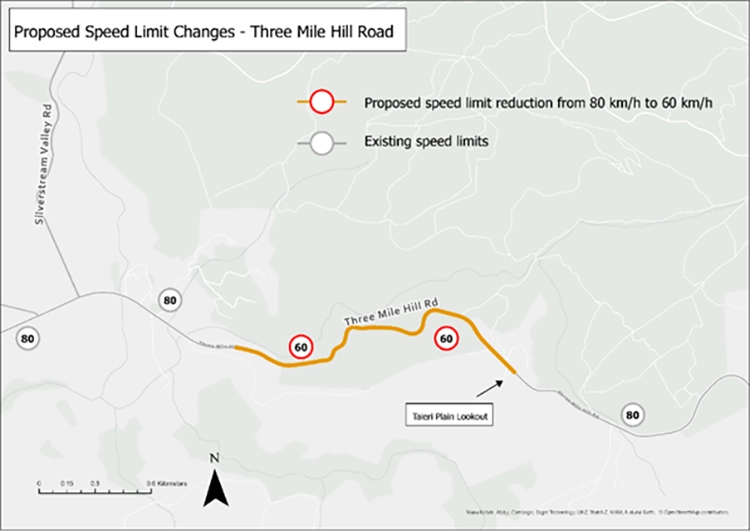
Option 2 - Status quo
No change to the current 80 km/h speed limit on the affected section.
Have your say
We want to hear your views. Submit your feedback before 5pm on Monday 30 November 2026.
Online feedback form
Requirements under the Rule
Still didn't find what you were looking for?