subslength = 28 subs = [{"id":"1321205","name":"3 Waters","href":"http://www.dunedin.govt.nz/services/3-waters","assetType":"page_standard","openType":"_self","titleText":"","children":[{"id":"655837","name":"Stormwater and water drainage ","href":"http://www.dunedin.govt.nz/services/3-waters/stormwater","assetType":"page_standard","openType":"_self","titleText":"","children":[{"name":"Catchment management","href":"http://www.dunedin.govt.nz/services/3-waters/stormwater/integrated-catchment-management-plans","assetType":"page_standard","openType":"_self","titleText":"","children":[]},{"name":"Minimising stormwater runoff","href":"http://www.dunedin.govt.nz/services/3-waters/stormwater/minimising-stormwater-runoff","assetType":"page_standard","openType":"_self","titleText":"","children":[]},{"name":"Preventing stormwater pollution","href":"http://www.dunedin.govt.nz/services/3-waters/stormwater/preventing-stormwater-pollution","assetType":"page_standard","openType":"_self","titleText":"","children":[]},{"name":"Stormwater monitoring","href":"http://www.dunedin.govt.nz/services/3-waters/stormwater/stormwater-monitoring","assetType":"page_standard","openType":"_self","titleText":"","children":[]},{"name":"Stormwater quality","href":"http://www.dunedin.govt.nz/services/3-waters/stormwater/stormwater-quality","assetType":"page_standard","openType":"_self","titleText":"","children":[]},{"name":"Stormwater responsibilities","href":"http://www.dunedin.govt.nz/services/3-waters/stormwater/stormwater-responsibilities","assetType":"page_standard","openType":"_self","titleText":"","children":[]},{"name":"Watercourses","href":"http://www.dunedin.govt.nz/services/3-waters/stormwater/watercourses","assetType":"page_standard","openType":"_self","titleText":"","children":[]}]},{"id":"655849","name":"Wastewater","href":"http://www.dunedin.govt.nz/services/3-waters/wastewater","assetType":"page_standard","openType":"_self","titleText":"","children":[{"name":"Allanton Wastewater Scheme","href":"http://www.dunedin.govt.nz/services/3-waters/wastewater/allanton-wastewater-scheme","assetType":"page_standard","openType":"_self","titleText":"","children":[]},{"name":"Beach water quality","href":"http://www.dunedin.govt.nz/services/3-waters/wastewater/beach-water-quality","assetType":"page_standard","openType":"_self","titleText":"","children":[]},{"name":"Environmental monitoring ","href":"http://www.dunedin.govt.nz/services/3-waters/wastewater/environmental-monitoring","assetType":"page_standard","openType":"_self","titleText":"","children":[]},{"name":"Network overflows","href":"http://www.dunedin.govt.nz/services/3-waters/wastewater/network-overflows","assetType":"page_standard","openType":"_self","titleText":"","children":[]},{"name":"Odours ","href":"http://www.dunedin.govt.nz/services/3-waters/wastewater/odours","assetType":"page_standard","openType":"_self","titleText":"","children":[]},{"name":"Trade waste","href":"http://www.dunedin.govt.nz/services/3-waters/wastewater/tradewaste","assetType":"page_standard","openType":"_self","titleText":"","children":[]},{"name":"Wastewater treatment plants","href":"http://www.dunedin.govt.nz/services/3-waters/wastewater/wastewater-treatment-plants","assetType":"page_standard","openType":"_self","titleText":"","children":[]},{"name":"Whose pipe is that?","href":"http://www.dunedin.govt.nz/services/3-waters/wastewater/whose-pipe-is-that","assetType":"page_standard","openType":"_self","titleText":"","children":[]}]},{"id":"655853","name":"Water supply","href":"http://www.dunedin.govt.nz/services/3-waters/water-supply","assetType":"page_standard","openType":"_self","titleText":"","children":[{"name":" Integrated System Plan – Planning for the Next 50 Years","href":"http://www.dunedin.govt.nz/services/3-waters/water-supply/integrated-system-plan","assetType":"page_standard","openType":"_self","titleText":"","children":[]},{"name":"Boundary backflow prevention – keeping our drinking water safe","href":"http://www.dunedin.govt.nz/services/3-waters/water-supply/backflow","assetType":"page_standard","openType":"_self","titleText":"","children":[]},{"name":"Deep Stream water supply catchment","href":"http://www.dunedin.govt.nz/services/3-waters/water-supply/deep-stream-water-supply-catchment","assetType":"page_standard","openType":"_self","titleText":"","children":[]},{"name":"Dunedin water supply system","href":"http://www.dunedin.govt.nz/services/3-waters/water-supply/dunedin-water-supply-system","assetType":"page_standard","openType":"_self","titleText":"","children":[]},{"name":"History","href":"http://www.dunedin.govt.nz/services/3-waters/water-supply/history","assetType":"page_standard","openType":"_self","titleText":"","children":[]},{"name":"New water connections","href":"http://www.dunedin.govt.nz/services/3-waters/water-supply/new-water-connections","assetType":"page_standard","openType":"_self","titleText":"","children":[]},{"name":"Paying your water account","href":"http://www.dunedin.govt.nz/services/3-waters/water-supply/paying-your-water-account","assetType":"page_standard","openType":"_self","titleText":"","children":[]},{"name":"Restricted water schemes","href":"http://www.dunedin.govt.nz/services/3-waters/water-supply/restricted-water-schemes","assetType":"page_standard","openType":"_self","titleText":"","children":[]},{"name":"Saving water tips","href":"http://www.dunedin.govt.nz/services/3-waters/water-supply/saving-water-tips","assetType":"page_standard","openType":"_self","titleText":"","children":[]},{"name":"Servicing Assessment: Drinking water, wastewater and stormwater","href":"http://www.dunedin.govt.nz/services/3-waters/water-supply/servicing-assessment","assetType":"page_standard","openType":"_self","titleText":"","children":[]},{"name":"Treatment","href":"http://www.dunedin.govt.nz/services/3-waters/water-supply/treatment","assetType":"page_standard","openType":"_self","titleText":"","children":[]},{"name":"Waikouaiti/Karitane/Hawksbury Village water supply contamination information","href":"http://www.dunedin.govt.nz/services/3-waters/water-supply/water-supply-contamination-information","assetType":"page_standard","openType":"_self","titleText":"","children":[]},{"name":"Water charges","href":"http://www.dunedin.govt.nz/services/3-waters/water-supply/water-charges","assetType":"page_standard","openType":"_self","titleText":"","children":[]},{"name":"Water pressure","href":"http://www.dunedin.govt.nz/services/3-waters/water-supply/water-pressure","assetType":"page_standard","openType":"_self","titleText":"","children":[]},{"name":"Water restrictions","href":"http://www.dunedin.govt.nz/services/3-waters/water-supply/water-restrictions","assetType":"page_standard","openType":"_self","titleText":"","children":[]},{"name":"Water supply catchment access and activity approval","href":"http://www.dunedin.govt.nz/services/3-waters/water-supply/water-supply-catchment-access-and-activity-approval","assetType":"page_standard","openType":"_self","titleText":"","children":[]}]},{"id":"1321213","name":"Local Water Done Well ","href":"http://www.dunedin.govt.nz/services/3-waters/local-water-done-well","assetType":"page_standard","openType":"_self","titleText":"","children":[{"name":"Local Water Done Well reform","href":"http://www.dunedin.govt.nz/services/3-waters/local-water-done-well/local-water-done-well-reform","assetType":"page_standard","openType":"_self","titleText":"","children":[{"name":"Comparing the water services delivery models","href":"http://www.dunedin.govt.nz/services/3-waters/local-water-done-well/local-water-done-well-reform/comparing-the-water-services-delivery-models","assetType":"page_standard","openType":"_self","titleText":""},{"name":"Financial assessment ","href":"http://www.dunedin.govt.nz/services/3-waters/local-water-done-well/local-water-done-well-reform/financial-assessment","assetType":"page_standard","openType":"_self","titleText":""},{"name":"Frequently asked questions","href":"http://www.dunedin.govt.nz/services/3-waters/local-water-done-well/local-water-done-well-reform/lwdw-faqs-page-1","assetType":"page_standard","openType":"_self","titleText":""},{"name":"The water services delivery models","href":"http://www.dunedin.govt.nz/services/3-waters/local-water-done-well/local-water-done-well-reform/the-water-services-delivery-models","assetType":"page_standard","openType":"_self","titleText":""},{"name":"What is a water services Council-Controlled Organisation (CCO)?","href":"http://www.dunedin.govt.nz/services/3-waters/local-water-done-well/local-water-done-well-reform/what-is-a-water-services-council-controlled-organisation-cco","assetType":"page_standard","openType":"_self","titleText":""},{"name":"What is Local Water Done Well?","href":"http://www.dunedin.govt.nz/services/3-waters/local-water-done-well/local-water-done-well-reform/what-is-local-water-done-well","assetType":"page_standard","openType":"_self","titleText":""},{"name":"What water services do we deliver?","href":"http://www.dunedin.govt.nz/services/3-waters/local-water-done-well/local-water-done-well-reform/what-water-services-do-we-deliver","assetType":"page_standard","openType":"_self","titleText":""}]}]},{"id":"1321267","name":"Reporting and disclosures","href":"http://www.dunedin.govt.nz/services/3-waters/reporting-and-disclosures","assetType":"page_standard","openType":"_self","titleText":"","children":[]},{"id":"711911","name":"3 Waters Projects","href":"http://www.dunedin.govt.nz/services/3-waters/3-waters-projects","assetType":"page_standard","openType":"_self","titleText":"","children":[]}]},{"id":"655817","name":"Alcohol licensing","href":"http://www.dunedin.govt.nz/services/licensing","assetType":"page_standard","openType":"_self","titleText":"","children":[{"id":"1132920","name":"Alcohol licensing regulation and compliance","href":"http://www.dunedin.govt.nz/services/licensing/alcohol-licensing-regulation-and-compliance","assetType":"page_standard","openType":"_self","titleText":"","children":[]},{"id":"683762","name":"Applying or renewing an alcohol licence","href":"http://www.dunedin.govt.nz/services/licensing/applying-or-renewing-an-alcohol-licence","assetType":"page_standard","openType":"_self","titleText":"","children":[]},{"id":"683754","name":"Alcohol licensing fees","href":"http://www.dunedin.govt.nz/services/licensing/alcohol-licensing-fees","assetType":"page_standard","openType":"_self","titleText":"","children":[]},{"id":"683778","name":"Applying for a manager's licence","href":"http://www.dunedin.govt.nz/services/licensing/applying-for-a-managers-licence","assetType":"page_standard","openType":"_self","titleText":"","children":[]},{"id":"683790","name":"Licence holder responsibilities","href":"http://www.dunedin.govt.nz/services/licensing/licence-holder-responsibilities","assetType":"page_standard","openType":"_self","titleText":"","children":[]},{"id":"684714","name":"Publicly notified licence applications","href":"http://www.dunedin.govt.nz/services/licensing/alcohol-licence-applications","assetType":"page_standard","openType":"_self","titleText":"","children":[]},{"id":"683774","name":"Objecting to an alcohol licence application","href":"http://www.dunedin.govt.nz/services/licensing/objecting-to-an-alcohol-licence-application","assetType":"page_standard","openType":"_self","titleText":"","children":[]},{"id":"549241","name":"Alcohol licence application decisions","href":"http://www.dunedin.govt.nz/services/licensing/alcohol-licence-application-decisions","assetType":"page_standard","openType":"_self","titleText":"","children":[]}]},{"id":"697876","name":"Arts and culture - Ara Toi","href":"http://www.dunedin.govt.nz/services/arts-and-culture","assetType":"page_standard","openType":"_self","titleText":"","children":[{"id":"1055263","name":"Ōtepoti Dunedin Community Gallery","href":"http://www.dunedin.govt.nz/services/arts-and-culture/community-gallery","assetType":"page_redirect","openType":"_self","titleText":"","children":[]},{"id":"1028451","name":"Arts grants","href":"http://www.dunedin.govt.nz/services/arts-and-culture/arts-grants","assetType":"page_redirect","openType":"_self","titleText":"","children":[]},{"id":"726705","name":"Ara Toi Creative - registration of interest","href":"http://www.dunedin.govt.nz/services/arts-and-culture/ara-toi-creative-registration-of-interest","assetType":"page_redirect","openType":"_self","titleText":"","children":[]},{"id":"1033721","name":"Ōtepoti Live Music Action Plan","href":"http://www.dunedin.govt.nz/services/arts-and-culture/otepoti-live-music-action-plan","assetType":"page_standard","openType":"_self","titleText":"","children":[]},{"id":"772252","name":"Public Artwork","href":"http://www.dunedin.govt.nz/services/arts-and-culture/public-artwork","assetType":"page_standard","openType":"_self","titleText":"","children":[{"name":"All From Water","href":"http://www.dunedin.govt.nz/services/arts-and-culture/public-artwork/all-from-water","assetType":"page_standard","openType":"_self","titleText":"","children":[]},{"name":"Ko te Tūhono","href":"http://www.dunedin.govt.nz/services/arts-and-culture/public-artwork/ko-te-tuhono","assetType":"page_standard","openType":"_self","titleText":"","children":[]}]},{"id":"1306904","name":"Ōtepoti Hou music compilation","href":"http://www.dunedin.govt.nz/services/arts-and-culture/otepoti-hou","assetType":"page_standard","openType":"_self","titleText":"","children":[]},{"id":"1050505","name":"Toi Oho – Ara Toi newsletter","href":"http://www.dunedin.govt.nz/services/arts-and-culture/ara-toi-toi-oho-issue-18","assetType":"page_redirect","openType":"_self","titleText":"","children":[]},{"id":"782140","name":"Performing arts feasibility study","href":"http://www.dunedin.govt.nz/services/arts-and-culture/performing-arts-feasibility-study","assetType":"page_standard","openType":"_self","titleText":"","children":[]}]},{"id":"655780","name":"Building services","href":"http://www.dunedin.govt.nz/services/building-services","assetType":"page_standard","openType":"_self","titleText":"","children":[{"id":"1136347","name":"Building forms, guides and fees","href":"http://www.dunedin.govt.nz/services/building-services/forms-guides-and-fees","assetType":"page_standard","openType":"_self","titleText":"","children":[{"name":"Building consent fees and charges ","href":"http://www.dunedin.govt.nz/services/building-services/forms-guides-and-fees/fees-and-charges","assetType":"page_standard","openType":"_self","titleText":"","children":[]},{"name":"Building forms and guidance","href":"http://www.dunedin.govt.nz/services/building-services/forms-guides-and-fees/forms-and-checksheets","assetType":"page_standard","openType":"_self","titleText":"","children":[]},{"name":"Building general fees and charges","href":"http://www.dunedin.govt.nz/services/building-services/forms-guides-and-fees/building-services-charges","assetType":"page_standard","openType":"_self","titleText":"","children":[]},{"name":"Building infringement offences and fees","href":"http://www.dunedin.govt.nz/services/building-services/forms-guides-and-fees/building-infringement-offences-and-fees","assetType":"page_standard","openType":"_self","titleText":"","children":[]},{"name":"Drainage fees and charges ","href":"http://www.dunedin.govt.nz/services/building-services/forms-guides-and-fees/drainage-fees-and-charges","assetType":"page_standard","openType":"_self","titleText":"","children":[]}]},{"id":"975332","name":"The building basics","href":"http://www.dunedin.govt.nz/services/building-services/the-building-basics","assetType":"page_standard","openType":"_self","titleText":"","children":[]},{"id":"1136367","name":"Planning your project","href":"http://www.dunedin.govt.nz/services/building-services/planning-your-project","assetType":"page_standard","openType":"_self","titleText":"","children":[{"name":"Advice on back yard sheds","href":"http://www.dunedin.govt.nz/services/building-services/planning-your-project/sheds","assetType":"page_standard","openType":"_self","titleText":"","children":[]},{"name":"Alterations to existing buildings","href":"http://www.dunedin.govt.nz/services/building-services/planning-your-project/alterations-to-existing-buildings","assetType":"page_standard","openType":"_self","titleText":"","children":[]},{"name":"Carrying out drainage work involving Council land or infrastructure ","href":"http://www.dunedin.govt.nz/services/building-services/planning-your-project/carrying-out-drainage-work-involving-council-land-or-infrastructure","assetType":"page_standard","openType":"_self","titleText":"","children":[]},{"name":"Earthquake prone buildings ","href":"http://www.dunedin.govt.nz/services/building-services/planning-your-project/earthquake-prone-buildings","assetType":"page_standard","openType":"_self","titleText":"","children":[]},{"name":"Eco design","href":"http://www.dunedin.govt.nz/services/building-services/planning-your-project/eco-design","assetType":"page_redirect","openType":"_self","titleText":"","children":[]},{"name":"HAIL and lead from paint","href":"http://www.dunedin.govt.nz/services/building-services/planning-your-project/hail-and-lead-from-paint","assetType":"page_redirect","openType":"_self","titleText":"","children":[]},{"name":"Liquefaction-prone land","href":"http://www.dunedin.govt.nz/services/building-services/planning-your-project/liquefaction-prone-land","assetType":"page_standard","openType":"_self","titleText":"","children":[]},{"name":"Minimum floor levels","href":"http://www.dunedin.govt.nz/services/building-services/planning-your-project/minimum-floor-levels","assetType":"page_standard","openType":"_self","titleText":"","children":[]},{"name":"Residential pools/spa barriers","href":"http://www.dunedin.govt.nz/services/building-services/planning-your-project/pool-fencing","assetType":"page_standard","openType":"_self","titleText":"","children":[]},{"name":"Short term visitor accommodation – compliance considerations","href":"http://www.dunedin.govt.nz/services/building-services/planning-your-project/short-term-visitor-accommodation","assetType":"page_standard","openType":"_self","titleText":"","children":[]}]},{"id":"1136351","name":"Before you start","href":"http://www.dunedin.govt.nz/services/building-services/before-you-start","assetType":"page_standard","openType":"_self","titleText":"","children":[{"name":"Before you begin","href":"http://www.dunedin.govt.nz/services/building-services/before-you-start/before-you-begin","assetType":"page_standard","openType":"_self","titleText":"","children":[]},{"name":"Building Services general information","href":"http://www.dunedin.govt.nz/services/building-services/before-you-start/general-information","assetType":"page_standard","openType":"_self","titleText":"","children":[]},{"name":"Consumer protection measures","href":"http://www.dunedin.govt.nz/services/building-services/before-you-start/consumer-protection-measures-for-homeowners-building-and-renovating","assetType":"page_standard","openType":"_self","titleText":"","children":[]},{"name":"Do you need consent","href":"http://www.dunedin.govt.nz/services/building-services/before-you-start/do-you-need-consent","assetType":"page_standard","openType":"_self","titleText":"","children":[]}]},{"id":"1136355","name":"Apply for a building consent","href":"http://www.dunedin.govt.nz/services/building-services/apply-for-a-building-consent","assetType":"page_standard","openType":"_self","titleText":"","children":[{"name":"How to complete an application form ","href":"http://www.dunedin.govt.nz/services/building-services/apply-for-a-building-consent/how-to-complete-an-application-form","assetType":"page_standard","openType":"_self","titleText":"","children":[]},{"name":"Making an application for building consent","href":"http://www.dunedin.govt.nz/services/building-services/apply-for-a-building-consent/making-an-application-for-building-consent","assetType":"page_standard","openType":"_self","titleText":"","children":[]},{"name":"Submit building applications online","href":"http://www.dunedin.govt.nz/do-it-online/apply/building-consent-applications","assetType":"page_standard","openType":"_self","titleText":"","children":[]}]},{"id":"1136359","name":"Processing applications","href":"http://www.dunedin.govt.nz/services/building-services/processing-applications","assetType":"page_standard","openType":"_self","titleText":"","children":[{"name":"Building consent process","href":"http://www.dunedin.govt.nz/services/building-services/processing-applications/consent-process","assetType":"page_standard","openType":"_self","titleText":"","children":[]},{"name":"Making changes to a building consent","href":"http://www.dunedin.govt.nz/services/building-services/processing-applications/making-changes-to-a-building-consent","assetType":"page_standard","openType":"_self","titleText":"","children":[]}]},{"id":"683118","name":"Starting work and inspections","href":"http://www.dunedin.govt.nz/services/building-services/inspections","assetType":"page_standard","openType":"_self","titleText":"","children":[]},{"id":"1136363","name":"Compliance and certifying","href":"http://www.dunedin.govt.nz/services/building-services/compliance-and-certifying","assetType":"page_standard","openType":"_self","titleText":"","children":[{"name":"Code compliance certificate","href":"http://www.dunedin.govt.nz/services/building-services/compliance-and-certifying/code-compliance-certificate","assetType":"page_standard","openType":"_self","titleText":"","children":[]},{"name":"Compliance schedule and building warrant of fitness","href":"http://www.dunedin.govt.nz/services/building-services/compliance-and-certifying/compliance-schedule-and-specified-system-information","assetType":"page_standard","openType":"_self","titleText":"","children":[]}]},{"id":"683230","name":"Amusement devices","href":"http://www.dunedin.govt.nz/services/building-services/amusement-devices","assetType":"page_standard","openType":"_self","titleText":"","children":[]},{"id":"797420","name":"Southern Building Controls Group (SBCG)","href":"http://www.dunedin.govt.nz/services/building-services/southern-building-controls-group","assetType":"page_standard","openType":"_self","titleText":"","children":[]},{"id":"683236","name":"Building Services newsletter","href":"http://www.dunedin.govt.nz/do-it-online/subscribe/building-services-newsletter","assetType":"page_standard","openType":"_self","titleText":"","children":[]},{"id":"1136371","name":"Complaints","href":"http://www.dunedin.govt.nz/services/building-services/complaints","assetType":"page_standard","openType":"_self","titleText":"","children":[]}]},{"id":"655804","name":"Business support","href":"http://www.dunedin.govt.nz/services/business-support","assetType":"page_standard","openType":"_self","titleText":"","children":[{"id":"679626","name":"DCC rules that might affect your business","href":"http://www.dunedin.govt.nz/services/business-support/council-rules-that-might-affect-your-business","assetType":"page_standard","openType":"_self","titleText":"","children":[]},{"id":"680891","name":"Commercial use of footpaths","href":"http://www.dunedin.govt.nz/services/business-support/commercial-use-of-footpaths","assetType":"page_standard","openType":"_self","titleText":"","children":[]},{"id":"679634","name":"Employing newcomers","href":"http://www.dunedin.govt.nz/services/business-support/moving-here-or-employing-newcomers","assetType":"page_standard","openType":"_self","titleText":"","children":[]},{"id":"1083774","name":"Good Food Dunedin","href":"http://www.dunedin.govt.nz/services/business-support/good-food-dunedin","assetType":"page_standard","openType":"_self","titleText":"","children":[]}]},{"id":"658056","name":"Cemeteries","href":"http://www.dunedin.govt.nz/services/cemeteries","assetType":"page_standard","openType":"_self","titleText":"","children":[{"id":"680167","name":"Ash burials","href":"http://www.dunedin.govt.nz/services/cemeteries/ash-burials","assetType":"page_standard","openType":"_self","titleText":"","children":[]},{"id":"680195","name":"Book of Remembrance","href":"http://www.dunedin.govt.nz/services/cemeteries/book-of-remembrance","assetType":"page_standard","openType":"_self","titleText":"","children":[]},{"id":"680137","name":"Burials","href":"http://www.dunedin.govt.nz/services/cemeteries/burials","assetType":"page_standard","openType":"_self","titleText":"","children":[]},{"id":"680141","name":"Burial and related fees","href":"http://www.dunedin.govt.nz/services/cemeteries/burial-and-related-fees","assetType":"page_standard","openType":"_self","titleText":"","children":[]},{"id":"790366","name":"Cemeteries Booking","href":"http://www.dunedin.govt.nz/services/cemeteries/cemeteries-booking","assetType":"page_redirect","openType":"_self","titleText":"","children":[]},{"id":"700083","name":"Cemeteries search","href":"http://www.dunedin.govt.nz/do-it-online/search/cemeteries-search","assetType":"page_remote_content","openType":"_self","titleText":"","children":[]},{"id":"680163","name":"Cemetery locations","href":"http://www.dunedin.govt.nz/services/cemeteries/cemetery-locations","assetType":"page_standard","openType":"_self","titleText":"","children":[]},{"id":"680171","name":"Crematorium fees","href":"http://www.dunedin.govt.nz/services/cemeteries/crematorium-fees","assetType":"page_standard","openType":"_self","titleText":"","children":[]},{"id":"680187","name":"Memorials","href":"http://www.dunedin.govt.nz/services/cemeteries/memorials","assetType":"page_standard","openType":"_self","titleText":"","children":[]},{"id":"680191","name":"Natural burials","href":"http://www.dunedin.govt.nz/services/cemeteries/natural-burials","assetType":"page_standard","openType":"_self","titleText":"","children":[]},{"id":"680203","name":"Queen Elisabeth Medal recipients","href":"http://www.dunedin.govt.nz/services/cemeteries/queen-elisabeth-medal-recipients","assetType":"page_standard","openType":"_self","titleText":"","children":[]}]},{"id":"658060","name":"City safety","href":"http://www.dunedin.govt.nz/services/city-safety","assetType":"page_standard","openType":"_self","titleText":"","children":[]},{"id":"658064","name":"Community Partnerships","href":"http://www.dunedin.govt.nz/services/community-partnerships","assetType":"page_standard","openType":"_self","titleText":"","children":[{"id":"680775","name":"Community directories","href":"http://www.dunedin.govt.nz/services/community-partnerships/community-directories","assetType":"page_standard","openType":"_self","titleText":"","children":[]},{"id":"699797","name":"Enviroschools","href":"http://www.dunedin.govt.nz/services/community-partnerships/enviroschools","assetType":"page_standard","openType":"_self","titleText":"","children":[]},{"id":"681264","name":"Support for former refugees'","href":"http://www.dunedin.govt.nz/services/new-to-dunedin/support-for-former-refugees","assetType":"page_standard","openType":"_self","titleText":"","children":[]},{"id":"355561","name":"Keep Dunedin Beautiful","href":"http://www.dunedin.govt.nz/services/community-partnerships/keep-dunedin-beautiful","assetType":"page_standard","openType":"_self","titleText":"","children":[]},{"id":"680785","name":"Ōtepoti Youth Vision","href":"http://www.dunedin.govt.nz/services/community-partnerships/young-people","assetType":"page_standard","openType":"_self","titleText":"","children":[]},{"id":"842394","name":"Pāsifika Communities in Ōtepoti Dunedin - Directory","href":"http://www.dunedin.govt.nz/services/community-partnerships/pasifika-communities-in-otepoti-dunedin-directory","assetType":"page_standard","openType":"_self","titleText":"","children":[]},{"id":"1277293","name":"Dunedin Youth Council","href":"http://www.dunedin.govt.nz/services/community-partnerships/dunedin-youth-council","assetType":"page_standard","openType":"_self","titleText":"","children":[]},{"id":"1308748","name":"Task Force Green","href":"http://www.dunedin.govt.nz/services/community-partnerships/task-force-green","assetType":"page_standard","openType":"_self","titleText":"","children":[]},{"id":"1310678","name":"Helping homeless in Ōtepoti Dunedin","href":"http://www.dunedin.govt.nz/services/community-partnerships/helping-homeless-in-otepoti-dunedin","assetType":"page_standard","openType":"_self","titleText":"","children":[]}]},{"id":"658068","name":"Council archives","href":"http://www.dunedin.govt.nz/services/council-archives","assetType":"page_standard","openType":"_self","titleText":"","children":[]},{"id":"699366","name":"Dunedin Heritage","href":"http://www.dunedin.govt.nz/services/dunedin-heritage","assetType":"page_standard","openType":"_self","titleText":"","children":[{"id":"699370","name":"Heritage Buildings and Archaeological Sites","href":"http://www.dunedin.govt.nz/services/dunedin-heritage/heritage-buildings-and-archaeological-sites","assetType":"page_standard","openType":"_self","titleText":"","children":[]},{"id":"699377","name":"Owning heritage buildings","href":"http://www.dunedin.govt.nz/services/dunedin-heritage/owning-heritage-buildings","assetType":"page_standard","openType":"_self","titleText":"","children":[{"name":"Adaptive Re-use","href":"http://www.dunedin.govt.nz/services/dunedin-heritage/owning-heritage-buildings/economic-re-use","assetType":"page_standard","openType":"_self","titleText":"","children":[]},{"name":"Heritage Buildings Maintenance Checklist","href":"http://www.dunedin.govt.nz/services/dunedin-heritage/owning-heritage-buildings/heritage-buildings-maintenance-checklist","assetType":"page_standard","openType":"_self","titleText":"","children":[]},{"name":"Heritage resource consents","href":"http://www.dunedin.govt.nz/services/dunedin-heritage/owning-heritage-buildings/heritage-resource-consents","assetType":"page_standard","openType":"_self","titleText":"","children":[]}]},{"id":"699410","name":"Dunedin Heritage Fund","href":"http://www.dunedin.govt.nz/services/dunedin-heritage/heritage-fund","assetType":"page_standard","openType":"_self","titleText":"","children":[]},{"id":"699393","name":"Heritage Awards","href":"http://www.dunedin.govt.nz/services/dunedin-heritage/awards","assetType":"page_standard","openType":"_self","titleText":"","children":[]},{"id":"699381","name":"Dunedin Thematic Study","href":"http://www.dunedin.govt.nz/services/dunedin-heritage/thematic-study","assetType":"page_standard","openType":"_self","titleText":"","children":[]},{"id":"981616","name":"Heritage Action Plan","href":"http://www.dunedin.govt.nz/services/dunedin-heritage/heritage-action-plan","assetType":"page_standard","openType":"_self","titleText":"","children":[]}]},{"id":"685114","name":"Eco-design advisor service ","href":"http://www.dunedin.govt.nz/services/eco-house-design","assetType":"page_standard","openType":"_self","titleText":"","children":[]},{"id":"720140","name":"Fees and charges","href":"http://www.dunedin.govt.nz/services/fees-and-charges","assetType":"page_standard","openType":"_self","titleText":"","children":[{"id":"720220","name":"Administration and Information Services ","href":"http://www.dunedin.govt.nz/services/fees-and-charges/administration-services","assetType":"page_standard","openType":"_self","titleText":"","children":[]},{"id":"720248","name":"Alcohol Licensing","href":"http://www.dunedin.govt.nz/services/fees-and-charges/alcohol-licensing","assetType":"page_standard","openType":"_self","titleText":"","children":[]},{"id":"720301","name":"Aquatic Services","href":"http://www.dunedin.govt.nz/services/fees-and-charges/aquatic-services","assetType":"page_standard","openType":"_self","titleText":"","children":[]},{"id":"720319","name":"Building Services","href":"http://www.dunedin.govt.nz/services/fees-and-charges/building-services","assetType":"page_standard","openType":"_self","titleText":"","children":[]},{"id":"720335","name":"Cemeteries and Crematorium","href":"http://www.dunedin.govt.nz/services/fees-and-charges/cemeteries-and-crematorium","assetType":"page_standard","openType":"_self","titleText":"","children":[]},{"id":"720343","name":"Galleries museums and gardens","href":"http://www.dunedin.govt.nz/services/fees-and-charges/chinese-garden","assetType":"page_standard","openType":"_self","titleText":"","children":[]},{"id":"720252","name":"Dogs and other animals","href":"http://www.dunedin.govt.nz/services/fees-and-charges/animal-services","assetType":"page_standard","openType":"_self","titleText":"","children":[]},{"id":"720386","name":"Environmental Health","href":"http://www.dunedin.govt.nz/services/fees-and-charges/environmental-health","assetType":"page_standard","openType":"_self","titleText":"","children":[]},{"id":"720378","name":"Filming in Dunedin","href":"http://www.dunedin.govt.nz/services/fees-and-charges/economic-development","assetType":"page_standard","openType":"_self","titleText":"","children":[]},{"id":"720402","name":"Housing","href":"http://www.dunedin.govt.nz/services/fees-and-charges/housing","assetType":"page_standard","openType":"_self","titleText":"","children":[]},{"id":"720418","name":"Libraries","href":"http://www.dunedin.govt.nz/services/fees-and-charges/libraries","assetType":"page_standard","openType":"_self","titleText":"","children":[]},{"id":"720450","name":"Parking ","href":"http://www.dunedin.govt.nz/services/fees-and-charges/parking","assetType":"page_standard","openType":"_self","titleText":"","children":[]},{"id":"1280260","name":"Parking infringements","href":"http://www.dunedin.govt.nz/services/fees-and-charges/parking-infringements","assetType":"page_standard","openType":"_self","titleText":"","children":[]},{"id":"720434","name":"Reserves and facilities","href":"http://www.dunedin.govt.nz/services/fees-and-charges/parks-and-recreation-facilities","assetType":"page_standard","openType":"_self","titleText":"","children":[]},{"id":"720351","name":"Resource consents","href":"http://www.dunedin.govt.nz/services/fees-and-charges/city-planning","assetType":"page_standard","openType":"_self","titleText":"","children":[]},{"id":"720474","name":"Roads and footpaths","href":"http://www.dunedin.govt.nz/services/fees-and-charges/transport","assetType":"page_standard","openType":"_self","titleText":"","children":[]},{"id":"720482","name":"Rubbish and recycling","href":"http://www.dunedin.govt.nz/services/fees-and-charges/waste-and-environmental-solutions","assetType":"page_standard","openType":"_self","titleText":"","children":[]},{"id":"720442","name":"Sportsgrounds","href":"http://www.dunedin.govt.nz/services/fees-and-charges/parks-and-recreation-sportsgrounds","assetType":"page_standard","openType":"_self","titleText":"","children":[]},{"id":"720494","name":"Trade waste and wastewater","href":"http://www.dunedin.govt.nz/services/fees-and-charges/wastewater","assetType":"page_standard","openType":"_self","titleText":"","children":[]},{"id":"720502","name":"Water Supply","href":"http://www.dunedin.govt.nz/services/fees-and-charges/water-supply","assetType":"page_standard","openType":"_self","titleText":"","children":[]},{"id":"708104","name":"Paying your DCC accounts","href":"http://www.dunedin.govt.nz/services/fees-and-charges/paying-your-dcc-accounts","assetType":"page_standard","openType":"_self","titleText":"","children":[]}]},{"id":"878158","name":"Food for sale","href":"http://www.dunedin.govt.nz/services/food-for-sale","assetType":"page_standard","openType":"_self","titleText":"","children":[]},{"id":"658120","name":"Funding and grants","href":"http://www.dunedin.govt.nz/services/funding-and-grants","assetType":"page_standard","openType":"_self","titleText":"","children":[{"id":"681957","name":"Arts grants","href":"http://www.dunedin.govt.nz/services/funding-and-grants/arts-funding","assetType":"page_standard","openType":"_self","titleText":"","children":[{"name":"Arts Capability Funding (Otago Community Trust/DCC funded)","href":"http://www.dunedin.govt.nz/services/funding-and-grants/arts-funding/arts-capability-funding-otago-community-trustdcc-funded","assetType":"page_redirect","openType":"_blank","titleText":"title=\"Arts Capability Funding (Otago Community Trust/DCC funded) - Opens in a new window.\"","children":[]},{"name":"City service and city projects grants","href":"http://www.dunedin.govt.nz/services/funding-and-grants/arts-funding/city-service-and-city-projects-grants","assetType":"page_redirect","openType":"_self","titleText":"","children":[]},{"name":"Creative Communities funding","href":"http://www.dunedin.govt.nz/services/funding-and-grants/arts-funding/creative-communities-funding","assetType":"page_standard","openType":"_self","titleText":"","children":[]},{"name":"DCC Arts Grants ","href":"http://www.dunedin.govt.nz/services/funding-and-grants/arts-funding/dcc-arts-grants","assetType":"page_standard","openType":"_self","titleText":"","children":[]},{"name":"Professional theatre fund","href":"http://www.dunedin.govt.nz/services/funding-and-grants/arts-funding/professional-theatre-fund","assetType":"page_standard","openType":"_self","titleText":"","children":[]},{"name":"Small Arts Grants","href":"http://www.dunedin.govt.nz/services/funding-and-grants/arts-funding/small-arts-grants2","assetType":"page_standard","openType":"_self","titleText":"","children":[]}]},{"id":"705035","name":"Biodiversity funding","href":"http://www.dunedin.govt.nz/services/funding-and-grants/biodiversity-funding","assetType":"page_standard","openType":"_self","titleText":"","children":[{"name":"Dunedin Biodiversity Fund guide for applicants","href":"http://www.dunedin.govt.nz/services/funding-and-grants/biodiversity-funding/dunedin-biodiversity-fund-guide-for-applicants","assetType":"page_standard","openType":"_self","titleText":"","children":[]}]},{"id":"681961","name":"City service and city project grants","href":"http://www.dunedin.govt.nz/services/funding-and-grants/city-service-and-city-project-grants","assetType":"page_standard","openType":"_self","titleText":"","children":[{"name":"City Projects grants criteria","href":"http://www.dunedin.govt.nz/services/funding-and-grants/city-service-and-city-project-grants/city-projects-grants","assetType":"page_standard","openType":"_self","titleText":"","children":[]},{"name":"City Service grants criteria","href":"http://www.dunedin.govt.nz/services/funding-and-grants/city-service-and-city-project-grants/city-service-grants","assetType":"page_standard","openType":"_self","titleText":"","children":[]},{"name":"Funding Strategic Criteria","href":"http://www.dunedin.govt.nz/services/funding-and-grants/events-funding/funding-strategic-criteria","assetType":"page_standard","openType":"_self","titleText":"","children":[]}]},{"id":"681965","name":"Community funding and grants","href":"http://www.dunedin.govt.nz/services/funding-and-grants/funding-and-grants","assetType":"page_standard","openType":"_self","titleText":"","children":[]},{"id":"681979","name":"Electricity fund","href":"http://www.dunedin.govt.nz/services/funding-and-grants/electricity-fund","assetType":"page_standard","openType":"_self","titleText":"","children":[{"name":"Dunedin City Council Consumers Electricity Fund criteria","href":"http://www.dunedin.govt.nz/services/funding-and-grants/electricity-fund/electricity-and-healthy-homes-grants","assetType":"page_standard","openType":"_self","titleText":"","children":[]}]},{"id":"681983","name":"Events funding","href":"http://www.dunedin.govt.nz/services/funding-and-grants/events-funding","assetType":"page_standard","openType":"_self","titleText":"","children":[{"name":"Community Event grants criteria","href":"http://www.dunedin.govt.nz/services/funding-and-grants/events-funding/community-event-grants","assetType":"page_standard","openType":"_self","titleText":"","children":[]},{"name":"Funding Strategic Criteria","href":"http://www.dunedin.govt.nz/services/funding-and-grants/events-funding/funding-strategic-criteria","assetType":"page_standard","openType":"_self","titleText":"","children":[]}]},{"id":"788621","name":"Hapori Māori Fund and Pāsifika Development Fund","href":"http://www.dunedin.govt.nz/services/funding-and-grants/hapori-maori-fund-and-pasifika-development-fund","assetType":"page_standard","openType":"_self","titleText":"","children":[]},{"id":"681997","name":"Heritage Fund","href":"http://www.dunedin.govt.nz/services/funding-and-grants/heritage-fund2","assetType":"page_redirect","openType":"_self","titleText":"","children":[]},{"id":"682002","name":"Neighbourhood matching grant","href":"http://www.dunedin.govt.nz/services/funding-and-grants/neighbourhood-matching-grant","assetType":"page_standard","openType":"_self","titleText":"","children":[{"name":"Neighbourhood Matching grant criteria","href":"http://www.dunedin.govt.nz/services/funding-and-grants/neighbourhood-matching-grant/4.6-neighbourhood-matching-grant","assetType":"page_standard","openType":"_self","titleText":"","children":[]}]},{"id":"682006","name":"Rates relief for community groups and organisations","href":"http://www.dunedin.govt.nz/services/funding-and-grants/rates-relief","assetType":"page_standard","openType":"_self","titleText":"","children":[]},{"id":"682010","name":"Place-based community grants fund ","href":"http://www.dunedin.govt.nz/services/funding-and-grants/place-based-community-grants-fund","assetType":"page_standard","openType":"_self","titleText":"","children":[{"name":"Place-based community grants fund criteria","href":"http://www.dunedin.govt.nz/services/funding-and-grants/place-based-community-grants-fund/place-based-community-grants-fund-criteria","assetType":"page_standard","openType":"_self","titleText":"","children":[]}]},{"id":"749884","name":"Dunedin Puaka Matariki Festival 2026","href":"http://www.dunedin.govt.nz/services/funding-and-grants/puaka-matariki","assetType":"page_standard","openType":"_self","titleText":"","children":[]},{"id":"682016","name":"Small project grants ","href":"http://www.dunedin.govt.nz/services/funding-and-grants/small-project-grants","assetType":"page_standard","openType":"_self","titleText":"","children":[{"name":"Small project grant criteria","href":"http://www.dunedin.govt.nz/services/funding-and-grants/small-project-grants/4.5-small-project-grant","assetType":"page_standard","openType":"_self","titleText":"","children":[]}]},{"id":"705374","name":"Waste minimisation funds","href":"http://www.dunedin.govt.nz/services/funding-and-grants/waste-minimisation-funds","assetType":"page_standard","openType":"_self","titleText":"","children":[]},{"id":"437618","name":"Capital Loan Guarantees","href":"http://www.dunedin.govt.nz/services/funding-and-grants/other-assistance","assetType":"page_standard","openType":"_self","titleText":"","children":[]}]},{"id":"655812","name":"Keeping dogs","href":"http://www.dunedin.govt.nz/services/dogs","assetType":"page_standard","openType":"_self","titleText":"","children":[{"id":"997623","name":"Dog Control Bylaw and Dog Control Policy","href":"http://www.dunedin.govt.nz/services/dogs/dog-control-bylaw-and-policy","assetType":"page_standard","openType":"_self","titleText":"","children":[]},{"id":"679038","name":"Desexing your dog","href":"http://www.dunedin.govt.nz/services/dogs/desexing-your-dog","assetType":"page_standard","openType":"_self","titleText":"","children":[]},{"id":"679044","name":"Where you can walk your dog","href":"http://www.dunedin.govt.nz/services/dogs/dog-exercise-areas","assetType":"page_standard","openType":"_self","titleText":"","children":[]},{"id":"679048","name":"Dog ownership records ","href":"http://www.dunedin.govt.nz/services/dogs/dog-owner-details","assetType":"page_standard","openType":"_self","titleText":"","children":[]},{"id":"679052","name":"Dog registration information","href":"http://www.dunedin.govt.nz/services/dogs/dog-registration","assetType":"page_standard","openType":"_self","titleText":"","children":[]},{"id":"910662","name":"Dog refunds and updates","href":"http://www.dunedin.govt.nz/services/dogs/dog-refunds-and-updates","assetType":"page_standard","openType":"_self","titleText":"","children":[]},{"id":"679060","name":"Animal Services fees and charges","href":"http://www.dunedin.govt.nz/services/dogs/fees","assetType":"page_standard","openType":"_self","titleText":"","children":[]},{"id":"679066","name":"Wandering dogs and animals","href":"http://www.dunedin.govt.nz/services/dogs/found","assetType":"page_standard","openType":"_self","titleText":"","children":[]},{"id":"679070","name":"Impounded dogs","href":"http://www.dunedin.govt.nz/services/dogs/impoundings","assetType":"page_standard","openType":"_self","titleText":"","children":[]},{"id":"679074","name":"Lost dogs and other animals","href":"http://www.dunedin.govt.nz/services/dogs/lost","assetType":"page_standard","openType":"_self","titleText":"","children":[]},{"id":"679080","name":"Legislation to keep you and your pet safe","href":"http://www.dunedin.govt.nz/services/dogs/legislation-and-bylaws","assetType":"page_standard","openType":"_self","titleText":"","children":[]},{"id":"679084","name":"Microchipping your dog","href":"http://www.dunedin.govt.nz/services/dogs/microchipping","assetType":"page_standard","openType":"_self","titleText":"","children":[]},{"id":"679088","name":"Paying Animal Services infringement notices","href":"http://www.dunedin.govt.nz/services/dogs/paying-animal-control-infringement-notices","assetType":"page_standard","openType":"_self","titleText":"","children":[]},{"id":"679094","name":"Permits and Responsible Dog Owner status","href":"http://www.dunedin.govt.nz/services/dogs/licences-and-selected-owners","assetType":"page_standard","openType":"_self","titleText":"","children":[]},{"id":"679098","name":"Dog behaviour","href":"http://www.dunedin.govt.nz/services/dogs/dog-behaviour","assetType":"page_standard","openType":"_self","titleText":"","children":[]},{"id":"679102","name":"Dog safety education ","href":"http://www.dunedin.govt.nz/services/dogs/dog-safety-education","assetType":"page_standard","openType":"_self","titleText":"","children":[]},{"id":"1026131","name":"Best Friend, Best Behaviour: Tips for Dog Owners","href":"http://www.dunedin.govt.nz/services/dogs/dog-behaviour-tips","assetType":"page_standard","openType":"_self","titleText":"","children":[]}]},{"id":"655825","name":"Keeping other animals","href":"http://www.dunedin.govt.nz/services/other-animals","assetType":"page_standard","openType":"_self","titleText":"","children":[]},{"id":"699815","name":"Mobile trading","href":"http://www.dunedin.govt.nz/services/mobile-trading","assetType":"page_standard","openType":"_self","titleText":"","children":[]},{"id":"699242","name":"New to Dunedin","href":"http://www.dunedin.govt.nz/services/new-to-dunedin","assetType":"page_standard","openType":"_self","titleText":"","children":[{"id":"733619","name":"Mayor’s welcome","href":"http://www.dunedin.govt.nz/services/new-to-dunedin/mayors-welcome","assetType":"page_standard","openType":"_self","titleText":"","children":[]},{"id":"730940","name":"Annual holidays and other regular events","href":"http://www.dunedin.govt.nz/services/new-to-dunedin/annual-holidays-and-other-regular-events2","assetType":"page_standard","openType":"_self","titleText":"","children":[]},{"id":"699470","name":"Banking","href":"http://www.dunedin.govt.nz/services/new-to-dunedin/banking","assetType":"page_standard","openType":"_self","titleText":"","children":[]},{"id":"680822","name":"Education","href":"http://www.dunedin.govt.nz/services/new-to-dunedin/education","assetType":"page_standard","openType":"_self","titleText":"","children":[]},{"id":"680826","name":"Employment","href":"http://www.dunedin.govt.nz/services/new-to-dunedin/employment","assetType":"page_standard","openType":"_self","titleText":"","children":[]},{"id":"714642","name":"Getting around Dunedin","href":"http://www.dunedin.govt.nz/services/new-to-dunedin/getting-around-dunedin","assetType":"page_redirect","openType":"_self","titleText":"","children":[]},{"id":"699246","name":"Housing","href":"http://www.dunedin.govt.nz/services/new-to-dunedin/housing","assetType":"page_standard","openType":"_self","titleText":"","children":[{"name":"Buying a house","href":"http://www.dunedin.govt.nz/services/new-to-dunedin/housing/buying-a-house","assetType":"page_standard","openType":"_self","titleText":"","children":[]},{"name":"Renting a house","href":"http://www.dunedin.govt.nz/services/new-to-dunedin/housing/renting-a-house","assetType":"page_standard","openType":"_self","titleText":"","children":[]},{"name":"Your new house","href":"http://www.dunedin.govt.nz/services/new-to-dunedin/housing/your-new-house","assetType":"page_standard","openType":"_self","titleText":"","children":[]}]},{"id":"734900","name":"Keeping safe and healthy in Dunedin","href":"http://www.dunedin.govt.nz/services/new-to-dunedin/keeping-safe-and-healthy-in-dunedin","assetType":"page_standard","openType":"_self","titleText":"","children":[{"name":"Family violence","href":"http://www.dunedin.govt.nz/services/new-to-dunedin/keeping-safe-and-healthy-in-dunedin/family-violence","assetType":"page_standard","openType":"_self","titleText":"","children":[]},{"name":"Health care","href":"http://www.dunedin.govt.nz/services/new-to-dunedin/keeping-safe-and-healthy-in-dunedin/health-care","assetType":"page_standard","openType":"_self","titleText":"","children":[]},{"name":"How to prepare for an emergency in Dunedin","href":"http://www.dunedin.govt.nz/services/new-to-dunedin/keeping-safe-and-healthy-in-dunedin/how-to-prepare-for-an-emergency-in-dunedin","assetType":"page_redirect","openType":"_self","titleText":"","children":[]},{"name":"New Zealand Police","href":"http://www.dunedin.govt.nz/services/new-to-dunedin/keeping-safe-and-healthy-in-dunedin/new-zealand-police","assetType":"page_standard","openType":"_self","titleText":"","children":[]},{"name":"Travelling safely in cars with children","href":"http://www.dunedin.govt.nz/services/new-to-dunedin/keeping-safe-and-healthy-in-dunedin/travelling-safely-with-children","assetType":"page_standard","openType":"_self","titleText":"","children":[]}]},{"id":"680834","name":"English language skills","href":"http://www.dunedin.govt.nz/services/new-to-dunedin/language-skill","assetType":"page_standard","openType":"_self","titleText":"","children":[]},{"id":"733580","name":"Māori in Ōtepoti Dunedin","href":"http://www.dunedin.govt.nz/services/new-to-dunedin/maori-in-otepoti-dunedin","assetType":"page_standard","openType":"_self","titleText":"","children":[]},{"id":"681264","name":"Support for former refugees'","href":"http://www.dunedin.govt.nz/services/new-to-dunedin/support-for-former-refugees","assetType":"page_standard","openType":"_self","titleText":"","children":[]},{"id":"733544","name":"Local media, TV and radio","href":"http://www.dunedin.govt.nz/services/new-to-dunedin/local-media,-tv-and-radio","assetType":"page_standard","openType":"_self","titleText":"","children":[]},{"id":"680838","name":"Shopping info","href":"http://www.dunedin.govt.nz/services/new-to-dunedin/shopping-info","assetType":"page_standard","openType":"_self","titleText":"","children":[]},{"id":"699272","name":"Social and sporting connections","href":"http://www.dunedin.govt.nz/services/new-to-dunedin/social-life","assetType":"page_standard","openType":"_self","titleText":"","children":[]},{"id":"699466","name":"More information sources","href":"http://www.dunedin.govt.nz/services/new-to-dunedin/information-centres","assetType":"page_standard","openType":"_self","titleText":"","children":[]}]},{"id":"655821","name":"Noise control","href":"http://www.dunedin.govt.nz/services/noise-control","assetType":"page_standard","openType":"_self","titleText":"","children":[]},{"id":"655829","name":"Parking","href":"http://www.dunedin.govt.nz/services/parking","assetType":"page_standard","openType":"_self","titleText":"","children":[{"id":"680873","name":"Where you can park","href":"http://www.dunedin.govt.nz/services/parking/where-you-can-park","assetType":"page_standard","openType":"_self","titleText":"","children":[{"name":"Map of different parking options around Dunedin","href":"http://www.dunedin.govt.nz/services/parking/where-you-can-park/map-of-different-parking-controls-around-dunedin","assetType":"page_standard","openType":"_self","titleText":"","children":[]},{"name":"Motorcycle parking","href":"http://www.dunedin.govt.nz/services/parking/where-you-can-park/motorcycle-parking","assetType":"page_standard","openType":"_self","titleText":"","children":[]},{"name":"Off-street car parking options","href":"http://www.dunedin.govt.nz/services/parking/where-you-can-park/off-street-car-parking-options","assetType":"page_standard","openType":"_self","titleText":"","children":[]},{"name":"On-street parking spaces","href":"http://www.dunedin.govt.nz/services/parking/where-you-can-park/on-street-parking-spaces","assetType":"page_standard","openType":"_self","titleText":"","children":[]},{"name":"Parking at sportsgrounds","href":"http://www.dunedin.govt.nz/services/parking/where-you-can-park/parking-at-sportsgrounds","assetType":"page_standard","openType":"_self","titleText":"","children":[]},{"name":"Parking on clearways","href":"http://www.dunedin.govt.nz/services/parking/where-you-can-park/clearways","assetType":"page_standard","openType":"_self","titleText":"","children":[]},{"name":"Parking on footpaths","href":"http://www.dunedin.govt.nz/services/parking/where-you-can-park/parking-on-footpaths","assetType":"page_standard","openType":"_self","titleText":"","children":[]},{"name":"PayMyPark","href":"http://www.dunedin.govt.nz/services/parking/where-you-can-park/pay-my-park","assetType":"page_standard","openType":"_self","titleText":"","children":[]}]},{"id":"752822","name":"Pay By Plate","href":"http://www.dunedin.govt.nz/services/parking/pay-by-plate","assetType":"page_standard","openType":"_self","titleText":"","children":[]},{"id":"680915","name":"Parking permits","href":"http://www.dunedin.govt.nz/services/parking/parking-permits","assetType":"page_standard","openType":"_self","titleText":"","children":[{"name":"75+ Parking Vehicle Permit","href":"http://www.dunedin.govt.nz/services/parking/parking-permits/75-parking-permit","assetType":"page_standard","openType":"_self","titleText":"","children":[]},{"name":"Authorised Vehicle Permit","href":"http://www.dunedin.govt.nz/services/parking/parking-permits/authorised-vehicle-permit","assetType":"page_standard","openType":"_self","titleText":"","children":[]},{"name":"Construction Zone Permits and permits for a skip or shipping container","href":"http://www.dunedin.govt.nz/services/parking/parking-permits/construction-zone-permit","assetType":"page_standard","openType":"_self","titleText":"","children":[]},{"name":"Mobility Parking Permit","href":"http://www.dunedin.govt.nz/services/parking/parking-permits/mobility-scheme","assetType":"page_standard","openType":"_self","titleText":"","children":[]},{"name":"Resident Parking Permit ","href":"http://www.dunedin.govt.nz/services/parking/parking-permits/residents-parking","assetType":"page_standard","openType":"_self","titleText":"","children":[]},{"name":"Short-term and temporary parking permits","href":"http://www.dunedin.govt.nz/services/parking/parking-permits/short-term-and-temporary-parking-permits","assetType":"page_standard","openType":"_self","titleText":"","children":[]}]},{"id":"680899","name":"Lease a car park","href":"http://www.dunedin.govt.nz/services/parking/lease-a-car-park","assetType":"page_standard","openType":"_self","titleText":"","children":[]},{"id":"680879","name":"Report a parking issue","href":"http://www.dunedin.govt.nz/services/parking/report-a-parking-issue","assetType":"page_standard","openType":"_self","titleText":"","children":[]},{"id":"680919","name":"Parking infringements","href":"http://www.dunedin.govt.nz/services/parking/parking-infringements","assetType":"page_standard","openType":"_self","titleText":"","children":[]},{"id":"1032396","name":"Licence Plate Recognition (LPR)","href":"http://www.dunedin.govt.nz/services/parking/licence-plate-recognition","assetType":"page_standard","openType":"_self","titleText":"","children":[]},{"id":"873621","name":"Parking regulations","href":"http://www.dunedin.govt.nz/services/parking/regulation","assetType":"page_standard","openType":"_self","titleText":"","children":[]}]},{"id":"655768","name":"Rates information","href":"http://www.dunedin.govt.nz/services/rates-information","assetType":"page_standard","openType":"_self","titleText":"","children":[{"id":"699884","name":"Rates by street address","href":"http://www.dunedin.govt.nz/do-it-online/search/rates","assetType":"page_remote_content","openType":"_self","titleText":"","children":[]},{"id":"681181","name":"Search by map","href":"http://www.dunedin.govt.nz/services/rates-information/search-by-map","assetType":"page_standard","openType":"_self","titleText":"","children":[]},{"id":"700050","name":"Search by valuation reference","href":"http://www.dunedin.govt.nz/services/rates-information/search-by-valuation-ref","assetType":"page_remote_content","openType":"_self","titleText":"","children":[]},{"id":"681191","name":"General revaluation 2025","href":"http://www.dunedin.govt.nz/services/rates-information/general-valuations","assetType":"page_standard","openType":"_self","titleText":"","children":[]},{"id":"681195","name":"Information we hold in our rates database","href":"http://www.dunedin.govt.nz/services/rates-information/information-we-hold","assetType":"page_standard","openType":"_self","titleText":"","children":[]},{"id":"681199","name":"Paying your rates","href":"http://www.dunedin.govt.nz/services/rates-information/paying-your-rates","assetType":"page_standard","openType":"_self","titleText":"","children":[]},{"id":"681203","name":"Pay rates by direct debit","href":"http://www.dunedin.govt.nz/services/rates-information/direct-debit-payment","assetType":"page_standard","openType":"_self","titleText":"","children":[]},{"id":"797823","name":"Email my rates","href":"http://www.dunedin.govt.nz/services/rates-information/email-my-rates","assetType":"page_standard","openType":"_self","titleText":"","children":[]},{"id":"681209","name":"Rates instalment dates","href":"http://www.dunedin.govt.nz/services/rates-information/rates-instalment-dates","assetType":"page_standard","openType":"_self","titleText":"","children":[]},{"id":"1124977","name":"Solicitor Portal","href":"http://www.dunedin.govt.nz/services/rates-information/solicitor-portal","assetType":"page_standard","openType":"_self","titleText":"","children":[]},{"id":"681227","name":"Rates rebate","href":"http://www.dunedin.govt.nz/services/rates-information/rates-rebate","assetType":"page_standard","openType":"_self","titleText":"","children":[]},{"id":"1322281","name":"Rates relief for community groups and organisations","href":"http://www.dunedin.govt.nz/services/rates-information/rates-relief-for-community-groups-and-organisations","assetType":"page_redirect","openType":"_self","titleText":"","children":[]},{"id":"1307302","name":"Rates remission and postponement","href":"http://www.dunedin.govt.nz/services/rates-information/rates-remission-and-postponement","assetType":"page_standard","openType":"_self","titleText":"","children":[]}]},{"id":"655772","name":"Recycling and rubbish","href":"http://www.dunedin.govt.nz/services/rubbish-and-recycling","assetType":"page_standard","openType":"_self","titleText":"","children":[{"id":"1025214","name":"Recycling and rubbish collection","href":"http://www.dunedin.govt.nz/services/rubbish-and-recycling/recycling-and-rubbish","assetType":"page_standard","openType":"_self","titleText":"","children":[]},{"id":"1001343","name":"Green Island landfill and transfer stations","href":"http://www.dunedin.govt.nz/services/rubbish-and-recycling/green-island-landfill-and-transfer-stations","assetType":"page_standard","openType":"_self","titleText":"","children":[]},{"id":"692329","name":"Landfill and transfer station charges","href":"http://www.dunedin.govt.nz/services/rubbish-and-recycling/landfill-charges-and-prices","assetType":"page_standard","openType":"_self","titleText":"","children":[]},{"id":"692305","name":"E-waste and batteries","href":"http://www.dunedin.govt.nz/services/rubbish-and-recycling/e-waste","assetType":"page_standard","openType":"_self","titleText":"","children":[]},{"id":"692195","name":"Rural recycling hubs","href":"http://www.dunedin.govt.nz/services/rubbish-and-recycling/community-recycling-facilities","assetType":"page_standard","openType":"_self","titleText":"","children":[]},{"id":"692207","name":"CBD recycling collection services","href":"http://www.dunedin.govt.nz/services/rubbish-and-recycling/recycling-collection-services-in-dunedins-central-activity-areas","assetType":"page_standard","openType":"_self","titleText":"","children":[]},{"id":"1046372","name":"CBD residential recycling hubs","href":"http://www.dunedin.govt.nz/services/rubbish-and-recycling/central-business-district-cbd-residential-recycling-hubs","assetType":"page_standard","openType":"_self","titleText":"","children":[]},{"id":"692265","name":"Public recycling and litter bins and Litter Compliance Policy","href":"http://www.dunedin.govt.nz/services/rubbish-and-recycling/public-place-recycling-stations","assetType":"page_standard","openType":"_self","titleText":"","children":[]},{"id":"729850","name":"Waste Futures","href":"http://www.dunedin.govt.nz/services/rubbish-and-recycling/waste-futures","assetType":"page_redirect","openType":"_self","titleText":"","children":[]},{"id":"655845","name":"Waste minimisation and education","href":"http://www.dunedin.govt.nz/services/rubbish-and-recycling/waste-minimisation","assetType":"page_standard","openType":"_self","titleText":"","children":[{"name":"Business waste minimisation","href":"http://www.dunedin.govt.nz/services/rubbish-and-recycling/waste-minimisation/business-waste-minimisation","assetType":"page_standard","openType":"_self","titleText":"","children":[{"name":"Agrecovery","href":"http://www.dunedin.govt.nz/services/rubbish-and-recycling/waste-minimisation/business-waste-minimisation/ruralrecycling","assetType":"page_standard","openType":"_self","titleText":""},{"name":"Construction and demolition waste","href":"http://www.dunedin.govt.nz/services/rubbish-and-recycling/waste-minimisation/business-waste-minimisation/construction-and-demolition-waste","assetType":"page_standard","openType":"_self","titleText":""},{"name":"Sustainable living and working","href":"http://www.dunedin.govt.nz/services/rubbish-and-recycling/waste-minimisation/business-waste-minimisation/sustainable-living-and-working","assetType":"page_standard","openType":"_self","titleText":""}]},{"name":"Community, household and event waste minimisation","href":"http://www.dunedin.govt.nz/services/rubbish-and-recycling/waste-minimisation/community-household-and-event-waste-minimisation","assetType":"page_standard","openType":"_self","titleText":"","children":[{"name":"Composting","href":"http://www.dunedin.govt.nz/services/rubbish-and-recycling/waste-minimisation/community-household-and-event-waste-minimisation/composting","assetType":"page_standard","openType":"_self","titleText":""},{"name":"Love Food Hate Waste","href":"http://www.dunedin.govt.nz/services/rubbish-and-recycling/waste-minimisation/community-household-and-event-waste-minimisation/love-food-hate-waste","assetType":"page_standard","openType":"_self","titleText":""},{"name":"Plastic Free July ","href":"http://www.dunedin.govt.nz/services/rubbish-and-recycling/waste-minimisation/community-household-and-event-waste-minimisation/plastic-free-july","assetType":"page_standard","openType":"_self","titleText":""},{"name":"Slow fashion","href":"http://www.dunedin.govt.nz/services/rubbish-and-recycling/waste-minimisation/community-household-and-event-waste-minimisation/slow-fashion","assetType":"page_standard","openType":"_self","titleText":""},{"name":"Sustainability education","href":"http://www.dunedin.govt.nz/services/rubbish-and-recycling/waste-minimisation/community-household-and-event-waste-minimisation/waste-minimisation-and-sustainable-education","assetType":"page_standard","openType":"_self","titleText":""},{"name":"Waste audit","href":"http://www.dunedin.govt.nz/services/rubbish-and-recycling/waste-minimisation/community-household-and-event-waste-minimisation/waste-audit","assetType":"page_standard","openType":"_self","titleText":""},{"name":"Waste minimisation at events","href":"http://www.dunedin.govt.nz/services/rubbish-and-recycling/waste-minimisation/community-household-and-event-waste-minimisation/waste-minimisation-at-events","assetType":"page_redirect","openType":"_self","titleText":""}]},{"name":"Waste Minimisation and Management Plan","href":"http://www.dunedin.govt.nz/services/rubbish-and-recycling/waste-minimisation/waste-minimisation-and-management-plan","assetType":"page_redirect","openType":"_self","titleText":"","children":[]},{"name":"Waste minimisation grants","href":"http://www.dunedin.govt.nz/services/rubbish-and-recycling/waste-minimisation/waste-minimisation-funds","assetType":"page_redirect","openType":"_self","titleText":"","children":[]}]}]},{"id":"699834","name":"Registered premises","href":"http://www.dunedin.govt.nz/services/registered-premises","assetType":"page_standard","openType":"_self","titleText":"","children":[]},{"id":"655784","name":"Resource consents","href":"http://www.dunedin.govt.nz/services/resource-consents","assetType":"page_standard","openType":"_self","titleText":"","children":[{"id":"1324295","name":"Resource Management Law Reform","href":"http://www.dunedin.govt.nz/services/resource-consents/resource-management-law-reform","assetType":"page_standard","openType":"_self","titleText":"","children":[]},{"id":"695344","name":"Pre-application consultation","href":"http://www.dunedin.govt.nz/services/resource-consents/pre-application-consultation","assetType":"page_standard","openType":"_self","titleText":"","children":[]},{"id":"695348","name":"Making a planning application","href":"http://www.dunedin.govt.nz/do-it-online/apply/apply","assetType":"page_standard","openType":"_self","titleText":"","children":[]},{"id":"695391","name":"Planning fees and charges ","href":"http://www.dunedin.govt.nz/services/resource-consents/fees","assetType":"page_standard","openType":"_self","titleText":"","children":[]},{"id":"695368","name":"Resource consent processing time","href":"http://www.dunedin.govt.nz/services/resource-consents/process-application","assetType":"page_standard","openType":"_self","titleText":"","children":[]},{"id":"695376","name":"Resource consent decision making","href":"http://www.dunedin.govt.nz/services/resource-consents/decisions","assetType":"page_standard","openType":"_self","titleText":"","children":[]},{"id":"695372","name":"After a resource consent decision has been made","href":"http://www.dunedin.govt.nz/services/resource-consents/after-a-decision","assetType":"page_standard","openType":"_self","titleText":"","children":[]},{"id":"695364","name":"Have your say in the resource consent process","href":"http://www.dunedin.govt.nz/services/resource-consents/have-your-say","assetType":"page_standard","openType":"_self","titleText":"","children":[]},{"id":"695352","name":"Assessment of environmental effects","href":"http://www.dunedin.govt.nz/services/resource-consents/environmental-effects","assetType":"page_standard","openType":"_self","titleText":"","children":[]},{"id":"695360","name":"About affected persons","href":"http://www.dunedin.govt.nz/services/resource-consents/affected-persons","assetType":"page_standard","openType":"_self","titleText":"","children":[]},{"id":"695356","name":"Notified or non-notified?","href":"http://www.dunedin.govt.nz/services/resource-consents/notified-or-non-notified","assetType":"page_standard","openType":"_self","titleText":"","children":[]},{"id":"695331","name":"Boundary activity information","href":"http://www.dunedin.govt.nz/services/resource-consents/boundary-activity-information","assetType":"page_standard","openType":"_self","titleText":"","children":[]},{"id":"695336","name":"Marginal or temporary activity information","href":"http://www.dunedin.govt.nz/services/resource-consents/marginaltemporary-activity-information","assetType":"page_standard","openType":"_self","titleText":"","children":[]},{"id":"1057612","name":"HAIL and lead from paint","href":"http://www.dunedin.govt.nz/services/resource-consents/hail-and-lead-from-paint","assetType":"page_standard","openType":"_self","titleText":"","children":[]},{"id":"695387","name":"Planning forms and guides","href":"http://www.dunedin.govt.nz/services/resource-consents/forms-and-guides","assetType":"page_standard","openType":"_self","titleText":"","children":[]},{"id":"1122881","name":"Residential consent activities","href":"http://www.dunedin.govt.nz/services/resource-consents/residential-consent-activities","assetType":"page_standard","openType":"_self","titleText":"","children":[{"name":"Building a fence on a residential-zoned property","href":"http://www.dunedin.govt.nz/services/resource-consents/residential-consent-activities/building-a-fence-on-a-residential-zoned-property","assetType":"page_standard","openType":"_self","titleText":"","children":[]},{"name":"Detached Minor Residential Units (DMRUs) – National Direction (2025)","href":"http://www.dunedin.govt.nz/council/district-plan/2nd-generation-district-plan/detached-minor-residential-units","assetType":"page_standard","openType":"_self","titleText":"","children":[]},{"name":"Working from home","href":"http://www.dunedin.govt.nz/services/resource-consents/residential-consent-activities/working-from-home","assetType":"page_standard","openType":"_self","titleText":"","children":[]}]},{"id":"695407","name":"Search all resource consent decisions","href":"http://www.dunedin.govt.nz/do-it-online/search/search-all-decisions","assetType":"page_standard","openType":"_self","titleText":"","children":[]},{"id":"684680","name":"Current notified applications","href":"http://www.dunedin.govt.nz/services/resource-consents/notified-resource-consents","assetType":"page_standard","openType":"_self","titleText":"","children":[]},{"id":"695413","name":"Browse non-notified consent decisions","href":"http://www.dunedin.govt.nz/services/resource-consents/browse-non-notified-decisions","assetType":"page_standard","openType":"_self","titleText":"","children":[]},{"id":"695427","name":"Browse notified consent decisions","href":"http://www.dunedin.govt.nz/services/resource-consents/browse-notified-decisions","assetType":"page_standard","openType":"_self","titleText":"","children":[{"name":"Browse notified consents pre 2015","href":"http://www.dunedin.govt.nz/services/resource-consents/browse-notified-decisions/browse-notified-consents-pre-2015","assetType":"page_standard","openType":"_self","titleText":"","children":[]}]},{"id":"1322918","name":"Scheduled trees","href":"http://www.dunedin.govt.nz/services/resource-consents/scheduled-trees","assetType":"page_standard","openType":"_self","titleText":"","children":[]},{"id":"1320030","name":"Lodged City Planning applications","href":"http://www.dunedin.govt.nz/services/resource-consents/lodged-city-planning-applications","assetType":"page_redirect","openType":"_self","titleText":"","children":[]}]},{"id":"715504","name":"Street Banners","href":"http://www.dunedin.govt.nz/services/dunedin-city-street-banners","assetType":"page_standard","openType":"_self","titleText":"","children":[]},{"id":"699802","name":"Street performing (Busking) in Dunedin","href":"http://www.dunedin.govt.nz/services/busking-in-dunedin","assetType":"page_standard","openType":"_self","titleText":"","children":[]},{"id":"655833","name":"Transport","href":"http://www.dunedin.govt.nz/services/roads-and-footpaths","assetType":"page_standard","openType":"_self","titleText":"","children":[{"id":"683543","name":"Getting around Dunedin","href":"http://www.dunedin.govt.nz/services/roads-and-footpaths/getting-around-dunedin","assetType":"page_standard","openType":"_self","titleText":"","children":[{"name":"Carpooling","href":"http://www.dunedin.govt.nz/services/roads-and-footpaths/getting-around-dunedin/carpooling","assetType":"page_standard","openType":"_self","titleText":"","children":[]},{"name":"Cycling","href":"http://www.dunedin.govt.nz/services/roads-and-footpaths/getting-around-dunedin/cycling","assetType":"page_redirect","openType":"_self","titleText":"","children":[]},{"name":"Getting to school","href":"http://www.dunedin.govt.nz/services/roads-and-footpaths/getting-around-dunedin/getting-to-school","assetType":"page_standard","openType":"_self","titleText":"","children":[{"name":"Crossing safety","href":"http://www.dunedin.govt.nz/services/roads-and-footpaths/getting-around-dunedin/getting-to-school/crossing-safety","assetType":"page_redirect","openType":"_self","titleText":""},{"name":"Move It! Schools programme","href":"http://www.dunedin.govt.nz/services/roads-and-footpaths/getting-around-dunedin/getting-to-school/move-it-schools-programme","assetType":"page_standard","openType":"_self","titleText":""},{"name":"School patrols","href":"http://www.dunedin.govt.nz/services/roads-and-footpaths/getting-around-dunedin/getting-to-school/school-patrols","assetType":"page_standard","openType":"_self","titleText":""},{"name":"School travel plans","href":"http://www.dunedin.govt.nz/services/roads-and-footpaths/getting-around-dunedin/getting-to-school/school-travel-plans","assetType":"page_standard","openType":"_self","titleText":""}]},{"name":"Getting to work","href":"http://www.dunedin.govt.nz/services/roads-and-footpaths/getting-around-dunedin/getting-to-work","assetType":"page_standard","openType":"_self","titleText":"","children":[]},{"name":"Road safety","href":"http://www.dunedin.govt.nz/services/roads-and-footpaths/getting-around-dunedin/road-safety","assetType":"page_redirect","openType":"_self","titleText":"","children":[]},{"name":"Scootering","href":"http://www.dunedin.govt.nz/services/roads-and-footpaths/getting-around-dunedin/scooting","assetType":"page_standard","openType":"_self","titleText":"","children":[]},{"name":"Sustainable travel events","href":"http://www.dunedin.govt.nz/services/roads-and-footpaths/getting-around-dunedin/events","assetType":"page_standard","openType":"_self","titleText":"","children":[]},{"name":"Taking the bus","href":"http://www.dunedin.govt.nz/services/roads-and-footpaths/getting-around-dunedin/taking-the-bus","assetType":"page_standard","openType":"_self","titleText":"","children":[]},{"name":"Work travel planning","href":"http://www.dunedin.govt.nz/services/roads-and-footpaths/getting-around-dunedin/work-travel-planning","assetType":"page_standard","openType":"_self","titleText":"","children":[]}]},{"id":"683535","name":"Streets, roads and roadsides","href":"http://www.dunedin.govt.nz/services/roads-and-footpaths/streets,-roads-and-roadsides","assetType":"page_standard","openType":"_self","titleText":"","children":[{"name":"Dust suppression","href":"http://www.dunedin.govt.nz/services/roads-and-footpaths/streets,-roads-and-roadsides/dust-suppression","assetType":"page_standard","openType":"_self","titleText":"","children":[]},{"name":"Encroachments","href":"http://www.dunedin.govt.nz/services/roads-and-footpaths/streets,-roads-and-roadsides/encroachments","assetType":"page_standard","openType":"_self","titleText":"","children":[]},{"name":"Maintaining our roads, verges and vegetation","href":"http://www.dunedin.govt.nz/services/roads-and-footpaths/streets,-roads-and-roadsides/maintenance","assetType":"page_standard","openType":"_self","titleText":"","children":[]},{"name":"Mudtanks","href":"http://www.dunedin.govt.nz/services/roads-and-footpaths/streets,-roads-and-roadsides/mudtanks","assetType":"page_standard","openType":"_self","titleText":"","children":[{"name":"How a mudtank works","href":"http://www.dunedin.govt.nz/services/roads-and-footpaths/streets,-roads-and-roadsides/mudtanks/how-a-mudtank-works","assetType":"page_standard","openType":"_self","titleText":""}]},{"name":"Road naming","href":"http://www.dunedin.govt.nz/services/roads-and-footpaths/streets,-roads-and-roadsides/road-naming","assetType":"page_standard","openType":"_self","titleText":"","children":[{"name":"Road name register","href":"http://www.dunedin.govt.nz/services/roads-and-footpaths/streets,-roads-and-roadsides/road-naming/road-name-register","assetType":"page_standard","openType":"_self","titleText":""}]},{"name":"Street and traffic lights","href":"http://www.dunedin.govt.nz/services/roads-and-footpaths/streets,-roads-and-roadsides/street-lighting","assetType":"page_standard","openType":"_self","titleText":"","children":[]},{"name":"Street signs and markings","href":"http://www.dunedin.govt.nz/services/roads-and-footpaths/streets,-roads-and-roadsides/street-marking-and-signs","assetType":"page_standard","openType":"_self","titleText":"","children":[]}]},{"id":"683547","name":"Road safety","href":"http://www.dunedin.govt.nz/services/roads-and-footpaths/road-safety","assetType":"page_standard","openType":"_self","titleText":"","children":[{"name":"Crossing safety","href":"http://www.dunedin.govt.nz/services/roads-and-footpaths/road-safety/crossing-safety","assetType":"page_standard","openType":"_self","titleText":"","children":[]},{"name":"Cycle safety","href":"http://www.dunedin.govt.nz/services/roads-and-footpaths/road-safety/cycle-safety","assetType":"page_redirect","openType":"_self","titleText":"","children":[]},{"name":"Driver distraction","href":"http://www.dunedin.govt.nz/services/roads-and-footpaths/road-safety/driver-distraction","assetType":"page_standard","openType":"_self","titleText":"","children":[]},{"name":"Intersection safety","href":"http://www.dunedin.govt.nz/services/roads-and-footpaths/road-safety/intersection-safety","assetType":"page_standard","openType":"_self","titleText":"","children":[]},{"name":"School safety","href":"http://www.dunedin.govt.nz/services/roads-and-footpaths/road-safety/school-safety","assetType":"page_standard","openType":"_self","titleText":"","children":[{"name":"Getting to school","href":"http://www.dunedin.govt.nz/services/roads-and-footpaths/road-safety/school-safety/getting-to-school","assetType":"page_redirect","openType":"_self","titleText":""},{"name":"Move It! Programme","href":"http://www.dunedin.govt.nz/services/roads-and-footpaths/road-safety/school-safety/move-it!-programme","assetType":"page_redirect","openType":"_self","titleText":""},{"name":"School patrols","href":"http://www.dunedin.govt.nz/services/roads-and-footpaths/road-safety/school-safety/school-patrols","assetType":"page_redirect","openType":"_self","titleText":""},{"name":"School travel plans","href":"http://www.dunedin.govt.nz/services/roads-and-footpaths/road-safety/school-safety/school-travel-plans","assetType":"page_redirect","openType":"_self","titleText":""}]},{"name":"Shared Path Guidelines","href":"http://www.dunedin.govt.nz/services/roads-and-footpaths/road-safety/shared-path-guidelines","assetType":"page_standard","openType":"_self","titleText":"","children":[]},{"name":"Winter travel","href":"http://www.dunedin.govt.nz/services/roads-and-footpaths/road-safety/winter-driving","assetType":"page_standard","openType":"_self","titleText":"","children":[]}]},{"id":"683539","name":"What's happening on our roads","href":"http://www.dunedin.govt.nz/services/roads-and-footpaths/whats-happening-on-our-roads","assetType":"page_standard","openType":"_self","titleText":"","children":[{"name":"Current road conditions and unplanned road closures","href":"http://www.dunedin.govt.nz/services/roads-and-footpaths/whats-happening-on-our-roads/current-road-conditions-and-unplanned-road-closures","assetType":"page_redirect","openType":"_self","titleText":"","children":[]},{"name":"Planned road closures","href":"http://www.dunedin.govt.nz/services/roads-and-footpaths/whats-happening-on-our-roads/notified-road-closures","assetType":"page_redirect","openType":"_self","titleText":"","children":[]},{"name":"Roadworks schedule (updated weekly)","href":"http://www.dunedin.govt.nz/news-and-events/public-notices/roadworks-schedule","assetType":"page_standard","openType":"_self","titleText":"","children":[]},{"name":"Transport and roading projects","href":"http://www.dunedin.govt.nz/council/council-projects/transport-and-roading-projects","assetType":"page_redirect","openType":"_self","titleText":"","children":[]}]},{"id":"683551","name":"Working on our roads","href":"http://www.dunedin.govt.nz/services/roads-and-footpaths/working-on-our-roads","assetType":"page_standard","openType":"_self","titleText":"","children":[{"name":"Construction Zone Permits and permits for a skip or shipping container","href":"http://www.dunedin.govt.nz/services/parking/parking-permits/construction-zone-permit","assetType":"page_standard","openType":"_self","titleText":"","children":[]},{"name":"Corridor access request","href":"http://www.dunedin.govt.nz/services/roads-and-footpaths/working-on-our-roads/corridor-access-request","assetType":"page_standard","openType":"_self","titleText":"","children":[]},{"name":"Oversize vehicles","href":"http://www.dunedin.govt.nz/services/roads-and-footpaths/working-on-our-roads/oversize-vechicles","assetType":"page_standard","openType":"_self","titleText":"","children":[]},{"name":"Temporary traffic management","href":"http://www.dunedin.govt.nz/services/roads-and-footpaths/working-on-our-roads/temporary-traffic-management","assetType":"page_standard","openType":"_self","titleText":"","children":[]},{"name":"Vehicle crossings - moving, repairing and changing","href":"http://www.dunedin.govt.nz/services/roads-and-footpaths/working-on-our-roads/driveways","assetType":"page_standard","openType":"_self","titleText":"","children":[]}]},{"id":"694187","name":"Transport projects","href":"http://www.dunedin.govt.nz/services/roads-and-footpaths/projects","assetType":"page_standard","openType":"_self","titleText":"","children":[]},{"id":"1313497","name":"Ōtepoti Pathways Strategy ","href":"http://www.dunedin.govt.nz/services/roads-and-footpaths/otepoti-pathways-strategy","assetType":"page_standard","openType":"_self","titleText":"","children":[]}]},{"id":"655841","name":"Trees maintenance","href":"http://www.dunedin.govt.nz/services/trees","assetType":"page_standard","openType":"_self","titleText":"","children":[]}]
subslength = 7 subs = [{"name":"Comparing the water services delivery models","href":"http://www.dunedin.govt.nz/services/3-waters/local-water-done-well/local-water-done-well-reform/comparing-the-water-services-delivery-models","assetType":"page_standard","openType":"_self","titleText":""},{"name":"Financial assessment ","href":"http://www.dunedin.govt.nz/services/3-waters/local-water-done-well/local-water-done-well-reform/financial-assessment","assetType":"page_standard","openType":"_self","titleText":""},{"name":"Frequently asked questions","href":"http://www.dunedin.govt.nz/services/3-waters/local-water-done-well/local-water-done-well-reform/lwdw-faqs-page-1","assetType":"page_standard","openType":"_self","titleText":""},{"name":"The water services delivery models","href":"http://www.dunedin.govt.nz/services/3-waters/local-water-done-well/local-water-done-well-reform/the-water-services-delivery-models","assetType":"page_standard","openType":"_self","titleText":""},{"name":"What is a water services Council-Controlled Organisation (CCO)?","href":"http://www.dunedin.govt.nz/services/3-waters/local-water-done-well/local-water-done-well-reform/what-is-a-water-services-council-controlled-organisation-cco","assetType":"page_standard","openType":"_self","titleText":""},{"name":"What is Local Water Done Well?","href":"http://www.dunedin.govt.nz/services/3-waters/local-water-done-well/local-water-done-well-reform/what-is-local-water-done-well","assetType":"page_standard","openType":"_self","titleText":""},{"name":"What water services do we deliver?","href":"http://www.dunedin.govt.nz/services/3-waters/local-water-done-well/local-water-done-well-reform/what-water-services-do-we-deliver","assetType":"page_standard","openType":"_self","titleText":""}]
subslength = 7 subs = [{"name":"Comparing the water services delivery models","href":"http://www.dunedin.govt.nz/services/3-waters/local-water-done-well/local-water-done-well-reform/comparing-the-water-services-delivery-models","assetType":"page_standard","openType":"_self","titleText":""},{"name":"Financial assessment ","href":"http://www.dunedin.govt.nz/services/3-waters/local-water-done-well/local-water-done-well-reform/financial-assessment","assetType":"page_standard","openType":"_self","titleText":""},{"name":"Frequently asked questions","href":"http://www.dunedin.govt.nz/services/3-waters/local-water-done-well/local-water-done-well-reform/lwdw-faqs-page-1","assetType":"page_standard","openType":"_self","titleText":""},{"name":"The water services delivery models","href":"http://www.dunedin.govt.nz/services/3-waters/local-water-done-well/local-water-done-well-reform/the-water-services-delivery-models","assetType":"page_standard","openType":"_self","titleText":""},{"name":"What is a water services Council-Controlled Organisation (CCO)?","href":"http://www.dunedin.govt.nz/services/3-waters/local-water-done-well/local-water-done-well-reform/what-is-a-water-services-council-controlled-organisation-cco","assetType":"page_standard","openType":"_self","titleText":""},{"name":"What is Local Water Done Well?","href":"http://www.dunedin.govt.nz/services/3-waters/local-water-done-well/local-water-done-well-reform/what-is-local-water-done-well","assetType":"page_standard","openType":"_self","titleText":""},{"name":"What water services do we deliver?","href":"http://www.dunedin.govt.nz/services/3-waters/local-water-done-well/local-water-done-well-reform/what-water-services-do-we-deliver","assetType":"page_standard","openType":"_self","titleText":""}]
subslength = 7 subs = [{"name":"Comparing the water services delivery models","href":"http://www.dunedin.govt.nz/services/3-waters/local-water-done-well/local-water-done-well-reform/comparing-the-water-services-delivery-models","assetType":"page_standard","openType":"_self","titleText":""},{"name":"Financial assessment ","href":"http://www.dunedin.govt.nz/services/3-waters/local-water-done-well/local-water-done-well-reform/financial-assessment","assetType":"page_standard","openType":"_self","titleText":""},{"name":"Frequently asked questions","href":"http://www.dunedin.govt.nz/services/3-waters/local-water-done-well/local-water-done-well-reform/lwdw-faqs-page-1","assetType":"page_standard","openType":"_self","titleText":""},{"name":"The water services delivery models","href":"http://www.dunedin.govt.nz/services/3-waters/local-water-done-well/local-water-done-well-reform/the-water-services-delivery-models","assetType":"page_standard","openType":"_self","titleText":""},{"name":"What is a water services Council-Controlled Organisation (CCO)?","href":"http://www.dunedin.govt.nz/services/3-waters/local-water-done-well/local-water-done-well-reform/what-is-a-water-services-council-controlled-organisation-cco","assetType":"page_standard","openType":"_self","titleText":""},{"name":"What is Local Water Done Well?","href":"http://www.dunedin.govt.nz/services/3-waters/local-water-done-well/local-water-done-well-reform/what-is-local-water-done-well","assetType":"page_standard","openType":"_self","titleText":""},{"name":"What water services do we deliver?","href":"http://www.dunedin.govt.nz/services/3-waters/local-water-done-well/local-water-done-well-reform/what-water-services-do-we-deliver","assetType":"page_standard","openType":"_self","titleText":""}]
subslength = 7 subs = [{"name":"Comparing the water services delivery models","href":"http://www.dunedin.govt.nz/services/3-waters/local-water-done-well/local-water-done-well-reform/comparing-the-water-services-delivery-models","assetType":"page_standard","openType":"_self","titleText":""},{"name":"Financial assessment ","href":"http://www.dunedin.govt.nz/services/3-waters/local-water-done-well/local-water-done-well-reform/financial-assessment","assetType":"page_standard","openType":"_self","titleText":""},{"name":"Frequently asked questions","href":"http://www.dunedin.govt.nz/services/3-waters/local-water-done-well/local-water-done-well-reform/lwdw-faqs-page-1","assetType":"page_standard","openType":"_self","titleText":""},{"name":"The water services delivery models","href":"http://www.dunedin.govt.nz/services/3-waters/local-water-done-well/local-water-done-well-reform/the-water-services-delivery-models","assetType":"page_standard","openType":"_self","titleText":""},{"name":"What is a water services Council-Controlled Organisation (CCO)?","href":"http://www.dunedin.govt.nz/services/3-waters/local-water-done-well/local-water-done-well-reform/what-is-a-water-services-council-controlled-organisation-cco","assetType":"page_standard","openType":"_self","titleText":""},{"name":"What is Local Water Done Well?","href":"http://www.dunedin.govt.nz/services/3-waters/local-water-done-well/local-water-done-well-reform/what-is-local-water-done-well","assetType":"page_standard","openType":"_self","titleText":""},{"name":"What water services do we deliver?","href":"http://www.dunedin.govt.nz/services/3-waters/local-water-done-well/local-water-done-well-reform/what-water-services-do-we-deliver","assetType":"page_standard","openType":"_self","titleText":""}]
subslength = 7 subs = [{"name":"Comparing the water services delivery models","href":"http://www.dunedin.govt.nz/services/3-waters/local-water-done-well/local-water-done-well-reform/comparing-the-water-services-delivery-models","assetType":"page_standard","openType":"_self","titleText":""},{"name":"Financial assessment ","href":"http://www.dunedin.govt.nz/services/3-waters/local-water-done-well/local-water-done-well-reform/financial-assessment","assetType":"page_standard","openType":"_self","titleText":""},{"name":"Frequently asked questions","href":"http://www.dunedin.govt.nz/services/3-waters/local-water-done-well/local-water-done-well-reform/lwdw-faqs-page-1","assetType":"page_standard","openType":"_self","titleText":""},{"name":"The water services delivery models","href":"http://www.dunedin.govt.nz/services/3-waters/local-water-done-well/local-water-done-well-reform/the-water-services-delivery-models","assetType":"page_standard","openType":"_self","titleText":""},{"name":"What is a water services Council-Controlled Organisation (CCO)?","href":"http://www.dunedin.govt.nz/services/3-waters/local-water-done-well/local-water-done-well-reform/what-is-a-water-services-council-controlled-organisation-cco","assetType":"page_standard","openType":"_self","titleText":""},{"name":"What is Local Water Done Well?","href":"http://www.dunedin.govt.nz/services/3-waters/local-water-done-well/local-water-done-well-reform/what-is-local-water-done-well","assetType":"page_standard","openType":"_self","titleText":""},{"name":"What water services do we deliver?","href":"http://www.dunedin.govt.nz/services/3-waters/local-water-done-well/local-water-done-well-reform/what-water-services-do-we-deliver","assetType":"page_standard","openType":"_self","titleText":""}]
subslength = 7 subs = [{"name":"Comparing the water services delivery models","href":"http://www.dunedin.govt.nz/services/3-waters/local-water-done-well/local-water-done-well-reform/comparing-the-water-services-delivery-models","assetType":"page_standard","openType":"_self","titleText":""},{"name":"Financial assessment ","href":"http://www.dunedin.govt.nz/services/3-waters/local-water-done-well/local-water-done-well-reform/financial-assessment","assetType":"page_standard","openType":"_self","titleText":""},{"name":"Frequently asked questions","href":"http://www.dunedin.govt.nz/services/3-waters/local-water-done-well/local-water-done-well-reform/lwdw-faqs-page-1","assetType":"page_standard","openType":"_self","titleText":""},{"name":"The water services delivery models","href":"http://www.dunedin.govt.nz/services/3-waters/local-water-done-well/local-water-done-well-reform/the-water-services-delivery-models","assetType":"page_standard","openType":"_self","titleText":""},{"name":"What is a water services Council-Controlled Organisation (CCO)?","href":"http://www.dunedin.govt.nz/services/3-waters/local-water-done-well/local-water-done-well-reform/what-is-a-water-services-council-controlled-organisation-cco","assetType":"page_standard","openType":"_self","titleText":""},{"name":"What is Local Water Done Well?","href":"http://www.dunedin.govt.nz/services/3-waters/local-water-done-well/local-water-done-well-reform/what-is-local-water-done-well","assetType":"page_standard","openType":"_self","titleText":""},{"name":"What water services do we deliver?","href":"http://www.dunedin.govt.nz/services/3-waters/local-water-done-well/local-water-done-well-reform/what-water-services-do-we-deliver","assetType":"page_standard","openType":"_self","titleText":""}]
subslength = 7 subs = [{"name":"Comparing the water services delivery models","href":"http://www.dunedin.govt.nz/services/3-waters/local-water-done-well/local-water-done-well-reform/comparing-the-water-services-delivery-models","assetType":"page_standard","openType":"_self","titleText":""},{"name":"Financial assessment ","href":"http://www.dunedin.govt.nz/services/3-waters/local-water-done-well/local-water-done-well-reform/financial-assessment","assetType":"page_standard","openType":"_self","titleText":""},{"name":"Frequently asked questions","href":"http://www.dunedin.govt.nz/services/3-waters/local-water-done-well/local-water-done-well-reform/lwdw-faqs-page-1","assetType":"page_standard","openType":"_self","titleText":""},{"name":"The water services delivery models","href":"http://www.dunedin.govt.nz/services/3-waters/local-water-done-well/local-water-done-well-reform/the-water-services-delivery-models","assetType":"page_standard","openType":"_self","titleText":""},{"name":"What is a water services Council-Controlled Organisation (CCO)?","href":"http://www.dunedin.govt.nz/services/3-waters/local-water-done-well/local-water-done-well-reform/what-is-a-water-services-council-controlled-organisation-cco","assetType":"page_standard","openType":"_self","titleText":""},{"name":"What is Local Water Done Well?","href":"http://www.dunedin.govt.nz/services/3-waters/local-water-done-well/local-water-done-well-reform/what-is-local-water-done-well","assetType":"page_standard","openType":"_self","titleText":""},{"name":"What water services do we deliver?","href":"http://www.dunedin.govt.nz/services/3-waters/local-water-done-well/local-water-done-well-reform/what-water-services-do-we-deliver","assetType":"page_standard","openType":"_self","titleText":""}]
subslength = 3 subs = [{"name":"Agrecovery","href":"http://www.dunedin.govt.nz/services/rubbish-and-recycling/waste-minimisation/business-waste-minimisation/ruralrecycling","assetType":"page_standard","openType":"_self","titleText":""},{"name":"Construction and demolition waste","href":"http://www.dunedin.govt.nz/services/rubbish-and-recycling/waste-minimisation/business-waste-minimisation/construction-and-demolition-waste","assetType":"page_standard","openType":"_self","titleText":""},{"name":"Sustainable living and working","href":"http://www.dunedin.govt.nz/services/rubbish-and-recycling/waste-minimisation/business-waste-minimisation/sustainable-living-and-working","assetType":"page_standard","openType":"_self","titleText":""}]
subslength = 3 subs = [{"name":"Agrecovery","href":"http://www.dunedin.govt.nz/services/rubbish-and-recycling/waste-minimisation/business-waste-minimisation/ruralrecycling","assetType":"page_standard","openType":"_self","titleText":""},{"name":"Construction and demolition waste","href":"http://www.dunedin.govt.nz/services/rubbish-and-recycling/waste-minimisation/business-waste-minimisation/construction-and-demolition-waste","assetType":"page_standard","openType":"_self","titleText":""},{"name":"Sustainable living and working","href":"http://www.dunedin.govt.nz/services/rubbish-and-recycling/waste-minimisation/business-waste-minimisation/sustainable-living-and-working","assetType":"page_standard","openType":"_self","titleText":""}]
subslength = 3 subs = [{"name":"Agrecovery","href":"http://www.dunedin.govt.nz/services/rubbish-and-recycling/waste-minimisation/business-waste-minimisation/ruralrecycling","assetType":"page_standard","openType":"_self","titleText":""},{"name":"Construction and demolition waste","href":"http://www.dunedin.govt.nz/services/rubbish-and-recycling/waste-minimisation/business-waste-minimisation/construction-and-demolition-waste","assetType":"page_standard","openType":"_self","titleText":""},{"name":"Sustainable living and working","href":"http://www.dunedin.govt.nz/services/rubbish-and-recycling/waste-minimisation/business-waste-minimisation/sustainable-living-and-working","assetType":"page_standard","openType":"_self","titleText":""}]
subslength = 7 subs = [{"name":"Composting","href":"http://www.dunedin.govt.nz/services/rubbish-and-recycling/waste-minimisation/community-household-and-event-waste-minimisation/composting","assetType":"page_standard","openType":"_self","titleText":""},{"name":"Love Food Hate Waste","href":"http://www.dunedin.govt.nz/services/rubbish-and-recycling/waste-minimisation/community-household-and-event-waste-minimisation/love-food-hate-waste","assetType":"page_standard","openType":"_self","titleText":""},{"name":"Plastic Free July ","href":"http://www.dunedin.govt.nz/services/rubbish-and-recycling/waste-minimisation/community-household-and-event-waste-minimisation/plastic-free-july","assetType":"page_standard","openType":"_self","titleText":""},{"name":"Slow fashion","href":"http://www.dunedin.govt.nz/services/rubbish-and-recycling/waste-minimisation/community-household-and-event-waste-minimisation/slow-fashion","assetType":"page_standard","openType":"_self","titleText":""},{"name":"Sustainability education","href":"http://www.dunedin.govt.nz/services/rubbish-and-recycling/waste-minimisation/community-household-and-event-waste-minimisation/waste-minimisation-and-sustainable-education","assetType":"page_standard","openType":"_self","titleText":""},{"name":"Waste audit","href":"http://www.dunedin.govt.nz/services/rubbish-and-recycling/waste-minimisation/community-household-and-event-waste-minimisation/waste-audit","assetType":"page_standard","openType":"_self","titleText":""},{"name":"Waste minimisation at events","href":"http://www.dunedin.govt.nz/services/rubbish-and-recycling/waste-minimisation/community-household-and-event-waste-minimisation/waste-minimisation-at-events","assetType":"page_redirect","openType":"_self","titleText":""}]
subslength = 7 subs = [{"name":"Composting","href":"http://www.dunedin.govt.nz/services/rubbish-and-recycling/waste-minimisation/community-household-and-event-waste-minimisation/composting","assetType":"page_standard","openType":"_self","titleText":""},{"name":"Love Food Hate Waste","href":"http://www.dunedin.govt.nz/services/rubbish-and-recycling/waste-minimisation/community-household-and-event-waste-minimisation/love-food-hate-waste","assetType":"page_standard","openType":"_self","titleText":""},{"name":"Plastic Free July ","href":"http://www.dunedin.govt.nz/services/rubbish-and-recycling/waste-minimisation/community-household-and-event-waste-minimisation/plastic-free-july","assetType":"page_standard","openType":"_self","titleText":""},{"name":"Slow fashion","href":"http://www.dunedin.govt.nz/services/rubbish-and-recycling/waste-minimisation/community-household-and-event-waste-minimisation/slow-fashion","assetType":"page_standard","openType":"_self","titleText":""},{"name":"Sustainability education","href":"http://www.dunedin.govt.nz/services/rubbish-and-recycling/waste-minimisation/community-household-and-event-waste-minimisation/waste-minimisation-and-sustainable-education","assetType":"page_standard","openType":"_self","titleText":""},{"name":"Waste audit","href":"http://www.dunedin.govt.nz/services/rubbish-and-recycling/waste-minimisation/community-household-and-event-waste-minimisation/waste-audit","assetType":"page_standard","openType":"_self","titleText":""},{"name":"Waste minimisation at events","href":"http://www.dunedin.govt.nz/services/rubbish-and-recycling/waste-minimisation/community-household-and-event-waste-minimisation/waste-minimisation-at-events","assetType":"page_redirect","openType":"_self","titleText":""}]
subslength = 7 subs = [{"name":"Composting","href":"http://www.dunedin.govt.nz/services/rubbish-and-recycling/waste-minimisation/community-household-and-event-waste-minimisation/composting","assetType":"page_standard","openType":"_self","titleText":""},{"name":"Love Food Hate Waste","href":"http://www.dunedin.govt.nz/services/rubbish-and-recycling/waste-minimisation/community-household-and-event-waste-minimisation/love-food-hate-waste","assetType":"page_standard","openType":"_self","titleText":""},{"name":"Plastic Free July ","href":"http://www.dunedin.govt.nz/services/rubbish-and-recycling/waste-minimisation/community-household-and-event-waste-minimisation/plastic-free-july","assetType":"page_standard","openType":"_self","titleText":""},{"name":"Slow fashion","href":"http://www.dunedin.govt.nz/services/rubbish-and-recycling/waste-minimisation/community-household-and-event-waste-minimisation/slow-fashion","assetType":"page_standard","openType":"_self","titleText":""},{"name":"Sustainability education","href":"http://www.dunedin.govt.nz/services/rubbish-and-recycling/waste-minimisation/community-household-and-event-waste-minimisation/waste-minimisation-and-sustainable-education","assetType":"page_standard","openType":"_self","titleText":""},{"name":"Waste audit","href":"http://www.dunedin.govt.nz/services/rubbish-and-recycling/waste-minimisation/community-household-and-event-waste-minimisation/waste-audit","assetType":"page_standard","openType":"_self","titleText":""},{"name":"Waste minimisation at events","href":"http://www.dunedin.govt.nz/services/rubbish-and-recycling/waste-minimisation/community-household-and-event-waste-minimisation/waste-minimisation-at-events","assetType":"page_redirect","openType":"_self","titleText":""}]
subslength = 7 subs = [{"name":"Composting","href":"http://www.dunedin.govt.nz/services/rubbish-and-recycling/waste-minimisation/community-household-and-event-waste-minimisation/composting","assetType":"page_standard","openType":"_self","titleText":""},{"name":"Love Food Hate Waste","href":"http://www.dunedin.govt.nz/services/rubbish-and-recycling/waste-minimisation/community-household-and-event-waste-minimisation/love-food-hate-waste","assetType":"page_standard","openType":"_self","titleText":""},{"name":"Plastic Free July ","href":"http://www.dunedin.govt.nz/services/rubbish-and-recycling/waste-minimisation/community-household-and-event-waste-minimisation/plastic-free-july","assetType":"page_standard","openType":"_self","titleText":""},{"name":"Slow fashion","href":"http://www.dunedin.govt.nz/services/rubbish-and-recycling/waste-minimisation/community-household-and-event-waste-minimisation/slow-fashion","assetType":"page_standard","openType":"_self","titleText":""},{"name":"Sustainability education","href":"http://www.dunedin.govt.nz/services/rubbish-and-recycling/waste-minimisation/community-household-and-event-waste-minimisation/waste-minimisation-and-sustainable-education","assetType":"page_standard","openType":"_self","titleText":""},{"name":"Waste audit","href":"http://www.dunedin.govt.nz/services/rubbish-and-recycling/waste-minimisation/community-household-and-event-waste-minimisation/waste-audit","assetType":"page_standard","openType":"_self","titleText":""},{"name":"Waste minimisation at events","href":"http://www.dunedin.govt.nz/services/rubbish-and-recycling/waste-minimisation/community-household-and-event-waste-minimisation/waste-minimisation-at-events","assetType":"page_redirect","openType":"_self","titleText":""}]
subslength = 7 subs = [{"name":"Composting","href":"http://www.dunedin.govt.nz/services/rubbish-and-recycling/waste-minimisation/community-household-and-event-waste-minimisation/composting","assetType":"page_standard","openType":"_self","titleText":""},{"name":"Love Food Hate Waste","href":"http://www.dunedin.govt.nz/services/rubbish-and-recycling/waste-minimisation/community-household-and-event-waste-minimisation/love-food-hate-waste","assetType":"page_standard","openType":"_self","titleText":""},{"name":"Plastic Free July ","href":"http://www.dunedin.govt.nz/services/rubbish-and-recycling/waste-minimisation/community-household-and-event-waste-minimisation/plastic-free-july","assetType":"page_standard","openType":"_self","titleText":""},{"name":"Slow fashion","href":"http://www.dunedin.govt.nz/services/rubbish-and-recycling/waste-minimisation/community-household-and-event-waste-minimisation/slow-fashion","assetType":"page_standard","openType":"_self","titleText":""},{"name":"Sustainability education","href":"http://www.dunedin.govt.nz/services/rubbish-and-recycling/waste-minimisation/community-household-and-event-waste-minimisation/waste-minimisation-and-sustainable-education","assetType":"page_standard","openType":"_self","titleText":""},{"name":"Waste audit","href":"http://www.dunedin.govt.nz/services/rubbish-and-recycling/waste-minimisation/community-household-and-event-waste-minimisation/waste-audit","assetType":"page_standard","openType":"_self","titleText":""},{"name":"Waste minimisation at events","href":"http://www.dunedin.govt.nz/services/rubbish-and-recycling/waste-minimisation/community-household-and-event-waste-minimisation/waste-minimisation-at-events","assetType":"page_redirect","openType":"_self","titleText":""}]
subslength = 7 subs = [{"name":"Composting","href":"http://www.dunedin.govt.nz/services/rubbish-and-recycling/waste-minimisation/community-household-and-event-waste-minimisation/composting","assetType":"page_standard","openType":"_self","titleText":""},{"name":"Love Food Hate Waste","href":"http://www.dunedin.govt.nz/services/rubbish-and-recycling/waste-minimisation/community-household-and-event-waste-minimisation/love-food-hate-waste","assetType":"page_standard","openType":"_self","titleText":""},{"name":"Plastic Free July ","href":"http://www.dunedin.govt.nz/services/rubbish-and-recycling/waste-minimisation/community-household-and-event-waste-minimisation/plastic-free-july","assetType":"page_standard","openType":"_self","titleText":""},{"name":"Slow fashion","href":"http://www.dunedin.govt.nz/services/rubbish-and-recycling/waste-minimisation/community-household-and-event-waste-minimisation/slow-fashion","assetType":"page_standard","openType":"_self","titleText":""},{"name":"Sustainability education","href":"http://www.dunedin.govt.nz/services/rubbish-and-recycling/waste-minimisation/community-household-and-event-waste-minimisation/waste-minimisation-and-sustainable-education","assetType":"page_standard","openType":"_self","titleText":""},{"name":"Waste audit","href":"http://www.dunedin.govt.nz/services/rubbish-and-recycling/waste-minimisation/community-household-and-event-waste-minimisation/waste-audit","assetType":"page_standard","openType":"_self","titleText":""},{"name":"Waste minimisation at events","href":"http://www.dunedin.govt.nz/services/rubbish-and-recycling/waste-minimisation/community-household-and-event-waste-minimisation/waste-minimisation-at-events","assetType":"page_redirect","openType":"_self","titleText":""}]
subslength = 7 subs = [{"name":"Composting","href":"http://www.dunedin.govt.nz/services/rubbish-and-recycling/waste-minimisation/community-household-and-event-waste-minimisation/composting","assetType":"page_standard","openType":"_self","titleText":""},{"name":"Love Food Hate Waste","href":"http://www.dunedin.govt.nz/services/rubbish-and-recycling/waste-minimisation/community-household-and-event-waste-minimisation/love-food-hate-waste","assetType":"page_standard","openType":"_self","titleText":""},{"name":"Plastic Free July ","href":"http://www.dunedin.govt.nz/services/rubbish-and-recycling/waste-minimisation/community-household-and-event-waste-minimisation/plastic-free-july","assetType":"page_standard","openType":"_self","titleText":""},{"name":"Slow fashion","href":"http://www.dunedin.govt.nz/services/rubbish-and-recycling/waste-minimisation/community-household-and-event-waste-minimisation/slow-fashion","assetType":"page_standard","openType":"_self","titleText":""},{"name":"Sustainability education","href":"http://www.dunedin.govt.nz/services/rubbish-and-recycling/waste-minimisation/community-household-and-event-waste-minimisation/waste-minimisation-and-sustainable-education","assetType":"page_standard","openType":"_self","titleText":""},{"name":"Waste audit","href":"http://www.dunedin.govt.nz/services/rubbish-and-recycling/waste-minimisation/community-household-and-event-waste-minimisation/waste-audit","assetType":"page_standard","openType":"_self","titleText":""},{"name":"Waste minimisation at events","href":"http://www.dunedin.govt.nz/services/rubbish-and-recycling/waste-minimisation/community-household-and-event-waste-minimisation/waste-minimisation-at-events","assetType":"page_redirect","openType":"_self","titleText":""}]
subslength = 4 subs = [{"name":"Crossing safety","href":"http://www.dunedin.govt.nz/services/roads-and-footpaths/getting-around-dunedin/getting-to-school/crossing-safety","assetType":"page_redirect","openType":"_self","titleText":""},{"name":"Move It! Schools programme","href":"http://www.dunedin.govt.nz/services/roads-and-footpaths/getting-around-dunedin/getting-to-school/move-it-schools-programme","assetType":"page_standard","openType":"_self","titleText":""},{"name":"School patrols","href":"http://www.dunedin.govt.nz/services/roads-and-footpaths/getting-around-dunedin/getting-to-school/school-patrols","assetType":"page_standard","openType":"_self","titleText":""},{"name":"School travel plans","href":"http://www.dunedin.govt.nz/services/roads-and-footpaths/getting-around-dunedin/getting-to-school/school-travel-plans","assetType":"page_standard","openType":"_self","titleText":""}]
subslength = 4 subs = [{"name":"Crossing safety","href":"http://www.dunedin.govt.nz/services/roads-and-footpaths/getting-around-dunedin/getting-to-school/crossing-safety","assetType":"page_redirect","openType":"_self","titleText":""},{"name":"Move It! Schools programme","href":"http://www.dunedin.govt.nz/services/roads-and-footpaths/getting-around-dunedin/getting-to-school/move-it-schools-programme","assetType":"page_standard","openType":"_self","titleText":""},{"name":"School patrols","href":"http://www.dunedin.govt.nz/services/roads-and-footpaths/getting-around-dunedin/getting-to-school/school-patrols","assetType":"page_standard","openType":"_self","titleText":""},{"name":"School travel plans","href":"http://www.dunedin.govt.nz/services/roads-and-footpaths/getting-around-dunedin/getting-to-school/school-travel-plans","assetType":"page_standard","openType":"_self","titleText":""}]
subslength = 4 subs = [{"name":"Crossing safety","href":"http://www.dunedin.govt.nz/services/roads-and-footpaths/getting-around-dunedin/getting-to-school/crossing-safety","assetType":"page_redirect","openType":"_self","titleText":""},{"name":"Move It! Schools programme","href":"http://www.dunedin.govt.nz/services/roads-and-footpaths/getting-around-dunedin/getting-to-school/move-it-schools-programme","assetType":"page_standard","openType":"_self","titleText":""},{"name":"School patrols","href":"http://www.dunedin.govt.nz/services/roads-and-footpaths/getting-around-dunedin/getting-to-school/school-patrols","assetType":"page_standard","openType":"_self","titleText":""},{"name":"School travel plans","href":"http://www.dunedin.govt.nz/services/roads-and-footpaths/getting-around-dunedin/getting-to-school/school-travel-plans","assetType":"page_standard","openType":"_self","titleText":""}]
subslength = 4 subs = [{"name":"Crossing safety","href":"http://www.dunedin.govt.nz/services/roads-and-footpaths/getting-around-dunedin/getting-to-school/crossing-safety","assetType":"page_redirect","openType":"_self","titleText":""},{"name":"Move It! Schools programme","href":"http://www.dunedin.govt.nz/services/roads-and-footpaths/getting-around-dunedin/getting-to-school/move-it-schools-programme","assetType":"page_standard","openType":"_self","titleText":""},{"name":"School patrols","href":"http://www.dunedin.govt.nz/services/roads-and-footpaths/getting-around-dunedin/getting-to-school/school-patrols","assetType":"page_standard","openType":"_self","titleText":""},{"name":"School travel plans","href":"http://www.dunedin.govt.nz/services/roads-and-footpaths/getting-around-dunedin/getting-to-school/school-travel-plans","assetType":"page_standard","openType":"_self","titleText":""}]
subslength = 1 subs = [{"name":"How a mudtank works","href":"http://www.dunedin.govt.nz/services/roads-and-footpaths/streets,-roads-and-roadsides/mudtanks/how-a-mudtank-works","assetType":"page_standard","openType":"_self","titleText":""}]
subslength = 1 subs = [{"name":"Road name register","href":"http://www.dunedin.govt.nz/services/roads-and-footpaths/streets,-roads-and-roadsides/road-naming/road-name-register","assetType":"page_standard","openType":"_self","titleText":""}]
subslength = 4 subs = [{"name":"Getting to school","href":"http://www.dunedin.govt.nz/services/roads-and-footpaths/road-safety/school-safety/getting-to-school","assetType":"page_redirect","openType":"_self","titleText":""},{"name":"Move It! Programme","href":"http://www.dunedin.govt.nz/services/roads-and-footpaths/road-safety/school-safety/move-it!-programme","assetType":"page_redirect","openType":"_self","titleText":""},{"name":"School patrols","href":"http://www.dunedin.govt.nz/services/roads-and-footpaths/road-safety/school-safety/school-patrols","assetType":"page_redirect","openType":"_self","titleText":""},{"name":"School travel plans","href":"http://www.dunedin.govt.nz/services/roads-and-footpaths/road-safety/school-safety/school-travel-plans","assetType":"page_redirect","openType":"_self","titleText":""}]
subslength = 4 subs = [{"name":"Getting to school","href":"http://www.dunedin.govt.nz/services/roads-and-footpaths/road-safety/school-safety/getting-to-school","assetType":"page_redirect","openType":"_self","titleText":""},{"name":"Move It! Programme","href":"http://www.dunedin.govt.nz/services/roads-and-footpaths/road-safety/school-safety/move-it!-programme","assetType":"page_redirect","openType":"_self","titleText":""},{"name":"School patrols","href":"http://www.dunedin.govt.nz/services/roads-and-footpaths/road-safety/school-safety/school-patrols","assetType":"page_redirect","openType":"_self","titleText":""},{"name":"School travel plans","href":"http://www.dunedin.govt.nz/services/roads-and-footpaths/road-safety/school-safety/school-travel-plans","assetType":"page_redirect","openType":"_self","titleText":""}]
subslength = 4 subs = [{"name":"Getting to school","href":"http://www.dunedin.govt.nz/services/roads-and-footpaths/road-safety/school-safety/getting-to-school","assetType":"page_redirect","openType":"_self","titleText":""},{"name":"Move It! Programme","href":"http://www.dunedin.govt.nz/services/roads-and-footpaths/road-safety/school-safety/move-it!-programme","assetType":"page_redirect","openType":"_self","titleText":""},{"name":"School patrols","href":"http://www.dunedin.govt.nz/services/roads-and-footpaths/road-safety/school-safety/school-patrols","assetType":"page_redirect","openType":"_self","titleText":""},{"name":"School travel plans","href":"http://www.dunedin.govt.nz/services/roads-and-footpaths/road-safety/school-safety/school-travel-plans","assetType":"page_redirect","openType":"_self","titleText":""}]
subslength = 4 subs = [{"name":"Getting to school","href":"http://www.dunedin.govt.nz/services/roads-and-footpaths/road-safety/school-safety/getting-to-school","assetType":"page_redirect","openType":"_self","titleText":""},{"name":"Move It! Programme","href":"http://www.dunedin.govt.nz/services/roads-and-footpaths/road-safety/school-safety/move-it!-programme","assetType":"page_redirect","openType":"_self","titleText":""},{"name":"School patrols","href":"http://www.dunedin.govt.nz/services/roads-and-footpaths/road-safety/school-safety/school-patrols","assetType":"page_redirect","openType":"_self","titleText":""},{"name":"School travel plans","href":"http://www.dunedin.govt.nz/services/roads-and-footpaths/road-safety/school-safety/school-travel-plans","assetType":"page_redirect","openType":"_self","titleText":""}]
subslength = 17 subs = [{"id":"791884","name":"A guide to building your own home","href":"http://www.dunedin.govt.nz/home-and-property/a-guide-to-building-your-own-home","assetType":"page_standard","openType":"_self","titleText":"","children":[]},{"id":"655796","name":"Biodiversity","href":"http://www.dunedin.govt.nz/home-and-property/biodiversity","assetType":"page_standard","openType":"_self","titleText":"","children":[]},{"id":"655780","name":"Building services","href":"http://www.dunedin.govt.nz/services/building-services","assetType":"page_standard","openType":"_self","titleText":"","children":[{"id":"1136347","name":"Building forms, guides and fees","href":"http://www.dunedin.govt.nz/services/building-services/forms-guides-and-fees","assetType":"page_standard","openType":"_self","titleText":"","children":[{"name":"Building consent fees and charges ","href":"http://www.dunedin.govt.nz/services/building-services/forms-guides-and-fees/fees-and-charges","assetType":"page_standard","openType":"_self","titleText":"","children":[]},{"name":"Building forms and guidance","href":"http://www.dunedin.govt.nz/services/building-services/forms-guides-and-fees/forms-and-checksheets","assetType":"page_standard","openType":"_self","titleText":"","children":[]},{"name":"Building general fees and charges","href":"http://www.dunedin.govt.nz/services/building-services/forms-guides-and-fees/building-services-charges","assetType":"page_standard","openType":"_self","titleText":"","children":[]},{"name":"Building infringement offences and fees","href":"http://www.dunedin.govt.nz/services/building-services/forms-guides-and-fees/building-infringement-offences-and-fees","assetType":"page_standard","openType":"_self","titleText":"","children":[]},{"name":"Drainage fees and charges ","href":"http://www.dunedin.govt.nz/services/building-services/forms-guides-and-fees/drainage-fees-and-charges","assetType":"page_standard","openType":"_self","titleText":"","children":[]}]},{"id":"975332","name":"The building basics","href":"http://www.dunedin.govt.nz/services/building-services/the-building-basics","assetType":"page_standard","openType":"_self","titleText":"","children":[]},{"id":"1136367","name":"Planning your project","href":"http://www.dunedin.govt.nz/services/building-services/planning-your-project","assetType":"page_standard","openType":"_self","titleText":"","children":[{"name":"Advice on back yard sheds","href":"http://www.dunedin.govt.nz/services/building-services/planning-your-project/sheds","assetType":"page_standard","openType":"_self","titleText":"","children":[]},{"name":"Alterations to existing buildings","href":"http://www.dunedin.govt.nz/services/building-services/planning-your-project/alterations-to-existing-buildings","assetType":"page_standard","openType":"_self","titleText":"","children":[]},{"name":"Carrying out drainage work involving Council land or infrastructure ","href":"http://www.dunedin.govt.nz/services/building-services/planning-your-project/carrying-out-drainage-work-involving-council-land-or-infrastructure","assetType":"page_standard","openType":"_self","titleText":"","children":[]},{"name":"Earthquake prone buildings ","href":"http://www.dunedin.govt.nz/services/building-services/planning-your-project/earthquake-prone-buildings","assetType":"page_standard","openType":"_self","titleText":"","children":[]},{"name":"Eco design","href":"http://www.dunedin.govt.nz/services/building-services/planning-your-project/eco-design","assetType":"page_redirect","openType":"_self","titleText":"","children":[]},{"name":"HAIL and lead from paint","href":"http://www.dunedin.govt.nz/services/building-services/planning-your-project/hail-and-lead-from-paint","assetType":"page_redirect","openType":"_self","titleText":"","children":[]},{"name":"Liquefaction-prone land","href":"http://www.dunedin.govt.nz/services/building-services/planning-your-project/liquefaction-prone-land","assetType":"page_standard","openType":"_self","titleText":"","children":[]},{"name":"Minimum floor levels","href":"http://www.dunedin.govt.nz/services/building-services/planning-your-project/minimum-floor-levels","assetType":"page_standard","openType":"_self","titleText":"","children":[]},{"name":"Residential pools/spa barriers","href":"http://www.dunedin.govt.nz/services/building-services/planning-your-project/pool-fencing","assetType":"page_standard","openType":"_self","titleText":"","children":[]},{"name":"Short term visitor accommodation – compliance considerations","href":"http://www.dunedin.govt.nz/services/building-services/planning-your-project/short-term-visitor-accommodation","assetType":"page_standard","openType":"_self","titleText":"","children":[]}]},{"id":"1136351","name":"Before you start","href":"http://www.dunedin.govt.nz/services/building-services/before-you-start","assetType":"page_standard","openType":"_self","titleText":"","children":[{"name":"Before you begin","href":"http://www.dunedin.govt.nz/services/building-services/before-you-start/before-you-begin","assetType":"page_standard","openType":"_self","titleText":"","children":[]},{"name":"Building Services general information","href":"http://www.dunedin.govt.nz/services/building-services/before-you-start/general-information","assetType":"page_standard","openType":"_self","titleText":"","children":[]},{"name":"Consumer protection measures","href":"http://www.dunedin.govt.nz/services/building-services/before-you-start/consumer-protection-measures-for-homeowners-building-and-renovating","assetType":"page_standard","openType":"_self","titleText":"","children":[]},{"name":"Do you need consent","href":"http://www.dunedin.govt.nz/services/building-services/before-you-start/do-you-need-consent","assetType":"page_standard","openType":"_self","titleText":"","children":[]}]},{"id":"1136355","name":"Apply for a building consent","href":"http://www.dunedin.govt.nz/services/building-services/apply-for-a-building-consent","assetType":"page_standard","openType":"_self","titleText":"","children":[{"name":"How to complete an application form ","href":"http://www.dunedin.govt.nz/services/building-services/apply-for-a-building-consent/how-to-complete-an-application-form","assetType":"page_standard","openType":"_self","titleText":"","children":[]},{"name":"Making an application for building consent","href":"http://www.dunedin.govt.nz/services/building-services/apply-for-a-building-consent/making-an-application-for-building-consent","assetType":"page_standard","openType":"_self","titleText":"","children":[]},{"name":"Submit building applications online","href":"http://www.dunedin.govt.nz/do-it-online/apply/building-consent-applications","assetType":"page_standard","openType":"_self","titleText":"","children":[]}]},{"id":"1136359","name":"Processing applications","href":"http://www.dunedin.govt.nz/services/building-services/processing-applications","assetType":"page_standard","openType":"_self","titleText":"","children":[{"name":"Building consent process","href":"http://www.dunedin.govt.nz/services/building-services/processing-applications/consent-process","assetType":"page_standard","openType":"_self","titleText":"","children":[]},{"name":"Making changes to a building consent","href":"http://www.dunedin.govt.nz/services/building-services/processing-applications/making-changes-to-a-building-consent","assetType":"page_standard","openType":"_self","titleText":"","children":[]}]},{"id":"683118","name":"Starting work and inspections","href":"http://www.dunedin.govt.nz/services/building-services/inspections","assetType":"page_standard","openType":"_self","titleText":"","children":[]},{"id":"1136363","name":"Compliance and certifying","href":"http://www.dunedin.govt.nz/services/building-services/compliance-and-certifying","assetType":"page_standard","openType":"_self","titleText":"","children":[{"name":"Code compliance certificate","href":"http://www.dunedin.govt.nz/services/building-services/compliance-and-certifying/code-compliance-certificate","assetType":"page_standard","openType":"_self","titleText":"","children":[]},{"name":"Compliance schedule and building warrant of fitness","href":"http://www.dunedin.govt.nz/services/building-services/compliance-and-certifying/compliance-schedule-and-specified-system-information","assetType":"page_standard","openType":"_self","titleText":"","children":[]}]},{"id":"683230","name":"Amusement devices","href":"http://www.dunedin.govt.nz/services/building-services/amusement-devices","assetType":"page_standard","openType":"_self","titleText":"","children":[]},{"id":"797420","name":"Southern Building Controls Group (SBCG)","href":"http://www.dunedin.govt.nz/services/building-services/southern-building-controls-group","assetType":"page_standard","openType":"_self","titleText":"","children":[]},{"id":"683236","name":"Building Services newsletter","href":"http://www.dunedin.govt.nz/do-it-online/subscribe/building-services-newsletter","assetType":"page_standard","openType":"_self","titleText":"","children":[]},{"id":"1136371","name":"Complaints","href":"http://www.dunedin.govt.nz/services/building-services/complaints","assetType":"page_standard","openType":"_self","titleText":"","children":[]}]},{"id":"729411","name":"Eco design","href":"http://www.dunedin.govt.nz/home-and-property/eco-design","assetType":"page_redirect","openType":"_self","titleText":"","children":[]},{"id":"800063","name":"Housing in Dunedin","href":"http://www.dunedin.govt.nz/home-and-property/housing-in-dunedin","assetType":"page_standard","openType":"_self","titleText":"","children":[]},{"id":"655812","name":"Keeping dogs","href":"http://www.dunedin.govt.nz/services/dogs","assetType":"page_standard","openType":"_self","titleText":"","children":[{"id":"997623","name":"Dog Control Bylaw and Dog Control Policy","href":"http://www.dunedin.govt.nz/services/dogs/dog-control-bylaw-and-policy","assetType":"page_standard","openType":"_self","titleText":"","children":[]},{"id":"679038","name":"Desexing your dog","href":"http://www.dunedin.govt.nz/services/dogs/desexing-your-dog","assetType":"page_standard","openType":"_self","titleText":"","children":[]},{"id":"679044","name":"Where you can walk your dog","href":"http://www.dunedin.govt.nz/services/dogs/dog-exercise-areas","assetType":"page_standard","openType":"_self","titleText":"","children":[]},{"id":"679048","name":"Dog ownership records ","href":"http://www.dunedin.govt.nz/services/dogs/dog-owner-details","assetType":"page_standard","openType":"_self","titleText":"","children":[]},{"id":"679052","name":"Dog registration information","href":"http://www.dunedin.govt.nz/services/dogs/dog-registration","assetType":"page_standard","openType":"_self","titleText":"","children":[]},{"id":"910662","name":"Dog refunds and updates","href":"http://www.dunedin.govt.nz/services/dogs/dog-refunds-and-updates","assetType":"page_standard","openType":"_self","titleText":"","children":[]},{"id":"679060","name":"Animal Services fees and charges","href":"http://www.dunedin.govt.nz/services/dogs/fees","assetType":"page_standard","openType":"_self","titleText":"","children":[]},{"id":"679066","name":"Wandering dogs and animals","href":"http://www.dunedin.govt.nz/services/dogs/found","assetType":"page_standard","openType":"_self","titleText":"","children":[]},{"id":"679070","name":"Impounded dogs","href":"http://www.dunedin.govt.nz/services/dogs/impoundings","assetType":"page_standard","openType":"_self","titleText":"","children":[]},{"id":"679074","name":"Lost dogs and other animals","href":"http://www.dunedin.govt.nz/services/dogs/lost","assetType":"page_standard","openType":"_self","titleText":"","children":[]},{"id":"679080","name":"Legislation to keep you and your pet safe","href":"http://www.dunedin.govt.nz/services/dogs/legislation-and-bylaws","assetType":"page_standard","openType":"_self","titleText":"","children":[]},{"id":"679084","name":"Microchipping your dog","href":"http://www.dunedin.govt.nz/services/dogs/microchipping","assetType":"page_standard","openType":"_self","titleText":"","children":[]},{"id":"679088","name":"Paying Animal Services infringement notices","href":"http://www.dunedin.govt.nz/services/dogs/paying-animal-control-infringement-notices","assetType":"page_standard","openType":"_self","titleText":"","children":[]},{"id":"679094","name":"Permits and Responsible Dog Owner status","href":"http://www.dunedin.govt.nz/services/dogs/licences-and-selected-owners","assetType":"page_standard","openType":"_self","titleText":"","children":[]},{"id":"679098","name":"Dog behaviour","href":"http://www.dunedin.govt.nz/services/dogs/dog-behaviour","assetType":"page_standard","openType":"_self","titleText":"","children":[]},{"id":"679102","name":"Dog safety education ","href":"http://www.dunedin.govt.nz/services/dogs/dog-safety-education","assetType":"page_standard","openType":"_self","titleText":"","children":[]},{"id":"1026131","name":"Best Friend, Best Behaviour: Tips for Dog Owners","href":"http://www.dunedin.govt.nz/services/dogs/dog-behaviour-tips","assetType":"page_standard","openType":"_self","titleText":"","children":[]}]},{"id":"655825","name":"Keeping other animals","href":"http://www.dunedin.govt.nz/services/other-animals","assetType":"page_standard","openType":"_self","titleText":"","children":[]},{"id":"655776","name":"LIMS","href":"http://www.dunedin.govt.nz/home-and-property/lims-pims","assetType":"page_standard","openType":"_self","titleText":"","children":[]},{"id":"655821","name":"Noise control","href":"http://www.dunedin.govt.nz/services/noise-control","assetType":"page_standard","openType":"_self","titleText":"","children":[]},{"id":"655768","name":"Rates information","href":"http://www.dunedin.govt.nz/services/rates-information","assetType":"page_standard","openType":"_self","titleText":"","children":[{"id":"699884","name":"Rates by street address","href":"http://www.dunedin.govt.nz/do-it-online/search/rates","assetType":"page_remote_content","openType":"_self","titleText":"","children":[]},{"id":"681181","name":"Search by map","href":"http://www.dunedin.govt.nz/services/rates-information/search-by-map","assetType":"page_standard","openType":"_self","titleText":"","children":[]},{"id":"700050","name":"Search by valuation reference","href":"http://www.dunedin.govt.nz/services/rates-information/search-by-valuation-ref","assetType":"page_remote_content","openType":"_self","titleText":"","children":[]},{"id":"681191","name":"General revaluation 2025","href":"http://www.dunedin.govt.nz/services/rates-information/general-valuations","assetType":"page_standard","openType":"_self","titleText":"","children":[]},{"id":"681195","name":"Information we hold in our rates database","href":"http://www.dunedin.govt.nz/services/rates-information/information-we-hold","assetType":"page_standard","openType":"_self","titleText":"","children":[]},{"id":"681199","name":"Paying your rates","href":"http://www.dunedin.govt.nz/services/rates-information/paying-your-rates","assetType":"page_standard","openType":"_self","titleText":"","children":[]},{"id":"681203","name":"Pay rates by direct debit","href":"http://www.dunedin.govt.nz/services/rates-information/direct-debit-payment","assetType":"page_standard","openType":"_self","titleText":"","children":[]},{"id":"797823","name":"Email my rates","href":"http://www.dunedin.govt.nz/services/rates-information/email-my-rates","assetType":"page_standard","openType":"_self","titleText":"","children":[]},{"id":"681209","name":"Rates instalment dates","href":"http://www.dunedin.govt.nz/services/rates-information/rates-instalment-dates","assetType":"page_standard","openType":"_self","titleText":"","children":[]},{"id":"1124977","name":"Solicitor Portal","href":"http://www.dunedin.govt.nz/services/rates-information/solicitor-portal","assetType":"page_standard","openType":"_self","titleText":"","children":[]},{"id":"681227","name":"Rates rebate","href":"http://www.dunedin.govt.nz/services/rates-information/rates-rebate","assetType":"page_standard","openType":"_self","titleText":"","children":[]},{"id":"1322281","name":"Rates relief for community groups and organisations","href":"http://www.dunedin.govt.nz/services/rates-information/rates-relief-for-community-groups-and-organisations","assetType":"page_redirect","openType":"_self","titleText":"","children":[]},{"id":"1307302","name":"Rates remission and postponement","href":"http://www.dunedin.govt.nz/services/rates-information/rates-remission-and-postponement","assetType":"page_standard","openType":"_self","titleText":"","children":[]}]},{"id":"655772","name":"Recycling and rubbish","href":"http://www.dunedin.govt.nz/services/rubbish-and-recycling","assetType":"page_standard","openType":"_self","titleText":"","children":[{"id":"1025214","name":"Recycling and rubbish collection","href":"http://www.dunedin.govt.nz/services/rubbish-and-recycling/recycling-and-rubbish","assetType":"page_standard","openType":"_self","titleText":"","children":[]},{"id":"1001343","name":"Green Island landfill and transfer stations","href":"http://www.dunedin.govt.nz/services/rubbish-and-recycling/green-island-landfill-and-transfer-stations","assetType":"page_standard","openType":"_self","titleText":"","children":[]},{"id":"692329","name":"Landfill and transfer station charges","href":"http://www.dunedin.govt.nz/services/rubbish-and-recycling/landfill-charges-and-prices","assetType":"page_standard","openType":"_self","titleText":"","children":[]},{"id":"692305","name":"E-waste and batteries","href":"http://www.dunedin.govt.nz/services/rubbish-and-recycling/e-waste","assetType":"page_standard","openType":"_self","titleText":"","children":[]},{"id":"692195","name":"Rural recycling hubs","href":"http://www.dunedin.govt.nz/services/rubbish-and-recycling/community-recycling-facilities","assetType":"page_standard","openType":"_self","titleText":"","children":[]},{"id":"692207","name":"CBD recycling collection services","href":"http://www.dunedin.govt.nz/services/rubbish-and-recycling/recycling-collection-services-in-dunedins-central-activity-areas","assetType":"page_standard","openType":"_self","titleText":"","children":[]},{"id":"1046372","name":"CBD residential recycling hubs","href":"http://www.dunedin.govt.nz/services/rubbish-and-recycling/central-business-district-cbd-residential-recycling-hubs","assetType":"page_standard","openType":"_self","titleText":"","children":[]},{"id":"692265","name":"Public recycling and litter bins and Litter Compliance Policy","href":"http://www.dunedin.govt.nz/services/rubbish-and-recycling/public-place-recycling-stations","assetType":"page_standard","openType":"_self","titleText":"","children":[]},{"id":"729850","name":"Waste Futures","href":"http://www.dunedin.govt.nz/services/rubbish-and-recycling/waste-futures","assetType":"page_redirect","openType":"_self","titleText":"","children":[]},{"id":"655845","name":"Waste minimisation and education","href":"http://www.dunedin.govt.nz/services/rubbish-and-recycling/waste-minimisation","assetType":"page_standard","openType":"_self","titleText":"","children":[{"name":"Business waste minimisation","href":"http://www.dunedin.govt.nz/services/rubbish-and-recycling/waste-minimisation/business-waste-minimisation","assetType":"page_standard","openType":"_self","titleText":"","children":[{"name":"Agrecovery","href":"http://www.dunedin.govt.nz/services/rubbish-and-recycling/waste-minimisation/business-waste-minimisation/ruralrecycling","assetType":"page_standard","openType":"_self","titleText":""},{"name":"Construction and demolition waste","href":"http://www.dunedin.govt.nz/services/rubbish-and-recycling/waste-minimisation/business-waste-minimisation/construction-and-demolition-waste","assetType":"page_standard","openType":"_self","titleText":""},{"name":"Sustainable living and working","href":"http://www.dunedin.govt.nz/services/rubbish-and-recycling/waste-minimisation/business-waste-minimisation/sustainable-living-and-working","assetType":"page_standard","openType":"_self","titleText":""}]},{"name":"Community, household and event waste minimisation","href":"http://www.dunedin.govt.nz/services/rubbish-and-recycling/waste-minimisation/community-household-and-event-waste-minimisation","assetType":"page_standard","openType":"_self","titleText":"","children":[{"name":"Composting","href":"http://www.dunedin.govt.nz/services/rubbish-and-recycling/waste-minimisation/community-household-and-event-waste-minimisation/composting","assetType":"page_standard","openType":"_self","titleText":""},{"name":"Love Food Hate Waste","href":"http://www.dunedin.govt.nz/services/rubbish-and-recycling/waste-minimisation/community-household-and-event-waste-minimisation/love-food-hate-waste","assetType":"page_standard","openType":"_self","titleText":""},{"name":"Plastic Free July ","href":"http://www.dunedin.govt.nz/services/rubbish-and-recycling/waste-minimisation/community-household-and-event-waste-minimisation/plastic-free-july","assetType":"page_standard","openType":"_self","titleText":""},{"name":"Slow fashion","href":"http://www.dunedin.govt.nz/services/rubbish-and-recycling/waste-minimisation/community-household-and-event-waste-minimisation/slow-fashion","assetType":"page_standard","openType":"_self","titleText":""},{"name":"Sustainability education","href":"http://www.dunedin.govt.nz/services/rubbish-and-recycling/waste-minimisation/community-household-and-event-waste-minimisation/waste-minimisation-and-sustainable-education","assetType":"page_standard","openType":"_self","titleText":""},{"name":"Waste audit","href":"http://www.dunedin.govt.nz/services/rubbish-and-recycling/waste-minimisation/community-household-and-event-waste-minimisation/waste-audit","assetType":"page_standard","openType":"_self","titleText":""},{"name":"Waste minimisation at events","href":"http://www.dunedin.govt.nz/services/rubbish-and-recycling/waste-minimisation/community-household-and-event-waste-minimisation/waste-minimisation-at-events","assetType":"page_redirect","openType":"_self","titleText":""}]},{"name":"Waste Minimisation and Management Plan","href":"http://www.dunedin.govt.nz/services/rubbish-and-recycling/waste-minimisation/waste-minimisation-and-management-plan","assetType":"page_redirect","openType":"_self","titleText":"","children":[]},{"name":"Waste minimisation grants","href":"http://www.dunedin.govt.nz/services/rubbish-and-recycling/waste-minimisation/waste-minimisation-funds","assetType":"page_redirect","openType":"_self","titleText":"","children":[]}]}]},{"id":"722655","name":"Rental housing issues","href":"http://www.dunedin.govt.nz/home-and-property/housing-issues","assetType":"page_standard","openType":"_self","titleText":"","children":[]},{"id":"741464","name":"Resource consents","href":"http://www.dunedin.govt.nz/home-and-property/resource-consents","assetType":"page_redirect","openType":"_self","titleText":"","children":[]},{"id":"1325446","name":"Stormwater and water drainage ","href":"http://www.dunedin.govt.nz/home-and-property/stormwater","assetType":"page_redirect","openType":"_self","titleText":"","children":[]},{"id":"964886","name":"Trees maintenance","href":"http://www.dunedin.govt.nz/home-and-property/tree-maintenance","assetType":"page_redirect","openType":"_self","titleText":"","children":[]},{"id":"1325441","name":"Wastewater","href":"http://www.dunedin.govt.nz/home-and-property/wastewater","assetType":"page_redirect","openType":"_self","titleText":"","children":[]},{"id":"1325439","name":"Water Supply","href":"http://www.dunedin.govt.nz/home-and-property/water-supply","assetType":"page_redirect","openType":"_self","titleText":"","children":[]}]
subslength = 3 subs = [{"name":"Agrecovery","href":"http://www.dunedin.govt.nz/services/rubbish-and-recycling/waste-minimisation/business-waste-minimisation/ruralrecycling","assetType":"page_standard","openType":"_self","titleText":""},{"name":"Construction and demolition waste","href":"http://www.dunedin.govt.nz/services/rubbish-and-recycling/waste-minimisation/business-waste-minimisation/construction-and-demolition-waste","assetType":"page_standard","openType":"_self","titleText":""},{"name":"Sustainable living and working","href":"http://www.dunedin.govt.nz/services/rubbish-and-recycling/waste-minimisation/business-waste-minimisation/sustainable-living-and-working","assetType":"page_standard","openType":"_self","titleText":""}]
subslength = 3 subs = [{"name":"Agrecovery","href":"http://www.dunedin.govt.nz/services/rubbish-and-recycling/waste-minimisation/business-waste-minimisation/ruralrecycling","assetType":"page_standard","openType":"_self","titleText":""},{"name":"Construction and demolition waste","href":"http://www.dunedin.govt.nz/services/rubbish-and-recycling/waste-minimisation/business-waste-minimisation/construction-and-demolition-waste","assetType":"page_standard","openType":"_self","titleText":""},{"name":"Sustainable living and working","href":"http://www.dunedin.govt.nz/services/rubbish-and-recycling/waste-minimisation/business-waste-minimisation/sustainable-living-and-working","assetType":"page_standard","openType":"_self","titleText":""}]
subslength = 3 subs = [{"name":"Agrecovery","href":"http://www.dunedin.govt.nz/services/rubbish-and-recycling/waste-minimisation/business-waste-minimisation/ruralrecycling","assetType":"page_standard","openType":"_self","titleText":""},{"name":"Construction and demolition waste","href":"http://www.dunedin.govt.nz/services/rubbish-and-recycling/waste-minimisation/business-waste-minimisation/construction-and-demolition-waste","assetType":"page_standard","openType":"_self","titleText":""},{"name":"Sustainable living and working","href":"http://www.dunedin.govt.nz/services/rubbish-and-recycling/waste-minimisation/business-waste-minimisation/sustainable-living-and-working","assetType":"page_standard","openType":"_self","titleText":""}]
subslength = 7 subs = [{"name":"Composting","href":"http://www.dunedin.govt.nz/services/rubbish-and-recycling/waste-minimisation/community-household-and-event-waste-minimisation/composting","assetType":"page_standard","openType":"_self","titleText":""},{"name":"Love Food Hate Waste","href":"http://www.dunedin.govt.nz/services/rubbish-and-recycling/waste-minimisation/community-household-and-event-waste-minimisation/love-food-hate-waste","assetType":"page_standard","openType":"_self","titleText":""},{"name":"Plastic Free July ","href":"http://www.dunedin.govt.nz/services/rubbish-and-recycling/waste-minimisation/community-household-and-event-waste-minimisation/plastic-free-july","assetType":"page_standard","openType":"_self","titleText":""},{"name":"Slow fashion","href":"http://www.dunedin.govt.nz/services/rubbish-and-recycling/waste-minimisation/community-household-and-event-waste-minimisation/slow-fashion","assetType":"page_standard","openType":"_self","titleText":""},{"name":"Sustainability education","href":"http://www.dunedin.govt.nz/services/rubbish-and-recycling/waste-minimisation/community-household-and-event-waste-minimisation/waste-minimisation-and-sustainable-education","assetType":"page_standard","openType":"_self","titleText":""},{"name":"Waste audit","href":"http://www.dunedin.govt.nz/services/rubbish-and-recycling/waste-minimisation/community-household-and-event-waste-minimisation/waste-audit","assetType":"page_standard","openType":"_self","titleText":""},{"name":"Waste minimisation at events","href":"http://www.dunedin.govt.nz/services/rubbish-and-recycling/waste-minimisation/community-household-and-event-waste-minimisation/waste-minimisation-at-events","assetType":"page_redirect","openType":"_self","titleText":""}]
subslength = 7 subs = [{"name":"Composting","href":"http://www.dunedin.govt.nz/services/rubbish-and-recycling/waste-minimisation/community-household-and-event-waste-minimisation/composting","assetType":"page_standard","openType":"_self","titleText":""},{"name":"Love Food Hate Waste","href":"http://www.dunedin.govt.nz/services/rubbish-and-recycling/waste-minimisation/community-household-and-event-waste-minimisation/love-food-hate-waste","assetType":"page_standard","openType":"_self","titleText":""},{"name":"Plastic Free July ","href":"http://www.dunedin.govt.nz/services/rubbish-and-recycling/waste-minimisation/community-household-and-event-waste-minimisation/plastic-free-july","assetType":"page_standard","openType":"_self","titleText":""},{"name":"Slow fashion","href":"http://www.dunedin.govt.nz/services/rubbish-and-recycling/waste-minimisation/community-household-and-event-waste-minimisation/slow-fashion","assetType":"page_standard","openType":"_self","titleText":""},{"name":"Sustainability education","href":"http://www.dunedin.govt.nz/services/rubbish-and-recycling/waste-minimisation/community-household-and-event-waste-minimisation/waste-minimisation-and-sustainable-education","assetType":"page_standard","openType":"_self","titleText":""},{"name":"Waste audit","href":"http://www.dunedin.govt.nz/services/rubbish-and-recycling/waste-minimisation/community-household-and-event-waste-minimisation/waste-audit","assetType":"page_standard","openType":"_self","titleText":""},{"name":"Waste minimisation at events","href":"http://www.dunedin.govt.nz/services/rubbish-and-recycling/waste-minimisation/community-household-and-event-waste-minimisation/waste-minimisation-at-events","assetType":"page_redirect","openType":"_self","titleText":""}]
subslength = 7 subs = [{"name":"Composting","href":"http://www.dunedin.govt.nz/services/rubbish-and-recycling/waste-minimisation/community-household-and-event-waste-minimisation/composting","assetType":"page_standard","openType":"_self","titleText":""},{"name":"Love Food Hate Waste","href":"http://www.dunedin.govt.nz/services/rubbish-and-recycling/waste-minimisation/community-household-and-event-waste-minimisation/love-food-hate-waste","assetType":"page_standard","openType":"_self","titleText":""},{"name":"Plastic Free July ","href":"http://www.dunedin.govt.nz/services/rubbish-and-recycling/waste-minimisation/community-household-and-event-waste-minimisation/plastic-free-july","assetType":"page_standard","openType":"_self","titleText":""},{"name":"Slow fashion","href":"http://www.dunedin.govt.nz/services/rubbish-and-recycling/waste-minimisation/community-household-and-event-waste-minimisation/slow-fashion","assetType":"page_standard","openType":"_self","titleText":""},{"name":"Sustainability education","href":"http://www.dunedin.govt.nz/services/rubbish-and-recycling/waste-minimisation/community-household-and-event-waste-minimisation/waste-minimisation-and-sustainable-education","assetType":"page_standard","openType":"_self","titleText":""},{"name":"Waste audit","href":"http://www.dunedin.govt.nz/services/rubbish-and-recycling/waste-minimisation/community-household-and-event-waste-minimisation/waste-audit","assetType":"page_standard","openType":"_self","titleText":""},{"name":"Waste minimisation at events","href":"http://www.dunedin.govt.nz/services/rubbish-and-recycling/waste-minimisation/community-household-and-event-waste-minimisation/waste-minimisation-at-events","assetType":"page_redirect","openType":"_self","titleText":""}]
subslength = 7 subs = [{"name":"Composting","href":"http://www.dunedin.govt.nz/services/rubbish-and-recycling/waste-minimisation/community-household-and-event-waste-minimisation/composting","assetType":"page_standard","openType":"_self","titleText":""},{"name":"Love Food Hate Waste","href":"http://www.dunedin.govt.nz/services/rubbish-and-recycling/waste-minimisation/community-household-and-event-waste-minimisation/love-food-hate-waste","assetType":"page_standard","openType":"_self","titleText":""},{"name":"Plastic Free July ","href":"http://www.dunedin.govt.nz/services/rubbish-and-recycling/waste-minimisation/community-household-and-event-waste-minimisation/plastic-free-july","assetType":"page_standard","openType":"_self","titleText":""},{"name":"Slow fashion","href":"http://www.dunedin.govt.nz/services/rubbish-and-recycling/waste-minimisation/community-household-and-event-waste-minimisation/slow-fashion","assetType":"page_standard","openType":"_self","titleText":""},{"name":"Sustainability education","href":"http://www.dunedin.govt.nz/services/rubbish-and-recycling/waste-minimisation/community-household-and-event-waste-minimisation/waste-minimisation-and-sustainable-education","assetType":"page_standard","openType":"_self","titleText":""},{"name":"Waste audit","href":"http://www.dunedin.govt.nz/services/rubbish-and-recycling/waste-minimisation/community-household-and-event-waste-minimisation/waste-audit","assetType":"page_standard","openType":"_self","titleText":""},{"name":"Waste minimisation at events","href":"http://www.dunedin.govt.nz/services/rubbish-and-recycling/waste-minimisation/community-household-and-event-waste-minimisation/waste-minimisation-at-events","assetType":"page_redirect","openType":"_self","titleText":""}]
subslength = 7 subs = [{"name":"Composting","href":"http://www.dunedin.govt.nz/services/rubbish-and-recycling/waste-minimisation/community-household-and-event-waste-minimisation/composting","assetType":"page_standard","openType":"_self","titleText":""},{"name":"Love Food Hate Waste","href":"http://www.dunedin.govt.nz/services/rubbish-and-recycling/waste-minimisation/community-household-and-event-waste-minimisation/love-food-hate-waste","assetType":"page_standard","openType":"_self","titleText":""},{"name":"Plastic Free July ","href":"http://www.dunedin.govt.nz/services/rubbish-and-recycling/waste-minimisation/community-household-and-event-waste-minimisation/plastic-free-july","assetType":"page_standard","openType":"_self","titleText":""},{"name":"Slow fashion","href":"http://www.dunedin.govt.nz/services/rubbish-and-recycling/waste-minimisation/community-household-and-event-waste-minimisation/slow-fashion","assetType":"page_standard","openType":"_self","titleText":""},{"name":"Sustainability education","href":"http://www.dunedin.govt.nz/services/rubbish-and-recycling/waste-minimisation/community-household-and-event-waste-minimisation/waste-minimisation-and-sustainable-education","assetType":"page_standard","openType":"_self","titleText":""},{"name":"Waste audit","href":"http://www.dunedin.govt.nz/services/rubbish-and-recycling/waste-minimisation/community-household-and-event-waste-minimisation/waste-audit","assetType":"page_standard","openType":"_self","titleText":""},{"name":"Waste minimisation at events","href":"http://www.dunedin.govt.nz/services/rubbish-and-recycling/waste-minimisation/community-household-and-event-waste-minimisation/waste-minimisation-at-events","assetType":"page_redirect","openType":"_self","titleText":""}]
subslength = 7 subs = [{"name":"Composting","href":"http://www.dunedin.govt.nz/services/rubbish-and-recycling/waste-minimisation/community-household-and-event-waste-minimisation/composting","assetType":"page_standard","openType":"_self","titleText":""},{"name":"Love Food Hate Waste","href":"http://www.dunedin.govt.nz/services/rubbish-and-recycling/waste-minimisation/community-household-and-event-waste-minimisation/love-food-hate-waste","assetType":"page_standard","openType":"_self","titleText":""},{"name":"Plastic Free July ","href":"http://www.dunedin.govt.nz/services/rubbish-and-recycling/waste-minimisation/community-household-and-event-waste-minimisation/plastic-free-july","assetType":"page_standard","openType":"_self","titleText":""},{"name":"Slow fashion","href":"http://www.dunedin.govt.nz/services/rubbish-and-recycling/waste-minimisation/community-household-and-event-waste-minimisation/slow-fashion","assetType":"page_standard","openType":"_self","titleText":""},{"name":"Sustainability education","href":"http://www.dunedin.govt.nz/services/rubbish-and-recycling/waste-minimisation/community-household-and-event-waste-minimisation/waste-minimisation-and-sustainable-education","assetType":"page_standard","openType":"_self","titleText":""},{"name":"Waste audit","href":"http://www.dunedin.govt.nz/services/rubbish-and-recycling/waste-minimisation/community-household-and-event-waste-minimisation/waste-audit","assetType":"page_standard","openType":"_self","titleText":""},{"name":"Waste minimisation at events","href":"http://www.dunedin.govt.nz/services/rubbish-and-recycling/waste-minimisation/community-household-and-event-waste-minimisation/waste-minimisation-at-events","assetType":"page_redirect","openType":"_self","titleText":""}]
subslength = 7 subs = [{"name":"Composting","href":"http://www.dunedin.govt.nz/services/rubbish-and-recycling/waste-minimisation/community-household-and-event-waste-minimisation/composting","assetType":"page_standard","openType":"_self","titleText":""},{"name":"Love Food Hate Waste","href":"http://www.dunedin.govt.nz/services/rubbish-and-recycling/waste-minimisation/community-household-and-event-waste-minimisation/love-food-hate-waste","assetType":"page_standard","openType":"_self","titleText":""},{"name":"Plastic Free July ","href":"http://www.dunedin.govt.nz/services/rubbish-and-recycling/waste-minimisation/community-household-and-event-waste-minimisation/plastic-free-july","assetType":"page_standard","openType":"_self","titleText":""},{"name":"Slow fashion","href":"http://www.dunedin.govt.nz/services/rubbish-and-recycling/waste-minimisation/community-household-and-event-waste-minimisation/slow-fashion","assetType":"page_standard","openType":"_self","titleText":""},{"name":"Sustainability education","href":"http://www.dunedin.govt.nz/services/rubbish-and-recycling/waste-minimisation/community-household-and-event-waste-minimisation/waste-minimisation-and-sustainable-education","assetType":"page_standard","openType":"_self","titleText":""},{"name":"Waste audit","href":"http://www.dunedin.govt.nz/services/rubbish-and-recycling/waste-minimisation/community-household-and-event-waste-minimisation/waste-audit","assetType":"page_standard","openType":"_self","titleText":""},{"name":"Waste minimisation at events","href":"http://www.dunedin.govt.nz/services/rubbish-and-recycling/waste-minimisation/community-household-and-event-waste-minimisation/waste-minimisation-at-events","assetType":"page_redirect","openType":"_self","titleText":""}]
subslength = 25 subs = [{"id":"695728","name":"Beaches around Dunedin","href":"http://www.dunedin.govt.nz/community-facilities/beaches-around-dunedin","assetType":"page_standard","openType":"_self","titleText":"","children":[]},{"id":"658056","name":"Cemeteries","href":"http://www.dunedin.govt.nz/services/cemeteries","assetType":"page_standard","openType":"_self","titleText":"","children":[{"id":"680167","name":"Ash burials","href":"http://www.dunedin.govt.nz/services/cemeteries/ash-burials","assetType":"page_standard","openType":"_self","titleText":"","children":[]},{"id":"680195","name":"Book of Remembrance","href":"http://www.dunedin.govt.nz/services/cemeteries/book-of-remembrance","assetType":"page_standard","openType":"_self","titleText":"","children":[]},{"id":"680137","name":"Burials","href":"http://www.dunedin.govt.nz/services/cemeteries/burials","assetType":"page_standard","openType":"_self","titleText":"","children":[]},{"id":"680141","name":"Burial and related fees","href":"http://www.dunedin.govt.nz/services/cemeteries/burial-and-related-fees","assetType":"page_standard","openType":"_self","titleText":"","children":[]},{"id":"790366","name":"Cemeteries Booking","href":"http://www.dunedin.govt.nz/services/cemeteries/cemeteries-booking","assetType":"page_redirect","openType":"_self","titleText":"","children":[]},{"id":"700083","name":"Cemeteries search","href":"http://www.dunedin.govt.nz/do-it-online/search/cemeteries-search","assetType":"page_remote_content","openType":"_self","titleText":"","children":[]},{"id":"680163","name":"Cemetery locations","href":"http://www.dunedin.govt.nz/services/cemeteries/cemetery-locations","assetType":"page_standard","openType":"_self","titleText":"","children":[]},{"id":"680171","name":"Crematorium fees","href":"http://www.dunedin.govt.nz/services/cemeteries/crematorium-fees","assetType":"page_standard","openType":"_self","titleText":"","children":[]},{"id":"680187","name":"Memorials","href":"http://www.dunedin.govt.nz/services/cemeteries/memorials","assetType":"page_standard","openType":"_self","titleText":"","children":[]},{"id":"680191","name":"Natural burials","href":"http://www.dunedin.govt.nz/services/cemeteries/natural-burials","assetType":"page_standard","openType":"_self","titleText":"","children":[]},{"id":"680203","name":"Queen Elisabeth Medal recipients","href":"http://www.dunedin.govt.nz/services/cemeteries/queen-elisabeth-medal-recipients","assetType":"page_standard","openType":"_self","titleText":"","children":[]}]},{"id":"697868","name":"Coastal structures","href":"http://www.dunedin.govt.nz/community-facilities/coastal-structures","assetType":"page_standard","openType":"_self","titleText":"","children":[]},{"id":"878465","name":"Community facilities/venues in Dunedin","href":"http://www.dunedin.govt.nz/community-facilities/community-facilitiesvenues-in-dunedin","assetType":"page_standard","openType":"_self","titleText":"","children":[]},{"id":"658076","name":"Community housing","href":"http://www.dunedin.govt.nz/community-facilities/community-housing","assetType":"page_standard","openType":"_self","titleText":"","children":[]},{"id":"658080","name":"Cycling","href":"http://www.dunedin.govt.nz/community-facilities/cycling","assetType":"page_standard","openType":"_self","titleText":"","children":[{"id":"694790","name":"Cycle facilities in Dunedin","href":"http://www.dunedin.govt.nz/community-facilities/cycling/cycle-facilities","assetType":"page_standard","openType":"_self","titleText":"","children":[]},{"id":"694814","name":"Cycle safety","href":"http://www.dunedin.govt.nz/community-facilities/cycling/cycle-safety","assetType":"page_standard","openType":"_self","titleText":"","children":[]},{"id":"694818","name":"Cycling routes","href":"http://www.dunedin.govt.nz/community-facilities/cycling/cycling-routes","assetType":"page_standard","openType":"_self","titleText":"","children":[]},{"id":"714630","name":"Electric bikes","href":"http://www.dunedin.govt.nz/community-facilities/cycling/electric-bikes","assetType":"page_standard","openType":"_self","titleText":"","children":[]},{"id":"804214","name":"Dunedin cycle rides to try","href":"http://www.dunedin.govt.nz/community-facilities/cycling/cycleridestotry","assetType":"page_standard","openType":"_self","titleText":"","children":[]},{"id":"714634","name":"New to cycling in Dunedin","href":"http://www.dunedin.govt.nz/community-facilities/cycling/new-to-cycling-in-dunedin","assetType":"page_standard","openType":"_self","titleText":"","children":[]},{"id":"694794","name":"Cycling and mountain biking contacts","href":"http://www.dunedin.govt.nz/community-facilities/cycling/cycling-contacts","assetType":"page_standard","openType":"_self","titleText":"","children":[]},{"id":"1052375","name":"Report a cycle hazard or incident","href":"http://www.dunedin.govt.nz/community-facilities/cycling/report-a-cycle-hazard-or-incident","assetType":"page_standard","openType":"_self","titleText":"","children":[]},{"id":"1058753","name":"Bike security","href":"http://www.dunedin.govt.nz/community-facilities/cycling/bike-security","assetType":"page_standard","openType":"_self","titleText":"","children":[]},{"id":"1150004","name":"Cycle Counter Dashboard","href":"http://www.dunedin.govt.nz/community-facilities/cycling/cycle-counter-dashboard","assetType":"page_standard","openType":"_self","titleText":"","children":[]}]},{"id":"680037","name":"Dunedin Botanic Garden","href":"http://www.dunedin.govt.nz/community-facilities/dunedin-botanic-garden","assetType":"page_redirect","openType":"_blank","titleText":"title=\"Dunedin Botanic Garden - Opens in a new window.\"","children":[]},{"id":"680038","name":"Dunedin Centre","href":"http://www.dunedin.govt.nz/community-facilities/dunedin-centre","assetType":"page_redirect","openType":"_blank","titleText":"title=\"Dunedin Centre - Opens in a new window.\"","children":[]},{"id":"680039","name":"Dunedin Chinese Garden","href":"http://www.dunedin.govt.nz/community-facilities/dunedin-chinese-garden","assetType":"page_redirect","openType":"_blank","titleText":"title=\"Dunedin Chinese Garden - Opens in a new window.\"","children":[]},{"id":"680040","name":"Dunedin Public Art Gallery","href":"http://www.dunedin.govt.nz/community-facilities/dunedin-public-art-gallery","assetType":"page_redirect","openType":"_blank","titleText":"title=\"Dunedin Public Art Gallery - Opens in a new window.\"","children":[]},{"id":"680041","name":"Dunedin Public Libraries","href":"http://www.dunedin.govt.nz/community-facilities/dunedin-public-libraries","assetType":"page_redirect","openType":"_blank","titleText":"title=\"Dunedin Public Libraries - Opens in a new window.\"","children":[]},{"id":"742860","name":"Dunedin Town Belt","href":"http://www.dunedin.govt.nz/community-facilities/dunedin-town-belt","assetType":"page_redirect","openType":"_self","titleText":"","children":[]},{"id":"692484","name":"Freedom camping","href":"http://www.dunedin.govt.nz/community-facilities/freedom-camping","assetType":"page_standard","openType":"_self","titleText":"","children":[]},{"id":"658088","name":"Mountain biking","href":"http://www.dunedin.govt.nz/community-facilities/mountain-biking","assetType":"page_standard","openType":"_self","titleText":"","children":[{"id":"692539","name":"Chain Hills road track","href":"http://www.dunedin.govt.nz/community-facilities/mountain-biking/chain-hills-road-track","assetType":"page_standard","openType":"_self","titleText":"","children":[]},{"id":"692543","name":"Government track","href":"http://www.dunedin.govt.nz/community-facilities/mountain-biking/government-track","assetType":"page_standard","openType":"_self","titleText":"","children":[]},{"id":"692547","name":"Jubilee Park","href":"http://www.dunedin.govt.nz/community-facilities/mountain-biking/jubilee-park","assetType":"page_standard","openType":"_self","titleText":"","children":[]},{"id":"692551","name":"Mt Allan - Pulpit Rock","href":"http://www.dunedin.govt.nz/community-facilities/mountain-biking/mt-allan-pulpit-rock","assetType":"page_standard","openType":"_self","titleText":"","children":[]},{"id":"692555","name":"Otago Central Rail Trail","href":"http://www.dunedin.govt.nz/community-facilities/mountain-biking/otago-rail-trail","assetType":"page_standard","openType":"_self","titleText":"","children":[]},{"id":"692559","name":"Signal Hill reserve","href":"http://www.dunedin.govt.nz/community-facilities/mountain-biking/signal-hill-reserve","assetType":"page_standard","openType":"_self","titleText":"","children":[]},{"id":"692565","name":"Swampy Summit circuit","href":"http://www.dunedin.govt.nz/community-facilities/mountain-biking/swampy-summit-circuit","assetType":"page_standard","openType":"_self","titleText":"","children":[]},{"id":"692569","name":"Whare Flat","href":"http://www.dunedin.govt.nz/community-facilities/mountain-biking/whare-flat","assetType":"page_standard","openType":"_self","titleText":"","children":[]}]},{"id":"680042","name":"Olveston Historic Home","href":"http://www.dunedin.govt.nz/community-facilities/olveston-historic-home","assetType":"page_redirect","openType":"_blank","titleText":"title=\"Olveston Historic Home - Opens in a new window.\"","children":[]},{"id":"658092","name":"Parks and reserves","href":"http://www.dunedin.govt.nz/community-facilities/parks-and-reserves","assetType":"page_standard","openType":"_self","titleText":"","children":[{"id":"795567","name":"Management plan reviews","href":"http://www.dunedin.govt.nz/community-facilities/parks-and-reserves/management-plan-reviews","assetType":"page_standard","openType":"_self","titleText":"","children":[{"name":"Coastal Dune Reserves Management Plan review","href":"http://www.dunedin.govt.nz/community-facilities/parks-and-reserves/management-plan-reviews/coastal-dune-reserves-management-plan-review","assetType":"page_standard","openType":"_self","titleText":"","children":[]},{"name":"Completed management plan reviews","href":"http://www.dunedin.govt.nz/community-facilities/parks-and-reserves/management-plan-reviews/completed-management-plan-reviews","assetType":"page_standard","openType":"_self","titleText":"","children":[{"name":"Dunedin sports facilities review","href":"http://www.dunedin.govt.nz/community-facilities/parks-and-reserves/management-plan-reviews/completed-management-plan-reviews/dunedin-sports-facilities-review","assetType":"page_standard","openType":"_self","titleText":""},{"name":"Mosgiel Recreation Area management plan review","href":"http://www.dunedin.govt.nz/community-facilities/parks-and-reserves/management-plan-reviews/completed-management-plan-reviews/mosgiel-recreation-area-management-plan-review","assetType":"page_standard","openType":"_self","titleText":""},{"name":"Otago Harbour Reserve Management Plan","href":"http://www.dunedin.govt.nz/community-facilities/parks-and-reserves/management-plan-reviews/completed-management-plan-reviews/otago-harbour-reserve-management-plan-review","assetType":"page_standard","openType":"_self","titleText":""},{"name":"Reserves Management Plan General Policies","href":"http://www.dunedin.govt.nz/community-facilities/parks-and-reserves/management-plan-reviews/completed-management-plan-reviews/reserves-management-plan-general-policies-review","assetType":"page_standard","openType":"_self","titleText":""},{"name":"Signal Hill Management Plan","href":"http://www.dunedin.govt.nz/community-facilities/parks-and-reserves/management-plan-reviews/completed-management-plan-reviews/signal-hill-management-plan-review","assetType":"page_standard","openType":"_self","titleText":""},{"name":"Town Belt Reserve Management Plan","href":"http://www.dunedin.govt.nz/community-facilities/parks-and-reserves/management-plan-reviews/completed-management-plan-reviews/town-belt-reserve-management-plan-review","assetType":"page_standard","openType":"_self","titleText":""}]},{"name":"Dunedin Botanic Garden Plan review","href":"http://www.dunedin.govt.nz/community-facilities/parks-and-reserves/management-plan-reviews/dunedin-botanic-garden-plan-review","assetType":"page_standard","openType":"_self","titleText":"","children":[]},{"name":"Hereweka Harbour Cone Management Plan review","href":"http://www.dunedin.govt.nz/community-facilities/parks-and-reserves/management-plan-reviews/hereweka-harbour-cone-management-plan-review","assetType":"page_standard","openType":"_self","titleText":"","children":[]},{"name":"Logan Park Management Plan","href":"http://www.dunedin.govt.nz/community-facilities/parks-and-reserves/management-plan-reviews/logan-park-recreation-reserve-management-plan-review","assetType":"page_standard","openType":"_self","titleText":"","children":[]},{"name":"Sports Ground Management Plan review","href":"http://www.dunedin.govt.nz/community-facilities/parks-and-reserves/management-plan-reviews/sports-ground-management-plan-review","assetType":"page_standard","openType":"_self","titleText":"","children":[]}]},{"id":"1273822","name":"Town Belt Active Travel Trial","href":"http://www.dunedin.govt.nz/community-facilities/parks-and-reserves/town-belt-active-travel-trial","assetType":"page_standard","openType":"_self","titleText":"","children":[]},{"id":"692480","name":"Dunedin Care Code","href":"http://www.dunedin.govt.nz/community-facilities/parks-and-reserves/dunedin-care-code","assetType":"page_standard","openType":"_self","titleText":"","children":[]},{"id":"692492","name":"Parks and reserves fees","href":"http://www.dunedin.govt.nz/community-facilities/parks-and-reserves/parks-and-reserves-fees","assetType":"page_standard","openType":"_self","titleText":"","children":[]},{"id":"692506","name":"Reserves and Beaches Bylaw 2017","href":"http://www.dunedin.govt.nz/community-facilities/parks-and-reserves/reserves-and-beaches-bylaw-2017","assetType":"page_standard","openType":"_self","titleText":"","children":[]},{"id":"692510","name":"Pest control","href":"http://www.dunedin.govt.nz/community-facilities/parks-and-reserves/pest-control","assetType":"page_standard","openType":"_self","titleText":"","children":[]},{"id":"692514","name":"Drones information","href":"http://www.dunedin.govt.nz/community-facilities/parks-and-reserves/permission-to-operate-a-remotely-piloted-aircraft-system","assetType":"page_standard","openType":"_self","titleText":"","children":[]},{"id":"589448","name":"Volunteer in Dunedin","href":"http://www.dunedin.govt.nz/community-facilities/parks-and-reserves/volunteer-in-dunedin","assetType":"page_standard","openType":"_self","titleText":"","children":[{"name":"Conservation Groups: Dunedin City","href":"http://www.dunedin.govt.nz/community-facilities/parks-and-reserves/volunteer-in-dunedin/conservation-groups-dunedin-city","assetType":"page_standard","openType":"_self","titleText":"","children":[]},{"name":"Conservation Groups: Further afield","href":"http://www.dunedin.govt.nz/community-facilities/parks-and-reserves/volunteer-in-dunedin/conservation-groups-further-afield","assetType":"page_standard","openType":"_self","titleText":"","children":[]},{"name":"Conservation Groups: Otago Harbour/Coastline","href":"http://www.dunedin.govt.nz/community-facilities/parks-and-reserves/volunteer-in-dunedin/conservation-groups-otago-harbour-coastline","assetType":"page_standard","openType":"_self","titleText":"","children":[]},{"name":"Conservation Groups: Otago Peninsula ","href":"http://www.dunedin.govt.nz/community-facilities/parks-and-reserves/volunteer-in-dunedin/conservation-groups-otago-peninsula","assetType":"page_standard","openType":"_self","titleText":"","children":[]},{"name":"Conservation Groups: Strath Taieri","href":"http://www.dunedin.govt.nz/community-facilities/parks-and-reserves/volunteer-in-dunedin/conservation-groups-strath-taieri","assetType":"page_standard","openType":"_self","titleText":"","children":[]},{"name":"Conservation Groups: Waikouaiti ","href":"http://www.dunedin.govt.nz/community-facilities/parks-and-reserves/volunteer-in-dunedin/conservation-groups-waikouaiti","assetType":"page_standard","openType":"_self","titleText":"","children":[]},{"name":"Setting up a volunteer group","href":"http://www.dunedin.govt.nz/community-facilities/parks-and-reserves/volunteer-in-dunedin/setting-up-a-volunteer-group","assetType":"page_standard","openType":"_self","titleText":"","children":[]}]},{"id":"707380","name":"Driving on the beach","href":"http://www.dunedin.govt.nz/community-facilities/parks-and-reserves/driving-on-the-beach","assetType":"page_standard","openType":"_self","titleText":"","children":[]},{"id":"850160","name":"Open Spaces Plan","href":"http://www.dunedin.govt.nz/community-facilities/parks-and-reserves/open-spaces-plan","assetType":"page_standard","openType":"_self","titleText":"","children":[]}]},{"id":"658096","name":"Playgrounds","href":"http://www.dunedin.govt.nz/community-facilities/playgrounds","assetType":"page_standard","openType":"_self","titleText":"","children":[]},{"id":"658100","name":"Public toilets","href":"http://www.dunedin.govt.nz/community-facilities/public-toilets","assetType":"page_standard","openType":"_self","titleText":"","children":[]},{"id":"658104","name":"Skateboarding","href":"http://www.dunedin.govt.nz/community-facilities/skateboarding","assetType":"page_standard","openType":"_self","titleText":"","children":[]},{"id":"658108","name":"Sportsgrounds","href":"http://www.dunedin.govt.nz/community-facilities/sportsgrounds","assetType":"page_standard","openType":"_self","titleText":"","children":[{"id":"1278505","name":"Bathgate Park","href":"http://www.dunedin.govt.nz/community-facilities/sportsgrounds/new-redirect-pages/bathgate-park","assetType":"page_redirect","openType":"_self","titleText":"","children":[]},{"id":"1278506","name":"Bayfield Park","href":"http://www.dunedin.govt.nz/community-facilities/sportsgrounds/new-redirect-pages/bayfield-park","assetType":"page_redirect","openType":"_self","titleText":"","children":[]},{"id":"1278509","name":"Bishopscourt","href":"http://www.dunedin.govt.nz/community-facilities/sportsgrounds/new-redirect-pages/bishopscourt","assetType":"page_redirect","openType":"_self","titleText":"","children":[]},{"id":"1278510","name":"Bland Park","href":"http://www.dunedin.govt.nz/community-facilities/sportsgrounds/new-redirect-pages/bland-park","assetType":"page_redirect","openType":"_self","titleText":"","children":[]},{"id":"1278511","name":"Brighton Domain","href":"http://www.dunedin.govt.nz/community-facilities/sportsgrounds/new-redirect-pages/brighton-domain","assetType":"page_redirect","openType":"_self","titleText":"","children":[]},{"id":"1278512","name":"Brockville Park","href":"http://www.dunedin.govt.nz/community-facilities/sportsgrounds/new-redirect-pages/brockville-park","assetType":"page_redirect","openType":"_self","titleText":"","children":[]},{"id":"1278513","name":"Brooklands","href":"http://www.dunedin.govt.nz/community-facilities/sportsgrounds/new-redirect-pages/brooklands","assetType":"page_redirect","openType":"_self","titleText":"","children":[]},{"id":"1278514","name":"Caledonian Ground","href":"http://www.dunedin.govt.nz/community-facilities/sportsgrounds/new-redirect-pages/caledonian-ground","assetType":"page_redirect","openType":"_self","titleText":"","children":[]},{"id":"1278515","name":"Caledonian Gymnasium","href":"http://www.dunedin.govt.nz/community-facilities/sportsgrounds/new-redirect-pages/caledonian-gymnasium","assetType":"page_redirect","openType":"_self","titleText":"","children":[]},{"id":"1278517","name":"Chingford Park","href":"http://www.dunedin.govt.nz/community-facilities/sportsgrounds/new-redirect-pages/chingford-park","assetType":"page_redirect","openType":"_self","titleText":"","children":[]},{"id":"1278518","name":"Corstorphine Park","href":"http://www.dunedin.govt.nz/community-facilities/sportsgrounds/new-redirect-pages/corstorphine-park","assetType":"page_redirect","openType":"_self","titleText":"","children":[]},{"id":"1278519","name":"Culling Park","href":"http://www.dunedin.govt.nz/community-facilities/sportsgrounds/new-redirect-pages/culling-park","assetType":"page_redirect","openType":"_self","titleText":"","children":[]},{"id":"1278520","name":"De Carle Park","href":"http://www.dunedin.govt.nz/community-facilities/sportsgrounds/new-redirect-pages/de-carle-park","assetType":"page_redirect","openType":"_self","titleText":"","children":[]},{"id":"1278521","name":"Ellis Park","href":"http://www.dunedin.govt.nz/community-facilities/sportsgrounds/new-redirect-pages/ellis-park","assetType":"page_redirect","openType":"_self","titleText":"","children":[]},{"id":"1278523","name":"Emerson Park","href":"http://www.dunedin.govt.nz/community-facilities/sportsgrounds/new-redirect-pages/emerson-park","assetType":"page_redirect","openType":"_self","titleText":"","children":[]},{"id":"1278524","name":"Forrester Park","href":"http://www.dunedin.govt.nz/community-facilities/sportsgrounds/new-redirect-pages/forrester-park","assetType":"page_redirect","openType":"_self","titleText":"","children":[]},{"id":"1278525","name":"Gardens Ground","href":"http://www.dunedin.govt.nz/community-facilities/sportsgrounds/new-redirect-pages/gardens-ground","assetType":"page_redirect","openType":"_self","titleText":"","children":[]},{"id":"1278526","name":"Hancock Park","href":"http://www.dunedin.govt.nz/community-facilities/sportsgrounds/new-redirect-pages/hancock-park","assetType":"page_redirect","openType":"_self","titleText":"","children":[]},{"id":"1278527","name":"Jubilee Park","href":"http://www.dunedin.govt.nz/community-facilities/sportsgrounds/new-redirect-pages/jubilee-park","assetType":"page_redirect","openType":"_self","titleText":"","children":[]},{"id":"1278528","name":"Kettle Park","href":"http://www.dunedin.govt.nz/community-facilities/sportsgrounds/new-redirect-pages/kettle-park","assetType":"page_redirect","openType":"_self","titleText":"","children":[]},{"id":"1278529","name":"Littlebourne","href":"http://www.dunedin.govt.nz/community-facilities/sportsgrounds/new-redirect-pages/littlebourne","assetType":"page_redirect","openType":"_self","titleText":"","children":[]},{"id":"1278530","name":"Logan Park","href":"http://www.dunedin.govt.nz/community-facilities/sportsgrounds/new-redirect-pages/logan-park","assetType":"page_redirect","openType":"_self","titleText":"","children":[]},{"id":"1278531","name":"Memorial Park","href":"http://www.dunedin.govt.nz/community-facilities/sportsgrounds/new-redirect-pages/memorial-park","assetType":"page_redirect","openType":"_self","titleText":"","children":[]},{"id":"1324763","name":"Memorial Park Gymnasium","href":"http://www.dunedin.govt.nz/community-facilities/sportsgrounds/memorial-park-gymnasium","assetType":"page_redirect","openType":"_self","titleText":"","children":[]},{"id":"1278532","name":"Miller Park","href":"http://www.dunedin.govt.nz/community-facilities/sportsgrounds/new-redirect-pages/miller-park","assetType":"page_redirect","openType":"_self","titleText":"","children":[]},{"id":"1278533","name":"Moller Park","href":"http://www.dunedin.govt.nz/community-facilities/sportsgrounds/new-redirect-pages/moller-park","assetType":"page_redirect","openType":"_self","titleText":"","children":[]},{"id":"1278534","name":"Montecillo Park","href":"http://www.dunedin.govt.nz/community-facilities/sportsgrounds/new-redirect-pages/montecillo-park","assetType":"page_redirect","openType":"_self","titleText":"","children":[]},{"id":"1278535","name":"Mornington Park","href":"http://www.dunedin.govt.nz/community-facilities/sportsgrounds/new-redirect-pages/mornington-park","assetType":"page_redirect","openType":"_self","titleText":"","children":[]},{"id":"1278536","name":"Nairn Street","href":"http://www.dunedin.govt.nz/community-facilities/sportsgrounds/new-redirect-pages/nairn-street","assetType":"page_redirect","openType":"_self","titleText":"","children":[]},{"id":"1278537","name":"North Ground","href":"http://www.dunedin.govt.nz/community-facilities/sportsgrounds/new-redirect-pages/north-ground","assetType":"page_redirect","openType":"_self","titleText":"","children":[]},{"id":"1278539","name":"Ocean Grove","href":"http://www.dunedin.govt.nz/community-facilities/sportsgrounds/new-redirect-pages/ocean-grove","assetType":"page_redirect","openType":"_self","titleText":"","children":[]},{"id":"1278540","name":"Opoho Park","href":"http://www.dunedin.govt.nz/community-facilities/sportsgrounds/new-redirect-pages/opoho-park","assetType":"page_redirect","openType":"_self","titleText":"","children":[]},{"id":"1278541","name":"Outram Reserve","href":"http://www.dunedin.govt.nz/community-facilities/sportsgrounds/new-redirect-pages/outram-reserve","assetType":"page_redirect","openType":"_self","titleText":"","children":[]},{"id":"1278542","name":"Peter Johnstone Park","href":"http://www.dunedin.govt.nz/community-facilities/sportsgrounds/new-redirect-pages/peter-johnstone-park","assetType":"page_redirect","openType":"_self","titleText":"","children":[]},{"id":"1278543","name":"Portobello","href":"http://www.dunedin.govt.nz/community-facilities/sportsgrounds/new-redirect-pages/portobello","assetType":"page_redirect","openType":"_self","titleText":"","children":[]},{"id":"1278544","name":"Prospect Park","href":"http://www.dunedin.govt.nz/community-facilities/sportsgrounds/new-redirect-pages/prospect-park","assetType":"page_redirect","openType":"_self","titleText":"","children":[]},{"id":"1278545","name":"Roberts Park","href":"http://www.dunedin.govt.nz/community-facilities/sportsgrounds/new-redirect-pages/roberts-park","assetType":"page_redirect","openType":"_self","titleText":"","children":[]},{"id":"1278546","name":"Robin Hood Park","href":"http://www.dunedin.govt.nz/community-facilities/sportsgrounds/new-redirect-pages/robin-hood-park","assetType":"page_redirect","openType":"_self","titleText":"","children":[]},{"id":"1278547","name":"Rotary Park","href":"http://www.dunedin.govt.nz/community-facilities/sportsgrounds/new-redirect-pages/rotary-park","assetType":"page_redirect","openType":"_self","titleText":"","children":[]},{"id":"1278548","name":"Seddon Park","href":"http://www.dunedin.govt.nz/community-facilities/sportsgrounds/new-redirect-pages/seddon-park","assetType":"page_redirect","openType":"_self","titleText":"","children":[]},{"id":"1278549","name":"St Leonards Park","href":"http://www.dunedin.govt.nz/community-facilities/sportsgrounds/new-redirect-pages/st-leonards-park","assetType":"page_redirect","openType":"_self","titleText":"","children":[]},{"id":"1278550","name":"Sunnyvale","href":"http://www.dunedin.govt.nz/community-facilities/sportsgrounds/new-redirect-pages/sunnyvale","assetType":"page_redirect","openType":"_self","titleText":"","children":[]},{"id":"1278551","name":"Tahuna Park","href":"http://www.dunedin.govt.nz/community-facilities/sportsgrounds/new-redirect-pages/tahuna-park","assetType":"page_redirect","openType":"_self","titleText":"","children":[]},{"id":"1278554","name":"The Oval","href":"http://www.dunedin.govt.nz/community-facilities/sportsgrounds/new-redirect-pages/the-oval","assetType":"page_redirect","openType":"_self","titleText":"","children":[]},{"id":"1278555","name":"Tonga Park","href":"http://www.dunedin.govt.nz/community-facilities/sportsgrounds/new-redirect-pages/tonga-park","assetType":"page_redirect","openType":"_self","titleText":"","children":[]},{"id":"1278556","name":"Unity Park","href":"http://www.dunedin.govt.nz/community-facilities/sportsgrounds/new-redirect-pages/unity-park","assetType":"page_redirect","openType":"_self","titleText":"","children":[]},{"id":"1278557","name":"University Oval","href":"http://www.dunedin.govt.nz/community-facilities/sportsgrounds/new-redirect-pages/university-oval","assetType":"page_redirect","openType":"_self","titleText":"","children":[]},{"id":"1278558","name":"Waikouaiti Park","href":"http://www.dunedin.govt.nz/community-facilities/sportsgrounds/new-redirect-pages/waikouaiti-park","assetType":"page_redirect","openType":"_self","titleText":"","children":[]},{"id":"1278559","name":"Walton Park","href":"http://www.dunedin.govt.nz/community-facilities/sportsgrounds/new-redirect-pages/walton-park","assetType":"page_redirect","openType":"_self","titleText":"","children":[]},{"id":"1278560","name":"Watson Park","href":"http://www.dunedin.govt.nz/community-facilities/sportsgrounds/new-redirect-pages/watson-park","assetType":"page_redirect","openType":"_self","titleText":"","children":[]}]},{"id":"658112","name":"Swimming pools","href":"http://www.dunedin.govt.nz/community-facilities/swimming-pools","assetType":"page_standard","openType":"_self","titleText":"","children":[{"id":"1304265","name":"Hāpai Access Card scheme ","href":"http://www.dunedin.govt.nz/community-facilities/swimming-pools/hapai-access-card-scheme","assetType":"page_standard","openType":"_self","titleText":"","children":[]},{"id":"694845","name":"Moana Pool","href":"http://www.dunedin.govt.nz/community-facilities/swimming-pools/moana-pool","assetType":"page_standard","openType":"_self","titleText":"","children":[{"name":"Aqua fitness at Moana Pool","href":"http://www.dunedin.govt.nz/community-facilities/swimming-pools/moana-pool/aqua-fitness-at-moana-pool","assetType":"page_standard","openType":"_self","titleText":"","children":[]},{"name":"Casual rates at Moana Pool","href":"http://www.dunedin.govt.nz/community-facilities/swimming-pools/moana-pool/casual-rates-at-moana-pool","assetType":"page_standard","openType":"_self","titleText":"","children":[]},{"name":"Hire rates","href":"http://www.dunedin.govt.nz/community-facilities/swimming-pools/moana-pool/hire-rates","assetType":"page_standard","openType":"_self","titleText":"","children":[]},{"name":"History of Moana Pool","href":"http://www.dunedin.govt.nz/community-facilities/swimming-pools/moana-pool/history-of-moana-pool","assetType":"page_standard","openType":"_self","titleText":"","children":[]},{"name":"Kids' stuff at the pools","href":"http://www.dunedin.govt.nz/community-facilities/swimming-pools/moana-pool/kids-stuff-at-the-pools","assetType":"page_standard","openType":"_self","titleText":"","children":[]},{"name":"Leisure activities at Moana Pool","href":"http://www.dunedin.govt.nz/community-facilities/swimming-pools/moana-pool/leisure-activities-at-moana-pool","assetType":"page_standard","openType":"_self","titleText":"","children":[]},{"name":"Moana Pool facilities","href":"http://www.dunedin.govt.nz/community-facilities/swimming-pools/moana-pool/moana-pool-facilities","assetType":"page_standard","openType":"_self","titleText":"","children":[]},{"name":"Moana Pool gym","href":"http://www.dunedin.govt.nz/community-facilities/swimming-pools/moana-pool/moana-pool-gym","assetType":"page_standard","openType":"_self","titleText":"","children":[]},{"name":"Moana Pool opening hours","href":"http://www.dunedin.govt.nz/community-facilities/swimming-pools/moana-pool/moana-pool-opening-hours","assetType":"page_standard","openType":"_self","titleText":"","children":[]},{"name":"Moana Pool redevelopment","href":"http://www.dunedin.govt.nz/community-facilities/swimming-pools/moana-pool/moana-pool-redevelopment","assetType":"page_redirect","openType":"_self","titleText":"","children":[]},{"name":"Moana Pool swim shop","href":"http://www.dunedin.govt.nz/community-facilities/swimming-pools/moana-pool/moana-pool-swim-shop","assetType":"page_standard","openType":"_self","titleText":"","children":[]},{"name":"Moana Pool timetable","href":"http://www.dunedin.govt.nz/community-facilities/swimming-pools/moana-pool/moana-pool-timetable","assetType":"page_standard","openType":"_self","titleText":"","children":[]},{"name":"Multi visit passes and memberships to Moana Pool","href":"http://www.dunedin.govt.nz/community-facilities/swimming-pools/moana-pool/multi-visit-passes-to-moana-pool","assetType":"page_standard","openType":"_self","titleText":"","children":[]},{"name":"Pools","href":"http://www.dunedin.govt.nz/community-facilities/swimming-pools/moana-pool/pools","assetType":"page_standard","openType":"_self","titleText":"","children":[]},{"name":"Rules for different pool areas","href":"http://www.dunedin.govt.nz/community-facilities/swimming-pools/moana-pool/rules-for-different-pool-areas","assetType":"page_standard","openType":"_self","titleText":"","children":[]}]},{"id":"694859","name":"Te Puna o Whakaehu","href":"http://www.dunedin.govt.nz/community-facilities/swimming-pools/te-puna-o-whakaehu","assetType":"page_standard","openType":"_self","titleText":"","children":[{"name":"Te Puna o Whakaehu - Aqua Fitness","href":"http://www.dunedin.govt.nz/community-facilities/swimming-pools/te-puna-o-whakaehu/te-puna-o-whakaehu-aqua-fitness","assetType":"page_standard","openType":"_self","titleText":"","children":[]},{"name":"Te Puna o Whakaehu - Construction Project","href":"http://www.dunedin.govt.nz/community-facilities/swimming-pools/te-puna-o-whakaehu/te-puna-o-whakaehu-construction-project","assetType":"page_standard","openType":"_self","titleText":"","children":[]},{"name":"Te Puna o Whakaehu - Facilities","href":"http://www.dunedin.govt.nz/community-facilities/swimming-pools/te-puna-o-whakaehu/te-puna-o-whakaehu-facilities","assetType":"page_standard","openType":"_self","titleText":"","children":[]},{"name":"Te Puna o Whakaehu - Fees and charges","href":"http://www.dunedin.govt.nz/community-facilities/swimming-pools/te-puna-o-whakaehu/te-puna-o-whakaehu-fees-and-charges","assetType":"page_standard","openType":"_self","titleText":"","children":[]},{"name":"Te Puna o Whakaehu – Pool rules","href":"http://www.dunedin.govt.nz/community-facilities/swimming-pools/te-puna-o-whakaehu/te-puna-o-whakaehu-pool-rules","assetType":"page_standard","openType":"_self","titleText":"","children":[]}]},{"id":"694887","name":"Port Chalmers Pool","href":"http://www.dunedin.govt.nz/community-facilities/swimming-pools/port-chalmers-pool","assetType":"page_standard","openType":"_self","titleText":"","children":[]},{"id":"694913","name":"St Clair Hot Salt Water Pool","href":"http://www.dunedin.govt.nz/community-facilities/swimming-pools/st-clair-pool","assetType":"page_standard","openType":"_self","titleText":"","children":[]},{"id":"694933","name":"Policies at the pools","href":"http://www.dunedin.govt.nz/community-facilities/swimming-pools/policies-at-the-pool","assetType":"page_standard","openType":"_self","titleText":"","children":[]},{"id":"694947","name":"Just Swim","href":"http://www.dunedin.govt.nz/community-facilities/swimming-pools/just-swim","assetType":"page_redirect","openType":"_blank","titleText":"title=\"Just Swim - Opens in a new window.\"","children":[]}]},{"id":"680043","name":"Toitū Otago Settlers Museum","href":"http://www.dunedin.govt.nz/community-facilities/toit-otago-settlers-museum","assetType":"page_redirect","openType":"_blank","titleText":"title=\"Toitū Otago Settlers Museum - Opens in a new window.\"","children":[]},{"id":"1318896","name":"Walking tracks","href":"http://www.dunedin.govt.nz/community-facilities/walking-tracks","assetType":"page_standard","openType":"_self","titleText":"","children":[{"id":"1303105","name":"Track Directory ","href":"http://www.dunedin.govt.nz/community-facilities/walking-tracks/track-directory","assetType":"page_standard","openType":"_self","titleText":"","children":[]},{"id":"1318576","name":"Top Tracks","href":"http://www.dunedin.govt.nz/community-facilities/walking-tracks/top-tracks","assetType":"page_standard","openType":"_self","titleText":"","children":[]},{"id":"1318917","name":"Track Maps","href":"http://www.dunedin.govt.nz/community-facilities/walking-tracks/track-maps","assetType":"page_standard","openType":"_self","titleText":"","children":[]},{"id":"1318912","name":"Mountain biking tracks","href":"http://www.dunedin.govt.nz/community-facilities/walking-tracks/mountain-biking-tracks","assetType":"page_standard","openType":"_self","titleText":"","children":[]},{"id":"1318905","name":"Accessible Tracks","href":"http://www.dunedin.govt.nz/community-facilities/walking-tracks/accessible-tracks","assetType":"page_standard","openType":"_self","titleText":"","children":[]},{"id":"1318592","name":"DOC Tracks","href":"http://www.dunedin.govt.nz/community-facilities/walking-tracks/doc-tracks","assetType":"page_standard","openType":"_self","titleText":"","children":[]},{"id":"1319066","name":"Pram Tracks","href":"http://www.dunedin.govt.nz/community-facilities/walking-tracks/pram-tracks","assetType":"page_standard","openType":"_self","titleText":"","children":[]},{"id":"1319057","name":"Track Volunteers","href":"http://www.dunedin.govt.nz/community-facilities/walking-tracks/track-volunteers","assetType":"page_redirect","openType":"_self","titleText":"","children":[]}]},{"id":"679044","name":"Where you can walk your dog","href":"http://www.dunedin.govt.nz/services/dogs/dog-exercise-areas","assetType":"page_standard","openType":"_self","titleText":"","children":[]},{"id":"758062","name":"Ōtepoti Dunedin Community Gallery","href":"http://www.dunedin.govt.nz/community-facilities/community-gallery","assetType":"page_standard","openType":"_self","titleText":"","children":[]}]
subslength = 6 subs = [{"name":"Dunedin sports facilities review","href":"http://www.dunedin.govt.nz/community-facilities/parks-and-reserves/management-plan-reviews/completed-management-plan-reviews/dunedin-sports-facilities-review","assetType":"page_standard","openType":"_self","titleText":""},{"name":"Mosgiel Recreation Area management plan review","href":"http://www.dunedin.govt.nz/community-facilities/parks-and-reserves/management-plan-reviews/completed-management-plan-reviews/mosgiel-recreation-area-management-plan-review","assetType":"page_standard","openType":"_self","titleText":""},{"name":"Otago Harbour Reserve Management Plan","href":"http://www.dunedin.govt.nz/community-facilities/parks-and-reserves/management-plan-reviews/completed-management-plan-reviews/otago-harbour-reserve-management-plan-review","assetType":"page_standard","openType":"_self","titleText":""},{"name":"Reserves Management Plan General Policies","href":"http://www.dunedin.govt.nz/community-facilities/parks-and-reserves/management-plan-reviews/completed-management-plan-reviews/reserves-management-plan-general-policies-review","assetType":"page_standard","openType":"_self","titleText":""},{"name":"Signal Hill Management Plan","href":"http://www.dunedin.govt.nz/community-facilities/parks-and-reserves/management-plan-reviews/completed-management-plan-reviews/signal-hill-management-plan-review","assetType":"page_standard","openType":"_self","titleText":""},{"name":"Town Belt Reserve Management Plan","href":"http://www.dunedin.govt.nz/community-facilities/parks-and-reserves/management-plan-reviews/completed-management-plan-reviews/town-belt-reserve-management-plan-review","assetType":"page_standard","openType":"_self","titleText":""}]
subslength = 6 subs = [{"name":"Dunedin sports facilities review","href":"http://www.dunedin.govt.nz/community-facilities/parks-and-reserves/management-plan-reviews/completed-management-plan-reviews/dunedin-sports-facilities-review","assetType":"page_standard","openType":"_self","titleText":""},{"name":"Mosgiel Recreation Area management plan review","href":"http://www.dunedin.govt.nz/community-facilities/parks-and-reserves/management-plan-reviews/completed-management-plan-reviews/mosgiel-recreation-area-management-plan-review","assetType":"page_standard","openType":"_self","titleText":""},{"name":"Otago Harbour Reserve Management Plan","href":"http://www.dunedin.govt.nz/community-facilities/parks-and-reserves/management-plan-reviews/completed-management-plan-reviews/otago-harbour-reserve-management-plan-review","assetType":"page_standard","openType":"_self","titleText":""},{"name":"Reserves Management Plan General Policies","href":"http://www.dunedin.govt.nz/community-facilities/parks-and-reserves/management-plan-reviews/completed-management-plan-reviews/reserves-management-plan-general-policies-review","assetType":"page_standard","openType":"_self","titleText":""},{"name":"Signal Hill Management Plan","href":"http://www.dunedin.govt.nz/community-facilities/parks-and-reserves/management-plan-reviews/completed-management-plan-reviews/signal-hill-management-plan-review","assetType":"page_standard","openType":"_self","titleText":""},{"name":"Town Belt Reserve Management Plan","href":"http://www.dunedin.govt.nz/community-facilities/parks-and-reserves/management-plan-reviews/completed-management-plan-reviews/town-belt-reserve-management-plan-review","assetType":"page_standard","openType":"_self","titleText":""}]
subslength = 6 subs = [{"name":"Dunedin sports facilities review","href":"http://www.dunedin.govt.nz/community-facilities/parks-and-reserves/management-plan-reviews/completed-management-plan-reviews/dunedin-sports-facilities-review","assetType":"page_standard","openType":"_self","titleText":""},{"name":"Mosgiel Recreation Area management plan review","href":"http://www.dunedin.govt.nz/community-facilities/parks-and-reserves/management-plan-reviews/completed-management-plan-reviews/mosgiel-recreation-area-management-plan-review","assetType":"page_standard","openType":"_self","titleText":""},{"name":"Otago Harbour Reserve Management Plan","href":"http://www.dunedin.govt.nz/community-facilities/parks-and-reserves/management-plan-reviews/completed-management-plan-reviews/otago-harbour-reserve-management-plan-review","assetType":"page_standard","openType":"_self","titleText":""},{"name":"Reserves Management Plan General Policies","href":"http://www.dunedin.govt.nz/community-facilities/parks-and-reserves/management-plan-reviews/completed-management-plan-reviews/reserves-management-plan-general-policies-review","assetType":"page_standard","openType":"_self","titleText":""},{"name":"Signal Hill Management Plan","href":"http://www.dunedin.govt.nz/community-facilities/parks-and-reserves/management-plan-reviews/completed-management-plan-reviews/signal-hill-management-plan-review","assetType":"page_standard","openType":"_self","titleText":""},{"name":"Town Belt Reserve Management Plan","href":"http://www.dunedin.govt.nz/community-facilities/parks-and-reserves/management-plan-reviews/completed-management-plan-reviews/town-belt-reserve-management-plan-review","assetType":"page_standard","openType":"_self","titleText":""}]
subslength = 6 subs = [{"name":"Dunedin sports facilities review","href":"http://www.dunedin.govt.nz/community-facilities/parks-and-reserves/management-plan-reviews/completed-management-plan-reviews/dunedin-sports-facilities-review","assetType":"page_standard","openType":"_self","titleText":""},{"name":"Mosgiel Recreation Area management plan review","href":"http://www.dunedin.govt.nz/community-facilities/parks-and-reserves/management-plan-reviews/completed-management-plan-reviews/mosgiel-recreation-area-management-plan-review","assetType":"page_standard","openType":"_self","titleText":""},{"name":"Otago Harbour Reserve Management Plan","href":"http://www.dunedin.govt.nz/community-facilities/parks-and-reserves/management-plan-reviews/completed-management-plan-reviews/otago-harbour-reserve-management-plan-review","assetType":"page_standard","openType":"_self","titleText":""},{"name":"Reserves Management Plan General Policies","href":"http://www.dunedin.govt.nz/community-facilities/parks-and-reserves/management-plan-reviews/completed-management-plan-reviews/reserves-management-plan-general-policies-review","assetType":"page_standard","openType":"_self","titleText":""},{"name":"Signal Hill Management Plan","href":"http://www.dunedin.govt.nz/community-facilities/parks-and-reserves/management-plan-reviews/completed-management-plan-reviews/signal-hill-management-plan-review","assetType":"page_standard","openType":"_self","titleText":""},{"name":"Town Belt Reserve Management Plan","href":"http://www.dunedin.govt.nz/community-facilities/parks-and-reserves/management-plan-reviews/completed-management-plan-reviews/town-belt-reserve-management-plan-review","assetType":"page_standard","openType":"_self","titleText":""}]
subslength = 6 subs = [{"name":"Dunedin sports facilities review","href":"http://www.dunedin.govt.nz/community-facilities/parks-and-reserves/management-plan-reviews/completed-management-plan-reviews/dunedin-sports-facilities-review","assetType":"page_standard","openType":"_self","titleText":""},{"name":"Mosgiel Recreation Area management plan review","href":"http://www.dunedin.govt.nz/community-facilities/parks-and-reserves/management-plan-reviews/completed-management-plan-reviews/mosgiel-recreation-area-management-plan-review","assetType":"page_standard","openType":"_self","titleText":""},{"name":"Otago Harbour Reserve Management Plan","href":"http://www.dunedin.govt.nz/community-facilities/parks-and-reserves/management-plan-reviews/completed-management-plan-reviews/otago-harbour-reserve-management-plan-review","assetType":"page_standard","openType":"_self","titleText":""},{"name":"Reserves Management Plan General Policies","href":"http://www.dunedin.govt.nz/community-facilities/parks-and-reserves/management-plan-reviews/completed-management-plan-reviews/reserves-management-plan-general-policies-review","assetType":"page_standard","openType":"_self","titleText":""},{"name":"Signal Hill Management Plan","href":"http://www.dunedin.govt.nz/community-facilities/parks-and-reserves/management-plan-reviews/completed-management-plan-reviews/signal-hill-management-plan-review","assetType":"page_standard","openType":"_self","titleText":""},{"name":"Town Belt Reserve Management Plan","href":"http://www.dunedin.govt.nz/community-facilities/parks-and-reserves/management-plan-reviews/completed-management-plan-reviews/town-belt-reserve-management-plan-review","assetType":"page_standard","openType":"_self","titleText":""}]
subslength = 6 subs = [{"name":"Dunedin sports facilities review","href":"http://www.dunedin.govt.nz/community-facilities/parks-and-reserves/management-plan-reviews/completed-management-plan-reviews/dunedin-sports-facilities-review","assetType":"page_standard","openType":"_self","titleText":""},{"name":"Mosgiel Recreation Area management plan review","href":"http://www.dunedin.govt.nz/community-facilities/parks-and-reserves/management-plan-reviews/completed-management-plan-reviews/mosgiel-recreation-area-management-plan-review","assetType":"page_standard","openType":"_self","titleText":""},{"name":"Otago Harbour Reserve Management Plan","href":"http://www.dunedin.govt.nz/community-facilities/parks-and-reserves/management-plan-reviews/completed-management-plan-reviews/otago-harbour-reserve-management-plan-review","assetType":"page_standard","openType":"_self","titleText":""},{"name":"Reserves Management Plan General Policies","href":"http://www.dunedin.govt.nz/community-facilities/parks-and-reserves/management-plan-reviews/completed-management-plan-reviews/reserves-management-plan-general-policies-review","assetType":"page_standard","openType":"_self","titleText":""},{"name":"Signal Hill Management Plan","href":"http://www.dunedin.govt.nz/community-facilities/parks-and-reserves/management-plan-reviews/completed-management-plan-reviews/signal-hill-management-plan-review","assetType":"page_standard","openType":"_self","titleText":""},{"name":"Town Belt Reserve Management Plan","href":"http://www.dunedin.govt.nz/community-facilities/parks-and-reserves/management-plan-reviews/completed-management-plan-reviews/town-belt-reserve-management-plan-review","assetType":"page_standard","openType":"_self","titleText":""}]
subslength = 8 subs = [{"id":"657624","name":"About Dunedin","href":"http://www.dunedin.govt.nz/dunedin-city/about-dunedin","assetType":"page_standard","openType":"_self","titleText":"","children":[]},{"id":"683878","name":"Civil Defence Emergency Management","href":"http://www.dunedin.govt.nz/dunedin-city/civil-defence-emergency-management","assetType":"page_redirect","openType":"_blank","titleText":"title=\"Civil Defence Emergency Management - Opens in a new window.\"","children":[]},{"id":"734363","name":"Climate change","href":"http://www.dunedin.govt.nz/dunedin-city/climate-change","assetType":"page_standard","openType":"_self","titleText":"","children":[{"id":"879565","name":"Zero Carbon","href":"http://www.dunedin.govt.nz/dunedin-city/climate-change/zero-carbon","assetType":"page_standard","openType":"_self","titleText":"","children":[{"name":"Business support","href":"http://www.dunedin.govt.nz/dunedin-city/climate-change/zero-carbon/business-support","assetType":"page_standard","openType":"_self","titleText":"","children":[]},{"name":"Dunedin City Council's emissions","href":"http://www.dunedin.govt.nz/dunedin-city/climate-change/zero-carbon/dccs-emissions","assetType":"page_standard","openType":"_self","titleText":"","children":[]},{"name":"Dunedin's emissions","href":"http://www.dunedin.govt.nz/dunedin-city/climate-change/zero-carbon/dunedins-emissions","assetType":"page_standard","openType":"_self","titleText":"","children":[]},{"name":"Dunedin's Zero Carbon vision","href":"http://www.dunedin.govt.nz/dunedin-city/climate-change/zero-carbon/our-vision","assetType":"page_standard","openType":"_self","titleText":"","children":[]},{"name":"Living low carbon","href":"http://www.dunedin.govt.nz/dunedin-city/climate-change/zero-carbon/living-low-carbon","assetType":"page_standard","openType":"_self","titleText":"","children":[]},{"name":"The Zero Carbon Plan","href":"http://www.dunedin.govt.nz/dunedin-city/climate-change/zero-carbon/the-zero-carbon-plan","assetType":"page_redirect","openType":"_self","titleText":"","children":[]},{"name":"Zero Carbon Alliance","href":"http://www.dunedin.govt.nz/dunedin-city/climate-change/zero-carbon/zero-carbon-alliance","assetType":"page_standard","openType":"_self","titleText":"","children":[]}]},{"id":"1318581","name":"Climate adaptation and resilience","href":"http://www.dunedin.govt.nz/dunedin-city/climate-change/climate-adaptation-and-resilience","assetType":"page_standard","openType":"_self","titleText":"","children":[]},{"id":"879592","name":"South Dunedin Future","href":"http://www.dunedin.govt.nz/dunedin-city/climate-change/south-dunedin-future","assetType":"page_redirect","openType":"_self","titleText":"","children":[]}]},{"id":"657591","name":"Dunedin isite Visitor Centre","href":"http://www.dunedin.govt.nz/dunedin-city/visitors-centre-isite","assetType":"page_standard","openType":"_self","titleText":"","children":[]},{"id":"679523","name":"Events calendar","href":"http://www.dunedin.govt.nz/dunedin-city/events","assetType":"page_standard","openType":"_self","titleText":"","children":[]},{"id":"657951","name":"Traffic cameras","href":"http://www.dunedin.govt.nz/dunedin-city/traffic-cameras","assetType":"page_standard","openType":"_self","titleText":"","children":[]},{"id":"684781","name":"Weather information","href":"http://www.dunedin.govt.nz/dunedin-city/weather-information","assetType":"page_redirect","openType":"_blank","titleText":"title=\"Weather information - Opens in a new window.\"","children":[]},{"id":"658052","name":"Webmaps","href":"http://www.dunedin.govt.nz/do-it-online/maps-and-photos","assetType":"page_standard","openType":"_self","titleText":"","children":[{"id":"680221","name":"Street map","href":"http://www.dunedin.govt.nz/do-it-online/maps-and-photos/street-map","assetType":"page_standard","openType":"_self","titleText":"","children":[]},{"id":"680229","name":"Water shut off ","href":"http://www.dunedin.govt.nz/dunedin-city/maps-and-photos/water-shut-off","assetType":"page_standard","openType":"_self","titleText":"","children":[]},{"id":"680233","name":"Tracks and trails around Dunedin","href":"http://www.dunedin.govt.nz/do-it-online/maps-and-photos/tracks-and-trails-around-dunedin","assetType":"page_standard","openType":"_self","titleText":"","children":[]},{"id":"680259","name":"Stormwater catchment boundaries","href":"http://www.dunedin.govt.nz/dunedin-city/maps-and-photos/stormwater-catchment-boundaries","assetType":"page_standard","openType":"_self","titleText":"","children":[]},{"id":"680265","name":"Gritting and CMA map","href":"http://www.dunedin.govt.nz/do-it-online/maps-and-photos/gritting-and-cma-map","assetType":"page_standard","openType":"_self","titleText":"","children":[]},{"id":"680251","name":"Water services map","href":"http://www.dunedin.govt.nz/do-it-online/maps-and-photos/water-services-map-and-wws-work-in-progress","assetType":"page_standard","openType":"_self","titleText":"","children":[]},{"id":"680287","name":"Water pressure map","href":"http://www.dunedin.govt.nz/do-it-online/maps-and-photos/water-pressure-map","assetType":"page_standard","openType":"_self","titleText":"","children":[]},{"id":"705773","name":"Rates map","href":"http://www.dunedin.govt.nz/dunedin-city/maps-and-photos/ratesmap","assetType":"page_standard","openType":"_self","titleText":"","children":[]},{"id":"759609","name":"Native planting in Dunedin","href":"http://www.dunedin.govt.nz/do-it-online/maps-and-photos/native-planting-in-dunedin","assetType":"page_standard","openType":"_self","titleText":"","children":[]}]}]
subslength = 12 subs = [{"id":"655742","name":"Apply","href":"http://www.dunedin.govt.nz/do-it-online/apply","assetType":"page_standard","openType":"_self","titleText":"","children":[{"id":"681954","name":"Apply for jobs","href":"http://www.dunedin.govt.nz/do-it-online/apply/apply-for-jobs","assetType":"page_redirect","openType":"_blank","titleText":"title=\"Apply for jobs - Opens in a new window.\"","children":[]},{"id":"733548","name":"Funding and grants","href":"http://www.dunedin.govt.nz/do-it-online/apply/funding-and-grants2","assetType":"page_redirect","openType":"_self","titleText":"","children":[]},{"id":"1307147","name":"Email my rates","href":"http://www.dunedin.govt.nz/do-it-online/apply/email-my-rates","assetType":"page_redirect","openType":"_self","titleText":"","children":[]},{"id":"1307148","name":"Rates rebate application","href":"http://www.dunedin.govt.nz/do-it-online/apply/rates-rebate-application","assetType":"page_redirect","openType":"_self","titleText":"","children":[]},{"id":"994063","name":"Permit for commercial filming","href":"http://www.dunedin.govt.nz/do-it-online/apply/permit-for-filming","assetType":"page_redirect","openType":"_self","titleText":"","children":[]},{"id":"533168","name":"Freedom Camping Discretionary Consent Application","href":"http://www.dunedin.govt.nz/do-it-online/apply/freedom-camping-discretionary-consent-application","assetType":"page_custom_form","openType":"_self","titleText":"","children":[]},{"id":"1309157","name":"Deep Stream water supply catchment approval application","href":"http://www.dunedin.govt.nz/do-it-online/apply/deep-stream-water-supply-catchment-approval-application","assetType":"page_redirect","openType":"_self","titleText":"","children":[]},{"id":"1322784","name":"Water supply catchment access application","href":"http://www.dunedin.govt.nz/do-it-online/apply/water-supply-catchment-access-application","assetType":"page_redirect","openType":"_self","titleText":"","children":[]},{"id":"877285","name":"Application to register a new dog","href":"http://www.dunedin.govt.nz/do-it-online/apply/application-to-register-a-dog","assetType":"page_redirect","openType":"_self","titleText":"","children":[]},{"id":"1053502","name":"Apply for kennel permit","href":"http://www.dunedin.govt.nz/do-it-online/apply/apply-for-kennel-permit","assetType":"page_redirect","openType":"_self","titleText":"","children":[]},{"id":"1053503","name":"Apply for Responsible Dog Owner status","href":"http://www.dunedin.govt.nz/do-it-online/apply/apply-for-responsible-dog-owner-status","assetType":"page_redirect","openType":"_self","titleText":"","children":[]},{"id":"1053504","name":"Apply for a kennel permit and Responsible Dog Owner status","href":"http://www.dunedin.govt.nz/do-it-online/apply/apply-for-a-kennel-permit-and-responsible-dog-owner-status","assetType":"page_redirect","openType":"_self","titleText":"","children":[]},{"id":"1020113","name":"Dog update form","href":"http://www.dunedin.govt.nz/do-it-online/apply/dog-update-form","assetType":"page_redirect","openType":"_self","titleText":"","children":[]},{"id":"672530","name":"Application For Registration Under Food Act 2014","href":"http://www.dunedin.govt.nz/do-it-online/apply/application-for-registration-under-food-act-2014","assetType":"page_custom_form","openType":"_self","titleText":"","children":[]},{"id":"695348","name":"Making a planning application","href":"http://www.dunedin.govt.nz/do-it-online/apply/apply","assetType":"page_standard","openType":"_self","titleText":"","children":[]},{"id":"683094","name":"Submit building applications online","href":"http://www.dunedin.govt.nz/do-it-online/apply/building-consent-applications","assetType":"page_standard","openType":"_self","titleText":"","children":[]},{"id":"1019371","name":"Licensed Building Practitioner Updates","href":"http://www.dunedin.govt.nz/do-it-online/apply/licensed-building-practitioner-updates","assetType":"page_redirect","openType":"_self","titleText":"","children":[]},{"id":"749408","name":"Application for memorials","href":"http://www.dunedin.govt.nz/do-it-online/apply/memorials-form","assetType":"page_custom_form","openType":"_self","titleText":"","children":[]},{"id":"799856","name":"Touting permit application","href":"http://www.dunedin.govt.nz/do-it-online/apply/touting-permit-application","assetType":"page_custom_form","openType":"_self","titleText":"","children":[]},{"id":"800554","name":"Application to Environmental Health for a Mobile trading permit","href":"http://www.dunedin.govt.nz/do-it-online/apply/mobile-trading-permit-application","assetType":"page_custom_form","openType":"_self","titleText":"","children":[]},{"id":"800713","name":"Application for a Street performing permit","href":"http://www.dunedin.govt.nz/do-it-online/apply/application-for-a-street-performing-permit","assetType":"page_custom_form","openType":"_self","titleText":"","children":[]},{"id":"800593","name":"Application to Parks and Recreation to operate mobile trading on DCC owned or administered land","href":"http://www.dunedin.govt.nz/do-it-online/apply/application-to-operate-mobile-trading-on-dcc-land","assetType":"page_custom_form","openType":"_self","titleText":"","children":[]},{"id":"926329","name":"Road name application form","href":"http://www.dunedin.govt.nz/do-it-online/apply/road-name-application-form","assetType":"page_custom_form","openType":"_self","titleText":"","children":[]},{"id":"1073939","name":"Application for financial assistance for work on significant tree","href":"http://www.dunedin.govt.nz/do-it-online/apply/application-for-financial-assistance-for-work-on-significant-tree","assetType":"page_custom_form","openType":"_self","titleText":"","children":[]},{"id":"1121519","name":"Apply for a permit for a skip/container","href":"http://www.dunedin.govt.nz/do-it-online/apply/apply-for-a-permit-for-a-skip-container","assetType":"page_redirect","openType":"_self","titleText":"","children":[]},{"id":"1082699","name":"Apply for a parking area to be zoned for construction vehicles and other items","href":"http://www.dunedin.govt.nz/do-it-online/apply/apply-for-a-parking-area-to-be-zoned-for-construction-vehicles","assetType":"page_redirect","openType":"_self","titleText":"","children":[]},{"id":"1082723","name":"Apply for a residents parking permit","href":"http://www.dunedin.govt.nz/do-it-online/apply/apply-for-a-residents-parking-permit","assetType":"page_redirect","openType":"_self","titleText":"","children":[]},{"id":"1089282","name":"Apply for a Commercial use of Footpath Permit","href":"http://www.dunedin.govt.nz/do-it-online/apply/apply-for-a-commercial-use-of-footpath-permit","assetType":"page_redirect","openType":"_self","titleText":"","children":[]},{"id":"1089322","name":"Apply for a Mobility Parking Exemption Permit","href":"http://www.dunedin.govt.nz/do-it-online/apply/apply-for-a-mobility-parking-exemption-permit","assetType":"page_redirect","openType":"_self","titleText":"","children":[]},{"id":"1270939","name":"Apply for building related applications","href":"http://www.dunedin.govt.nz/do-it-online/apply/apply-for-building-related-applications","assetType":"page_redirect","openType":"_self","titleText":"","children":[]},{"id":"219808","name":"Registration of interest","href":"http://www.dunedin.govt.nz/do-it-online/apply/registration-of-interest","assetType":"page_custom_form","openType":"_self","titleText":"","children":[]},{"id":"212482","name":"Street Fundraising Appeal Application","href":"http://www.dunedin.govt.nz/do-it-online/apply/street-fundraising-appeal-application","assetType":"page_custom_form","openType":"_self","titleText":"","children":[]}]},{"id":"655764","name":"Book","href":"http://www.dunedin.govt.nz/do-it-online/book","assetType":"page_standard","openType":"_self","titleText":"","children":[{"id":"558432","name":"Resource consent monitoring request","href":"http://www.dunedin.govt.nz/do-it-online/book/resource-consent-monitoring-request","assetType":"page_custom_form","openType":"_self","titleText":"","children":[]},{"id":"158104","name":"Inspection request","href":"http://www.dunedin.govt.nz/do-it-online/book/inspection-request","assetType":"page_custom_form","openType":"_self","titleText":"","children":[]},{"id":"832738","name":"Facilities/cemeteries bookings","href":"http://www.dunedin.govt.nz/do-it-online/book/facility-bookings","assetType":"page_standard","openType":"_self","titleText":"","children":[]},{"id":"578274","name":"Moana Pool party and group booking requests","href":"http://www.dunedin.govt.nz/do-it-online/book/party-and-group-booking-request-form","assetType":"page_custom_form","openType":"_self","titleText":"","children":[]},{"id":"806296","name":"Botanic Garden - Education outside the classroom booking request","href":"http://www.dunedin.govt.nz/do-it-online/book/botanic-garden-education-outside-the-classroom-booking-request","assetType":"page_redirect","openType":"_blank","titleText":"title=\"Botanic Garden - Education outside the classroom booking request - Opens in a new window.\"","children":[]},{"id":"850986","name":"Botanic Garden - School group visit to Dunedin booking request","href":"http://www.dunedin.govt.nz/do-it-online/book/booking-request-school-group-visit-to-dunedin-botanic-garden","assetType":"page_redirect","openType":"_self","titleText":"","children":[]},{"id":"999131","name":"Botanic Garden - Facilities bookings","href":"http://www.dunedin.govt.nz/do-it-online/book/botanic-garden-facilities-bookings","assetType":"page_redirect","openType":"_self","titleText":"","children":[]},{"id":"1050174","name":"Mobile trading leased site bookings ","href":"http://www.dunedin.govt.nz/do-it-online/book/mobile-trading-leased-site-bookings","assetType":"page_standard","openType":"_self","titleText":"","children":[]}]},{"id":"694680","name":"Have your say","href":"http://www.dunedin.govt.nz/do-it-online/have-your-say","assetType":"page_standard","openType":"_self","titleText":"","children":[]},{"id":"699680","name":"Infringement explanation","href":"http://www.dunedin.govt.nz/do-it-online/infringement-explanation","assetType":"page_standard","openType":"_self","titleText":"","children":[{"id":"523803","name":"Freedom camping infringement explanation","href":"http://www.dunedin.govt.nz/do-it-online/infringement-explanation/freedom-camping-infringement-explanation","assetType":"page_custom_form","openType":"_self","titleText":"","children":[]},{"id":"1121527","name":"Parking infringement explanation","href":"http://www.dunedin.govt.nz/do-it-online/infringement-explanation/parking-infringement-explanation","assetType":"page_redirect","openType":"_self","titleText":"","children":[]},{"id":"1294880","name":"Animal Services infringement explanation","href":"http://www.dunedin.govt.nz/do-it-online/infringement-explanation/animal-services-infringement-explanation","assetType":"page_custom_form","openType":"_self","titleText":"","children":[]}]},{"id":"695096","name":"Online forms","href":"http://www.dunedin.govt.nz/do-it-online/online-forms","assetType":"page_standard","openType":"_self","titleText":"","children":[]},{"id":"655738","name":"Pay online","href":"http://www.dunedin.govt.nz/do-it-online/pay-online","assetType":"page_standard","openType":"_self","titleText":"","children":[{"id":"679233","name":"Dog registration renewal","href":"http://www.dunedin.govt.nz/do-it-online/pay-online/dog-reregistration","assetType":"page_standard","openType":"_self","titleText":"","children":[]},{"id":"679277","name":"Pay parking infringements","href":"http://www.dunedin.govt.nz/do-it-online/pay-online/parking-fines","assetType":"page_standard","openType":"_self","titleText":"","children":[]},{"id":"679291","name":"Pay dog infringements","href":"http://www.dunedin.govt.nz/do-it-online/pay-online/pay-dog-fine","assetType":"page_standard","openType":"_self","titleText":"","children":[]},{"id":"679305","name":"Pay litter infringements","href":"http://www.dunedin.govt.nz/do-it-online/pay-online/pay-litter-fine","assetType":"page_standard","openType":"_self","titleText":"","children":[]},{"id":"679319","name":"Pay noise infringements","href":"http://www.dunedin.govt.nz/do-it-online/pay-online/pay-litter-fine2","assetType":"page_standard","openType":"_self","titleText":"","children":[]},{"id":"679333","name":"Pay freedom camping infringements","href":"http://www.dunedin.govt.nz/do-it-online/pay-online/pay-freedom-camping-fine","assetType":"page_standard","openType":"_self","titleText":"","children":[]},{"id":"679251","name":"LIM request","href":"http://www.dunedin.govt.nz/do-it-online/pay-online/request-lim","assetType":"page_standard","openType":"_self","titleText":"","children":[]},{"id":"769170","name":"Pay RMA infringements","href":"http://www.dunedin.govt.nz/do-it-online/pay-online/pay-rma-infringement","assetType":"page_standard","openType":"_self","titleText":"","children":[]},{"id":"760121","name":"Pay building infringements","href":"http://www.dunedin.govt.nz/do-it-online/pay-online/pay-building-infringements","assetType":"page_standard","openType":"_self","titleText":"","children":[]},{"id":"769125","name":"Pay rates","href":"http://www.dunedin.govt.nz/do-it-online/pay-online/pay-rates","assetType":"page_standard","openType":"_self","titleText":"","children":[]},{"id":"769141","name":"Pay water invoice","href":"http://www.dunedin.govt.nz/do-it-online/pay-online/pay-water","assetType":"page_standard","openType":"_self","titleText":"","children":[]},{"id":"769158","name":"Pay all other invoices","href":"http://www.dunedin.govt.nz/do-it-online/pay-online/pay-debtor-invoice","assetType":"page_standard","openType":"_self","titleText":"","children":[]}]},{"id":"655747","name":"Report","href":"http://www.dunedin.govt.nz/do-it-online/report","assetType":"page_standard","openType":"_self","titleText":"","children":[{"id":"1307176","name":"Fix it request","href":"http://www.dunedin.govt.nz/do-it-online/report/fix-it-request","assetType":"page_standard","openType":"_self","titleText":"","children":[]},{"id":"1054003","name":"Report a dog barking","href":"http://www.dunedin.govt.nz/do-it-online/report/report-a-dog-barking","assetType":"page_redirect","openType":"_self","titleText":"","children":[]},{"id":"1054004","name":"Report a dog fouling","href":"http://www.dunedin.govt.nz/do-it-online/report/report-a-dog-fouling","assetType":"page_redirect","openType":"_self","titleText":"","children":[]},{"id":"1054005","name":"Report a wandering dog - home address known","href":"http://www.dunedin.govt.nz/do-it-online/report/report-a-wandering-dog-home-address-know","assetType":"page_redirect","openType":"_self","titleText":"","children":[]},{"id":"1054006","name":"Report a wandering dog - home address unknow","href":"http://www.dunedin.govt.nz/do-it-online/report/report-a-wandering-dog-home-address-unknow","assetType":"page_redirect","openType":"_self","titleText":"","children":[]},{"id":"1056273","name":"Report missed rubbish clean up","href":"http://www.dunedin.govt.nz/do-it-online/report/report-missed-clean-up","assetType":"page_redirect","openType":"_self","titleText":"","children":[]},{"id":"1056352","name":"Report missed rubbish collection","href":"http://www.dunedin.govt.nz/do-it-online/report/report-missed-collection","assetType":"page_redirect","openType":"_self","titleText":"","children":[]},{"id":"1083038","name":"Report a problem with a road or footpath","href":"http://www.dunedin.govt.nz/do-it-online/report/report-a-problem-with-a-road-or-footpath","assetType":"page_redirect","openType":"_self","titleText":"","children":[]},{"id":"1083047","name":"Report a problem with a vehicle crossing","href":"http://www.dunedin.govt.nz/do-it-online/report/report-a-problem-with-a-vehicle-crossing","assetType":"page_redirect","openType":"_self","titleText":"","children":[]},{"id":"1092662","name":"Report a vehicle that might be abandoned","href":"http://www.dunedin.govt.nz/do-it-online/report/report-a-vehicle-that-might-be-abandoned","assetType":"page_redirect","openType":"_self","titleText":"","children":[]},{"id":"1098462","name":"Report a problem with a building or structure","href":"http://www.dunedin.govt.nz/do-it-online/report/report-a-problem-with-a-building-or-structure","assetType":"page_redirect","openType":"_self","titleText":"","children":[]},{"id":"1098463","name":"Report a problem with water on a property","href":"http://www.dunedin.govt.nz/do-it-online/report/report-a-problem-with-water-on-a-property","assetType":"page_redirect","openType":"_self","titleText":"","children":[]}]},{"id":"699676","name":"Request for","href":"http://www.dunedin.govt.nz/do-it-online/request-for","assetType":"page_standard","openType":"_self","titleText":"","children":[{"id":"558432","name":"Resource consent monitoring request","href":"http://www.dunedin.govt.nz/do-it-online/book/resource-consent-monitoring-request","assetType":"page_custom_form","openType":"_self","titleText":"","children":[]},{"id":"158104","name":"Inspection request","href":"http://www.dunedin.govt.nz/do-it-online/book/inspection-request","assetType":"page_custom_form","openType":"_self","titleText":"","children":[]},{"id":"1271958","name":"Request a property search","href":"http://www.dunedin.govt.nz/do-it-online/request-for/request-a-property-search","assetType":"page_redirect","openType":"_self","titleText":"","children":[]},{"id":"1307147","name":"Email my rates","href":"http://www.dunedin.govt.nz/do-it-online/apply/email-my-rates","assetType":"page_redirect","openType":"_self","titleText":"","children":[]},{"id":"1307148","name":"Rates rebate application","href":"http://www.dunedin.govt.nz/do-it-online/apply/rates-rebate-application","assetType":"page_redirect","openType":"_self","titleText":"","children":[]},{"id":"823871","name":"Request extension of time for a building consent","href":"http://www.dunedin.govt.nz/do-it-online/request-for/request-extension-of-time-for-a-building-consent","assetType":"page_redirect","openType":"_self","titleText":"","children":[]},{"id":"239718","name":"LGOIMA request form","href":"http://www.dunedin.govt.nz/do-it-online/request-for/oia-form","assetType":"page_custom_form","openType":"_self","titleText":"","children":[]},{"id":"570939","name":"Rural Water Scheme request form","href":"http://www.dunedin.govt.nz/do-it-online/request-for/rural-water-scheme-request-form","assetType":"page_custom_form","openType":"_self","titleText":"","children":[]},{"id":"707008","name":"Request accommodation booking","href":"http://www.dunedin.govt.nz/do-it-online/request-for/request-an-accommodation-booking","assetType":"page_redirect","openType":"_blank","titleText":"title=\"Request accommodation booking - Opens in a new window.\"","children":[]},{"id":"781134","name":"Court hearing request for parking infringements","href":"http://www.dunedin.govt.nz/do-it-online/request-for/court-hearing","assetType":"page_custom_form","openType":"_self","titleText":"","children":[]},{"id":"1057186","name":"Request new rubbish bins for newly built property","href":"http://www.dunedin.govt.nz/do-it-online/request-for/request-new-bins-for-newly-built-property","assetType":"page_redirect","openType":"_self","titleText":"","children":[]},{"id":"1057260","name":"Request repair or replacement of rubbish bin","href":"http://www.dunedin.govt.nz/do-it-online/request-for/request-repair-or-replacement-of-bin","assetType":"page_redirect","openType":"_self","titleText":"","children":[]},{"id":"1083051","name":"Request a new vehicle crossing or repair to a current vehicle crossing","href":"http://www.dunedin.govt.nz/do-it-online/request-for/request-a-new-vehicle-crossing-or-repair-to-a-current-vehicle-crossing","assetType":"page_redirect","openType":"_self","titleText":"","children":[]},{"id":"1082205","name":"Request to have property included on no-spray list","href":"http://www.dunedin.govt.nz/do-it-online/request-for/application-for-inclusion-on-no-spray-list","assetType":"page_redirect","openType":"_self","titleText":"","children":[]},{"id":"1082206","name":"Request to have grass verge mowed by Council","href":"http://www.dunedin.govt.nz/do-it-online/request-for/application-to-have-grass-verge-mowed-by-council2","assetType":"page_redirect","openType":"_self","titleText":"","children":[]},{"id":"1093064","name":"Planning Information Enquiry (PIF)","href":"http://www.dunedin.govt.nz/do-it-online/request-for/request-information-to-support-a-new-or-existing-planning-activity","assetType":"page_redirect","openType":"_self","titleText":"","children":[]},{"id":"1123058","name":"Request information from Building Services (this is not a property search)","href":"http://www.dunedin.govt.nz/do-it-online/request-for/request-for-building-information","assetType":"page_redirect","openType":"_self","titleText":"","children":[]}]},{"id":"694688","name":"Search","href":"http://www.dunedin.govt.nz/do-it-online/search","assetType":"page_standard","openType":"_self","titleText":"","children":[{"id":"655510","name":"Agendas and minutes","href":"http://www.dunedin.govt.nz/do-it-online/search/agendas-and-minutes","assetType":"page_standard","openType":"_self","titleText":"","children":[]},{"id":"695407","name":"Search all resource consent decisions","href":"http://www.dunedin.govt.nz/do-it-online/search/search-all-decisions","assetType":"page_standard","openType":"_self","titleText":"","children":[]},{"id":"700083","name":"Cemeteries search","href":"http://www.dunedin.govt.nz/do-it-online/search/cemeteries-search","assetType":"page_remote_content","openType":"_self","titleText":"","children":[]},{"id":"893063","name":"Kerbside collection days","href":"http://www.dunedin.govt.nz/do-it-online/search/collection-days","assetType":"page_standard","openType":"_self","titleText":"","children":[]},{"id":"699884","name":"Rates by street address","href":"http://www.dunedin.govt.nz/do-it-online/search/rates","assetType":"page_remote_content","openType":"_self","titleText":"","children":[]}]},{"id":"699728","name":"Subscribe","href":"http://www.dunedin.govt.nz/do-it-online/subscribe","assetType":"page_standard","openType":"_self","titleText":"","children":[{"id":"994300","name":"FYI – Your DCC News newsletter","href":"http://www.dunedin.govt.nz/do-it-online/subscribe/fyi-your-dcc-news-newsletter","assetType":"page_redirect","openType":"_blank","titleText":"title=\"FYI – Your DCC News newsletter - Opens in a new window.\"","children":[]},{"id":"683236","name":"Building Services newsletter","href":"http://www.dunedin.govt.nz/do-it-online/subscribe/building-services-newsletter","assetType":"page_standard","openType":"_self","titleText":"","children":[]},{"id":"845152","name":"City Development newsletter","href":"http://www.dunedin.govt.nz/council/district-plan/city-development-news","assetType":"page_standard","openType":"_self","titleText":"","children":[]}]},{"id":"657951","name":"Traffic cameras","href":"http://www.dunedin.govt.nz/dunedin-city/traffic-cameras","assetType":"page_standard","openType":"_self","titleText":"","children":[]},{"id":"658052","name":"Webmaps","href":"http://www.dunedin.govt.nz/do-it-online/maps-and-photos","assetType":"page_standard","openType":"_self","titleText":"","children":[{"id":"680221","name":"Street map","href":"http://www.dunedin.govt.nz/do-it-online/maps-and-photos/street-map","assetType":"page_standard","openType":"_self","titleText":"","children":[]},{"id":"680229","name":"Water shut off ","href":"http://www.dunedin.govt.nz/dunedin-city/maps-and-photos/water-shut-off","assetType":"page_standard","openType":"_self","titleText":"","children":[]},{"id":"680233","name":"Tracks and trails around Dunedin","href":"http://www.dunedin.govt.nz/do-it-online/maps-and-photos/tracks-and-trails-around-dunedin","assetType":"page_standard","openType":"_self","titleText":"","children":[]},{"id":"680259","name":"Stormwater catchment boundaries","href":"http://www.dunedin.govt.nz/dunedin-city/maps-and-photos/stormwater-catchment-boundaries","assetType":"page_standard","openType":"_self","titleText":"","children":[]},{"id":"680265","name":"Gritting and CMA map","href":"http://www.dunedin.govt.nz/do-it-online/maps-and-photos/gritting-and-cma-map","assetType":"page_standard","openType":"_self","titleText":"","children":[]},{"id":"680251","name":"Water services map","href":"http://www.dunedin.govt.nz/do-it-online/maps-and-photos/water-services-map-and-wws-work-in-progress","assetType":"page_standard","openType":"_self","titleText":"","children":[]},{"id":"680287","name":"Water pressure map","href":"http://www.dunedin.govt.nz/do-it-online/maps-and-photos/water-pressure-map","assetType":"page_standard","openType":"_self","titleText":"","children":[]},{"id":"705773","name":"Rates map","href":"http://www.dunedin.govt.nz/dunedin-city/maps-and-photos/ratesmap","assetType":"page_standard","openType":"_self","titleText":"","children":[]},{"id":"759609","name":"Native planting in Dunedin","href":"http://www.dunedin.govt.nz/do-it-online/maps-and-photos/native-planting-in-dunedin","assetType":"page_standard","openType":"_self","titleText":"","children":[]}]}]
subslength = 4 subs = [{"id":"699616","name":"FYI – Your DCC News","href":"http://www.dunedin.govt.nz/news-and-events/fyi-dunedin","assetType":"page_standard","openType":"_self","titleText":"","children":[]},{"id":"655696","name":"Latest news","href":"http://www.dunedin.govt.nz/news-and-events/news","assetType":"page_standard","openType":"_self","titleText":"","children":[{"id":"1324888","name":"November 2026","href":"http://www.dunedin.govt.nz/news-and-events/news/november-2026","assetType":"folder","openType":"_self","titleText":"","children":[]},{"id":"1320080","name":"October 2026","href":"http://www.dunedin.govt.nz/news-and-events/news/october-2026","assetType":"folder","openType":"_self","titleText":"","children":[]},{"id":"1313415","name":"September 2026","href":"http://www.dunedin.govt.nz/news-and-events/news/september-2026","assetType":"folder","openType":"_self","titleText":"","children":[]},{"id":"1308959","name":"August 2026","href":"http://www.dunedin.govt.nz/news-and-events/news/august-2026","assetType":"folder","openType":"_self","titleText":"","children":[]},{"id":"1304449","name":"July 2026","href":"http://www.dunedin.govt.nz/news-and-events/news/july-2026","assetType":"folder","openType":"_self","titleText":"","children":[]},{"id":"1299861","name":"June 2026","href":"http://www.dunedin.govt.nz/news-and-events/news/june-2026","assetType":"folder","openType":"_self","titleText":"","children":[]},{"id":"1294594","name":"May 2026","href":"http://www.dunedin.govt.nz/news-and-events/news/may-2026","assetType":"folder","openType":"_self","titleText":"","children":[]},{"id":"1290768","name":"April 2026","href":"http://www.dunedin.govt.nz/news-and-events/news/april-2026","assetType":"folder","openType":"_self","titleText":"","children":[]},{"id":"1284706","name":"March 2026","href":"http://www.dunedin.govt.nz/news-and-events/news/march-2026","assetType":"folder","openType":"_self","titleText":"","children":[]},{"id":"1279854","name":"February 2026","href":"http://www.dunedin.govt.nz/news-and-events/news/february-2026","assetType":"folder","openType":"_self","titleText":"","children":[]},{"id":"1274399","name":"January 2026","href":"http://www.dunedin.govt.nz/news-and-events/news/january-2026","assetType":"folder","openType":"_self","titleText":"","children":[]},{"id":"1269782","name":"December 2025","href":"http://www.dunedin.govt.nz/news-and-events/news/december-2025","assetType":"folder","openType":"_self","titleText":"","children":[]}]},{"id":"655700","name":"Public notices","href":"http://www.dunedin.govt.nz/news-and-events/public-notices","assetType":"page_standard","openType":"_self","titleText":"","children":[{"id":"1147911","name":"Current road conditions and unplanned road closures","href":"http://www.dunedin.govt.nz/news-and-events/public-notices/road-conditions-and-closures","assetType":"page_standard","openType":"_self","titleText":"","children":[]},{"id":"684706","name":"Roadworks schedule (updated weekly)","href":"http://www.dunedin.govt.nz/news-and-events/public-notices/roadworks-schedule","assetType":"page_standard","openType":"_self","titleText":"","children":[]},{"id":"19927","name":"Notified road closures","href":"http://www.dunedin.govt.nz/news-and-events/public-notices/notified-road-closures","assetType":"folder","openType":"_self","titleText":"","children":[]},{"id":"1147906","name":"Water shutdowns","href":"http://www.dunedin.govt.nz/news-and-events/public-notices/water-shutdowns","assetType":"page_standard","openType":"_self","titleText":"","children":[]},{"id":"684710","name":"Sportsground status","href":"http://www.dunedin.govt.nz/news-and-events/public-notices/sportsground-status","assetType":"page_standard","openType":"_self","titleText":"","children":[]},{"id":"1316405","name":"Designation response to October 2024 weather event","href":"http://www.dunedin.govt.nz/news-and-events/public-notices/designation-response-to-october-2024-weather-event","assetType":"page_standard","openType":"_self","titleText":"","children":[]},{"id":"1326108","name":"Have your say","href":"http://www.dunedin.govt.nz/council/have-your-say","assetType":"page_redirect","openType":"_self","titleText":"","children":[]},{"id":"741733","name":"Current notified applications","href":"http://www.dunedin.govt.nz/news-and-events/public-notices/current-notified-applications","assetType":"page_redirect","openType":"_self","titleText":"","children":[]},{"id":"1135314","name":"Publicly notified licence applications","href":"http://www.dunedin.govt.nz/news-and-events/public-notices/publicly-notified-licence-applications","assetType":"page_redirect","openType":"_self","titleText":"","children":[]},{"id":"1315655","name":"Notice of the right to demand a poll on the electoral system","href":"http://www.dunedin.govt.nz/news-and-events/public-notices/notice-of-the-right-to-demand-a-poll-on-the-electoral-system","assetType":"page_standard","openType":"_self","titleText":"","children":[]},{"id":"684700","name":"Impounded dogs and stock","href":"http://www.dunedin.govt.nz/news-and-events/public-notices/impounded-dogs-and-stock","assetType":"page_standard","openType":"_self","titleText":"","children":[]},{"id":"681954","name":"Apply for jobs","href":"http://www.dunedin.govt.nz/do-it-online/apply/apply-for-jobs","assetType":"page_redirect","openType":"_blank","titleText":"title=\"Apply for jobs - Opens in a new window.\"","children":[]},{"id":"739345","name":"Council meetings","href":"http://www.dunedin.govt.nz/news-and-events/public-notices/council_meetings","assetType":"page_redirect","openType":"_self","titleText":"","children":[]},{"id":"1289658","name":"H5N1 Bird Flu","href":"http://www.dunedin.govt.nz/news-and-events/public-notices/avian-flu-hpai","assetType":"page_standard","openType":"_self","titleText":"","children":[]},{"id":"684726","name":"Citizenship ceremonies","href":"http://www.dunedin.govt.nz/news-and-events/whats-on/citizenship-ceremonies","assetType":"page_standard","openType":"_self","titleText":"","children":[]},{"id":"972740","name":"Moana Pool & Te Puna o Whakaehu timetables","href":"http://www.dunedin.govt.nz/news-and-events/public-notices/moana-pool-and-te-puna-o-whakaehu-timetables","assetType":"page_standard","openType":"_self","titleText":"","children":[]},{"id":"700315","name":"DCC Noticeboard","href":"http://www.dunedin.govt.nz/news-and-events/public-notices/dcc-noticeboard","assetType":"page_standard","openType":"_self","titleText":"","children":[]},{"id":"684722","name":"Tracks closures","href":"http://www.dunedin.govt.nz/news-and-events/public-notices/temporary-closures","assetType":"page_standard","openType":"_self","titleText":"","children":[]},{"id":"738902","name":"Current pest control operations","href":"http://www.dunedin.govt.nz/news-and-events/public-notices/pest-control-operations","assetType":"page_standard","openType":"_self","titleText":"","children":[]}]},{"id":"655708","name":"What's on","href":"http://www.dunedin.govt.nz/news-and-events/whats-on","assetType":"page_standard","openType":"_self","titleText":"","children":[{"id":"679523","name":"Events calendar","href":"http://www.dunedin.govt.nz/dunedin-city/events","assetType":"page_standard","openType":"_self","titleText":"","children":[]},{"id":"1323845","name":"Eventful Summer","href":"http://www.dunedin.govt.nz/news-and-events/whats-on/eventful-summer","assetType":"page_standard","openType":"_self","titleText":"","children":[]},{"id":"1267715","name":"Christmas in the Garden","href":"http://www.dunedin.govt.nz/news-and-events/whats-on/christmas-in-the-garden","assetType":"page_standard","openType":"_self","titleText":"","children":[]},{"id":"1087174","name":"New Years Eve 2026","href":"http://www.dunedin.govt.nz/news-and-events/whats-on/new-years-eve","assetType":"page_standard","openType":"_self","titleText":"","children":[]},{"id":"1262921","name":"Dunedin Chinese Cultural Festival 2027","href":"http://www.dunedin.govt.nz/news-and-events/whats-on/dunedin-chinese-cultural-festival-2027","assetType":"page_standard","openType":"_self","titleText":"","children":[]},{"id":"1049111","name":"Puaka Matariki Festival","href":"http://www.dunedin.govt.nz/news-and-events/whats-on/puaka-matariki-festival","assetType":"page_standard","openType":"_self","titleText":"","children":[{"name":"About the Festival","href":"http://www.dunedin.govt.nz/news-and-events/whats-on/puaka-matariki-festival/about-the-festival","assetType":"page_standard","openType":"_self","titleText":"","children":[]},{"name":"Puaka Matariki Festival Funding","href":"http://www.dunedin.govt.nz/news-and-events/whats-on/puaka-matariki-festival/puaka-matariki-festival-funding","assetType":"page_redirect","openType":"_self","titleText":"","children":[]}]},{"id":"684726","name":"Citizenship ceremonies","href":"http://www.dunedin.govt.nz/news-and-events/whats-on/citizenship-ceremonies","assetType":"page_standard","openType":"_self","titleText":"","children":[]},{"id":"655704","name":"Council activities","href":"http://www.dunedin.govt.nz/news-and-events/whats-on/council-activities","assetType":"page_standard","openType":"_self","titleText":"","children":[{"name":"Council meetings","href":"http://www.dunedin.govt.nz/news-and-events/whats-on/council-activities/council_meetings","assetType":"page_redirect","openType":"_self","titleText":"","children":[]},{"name":"Have your say","href":"http://www.dunedin.govt.nz/council/have-your-say","assetType":"page_redirect","openType":"_self","titleText":"","children":[]}]},{"id":"53795","name":"Street day appeals","href":"http://www.dunedin.govt.nz/news-and-events/whats-on/street-day-appeal","assetType":"folder","openType":"_self","titleText":"","children":[]},{"id":"831030","name":"Organising festivals and events in Dunedin","href":"http://www.dunedin.govt.nz/news-and-events/whats-on/festivals-and-events-in-dunedin","assetType":"page_standard","openType":"_self","titleText":"","children":[]}]}]
subslength = 26 subs = [{"id":"695954","name":"Annual and Long Term Plans","href":"http://www.dunedin.govt.nz/council/annual-and-long-term-plans","assetType":"page_standard","openType":"_self","titleText":"","children":[{"id":"1286928","name":"Annual Plan 2026-2027","href":"http://www.dunedin.govt.nz/council/annual-and-long-term-plans/annual-plan-2026-2027","assetType":"page_standard","openType":"_self","titleText":"","children":[{"name":"Consultation information","href":"http://www.dunedin.govt.nz/council/annual-and-long-term-plans/annual-plan-2026-2027/consultation-information","assetType":"page_standard","openType":"_self","titleText":"","children":[]},{"name":"Schedule of fees and charges 2026-27","href":"http://www.dunedin.govt.nz/council/annual-and-long-term-plans/annual-plan-2026-2027/schedule-of-fees-and-charges-2026-27","assetType":"page_standard","openType":"_self","titleText":"","children":[]},{"name":"Section 1 Introduction | He kupu whakataki ","href":"http://www.dunedin.govt.nz/council/annual-and-long-term-plans/annual-plan-2026-2027/section-1","assetType":"page_standard","openType":"_self","titleText":"","children":[]},{"name":"Section 2 Overview |He tirohaka whānui ","href":"http://www.dunedin.govt.nz/council/annual-and-long-term-plans/annual-plan-2026-2027/section-2","assetType":"page_standard","openType":"_self","titleText":"","children":[]},{"name":"Section 3 Finances |Kā mihi tahua ","href":"http://www.dunedin.govt.nz/council/annual-and-long-term-plans/annual-plan-2026-2027/section-3","assetType":"page_standard","openType":"_self","titleText":"","children":[]}]},{"id":"1072811","name":"9 year plan 2025 - 2034","href":"http://www.dunedin.govt.nz/council/annual-and-long-term-plans/9-year-plan-2025-2034","assetType":"page_standard","openType":"_self","titleText":"","children":[]},{"id":"1034745","name":"Annual Plan 2024 - 2025","href":"http://www.dunedin.govt.nz/council/annual-and-long-term-plans/annual-plan-2024-2025","assetType":"page_standard","openType":"_self","titleText":"","children":[]},{"id":"923736","name":"Annual Plan 2023 - 2024","href":"http://www.dunedin.govt.nz/council/annual-and-long-term-plans/annual-plan-2023-2024","assetType":"page_standard","openType":"_self","titleText":"","children":[]},{"id":"859606","name":"Annual Plan 2022 - 2023","href":"http://www.dunedin.govt.nz/council/annual-and-long-term-plans/annual-plan-2022-2023","assetType":"page_standard","openType":"_self","titleText":"","children":[]},{"id":"789270","name":"10 year plan 2021 - 2031","href":"http://www.dunedin.govt.nz/council/annual-and-long-term-plans/10-year-plan-2021-2031","assetType":"page_standard","openType":"_self","titleText":"","children":[]},{"id":"755138","name":"Dunedin’s Annual Plan | Te Mahere Pae Tata Ki Ōtepoti 2020/21","href":"http://www.dunedin.govt.nz/council/annual-and-long-term-plans/annual-plan-202021","assetType":"page_standard","openType":"_self","titleText":"","children":[]},{"id":"706383","name":"Annual Plan 2019/20 | Te mahere pae tata ki Ōtepoti 2019/20","href":"http://www.dunedin.govt.nz/council/annual-and-long-term-plans/annual-plan-201920","assetType":"page_standard","openType":"_self","titleText":"","children":[]},{"id":"690315","name":"10 year plan 2018-28","href":"http://www.dunedin.govt.nz/council/annual-and-long-term-plans/10-year-plan","assetType":"page_standard","openType":"_self","titleText":"","children":[]},{"id":"697266","name":"Annual Plan 2017/18","href":"http://www.dunedin.govt.nz/council/annual-and-long-term-plans/annual-plan-201718","assetType":"page_standard","openType":"_self","titleText":"","children":[]},{"id":"698998","name":"Annual Plan 2016/17","href":"http://www.dunedin.govt.nz/council/annual-and-long-term-plans/annual-plan-201617","assetType":"page_standard","openType":"_self","titleText":"","children":[]},{"id":"508685","name":"Long Term Plan 2015/16 - 2024/25","href":"http://www.dunedin.govt.nz/council/annual-and-long-term-plans/long-term-plan-201516-202425-documents","assetType":"page_standard","openType":"_self","titleText":"","children":[]},{"id":"749761","name":"Other Financial information – Group Debt profile","href":"http://www.dunedin.govt.nz/council/annual-and-long-term-plans/other-financial-information-group-debt-profile","assetType":"page_standard","openType":"_self","titleText":"","children":[]}]},{"id":"695958","name":"Annual Reports","href":"http://www.dunedin.govt.nz/council/annual-reports","assetType":"page_standard","openType":"_self","titleText":"","children":[]},{"id":"716652","name":"Brand guidelines","href":"http://www.dunedin.govt.nz/council/brand-guidelines","assetType":"page_standard","openType":"_self","titleText":"","children":[]},{"id":"655323","name":"Bylaws, plans and policies","href":"http://www.dunedin.govt.nz/council/policies,-plans-and-strategies","assetType":"page_standard","openType":"_self","titleText":"","children":[{"id":"695954","name":"Annual and Long Term Plans","href":"http://www.dunedin.govt.nz/council/annual-and-long-term-plans","assetType":"page_standard","openType":"_self","titleText":"","children":[{"name":"10 year plan 2018-28","href":"http://www.dunedin.govt.nz/council/annual-and-long-term-plans/10-year-plan","assetType":"page_standard","openType":"_self","titleText":"","children":[]},{"name":"10 year plan 2021 - 2031","href":"http://www.dunedin.govt.nz/council/annual-and-long-term-plans/10-year-plan-2021-2031","assetType":"page_standard","openType":"_self","titleText":"","children":[]},{"name":"9 year plan 2025 - 2034","href":"http://www.dunedin.govt.nz/council/annual-and-long-term-plans/9-year-plan-2025-2034","assetType":"page_standard","openType":"_self","titleText":"","children":[]},{"name":"Annual Plan 2016/17","href":"http://www.dunedin.govt.nz/council/annual-and-long-term-plans/annual-plan-201617","assetType":"page_standard","openType":"_self","titleText":"","children":[]},{"name":"Annual Plan 2017/18","href":"http://www.dunedin.govt.nz/council/annual-and-long-term-plans/annual-plan-201718","assetType":"page_standard","openType":"_self","titleText":"","children":[]},{"name":"Annual Plan 2019/20 | Te mahere pae tata ki Ōtepoti 2019/20","href":"http://www.dunedin.govt.nz/council/annual-and-long-term-plans/annual-plan-201920","assetType":"page_standard","openType":"_self","titleText":"","children":[]},{"name":"Annual Plan 2022 - 2023","href":"http://www.dunedin.govt.nz/council/annual-and-long-term-plans/annual-plan-2022-2023","assetType":"page_standard","openType":"_self","titleText":"","children":[]},{"name":"Annual Plan 2023 - 2024","href":"http://www.dunedin.govt.nz/council/annual-and-long-term-plans/annual-plan-2023-2024","assetType":"page_standard","openType":"_self","titleText":"","children":[]},{"name":"Annual Plan 2024 - 2025","href":"http://www.dunedin.govt.nz/council/annual-and-long-term-plans/annual-plan-2024-2025","assetType":"page_standard","openType":"_self","titleText":"","children":[]},{"name":"Annual Plan 2026-2027","href":"http://www.dunedin.govt.nz/council/annual-and-long-term-plans/annual-plan-2026-2027","assetType":"page_standard","openType":"_self","titleText":"","children":[{"name":"Consultation information","href":"http://www.dunedin.govt.nz/council/annual-and-long-term-plans/annual-plan-2026-2027/consultation-information","assetType":"page_standard","openType":"_self","titleText":""},{"name":"Schedule of fees and charges 2026-27","href":"http://www.dunedin.govt.nz/council/annual-and-long-term-plans/annual-plan-2026-2027/schedule-of-fees-and-charges-2026-27","assetType":"page_standard","openType":"_self","titleText":""},{"name":"Section 1 Introduction | He kupu whakataki ","href":"http://www.dunedin.govt.nz/council/annual-and-long-term-plans/annual-plan-2026-2027/section-1","assetType":"page_standard","openType":"_self","titleText":""},{"name":"Section 2 Overview |He tirohaka whānui ","href":"http://www.dunedin.govt.nz/council/annual-and-long-term-plans/annual-plan-2026-2027/section-2","assetType":"page_standard","openType":"_self","titleText":""},{"name":"Section 3 Finances |Kā mihi tahua ","href":"http://www.dunedin.govt.nz/council/annual-and-long-term-plans/annual-plan-2026-2027/section-3","assetType":"page_standard","openType":"_self","titleText":""}]},{"name":"Dunedin’s Annual Plan | Te Mahere Pae Tata Ki Ōtepoti 2020/21","href":"http://www.dunedin.govt.nz/council/annual-and-long-term-plans/annual-plan-202021","assetType":"page_standard","openType":"_self","titleText":"","children":[]},{"name":"Long Term Plan 2015/16 - 2024/25","href":"http://www.dunedin.govt.nz/council/annual-and-long-term-plans/long-term-plan-201516-202425-documents","assetType":"page_standard","openType":"_self","titleText":"","children":[]},{"name":"Other Financial information – Group Debt profile","href":"http://www.dunedin.govt.nz/council/annual-and-long-term-plans/other-financial-information-group-debt-profile","assetType":"page_standard","openType":"_self","titleText":"","children":[]}]},{"id":"695958","name":"Annual Reports","href":"http://www.dunedin.govt.nz/council/annual-reports","assetType":"page_standard","openType":"_self","titleText":"","children":[]},{"id":"696012","name":"Bylaws","href":"http://www.dunedin.govt.nz/council/policies,-plans-and-strategies/bylaws","assetType":"folder","openType":"_self","titleText":"","children":[]},{"id":"696014","name":"Plans","href":"http://www.dunedin.govt.nz/council/policies,-plans-and-strategies/plans","assetType":"folder","openType":"_self","titleText":"","children":[{"name":"St Clair to St Kilda Coastal Plan | Whakahekerau – Rakiātea Rautaki Tai","href":"http://www.dunedin.govt.nz/council/policies,-plans-and-strategies/plans/st-clair-to-st-kilda-coastal-plan","assetType":"page_standard","openType":"_self","titleText":"","children":[{"name":"Coastal plan resources","href":"http://www.dunedin.govt.nz/council/policies,-plans-and-strategies/plans/st-clair-to-st-kilda-coastal-plan/learn-more","assetType":"page_standard","openType":"_self","titleText":""},{"name":"Coastal plan updates","href":"http://www.dunedin.govt.nz/council/policies,-plans-and-strategies/plans/st-clair-to-st-kilda-coastal-plan/updates","assetType":"page_standard","openType":"_self","titleText":""},{"name":"CoastSnap","href":"http://www.dunedin.govt.nz/council/policies,-plans-and-strategies/plans/st-clair-to-st-kilda-coastal-plan/coastsnap","assetType":"page_standard","openType":"_self","titleText":""},{"name":"The issues and challenges","href":"http://www.dunedin.govt.nz/council/policies,-plans-and-strategies/plans/st-clair-to-st-kilda-coastal-plan/the-issues-and-challenges","assetType":"page_standard","openType":"_self","titleText":""},{"name":"What has been done on the coast?","href":"http://www.dunedin.govt.nz/council/policies,-plans-and-strategies/plans/st-clair-to-st-kilda-coastal-plan/what-has-been-done-on-the-coast","assetType":"page_standard","openType":"_self","titleText":""},{"name":"What shapes the coast?","href":"http://www.dunedin.govt.nz/council/policies,-plans-and-strategies/plans/st-clair-to-st-kilda-coastal-plan/what-shapes-the-coast","assetType":"page_standard","openType":"_self","titleText":""},{"name":"What’s this all about?","href":"http://www.dunedin.govt.nz/council/policies,-plans-and-strategies/plans/st-clair-to-st-kilda-coastal-plan/whats-this-all-about","assetType":"page_standard","openType":"_self","titleText":""}]}]},{"id":"696015","name":"Policies","href":"http://www.dunedin.govt.nz/council/policies,-plans-and-strategies/policies","assetType":"folder","openType":"_self","titleText":"","children":[]},{"id":"696016","name":"Strategies","href":"http://www.dunedin.govt.nz/council/policies,-plans-and-strategies/strategies","assetType":"folder","openType":"_self","titleText":"","children":[]},{"id":"878299","name":"Submissions made by the DCC","href":"http://www.dunedin.govt.nz/council/policies,-plans-and-strategies/submissions-made-by-the-dcc","assetType":"page_standard","openType":"_self","titleText":"","children":[]},{"id":"697215","name":"Reports","href":"http://www.dunedin.govt.nz/council/policies,-plans-and-strategies/reports","assetType":"page_standard","openType":"_self","titleText":"","children":[{"name":"Forsyth Barr Stadium Review","href":"http://www.dunedin.govt.nz/council/policies,-plans-and-strategies/reports/forsyth-barr-stadium-review","assetType":"page_standard","openType":"_self","titleText":"","children":[]},{"name":"Local Government Reputation Index","href":"http://www.dunedin.govt.nz/council/policies,-plans-and-strategies/reports/local-government-reputation-index","assetType":"page_standard","openType":"_self","titleText":"","children":[]},{"name":"PwC Review","href":"http://www.dunedin.govt.nz/council/policies,-plans-and-strategies/reports/pwc-review","assetType":"page_standard","openType":"_self","titleText":"","children":[]}]},{"id":"1306299","name":"Regulatory Analysis Documents","href":"http://www.dunedin.govt.nz/council/policies,-plans-and-strategies/regulatory-analysis-documents","assetType":"page_standard","openType":"_self","titleText":"","children":[]}]},{"id":"655366","name":"Committees","href":"http://www.dunedin.govt.nz/council/committees","assetType":"page_standard","openType":"_self","titleText":"","children":[]},{"id":"655315","name":"Community boards","href":"http://www.dunedin.govt.nz/council/community-boards","assetType":"page_standard","openType":"_self","titleText":"","children":[{"id":"655485","name":"Mosgiel-Taieri","href":"http://www.dunedin.govt.nz/council/community-boards/mosgiel-taieri","assetType":"page_standard","openType":"_self","titleText":"","children":[{"name":"Andrew Sutton (Deputy Chair)","href":"http://www.dunedin.govt.nz/council/community-boards/mosgiel-taieri/andrew-sutton","assetType":"page_standard","openType":"_self","titleText":"","children":[]},{"name":"Austen Banks","href":"http://www.dunedin.govt.nz/council/community-boards/mosgiel-taieri/austen-banks","assetType":"page_standard","openType":"_self","titleText":"","children":[]},{"name":"Brian Peat","href":"http://www.dunedin.govt.nz/council/community-boards/mosgiel-taieri/brian-peat","assetType":"page_standard","openType":"_self","titleText":"","children":[]},{"name":"Cr Cherry Lucas","href":"http://www.dunedin.govt.nz/council/mayor-and-councillors/cr-cherry-lucas","assetType":"page_standard","openType":"_self","titleText":"","children":[]},{"name":"Rebecca Shepherd (Chair)","href":"http://www.dunedin.govt.nz/council/community-boards/mosgiel-taieri/rebecca-shepherd","assetType":"page_standard","openType":"_self","titleText":"","children":[]},{"name":"Rose Finnie","href":"http://www.dunedin.govt.nz/council/community-boards/mosgiel-taieri/rose-finnie","assetType":"page_standard","openType":"_self","titleText":"","children":[]},{"name":"Steve Wilson","href":"http://www.dunedin.govt.nz/council/community-boards/mosgiel-taieri/steve-wilson","assetType":"page_standard","openType":"_self","titleText":"","children":[]}]},{"id":"655489","name":"Otago Peninsula","href":"http://www.dunedin.govt.nz/council/community-boards/otago-peninsula","assetType":"page_standard","openType":"_self","titleText":"","children":[{"name":"Cheryl Neill","href":"http://www.dunedin.govt.nz/council/community-boards/otago-peninsula/cheryl-neill","assetType":"page_standard","openType":"_self","titleText":"","children":[]},{"name":"Cr Mickey Treadwell","href":"http://www.dunedin.govt.nz/council/mayor-and-councillors/cr-mickey-treadwell","assetType":"page_standard","openType":"_self","titleText":"","children":[]},{"name":"Emma Strybosch","href":"http://www.dunedin.govt.nz/council/community-boards/otago-peninsula/emma-strybosch","assetType":"page_standard","openType":"_self","titleText":"","children":[]},{"name":"Hoani Langsbury (Deputy Chair)","href":"http://www.dunedin.govt.nz/council/community-boards/otago-peninsula/hoani-langsbury-deputy-chair","assetType":"page_standard","openType":"_self","titleText":"","children":[]},{"name":"Hugh O'Neill","href":"http://www.dunedin.govt.nz/council/community-boards/otago-peninsula/hugh-oneill","assetType":"page_standard","openType":"_self","titleText":"","children":[]},{"name":"Paul Pope (Chair)","href":"http://www.dunedin.govt.nz/council/community-boards/otago-peninsula/paul-pope-chair","assetType":"page_standard","openType":"_self","titleText":"","children":[]},{"name":"Stacey Kokaua-Balfour","href":"http://www.dunedin.govt.nz/council/community-boards/otago-peninsula/stacey-kokaua-balfour","assetType":"page_standard","openType":"_self","titleText":"","children":[]}]},{"id":"655494","name":"Saddle Hill","href":"http://www.dunedin.govt.nz/council/community-boards/saddle-hill","assetType":"page_standard","openType":"_self","titleText":"","children":[{"name":"Barry (Baza) McLellan","href":"http://www.dunedin.govt.nz/council/community-boards/saddle-hill/barry-baza-mclellan","assetType":"page_standard","openType":"_self","titleText":"","children":[]},{"name":"Cr Marie Laufiso","href":"http://www.dunedin.govt.nz/council/mayor-and-councillors/cr-marie-laufiso","assetType":"page_standard","openType":"_self","titleText":"","children":[]},{"name":"John Moyle","href":"http://www.dunedin.govt.nz/council/community-boards/saddle-hill/john-moyle","assetType":"page_standard","openType":"_self","titleText":"","children":[]},{"name":"Lianna MacFarlane","href":"http://www.dunedin.govt.nz/council/community-boards/saddle-hill/lianna-macfarlane","assetType":"page_standard","openType":"_self","titleText":"","children":[]},{"name":"Paul Weir (Chair)","href":"http://www.dunedin.govt.nz/council/community-boards/saddle-hill/paul-weir","assetType":"page_standard","openType":"_self","titleText":"","children":[]},{"name":"Tracey Boereboom (Deputy chair)","href":"http://www.dunedin.govt.nz/council/community-boards/saddle-hill/tracey-boereboom","assetType":"page_standard","openType":"_self","titleText":"","children":[]},{"name":"Vianney Santagati","href":"http://www.dunedin.govt.nz/council/community-boards/saddle-hill/vianney-santagati","assetType":"page_standard","openType":"_self","titleText":"","children":[]}]},{"id":"655498","name":"Strath Taieri","href":"http://www.dunedin.govt.nz/council/community-boards/strath-taieri","assetType":"page_standard","openType":"_self","titleText":"","children":[{"name":"Bruce Thomas","href":"http://www.dunedin.govt.nz/council/community-boards/strath-taieri/bruce-thomas","assetType":"page_standard","openType":"_self","titleText":"","children":[]},{"name":"Cr Brent Weatherall","href":"http://www.dunedin.govt.nz/council/mayor-and-councillors/cr-brent-weatherall","assetType":"page_standard","openType":"_self","titleText":"","children":[]},{"name":"Donna Hall","href":"http://www.dunedin.govt.nz/council/community-boards/strath-taieri/donna-hall","assetType":"page_standard","openType":"_self","titleText":"","children":[]},{"name":"Ken Bain (Deputy Chair)","href":"http://www.dunedin.govt.nz/council/community-boards/strath-taieri/ken-bain","assetType":"page_standard","openType":"_self","titleText":"","children":[]},{"name":"Quentin (Soddy) MacLeod","href":"http://www.dunedin.govt.nz/council/community-boards/strath-taieri/quentin-soddy-macleod","assetType":"page_standard","openType":"_self","titleText":"","children":[]},{"name":"Robin Thomas","href":"http://www.dunedin.govt.nz/council/community-boards/strath-taieri/robin-thomas","assetType":"page_standard","openType":"_self","titleText":"","children":[]},{"name":"Terina Geddes (Chair)","href":"http://www.dunedin.govt.nz/council/community-boards/strath-taieri/terina-geddes","assetType":"page_standard","openType":"_self","titleText":"","children":[]}]},{"id":"655502","name":"Waikouaiti Coast","href":"http://www.dunedin.govt.nz/council/community-boards/waikouaiti-coast","assetType":"page_standard","openType":"_self","titleText":"","children":[{"name":"Alasdair Morrison (Chair)","href":"http://www.dunedin.govt.nz/council/community-boards/waikouaiti-coast/alasdair-morrison-chair","assetType":"page_standard","openType":"_self","titleText":"","children":[]},{"name":"Andy Barratt","href":"http://www.dunedin.govt.nz/council/community-boards/waikouaiti-coast/andy-barratt","assetType":"page_standard","openType":"_self","titleText":"","children":[]},{"name":"Anna Knight (Deputy Chair)","href":"http://www.dunedin.govt.nz/council/community-boards/waikouaiti-coast/anna-knight","assetType":"page_standard","openType":"_self","titleText":"","children":[]},{"name":"Cr John Chambers","href":"http://www.dunedin.govt.nz/council/mayor-and-councillors/cr-john-chambers","assetType":"page_standard","openType":"_self","titleText":"","children":[]},{"name":"Danny Hailes","href":"http://www.dunedin.govt.nz/council/community-boards/waikouaiti-coast/danny-hailes","assetType":"page_standard","openType":"_self","titleText":"","children":[]},{"name":"Geraldine Tait","href":"http://www.dunedin.govt.nz/council/community-boards/waikouaiti-coast/geraldine-tait","assetType":"page_standard","openType":"_self","titleText":"","children":[]},{"name":"Sonya Billyard","href":"http://www.dunedin.govt.nz/council/community-boards/waikouaiti-coast/sonya-billyard","assetType":"page_standard","openType":"_self","titleText":"","children":[]}]},{"id":"655506","name":"West Harbour","href":"http://www.dunedin.govt.nz/council/community-boards/west-harbour","assetType":"page_standard","openType":"_self","titleText":"","children":[{"name":"Ange McErlane ","href":"http://www.dunedin.govt.nz/council/community-boards/west-harbour/ange-mcerlane","assetType":"page_standard","openType":"_self","titleText":"","children":[]},{"name":"Barbara Olah (Deputy Chair)","href":"http://www.dunedin.govt.nz/council/community-boards/west-harbour/barbara-olah","assetType":"page_standard","openType":"_self","titleText":"","children":[]},{"name":"Cr Doug Hall","href":"http://www.dunedin.govt.nz/council/mayor-and-councillors/cr-doug-hall","assetType":"page_standard","openType":"_self","titleText":"","children":[]},{"name":"Duncan Eddy","href":"http://www.dunedin.govt.nz/council/community-boards/west-harbour/duncan-eddy","assetType":"page_standard","openType":"_self","titleText":"","children":[]},{"name":"Jarrod Hodson (Chair)","href":"http://www.dunedin.govt.nz/council/community-boards/west-harbour/jarrod-hodson","assetType":"page_standard","openType":"_self","titleText":"","children":[]},{"name":"Marian Poole","href":"http://www.dunedin.govt.nz/council/community-boards/west-harbour/marian-poole","assetType":"page_standard","openType":"_self","titleText":"","children":[]},{"name":"Wayne (Blackdog) Sefton","href":"http://www.dunedin.govt.nz/council/community-boards/west-harbour/wanye-blackdog-sefton","assetType":"page_standard","openType":"_self","titleText":"","children":[]}]}]},{"id":"655319","name":"Council meetings","href":"http://www.dunedin.govt.nz/council/council-meetings","assetType":"page_standard","openType":"_self","titleText":"","children":[{"id":"655510","name":"Agendas and minutes","href":"http://www.dunedin.govt.nz/do-it-online/search/agendas-and-minutes","assetType":"page_standard","openType":"_self","titleText":"","children":[]},{"id":"655514","name":"Meeting calendar","href":"http://www.dunedin.govt.nz/council/council-meetings/meeting-calendar","assetType":"page_standard","openType":"_self","titleText":"","children":[{"name":"Committee meetings","href":"http://www.dunedin.govt.nz/council/council-meetings/meeting-calendar/committee_meetings","assetType":"folder","openType":"_self","titleText":"","children":[]},{"name":"Community Board meetings","href":"http://www.dunedin.govt.nz/council/council-meetings/meeting-calendar/community_board_meetings","assetType":"folder","openType":"_self","titleText":"","children":[]},{"name":"Council meetings","href":"http://www.dunedin.govt.nz/council/council-meetings/meeting-calendar/council_meetings","assetType":"folder","openType":"_self","titleText":"","children":[]}]},{"id":"349468","name":"Minutes, agendas and reports search (prior to May 2016)","href":"http://www.dunedin.govt.nz/council/council-meetings/council-minutes","assetType":"page_standard","openType":"_self","titleText":"","children":[]},{"id":"729331","name":"Released confidential reports","href":"http://www.dunedin.govt.nz/council/council-meetings/rcs","assetType":"page_standard","openType":"_self","titleText":"","children":[]},{"id":"999218","name":"Council workshops","href":"http://www.dunedin.govt.nz/council/council-meetings/workshops","assetType":"page_standard","openType":"_self","titleText":"","children":[]},{"id":"1309444","name":"Watch Live","href":"http://www.dunedin.govt.nz/council/council-meetings/watch-council-meeting-live","assetType":"page_standard","openType":"_self","titleText":"","children":[]}]},{"id":"679479","name":"Council projects","href":"http://www.dunedin.govt.nz/council/council-projects","assetType":"page_standard","openType":"_self","titleText":"","children":[{"id":"679483","name":"Waste Futures","href":"http://www.dunedin.govt.nz/council/council-projects/waste-futures","assetType":"page_standard","openType":"_self","titleText":"","children":[{"name":"Development of Smooth Hill Landfill","href":"http://www.dunedin.govt.nz/council/council-projects/waste-futures/smooth-hill","assetType":"page_standard","openType":"_self","titleText":"","children":[]},{"name":"Green Island Landfill site","href":"http://www.dunedin.govt.nz/council/council-projects/waste-futures/green-island-landfill-site","assetType":"page_standard","openType":"_self","titleText":"","children":[]},{"name":"Green Island Resource Recovery Park (GIRRP) redevelopment","href":"http://www.dunedin.govt.nz/council/council-projects/waste-futures/green-island-resource-recovery-park-redevelopment","assetType":"page_standard","openType":"_self","titleText":"","children":[]}]},{"id":"718377","name":"Transport and roading projects","href":"http://www.dunedin.govt.nz/council/council-projects/transport-and-roading-projects","assetType":"page_redirect","openType":"_self","titleText":"","children":[]},{"id":"718378","name":"3 waters projects","href":"http://www.dunedin.govt.nz/council/council-projects/3-waters-projects","assetType":"page_redirect","openType":"_self","titleText":"","children":[]},{"id":"695266","name":"South Dunedin Future","href":"http://www.dunedin.govt.nz/council/council-projects/south-dunedin-future","assetType":"page_standard","openType":"_self","titleText":"","children":[]},{"id":"799881","name":"Moana Pool redevelopment","href":"http://www.dunedin.govt.nz/council/council-projects/moana-pool-redevelopment","assetType":"page_standard","openType":"_self","titleText":"","children":[]},{"id":"1034580","name":"Aurora Energy Proposal","href":"http://www.dunedin.govt.nz/council/council-projects/aurora-energy-proposal","assetType":"page_standard","openType":"_self","titleText":"","children":[{"name":"About Aurora Energy ","href":"http://www.dunedin.govt.nz/council/council-projects/aurora-energy-proposal/about-aurora-energy","assetType":"page_standard","openType":"_self","titleText":"","children":[]},{"name":"Aurora Energy Proposal FAQ","href":"http://www.dunedin.govt.nz/council/council-projects/aurora-energy-proposal/aurora-energy-proposal-faq","assetType":"page_standard","openType":"_self","titleText":"","children":[]},{"name":"Impact of a proposed sale","href":"http://www.dunedin.govt.nz/council/council-projects/aurora-energy-proposal/impact-of-a-proposed-sale","assetType":"page_standard","openType":"_self","titleText":"","children":[]},{"name":"Options overview","href":"http://www.dunedin.govt.nz/council/council-projects/aurora-energy-proposal/options-overview","assetType":"page_standard","openType":"_self","titleText":"","children":[]},{"name":"Who is DCHL?","href":"http://www.dunedin.govt.nz/council/council-projects/aurora-energy-proposal/who-is-dchl","assetType":"page_standard","openType":"_self","titleText":"","children":[]}]},{"id":"1051478","name":"Town Hall Heritage Restoration","href":"http://www.dunedin.govt.nz/council/council-projects/town-hall-heritage-restoration","assetType":"page_standard","openType":"_self","titleText":"","children":[]},{"id":"1298634","name":"Marlow Park - Destination playground upgrade","href":"http://www.dunedin.govt.nz/council/council-projects/marlow-park-destination-playground-upgrade","assetType":"page_standard","openType":"_self","titleText":"","children":[]},{"id":"1297299","name":"Seacliff Asylum and Cherry Farm Asylum Unmarked Graves project","href":"http://www.dunedin.govt.nz/council/council-projects/seacliff-asylum-and-cherry-farm-asylum-unmarked-graves-project","assetType":"page_standard","openType":"_self","titleText":"","children":[]},{"id":"1303111","name":"231 Stuart Street - ex Fortune Theatre","href":"http://www.dunedin.govt.nz/council/council-projects/231-stuart-street","assetType":"page_standard","openType":"_self","titleText":"","children":[]}]},{"id":"679137","name":"Dunedin City Council history","href":"http://www.dunedin.govt.nz/council/dcc-history","assetType":"page_standard","openType":"_self","titleText":"","children":[]},{"id":"695442","name":"Dunedin City District Plan","href":"http://www.dunedin.govt.nz/council/district-plan","assetType":"page_standard","openType":"_self","titleText":"","children":[{"id":"695460","name":"National Environmental Standards","href":"http://www.dunedin.govt.nz/council/district-plan/national-environmental-standards","assetType":"page_standard","openType":"_self","titleText":"","children":[]},{"id":"695468","name":"Monitoring and Research","href":"http://www.dunedin.govt.nz/council/district-plan/monitoring-and-research","assetType":"page_standard","openType":"_self","titleText":"","children":[]},{"id":"699160","name":"District Plan (2006)","href":"http://www.dunedin.govt.nz/council/district-plan/district-plan-2006","assetType":"page_standard","openType":"_self","titleText":"","children":[{"name":"District Plan changes","href":"http://www.dunedin.govt.nz/council/district-plan/district-plan-2006/district-plan-changes","assetType":"page_standard","openType":"_self","titleText":"","children":[{"name":"DIS-2010-4 Waitati Curve Realignment & LUC-2010-343 ","href":"http://www.dunedin.govt.nz/council/district-plan/district-plan-2006/district-plan-changes/dis2010-4","assetType":"page_standard","openType":"_self","titleText":""},{"name":"DIS-2011-1 Caversham Valley Road","href":"http://www.dunedin.govt.nz/council/district-plan/district-plan-2006/district-plan-changes/notice-of-requirement-nzta","assetType":"page_standard","openType":"_self","titleText":""},{"name":"DIS-2013-1 Frederick Street - Ravensbourne Road","href":"http://www.dunedin.govt.nz/council/district-plan/district-plan-2006/district-plan-changes/dis-2013-1","assetType":"page_standard","openType":"_self","titleText":""},{"name":"DIS-2017-1 - Central City Bus Hub","href":"http://www.dunedin.govt.nz/council/district-plan/district-plan-2006/district-plan-changes/dis-2017-1-central-city-bus-hub","assetType":"page_standard","openType":"_self","titleText":""},{"name":"DIS-2018-1 - Mosgiel Community and Recreation Area","href":"http://www.dunedin.govt.nz/council/district-plan/district-plan-2006/district-plan-changes/dis-2018-1-mosgiel-community-and-recreation-area","assetType":"page_standard","openType":"_self","titleText":""},{"name":"Notice of Requirement - DIS-2007-4: Fairley Street Walkway - Southern Section","href":"http://www.dunedin.govt.nz/council/district-plan/district-plan-2006/district-plan-changes/dis-2007-4","assetType":"page_standard","openType":"_self","titleText":""},{"name":"Notice of Requirement - DIS-2007-9 Wharf Street realigned arterial roadway and over bridge off-ramp at 41 Wharf Street","href":"http://www.dunedin.govt.nz/council/district-plan/district-plan-2006/district-plan-changes/dis-2007-9","assetType":"page_standard","openType":"_self","titleText":""},{"name":"Notice of Requirement - DIS-2009-1 Riccarton Road West Upgrade","href":"http://www.dunedin.govt.nz/council/district-plan/district-plan-2006/district-plan-changes/dis-2007-10","assetType":"page_standard","openType":"_self","titleText":""},{"name":"Notice of Requirement - DIS-2010-1157 Helensburgh Road","href":"http://www.dunedin.govt.nz/council/district-plan/district-plan-2006/district-plan-changes/dis-2007-11","assetType":"page_standard","openType":"_self","titleText":""},{"name":"Notice of Requirement - Harbour Arterial (DIS-2008-3)","href":"http://www.dunedin.govt.nz/council/district-plan/district-plan-2006/district-plan-changes/harbour-arterial","assetType":"page_standard","openType":"_self","titleText":""},{"name":"Notice of Requirement DIS-2007-5 Fairley Street Walkway - Northern Section","href":"http://www.dunedin.govt.nz/council/district-plan/district-plan-2006/district-plan-changes/dis-2007-5","assetType":"page_standard","openType":"_self","titleText":""},{"name":"Plan Change 1 - St Clair","href":"http://www.dunedin.govt.nz/council/district-plan/district-plan-2006/district-plan-changes/st-clair","assetType":"page_standard","openType":"_self","titleText":""},{"name":"Plan Change 10 - Transportation Rules and Definitions","href":"http://www.dunedin.govt.nz/council/district-plan/district-plan-2006/district-plan-changes/plan-change-10-transportation-rules-and-definitions","assetType":"page_standard","openType":"_self","titleText":""},{"name":"Plan Change 11 - Earthworks","href":"http://www.dunedin.govt.nz/council/district-plan/district-plan-2006/district-plan-changes/dis-2007-12","assetType":"page_standard","openType":"_self","titleText":""},{"name":"Plan Change 12 - Code of Subdivision : District Plan Reference","href":"http://www.dunedin.govt.nz/council/district-plan/district-plan-2006/district-plan-changes/plan-change-12","assetType":"page_standard","openType":"_self","titleText":""},{"name":"Plan Change 13 - Hazardous Substances","href":"http://www.dunedin.govt.nz/council/district-plan/district-plan-2006/district-plan-changes/plan-change-13","assetType":"page_standard","openType":"_self","titleText":""},{"name":"Plan Change 14","href":"http://www.dunedin.govt.nz/council/district-plan/district-plan-2006/district-plan-changes/plan-change-14","assetType":"page_standard","openType":"_self","titleText":""},{"name":"Plan Change 15 - Mosgiel Residential Expansion","href":"http://www.dunedin.govt.nz/council/district-plan/district-plan-2006/district-plan-changes/mosgiel-expansion","assetType":"page_standard","openType":"_self","titleText":""},{"name":"Plan Change 16 - Formby Street Outram","href":"http://www.dunedin.govt.nz/council/district-plan/district-plan-2006/district-plan-changes/plan-change-16","assetType":"page_standard","openType":"_self","titleText":""},{"name":"Plan Change 17","href":"http://www.dunedin.govt.nz/council/district-plan/district-plan-2006/district-plan-changes/plan-change-17","assetType":"page_standard","openType":"_self","titleText":""},{"name":"Plan Change 2 - Inner City Noise","href":"http://www.dunedin.govt.nz/council/district-plan/district-plan-2006/district-plan-changes/inner-city-noise","assetType":"page_standard","openType":"_self","titleText":""},{"name":"Plan Change 5 - Update of Schedule 25.1 Townscape and Heritage Buildings and Structures","href":"http://www.dunedin.govt.nz/council/district-plan/district-plan-2006/district-plan-changes/schedule-25.1","assetType":"page_standard","openType":"_self","titleText":""},{"name":"Plan Change 6 - Significant Trees Schedule Update","href":"http://www.dunedin.govt.nz/council/district-plan/district-plan-2006/district-plan-changes/significant-trees","assetType":"page_standard","openType":"_self","titleText":""},{"name":"Plan Change 7 - Dunedin Harbourside","href":"http://www.dunedin.govt.nz/council/district-plan/district-plan-2006/district-plan-changes/harbourside","assetType":"page_standard","openType":"_self","titleText":""},{"name":"Plan Change 8 - Stadium","href":"http://www.dunedin.govt.nz/council/district-plan/district-plan-2006/district-plan-changes/stadium","assetType":"page_standard","openType":"_self","titleText":""},{"name":"Plan Change 9 - Braeside","href":"http://www.dunedin.govt.nz/council/district-plan/district-plan-2006/district-plan-changes/braeside","assetType":"page_standard","openType":"_self","titleText":""},{"name":"Private Plan Change Request - Grandvista Estate (RMA 20070001)","href":"http://www.dunedin.govt.nz/council/district-plan/district-plan-2006/district-plan-changes/grandvista-estate","assetType":"page_standard","openType":"_self","titleText":""}]},{"name":"District Plan changes updates","href":"http://www.dunedin.govt.nz/council/district-plan/district-plan-2006/district-plan-changes-updates","assetType":"page_standard","openType":"_self","titleText":"","children":[]},{"name":"Planning fees and charges ","href":"http://www.dunedin.govt.nz/services/resource-consents/fees","assetType":"page_standard","openType":"_self","titleText":"","children":[]},{"name":"Variations","href":"http://www.dunedin.govt.nz/council/district-plan/district-plan-2006/variations","assetType":"page_standard","openType":"_self","titleText":"","children":[]},{"name":"Volume 1","href":"http://www.dunedin.govt.nz/council/district-plan/district-plan-2006/volume-1","assetType":"page_standard","openType":"_self","titleText":"","children":[]},{"name":"Volume 2","href":"http://www.dunedin.govt.nz/council/district-plan/district-plan-2006/volume-2","assetType":"page_standard","openType":"_self","titleText":"","children":[]}]},{"id":"699164","name":"2nd Generation District Plan (2GP)","href":"http://www.dunedin.govt.nz/council/district-plan/2nd-generation-district-plan","assetType":"page_standard","openType":"_self","titleText":"","children":[{"name":"2GP public notices and updates","href":"http://www.dunedin.govt.nz/council/district-plan/2nd-generation-district-plan/2gp-public-notices","assetType":"page_standard","openType":"_self","titleText":"","children":[]},{"name":"2GP Supporting documents","href":"http://www.dunedin.govt.nz/council/district-plan/2nd-generation-district-plan/2gp-supporting-documents","assetType":"page_standard","openType":"_self","titleText":"","children":[]},{"name":"Background","href":"http://www.dunedin.govt.nz/council/district-plan/2nd-generation-district-plan/background","assetType":"page_standard","openType":"_self","titleText":"","children":[]},{"name":"Decisions","href":"http://www.dunedin.govt.nz/council/district-plan/2nd-generation-district-plan/decisions","assetType":"page_standard","openType":"_self","titleText":"","children":[]},{"name":"Detached Minor Residential Units (DMRUs) – National Direction (2025)","href":"http://www.dunedin.govt.nz/council/district-plan/2nd-generation-district-plan/detached-minor-residential-units","assetType":"page_standard","openType":"_self","titleText":"","children":[]},{"name":"Gordon Road Floodway Consultation","href":"http://www.dunedin.govt.nz/council/district-plan/2nd-generation-district-plan/gordon-road-floodway-consultation","assetType":"page_standard","openType":"_self","titleText":"","children":[]},{"name":"Hearings process","href":"http://www.dunedin.govt.nz/council/district-plan/2nd-generation-district-plan/hearings-process","assetType":"page_standard","openType":"_self","titleText":"","children":[]},{"name":"Plan change - DIS-2019-1 (Variation 1)","href":"http://www.dunedin.govt.nz/council/district-plan/2nd-generation-district-plan/variation-1-minor-amendments","assetType":"page_standard","openType":"_self","titleText":"","children":[]},{"name":"Plan change - DIS-2021-1 (Variation 2)","href":"http://www.dunedin.govt.nz/council/district-plan/2nd-generation-district-plan/plan-change-dis-2021-1-variation-2","assetType":"page_standard","openType":"_self","titleText":"","children":[{"name":"Frequently asked questions about Variation 2","href":"http://www.dunedin.govt.nz/council/district-plan/2nd-generation-district-plan/plan-change-dis-2021-1-variation-2/frequently-asked-questions","assetType":"page_standard","openType":"_self","titleText":""},{"name":"Submissions received on Variation 2 Additional Housing Capacity","href":"http://www.dunedin.govt.nz/resources/documents/council/district-plan/variation-2-docs-and-pages/submissions-received-on-variation-2-additional-housing-capacity","assetType":"page_redirect","openType":"_self","titleText":""},{"name":"Variation 2 – Summary of Changes","href":"http://www.dunedin.govt.nz/council/district-plan/2nd-generation-district-plan/plan-change-dis-2021-1-variation-2/variation-2summary-of-changes","assetType":"page_standard","openType":"_self","titleText":""}]},{"name":"Plan Change 1 – Minor Improvements","href":"http://www.dunedin.govt.nz/council/district-plan/2nd-generation-district-plan/plan-change-1-minor-improvements-pc-2024-1","assetType":"page_standard","openType":"_self","titleText":"","children":[{"name":"Summary of changes","href":"http://www.dunedin.govt.nz/council/district-plan/2nd-generation-district-plan/plan-change-1-minor-improvements-pc-2024-1/summary-of-changes","assetType":"page_standard","openType":"_self","titleText":""}]},{"name":"Previous versions of the 2GP","href":"http://www.dunedin.govt.nz/council/district-plan/2nd-generation-district-plan/previous-versions-of-the-2gp","assetType":"page_standard","openType":"_self","titleText":"","children":[]},{"name":"Read the plan","href":"http://www.dunedin.govt.nz/council/district-plan/2nd-generation-district-plan/read-the-plan","assetType":"page_standard","openType":"_self","titleText":"","children":[]},{"name":"South Dunedin Natural Hazards Plan Review","href":"http://www.dunedin.govt.nz/council/district-plan/2nd-generation-district-plan/south-dunedin-natural-hazards-plan-review","assetType":"page_standard","openType":"_self","titleText":"","children":[]},{"name":"The 2GP Process","href":"http://www.dunedin.govt.nz/council/district-plan/2nd-generation-district-plan/the-2gp-process","assetType":"page_standard","openType":"_self","titleText":"","children":[]},{"name":"Transitional Consenting ","href":"http://www.dunedin.govt.nz/council/district-plan/2nd-generation-district-plan/transitional-consenting","assetType":"page_standard","openType":"_self","titleText":"","children":[]},{"name":"View the 2GP maps","href":"http://www.dunedin.govt.nz/council/district-plan/2nd-generation-district-plan/view-the-2gp-maps","assetType":"page_standard","openType":"_self","titleText":"","children":[]},{"name":"What is a District Plan","href":"http://www.dunedin.govt.nz/council/district-plan/2nd-generation-district-plan/what-is-a-district-plan","assetType":"page_standard","openType":"_self","titleText":"","children":[]}]},{"id":"1291410","name":"North Dunedin Spatial Plan","href":"http://www.dunedin.govt.nz/council/district-plan/north-dunedin-spatial-plan","assetType":"page_standard","openType":"_self","titleText":"","children":[]},{"id":"717971","name":"Port Noise Management Plan","href":"http://www.dunedin.govt.nz/council/district-plan/port-noise-management-plan","assetType":"page_standard","openType":"_self","titleText":"","children":[]},{"id":"734639","name":"Resource consents","href":"http://www.dunedin.govt.nz/council/district-plan/resource-consents","assetType":"page_redirect","openType":"_self","titleText":"","children":[]},{"id":"703688","name":"Dunedin Central City Plan","href":"http://www.dunedin.govt.nz/council/district-plan/dunedin-central-city-plan2","assetType":"page_redirect","openType":"_self","titleText":"","children":[]},{"id":"845152","name":"City Development newsletter","href":"http://www.dunedin.govt.nz/council/district-plan/city-development-news","assetType":"page_standard","openType":"_self","titleText":"","children":[]}]},{"id":"655347","name":"Dunedin City Holdings","href":"http://www.dunedin.govt.nz/council/dunedin-city-holdings","assetType":"page_standard","openType":"_self","titleText":"","children":[{"id":"655658","name":"Aurora Energy","href":"http://www.dunedin.govt.nz/council/dunedin-city-holdings/aurora-energy","assetType":"page_standard","openType":"_self","titleText":"","children":[]},{"id":"655662","name":"City Forests Ltd","href":"http://www.dunedin.govt.nz/council/dunedin-city-holdings/city-forests-ltd","assetType":"page_standard","openType":"_self","titleText":"","children":[]},{"id":"655666","name":"Delta Utility Services Ltd","href":"http://www.dunedin.govt.nz/council/dunedin-city-holdings/delta-utility-services-ltd","assetType":"page_standard","openType":"_self","titleText":"","children":[]},{"id":"655671","name":"Dunedin City Treasury Ltd","href":"http://www.dunedin.govt.nz/council/dunedin-city-holdings/dunedin-city-treasury-ltd","assetType":"page_standard","openType":"_self","titleText":"","children":[]},{"id":"655675","name":"Dunedin International Airport Ltd","href":"http://www.dunedin.govt.nz/council/dunedin-city-holdings/dunedin-international-airport-ltd","assetType":"page_standard","openType":"_self","titleText":"","children":[]},{"id":"655679","name":"Dunedin Stadium Property Limited","href":"http://www.dunedin.govt.nz/council/dunedin-city-holdings/dunedin-stadium-property-limited","assetType":"page_standard","openType":"_self","titleText":"","children":[]},{"id":"655683","name":"Dunedin Venues Management Ltd","href":"http://www.dunedin.govt.nz/council/dunedin-city-holdings/dunedin-venues-management-ltd","assetType":"page_standard","openType":"_self","titleText":"","children":[]},{"id":"655687","name":"Dunedin Railways Ltd","href":"http://www.dunedin.govt.nz/council/dunedin-city-holdings/taieri-gorge-railway-ltd","assetType":"page_standard","openType":"_self","titleText":"","children":[]}]},{"id":"655331","name":"Elections","href":"http://www.dunedin.govt.nz/council/electoral-information","assetType":"page_standard","openType":"_self","titleText":"","children":[{"id":"1294762","name":"2026 by-election results","href":"http://www.dunedin.govt.nz/council/electoral-information/2026-by-election-results","assetType":"page_standard","openType":"_self","titleText":"","children":[]},{"id":"1258989","name":"Number of votes returned (2026 by-election)","href":"http://www.dunedin.govt.nz/council/electoral-information/number-of-votes-returned","assetType":"page_redirect","openType":"_self","titleText":"","children":[]},{"id":"1258539","name":"2025 election results","href":"http://www.dunedin.govt.nz/council/electoral-information/2025-election-results","assetType":"page_standard","openType":"_self","titleText":"","children":[]},{"id":"707140","name":"Pre-election reports","href":"http://www.dunedin.govt.nz/council/electoral-information/pre-election-reports","assetType":"page_standard","openType":"_self","titleText":"","children":[]},{"id":"655598","name":"Past election results","href":"http://www.dunedin.govt.nz/council/electoral-information/past-election-results","assetType":"page_standard","openType":"_self","titleText":"","children":[]}]},{"id":"1320161","name":"Executive Updates","href":"http://www.dunedin.govt.nz/council/executive-updates","assetType":"page_standard","openType":"_self","titleText":"","children":[]},{"id":"1326108","name":"Have your say","href":"http://www.dunedin.govt.nz/council/have-your-say","assetType":"page_redirect","openType":"_self","titleText":"","children":[]},{"id":"655358","name":"Local Governance Statement","href":"http://www.dunedin.govt.nz/council/local-governance-statement","assetType":"page_standard","openType":"_self","titleText":"","children":[{"id":"926607","name":"Register of Members' Pecuniary Interests","href":"http://www.dunedin.govt.nz/council/local-governance-statement/register-of-members-pecuniary-interests","assetType":"page_standard","openType":"_self","titleText":"","children":[]}]},{"id":"655311","name":"Mayor and Councillors","href":"http://www.dunedin.govt.nz/council/mayor-and-councillors","assetType":"page_standard","openType":"_self","titleText":"","children":[{"id":"752938","name":"Mayor Sophie Barker","href":"http://www.dunedin.govt.nz/council/mayor-and-councillors/mayor-sophie-barker","assetType":"page_standard","openType":"_self","titleText":"","children":[]},{"id":"911850","name":"Cr Cherry Lucas","href":"http://www.dunedin.govt.nz/council/mayor-and-councillors/cr-cherry-lucas","assetType":"page_standard","openType":"_self","titleText":"","children":[]},{"id":"1263131","name":"Cr John Chambers","href":"http://www.dunedin.govt.nz/council/mayor-and-councillors/cr-john-chambers","assetType":"page_standard","openType":"_self","titleText":"","children":[]},{"id":"1297843","name":"Cr Jo Galer","href":"http://www.dunedin.govt.nz/council/mayor-and-councillors/cr-jo-galer","assetType":"page_standard","openType":"_self","titleText":"","children":[]},{"id":"655437","name":"Cr Christine Garey","href":"http://www.dunedin.govt.nz/council/mayor-and-councillors/cr-christine-garey","assetType":"page_standard","openType":"_self","titleText":"","children":[]},{"id":"1263147","name":"Cr Doug Hall","href":"http://www.dunedin.govt.nz/council/mayor-and-councillors/cr-doug-hall","assetType":"page_standard","openType":"_self","titleText":"","children":[]},{"id":"655449","name":"Cr Marie Laufiso","href":"http://www.dunedin.govt.nz/council/mayor-and-councillors/cr-marie-laufiso","assetType":"page_standard","openType":"_self","titleText":"","children":[]},{"id":"1263135","name":"Cr Russell Lund","href":"http://www.dunedin.govt.nz/council/mayor-and-councillors/cr-russell-lund","assetType":"page_standard","openType":"_self","titleText":"","children":[]},{"id":"911855","name":"Cr Mandy Mayhem","href":"http://www.dunedin.govt.nz/council/mayor-and-councillors/cr-mandy-mayhem","assetType":"page_standard","openType":"_self","titleText":"","children":[]},{"id":"1263143","name":"Cr Benedict Ong","href":"http://www.dunedin.govt.nz/council/mayor-and-councillors/cr-benedict-ong","assetType":"page_standard","openType":"_self","titleText":"","children":[]},{"id":"1263127","name":"Cr Andrew Simms","href":"http://www.dunedin.govt.nz/council/mayor-and-councillors/cr-andrew-simms","assetType":"page_standard","openType":"_self","titleText":"","children":[]},{"id":"1263139","name":"Cr Mickey Treadwell","href":"http://www.dunedin.govt.nz/council/mayor-and-councillors/cr-mickey-treadwell","assetType":"page_standard","openType":"_self","titleText":"","children":[]},{"id":"655473","name":"Cr Lee Vandervis","href":"http://www.dunedin.govt.nz/council/mayor-and-councillors/cr-lee-vandervis","assetType":"page_standard","openType":"_self","titleText":"","children":[]},{"id":"689961","name":"Cr Steve Walker","href":"http://www.dunedin.govt.nz/council/mayor-and-councillors/steve-walker-chair","assetType":"page_standard","openType":"_self","titleText":"","children":[]},{"id":"911836","name":"Cr Brent Weatherall","href":"http://www.dunedin.govt.nz/council/mayor-and-councillors/cr-brent-weatherall","assetType":"page_standard","openType":"_self","titleText":"","children":[]}]},{"id":"655362","name":"Official information requests","href":"http://www.dunedin.govt.nz/council/official-information-lgoima","assetType":"page_standard","openType":"_self","titleText":"","children":[{"id":"695485","name":"LGOIMA Responses","href":"http://www.dunedin.govt.nz/council/official-information-lgoima/lgoima-requests","assetType":"page_standard","openType":"_self","titleText":"","children":[{"name":"Responses from 2015","href":"http://www.dunedin.govt.nz/council/official-information-lgoima/lgoima-requests/responses-from-2015","assetType":"page_standard","openType":"_self","titleText":"","children":[]},{"name":"Responses from 2016","href":"http://www.dunedin.govt.nz/council/official-information-lgoima/lgoima-requests/responses-from-2016","assetType":"page_standard","openType":"_self","titleText":"","children":[]},{"name":"Responses from 2017","href":"http://www.dunedin.govt.nz/council/official-information-lgoima/lgoima-requests/responses-from-2017","assetType":"page_standard","openType":"_self","titleText":"","children":[]},{"name":"Responses from 2018","href":"http://www.dunedin.govt.nz/council/official-information-lgoima/lgoima-requests/responses-from-2018","assetType":"page_standard","openType":"_self","titleText":"","children":[]},{"name":"Responses from 2019","href":"http://www.dunedin.govt.nz/council/official-information-lgoima/lgoima-requests/responses-from-2019","assetType":"page_standard","openType":"_self","titleText":"","children":[]},{"name":"Responses from 2020","href":"http://www.dunedin.govt.nz/council/official-information-lgoima/lgoima-requests/responses-from-2020","assetType":"page_standard","openType":"_self","titleText":"","children":[]},{"name":"Responses from 2021","href":"http://www.dunedin.govt.nz/council/official-information-lgoima/lgoima-requests/responses-from-2021","assetType":"page_standard","openType":"_self","titleText":"","children":[]},{"name":"Responses from 2022","href":"http://www.dunedin.govt.nz/council/official-information-lgoima/lgoima-requests/responses-from-2022","assetType":"page_standard","openType":"_self","titleText":"","children":[]},{"name":"Responses from 2023","href":"http://www.dunedin.govt.nz/council/official-information-lgoima/lgoima-requests/responses-from-2023","assetType":"page_standard","openType":"_self","titleText":"","children":[]},{"name":"Responses from 2024","href":"http://www.dunedin.govt.nz/council/official-information-lgoima/lgoima-requests/responses-from-2024","assetType":"page_standard","openType":"_self","titleText":"","children":[]},{"name":"Responses from 2025","href":"http://www.dunedin.govt.nz/council/official-information-lgoima/lgoima-requests/responses-from-2025","assetType":"page_standard","openType":"_self","titleText":"","children":[]},{"name":"Responses from 2026","href":"http://www.dunedin.govt.nz/council/official-information-lgoima/lgoima-requests/responses-from-2026","assetType":"page_standard","openType":"_self","titleText":"","children":[]}]}]},{"id":"700476","name":"Organisation structure","href":"http://www.dunedin.govt.nz/council/organisation-structure","assetType":"page_standard","openType":"_self","titleText":"","children":[]},{"id":"843336","name":"Our Executive Leadership Team","href":"http://www.dunedin.govt.nz/council/our-executive-leadership-team","assetType":"page_standard","openType":"_self","titleText":"","children":[]},{"id":"684776","name":"People's Panel","href":"http://www.dunedin.govt.nz/council/peoples-panel","assetType":"page_standard","openType":"_self","titleText":"","children":[{"id":"501152","name":"Skateboarding Bylaw survey report","href":"http://www.dunedin.govt.nz/council/peoples-panel/skateboarding-bylaw-survey-report","assetType":"page_standard","openType":"_self","titleText":"","children":[]},{"id":"501162","name":"Long Term Plan","href":"http://www.dunedin.govt.nz/council/peoples-panel/long-term-plan","assetType":"page_standard","openType":"_self","titleText":"","children":[]},{"id":"522662","name":"Food grading system","href":"http://www.dunedin.govt.nz/council/peoples-panel/food-grading-system","assetType":"page_standard","openType":"_self","titleText":"","children":[]},{"id":"522666","name":"Legal high retail location survey","href":"http://www.dunedin.govt.nz/council/peoples-panel/legal-high-retail-location-survey","assetType":"page_standard","openType":"_self","titleText":"","children":[]},{"id":"522670","name":"Dog Control survey – August 2014","href":"http://www.dunedin.govt.nz/council/peoples-panel/dog-control-survey-august-2014","assetType":"page_standard","openType":"_self","titleText":"","children":[]},{"id":"585105","name":"Draft Dunedin Destination Plan ","href":"http://www.dunedin.govt.nz/council/peoples-panel/draft-dunedin-destination-plan","assetType":"page_standard","openType":"_self","titleText":"","children":[]},{"id":"600433","name":"Mobile Library Services Survey","href":"http://www.dunedin.govt.nz/council/peoples-panel/mobile-library-services-survey","assetType":"page_standard","openType":"_self","titleText":"","children":[]},{"id":"629572","name":"Draft Public Art Framework","href":"http://www.dunedin.govt.nz/council/peoples-panel/draft-public-art-framework","assetType":"page_standard","openType":"_self","titleText":"","children":[]},{"id":"771692","name":"Footpath courtesy zone report","href":"http://www.dunedin.govt.nz/council/peoples-panel/footpath-courtesy-zone-report","assetType":"page_standard","openType":"_self","titleText":"","children":[]},{"id":"1013148","name":"Dog Control Bylaw & Policy - Early engagement survey","href":"http://www.dunedin.govt.nz/council/peoples-panel/dog-control-bylaw-and-policy-early-engagement-survey","assetType":"page_standard","openType":"_self","titleText":"","children":[]}]},{"id":"655335","name":"Procurement","href":"http://www.dunedin.govt.nz/council/procurement","assetType":"page_standard","openType":"_self","titleText":"","children":[{"id":"655606","name":"Online tenders","href":"http://www.dunedin.govt.nz/council/procurement/online-tenders","assetType":"page_standard","openType":"_self","titleText":"","children":[]},{"id":"655610","name":"Tender results","href":"http://www.dunedin.govt.nz/council/procurement/tender-results","assetType":"page_standard","openType":"_self","titleText":"","children":[]},{"id":"655614","name":"Health and Safety Approved Contractor Process","href":"http://www.dunedin.govt.nz/council/procurement/health-and-safety-approved-contractor-process","assetType":"page_standard","openType":"_self","titleText":"","children":[{"name":"DCC Health and Safety Approved Contractors","href":"http://www.dunedin.govt.nz/council/procurement/health-and-safety-approved-contractor-process/dcc-health-and-safety-approved-contractors","assetType":"page_standard","openType":"_self","titleText":"","children":[]}]},{"id":"1001025","name":"Procurement Emissions Standards","href":"http://www.dunedin.govt.nz/council/procurement/procurement-emissions-standards","assetType":"page_standard","openType":"_self","titleText":"","children":[]}]},{"id":"684758","name":"Quality of Life Survey","href":"http://www.dunedin.govt.nz/council/quality-of-life-survey","assetType":"page_standard","openType":"_self","titleText":"","children":[]},{"id":"684764","name":"Residents' Opinion Survey","href":"http://www.dunedin.govt.nz/council/residents-opinion-survey","assetType":"page_standard","openType":"_self","titleText":"","children":[]},{"id":"655339","name":"Sister cities","href":"http://www.dunedin.govt.nz/council/sister-cities","assetType":"page_standard","openType":"_self","titleText":"","children":[{"id":"655618","name":"Edinburgh - Scotland","href":"http://www.dunedin.govt.nz/council/sister-cities/edinburgh-scotland","assetType":"page_standard","openType":"_self","titleText":"","children":[]},{"id":"655622","name":"Otaru - Japan","href":"http://www.dunedin.govt.nz/council/sister-cities/otaru-japan","assetType":"page_standard","openType":"_self","titleText":"","children":[]},{"id":"655626","name":"Portsmouth - USA","href":"http://www.dunedin.govt.nz/council/sister-cities/portsmouth-usa","assetType":"page_standard","openType":"_self","titleText":"","children":[]},{"id":"655630","name":"Shanghai - China","href":"http://www.dunedin.govt.nz/council/sister-cities/shanghai-china","assetType":"page_standard","openType":"_self","titleText":"","children":[{"name":"2026 Shanghai International Sister Cities Youth Camp","href":"http://www.dunedin.govt.nz/council/sister-cities/shanghai-china/2026-shanghai-international-sister-cities-youth-camp","assetType":"page_standard","openType":"_self","titleText":"","children":[]}]},{"id":"655634","name":"Friendship cities","href":"http://www.dunedin.govt.nz/council/sister-cities/friendship-cities","assetType":"page_standard","openType":"_self","titleText":"","children":[]}]},{"id":"684754","name":"Strategic framework","href":"http://www.dunedin.govt.nz/council/strategic-framework","assetType":"page_standard","openType":"_self","titleText":"","children":[{"id":"699189","name":"Economic Development Strategy","href":"http://www.dunedin.govt.nz/council/strategic-framework/economic-development-strategy","assetType":"page_standard","openType":"_self","titleText":"","children":[]},{"id":"699193","name":"Social Wellbeing Strategy","href":"http://www.dunedin.govt.nz/council/strategic-framework/social-wellbeing-strategy","assetType":"page_standard","openType":"_self","titleText":"","children":[{"name":"Feedback","href":"http://www.dunedin.govt.nz/council/strategic-framework/social-wellbeing-strategy/feedback","assetType":"page_standard","openType":"_self","titleText":"","children":[]},{"name":"Implementation pathways","href":"http://www.dunedin.govt.nz/council/strategic-framework/social-wellbeing-strategy/implementation-pathways","assetType":"page_standard","openType":"_self","titleText":"","children":[]},{"name":"Manaakitanga","href":"http://www.dunedin.govt.nz/council/strategic-framework/social-wellbeing-strategy/manaakitanga","assetType":"page_standard","openType":"_self","titleText":"","children":[]},{"name":"Monitoring and Review","href":"http://www.dunedin.govt.nz/council/strategic-framework/social-wellbeing-strategy/monitoring-and-review","assetType":"page_standard","openType":"_self","titleText":"","children":[]},{"name":"Strategy Documents","href":"http://www.dunedin.govt.nz/council/strategic-framework/social-wellbeing-strategy/documents","assetType":"page_standard","openType":"_self","titleText":"","children":[]},{"name":"Stronger Communities","href":"http://www.dunedin.govt.nz/council/strategic-framework/social-wellbeing-strategy/stronger-communities","assetType":"page_standard","openType":"_self","titleText":"","children":[]},{"name":"What do you think?","href":"http://www.dunedin.govt.nz/council/strategic-framework/social-wellbeing-strategy/how-to-get-involved","assetType":"page_standard","openType":"_self","titleText":"","children":[]}]},{"id":"699197","name":"Ara Toi, The Arts and Culture Strategy","href":"http://www.dunedin.govt.nz/council/strategic-framework/ara-toi-the-arts-and-culture-strategy","assetType":"page_standard","openType":"_self","titleText":"","children":[{"name":"Creative Dunedin Partnership - Responsibilities, Reporting and Review","href":"http://www.dunedin.govt.nz/council/strategic-framework/ara-toi-the-arts-and-culture-strategy/creative-dunedin-partnership-responsibilities,-reporting-and-review","assetType":"page_standard","openType":"_self","titleText":"","children":[]},{"name":"Creative Dunedin Partnership - Structure and Relationship","href":"http://www.dunedin.govt.nz/council/strategic-framework/ara-toi-the-arts-and-culture-strategy/creative-dunedin-partnership-structure-and-relationship","assetType":"page_standard","openType":"_self","titleText":"","children":[]},{"name":"Creative Dunedin Partnership - Terms of Reference","href":"http://www.dunedin.govt.nz/council/strategic-framework/ara-toi-the-arts-and-culture-strategy/creative-dunedin-partnership-terms-of-reference","assetType":"page_standard","openType":"_self","titleText":"","children":[]},{"name":"Greetings","href":"http://www.dunedin.govt.nz/council/strategic-framework/ara-toi-the-arts-and-culture-strategy/greetings","assetType":"page_standard","openType":"_self","titleText":"","children":[]},{"name":"How are we going to know Ara Toi is working","href":"http://www.dunedin.govt.nz/council/strategic-framework/ara-toi-the-arts-and-culture-strategy/how-are-we-going-to-know-ara-toi-is-working","assetType":"page_standard","openType":"_self","titleText":"","children":[]},{"name":"How are we going to make Ara Toi a reality","href":"http://www.dunedin.govt.nz/council/strategic-framework/ara-toi-the-arts-and-culture-strategy/how-are-we-going-to-make-ara-toi-a-reality","assetType":"page_standard","openType":"_self","titleText":"","children":[]},{"name":"How does Ara Toi link to other strategies","href":"http://www.dunedin.govt.nz/council/strategic-framework/ara-toi-the-arts-and-culture-strategy/how-does-ara-toi-link-to-other-strategies","assetType":"page_standard","openType":"_self","titleText":"","children":[]},{"name":"Introduction","href":"http://www.dunedin.govt.nz/council/strategic-framework/ara-toi-the-arts-and-culture-strategy/introduction","assetType":"page_standard","openType":"_self","titleText":"","children":[]},{"name":"Purpose of the Strategy","href":"http://www.dunedin.govt.nz/council/strategic-framework/ara-toi-the-arts-and-culture-strategy/purpose-of-the-strategy","assetType":"page_standard","openType":"_self","titleText":"","children":[]},{"name":"Related documents","href":"http://www.dunedin.govt.nz/council/strategic-framework/ara-toi-the-arts-and-culture-strategy/related-documents","assetType":"page_standard","openType":"_self","titleText":"","children":[]},{"name":"Strategic Theme 1: Identity Pride","href":"http://www.dunedin.govt.nz/council/strategic-framework/ara-toi-the-arts-and-culture-strategy/strategic-theme-1-identity-pride","assetType":"page_standard","openType":"_self","titleText":"","children":[]},{"name":"Strategic Theme 2: Access and Inclusion","href":"http://www.dunedin.govt.nz/council/strategic-framework/ara-toi-the-arts-and-culture-strategy/strategic-theme-2-access-and-inclusion","assetType":"page_standard","openType":"_self","titleText":"","children":[]},{"name":"Strategic Theme 3: Inspired Connections","href":"http://www.dunedin.govt.nz/council/strategic-framework/ara-toi-the-arts-and-culture-strategy/strategic-theme-3-inspired-connections","assetType":"page_standard","openType":"_self","titleText":"","children":[]},{"name":"Strategic Theme 4: Creative Economy","href":"http://www.dunedin.govt.nz/council/strategic-framework/ara-toi-the-arts-and-culture-strategy/strategic-theme-4-creative-economy","assetType":"page_standard","openType":"_self","titleText":"","children":[]},{"name":"Vision","href":"http://www.dunedin.govt.nz/council/strategic-framework/ara-toi-the-arts-and-culture-strategy/vision","assetType":"page_standard","openType":"_self","titleText":"","children":[]},{"name":"Welcome from the Mayor of Dunedin","href":"http://www.dunedin.govt.nz/council/strategic-framework/ara-toi-the-arts-and-culture-strategy/welcome-from-the-mayor-of-dunedin","assetType":"page_standard","openType":"_self","titleText":"","children":[]},{"name":"What's the plan","href":"http://www.dunedin.govt.nz/council/strategic-framework/ara-toi-the-arts-and-culture-strategy/whats-the-plan","assetType":"page_standard","openType":"_self","titleText":"","children":[]}]},{"id":"699205","name":"Three Waters Strategy","href":"http://www.dunedin.govt.nz/council/strategic-framework/three-waters-strategy","assetType":"page_standard","openType":"_self","titleText":"","children":[]},{"id":"699209","name":"Dunedin City Integrated Transport Strategy ","href":"http://www.dunedin.govt.nz/council/strategic-framework/integrated-transport-strategy","assetType":"page_standard","openType":"_self","titleText":"","children":[{"name":"Appendix 1","href":"http://www.dunedin.govt.nz/council/strategic-framework/integrated-transport-strategy/appendix-1","assetType":"page_standard","openType":"_self","titleText":"","children":[]},{"name":"Appendix 2","href":"http://www.dunedin.govt.nz/council/strategic-framework/integrated-transport-strategy/appendix-2","assetType":"page_standard","openType":"_self","titleText":"","children":[]},{"name":"Areas of Focus","href":"http://www.dunedin.govt.nz/council/strategic-framework/integrated-transport-strategy/areas-of-focus","assetType":"page_standard","openType":"_self","titleText":"","children":[{"name":"9.1 Focus on safety","href":"http://www.dunedin.govt.nz/council/strategic-framework/integrated-transport-strategy/areas-of-focus/9-1-focus-on-safety","assetType":"page_standard","openType":"_self","titleText":""},{"name":"9.2 Focus on travel choices","href":"http://www.dunedin.govt.nz/council/strategic-framework/integrated-transport-strategy/areas-of-focus/9-2-focus-on-travel-choices","assetType":"page_standard","openType":"_self","titleText":""},{"name":"9.3 Focus on centres","href":"http://www.dunedin.govt.nz/council/strategic-framework/integrated-transport-strategy/areas-of-focus/9-3-focus-on-centres","assetType":"page_standard","openType":"_self","titleText":""},{"name":"9.4 Focus on freight","href":"http://www.dunedin.govt.nz/council/strategic-framework/integrated-transport-strategy/areas-of-focus/9-4-focus-on-freight","assetType":"page_standard","openType":"_self","titleText":""},{"name":"9.5 Focus on resilience","href":"http://www.dunedin.govt.nz/council/strategic-framework/integrated-transport-strategy/areas-of-focus/9-5-focus-on-resilience","assetType":"page_standard","openType":"_self","titleText":""}]},{"name":"Assumptions","href":"http://www.dunedin.govt.nz/council/strategic-framework/integrated-transport-strategy/assumptions","assetType":"page_standard","openType":"_self","titleText":"","children":[]},{"name":"Core Principles","href":"http://www.dunedin.govt.nz/council/strategic-framework/integrated-transport-strategy/core-principles","assetType":"page_standard","openType":"_self","titleText":"","children":[]},{"name":"Documents and links","href":"http://www.dunedin.govt.nz/council/strategic-framework/integrated-transport-strategy/documents-and-links","assetType":"page_standard","openType":"_self","titleText":"","children":[]},{"name":"Foreword","href":"http://www.dunedin.govt.nz/council/strategic-framework/integrated-transport-strategy/foreward","assetType":"page_standard","openType":"_self","titleText":"","children":[]},{"name":"i Glossary and Abbreviations","href":"http://www.dunedin.govt.nz/council/strategic-framework/integrated-transport-strategy/i-glossary-and-abbreviations","assetType":"page_standard","openType":"_self","titleText":"","children":[]},{"name":"Implementation","href":"http://www.dunedin.govt.nz/council/strategic-framework/integrated-transport-strategy/implementation","assetType":"page_standard","openType":"_self","titleText":"","children":[{"name":"10.1 The NZTA’s Business Case approach","href":"http://www.dunedin.govt.nz/council/strategic-framework/integrated-transport-strategy/implementation/10-1-developing-a-network-operating-plan","assetType":"page_standard","openType":"_self","titleText":""},{"name":"10.2 Developing Network Operating Plans","href":"http://www.dunedin.govt.nz/council/strategic-framework/integrated-transport-strategy/implementation/10-2-developing-the-indicative-implementation-plan","assetType":"page_standard","openType":"_self","titleText":""},{"name":"10.3 The District Plan Transport Hierarchy","href":"http://www.dunedin.govt.nz/council/strategic-framework/integrated-transport-strategy/implementation/10-3-priority-projects","assetType":"page_standard","openType":"_self","titleText":""},{"name":"10.4 Integrated Transport Strategy Monitoring Plan","href":"http://www.dunedin.govt.nz/council/strategic-framework/integrated-transport-strategy/implementation/10-4-indicative-implementation-plan","assetType":"page_standard","openType":"_self","titleText":""},{"name":"10.5 Courses of action and possible projects","href":"http://www.dunedin.govt.nz/council/strategic-framework/integrated-transport-strategy/implementation/10.5-courses-of-action-and-possible-projects","assetType":"page_standard","openType":"_self","titleText":""},{"name":"10.6 Priority Projects for a Programme Business Case investigation (Coded for cross-referencing with Appendix 2)","href":"http://www.dunedin.govt.nz/council/strategic-framework/integrated-transport-strategy/implementation/priority-projects-for-a-programme-business-case-investigation","assetType":"page_standard","openType":"_self","titleText":""}]},{"name":"Introduction","href":"http://www.dunedin.govt.nz/council/strategic-framework/integrated-transport-strategy/introduction","assetType":"page_standard","openType":"_self","titleText":"","children":[]},{"name":"Key Transport Challenges for Dunedin","href":"http://www.dunedin.govt.nz/council/strategic-framework/integrated-transport-strategy/key-transport-challenges-for-dunedin","assetType":"page_standard","openType":"_self","titleText":"","children":[]},{"name":"Strategic Approach – Overview","href":"http://www.dunedin.govt.nz/council/strategic-framework/integrated-transport-strategy/strategic-approach-overview","assetType":"page_standard","openType":"_self","titleText":"","children":[]},{"name":"The Strategic Approach","href":"http://www.dunedin.govt.nz/council/strategic-framework/integrated-transport-strategy/the-strategic-approach","assetType":"page_standard","openType":"_self","titleText":"","children":[{"name":"9.1 Focus on: Safety","href":"http://www.dunedin.govt.nz/council/strategic-framework/integrated-transport-strategy/the-strategic-approach/9.1-focus-on-safety","assetType":"page_standard","openType":"_self","titleText":""},{"name":"9.2 Focus on: Travel Choices","href":"http://www.dunedin.govt.nz/council/strategic-framework/integrated-transport-strategy/the-strategic-approach/10.1-focus-on-safety","assetType":"page_standard","openType":"_self","titleText":""},{"name":"9.3 Focus on Centres","href":"http://www.dunedin.govt.nz/council/strategic-framework/integrated-transport-strategy/the-strategic-approach/9.3-focus-on-centres","assetType":"page_standard","openType":"_self","titleText":""},{"name":"9.4 Focus on Freight","href":"http://www.dunedin.govt.nz/council/strategic-framework/integrated-transport-strategy/the-strategic-approach/9.4-focus-on-freight","assetType":"page_standard","openType":"_self","titleText":""},{"name":"9.5 Focus on Resilience","href":"http://www.dunedin.govt.nz/council/strategic-framework/integrated-transport-strategy/the-strategic-approach/9.5-focus-on-resilience","assetType":"page_standard","openType":"_self","titleText":""}]},{"name":"The strategic context for Dunedin’s transport system","href":"http://www.dunedin.govt.nz/council/strategic-framework/integrated-transport-strategy/the-strategic-direction-for-dunedins-transport-system","assetType":"page_standard","openType":"_self","titleText":"","children":[]},{"name":"Transport Objectives","href":"http://www.dunedin.govt.nz/council/strategic-framework/integrated-transport-strategy/transport-objectives","assetType":"page_standard","openType":"_self","titleText":"","children":[]},{"name":"Vision","href":"http://www.dunedin.govt.nz/council/strategic-framework/integrated-transport-strategy/vision","assetType":"page_standard","openType":"_self","titleText":"","children":[]},{"name":"What Has Been Done Before?","href":"http://www.dunedin.govt.nz/council/strategic-framework/integrated-transport-strategy/what-has-been-done-before","assetType":"page_standard","openType":"_self","titleText":"","children":[]}]},{"id":"699213","name":"Te Ao Tūroa, The Environment Strategy","href":"http://www.dunedin.govt.nz/council/strategic-framework/te-ao-turoa,-the-environment-strategy","assetType":"page_standard","openType":"_self","titleText":"","children":[{"name":"Delivering on the Strategy’s objectives ","href":"http://www.dunedin.govt.nz/council/strategic-framework/te-ao-turoa,-the-environment-strategy/delivering-on-the-strategys-objectives","assetType":"page_standard","openType":"_self","titleText":"","children":[]},{"name":"Dunedin Town Belt","href":"http://www.dunedin.govt.nz/council/strategic-framework/te-ao-turoa,-the-environment-strategy/dunedin-town-belt","assetType":"page_standard","openType":"_self","titleText":"","children":[{"name":"Town Belt Kaitiaki","href":"http://www.dunedin.govt.nz/council/strategic-framework/te-ao-turoa,-the-environment-strategy/dunedin-town-belt/town-belt-kaitiaki","assetType":"page_standard","openType":"_self","titleText":""}]},{"name":"Glossary","href":"http://www.dunedin.govt.nz/council/strategic-framework/te-ao-turoa,-the-environment-strategy/glossary","assetType":"page_standard","openType":"_self","titleText":"","children":[]},{"name":"Goal 1","href":"http://www.dunedin.govt.nz/council/strategic-framework/te-ao-turoa,-the-environment-strategy/goal-1","assetType":"page_standard","openType":"_self","titleText":"","children":[]},{"name":"Goal 2","href":"http://www.dunedin.govt.nz/council/strategic-framework/te-ao-turoa,-the-environment-strategy/goal-2","assetType":"page_standard","openType":"_self","titleText":"","children":[]},{"name":"Goal 3","href":"http://www.dunedin.govt.nz/council/strategic-framework/te-ao-turoa,-the-environment-strategy/goal-3","assetType":"page_standard","openType":"_self","titleText":"","children":[]},{"name":"Introduction","href":"http://www.dunedin.govt.nz/council/strategic-framework/te-ao-turoa,-the-environment-strategy/introduction","assetType":"page_standard","openType":"_self","titleText":"","children":[]},{"name":"Introduction from Kāi Tahu","href":"http://www.dunedin.govt.nz/council/strategic-framework/te-ao-turoa,-the-environment-strategy/introduction-from-ki-tahu","assetType":"page_standard","openType":"_self","titleText":"","children":[]},{"name":"Monitoring and review","href":"http://www.dunedin.govt.nz/council/strategic-framework/te-ao-turoa,-the-environment-strategy/monitoring-and-review","assetType":"page_standard","openType":"_self","titleText":"","children":[]},{"name":"Strategy at a glance","href":"http://www.dunedin.govt.nz/council/strategic-framework/te-ao-turoa,-the-environment-strategy/strategy-at-a-glance","assetType":"page_standard","openType":"_self","titleText":"","children":[]},{"name":"Te Ao Tūroa Partnership","href":"http://www.dunedin.govt.nz/council/strategic-framework/te-ao-turoa,-the-environment-strategy/te-ao-troa-partnership","assetType":"page_standard","openType":"_self","titleText":"","children":[]},{"name":"The Dunedin context ","href":"http://www.dunedin.govt.nz/council/strategic-framework/te-ao-turoa,-the-environment-strategy/the-dunedin-context","assetType":"page_standard","openType":"_self","titleText":"","children":[]},{"name":"Welcome from the Mayor","href":"http://www.dunedin.govt.nz/council/strategic-framework/te-ao-turoa,-the-environment-strategy/welcome-from-the-mayor","assetType":"page_standard","openType":"_self","titleText":"","children":[]}]},{"id":"699217","name":"Parks and Recreation Strategy 2017- 2027","href":"http://www.dunedin.govt.nz/council/strategic-framework/parks-and-recreation-strategy2","assetType":"page_standard","openType":"_self","titleText":"","children":[{"name":"Council’s strategic framework","href":"http://www.dunedin.govt.nz/council/strategic-framework/parks-and-recreation-strategy2/councils-strategic-framework","assetType":"page_standard","openType":"_self","titleText":"","children":[]},{"name":"Documents and links","href":"http://www.dunedin.govt.nz/council/strategic-framework/parks-and-recreation-strategy2/documents-and-links","assetType":"page_standard","openType":"_self","titleText":"","children":[]},{"name":"Glossary","href":"http://www.dunedin.govt.nz/council/strategic-framework/parks-and-recreation-strategy2/glossary","assetType":"page_standard","openType":"_self","titleText":"","children":[]},{"name":"Implementing the strategy","href":"http://www.dunedin.govt.nz/council/strategic-framework/parks-and-recreation-strategy2/implementing-the-strategy","assetType":"page_standard","openType":"_self","titleText":"","children":[]},{"name":"Introduction","href":"http://www.dunedin.govt.nz/council/strategic-framework/parks-and-recreation-strategy2/introduction","assetType":"page_standard","openType":"_self","titleText":"","children":[]},{"name":"Monitoring our progress - Monitoring our progress","href":"http://www.dunedin.govt.nz/council/strategic-framework/parks-and-recreation-strategy2/monitoring-our-progress","assetType":"page_standard","openType":"_self","titleText":"","children":[{"name":"Measures - Open spaces and facilities support Dunedin’s communities to thrive","href":"http://www.dunedin.govt.nz/council/strategic-framework/parks-and-recreation-strategy2/monitoring-our-progress/measures2","assetType":"page_standard","openType":"_self","titleText":""},{"name":"Measures - Our parks, natural landscapes, flora and fauna are treasured by the community","href":"http://www.dunedin.govt.nz/council/strategic-framework/parks-and-recreation-strategy2/monitoring-our-progress/measures3","assetType":"page_standard","openType":"_self","titleText":""},{"name":"Measures - People are active","href":"http://www.dunedin.govt.nz/council/strategic-framework/parks-and-recreation-strategy2/monitoring-our-progress/measures","assetType":"page_standard","openType":"_self","titleText":""},{"name":"Measures - We work with others","href":"http://www.dunedin.govt.nz/council/strategic-framework/parks-and-recreation-strategy2/monitoring-our-progress/measures4","assetType":"page_standard","openType":"_self","titleText":""}]},{"name":"Parks and Open Space Action Plan","href":"http://www.dunedin.govt.nz/council/strategic-framework/parks-and-recreation-strategy2/parks-and-open-space-action-plan","assetType":"page_standard","openType":"_self","titleText":"","children":[{"name":"Objective 1 People are active","href":"http://www.dunedin.govt.nz/council/strategic-framework/parks-and-recreation-strategy2/parks-and-open-space-action-plan/objectives","assetType":"page_standard","openType":"_self","titleText":""},{"name":"Objective 2 Open spaces and facilities support Dunedin’s communities to thrive","href":"http://www.dunedin.govt.nz/council/strategic-framework/parks-and-recreation-strategy2/parks-and-open-space-action-plan/objective-2","assetType":"page_standard","openType":"_self","titleText":""},{"name":"Objective 3 Our parks, natural landscapes, flora and fauna are treasured by the community","href":"http://www.dunedin.govt.nz/council/strategic-framework/parks-and-recreation-strategy2/parks-and-open-space-action-plan/objective-3","assetType":"page_standard","openType":"_self","titleText":""},{"name":"Objective 4 We work with others","href":"http://www.dunedin.govt.nz/council/strategic-framework/parks-and-recreation-strategy2/parks-and-open-space-action-plan/objective-4","assetType":"page_standard","openType":"_self","titleText":""},{"name":"Parks and open spaces in Dunedin","href":"http://www.dunedin.govt.nz/council/strategic-framework/parks-and-recreation-strategy2/parks-and-open-space-action-plan/parks-and-open-spaces-in-dunedin","assetType":"page_standard","openType":"_self","titleText":""}]},{"name":"Parks and recreation in Dunedin","href":"http://www.dunedin.govt.nz/council/strategic-framework/parks-and-recreation-strategy2/parks-and-recreation-in-dunedin","assetType":"page_standard","openType":"_self","titleText":"","children":[]},{"name":"Sport and Recreation Action Plan","href":"http://www.dunedin.govt.nz/council/strategic-framework/parks-and-recreation-strategy2/sport-and-recreation-action-plan","assetType":"page_standard","openType":"_self","titleText":"","children":[{"name":"Objective 1 People are active","href":"http://www.dunedin.govt.nz/council/strategic-framework/parks-and-recreation-strategy2/sport-and-recreation-action-plan/objectives","assetType":"page_standard","openType":"_self","titleText":""},{"name":"Objective 2 Open spaces and facilities support Dunedin’s communities to thrive","href":"http://www.dunedin.govt.nz/council/strategic-framework/parks-and-recreation-strategy2/sport-and-recreation-action-plan/objective-2","assetType":"page_standard","openType":"_self","titleText":""},{"name":"Objective 4 We work with others","href":"http://www.dunedin.govt.nz/council/strategic-framework/parks-and-recreation-strategy2/sport-and-recreation-action-plan/objective-4","assetType":"page_standard","openType":"_self","titleText":""},{"name":"The Otago region’s participation profile","href":"http://www.dunedin.govt.nz/council/strategic-framework/parks-and-recreation-strategy2/sport-and-recreation-action-plan/the-otago-regions-participation-profile","assetType":"page_standard","openType":"_self","titleText":""}]},{"name":"What we want to achieve","href":"http://www.dunedin.govt.nz/council/strategic-framework/parks-and-recreation-strategy2/what-we-want-to-achieve","assetType":"page_standard","openType":"_self","titleText":"","children":[]},{"name":"What will the future bring","href":"http://www.dunedin.govt.nz/council/strategic-framework/parks-and-recreation-strategy2/what-will-the-future-bring","assetType":"page_standard","openType":"_self","titleText":"","children":[]}]},{"id":"931467","name":"Future Development Strategy (FDS) for Dunedin","href":"http://www.dunedin.govt.nz/council/strategic-framework/future-development-strategy-for-dunedin","assetType":"page_standard","openType":"_self","titleText":"","children":[]},{"id":"1129528","name":"Te Taki Haruru, Māori Strategic Framework","href":"http://www.dunedin.govt.nz/council/strategic-framework/te-taki-haruru-maori-strategic-framework","assetType":"page_standard","openType":"_self","titleText":"","children":[]}]},{"id":"883325","name":"Submissions made by the DCC","href":"http://www.dunedin.govt.nz/council/we-are-submitting-on","assetType":"page_standard","openType":"_self","titleText":"","children":[{"id":"1321938","name":"References to Tiriti o Waitangi/Treaty of Waitangi (Standardisation) Amendment Bill","href":"http://www.dunedin.govt.nz/council/we-are-submitting-on/references-to-tiriti-o-waitangitreaty-of-waitangi-standardisation-amendment-bill","assetType":"page_standard","openType":"_self","titleText":"","children":[]}]}]
subslength = 5 subs = [{"name":"Consultation information","href":"http://www.dunedin.govt.nz/council/annual-and-long-term-plans/annual-plan-2026-2027/consultation-information","assetType":"page_standard","openType":"_self","titleText":""},{"name":"Schedule of fees and charges 2026-27","href":"http://www.dunedin.govt.nz/council/annual-and-long-term-plans/annual-plan-2026-2027/schedule-of-fees-and-charges-2026-27","assetType":"page_standard","openType":"_self","titleText":""},{"name":"Section 1 Introduction | He kupu whakataki ","href":"http://www.dunedin.govt.nz/council/annual-and-long-term-plans/annual-plan-2026-2027/section-1","assetType":"page_standard","openType":"_self","titleText":""},{"name":"Section 2 Overview |He tirohaka whānui ","href":"http://www.dunedin.govt.nz/council/annual-and-long-term-plans/annual-plan-2026-2027/section-2","assetType":"page_standard","openType":"_self","titleText":""},{"name":"Section 3 Finances |Kā mihi tahua ","href":"http://www.dunedin.govt.nz/council/annual-and-long-term-plans/annual-plan-2026-2027/section-3","assetType":"page_standard","openType":"_self","titleText":""}]
subslength = 5 subs = [{"name":"Consultation information","href":"http://www.dunedin.govt.nz/council/annual-and-long-term-plans/annual-plan-2026-2027/consultation-information","assetType":"page_standard","openType":"_self","titleText":""},{"name":"Schedule of fees and charges 2026-27","href":"http://www.dunedin.govt.nz/council/annual-and-long-term-plans/annual-plan-2026-2027/schedule-of-fees-and-charges-2026-27","assetType":"page_standard","openType":"_self","titleText":""},{"name":"Section 1 Introduction | He kupu whakataki ","href":"http://www.dunedin.govt.nz/council/annual-and-long-term-plans/annual-plan-2026-2027/section-1","assetType":"page_standard","openType":"_self","titleText":""},{"name":"Section 2 Overview |He tirohaka whānui ","href":"http://www.dunedin.govt.nz/council/annual-and-long-term-plans/annual-plan-2026-2027/section-2","assetType":"page_standard","openType":"_self","titleText":""},{"name":"Section 3 Finances |Kā mihi tahua ","href":"http://www.dunedin.govt.nz/council/annual-and-long-term-plans/annual-plan-2026-2027/section-3","assetType":"page_standard","openType":"_self","titleText":""}]
subslength = 5 subs = [{"name":"Consultation information","href":"http://www.dunedin.govt.nz/council/annual-and-long-term-plans/annual-plan-2026-2027/consultation-information","assetType":"page_standard","openType":"_self","titleText":""},{"name":"Schedule of fees and charges 2026-27","href":"http://www.dunedin.govt.nz/council/annual-and-long-term-plans/annual-plan-2026-2027/schedule-of-fees-and-charges-2026-27","assetType":"page_standard","openType":"_self","titleText":""},{"name":"Section 1 Introduction | He kupu whakataki ","href":"http://www.dunedin.govt.nz/council/annual-and-long-term-plans/annual-plan-2026-2027/section-1","assetType":"page_standard","openType":"_self","titleText":""},{"name":"Section 2 Overview |He tirohaka whānui ","href":"http://www.dunedin.govt.nz/council/annual-and-long-term-plans/annual-plan-2026-2027/section-2","assetType":"page_standard","openType":"_self","titleText":""},{"name":"Section 3 Finances |Kā mihi tahua ","href":"http://www.dunedin.govt.nz/council/annual-and-long-term-plans/annual-plan-2026-2027/section-3","assetType":"page_standard","openType":"_self","titleText":""}]
subslength = 5 subs = [{"name":"Consultation information","href":"http://www.dunedin.govt.nz/council/annual-and-long-term-plans/annual-plan-2026-2027/consultation-information","assetType":"page_standard","openType":"_self","titleText":""},{"name":"Schedule of fees and charges 2026-27","href":"http://www.dunedin.govt.nz/council/annual-and-long-term-plans/annual-plan-2026-2027/schedule-of-fees-and-charges-2026-27","assetType":"page_standard","openType":"_self","titleText":""},{"name":"Section 1 Introduction | He kupu whakataki ","href":"http://www.dunedin.govt.nz/council/annual-and-long-term-plans/annual-plan-2026-2027/section-1","assetType":"page_standard","openType":"_self","titleText":""},{"name":"Section 2 Overview |He tirohaka whānui ","href":"http://www.dunedin.govt.nz/council/annual-and-long-term-plans/annual-plan-2026-2027/section-2","assetType":"page_standard","openType":"_self","titleText":""},{"name":"Section 3 Finances |Kā mihi tahua ","href":"http://www.dunedin.govt.nz/council/annual-and-long-term-plans/annual-plan-2026-2027/section-3","assetType":"page_standard","openType":"_self","titleText":""}]
subslength = 5 subs = [{"name":"Consultation information","href":"http://www.dunedin.govt.nz/council/annual-and-long-term-plans/annual-plan-2026-2027/consultation-information","assetType":"page_standard","openType":"_self","titleText":""},{"name":"Schedule of fees and charges 2026-27","href":"http://www.dunedin.govt.nz/council/annual-and-long-term-plans/annual-plan-2026-2027/schedule-of-fees-and-charges-2026-27","assetType":"page_standard","openType":"_self","titleText":""},{"name":"Section 1 Introduction | He kupu whakataki ","href":"http://www.dunedin.govt.nz/council/annual-and-long-term-plans/annual-plan-2026-2027/section-1","assetType":"page_standard","openType":"_self","titleText":""},{"name":"Section 2 Overview |He tirohaka whānui ","href":"http://www.dunedin.govt.nz/council/annual-and-long-term-plans/annual-plan-2026-2027/section-2","assetType":"page_standard","openType":"_self","titleText":""},{"name":"Section 3 Finances |Kā mihi tahua ","href":"http://www.dunedin.govt.nz/council/annual-and-long-term-plans/annual-plan-2026-2027/section-3","assetType":"page_standard","openType":"_self","titleText":""}]
subslength = 7 subs = [{"name":"Coastal plan resources","href":"http://www.dunedin.govt.nz/council/policies,-plans-and-strategies/plans/st-clair-to-st-kilda-coastal-plan/learn-more","assetType":"page_standard","openType":"_self","titleText":""},{"name":"Coastal plan updates","href":"http://www.dunedin.govt.nz/council/policies,-plans-and-strategies/plans/st-clair-to-st-kilda-coastal-plan/updates","assetType":"page_standard","openType":"_self","titleText":""},{"name":"CoastSnap","href":"http://www.dunedin.govt.nz/council/policies,-plans-and-strategies/plans/st-clair-to-st-kilda-coastal-plan/coastsnap","assetType":"page_standard","openType":"_self","titleText":""},{"name":"The issues and challenges","href":"http://www.dunedin.govt.nz/council/policies,-plans-and-strategies/plans/st-clair-to-st-kilda-coastal-plan/the-issues-and-challenges","assetType":"page_standard","openType":"_self","titleText":""},{"name":"What has been done on the coast?","href":"http://www.dunedin.govt.nz/council/policies,-plans-and-strategies/plans/st-clair-to-st-kilda-coastal-plan/what-has-been-done-on-the-coast","assetType":"page_standard","openType":"_self","titleText":""},{"name":"What shapes the coast?","href":"http://www.dunedin.govt.nz/council/policies,-plans-and-strategies/plans/st-clair-to-st-kilda-coastal-plan/what-shapes-the-coast","assetType":"page_standard","openType":"_self","titleText":""},{"name":"What’s this all about?","href":"http://www.dunedin.govt.nz/council/policies,-plans-and-strategies/plans/st-clair-to-st-kilda-coastal-plan/whats-this-all-about","assetType":"page_standard","openType":"_self","titleText":""}]
subslength = 7 subs = [{"name":"Coastal plan resources","href":"http://www.dunedin.govt.nz/council/policies,-plans-and-strategies/plans/st-clair-to-st-kilda-coastal-plan/learn-more","assetType":"page_standard","openType":"_self","titleText":""},{"name":"Coastal plan updates","href":"http://www.dunedin.govt.nz/council/policies,-plans-and-strategies/plans/st-clair-to-st-kilda-coastal-plan/updates","assetType":"page_standard","openType":"_self","titleText":""},{"name":"CoastSnap","href":"http://www.dunedin.govt.nz/council/policies,-plans-and-strategies/plans/st-clair-to-st-kilda-coastal-plan/coastsnap","assetType":"page_standard","openType":"_self","titleText":""},{"name":"The issues and challenges","href":"http://www.dunedin.govt.nz/council/policies,-plans-and-strategies/plans/st-clair-to-st-kilda-coastal-plan/the-issues-and-challenges","assetType":"page_standard","openType":"_self","titleText":""},{"name":"What has been done on the coast?","href":"http://www.dunedin.govt.nz/council/policies,-plans-and-strategies/plans/st-clair-to-st-kilda-coastal-plan/what-has-been-done-on-the-coast","assetType":"page_standard","openType":"_self","titleText":""},{"name":"What shapes the coast?","href":"http://www.dunedin.govt.nz/council/policies,-plans-and-strategies/plans/st-clair-to-st-kilda-coastal-plan/what-shapes-the-coast","assetType":"page_standard","openType":"_self","titleText":""},{"name":"What’s this all about?","href":"http://www.dunedin.govt.nz/council/policies,-plans-and-strategies/plans/st-clair-to-st-kilda-coastal-plan/whats-this-all-about","assetType":"page_standard","openType":"_self","titleText":""}]
subslength = 7 subs = [{"name":"Coastal plan resources","href":"http://www.dunedin.govt.nz/council/policies,-plans-and-strategies/plans/st-clair-to-st-kilda-coastal-plan/learn-more","assetType":"page_standard","openType":"_self","titleText":""},{"name":"Coastal plan updates","href":"http://www.dunedin.govt.nz/council/policies,-plans-and-strategies/plans/st-clair-to-st-kilda-coastal-plan/updates","assetType":"page_standard","openType":"_self","titleText":""},{"name":"CoastSnap","href":"http://www.dunedin.govt.nz/council/policies,-plans-and-strategies/plans/st-clair-to-st-kilda-coastal-plan/coastsnap","assetType":"page_standard","openType":"_self","titleText":""},{"name":"The issues and challenges","href":"http://www.dunedin.govt.nz/council/policies,-plans-and-strategies/plans/st-clair-to-st-kilda-coastal-plan/the-issues-and-challenges","assetType":"page_standard","openType":"_self","titleText":""},{"name":"What has been done on the coast?","href":"http://www.dunedin.govt.nz/council/policies,-plans-and-strategies/plans/st-clair-to-st-kilda-coastal-plan/what-has-been-done-on-the-coast","assetType":"page_standard","openType":"_self","titleText":""},{"name":"What shapes the coast?","href":"http://www.dunedin.govt.nz/council/policies,-plans-and-strategies/plans/st-clair-to-st-kilda-coastal-plan/what-shapes-the-coast","assetType":"page_standard","openType":"_self","titleText":""},{"name":"What’s this all about?","href":"http://www.dunedin.govt.nz/council/policies,-plans-and-strategies/plans/st-clair-to-st-kilda-coastal-plan/whats-this-all-about","assetType":"page_standard","openType":"_self","titleText":""}]
subslength = 7 subs = [{"name":"Coastal plan resources","href":"http://www.dunedin.govt.nz/council/policies,-plans-and-strategies/plans/st-clair-to-st-kilda-coastal-plan/learn-more","assetType":"page_standard","openType":"_self","titleText":""},{"name":"Coastal plan updates","href":"http://www.dunedin.govt.nz/council/policies,-plans-and-strategies/plans/st-clair-to-st-kilda-coastal-plan/updates","assetType":"page_standard","openType":"_self","titleText":""},{"name":"CoastSnap","href":"http://www.dunedin.govt.nz/council/policies,-plans-and-strategies/plans/st-clair-to-st-kilda-coastal-plan/coastsnap","assetType":"page_standard","openType":"_self","titleText":""},{"name":"The issues and challenges","href":"http://www.dunedin.govt.nz/council/policies,-plans-and-strategies/plans/st-clair-to-st-kilda-coastal-plan/the-issues-and-challenges","assetType":"page_standard","openType":"_self","titleText":""},{"name":"What has been done on the coast?","href":"http://www.dunedin.govt.nz/council/policies,-plans-and-strategies/plans/st-clair-to-st-kilda-coastal-plan/what-has-been-done-on-the-coast","assetType":"page_standard","openType":"_self","titleText":""},{"name":"What shapes the coast?","href":"http://www.dunedin.govt.nz/council/policies,-plans-and-strategies/plans/st-clair-to-st-kilda-coastal-plan/what-shapes-the-coast","assetType":"page_standard","openType":"_self","titleText":""},{"name":"What’s this all about?","href":"http://www.dunedin.govt.nz/council/policies,-plans-and-strategies/plans/st-clair-to-st-kilda-coastal-plan/whats-this-all-about","assetType":"page_standard","openType":"_self","titleText":""}]
subslength = 7 subs = [{"name":"Coastal plan resources","href":"http://www.dunedin.govt.nz/council/policies,-plans-and-strategies/plans/st-clair-to-st-kilda-coastal-plan/learn-more","assetType":"page_standard","openType":"_self","titleText":""},{"name":"Coastal plan updates","href":"http://www.dunedin.govt.nz/council/policies,-plans-and-strategies/plans/st-clair-to-st-kilda-coastal-plan/updates","assetType":"page_standard","openType":"_self","titleText":""},{"name":"CoastSnap","href":"http://www.dunedin.govt.nz/council/policies,-plans-and-strategies/plans/st-clair-to-st-kilda-coastal-plan/coastsnap","assetType":"page_standard","openType":"_self","titleText":""},{"name":"The issues and challenges","href":"http://www.dunedin.govt.nz/council/policies,-plans-and-strategies/plans/st-clair-to-st-kilda-coastal-plan/the-issues-and-challenges","assetType":"page_standard","openType":"_self","titleText":""},{"name":"What has been done on the coast?","href":"http://www.dunedin.govt.nz/council/policies,-plans-and-strategies/plans/st-clair-to-st-kilda-coastal-plan/what-has-been-done-on-the-coast","assetType":"page_standard","openType":"_self","titleText":""},{"name":"What shapes the coast?","href":"http://www.dunedin.govt.nz/council/policies,-plans-and-strategies/plans/st-clair-to-st-kilda-coastal-plan/what-shapes-the-coast","assetType":"page_standard","openType":"_self","titleText":""},{"name":"What’s this all about?","href":"http://www.dunedin.govt.nz/council/policies,-plans-and-strategies/plans/st-clair-to-st-kilda-coastal-plan/whats-this-all-about","assetType":"page_standard","openType":"_self","titleText":""}]
subslength = 7 subs = [{"name":"Coastal plan resources","href":"http://www.dunedin.govt.nz/council/policies,-plans-and-strategies/plans/st-clair-to-st-kilda-coastal-plan/learn-more","assetType":"page_standard","openType":"_self","titleText":""},{"name":"Coastal plan updates","href":"http://www.dunedin.govt.nz/council/policies,-plans-and-strategies/plans/st-clair-to-st-kilda-coastal-plan/updates","assetType":"page_standard","openType":"_self","titleText":""},{"name":"CoastSnap","href":"http://www.dunedin.govt.nz/council/policies,-plans-and-strategies/plans/st-clair-to-st-kilda-coastal-plan/coastsnap","assetType":"page_standard","openType":"_self","titleText":""},{"name":"The issues and challenges","href":"http://www.dunedin.govt.nz/council/policies,-plans-and-strategies/plans/st-clair-to-st-kilda-coastal-plan/the-issues-and-challenges","assetType":"page_standard","openType":"_self","titleText":""},{"name":"What has been done on the coast?","href":"http://www.dunedin.govt.nz/council/policies,-plans-and-strategies/plans/st-clair-to-st-kilda-coastal-plan/what-has-been-done-on-the-coast","assetType":"page_standard","openType":"_self","titleText":""},{"name":"What shapes the coast?","href":"http://www.dunedin.govt.nz/council/policies,-plans-and-strategies/plans/st-clair-to-st-kilda-coastal-plan/what-shapes-the-coast","assetType":"page_standard","openType":"_self","titleText":""},{"name":"What’s this all about?","href":"http://www.dunedin.govt.nz/council/policies,-plans-and-strategies/plans/st-clair-to-st-kilda-coastal-plan/whats-this-all-about","assetType":"page_standard","openType":"_self","titleText":""}]
subslength = 7 subs = [{"name":"Coastal plan resources","href":"http://www.dunedin.govt.nz/council/policies,-plans-and-strategies/plans/st-clair-to-st-kilda-coastal-plan/learn-more","assetType":"page_standard","openType":"_self","titleText":""},{"name":"Coastal plan updates","href":"http://www.dunedin.govt.nz/council/policies,-plans-and-strategies/plans/st-clair-to-st-kilda-coastal-plan/updates","assetType":"page_standard","openType":"_self","titleText":""},{"name":"CoastSnap","href":"http://www.dunedin.govt.nz/council/policies,-plans-and-strategies/plans/st-clair-to-st-kilda-coastal-plan/coastsnap","assetType":"page_standard","openType":"_self","titleText":""},{"name":"The issues and challenges","href":"http://www.dunedin.govt.nz/council/policies,-plans-and-strategies/plans/st-clair-to-st-kilda-coastal-plan/the-issues-and-challenges","assetType":"page_standard","openType":"_self","titleText":""},{"name":"What has been done on the coast?","href":"http://www.dunedin.govt.nz/council/policies,-plans-and-strategies/plans/st-clair-to-st-kilda-coastal-plan/what-has-been-done-on-the-coast","assetType":"page_standard","openType":"_self","titleText":""},{"name":"What shapes the coast?","href":"http://www.dunedin.govt.nz/council/policies,-plans-and-strategies/plans/st-clair-to-st-kilda-coastal-plan/what-shapes-the-coast","assetType":"page_standard","openType":"_self","titleText":""},{"name":"What’s this all about?","href":"http://www.dunedin.govt.nz/council/policies,-plans-and-strategies/plans/st-clair-to-st-kilda-coastal-plan/whats-this-all-about","assetType":"page_standard","openType":"_self","titleText":""}]
subslength = 27 subs = [{"name":"DIS-2010-4 Waitati Curve Realignment & LUC-2010-343 ","href":"http://www.dunedin.govt.nz/council/district-plan/district-plan-2006/district-plan-changes/dis2010-4","assetType":"page_standard","openType":"_self","titleText":""},{"name":"DIS-2011-1 Caversham Valley Road","href":"http://www.dunedin.govt.nz/council/district-plan/district-plan-2006/district-plan-changes/notice-of-requirement-nzta","assetType":"page_standard","openType":"_self","titleText":""},{"name":"DIS-2013-1 Frederick Street - Ravensbourne Road","href":"http://www.dunedin.govt.nz/council/district-plan/district-plan-2006/district-plan-changes/dis-2013-1","assetType":"page_standard","openType":"_self","titleText":""},{"name":"DIS-2017-1 - Central City Bus Hub","href":"http://www.dunedin.govt.nz/council/district-plan/district-plan-2006/district-plan-changes/dis-2017-1-central-city-bus-hub","assetType":"page_standard","openType":"_self","titleText":""},{"name":"DIS-2018-1 - Mosgiel Community and Recreation Area","href":"http://www.dunedin.govt.nz/council/district-plan/district-plan-2006/district-plan-changes/dis-2018-1-mosgiel-community-and-recreation-area","assetType":"page_standard","openType":"_self","titleText":""},{"name":"Notice of Requirement - DIS-2007-4: Fairley Street Walkway - Southern Section","href":"http://www.dunedin.govt.nz/council/district-plan/district-plan-2006/district-plan-changes/dis-2007-4","assetType":"page_standard","openType":"_self","titleText":""},{"name":"Notice of Requirement - DIS-2007-9 Wharf Street realigned arterial roadway and over bridge off-ramp at 41 Wharf Street","href":"http://www.dunedin.govt.nz/council/district-plan/district-plan-2006/district-plan-changes/dis-2007-9","assetType":"page_standard","openType":"_self","titleText":""},{"name":"Notice of Requirement - DIS-2009-1 Riccarton Road West Upgrade","href":"http://www.dunedin.govt.nz/council/district-plan/district-plan-2006/district-plan-changes/dis-2007-10","assetType":"page_standard","openType":"_self","titleText":""},{"name":"Notice of Requirement - DIS-2010-1157 Helensburgh Road","href":"http://www.dunedin.govt.nz/council/district-plan/district-plan-2006/district-plan-changes/dis-2007-11","assetType":"page_standard","openType":"_self","titleText":""},{"name":"Notice of Requirement - Harbour Arterial (DIS-2008-3)","href":"http://www.dunedin.govt.nz/council/district-plan/district-plan-2006/district-plan-changes/harbour-arterial","assetType":"page_standard","openType":"_self","titleText":""},{"name":"Notice of Requirement DIS-2007-5 Fairley Street Walkway - Northern Section","href":"http://www.dunedin.govt.nz/council/district-plan/district-plan-2006/district-plan-changes/dis-2007-5","assetType":"page_standard","openType":"_self","titleText":""},{"name":"Plan Change 1 - St Clair","href":"http://www.dunedin.govt.nz/council/district-plan/district-plan-2006/district-plan-changes/st-clair","assetType":"page_standard","openType":"_self","titleText":""},{"name":"Plan Change 10 - Transportation Rules and Definitions","href":"http://www.dunedin.govt.nz/council/district-plan/district-plan-2006/district-plan-changes/plan-change-10-transportation-rules-and-definitions","assetType":"page_standard","openType":"_self","titleText":""},{"name":"Plan Change 11 - Earthworks","href":"http://www.dunedin.govt.nz/council/district-plan/district-plan-2006/district-plan-changes/dis-2007-12","assetType":"page_standard","openType":"_self","titleText":""},{"name":"Plan Change 12 - Code of Subdivision : District Plan Reference","href":"http://www.dunedin.govt.nz/council/district-plan/district-plan-2006/district-plan-changes/plan-change-12","assetType":"page_standard","openType":"_self","titleText":""},{"name":"Plan Change 13 - Hazardous Substances","href":"http://www.dunedin.govt.nz/council/district-plan/district-plan-2006/district-plan-changes/plan-change-13","assetType":"page_standard","openType":"_self","titleText":""},{"name":"Plan Change 14","href":"http://www.dunedin.govt.nz/council/district-plan/district-plan-2006/district-plan-changes/plan-change-14","assetType":"page_standard","openType":"_self","titleText":""},{"name":"Plan Change 15 - Mosgiel Residential Expansion","href":"http://www.dunedin.govt.nz/council/district-plan/district-plan-2006/district-plan-changes/mosgiel-expansion","assetType":"page_standard","openType":"_self","titleText":""},{"name":"Plan Change 16 - Formby Street Outram","href":"http://www.dunedin.govt.nz/council/district-plan/district-plan-2006/district-plan-changes/plan-change-16","assetType":"page_standard","openType":"_self","titleText":""},{"name":"Plan Change 17","href":"http://www.dunedin.govt.nz/council/district-plan/district-plan-2006/district-plan-changes/plan-change-17","assetType":"page_standard","openType":"_self","titleText":""},{"name":"Plan Change 2 - Inner City Noise","href":"http://www.dunedin.govt.nz/council/district-plan/district-plan-2006/district-plan-changes/inner-city-noise","assetType":"page_standard","openType":"_self","titleText":""},{"name":"Plan Change 5 - Update of Schedule 25.1 Townscape and Heritage Buildings and Structures","href":"http://www.dunedin.govt.nz/council/district-plan/district-plan-2006/district-plan-changes/schedule-25.1","assetType":"page_standard","openType":"_self","titleText":""},{"name":"Plan Change 6 - Significant Trees Schedule Update","href":"http://www.dunedin.govt.nz/council/district-plan/district-plan-2006/district-plan-changes/significant-trees","assetType":"page_standard","openType":"_self","titleText":""},{"name":"Plan Change 7 - Dunedin Harbourside","href":"http://www.dunedin.govt.nz/council/district-plan/district-plan-2006/district-plan-changes/harbourside","assetType":"page_standard","openType":"_self","titleText":""},{"name":"Plan Change 8 - Stadium","href":"http://www.dunedin.govt.nz/council/district-plan/district-plan-2006/district-plan-changes/stadium","assetType":"page_standard","openType":"_self","titleText":""},{"name":"Plan Change 9 - Braeside","href":"http://www.dunedin.govt.nz/council/district-plan/district-plan-2006/district-plan-changes/braeside","assetType":"page_standard","openType":"_self","titleText":""},{"name":"Private Plan Change Request - Grandvista Estate (RMA 20070001)","href":"http://www.dunedin.govt.nz/council/district-plan/district-plan-2006/district-plan-changes/grandvista-estate","assetType":"page_standard","openType":"_self","titleText":""}]
subslength = 27 subs = [{"name":"DIS-2010-4 Waitati Curve Realignment & LUC-2010-343 ","href":"http://www.dunedin.govt.nz/council/district-plan/district-plan-2006/district-plan-changes/dis2010-4","assetType":"page_standard","openType":"_self","titleText":""},{"name":"DIS-2011-1 Caversham Valley Road","href":"http://www.dunedin.govt.nz/council/district-plan/district-plan-2006/district-plan-changes/notice-of-requirement-nzta","assetType":"page_standard","openType":"_self","titleText":""},{"name":"DIS-2013-1 Frederick Street - Ravensbourne Road","href":"http://www.dunedin.govt.nz/council/district-plan/district-plan-2006/district-plan-changes/dis-2013-1","assetType":"page_standard","openType":"_self","titleText":""},{"name":"DIS-2017-1 - Central City Bus Hub","href":"http://www.dunedin.govt.nz/council/district-plan/district-plan-2006/district-plan-changes/dis-2017-1-central-city-bus-hub","assetType":"page_standard","openType":"_self","titleText":""},{"name":"DIS-2018-1 - Mosgiel Community and Recreation Area","href":"http://www.dunedin.govt.nz/council/district-plan/district-plan-2006/district-plan-changes/dis-2018-1-mosgiel-community-and-recreation-area","assetType":"page_standard","openType":"_self","titleText":""},{"name":"Notice of Requirement - DIS-2007-4: Fairley Street Walkway - Southern Section","href":"http://www.dunedin.govt.nz/council/district-plan/district-plan-2006/district-plan-changes/dis-2007-4","assetType":"page_standard","openType":"_self","titleText":""},{"name":"Notice of Requirement - DIS-2007-9 Wharf Street realigned arterial roadway and over bridge off-ramp at 41 Wharf Street","href":"http://www.dunedin.govt.nz/council/district-plan/district-plan-2006/district-plan-changes/dis-2007-9","assetType":"page_standard","openType":"_self","titleText":""},{"name":"Notice of Requirement - DIS-2009-1 Riccarton Road West Upgrade","href":"http://www.dunedin.govt.nz/council/district-plan/district-plan-2006/district-plan-changes/dis-2007-10","assetType":"page_standard","openType":"_self","titleText":""},{"name":"Notice of Requirement - DIS-2010-1157 Helensburgh Road","href":"http://www.dunedin.govt.nz/council/district-plan/district-plan-2006/district-plan-changes/dis-2007-11","assetType":"page_standard","openType":"_self","titleText":""},{"name":"Notice of Requirement - Harbour Arterial (DIS-2008-3)","href":"http://www.dunedin.govt.nz/council/district-plan/district-plan-2006/district-plan-changes/harbour-arterial","assetType":"page_standard","openType":"_self","titleText":""},{"name":"Notice of Requirement DIS-2007-5 Fairley Street Walkway - Northern Section","href":"http://www.dunedin.govt.nz/council/district-plan/district-plan-2006/district-plan-changes/dis-2007-5","assetType":"page_standard","openType":"_self","titleText":""},{"name":"Plan Change 1 - St Clair","href":"http://www.dunedin.govt.nz/council/district-plan/district-plan-2006/district-plan-changes/st-clair","assetType":"page_standard","openType":"_self","titleText":""},{"name":"Plan Change 10 - Transportation Rules and Definitions","href":"http://www.dunedin.govt.nz/council/district-plan/district-plan-2006/district-plan-changes/plan-change-10-transportation-rules-and-definitions","assetType":"page_standard","openType":"_self","titleText":""},{"name":"Plan Change 11 - Earthworks","href":"http://www.dunedin.govt.nz/council/district-plan/district-plan-2006/district-plan-changes/dis-2007-12","assetType":"page_standard","openType":"_self","titleText":""},{"name":"Plan Change 12 - Code of Subdivision : District Plan Reference","href":"http://www.dunedin.govt.nz/council/district-plan/district-plan-2006/district-plan-changes/plan-change-12","assetType":"page_standard","openType":"_self","titleText":""},{"name":"Plan Change 13 - Hazardous Substances","href":"http://www.dunedin.govt.nz/council/district-plan/district-plan-2006/district-plan-changes/plan-change-13","assetType":"page_standard","openType":"_self","titleText":""},{"name":"Plan Change 14","href":"http://www.dunedin.govt.nz/council/district-plan/district-plan-2006/district-plan-changes/plan-change-14","assetType":"page_standard","openType":"_self","titleText":""},{"name":"Plan Change 15 - Mosgiel Residential Expansion","href":"http://www.dunedin.govt.nz/council/district-plan/district-plan-2006/district-plan-changes/mosgiel-expansion","assetType":"page_standard","openType":"_self","titleText":""},{"name":"Plan Change 16 - Formby Street Outram","href":"http://www.dunedin.govt.nz/council/district-plan/district-plan-2006/district-plan-changes/plan-change-16","assetType":"page_standard","openType":"_self","titleText":""},{"name":"Plan Change 17","href":"http://www.dunedin.govt.nz/council/district-plan/district-plan-2006/district-plan-changes/plan-change-17","assetType":"page_standard","openType":"_self","titleText":""},{"name":"Plan Change 2 - Inner City Noise","href":"http://www.dunedin.govt.nz/council/district-plan/district-plan-2006/district-plan-changes/inner-city-noise","assetType":"page_standard","openType":"_self","titleText":""},{"name":"Plan Change 5 - Update of Schedule 25.1 Townscape and Heritage Buildings and Structures","href":"http://www.dunedin.govt.nz/council/district-plan/district-plan-2006/district-plan-changes/schedule-25.1","assetType":"page_standard","openType":"_self","titleText":""},{"name":"Plan Change 6 - Significant Trees Schedule Update","href":"http://www.dunedin.govt.nz/council/district-plan/district-plan-2006/district-plan-changes/significant-trees","assetType":"page_standard","openType":"_self","titleText":""},{"name":"Plan Change 7 - Dunedin Harbourside","href":"http://www.dunedin.govt.nz/council/district-plan/district-plan-2006/district-plan-changes/harbourside","assetType":"page_standard","openType":"_self","titleText":""},{"name":"Plan Change 8 - Stadium","href":"http://www.dunedin.govt.nz/council/district-plan/district-plan-2006/district-plan-changes/stadium","assetType":"page_standard","openType":"_self","titleText":""},{"name":"Plan Change 9 - Braeside","href":"http://www.dunedin.govt.nz/council/district-plan/district-plan-2006/district-plan-changes/braeside","assetType":"page_standard","openType":"_self","titleText":""},{"name":"Private Plan Change Request - Grandvista Estate (RMA 20070001)","href":"http://www.dunedin.govt.nz/council/district-plan/district-plan-2006/district-plan-changes/grandvista-estate","assetType":"page_standard","openType":"_self","titleText":""}]
subslength = 27 subs = [{"name":"DIS-2010-4 Waitati Curve Realignment & LUC-2010-343 ","href":"http://www.dunedin.govt.nz/council/district-plan/district-plan-2006/district-plan-changes/dis2010-4","assetType":"page_standard","openType":"_self","titleText":""},{"name":"DIS-2011-1 Caversham Valley Road","href":"http://www.dunedin.govt.nz/council/district-plan/district-plan-2006/district-plan-changes/notice-of-requirement-nzta","assetType":"page_standard","openType":"_self","titleText":""},{"name":"DIS-2013-1 Frederick Street - Ravensbourne Road","href":"http://www.dunedin.govt.nz/council/district-plan/district-plan-2006/district-plan-changes/dis-2013-1","assetType":"page_standard","openType":"_self","titleText":""},{"name":"DIS-2017-1 - Central City Bus Hub","href":"http://www.dunedin.govt.nz/council/district-plan/district-plan-2006/district-plan-changes/dis-2017-1-central-city-bus-hub","assetType":"page_standard","openType":"_self","titleText":""},{"name":"DIS-2018-1 - Mosgiel Community and Recreation Area","href":"http://www.dunedin.govt.nz/council/district-plan/district-plan-2006/district-plan-changes/dis-2018-1-mosgiel-community-and-recreation-area","assetType":"page_standard","openType":"_self","titleText":""},{"name":"Notice of Requirement - DIS-2007-4: Fairley Street Walkway - Southern Section","href":"http://www.dunedin.govt.nz/council/district-plan/district-plan-2006/district-plan-changes/dis-2007-4","assetType":"page_standard","openType":"_self","titleText":""},{"name":"Notice of Requirement - DIS-2007-9 Wharf Street realigned arterial roadway and over bridge off-ramp at 41 Wharf Street","href":"http://www.dunedin.govt.nz/council/district-plan/district-plan-2006/district-plan-changes/dis-2007-9","assetType":"page_standard","openType":"_self","titleText":""},{"name":"Notice of Requirement - DIS-2009-1 Riccarton Road West Upgrade","href":"http://www.dunedin.govt.nz/council/district-plan/district-plan-2006/district-plan-changes/dis-2007-10","assetType":"page_standard","openType":"_self","titleText":""},{"name":"Notice of Requirement - DIS-2010-1157 Helensburgh Road","href":"http://www.dunedin.govt.nz/council/district-plan/district-plan-2006/district-plan-changes/dis-2007-11","assetType":"page_standard","openType":"_self","titleText":""},{"name":"Notice of Requirement - Harbour Arterial (DIS-2008-3)","href":"http://www.dunedin.govt.nz/council/district-plan/district-plan-2006/district-plan-changes/harbour-arterial","assetType":"page_standard","openType":"_self","titleText":""},{"name":"Notice of Requirement DIS-2007-5 Fairley Street Walkway - Northern Section","href":"http://www.dunedin.govt.nz/council/district-plan/district-plan-2006/district-plan-changes/dis-2007-5","assetType":"page_standard","openType":"_self","titleText":""},{"name":"Plan Change 1 - St Clair","href":"http://www.dunedin.govt.nz/council/district-plan/district-plan-2006/district-plan-changes/st-clair","assetType":"page_standard","openType":"_self","titleText":""},{"name":"Plan Change 10 - Transportation Rules and Definitions","href":"http://www.dunedin.govt.nz/council/district-plan/district-plan-2006/district-plan-changes/plan-change-10-transportation-rules-and-definitions","assetType":"page_standard","openType":"_self","titleText":""},{"name":"Plan Change 11 - Earthworks","href":"http://www.dunedin.govt.nz/council/district-plan/district-plan-2006/district-plan-changes/dis-2007-12","assetType":"page_standard","openType":"_self","titleText":""},{"name":"Plan Change 12 - Code of Subdivision : District Plan Reference","href":"http://www.dunedin.govt.nz/council/district-plan/district-plan-2006/district-plan-changes/plan-change-12","assetType":"page_standard","openType":"_self","titleText":""},{"name":"Plan Change 13 - Hazardous Substances","href":"http://www.dunedin.govt.nz/council/district-plan/district-plan-2006/district-plan-changes/plan-change-13","assetType":"page_standard","openType":"_self","titleText":""},{"name":"Plan Change 14","href":"http://www.dunedin.govt.nz/council/district-plan/district-plan-2006/district-plan-changes/plan-change-14","assetType":"page_standard","openType":"_self","titleText":""},{"name":"Plan Change 15 - Mosgiel Residential Expansion","href":"http://www.dunedin.govt.nz/council/district-plan/district-plan-2006/district-plan-changes/mosgiel-expansion","assetType":"page_standard","openType":"_self","titleText":""},{"name":"Plan Change 16 - Formby Street Outram","href":"http://www.dunedin.govt.nz/council/district-plan/district-plan-2006/district-plan-changes/plan-change-16","assetType":"page_standard","openType":"_self","titleText":""},{"name":"Plan Change 17","href":"http://www.dunedin.govt.nz/council/district-plan/district-plan-2006/district-plan-changes/plan-change-17","assetType":"page_standard","openType":"_self","titleText":""},{"name":"Plan Change 2 - Inner City Noise","href":"http://www.dunedin.govt.nz/council/district-plan/district-plan-2006/district-plan-changes/inner-city-noise","assetType":"page_standard","openType":"_self","titleText":""},{"name":"Plan Change 5 - Update of Schedule 25.1 Townscape and Heritage Buildings and Structures","href":"http://www.dunedin.govt.nz/council/district-plan/district-plan-2006/district-plan-changes/schedule-25.1","assetType":"page_standard","openType":"_self","titleText":""},{"name":"Plan Change 6 - Significant Trees Schedule Update","href":"http://www.dunedin.govt.nz/council/district-plan/district-plan-2006/district-plan-changes/significant-trees","assetType":"page_standard","openType":"_self","titleText":""},{"name":"Plan Change 7 - Dunedin Harbourside","href":"http://www.dunedin.govt.nz/council/district-plan/district-plan-2006/district-plan-changes/harbourside","assetType":"page_standard","openType":"_self","titleText":""},{"name":"Plan Change 8 - Stadium","href":"http://www.dunedin.govt.nz/council/district-plan/district-plan-2006/district-plan-changes/stadium","assetType":"page_standard","openType":"_self","titleText":""},{"name":"Plan Change 9 - Braeside","href":"http://www.dunedin.govt.nz/council/district-plan/district-plan-2006/district-plan-changes/braeside","assetType":"page_standard","openType":"_self","titleText":""},{"name":"Private Plan Change Request - Grandvista Estate (RMA 20070001)","href":"http://www.dunedin.govt.nz/council/district-plan/district-plan-2006/district-plan-changes/grandvista-estate","assetType":"page_standard","openType":"_self","titleText":""}]
subslength = 27 subs = [{"name":"DIS-2010-4 Waitati Curve Realignment & LUC-2010-343 ","href":"http://www.dunedin.govt.nz/council/district-plan/district-plan-2006/district-plan-changes/dis2010-4","assetType":"page_standard","openType":"_self","titleText":""},{"name":"DIS-2011-1 Caversham Valley Road","href":"http://www.dunedin.govt.nz/council/district-plan/district-plan-2006/district-plan-changes/notice-of-requirement-nzta","assetType":"page_standard","openType":"_self","titleText":""},{"name":"DIS-2013-1 Frederick Street - Ravensbourne Road","href":"http://www.dunedin.govt.nz/council/district-plan/district-plan-2006/district-plan-changes/dis-2013-1","assetType":"page_standard","openType":"_self","titleText":""},{"name":"DIS-2017-1 - Central City Bus Hub","href":"http://www.dunedin.govt.nz/council/district-plan/district-plan-2006/district-plan-changes/dis-2017-1-central-city-bus-hub","assetType":"page_standard","openType":"_self","titleText":""},{"name":"DIS-2018-1 - Mosgiel Community and Recreation Area","href":"http://www.dunedin.govt.nz/council/district-plan/district-plan-2006/district-plan-changes/dis-2018-1-mosgiel-community-and-recreation-area","assetType":"page_standard","openType":"_self","titleText":""},{"name":"Notice of Requirement - DIS-2007-4: Fairley Street Walkway - Southern Section","href":"http://www.dunedin.govt.nz/council/district-plan/district-plan-2006/district-plan-changes/dis-2007-4","assetType":"page_standard","openType":"_self","titleText":""},{"name":"Notice of Requirement - DIS-2007-9 Wharf Street realigned arterial roadway and over bridge off-ramp at 41 Wharf Street","href":"http://www.dunedin.govt.nz/council/district-plan/district-plan-2006/district-plan-changes/dis-2007-9","assetType":"page_standard","openType":"_self","titleText":""},{"name":"Notice of Requirement - DIS-2009-1 Riccarton Road West Upgrade","href":"http://www.dunedin.govt.nz/council/district-plan/district-plan-2006/district-plan-changes/dis-2007-10","assetType":"page_standard","openType":"_self","titleText":""},{"name":"Notice of Requirement - DIS-2010-1157 Helensburgh Road","href":"http://www.dunedin.govt.nz/council/district-plan/district-plan-2006/district-plan-changes/dis-2007-11","assetType":"page_standard","openType":"_self","titleText":""},{"name":"Notice of Requirement - Harbour Arterial (DIS-2008-3)","href":"http://www.dunedin.govt.nz/council/district-plan/district-plan-2006/district-plan-changes/harbour-arterial","assetType":"page_standard","openType":"_self","titleText":""},{"name":"Notice of Requirement DIS-2007-5 Fairley Street Walkway - Northern Section","href":"http://www.dunedin.govt.nz/council/district-plan/district-plan-2006/district-plan-changes/dis-2007-5","assetType":"page_standard","openType":"_self","titleText":""},{"name":"Plan Change 1 - St Clair","href":"http://www.dunedin.govt.nz/council/district-plan/district-plan-2006/district-plan-changes/st-clair","assetType":"page_standard","openType":"_self","titleText":""},{"name":"Plan Change 10 - Transportation Rules and Definitions","href":"http://www.dunedin.govt.nz/council/district-plan/district-plan-2006/district-plan-changes/plan-change-10-transportation-rules-and-definitions","assetType":"page_standard","openType":"_self","titleText":""},{"name":"Plan Change 11 - Earthworks","href":"http://www.dunedin.govt.nz/council/district-plan/district-plan-2006/district-plan-changes/dis-2007-12","assetType":"page_standard","openType":"_self","titleText":""},{"name":"Plan Change 12 - Code of Subdivision : District Plan Reference","href":"http://www.dunedin.govt.nz/council/district-plan/district-plan-2006/district-plan-changes/plan-change-12","assetType":"page_standard","openType":"_self","titleText":""},{"name":"Plan Change 13 - Hazardous Substances","href":"http://www.dunedin.govt.nz/council/district-plan/district-plan-2006/district-plan-changes/plan-change-13","assetType":"page_standard","openType":"_self","titleText":""},{"name":"Plan Change 14","href":"http://www.dunedin.govt.nz/council/district-plan/district-plan-2006/district-plan-changes/plan-change-14","assetType":"page_standard","openType":"_self","titleText":""},{"name":"Plan Change 15 - Mosgiel Residential Expansion","href":"http://www.dunedin.govt.nz/council/district-plan/district-plan-2006/district-plan-changes/mosgiel-expansion","assetType":"page_standard","openType":"_self","titleText":""},{"name":"Plan Change 16 - Formby Street Outram","href":"http://www.dunedin.govt.nz/council/district-plan/district-plan-2006/district-plan-changes/plan-change-16","assetType":"page_standard","openType":"_self","titleText":""},{"name":"Plan Change 17","href":"http://www.dunedin.govt.nz/council/district-plan/district-plan-2006/district-plan-changes/plan-change-17","assetType":"page_standard","openType":"_self","titleText":""},{"name":"Plan Change 2 - Inner City Noise","href":"http://www.dunedin.govt.nz/council/district-plan/district-plan-2006/district-plan-changes/inner-city-noise","assetType":"page_standard","openType":"_self","titleText":""},{"name":"Plan Change 5 - Update of Schedule 25.1 Townscape and Heritage Buildings and Structures","href":"http://www.dunedin.govt.nz/council/district-plan/district-plan-2006/district-plan-changes/schedule-25.1","assetType":"page_standard","openType":"_self","titleText":""},{"name":"Plan Change 6 - Significant Trees Schedule Update","href":"http://www.dunedin.govt.nz/council/district-plan/district-plan-2006/district-plan-changes/significant-trees","assetType":"page_standard","openType":"_self","titleText":""},{"name":"Plan Change 7 - Dunedin Harbourside","href":"http://www.dunedin.govt.nz/council/district-plan/district-plan-2006/district-plan-changes/harbourside","assetType":"page_standard","openType":"_self","titleText":""},{"name":"Plan Change 8 - Stadium","href":"http://www.dunedin.govt.nz/council/district-plan/district-plan-2006/district-plan-changes/stadium","assetType":"page_standard","openType":"_self","titleText":""},{"name":"Plan Change 9 - Braeside","href":"http://www.dunedin.govt.nz/council/district-plan/district-plan-2006/district-plan-changes/braeside","assetType":"page_standard","openType":"_self","titleText":""},{"name":"Private Plan Change Request - Grandvista Estate (RMA 20070001)","href":"http://www.dunedin.govt.nz/council/district-plan/district-plan-2006/district-plan-changes/grandvista-estate","assetType":"page_standard","openType":"_self","titleText":""}]
subslength = 27 subs = [{"name":"DIS-2010-4 Waitati Curve Realignment & LUC-2010-343 ","href":"http://www.dunedin.govt.nz/council/district-plan/district-plan-2006/district-plan-changes/dis2010-4","assetType":"page_standard","openType":"_self","titleText":""},{"name":"DIS-2011-1 Caversham Valley Road","href":"http://www.dunedin.govt.nz/council/district-plan/district-plan-2006/district-plan-changes/notice-of-requirement-nzta","assetType":"page_standard","openType":"_self","titleText":""},{"name":"DIS-2013-1 Frederick Street - Ravensbourne Road","href":"http://www.dunedin.govt.nz/council/district-plan/district-plan-2006/district-plan-changes/dis-2013-1","assetType":"page_standard","openType":"_self","titleText":""},{"name":"DIS-2017-1 - Central City Bus Hub","href":"http://www.dunedin.govt.nz/council/district-plan/district-plan-2006/district-plan-changes/dis-2017-1-central-city-bus-hub","assetType":"page_standard","openType":"_self","titleText":""},{"name":"DIS-2018-1 - Mosgiel Community and Recreation Area","href":"http://www.dunedin.govt.nz/council/district-plan/district-plan-2006/district-plan-changes/dis-2018-1-mosgiel-community-and-recreation-area","assetType":"page_standard","openType":"_self","titleText":""},{"name":"Notice of Requirement - DIS-2007-4: Fairley Street Walkway - Southern Section","href":"http://www.dunedin.govt.nz/council/district-plan/district-plan-2006/district-plan-changes/dis-2007-4","assetType":"page_standard","openType":"_self","titleText":""},{"name":"Notice of Requirement - DIS-2007-9 Wharf Street realigned arterial roadway and over bridge off-ramp at 41 Wharf Street","href":"http://www.dunedin.govt.nz/council/district-plan/district-plan-2006/district-plan-changes/dis-2007-9","assetType":"page_standard","openType":"_self","titleText":""},{"name":"Notice of Requirement - DIS-2009-1 Riccarton Road West Upgrade","href":"http://www.dunedin.govt.nz/council/district-plan/district-plan-2006/district-plan-changes/dis-2007-10","assetType":"page_standard","openType":"_self","titleText":""},{"name":"Notice of Requirement - DIS-2010-1157 Helensburgh Road","href":"http://www.dunedin.govt.nz/council/district-plan/district-plan-2006/district-plan-changes/dis-2007-11","assetType":"page_standard","openType":"_self","titleText":""},{"name":"Notice of Requirement - Harbour Arterial (DIS-2008-3)","href":"http://www.dunedin.govt.nz/council/district-plan/district-plan-2006/district-plan-changes/harbour-arterial","assetType":"page_standard","openType":"_self","titleText":""},{"name":"Notice of Requirement DIS-2007-5 Fairley Street Walkway - Northern Section","href":"http://www.dunedin.govt.nz/council/district-plan/district-plan-2006/district-plan-changes/dis-2007-5","assetType":"page_standard","openType":"_self","titleText":""},{"name":"Plan Change 1 - St Clair","href":"http://www.dunedin.govt.nz/council/district-plan/district-plan-2006/district-plan-changes/st-clair","assetType":"page_standard","openType":"_self","titleText":""},{"name":"Plan Change 10 - Transportation Rules and Definitions","href":"http://www.dunedin.govt.nz/council/district-plan/district-plan-2006/district-plan-changes/plan-change-10-transportation-rules-and-definitions","assetType":"page_standard","openType":"_self","titleText":""},{"name":"Plan Change 11 - Earthworks","href":"http://www.dunedin.govt.nz/council/district-plan/district-plan-2006/district-plan-changes/dis-2007-12","assetType":"page_standard","openType":"_self","titleText":""},{"name":"Plan Change 12 - Code of Subdivision : District Plan Reference","href":"http://www.dunedin.govt.nz/council/district-plan/district-plan-2006/district-plan-changes/plan-change-12","assetType":"page_standard","openType":"_self","titleText":""},{"name":"Plan Change 13 - Hazardous Substances","href":"http://www.dunedin.govt.nz/council/district-plan/district-plan-2006/district-plan-changes/plan-change-13","assetType":"page_standard","openType":"_self","titleText":""},{"name":"Plan Change 14","href":"http://www.dunedin.govt.nz/council/district-plan/district-plan-2006/district-plan-changes/plan-change-14","assetType":"page_standard","openType":"_self","titleText":""},{"name":"Plan Change 15 - Mosgiel Residential Expansion","href":"http://www.dunedin.govt.nz/council/district-plan/district-plan-2006/district-plan-changes/mosgiel-expansion","assetType":"page_standard","openType":"_self","titleText":""},{"name":"Plan Change 16 - Formby Street Outram","href":"http://www.dunedin.govt.nz/council/district-plan/district-plan-2006/district-plan-changes/plan-change-16","assetType":"page_standard","openType":"_self","titleText":""},{"name":"Plan Change 17","href":"http://www.dunedin.govt.nz/council/district-plan/district-plan-2006/district-plan-changes/plan-change-17","assetType":"page_standard","openType":"_self","titleText":""},{"name":"Plan Change 2 - Inner City Noise","href":"http://www.dunedin.govt.nz/council/district-plan/district-plan-2006/district-plan-changes/inner-city-noise","assetType":"page_standard","openType":"_self","titleText":""},{"name":"Plan Change 5 - Update of Schedule 25.1 Townscape and Heritage Buildings and Structures","href":"http://www.dunedin.govt.nz/council/district-plan/district-plan-2006/district-plan-changes/schedule-25.1","assetType":"page_standard","openType":"_self","titleText":""},{"name":"Plan Change 6 - Significant Trees Schedule Update","href":"http://www.dunedin.govt.nz/council/district-plan/district-plan-2006/district-plan-changes/significant-trees","assetType":"page_standard","openType":"_self","titleText":""},{"name":"Plan Change 7 - Dunedin Harbourside","href":"http://www.dunedin.govt.nz/council/district-plan/district-plan-2006/district-plan-changes/harbourside","assetType":"page_standard","openType":"_self","titleText":""},{"name":"Plan Change 8 - Stadium","href":"http://www.dunedin.govt.nz/council/district-plan/district-plan-2006/district-plan-changes/stadium","assetType":"page_standard","openType":"_self","titleText":""},{"name":"Plan Change 9 - Braeside","href":"http://www.dunedin.govt.nz/council/district-plan/district-plan-2006/district-plan-changes/braeside","assetType":"page_standard","openType":"_self","titleText":""},{"name":"Private Plan Change Request - Grandvista Estate (RMA 20070001)","href":"http://www.dunedin.govt.nz/council/district-plan/district-plan-2006/district-plan-changes/grandvista-estate","assetType":"page_standard","openType":"_self","titleText":""}]
subslength = 27 subs = [{"name":"DIS-2010-4 Waitati Curve Realignment & LUC-2010-343 ","href":"http://www.dunedin.govt.nz/council/district-plan/district-plan-2006/district-plan-changes/dis2010-4","assetType":"page_standard","openType":"_self","titleText":""},{"name":"DIS-2011-1 Caversham Valley Road","href":"http://www.dunedin.govt.nz/council/district-plan/district-plan-2006/district-plan-changes/notice-of-requirement-nzta","assetType":"page_standard","openType":"_self","titleText":""},{"name":"DIS-2013-1 Frederick Street - Ravensbourne Road","href":"http://www.dunedin.govt.nz/council/district-plan/district-plan-2006/district-plan-changes/dis-2013-1","assetType":"page_standard","openType":"_self","titleText":""},{"name":"DIS-2017-1 - Central City Bus Hub","href":"http://www.dunedin.govt.nz/council/district-plan/district-plan-2006/district-plan-changes/dis-2017-1-central-city-bus-hub","assetType":"page_standard","openType":"_self","titleText":""},{"name":"DIS-2018-1 - Mosgiel Community and Recreation Area","href":"http://www.dunedin.govt.nz/council/district-plan/district-plan-2006/district-plan-changes/dis-2018-1-mosgiel-community-and-recreation-area","assetType":"page_standard","openType":"_self","titleText":""},{"name":"Notice of Requirement - DIS-2007-4: Fairley Street Walkway - Southern Section","href":"http://www.dunedin.govt.nz/council/district-plan/district-plan-2006/district-plan-changes/dis-2007-4","assetType":"page_standard","openType":"_self","titleText":""},{"name":"Notice of Requirement - DIS-2007-9 Wharf Street realigned arterial roadway and over bridge off-ramp at 41 Wharf Street","href":"http://www.dunedin.govt.nz/council/district-plan/district-plan-2006/district-plan-changes/dis-2007-9","assetType":"page_standard","openType":"_self","titleText":""},{"name":"Notice of Requirement - DIS-2009-1 Riccarton Road West Upgrade","href":"http://www.dunedin.govt.nz/council/district-plan/district-plan-2006/district-plan-changes/dis-2007-10","assetType":"page_standard","openType":"_self","titleText":""},{"name":"Notice of Requirement - DIS-2010-1157 Helensburgh Road","href":"http://www.dunedin.govt.nz/council/district-plan/district-plan-2006/district-plan-changes/dis-2007-11","assetType":"page_standard","openType":"_self","titleText":""},{"name":"Notice of Requirement - Harbour Arterial (DIS-2008-3)","href":"http://www.dunedin.govt.nz/council/district-plan/district-plan-2006/district-plan-changes/harbour-arterial","assetType":"page_standard","openType":"_self","titleText":""},{"name":"Notice of Requirement DIS-2007-5 Fairley Street Walkway - Northern Section","href":"http://www.dunedin.govt.nz/council/district-plan/district-plan-2006/district-plan-changes/dis-2007-5","assetType":"page_standard","openType":"_self","titleText":""},{"name":"Plan Change 1 - St Clair","href":"http://www.dunedin.govt.nz/council/district-plan/district-plan-2006/district-plan-changes/st-clair","assetType":"page_standard","openType":"_self","titleText":""},{"name":"Plan Change 10 - Transportation Rules and Definitions","href":"http://www.dunedin.govt.nz/council/district-plan/district-plan-2006/district-plan-changes/plan-change-10-transportation-rules-and-definitions","assetType":"page_standard","openType":"_self","titleText":""},{"name":"Plan Change 11 - Earthworks","href":"http://www.dunedin.govt.nz/council/district-plan/district-plan-2006/district-plan-changes/dis-2007-12","assetType":"page_standard","openType":"_self","titleText":""},{"name":"Plan Change 12 - Code of Subdivision : District Plan Reference","href":"http://www.dunedin.govt.nz/council/district-plan/district-plan-2006/district-plan-changes/plan-change-12","assetType":"page_standard","openType":"_self","titleText":""},{"name":"Plan Change 13 - Hazardous Substances","href":"http://www.dunedin.govt.nz/council/district-plan/district-plan-2006/district-plan-changes/plan-change-13","assetType":"page_standard","openType":"_self","titleText":""},{"name":"Plan Change 14","href":"http://www.dunedin.govt.nz/council/district-plan/district-plan-2006/district-plan-changes/plan-change-14","assetType":"page_standard","openType":"_self","titleText":""},{"name":"Plan Change 15 - Mosgiel Residential Expansion","href":"http://www.dunedin.govt.nz/council/district-plan/district-plan-2006/district-plan-changes/mosgiel-expansion","assetType":"page_standard","openType":"_self","titleText":""},{"name":"Plan Change 16 - Formby Street Outram","href":"http://www.dunedin.govt.nz/council/district-plan/district-plan-2006/district-plan-changes/plan-change-16","assetType":"page_standard","openType":"_self","titleText":""},{"name":"Plan Change 17","href":"http://www.dunedin.govt.nz/council/district-plan/district-plan-2006/district-plan-changes/plan-change-17","assetType":"page_standard","openType":"_self","titleText":""},{"name":"Plan Change 2 - Inner City Noise","href":"http://www.dunedin.govt.nz/council/district-plan/district-plan-2006/district-plan-changes/inner-city-noise","assetType":"page_standard","openType":"_self","titleText":""},{"name":"Plan Change 5 - Update of Schedule 25.1 Townscape and Heritage Buildings and Structures","href":"http://www.dunedin.govt.nz/council/district-plan/district-plan-2006/district-plan-changes/schedule-25.1","assetType":"page_standard","openType":"_self","titleText":""},{"name":"Plan Change 6 - Significant Trees Schedule Update","href":"http://www.dunedin.govt.nz/council/district-plan/district-plan-2006/district-plan-changes/significant-trees","assetType":"page_standard","openType":"_self","titleText":""},{"name":"Plan Change 7 - Dunedin Harbourside","href":"http://www.dunedin.govt.nz/council/district-plan/district-plan-2006/district-plan-changes/harbourside","assetType":"page_standard","openType":"_self","titleText":""},{"name":"Plan Change 8 - Stadium","href":"http://www.dunedin.govt.nz/council/district-plan/district-plan-2006/district-plan-changes/stadium","assetType":"page_standard","openType":"_self","titleText":""},{"name":"Plan Change 9 - Braeside","href":"http://www.dunedin.govt.nz/council/district-plan/district-plan-2006/district-plan-changes/braeside","assetType":"page_standard","openType":"_self","titleText":""},{"name":"Private Plan Change Request - Grandvista Estate (RMA 20070001)","href":"http://www.dunedin.govt.nz/council/district-plan/district-plan-2006/district-plan-changes/grandvista-estate","assetType":"page_standard","openType":"_self","titleText":""}]
subslength = 27 subs = [{"name":"DIS-2010-4 Waitati Curve Realignment & LUC-2010-343 ","href":"http://www.dunedin.govt.nz/council/district-plan/district-plan-2006/district-plan-changes/dis2010-4","assetType":"page_standard","openType":"_self","titleText":""},{"name":"DIS-2011-1 Caversham Valley Road","href":"http://www.dunedin.govt.nz/council/district-plan/district-plan-2006/district-plan-changes/notice-of-requirement-nzta","assetType":"page_standard","openType":"_self","titleText":""},{"name":"DIS-2013-1 Frederick Street - Ravensbourne Road","href":"http://www.dunedin.govt.nz/council/district-plan/district-plan-2006/district-plan-changes/dis-2013-1","assetType":"page_standard","openType":"_self","titleText":""},{"name":"DIS-2017-1 - Central City Bus Hub","href":"http://www.dunedin.govt.nz/council/district-plan/district-plan-2006/district-plan-changes/dis-2017-1-central-city-bus-hub","assetType":"page_standard","openType":"_self","titleText":""},{"name":"DIS-2018-1 - Mosgiel Community and Recreation Area","href":"http://www.dunedin.govt.nz/council/district-plan/district-plan-2006/district-plan-changes/dis-2018-1-mosgiel-community-and-recreation-area","assetType":"page_standard","openType":"_self","titleText":""},{"name":"Notice of Requirement - DIS-2007-4: Fairley Street Walkway - Southern Section","href":"http://www.dunedin.govt.nz/council/district-plan/district-plan-2006/district-plan-changes/dis-2007-4","assetType":"page_standard","openType":"_self","titleText":""},{"name":"Notice of Requirement - DIS-2007-9 Wharf Street realigned arterial roadway and over bridge off-ramp at 41 Wharf Street","href":"http://www.dunedin.govt.nz/council/district-plan/district-plan-2006/district-plan-changes/dis-2007-9","assetType":"page_standard","openType":"_self","titleText":""},{"name":"Notice of Requirement - DIS-2009-1 Riccarton Road West Upgrade","href":"http://www.dunedin.govt.nz/council/district-plan/district-plan-2006/district-plan-changes/dis-2007-10","assetType":"page_standard","openType":"_self","titleText":""},{"name":"Notice of Requirement - DIS-2010-1157 Helensburgh Road","href":"http://www.dunedin.govt.nz/council/district-plan/district-plan-2006/district-plan-changes/dis-2007-11","assetType":"page_standard","openType":"_self","titleText":""},{"name":"Notice of Requirement - Harbour Arterial (DIS-2008-3)","href":"http://www.dunedin.govt.nz/council/district-plan/district-plan-2006/district-plan-changes/harbour-arterial","assetType":"page_standard","openType":"_self","titleText":""},{"name":"Notice of Requirement DIS-2007-5 Fairley Street Walkway - Northern Section","href":"http://www.dunedin.govt.nz/council/district-plan/district-plan-2006/district-plan-changes/dis-2007-5","assetType":"page_standard","openType":"_self","titleText":""},{"name":"Plan Change 1 - St Clair","href":"http://www.dunedin.govt.nz/council/district-plan/district-plan-2006/district-plan-changes/st-clair","assetType":"page_standard","openType":"_self","titleText":""},{"name":"Plan Change 10 - Transportation Rules and Definitions","href":"http://www.dunedin.govt.nz/council/district-plan/district-plan-2006/district-plan-changes/plan-change-10-transportation-rules-and-definitions","assetType":"page_standard","openType":"_self","titleText":""},{"name":"Plan Change 11 - Earthworks","href":"http://www.dunedin.govt.nz/council/district-plan/district-plan-2006/district-plan-changes/dis-2007-12","assetType":"page_standard","openType":"_self","titleText":""},{"name":"Plan Change 12 - Code of Subdivision : District Plan Reference","href":"http://www.dunedin.govt.nz/council/district-plan/district-plan-2006/district-plan-changes/plan-change-12","assetType":"page_standard","openType":"_self","titleText":""},{"name":"Plan Change 13 - Hazardous Substances","href":"http://www.dunedin.govt.nz/council/district-plan/district-plan-2006/district-plan-changes/plan-change-13","assetType":"page_standard","openType":"_self","titleText":""},{"name":"Plan Change 14","href":"http://www.dunedin.govt.nz/council/district-plan/district-plan-2006/district-plan-changes/plan-change-14","assetType":"page_standard","openType":"_self","titleText":""},{"name":"Plan Change 15 - Mosgiel Residential Expansion","href":"http://www.dunedin.govt.nz/council/district-plan/district-plan-2006/district-plan-changes/mosgiel-expansion","assetType":"page_standard","openType":"_self","titleText":""},{"name":"Plan Change 16 - Formby Street Outram","href":"http://www.dunedin.govt.nz/council/district-plan/district-plan-2006/district-plan-changes/plan-change-16","assetType":"page_standard","openType":"_self","titleText":""},{"name":"Plan Change 17","href":"http://www.dunedin.govt.nz/council/district-plan/district-plan-2006/district-plan-changes/plan-change-17","assetType":"page_standard","openType":"_self","titleText":""},{"name":"Plan Change 2 - Inner City Noise","href":"http://www.dunedin.govt.nz/council/district-plan/district-plan-2006/district-plan-changes/inner-city-noise","assetType":"page_standard","openType":"_self","titleText":""},{"name":"Plan Change 5 - Update of Schedule 25.1 Townscape and Heritage Buildings and Structures","href":"http://www.dunedin.govt.nz/council/district-plan/district-plan-2006/district-plan-changes/schedule-25.1","assetType":"page_standard","openType":"_self","titleText":""},{"name":"Plan Change 6 - Significant Trees Schedule Update","href":"http://www.dunedin.govt.nz/council/district-plan/district-plan-2006/district-plan-changes/significant-trees","assetType":"page_standard","openType":"_self","titleText":""},{"name":"Plan Change 7 - Dunedin Harbourside","href":"http://www.dunedin.govt.nz/council/district-plan/district-plan-2006/district-plan-changes/harbourside","assetType":"page_standard","openType":"_self","titleText":""},{"name":"Plan Change 8 - Stadium","href":"http://www.dunedin.govt.nz/council/district-plan/district-plan-2006/district-plan-changes/stadium","assetType":"page_standard","openType":"_self","titleText":""},{"name":"Plan Change 9 - Braeside","href":"http://www.dunedin.govt.nz/council/district-plan/district-plan-2006/district-plan-changes/braeside","assetType":"page_standard","openType":"_self","titleText":""},{"name":"Private Plan Change Request - Grandvista Estate (RMA 20070001)","href":"http://www.dunedin.govt.nz/council/district-plan/district-plan-2006/district-plan-changes/grandvista-estate","assetType":"page_standard","openType":"_self","titleText":""}]
subslength = 27 subs = [{"name":"DIS-2010-4 Waitati Curve Realignment & LUC-2010-343 ","href":"http://www.dunedin.govt.nz/council/district-plan/district-plan-2006/district-plan-changes/dis2010-4","assetType":"page_standard","openType":"_self","titleText":""},{"name":"DIS-2011-1 Caversham Valley Road","href":"http://www.dunedin.govt.nz/council/district-plan/district-plan-2006/district-plan-changes/notice-of-requirement-nzta","assetType":"page_standard","openType":"_self","titleText":""},{"name":"DIS-2013-1 Frederick Street - Ravensbourne Road","href":"http://www.dunedin.govt.nz/council/district-plan/district-plan-2006/district-plan-changes/dis-2013-1","assetType":"page_standard","openType":"_self","titleText":""},{"name":"DIS-2017-1 - Central City Bus Hub","href":"http://www.dunedin.govt.nz/council/district-plan/district-plan-2006/district-plan-changes/dis-2017-1-central-city-bus-hub","assetType":"page_standard","openType":"_self","titleText":""},{"name":"DIS-2018-1 - Mosgiel Community and Recreation Area","href":"http://www.dunedin.govt.nz/council/district-plan/district-plan-2006/district-plan-changes/dis-2018-1-mosgiel-community-and-recreation-area","assetType":"page_standard","openType":"_self","titleText":""},{"name":"Notice of Requirement - DIS-2007-4: Fairley Street Walkway - Southern Section","href":"http://www.dunedin.govt.nz/council/district-plan/district-plan-2006/district-plan-changes/dis-2007-4","assetType":"page_standard","openType":"_self","titleText":""},{"name":"Notice of Requirement - DIS-2007-9 Wharf Street realigned arterial roadway and over bridge off-ramp at 41 Wharf Street","href":"http://www.dunedin.govt.nz/council/district-plan/district-plan-2006/district-plan-changes/dis-2007-9","assetType":"page_standard","openType":"_self","titleText":""},{"name":"Notice of Requirement - DIS-2009-1 Riccarton Road West Upgrade","href":"http://www.dunedin.govt.nz/council/district-plan/district-plan-2006/district-plan-changes/dis-2007-10","assetType":"page_standard","openType":"_self","titleText":""},{"name":"Notice of Requirement - DIS-2010-1157 Helensburgh Road","href":"http://www.dunedin.govt.nz/council/district-plan/district-plan-2006/district-plan-changes/dis-2007-11","assetType":"page_standard","openType":"_self","titleText":""},{"name":"Notice of Requirement - Harbour Arterial (DIS-2008-3)","href":"http://www.dunedin.govt.nz/council/district-plan/district-plan-2006/district-plan-changes/harbour-arterial","assetType":"page_standard","openType":"_self","titleText":""},{"name":"Notice of Requirement DIS-2007-5 Fairley Street Walkway - Northern Section","href":"http://www.dunedin.govt.nz/council/district-plan/district-plan-2006/district-plan-changes/dis-2007-5","assetType":"page_standard","openType":"_self","titleText":""},{"name":"Plan Change 1 - St Clair","href":"http://www.dunedin.govt.nz/council/district-plan/district-plan-2006/district-plan-changes/st-clair","assetType":"page_standard","openType":"_self","titleText":""},{"name":"Plan Change 10 - Transportation Rules and Definitions","href":"http://www.dunedin.govt.nz/council/district-plan/district-plan-2006/district-plan-changes/plan-change-10-transportation-rules-and-definitions","assetType":"page_standard","openType":"_self","titleText":""},{"name":"Plan Change 11 - Earthworks","href":"http://www.dunedin.govt.nz/council/district-plan/district-plan-2006/district-plan-changes/dis-2007-12","assetType":"page_standard","openType":"_self","titleText":""},{"name":"Plan Change 12 - Code of Subdivision : District Plan Reference","href":"http://www.dunedin.govt.nz/council/district-plan/district-plan-2006/district-plan-changes/plan-change-12","assetType":"page_standard","openType":"_self","titleText":""},{"name":"Plan Change 13 - Hazardous Substances","href":"http://www.dunedin.govt.nz/council/district-plan/district-plan-2006/district-plan-changes/plan-change-13","assetType":"page_standard","openType":"_self","titleText":""},{"name":"Plan Change 14","href":"http://www.dunedin.govt.nz/council/district-plan/district-plan-2006/district-plan-changes/plan-change-14","assetType":"page_standard","openType":"_self","titleText":""},{"name":"Plan Change 15 - Mosgiel Residential Expansion","href":"http://www.dunedin.govt.nz/council/district-plan/district-plan-2006/district-plan-changes/mosgiel-expansion","assetType":"page_standard","openType":"_self","titleText":""},{"name":"Plan Change 16 - Formby Street Outram","href":"http://www.dunedin.govt.nz/council/district-plan/district-plan-2006/district-plan-changes/plan-change-16","assetType":"page_standard","openType":"_self","titleText":""},{"name":"Plan Change 17","href":"http://www.dunedin.govt.nz/council/district-plan/district-plan-2006/district-plan-changes/plan-change-17","assetType":"page_standard","openType":"_self","titleText":""},{"name":"Plan Change 2 - Inner City Noise","href":"http://www.dunedin.govt.nz/council/district-plan/district-plan-2006/district-plan-changes/inner-city-noise","assetType":"page_standard","openType":"_self","titleText":""},{"name":"Plan Change 5 - Update of Schedule 25.1 Townscape and Heritage Buildings and Structures","href":"http://www.dunedin.govt.nz/council/district-plan/district-plan-2006/district-plan-changes/schedule-25.1","assetType":"page_standard","openType":"_self","titleText":""},{"name":"Plan Change 6 - Significant Trees Schedule Update","href":"http://www.dunedin.govt.nz/council/district-plan/district-plan-2006/district-plan-changes/significant-trees","assetType":"page_standard","openType":"_self","titleText":""},{"name":"Plan Change 7 - Dunedin Harbourside","href":"http://www.dunedin.govt.nz/council/district-plan/district-plan-2006/district-plan-changes/harbourside","assetType":"page_standard","openType":"_self","titleText":""},{"name":"Plan Change 8 - Stadium","href":"http://www.dunedin.govt.nz/council/district-plan/district-plan-2006/district-plan-changes/stadium","assetType":"page_standard","openType":"_self","titleText":""},{"name":"Plan Change 9 - Braeside","href":"http://www.dunedin.govt.nz/council/district-plan/district-plan-2006/district-plan-changes/braeside","assetType":"page_standard","openType":"_self","titleText":""},{"name":"Private Plan Change Request - Grandvista Estate (RMA 20070001)","href":"http://www.dunedin.govt.nz/council/district-plan/district-plan-2006/district-plan-changes/grandvista-estate","assetType":"page_standard","openType":"_self","titleText":""}]
subslength = 27 subs = [{"name":"DIS-2010-4 Waitati Curve Realignment & LUC-2010-343 ","href":"http://www.dunedin.govt.nz/council/district-plan/district-plan-2006/district-plan-changes/dis2010-4","assetType":"page_standard","openType":"_self","titleText":""},{"name":"DIS-2011-1 Caversham Valley Road","href":"http://www.dunedin.govt.nz/council/district-plan/district-plan-2006/district-plan-changes/notice-of-requirement-nzta","assetType":"page_standard","openType":"_self","titleText":""},{"name":"DIS-2013-1 Frederick Street - Ravensbourne Road","href":"http://www.dunedin.govt.nz/council/district-plan/district-plan-2006/district-plan-changes/dis-2013-1","assetType":"page_standard","openType":"_self","titleText":""},{"name":"DIS-2017-1 - Central City Bus Hub","href":"http://www.dunedin.govt.nz/council/district-plan/district-plan-2006/district-plan-changes/dis-2017-1-central-city-bus-hub","assetType":"page_standard","openType":"_self","titleText":""},{"name":"DIS-2018-1 - Mosgiel Community and Recreation Area","href":"http://www.dunedin.govt.nz/council/district-plan/district-plan-2006/district-plan-changes/dis-2018-1-mosgiel-community-and-recreation-area","assetType":"page_standard","openType":"_self","titleText":""},{"name":"Notice of Requirement - DIS-2007-4: Fairley Street Walkway - Southern Section","href":"http://www.dunedin.govt.nz/council/district-plan/district-plan-2006/district-plan-changes/dis-2007-4","assetType":"page_standard","openType":"_self","titleText":""},{"name":"Notice of Requirement - DIS-2007-9 Wharf Street realigned arterial roadway and over bridge off-ramp at 41 Wharf Street","href":"http://www.dunedin.govt.nz/council/district-plan/district-plan-2006/district-plan-changes/dis-2007-9","assetType":"page_standard","openType":"_self","titleText":""},{"name":"Notice of Requirement - DIS-2009-1 Riccarton Road West Upgrade","href":"http://www.dunedin.govt.nz/council/district-plan/district-plan-2006/district-plan-changes/dis-2007-10","assetType":"page_standard","openType":"_self","titleText":""},{"name":"Notice of Requirement - DIS-2010-1157 Helensburgh Road","href":"http://www.dunedin.govt.nz/council/district-plan/district-plan-2006/district-plan-changes/dis-2007-11","assetType":"page_standard","openType":"_self","titleText":""},{"name":"Notice of Requirement - Harbour Arterial (DIS-2008-3)","href":"http://www.dunedin.govt.nz/council/district-plan/district-plan-2006/district-plan-changes/harbour-arterial","assetType":"page_standard","openType":"_self","titleText":""},{"name":"Notice of Requirement DIS-2007-5 Fairley Street Walkway - Northern Section","href":"http://www.dunedin.govt.nz/council/district-plan/district-plan-2006/district-plan-changes/dis-2007-5","assetType":"page_standard","openType":"_self","titleText":""},{"name":"Plan Change 1 - St Clair","href":"http://www.dunedin.govt.nz/council/district-plan/district-plan-2006/district-plan-changes/st-clair","assetType":"page_standard","openType":"_self","titleText":""},{"name":"Plan Change 10 - Transportation Rules and Definitions","href":"http://www.dunedin.govt.nz/council/district-plan/district-plan-2006/district-plan-changes/plan-change-10-transportation-rules-and-definitions","assetType":"page_standard","openType":"_self","titleText":""},{"name":"Plan Change 11 - Earthworks","href":"http://www.dunedin.govt.nz/council/district-plan/district-plan-2006/district-plan-changes/dis-2007-12","assetType":"page_standard","openType":"_self","titleText":""},{"name":"Plan Change 12 - Code of Subdivision : District Plan Reference","href":"http://www.dunedin.govt.nz/council/district-plan/district-plan-2006/district-plan-changes/plan-change-12","assetType":"page_standard","openType":"_self","titleText":""},{"name":"Plan Change 13 - Hazardous Substances","href":"http://www.dunedin.govt.nz/council/district-plan/district-plan-2006/district-plan-changes/plan-change-13","assetType":"page_standard","openType":"_self","titleText":""},{"name":"Plan Change 14","href":"http://www.dunedin.govt.nz/council/district-plan/district-plan-2006/district-plan-changes/plan-change-14","assetType":"page_standard","openType":"_self","titleText":""},{"name":"Plan Change 15 - Mosgiel Residential Expansion","href":"http://www.dunedin.govt.nz/council/district-plan/district-plan-2006/district-plan-changes/mosgiel-expansion","assetType":"page_standard","openType":"_self","titleText":""},{"name":"Plan Change 16 - Formby Street Outram","href":"http://www.dunedin.govt.nz/council/district-plan/district-plan-2006/district-plan-changes/plan-change-16","assetType":"page_standard","openType":"_self","titleText":""},{"name":"Plan Change 17","href":"http://www.dunedin.govt.nz/council/district-plan/district-plan-2006/district-plan-changes/plan-change-17","assetType":"page_standard","openType":"_self","titleText":""},{"name":"Plan Change 2 - Inner City Noise","href":"http://www.dunedin.govt.nz/council/district-plan/district-plan-2006/district-plan-changes/inner-city-noise","assetType":"page_standard","openType":"_self","titleText":""},{"name":"Plan Change 5 - Update of Schedule 25.1 Townscape and Heritage Buildings and Structures","href":"http://www.dunedin.govt.nz/council/district-plan/district-plan-2006/district-plan-changes/schedule-25.1","assetType":"page_standard","openType":"_self","titleText":""},{"name":"Plan Change 6 - Significant Trees Schedule Update","href":"http://www.dunedin.govt.nz/council/district-plan/district-plan-2006/district-plan-changes/significant-trees","assetType":"page_standard","openType":"_self","titleText":""},{"name":"Plan Change 7 - Dunedin Harbourside","href":"http://www.dunedin.govt.nz/council/district-plan/district-plan-2006/district-plan-changes/harbourside","assetType":"page_standard","openType":"_self","titleText":""},{"name":"Plan Change 8 - Stadium","href":"http://www.dunedin.govt.nz/council/district-plan/district-plan-2006/district-plan-changes/stadium","assetType":"page_standard","openType":"_self","titleText":""},{"name":"Plan Change 9 - Braeside","href":"http://www.dunedin.govt.nz/council/district-plan/district-plan-2006/district-plan-changes/braeside","assetType":"page_standard","openType":"_self","titleText":""},{"name":"Private Plan Change Request - Grandvista Estate (RMA 20070001)","href":"http://www.dunedin.govt.nz/council/district-plan/district-plan-2006/district-plan-changes/grandvista-estate","assetType":"page_standard","openType":"_self","titleText":""}]
subslength = 27 subs = [{"name":"DIS-2010-4 Waitati Curve Realignment & LUC-2010-343 ","href":"http://www.dunedin.govt.nz/council/district-plan/district-plan-2006/district-plan-changes/dis2010-4","assetType":"page_standard","openType":"_self","titleText":""},{"name":"DIS-2011-1 Caversham Valley Road","href":"http://www.dunedin.govt.nz/council/district-plan/district-plan-2006/district-plan-changes/notice-of-requirement-nzta","assetType":"page_standard","openType":"_self","titleText":""},{"name":"DIS-2013-1 Frederick Street - Ravensbourne Road","href":"http://www.dunedin.govt.nz/council/district-plan/district-plan-2006/district-plan-changes/dis-2013-1","assetType":"page_standard","openType":"_self","titleText":""},{"name":"DIS-2017-1 - Central City Bus Hub","href":"http://www.dunedin.govt.nz/council/district-plan/district-plan-2006/district-plan-changes/dis-2017-1-central-city-bus-hub","assetType":"page_standard","openType":"_self","titleText":""},{"name":"DIS-2018-1 - Mosgiel Community and Recreation Area","href":"http://www.dunedin.govt.nz/council/district-plan/district-plan-2006/district-plan-changes/dis-2018-1-mosgiel-community-and-recreation-area","assetType":"page_standard","openType":"_self","titleText":""},{"name":"Notice of Requirement - DIS-2007-4: Fairley Street Walkway - Southern Section","href":"http://www.dunedin.govt.nz/council/district-plan/district-plan-2006/district-plan-changes/dis-2007-4","assetType":"page_standard","openType":"_self","titleText":""},{"name":"Notice of Requirement - DIS-2007-9 Wharf Street realigned arterial roadway and over bridge off-ramp at 41 Wharf Street","href":"http://www.dunedin.govt.nz/council/district-plan/district-plan-2006/district-plan-changes/dis-2007-9","assetType":"page_standard","openType":"_self","titleText":""},{"name":"Notice of Requirement - DIS-2009-1 Riccarton Road West Upgrade","href":"http://www.dunedin.govt.nz/council/district-plan/district-plan-2006/district-plan-changes/dis-2007-10","assetType":"page_standard","openType":"_self","titleText":""},{"name":"Notice of Requirement - DIS-2010-1157 Helensburgh Road","href":"http://www.dunedin.govt.nz/council/district-plan/district-plan-2006/district-plan-changes/dis-2007-11","assetType":"page_standard","openType":"_self","titleText":""},{"name":"Notice of Requirement - Harbour Arterial (DIS-2008-3)","href":"http://www.dunedin.govt.nz/council/district-plan/district-plan-2006/district-plan-changes/harbour-arterial","assetType":"page_standard","openType":"_self","titleText":""},{"name":"Notice of Requirement DIS-2007-5 Fairley Street Walkway - Northern Section","href":"http://www.dunedin.govt.nz/council/district-plan/district-plan-2006/district-plan-changes/dis-2007-5","assetType":"page_standard","openType":"_self","titleText":""},{"name":"Plan Change 1 - St Clair","href":"http://www.dunedin.govt.nz/council/district-plan/district-plan-2006/district-plan-changes/st-clair","assetType":"page_standard","openType":"_self","titleText":""},{"name":"Plan Change 10 - Transportation Rules and Definitions","href":"http://www.dunedin.govt.nz/council/district-plan/district-plan-2006/district-plan-changes/plan-change-10-transportation-rules-and-definitions","assetType":"page_standard","openType":"_self","titleText":""},{"name":"Plan Change 11 - Earthworks","href":"http://www.dunedin.govt.nz/council/district-plan/district-plan-2006/district-plan-changes/dis-2007-12","assetType":"page_standard","openType":"_self","titleText":""},{"name":"Plan Change 12 - Code of Subdivision : District Plan Reference","href":"http://www.dunedin.govt.nz/council/district-plan/district-plan-2006/district-plan-changes/plan-change-12","assetType":"page_standard","openType":"_self","titleText":""},{"name":"Plan Change 13 - Hazardous Substances","href":"http://www.dunedin.govt.nz/council/district-plan/district-plan-2006/district-plan-changes/plan-change-13","assetType":"page_standard","openType":"_self","titleText":""},{"name":"Plan Change 14","href":"http://www.dunedin.govt.nz/council/district-plan/district-plan-2006/district-plan-changes/plan-change-14","assetType":"page_standard","openType":"_self","titleText":""},{"name":"Plan Change 15 - Mosgiel Residential Expansion","href":"http://www.dunedin.govt.nz/council/district-plan/district-plan-2006/district-plan-changes/mosgiel-expansion","assetType":"page_standard","openType":"_self","titleText":""},{"name":"Plan Change 16 - Formby Street Outram","href":"http://www.dunedin.govt.nz/council/district-plan/district-plan-2006/district-plan-changes/plan-change-16","assetType":"page_standard","openType":"_self","titleText":""},{"name":"Plan Change 17","href":"http://www.dunedin.govt.nz/council/district-plan/district-plan-2006/district-plan-changes/plan-change-17","assetType":"page_standard","openType":"_self","titleText":""},{"name":"Plan Change 2 - Inner City Noise","href":"http://www.dunedin.govt.nz/council/district-plan/district-plan-2006/district-plan-changes/inner-city-noise","assetType":"page_standard","openType":"_self","titleText":""},{"name":"Plan Change 5 - Update of Schedule 25.1 Townscape and Heritage Buildings and Structures","href":"http://www.dunedin.govt.nz/council/district-plan/district-plan-2006/district-plan-changes/schedule-25.1","assetType":"page_standard","openType":"_self","titleText":""},{"name":"Plan Change 6 - Significant Trees Schedule Update","href":"http://www.dunedin.govt.nz/council/district-plan/district-plan-2006/district-plan-changes/significant-trees","assetType":"page_standard","openType":"_self","titleText":""},{"name":"Plan Change 7 - Dunedin Harbourside","href":"http://www.dunedin.govt.nz/council/district-plan/district-plan-2006/district-plan-changes/harbourside","assetType":"page_standard","openType":"_self","titleText":""},{"name":"Plan Change 8 - Stadium","href":"http://www.dunedin.govt.nz/council/district-plan/district-plan-2006/district-plan-changes/stadium","assetType":"page_standard","openType":"_self","titleText":""},{"name":"Plan Change 9 - Braeside","href":"http://www.dunedin.govt.nz/council/district-plan/district-plan-2006/district-plan-changes/braeside","assetType":"page_standard","openType":"_self","titleText":""},{"name":"Private Plan Change Request - Grandvista Estate (RMA 20070001)","href":"http://www.dunedin.govt.nz/council/district-plan/district-plan-2006/district-plan-changes/grandvista-estate","assetType":"page_standard","openType":"_self","titleText":""}]
subslength = 27 subs = [{"name":"DIS-2010-4 Waitati Curve Realignment & LUC-2010-343 ","href":"http://www.dunedin.govt.nz/council/district-plan/district-plan-2006/district-plan-changes/dis2010-4","assetType":"page_standard","openType":"_self","titleText":""},{"name":"DIS-2011-1 Caversham Valley Road","href":"http://www.dunedin.govt.nz/council/district-plan/district-plan-2006/district-plan-changes/notice-of-requirement-nzta","assetType":"page_standard","openType":"_self","titleText":""},{"name":"DIS-2013-1 Frederick Street - Ravensbourne Road","href":"http://www.dunedin.govt.nz/council/district-plan/district-plan-2006/district-plan-changes/dis-2013-1","assetType":"page_standard","openType":"_self","titleText":""},{"name":"DIS-2017-1 - Central City Bus Hub","href":"http://www.dunedin.govt.nz/council/district-plan/district-plan-2006/district-plan-changes/dis-2017-1-central-city-bus-hub","assetType":"page_standard","openType":"_self","titleText":""},{"name":"DIS-2018-1 - Mosgiel Community and Recreation Area","href":"http://www.dunedin.govt.nz/council/district-plan/district-plan-2006/district-plan-changes/dis-2018-1-mosgiel-community-and-recreation-area","assetType":"page_standard","openType":"_self","titleText":""},{"name":"Notice of Requirement - DIS-2007-4: Fairley Street Walkway - Southern Section","href":"http://www.dunedin.govt.nz/council/district-plan/district-plan-2006/district-plan-changes/dis-2007-4","assetType":"page_standard","openType":"_self","titleText":""},{"name":"Notice of Requirement - DIS-2007-9 Wharf Street realigned arterial roadway and over bridge off-ramp at 41 Wharf Street","href":"http://www.dunedin.govt.nz/council/district-plan/district-plan-2006/district-plan-changes/dis-2007-9","assetType":"page_standard","openType":"_self","titleText":""},{"name":"Notice of Requirement - DIS-2009-1 Riccarton Road West Upgrade","href":"http://www.dunedin.govt.nz/council/district-plan/district-plan-2006/district-plan-changes/dis-2007-10","assetType":"page_standard","openType":"_self","titleText":""},{"name":"Notice of Requirement - DIS-2010-1157 Helensburgh Road","href":"http://www.dunedin.govt.nz/council/district-plan/district-plan-2006/district-plan-changes/dis-2007-11","assetType":"page_standard","openType":"_self","titleText":""},{"name":"Notice of Requirement - Harbour Arterial (DIS-2008-3)","href":"http://www.dunedin.govt.nz/council/district-plan/district-plan-2006/district-plan-changes/harbour-arterial","assetType":"page_standard","openType":"_self","titleText":""},{"name":"Notice of Requirement DIS-2007-5 Fairley Street Walkway - Northern Section","href":"http://www.dunedin.govt.nz/council/district-plan/district-plan-2006/district-plan-changes/dis-2007-5","assetType":"page_standard","openType":"_self","titleText":""},{"name":"Plan Change 1 - St Clair","href":"http://www.dunedin.govt.nz/council/district-plan/district-plan-2006/district-plan-changes/st-clair","assetType":"page_standard","openType":"_self","titleText":""},{"name":"Plan Change 10 - Transportation Rules and Definitions","href":"http://www.dunedin.govt.nz/council/district-plan/district-plan-2006/district-plan-changes/plan-change-10-transportation-rules-and-definitions","assetType":"page_standard","openType":"_self","titleText":""},{"name":"Plan Change 11 - Earthworks","href":"http://www.dunedin.govt.nz/council/district-plan/district-plan-2006/district-plan-changes/dis-2007-12","assetType":"page_standard","openType":"_self","titleText":""},{"name":"Plan Change 12 - Code of Subdivision : District Plan Reference","href":"http://www.dunedin.govt.nz/council/district-plan/district-plan-2006/district-plan-changes/plan-change-12","assetType":"page_standard","openType":"_self","titleText":""},{"name":"Plan Change 13 - Hazardous Substances","href":"http://www.dunedin.govt.nz/council/district-plan/district-plan-2006/district-plan-changes/plan-change-13","assetType":"page_standard","openType":"_self","titleText":""},{"name":"Plan Change 14","href":"http://www.dunedin.govt.nz/council/district-plan/district-plan-2006/district-plan-changes/plan-change-14","assetType":"page_standard","openType":"_self","titleText":""},{"name":"Plan Change 15 - Mosgiel Residential Expansion","href":"http://www.dunedin.govt.nz/council/district-plan/district-plan-2006/district-plan-changes/mosgiel-expansion","assetType":"page_standard","openType":"_self","titleText":""},{"name":"Plan Change 16 - Formby Street Outram","href":"http://www.dunedin.govt.nz/council/district-plan/district-plan-2006/district-plan-changes/plan-change-16","assetType":"page_standard","openType":"_self","titleText":""},{"name":"Plan Change 17","href":"http://www.dunedin.govt.nz/council/district-plan/district-plan-2006/district-plan-changes/plan-change-17","assetType":"page_standard","openType":"_self","titleText":""},{"name":"Plan Change 2 - Inner City Noise","href":"http://www.dunedin.govt.nz/council/district-plan/district-plan-2006/district-plan-changes/inner-city-noise","assetType":"page_standard","openType":"_self","titleText":""},{"name":"Plan Change 5 - Update of Schedule 25.1 Townscape and Heritage Buildings and Structures","href":"http://www.dunedin.govt.nz/council/district-plan/district-plan-2006/district-plan-changes/schedule-25.1","assetType":"page_standard","openType":"_self","titleText":""},{"name":"Plan Change 6 - Significant Trees Schedule Update","href":"http://www.dunedin.govt.nz/council/district-plan/district-plan-2006/district-plan-changes/significant-trees","assetType":"page_standard","openType":"_self","titleText":""},{"name":"Plan Change 7 - Dunedin Harbourside","href":"http://www.dunedin.govt.nz/council/district-plan/district-plan-2006/district-plan-changes/harbourside","assetType":"page_standard","openType":"_self","titleText":""},{"name":"Plan Change 8 - Stadium","href":"http://www.dunedin.govt.nz/council/district-plan/district-plan-2006/district-plan-changes/stadium","assetType":"page_standard","openType":"_self","titleText":""},{"name":"Plan Change 9 - Braeside","href":"http://www.dunedin.govt.nz/council/district-plan/district-plan-2006/district-plan-changes/braeside","assetType":"page_standard","openType":"_self","titleText":""},{"name":"Private Plan Change Request - Grandvista Estate (RMA 20070001)","href":"http://www.dunedin.govt.nz/council/district-plan/district-plan-2006/district-plan-changes/grandvista-estate","assetType":"page_standard","openType":"_self","titleText":""}]
subslength = 27 subs = [{"name":"DIS-2010-4 Waitati Curve Realignment & LUC-2010-343 ","href":"http://www.dunedin.govt.nz/council/district-plan/district-plan-2006/district-plan-changes/dis2010-4","assetType":"page_standard","openType":"_self","titleText":""},{"name":"DIS-2011-1 Caversham Valley Road","href":"http://www.dunedin.govt.nz/council/district-plan/district-plan-2006/district-plan-changes/notice-of-requirement-nzta","assetType":"page_standard","openType":"_self","titleText":""},{"name":"DIS-2013-1 Frederick Street - Ravensbourne Road","href":"http://www.dunedin.govt.nz/council/district-plan/district-plan-2006/district-plan-changes/dis-2013-1","assetType":"page_standard","openType":"_self","titleText":""},{"name":"DIS-2017-1 - Central City Bus Hub","href":"http://www.dunedin.govt.nz/council/district-plan/district-plan-2006/district-plan-changes/dis-2017-1-central-city-bus-hub","assetType":"page_standard","openType":"_self","titleText":""},{"name":"DIS-2018-1 - Mosgiel Community and Recreation Area","href":"http://www.dunedin.govt.nz/council/district-plan/district-plan-2006/district-plan-changes/dis-2018-1-mosgiel-community-and-recreation-area","assetType":"page_standard","openType":"_self","titleText":""},{"name":"Notice of Requirement - DIS-2007-4: Fairley Street Walkway - Southern Section","href":"http://www.dunedin.govt.nz/council/district-plan/district-plan-2006/district-plan-changes/dis-2007-4","assetType":"page_standard","openType":"_self","titleText":""},{"name":"Notice of Requirement - DIS-2007-9 Wharf Street realigned arterial roadway and over bridge off-ramp at 41 Wharf Street","href":"http://www.dunedin.govt.nz/council/district-plan/district-plan-2006/district-plan-changes/dis-2007-9","assetType":"page_standard","openType":"_self","titleText":""},{"name":"Notice of Requirement - DIS-2009-1 Riccarton Road West Upgrade","href":"http://www.dunedin.govt.nz/council/district-plan/district-plan-2006/district-plan-changes/dis-2007-10","assetType":"page_standard","openType":"_self","titleText":""},{"name":"Notice of Requirement - DIS-2010-1157 Helensburgh Road","href":"http://www.dunedin.govt.nz/council/district-plan/district-plan-2006/district-plan-changes/dis-2007-11","assetType":"page_standard","openType":"_self","titleText":""},{"name":"Notice of Requirement - Harbour Arterial (DIS-2008-3)","href":"http://www.dunedin.govt.nz/council/district-plan/district-plan-2006/district-plan-changes/harbour-arterial","assetType":"page_standard","openType":"_self","titleText":""},{"name":"Notice of Requirement DIS-2007-5 Fairley Street Walkway - Northern Section","href":"http://www.dunedin.govt.nz/council/district-plan/district-plan-2006/district-plan-changes/dis-2007-5","assetType":"page_standard","openType":"_self","titleText":""},{"name":"Plan Change 1 - St Clair","href":"http://www.dunedin.govt.nz/council/district-plan/district-plan-2006/district-plan-changes/st-clair","assetType":"page_standard","openType":"_self","titleText":""},{"name":"Plan Change 10 - Transportation Rules and Definitions","href":"http://www.dunedin.govt.nz/council/district-plan/district-plan-2006/district-plan-changes/plan-change-10-transportation-rules-and-definitions","assetType":"page_standard","openType":"_self","titleText":""},{"name":"Plan Change 11 - Earthworks","href":"http://www.dunedin.govt.nz/council/district-plan/district-plan-2006/district-plan-changes/dis-2007-12","assetType":"page_standard","openType":"_self","titleText":""},{"name":"Plan Change 12 - Code of Subdivision : District Plan Reference","href":"http://www.dunedin.govt.nz/council/district-plan/district-plan-2006/district-plan-changes/plan-change-12","assetType":"page_standard","openType":"_self","titleText":""},{"name":"Plan Change 13 - Hazardous Substances","href":"http://www.dunedin.govt.nz/council/district-plan/district-plan-2006/district-plan-changes/plan-change-13","assetType":"page_standard","openType":"_self","titleText":""},{"name":"Plan Change 14","href":"http://www.dunedin.govt.nz/council/district-plan/district-plan-2006/district-plan-changes/plan-change-14","assetType":"page_standard","openType":"_self","titleText":""},{"name":"Plan Change 15 - Mosgiel Residential Expansion","href":"http://www.dunedin.govt.nz/council/district-plan/district-plan-2006/district-plan-changes/mosgiel-expansion","assetType":"page_standard","openType":"_self","titleText":""},{"name":"Plan Change 16 - Formby Street Outram","href":"http://www.dunedin.govt.nz/council/district-plan/district-plan-2006/district-plan-changes/plan-change-16","assetType":"page_standard","openType":"_self","titleText":""},{"name":"Plan Change 17","href":"http://www.dunedin.govt.nz/council/district-plan/district-plan-2006/district-plan-changes/plan-change-17","assetType":"page_standard","openType":"_self","titleText":""},{"name":"Plan Change 2 - Inner City Noise","href":"http://www.dunedin.govt.nz/council/district-plan/district-plan-2006/district-plan-changes/inner-city-noise","assetType":"page_standard","openType":"_self","titleText":""},{"name":"Plan Change 5 - Update of Schedule 25.1 Townscape and Heritage Buildings and Structures","href":"http://www.dunedin.govt.nz/council/district-plan/district-plan-2006/district-plan-changes/schedule-25.1","assetType":"page_standard","openType":"_self","titleText":""},{"name":"Plan Change 6 - Significant Trees Schedule Update","href":"http://www.dunedin.govt.nz/council/district-plan/district-plan-2006/district-plan-changes/significant-trees","assetType":"page_standard","openType":"_self","titleText":""},{"name":"Plan Change 7 - Dunedin Harbourside","href":"http://www.dunedin.govt.nz/council/district-plan/district-plan-2006/district-plan-changes/harbourside","assetType":"page_standard","openType":"_self","titleText":""},{"name":"Plan Change 8 - Stadium","href":"http://www.dunedin.govt.nz/council/district-plan/district-plan-2006/district-plan-changes/stadium","assetType":"page_standard","openType":"_self","titleText":""},{"name":"Plan Change 9 - Braeside","href":"http://www.dunedin.govt.nz/council/district-plan/district-plan-2006/district-plan-changes/braeside","assetType":"page_standard","openType":"_self","titleText":""},{"name":"Private Plan Change Request - Grandvista Estate (RMA 20070001)","href":"http://www.dunedin.govt.nz/council/district-plan/district-plan-2006/district-plan-changes/grandvista-estate","assetType":"page_standard","openType":"_self","titleText":""}]
subslength = 27 subs = [{"name":"DIS-2010-4 Waitati Curve Realignment & LUC-2010-343 ","href":"http://www.dunedin.govt.nz/council/district-plan/district-plan-2006/district-plan-changes/dis2010-4","assetType":"page_standard","openType":"_self","titleText":""},{"name":"DIS-2011-1 Caversham Valley Road","href":"http://www.dunedin.govt.nz/council/district-plan/district-plan-2006/district-plan-changes/notice-of-requirement-nzta","assetType":"page_standard","openType":"_self","titleText":""},{"name":"DIS-2013-1 Frederick Street - Ravensbourne Road","href":"http://www.dunedin.govt.nz/council/district-plan/district-plan-2006/district-plan-changes/dis-2013-1","assetType":"page_standard","openType":"_self","titleText":""},{"name":"DIS-2017-1 - Central City Bus Hub","href":"http://www.dunedin.govt.nz/council/district-plan/district-plan-2006/district-plan-changes/dis-2017-1-central-city-bus-hub","assetType":"page_standard","openType":"_self","titleText":""},{"name":"DIS-2018-1 - Mosgiel Community and Recreation Area","href":"http://www.dunedin.govt.nz/council/district-plan/district-plan-2006/district-plan-changes/dis-2018-1-mosgiel-community-and-recreation-area","assetType":"page_standard","openType":"_self","titleText":""},{"name":"Notice of Requirement - DIS-2007-4: Fairley Street Walkway - Southern Section","href":"http://www.dunedin.govt.nz/council/district-plan/district-plan-2006/district-plan-changes/dis-2007-4","assetType":"page_standard","openType":"_self","titleText":""},{"name":"Notice of Requirement - DIS-2007-9 Wharf Street realigned arterial roadway and over bridge off-ramp at 41 Wharf Street","href":"http://www.dunedin.govt.nz/council/district-plan/district-plan-2006/district-plan-changes/dis-2007-9","assetType":"page_standard","openType":"_self","titleText":""},{"name":"Notice of Requirement - DIS-2009-1 Riccarton Road West Upgrade","href":"http://www.dunedin.govt.nz/council/district-plan/district-plan-2006/district-plan-changes/dis-2007-10","assetType":"page_standard","openType":"_self","titleText":""},{"name":"Notice of Requirement - DIS-2010-1157 Helensburgh Road","href":"http://www.dunedin.govt.nz/council/district-plan/district-plan-2006/district-plan-changes/dis-2007-11","assetType":"page_standard","openType":"_self","titleText":""},{"name":"Notice of Requirement - Harbour Arterial (DIS-2008-3)","href":"http://www.dunedin.govt.nz/council/district-plan/district-plan-2006/district-plan-changes/harbour-arterial","assetType":"page_standard","openType":"_self","titleText":""},{"name":"Notice of Requirement DIS-2007-5 Fairley Street Walkway - Northern Section","href":"http://www.dunedin.govt.nz/council/district-plan/district-plan-2006/district-plan-changes/dis-2007-5","assetType":"page_standard","openType":"_self","titleText":""},{"name":"Plan Change 1 - St Clair","href":"http://www.dunedin.govt.nz/council/district-plan/district-plan-2006/district-plan-changes/st-clair","assetType":"page_standard","openType":"_self","titleText":""},{"name":"Plan Change 10 - Transportation Rules and Definitions","href":"http://www.dunedin.govt.nz/council/district-plan/district-plan-2006/district-plan-changes/plan-change-10-transportation-rules-and-definitions","assetType":"page_standard","openType":"_self","titleText":""},{"name":"Plan Change 11 - Earthworks","href":"http://www.dunedin.govt.nz/council/district-plan/district-plan-2006/district-plan-changes/dis-2007-12","assetType":"page_standard","openType":"_self","titleText":""},{"name":"Plan Change 12 - Code of Subdivision : District Plan Reference","href":"http://www.dunedin.govt.nz/council/district-plan/district-plan-2006/district-plan-changes/plan-change-12","assetType":"page_standard","openType":"_self","titleText":""},{"name":"Plan Change 13 - Hazardous Substances","href":"http://www.dunedin.govt.nz/council/district-plan/district-plan-2006/district-plan-changes/plan-change-13","assetType":"page_standard","openType":"_self","titleText":""},{"name":"Plan Change 14","href":"http://www.dunedin.govt.nz/council/district-plan/district-plan-2006/district-plan-changes/plan-change-14","assetType":"page_standard","openType":"_self","titleText":""},{"name":"Plan Change 15 - Mosgiel Residential Expansion","href":"http://www.dunedin.govt.nz/council/district-plan/district-plan-2006/district-plan-changes/mosgiel-expansion","assetType":"page_standard","openType":"_self","titleText":""},{"name":"Plan Change 16 - Formby Street Outram","href":"http://www.dunedin.govt.nz/council/district-plan/district-plan-2006/district-plan-changes/plan-change-16","assetType":"page_standard","openType":"_self","titleText":""},{"name":"Plan Change 17","href":"http://www.dunedin.govt.nz/council/district-plan/district-plan-2006/district-plan-changes/plan-change-17","assetType":"page_standard","openType":"_self","titleText":""},{"name":"Plan Change 2 - Inner City Noise","href":"http://www.dunedin.govt.nz/council/district-plan/district-plan-2006/district-plan-changes/inner-city-noise","assetType":"page_standard","openType":"_self","titleText":""},{"name":"Plan Change 5 - Update of Schedule 25.1 Townscape and Heritage Buildings and Structures","href":"http://www.dunedin.govt.nz/council/district-plan/district-plan-2006/district-plan-changes/schedule-25.1","assetType":"page_standard","openType":"_self","titleText":""},{"name":"Plan Change 6 - Significant Trees Schedule Update","href":"http://www.dunedin.govt.nz/council/district-plan/district-plan-2006/district-plan-changes/significant-trees","assetType":"page_standard","openType":"_self","titleText":""},{"name":"Plan Change 7 - Dunedin Harbourside","href":"http://www.dunedin.govt.nz/council/district-plan/district-plan-2006/district-plan-changes/harbourside","assetType":"page_standard","openType":"_self","titleText":""},{"name":"Plan Change 8 - Stadium","href":"http://www.dunedin.govt.nz/council/district-plan/district-plan-2006/district-plan-changes/stadium","assetType":"page_standard","openType":"_self","titleText":""},{"name":"Plan Change 9 - Braeside","href":"http://www.dunedin.govt.nz/council/district-plan/district-plan-2006/district-plan-changes/braeside","assetType":"page_standard","openType":"_self","titleText":""},{"name":"Private Plan Change Request - Grandvista Estate (RMA 20070001)","href":"http://www.dunedin.govt.nz/council/district-plan/district-plan-2006/district-plan-changes/grandvista-estate","assetType":"page_standard","openType":"_self","titleText":""}]
subslength = 27 subs = [{"name":"DIS-2010-4 Waitati Curve Realignment & LUC-2010-343 ","href":"http://www.dunedin.govt.nz/council/district-plan/district-plan-2006/district-plan-changes/dis2010-4","assetType":"page_standard","openType":"_self","titleText":""},{"name":"DIS-2011-1 Caversham Valley Road","href":"http://www.dunedin.govt.nz/council/district-plan/district-plan-2006/district-plan-changes/notice-of-requirement-nzta","assetType":"page_standard","openType":"_self","titleText":""},{"name":"DIS-2013-1 Frederick Street - Ravensbourne Road","href":"http://www.dunedin.govt.nz/council/district-plan/district-plan-2006/district-plan-changes/dis-2013-1","assetType":"page_standard","openType":"_self","titleText":""},{"name":"DIS-2017-1 - Central City Bus Hub","href":"http://www.dunedin.govt.nz/council/district-plan/district-plan-2006/district-plan-changes/dis-2017-1-central-city-bus-hub","assetType":"page_standard","openType":"_self","titleText":""},{"name":"DIS-2018-1 - Mosgiel Community and Recreation Area","href":"http://www.dunedin.govt.nz/council/district-plan/district-plan-2006/district-plan-changes/dis-2018-1-mosgiel-community-and-recreation-area","assetType":"page_standard","openType":"_self","titleText":""},{"name":"Notice of Requirement - DIS-2007-4: Fairley Street Walkway - Southern Section","href":"http://www.dunedin.govt.nz/council/district-plan/district-plan-2006/district-plan-changes/dis-2007-4","assetType":"page_standard","openType":"_self","titleText":""},{"name":"Notice of Requirement - DIS-2007-9 Wharf Street realigned arterial roadway and over bridge off-ramp at 41 Wharf Street","href":"http://www.dunedin.govt.nz/council/district-plan/district-plan-2006/district-plan-changes/dis-2007-9","assetType":"page_standard","openType":"_self","titleText":""},{"name":"Notice of Requirement - DIS-2009-1 Riccarton Road West Upgrade","href":"http://www.dunedin.govt.nz/council/district-plan/district-plan-2006/district-plan-changes/dis-2007-10","assetType":"page_standard","openType":"_self","titleText":""},{"name":"Notice of Requirement - DIS-2010-1157 Helensburgh Road","href":"http://www.dunedin.govt.nz/council/district-plan/district-plan-2006/district-plan-changes/dis-2007-11","assetType":"page_standard","openType":"_self","titleText":""},{"name":"Notice of Requirement - Harbour Arterial (DIS-2008-3)","href":"http://www.dunedin.govt.nz/council/district-plan/district-plan-2006/district-plan-changes/harbour-arterial","assetType":"page_standard","openType":"_self","titleText":""},{"name":"Notice of Requirement DIS-2007-5 Fairley Street Walkway - Northern Section","href":"http://www.dunedin.govt.nz/council/district-plan/district-plan-2006/district-plan-changes/dis-2007-5","assetType":"page_standard","openType":"_self","titleText":""},{"name":"Plan Change 1 - St Clair","href":"http://www.dunedin.govt.nz/council/district-plan/district-plan-2006/district-plan-changes/st-clair","assetType":"page_standard","openType":"_self","titleText":""},{"name":"Plan Change 10 - Transportation Rules and Definitions","href":"http://www.dunedin.govt.nz/council/district-plan/district-plan-2006/district-plan-changes/plan-change-10-transportation-rules-and-definitions","assetType":"page_standard","openType":"_self","titleText":""},{"name":"Plan Change 11 - Earthworks","href":"http://www.dunedin.govt.nz/council/district-plan/district-plan-2006/district-plan-changes/dis-2007-12","assetType":"page_standard","openType":"_self","titleText":""},{"name":"Plan Change 12 - Code of Subdivision : District Plan Reference","href":"http://www.dunedin.govt.nz/council/district-plan/district-plan-2006/district-plan-changes/plan-change-12","assetType":"page_standard","openType":"_self","titleText":""},{"name":"Plan Change 13 - Hazardous Substances","href":"http://www.dunedin.govt.nz/council/district-plan/district-plan-2006/district-plan-changes/plan-change-13","assetType":"page_standard","openType":"_self","titleText":""},{"name":"Plan Change 14","href":"http://www.dunedin.govt.nz/council/district-plan/district-plan-2006/district-plan-changes/plan-change-14","assetType":"page_standard","openType":"_self","titleText":""},{"name":"Plan Change 15 - Mosgiel Residential Expansion","href":"http://www.dunedin.govt.nz/council/district-plan/district-plan-2006/district-plan-changes/mosgiel-expansion","assetType":"page_standard","openType":"_self","titleText":""},{"name":"Plan Change 16 - Formby Street Outram","href":"http://www.dunedin.govt.nz/council/district-plan/district-plan-2006/district-plan-changes/plan-change-16","assetType":"page_standard","openType":"_self","titleText":""},{"name":"Plan Change 17","href":"http://www.dunedin.govt.nz/council/district-plan/district-plan-2006/district-plan-changes/plan-change-17","assetType":"page_standard","openType":"_self","titleText":""},{"name":"Plan Change 2 - Inner City Noise","href":"http://www.dunedin.govt.nz/council/district-plan/district-plan-2006/district-plan-changes/inner-city-noise","assetType":"page_standard","openType":"_self","titleText":""},{"name":"Plan Change 5 - Update of Schedule 25.1 Townscape and Heritage Buildings and Structures","href":"http://www.dunedin.govt.nz/council/district-plan/district-plan-2006/district-plan-changes/schedule-25.1","assetType":"page_standard","openType":"_self","titleText":""},{"name":"Plan Change 6 - Significant Trees Schedule Update","href":"http://www.dunedin.govt.nz/council/district-plan/district-plan-2006/district-plan-changes/significant-trees","assetType":"page_standard","openType":"_self","titleText":""},{"name":"Plan Change 7 - Dunedin Harbourside","href":"http://www.dunedin.govt.nz/council/district-plan/district-plan-2006/district-plan-changes/harbourside","assetType":"page_standard","openType":"_self","titleText":""},{"name":"Plan Change 8 - Stadium","href":"http://www.dunedin.govt.nz/council/district-plan/district-plan-2006/district-plan-changes/stadium","assetType":"page_standard","openType":"_self","titleText":""},{"name":"Plan Change 9 - Braeside","href":"http://www.dunedin.govt.nz/council/district-plan/district-plan-2006/district-plan-changes/braeside","assetType":"page_standard","openType":"_self","titleText":""},{"name":"Private Plan Change Request - Grandvista Estate (RMA 20070001)","href":"http://www.dunedin.govt.nz/council/district-plan/district-plan-2006/district-plan-changes/grandvista-estate","assetType":"page_standard","openType":"_self","titleText":""}]
subslength = 27 subs = [{"name":"DIS-2010-4 Waitati Curve Realignment & LUC-2010-343 ","href":"http://www.dunedin.govt.nz/council/district-plan/district-plan-2006/district-plan-changes/dis2010-4","assetType":"page_standard","openType":"_self","titleText":""},{"name":"DIS-2011-1 Caversham Valley Road","href":"http://www.dunedin.govt.nz/council/district-plan/district-plan-2006/district-plan-changes/notice-of-requirement-nzta","assetType":"page_standard","openType":"_self","titleText":""},{"name":"DIS-2013-1 Frederick Street - Ravensbourne Road","href":"http://www.dunedin.govt.nz/council/district-plan/district-plan-2006/district-plan-changes/dis-2013-1","assetType":"page_standard","openType":"_self","titleText":""},{"name":"DIS-2017-1 - Central City Bus Hub","href":"http://www.dunedin.govt.nz/council/district-plan/district-plan-2006/district-plan-changes/dis-2017-1-central-city-bus-hub","assetType":"page_standard","openType":"_self","titleText":""},{"name":"DIS-2018-1 - Mosgiel Community and Recreation Area","href":"http://www.dunedin.govt.nz/council/district-plan/district-plan-2006/district-plan-changes/dis-2018-1-mosgiel-community-and-recreation-area","assetType":"page_standard","openType":"_self","titleText":""},{"name":"Notice of Requirement - DIS-2007-4: Fairley Street Walkway - Southern Section","href":"http://www.dunedin.govt.nz/council/district-plan/district-plan-2006/district-plan-changes/dis-2007-4","assetType":"page_standard","openType":"_self","titleText":""},{"name":"Notice of Requirement - DIS-2007-9 Wharf Street realigned arterial roadway and over bridge off-ramp at 41 Wharf Street","href":"http://www.dunedin.govt.nz/council/district-plan/district-plan-2006/district-plan-changes/dis-2007-9","assetType":"page_standard","openType":"_self","titleText":""},{"name":"Notice of Requirement - DIS-2009-1 Riccarton Road West Upgrade","href":"http://www.dunedin.govt.nz/council/district-plan/district-plan-2006/district-plan-changes/dis-2007-10","assetType":"page_standard","openType":"_self","titleText":""},{"name":"Notice of Requirement - DIS-2010-1157 Helensburgh Road","href":"http://www.dunedin.govt.nz/council/district-plan/district-plan-2006/district-plan-changes/dis-2007-11","assetType":"page_standard","openType":"_self","titleText":""},{"name":"Notice of Requirement - Harbour Arterial (DIS-2008-3)","href":"http://www.dunedin.govt.nz/council/district-plan/district-plan-2006/district-plan-changes/harbour-arterial","assetType":"page_standard","openType":"_self","titleText":""},{"name":"Notice of Requirement DIS-2007-5 Fairley Street Walkway - Northern Section","href":"http://www.dunedin.govt.nz/council/district-plan/district-plan-2006/district-plan-changes/dis-2007-5","assetType":"page_standard","openType":"_self","titleText":""},{"name":"Plan Change 1 - St Clair","href":"http://www.dunedin.govt.nz/council/district-plan/district-plan-2006/district-plan-changes/st-clair","assetType":"page_standard","openType":"_self","titleText":""},{"name":"Plan Change 10 - Transportation Rules and Definitions","href":"http://www.dunedin.govt.nz/council/district-plan/district-plan-2006/district-plan-changes/plan-change-10-transportation-rules-and-definitions","assetType":"page_standard","openType":"_self","titleText":""},{"name":"Plan Change 11 - Earthworks","href":"http://www.dunedin.govt.nz/council/district-plan/district-plan-2006/district-plan-changes/dis-2007-12","assetType":"page_standard","openType":"_self","titleText":""},{"name":"Plan Change 12 - Code of Subdivision : District Plan Reference","href":"http://www.dunedin.govt.nz/council/district-plan/district-plan-2006/district-plan-changes/plan-change-12","assetType":"page_standard","openType":"_self","titleText":""},{"name":"Plan Change 13 - Hazardous Substances","href":"http://www.dunedin.govt.nz/council/district-plan/district-plan-2006/district-plan-changes/plan-change-13","assetType":"page_standard","openType":"_self","titleText":""},{"name":"Plan Change 14","href":"http://www.dunedin.govt.nz/council/district-plan/district-plan-2006/district-plan-changes/plan-change-14","assetType":"page_standard","openType":"_self","titleText":""},{"name":"Plan Change 15 - Mosgiel Residential Expansion","href":"http://www.dunedin.govt.nz/council/district-plan/district-plan-2006/district-plan-changes/mosgiel-expansion","assetType":"page_standard","openType":"_self","titleText":""},{"name":"Plan Change 16 - Formby Street Outram","href":"http://www.dunedin.govt.nz/council/district-plan/district-plan-2006/district-plan-changes/plan-change-16","assetType":"page_standard","openType":"_self","titleText":""},{"name":"Plan Change 17","href":"http://www.dunedin.govt.nz/council/district-plan/district-plan-2006/district-plan-changes/plan-change-17","assetType":"page_standard","openType":"_self","titleText":""},{"name":"Plan Change 2 - Inner City Noise","href":"http://www.dunedin.govt.nz/council/district-plan/district-plan-2006/district-plan-changes/inner-city-noise","assetType":"page_standard","openType":"_self","titleText":""},{"name":"Plan Change 5 - Update of Schedule 25.1 Townscape and Heritage Buildings and Structures","href":"http://www.dunedin.govt.nz/council/district-plan/district-plan-2006/district-plan-changes/schedule-25.1","assetType":"page_standard","openType":"_self","titleText":""},{"name":"Plan Change 6 - Significant Trees Schedule Update","href":"http://www.dunedin.govt.nz/council/district-plan/district-plan-2006/district-plan-changes/significant-trees","assetType":"page_standard","openType":"_self","titleText":""},{"name":"Plan Change 7 - Dunedin Harbourside","href":"http://www.dunedin.govt.nz/council/district-plan/district-plan-2006/district-plan-changes/harbourside","assetType":"page_standard","openType":"_self","titleText":""},{"name":"Plan Change 8 - Stadium","href":"http://www.dunedin.govt.nz/council/district-plan/district-plan-2006/district-plan-changes/stadium","assetType":"page_standard","openType":"_self","titleText":""},{"name":"Plan Change 9 - Braeside","href":"http://www.dunedin.govt.nz/council/district-plan/district-plan-2006/district-plan-changes/braeside","assetType":"page_standard","openType":"_self","titleText":""},{"name":"Private Plan Change Request - Grandvista Estate (RMA 20070001)","href":"http://www.dunedin.govt.nz/council/district-plan/district-plan-2006/district-plan-changes/grandvista-estate","assetType":"page_standard","openType":"_self","titleText":""}]
subslength = 27 subs = [{"name":"DIS-2010-4 Waitati Curve Realignment & LUC-2010-343 ","href":"http://www.dunedin.govt.nz/council/district-plan/district-plan-2006/district-plan-changes/dis2010-4","assetType":"page_standard","openType":"_self","titleText":""},{"name":"DIS-2011-1 Caversham Valley Road","href":"http://www.dunedin.govt.nz/council/district-plan/district-plan-2006/district-plan-changes/notice-of-requirement-nzta","assetType":"page_standard","openType":"_self","titleText":""},{"name":"DIS-2013-1 Frederick Street - Ravensbourne Road","href":"http://www.dunedin.govt.nz/council/district-plan/district-plan-2006/district-plan-changes/dis-2013-1","assetType":"page_standard","openType":"_self","titleText":""},{"name":"DIS-2017-1 - Central City Bus Hub","href":"http://www.dunedin.govt.nz/council/district-plan/district-plan-2006/district-plan-changes/dis-2017-1-central-city-bus-hub","assetType":"page_standard","openType":"_self","titleText":""},{"name":"DIS-2018-1 - Mosgiel Community and Recreation Area","href":"http://www.dunedin.govt.nz/council/district-plan/district-plan-2006/district-plan-changes/dis-2018-1-mosgiel-community-and-recreation-area","assetType":"page_standard","openType":"_self","titleText":""},{"name":"Notice of Requirement - DIS-2007-4: Fairley Street Walkway - Southern Section","href":"http://www.dunedin.govt.nz/council/district-plan/district-plan-2006/district-plan-changes/dis-2007-4","assetType":"page_standard","openType":"_self","titleText":""},{"name":"Notice of Requirement - DIS-2007-9 Wharf Street realigned arterial roadway and over bridge off-ramp at 41 Wharf Street","href":"http://www.dunedin.govt.nz/council/district-plan/district-plan-2006/district-plan-changes/dis-2007-9","assetType":"page_standard","openType":"_self","titleText":""},{"name":"Notice of Requirement - DIS-2009-1 Riccarton Road West Upgrade","href":"http://www.dunedin.govt.nz/council/district-plan/district-plan-2006/district-plan-changes/dis-2007-10","assetType":"page_standard","openType":"_self","titleText":""},{"name":"Notice of Requirement - DIS-2010-1157 Helensburgh Road","href":"http://www.dunedin.govt.nz/council/district-plan/district-plan-2006/district-plan-changes/dis-2007-11","assetType":"page_standard","openType":"_self","titleText":""},{"name":"Notice of Requirement - Harbour Arterial (DIS-2008-3)","href":"http://www.dunedin.govt.nz/council/district-plan/district-plan-2006/district-plan-changes/harbour-arterial","assetType":"page_standard","openType":"_self","titleText":""},{"name":"Notice of Requirement DIS-2007-5 Fairley Street Walkway - Northern Section","href":"http://www.dunedin.govt.nz/council/district-plan/district-plan-2006/district-plan-changes/dis-2007-5","assetType":"page_standard","openType":"_self","titleText":""},{"name":"Plan Change 1 - St Clair","href":"http://www.dunedin.govt.nz/council/district-plan/district-plan-2006/district-plan-changes/st-clair","assetType":"page_standard","openType":"_self","titleText":""},{"name":"Plan Change 10 - Transportation Rules and Definitions","href":"http://www.dunedin.govt.nz/council/district-plan/district-plan-2006/district-plan-changes/plan-change-10-transportation-rules-and-definitions","assetType":"page_standard","openType":"_self","titleText":""},{"name":"Plan Change 11 - Earthworks","href":"http://www.dunedin.govt.nz/council/district-plan/district-plan-2006/district-plan-changes/dis-2007-12","assetType":"page_standard","openType":"_self","titleText":""},{"name":"Plan Change 12 - Code of Subdivision : District Plan Reference","href":"http://www.dunedin.govt.nz/council/district-plan/district-plan-2006/district-plan-changes/plan-change-12","assetType":"page_standard","openType":"_self","titleText":""},{"name":"Plan Change 13 - Hazardous Substances","href":"http://www.dunedin.govt.nz/council/district-plan/district-plan-2006/district-plan-changes/plan-change-13","assetType":"page_standard","openType":"_self","titleText":""},{"name":"Plan Change 14","href":"http://www.dunedin.govt.nz/council/district-plan/district-plan-2006/district-plan-changes/plan-change-14","assetType":"page_standard","openType":"_self","titleText":""},{"name":"Plan Change 15 - Mosgiel Residential Expansion","href":"http://www.dunedin.govt.nz/council/district-plan/district-plan-2006/district-plan-changes/mosgiel-expansion","assetType":"page_standard","openType":"_self","titleText":""},{"name":"Plan Change 16 - Formby Street Outram","href":"http://www.dunedin.govt.nz/council/district-plan/district-plan-2006/district-plan-changes/plan-change-16","assetType":"page_standard","openType":"_self","titleText":""},{"name":"Plan Change 17","href":"http://www.dunedin.govt.nz/council/district-plan/district-plan-2006/district-plan-changes/plan-change-17","assetType":"page_standard","openType":"_self","titleText":""},{"name":"Plan Change 2 - Inner City Noise","href":"http://www.dunedin.govt.nz/council/district-plan/district-plan-2006/district-plan-changes/inner-city-noise","assetType":"page_standard","openType":"_self","titleText":""},{"name":"Plan Change 5 - Update of Schedule 25.1 Townscape and Heritage Buildings and Structures","href":"http://www.dunedin.govt.nz/council/district-plan/district-plan-2006/district-plan-changes/schedule-25.1","assetType":"page_standard","openType":"_self","titleText":""},{"name":"Plan Change 6 - Significant Trees Schedule Update","href":"http://www.dunedin.govt.nz/council/district-plan/district-plan-2006/district-plan-changes/significant-trees","assetType":"page_standard","openType":"_self","titleText":""},{"name":"Plan Change 7 - Dunedin Harbourside","href":"http://www.dunedin.govt.nz/council/district-plan/district-plan-2006/district-plan-changes/harbourside","assetType":"page_standard","openType":"_self","titleText":""},{"name":"Plan Change 8 - Stadium","href":"http://www.dunedin.govt.nz/council/district-plan/district-plan-2006/district-plan-changes/stadium","assetType":"page_standard","openType":"_self","titleText":""},{"name":"Plan Change 9 - Braeside","href":"http://www.dunedin.govt.nz/council/district-plan/district-plan-2006/district-plan-changes/braeside","assetType":"page_standard","openType":"_self","titleText":""},{"name":"Private Plan Change Request - Grandvista Estate (RMA 20070001)","href":"http://www.dunedin.govt.nz/council/district-plan/district-plan-2006/district-plan-changes/grandvista-estate","assetType":"page_standard","openType":"_self","titleText":""}]
subslength = 27 subs = [{"name":"DIS-2010-4 Waitati Curve Realignment & LUC-2010-343 ","href":"http://www.dunedin.govt.nz/council/district-plan/district-plan-2006/district-plan-changes/dis2010-4","assetType":"page_standard","openType":"_self","titleText":""},{"name":"DIS-2011-1 Caversham Valley Road","href":"http://www.dunedin.govt.nz/council/district-plan/district-plan-2006/district-plan-changes/notice-of-requirement-nzta","assetType":"page_standard","openType":"_self","titleText":""},{"name":"DIS-2013-1 Frederick Street - Ravensbourne Road","href":"http://www.dunedin.govt.nz/council/district-plan/district-plan-2006/district-plan-changes/dis-2013-1","assetType":"page_standard","openType":"_self","titleText":""},{"name":"DIS-2017-1 - Central City Bus Hub","href":"http://www.dunedin.govt.nz/council/district-plan/district-plan-2006/district-plan-changes/dis-2017-1-central-city-bus-hub","assetType":"page_standard","openType":"_self","titleText":""},{"name":"DIS-2018-1 - Mosgiel Community and Recreation Area","href":"http://www.dunedin.govt.nz/council/district-plan/district-plan-2006/district-plan-changes/dis-2018-1-mosgiel-community-and-recreation-area","assetType":"page_standard","openType":"_self","titleText":""},{"name":"Notice of Requirement - DIS-2007-4: Fairley Street Walkway - Southern Section","href":"http://www.dunedin.govt.nz/council/district-plan/district-plan-2006/district-plan-changes/dis-2007-4","assetType":"page_standard","openType":"_self","titleText":""},{"name":"Notice of Requirement - DIS-2007-9 Wharf Street realigned arterial roadway and over bridge off-ramp at 41 Wharf Street","href":"http://www.dunedin.govt.nz/council/district-plan/district-plan-2006/district-plan-changes/dis-2007-9","assetType":"page_standard","openType":"_self","titleText":""},{"name":"Notice of Requirement - DIS-2009-1 Riccarton Road West Upgrade","href":"http://www.dunedin.govt.nz/council/district-plan/district-plan-2006/district-plan-changes/dis-2007-10","assetType":"page_standard","openType":"_self","titleText":""},{"name":"Notice of Requirement - DIS-2010-1157 Helensburgh Road","href":"http://www.dunedin.govt.nz/council/district-plan/district-plan-2006/district-plan-changes/dis-2007-11","assetType":"page_standard","openType":"_self","titleText":""},{"name":"Notice of Requirement - Harbour Arterial (DIS-2008-3)","href":"http://www.dunedin.govt.nz/council/district-plan/district-plan-2006/district-plan-changes/harbour-arterial","assetType":"page_standard","openType":"_self","titleText":""},{"name":"Notice of Requirement DIS-2007-5 Fairley Street Walkway - Northern Section","href":"http://www.dunedin.govt.nz/council/district-plan/district-plan-2006/district-plan-changes/dis-2007-5","assetType":"page_standard","openType":"_self","titleText":""},{"name":"Plan Change 1 - St Clair","href":"http://www.dunedin.govt.nz/council/district-plan/district-plan-2006/district-plan-changes/st-clair","assetType":"page_standard","openType":"_self","titleText":""},{"name":"Plan Change 10 - Transportation Rules and Definitions","href":"http://www.dunedin.govt.nz/council/district-plan/district-plan-2006/district-plan-changes/plan-change-10-transportation-rules-and-definitions","assetType":"page_standard","openType":"_self","titleText":""},{"name":"Plan Change 11 - Earthworks","href":"http://www.dunedin.govt.nz/council/district-plan/district-plan-2006/district-plan-changes/dis-2007-12","assetType":"page_standard","openType":"_self","titleText":""},{"name":"Plan Change 12 - Code of Subdivision : District Plan Reference","href":"http://www.dunedin.govt.nz/council/district-plan/district-plan-2006/district-plan-changes/plan-change-12","assetType":"page_standard","openType":"_self","titleText":""},{"name":"Plan Change 13 - Hazardous Substances","href":"http://www.dunedin.govt.nz/council/district-plan/district-plan-2006/district-plan-changes/plan-change-13","assetType":"page_standard","openType":"_self","titleText":""},{"name":"Plan Change 14","href":"http://www.dunedin.govt.nz/council/district-plan/district-plan-2006/district-plan-changes/plan-change-14","assetType":"page_standard","openType":"_self","titleText":""},{"name":"Plan Change 15 - Mosgiel Residential Expansion","href":"http://www.dunedin.govt.nz/council/district-plan/district-plan-2006/district-plan-changes/mosgiel-expansion","assetType":"page_standard","openType":"_self","titleText":""},{"name":"Plan Change 16 - Formby Street Outram","href":"http://www.dunedin.govt.nz/council/district-plan/district-plan-2006/district-plan-changes/plan-change-16","assetType":"page_standard","openType":"_self","titleText":""},{"name":"Plan Change 17","href":"http://www.dunedin.govt.nz/council/district-plan/district-plan-2006/district-plan-changes/plan-change-17","assetType":"page_standard","openType":"_self","titleText":""},{"name":"Plan Change 2 - Inner City Noise","href":"http://www.dunedin.govt.nz/council/district-plan/district-plan-2006/district-plan-changes/inner-city-noise","assetType":"page_standard","openType":"_self","titleText":""},{"name":"Plan Change 5 - Update of Schedule 25.1 Townscape and Heritage Buildings and Structures","href":"http://www.dunedin.govt.nz/council/district-plan/district-plan-2006/district-plan-changes/schedule-25.1","assetType":"page_standard","openType":"_self","titleText":""},{"name":"Plan Change 6 - Significant Trees Schedule Update","href":"http://www.dunedin.govt.nz/council/district-plan/district-plan-2006/district-plan-changes/significant-trees","assetType":"page_standard","openType":"_self","titleText":""},{"name":"Plan Change 7 - Dunedin Harbourside","href":"http://www.dunedin.govt.nz/council/district-plan/district-plan-2006/district-plan-changes/harbourside","assetType":"page_standard","openType":"_self","titleText":""},{"name":"Plan Change 8 - Stadium","href":"http://www.dunedin.govt.nz/council/district-plan/district-plan-2006/district-plan-changes/stadium","assetType":"page_standard","openType":"_self","titleText":""},{"name":"Plan Change 9 - Braeside","href":"http://www.dunedin.govt.nz/council/district-plan/district-plan-2006/district-plan-changes/braeside","assetType":"page_standard","openType":"_self","titleText":""},{"name":"Private Plan Change Request - Grandvista Estate (RMA 20070001)","href":"http://www.dunedin.govt.nz/council/district-plan/district-plan-2006/district-plan-changes/grandvista-estate","assetType":"page_standard","openType":"_self","titleText":""}]
subslength = 27 subs = [{"name":"DIS-2010-4 Waitati Curve Realignment & LUC-2010-343 ","href":"http://www.dunedin.govt.nz/council/district-plan/district-plan-2006/district-plan-changes/dis2010-4","assetType":"page_standard","openType":"_self","titleText":""},{"name":"DIS-2011-1 Caversham Valley Road","href":"http://www.dunedin.govt.nz/council/district-plan/district-plan-2006/district-plan-changes/notice-of-requirement-nzta","assetType":"page_standard","openType":"_self","titleText":""},{"name":"DIS-2013-1 Frederick Street - Ravensbourne Road","href":"http://www.dunedin.govt.nz/council/district-plan/district-plan-2006/district-plan-changes/dis-2013-1","assetType":"page_standard","openType":"_self","titleText":""},{"name":"DIS-2017-1 - Central City Bus Hub","href":"http://www.dunedin.govt.nz/council/district-plan/district-plan-2006/district-plan-changes/dis-2017-1-central-city-bus-hub","assetType":"page_standard","openType":"_self","titleText":""},{"name":"DIS-2018-1 - Mosgiel Community and Recreation Area","href":"http://www.dunedin.govt.nz/council/district-plan/district-plan-2006/district-plan-changes/dis-2018-1-mosgiel-community-and-recreation-area","assetType":"page_standard","openType":"_self","titleText":""},{"name":"Notice of Requirement - DIS-2007-4: Fairley Street Walkway - Southern Section","href":"http://www.dunedin.govt.nz/council/district-plan/district-plan-2006/district-plan-changes/dis-2007-4","assetType":"page_standard","openType":"_self","titleText":""},{"name":"Notice of Requirement - DIS-2007-9 Wharf Street realigned arterial roadway and over bridge off-ramp at 41 Wharf Street","href":"http://www.dunedin.govt.nz/council/district-plan/district-plan-2006/district-plan-changes/dis-2007-9","assetType":"page_standard","openType":"_self","titleText":""},{"name":"Notice of Requirement - DIS-2009-1 Riccarton Road West Upgrade","href":"http://www.dunedin.govt.nz/council/district-plan/district-plan-2006/district-plan-changes/dis-2007-10","assetType":"page_standard","openType":"_self","titleText":""},{"name":"Notice of Requirement - DIS-2010-1157 Helensburgh Road","href":"http://www.dunedin.govt.nz/council/district-plan/district-plan-2006/district-plan-changes/dis-2007-11","assetType":"page_standard","openType":"_self","titleText":""},{"name":"Notice of Requirement - Harbour Arterial (DIS-2008-3)","href":"http://www.dunedin.govt.nz/council/district-plan/district-plan-2006/district-plan-changes/harbour-arterial","assetType":"page_standard","openType":"_self","titleText":""},{"name":"Notice of Requirement DIS-2007-5 Fairley Street Walkway - Northern Section","href":"http://www.dunedin.govt.nz/council/district-plan/district-plan-2006/district-plan-changes/dis-2007-5","assetType":"page_standard","openType":"_self","titleText":""},{"name":"Plan Change 1 - St Clair","href":"http://www.dunedin.govt.nz/council/district-plan/district-plan-2006/district-plan-changes/st-clair","assetType":"page_standard","openType":"_self","titleText":""},{"name":"Plan Change 10 - Transportation Rules and Definitions","href":"http://www.dunedin.govt.nz/council/district-plan/district-plan-2006/district-plan-changes/plan-change-10-transportation-rules-and-definitions","assetType":"page_standard","openType":"_self","titleText":""},{"name":"Plan Change 11 - Earthworks","href":"http://www.dunedin.govt.nz/council/district-plan/district-plan-2006/district-plan-changes/dis-2007-12","assetType":"page_standard","openType":"_self","titleText":""},{"name":"Plan Change 12 - Code of Subdivision : District Plan Reference","href":"http://www.dunedin.govt.nz/council/district-plan/district-plan-2006/district-plan-changes/plan-change-12","assetType":"page_standard","openType":"_self","titleText":""},{"name":"Plan Change 13 - Hazardous Substances","href":"http://www.dunedin.govt.nz/council/district-plan/district-plan-2006/district-plan-changes/plan-change-13","assetType":"page_standard","openType":"_self","titleText":""},{"name":"Plan Change 14","href":"http://www.dunedin.govt.nz/council/district-plan/district-plan-2006/district-plan-changes/plan-change-14","assetType":"page_standard","openType":"_self","titleText":""},{"name":"Plan Change 15 - Mosgiel Residential Expansion","href":"http://www.dunedin.govt.nz/council/district-plan/district-plan-2006/district-plan-changes/mosgiel-expansion","assetType":"page_standard","openType":"_self","titleText":""},{"name":"Plan Change 16 - Formby Street Outram","href":"http://www.dunedin.govt.nz/council/district-plan/district-plan-2006/district-plan-changes/plan-change-16","assetType":"page_standard","openType":"_self","titleText":""},{"name":"Plan Change 17","href":"http://www.dunedin.govt.nz/council/district-plan/district-plan-2006/district-plan-changes/plan-change-17","assetType":"page_standard","openType":"_self","titleText":""},{"name":"Plan Change 2 - Inner City Noise","href":"http://www.dunedin.govt.nz/council/district-plan/district-plan-2006/district-plan-changes/inner-city-noise","assetType":"page_standard","openType":"_self","titleText":""},{"name":"Plan Change 5 - Update of Schedule 25.1 Townscape and Heritage Buildings and Structures","href":"http://www.dunedin.govt.nz/council/district-plan/district-plan-2006/district-plan-changes/schedule-25.1","assetType":"page_standard","openType":"_self","titleText":""},{"name":"Plan Change 6 - Significant Trees Schedule Update","href":"http://www.dunedin.govt.nz/council/district-plan/district-plan-2006/district-plan-changes/significant-trees","assetType":"page_standard","openType":"_self","titleText":""},{"name":"Plan Change 7 - Dunedin Harbourside","href":"http://www.dunedin.govt.nz/council/district-plan/district-plan-2006/district-plan-changes/harbourside","assetType":"page_standard","openType":"_self","titleText":""},{"name":"Plan Change 8 - Stadium","href":"http://www.dunedin.govt.nz/council/district-plan/district-plan-2006/district-plan-changes/stadium","assetType":"page_standard","openType":"_self","titleText":""},{"name":"Plan Change 9 - Braeside","href":"http://www.dunedin.govt.nz/council/district-plan/district-plan-2006/district-plan-changes/braeside","assetType":"page_standard","openType":"_self","titleText":""},{"name":"Private Plan Change Request - Grandvista Estate (RMA 20070001)","href":"http://www.dunedin.govt.nz/council/district-plan/district-plan-2006/district-plan-changes/grandvista-estate","assetType":"page_standard","openType":"_self","titleText":""}]
subslength = 27 subs = [{"name":"DIS-2010-4 Waitati Curve Realignment & LUC-2010-343 ","href":"http://www.dunedin.govt.nz/council/district-plan/district-plan-2006/district-plan-changes/dis2010-4","assetType":"page_standard","openType":"_self","titleText":""},{"name":"DIS-2011-1 Caversham Valley Road","href":"http://www.dunedin.govt.nz/council/district-plan/district-plan-2006/district-plan-changes/notice-of-requirement-nzta","assetType":"page_standard","openType":"_self","titleText":""},{"name":"DIS-2013-1 Frederick Street - Ravensbourne Road","href":"http://www.dunedin.govt.nz/council/district-plan/district-plan-2006/district-plan-changes/dis-2013-1","assetType":"page_standard","openType":"_self","titleText":""},{"name":"DIS-2017-1 - Central City Bus Hub","href":"http://www.dunedin.govt.nz/council/district-plan/district-plan-2006/district-plan-changes/dis-2017-1-central-city-bus-hub","assetType":"page_standard","openType":"_self","titleText":""},{"name":"DIS-2018-1 - Mosgiel Community and Recreation Area","href":"http://www.dunedin.govt.nz/council/district-plan/district-plan-2006/district-plan-changes/dis-2018-1-mosgiel-community-and-recreation-area","assetType":"page_standard","openType":"_self","titleText":""},{"name":"Notice of Requirement - DIS-2007-4: Fairley Street Walkway - Southern Section","href":"http://www.dunedin.govt.nz/council/district-plan/district-plan-2006/district-plan-changes/dis-2007-4","assetType":"page_standard","openType":"_self","titleText":""},{"name":"Notice of Requirement - DIS-2007-9 Wharf Street realigned arterial roadway and over bridge off-ramp at 41 Wharf Street","href":"http://www.dunedin.govt.nz/council/district-plan/district-plan-2006/district-plan-changes/dis-2007-9","assetType":"page_standard","openType":"_self","titleText":""},{"name":"Notice of Requirement - DIS-2009-1 Riccarton Road West Upgrade","href":"http://www.dunedin.govt.nz/council/district-plan/district-plan-2006/district-plan-changes/dis-2007-10","assetType":"page_standard","openType":"_self","titleText":""},{"name":"Notice of Requirement - DIS-2010-1157 Helensburgh Road","href":"http://www.dunedin.govt.nz/council/district-plan/district-plan-2006/district-plan-changes/dis-2007-11","assetType":"page_standard","openType":"_self","titleText":""},{"name":"Notice of Requirement - Harbour Arterial (DIS-2008-3)","href":"http://www.dunedin.govt.nz/council/district-plan/district-plan-2006/district-plan-changes/harbour-arterial","assetType":"page_standard","openType":"_self","titleText":""},{"name":"Notice of Requirement DIS-2007-5 Fairley Street Walkway - Northern Section","href":"http://www.dunedin.govt.nz/council/district-plan/district-plan-2006/district-plan-changes/dis-2007-5","assetType":"page_standard","openType":"_self","titleText":""},{"name":"Plan Change 1 - St Clair","href":"http://www.dunedin.govt.nz/council/district-plan/district-plan-2006/district-plan-changes/st-clair","assetType":"page_standard","openType":"_self","titleText":""},{"name":"Plan Change 10 - Transportation Rules and Definitions","href":"http://www.dunedin.govt.nz/council/district-plan/district-plan-2006/district-plan-changes/plan-change-10-transportation-rules-and-definitions","assetType":"page_standard","openType":"_self","titleText":""},{"name":"Plan Change 11 - Earthworks","href":"http://www.dunedin.govt.nz/council/district-plan/district-plan-2006/district-plan-changes/dis-2007-12","assetType":"page_standard","openType":"_self","titleText":""},{"name":"Plan Change 12 - Code of Subdivision : District Plan Reference","href":"http://www.dunedin.govt.nz/council/district-plan/district-plan-2006/district-plan-changes/plan-change-12","assetType":"page_standard","openType":"_self","titleText":""},{"name":"Plan Change 13 - Hazardous Substances","href":"http://www.dunedin.govt.nz/council/district-plan/district-plan-2006/district-plan-changes/plan-change-13","assetType":"page_standard","openType":"_self","titleText":""},{"name":"Plan Change 14","href":"http://www.dunedin.govt.nz/council/district-plan/district-plan-2006/district-plan-changes/plan-change-14","assetType":"page_standard","openType":"_self","titleText":""},{"name":"Plan Change 15 - Mosgiel Residential Expansion","href":"http://www.dunedin.govt.nz/council/district-plan/district-plan-2006/district-plan-changes/mosgiel-expansion","assetType":"page_standard","openType":"_self","titleText":""},{"name":"Plan Change 16 - Formby Street Outram","href":"http://www.dunedin.govt.nz/council/district-plan/district-plan-2006/district-plan-changes/plan-change-16","assetType":"page_standard","openType":"_self","titleText":""},{"name":"Plan Change 17","href":"http://www.dunedin.govt.nz/council/district-plan/district-plan-2006/district-plan-changes/plan-change-17","assetType":"page_standard","openType":"_self","titleText":""},{"name":"Plan Change 2 - Inner City Noise","href":"http://www.dunedin.govt.nz/council/district-plan/district-plan-2006/district-plan-changes/inner-city-noise","assetType":"page_standard","openType":"_self","titleText":""},{"name":"Plan Change 5 - Update of Schedule 25.1 Townscape and Heritage Buildings and Structures","href":"http://www.dunedin.govt.nz/council/district-plan/district-plan-2006/district-plan-changes/schedule-25.1","assetType":"page_standard","openType":"_self","titleText":""},{"name":"Plan Change 6 - Significant Trees Schedule Update","href":"http://www.dunedin.govt.nz/council/district-plan/district-plan-2006/district-plan-changes/significant-trees","assetType":"page_standard","openType":"_self","titleText":""},{"name":"Plan Change 7 - Dunedin Harbourside","href":"http://www.dunedin.govt.nz/council/district-plan/district-plan-2006/district-plan-changes/harbourside","assetType":"page_standard","openType":"_self","titleText":""},{"name":"Plan Change 8 - Stadium","href":"http://www.dunedin.govt.nz/council/district-plan/district-plan-2006/district-plan-changes/stadium","assetType":"page_standard","openType":"_self","titleText":""},{"name":"Plan Change 9 - Braeside","href":"http://www.dunedin.govt.nz/council/district-plan/district-plan-2006/district-plan-changes/braeside","assetType":"page_standard","openType":"_self","titleText":""},{"name":"Private Plan Change Request - Grandvista Estate (RMA 20070001)","href":"http://www.dunedin.govt.nz/council/district-plan/district-plan-2006/district-plan-changes/grandvista-estate","assetType":"page_standard","openType":"_self","titleText":""}]
subslength = 27 subs = [{"name":"DIS-2010-4 Waitati Curve Realignment & LUC-2010-343 ","href":"http://www.dunedin.govt.nz/council/district-plan/district-plan-2006/district-plan-changes/dis2010-4","assetType":"page_standard","openType":"_self","titleText":""},{"name":"DIS-2011-1 Caversham Valley Road","href":"http://www.dunedin.govt.nz/council/district-plan/district-plan-2006/district-plan-changes/notice-of-requirement-nzta","assetType":"page_standard","openType":"_self","titleText":""},{"name":"DIS-2013-1 Frederick Street - Ravensbourne Road","href":"http://www.dunedin.govt.nz/council/district-plan/district-plan-2006/district-plan-changes/dis-2013-1","assetType":"page_standard","openType":"_self","titleText":""},{"name":"DIS-2017-1 - Central City Bus Hub","href":"http://www.dunedin.govt.nz/council/district-plan/district-plan-2006/district-plan-changes/dis-2017-1-central-city-bus-hub","assetType":"page_standard","openType":"_self","titleText":""},{"name":"DIS-2018-1 - Mosgiel Community and Recreation Area","href":"http://www.dunedin.govt.nz/council/district-plan/district-plan-2006/district-plan-changes/dis-2018-1-mosgiel-community-and-recreation-area","assetType":"page_standard","openType":"_self","titleText":""},{"name":"Notice of Requirement - DIS-2007-4: Fairley Street Walkway - Southern Section","href":"http://www.dunedin.govt.nz/council/district-plan/district-plan-2006/district-plan-changes/dis-2007-4","assetType":"page_standard","openType":"_self","titleText":""},{"name":"Notice of Requirement - DIS-2007-9 Wharf Street realigned arterial roadway and over bridge off-ramp at 41 Wharf Street","href":"http://www.dunedin.govt.nz/council/district-plan/district-plan-2006/district-plan-changes/dis-2007-9","assetType":"page_standard","openType":"_self","titleText":""},{"name":"Notice of Requirement - DIS-2009-1 Riccarton Road West Upgrade","href":"http://www.dunedin.govt.nz/council/district-plan/district-plan-2006/district-plan-changes/dis-2007-10","assetType":"page_standard","openType":"_self","titleText":""},{"name":"Notice of Requirement - DIS-2010-1157 Helensburgh Road","href":"http://www.dunedin.govt.nz/council/district-plan/district-plan-2006/district-plan-changes/dis-2007-11","assetType":"page_standard","openType":"_self","titleText":""},{"name":"Notice of Requirement - Harbour Arterial (DIS-2008-3)","href":"http://www.dunedin.govt.nz/council/district-plan/district-plan-2006/district-plan-changes/harbour-arterial","assetType":"page_standard","openType":"_self","titleText":""},{"name":"Notice of Requirement DIS-2007-5 Fairley Street Walkway - Northern Section","href":"http://www.dunedin.govt.nz/council/district-plan/district-plan-2006/district-plan-changes/dis-2007-5","assetType":"page_standard","openType":"_self","titleText":""},{"name":"Plan Change 1 - St Clair","href":"http://www.dunedin.govt.nz/council/district-plan/district-plan-2006/district-plan-changes/st-clair","assetType":"page_standard","openType":"_self","titleText":""},{"name":"Plan Change 10 - Transportation Rules and Definitions","href":"http://www.dunedin.govt.nz/council/district-plan/district-plan-2006/district-plan-changes/plan-change-10-transportation-rules-and-definitions","assetType":"page_standard","openType":"_self","titleText":""},{"name":"Plan Change 11 - Earthworks","href":"http://www.dunedin.govt.nz/council/district-plan/district-plan-2006/district-plan-changes/dis-2007-12","assetType":"page_standard","openType":"_self","titleText":""},{"name":"Plan Change 12 - Code of Subdivision : District Plan Reference","href":"http://www.dunedin.govt.nz/council/district-plan/district-plan-2006/district-plan-changes/plan-change-12","assetType":"page_standard","openType":"_self","titleText":""},{"name":"Plan Change 13 - Hazardous Substances","href":"http://www.dunedin.govt.nz/council/district-plan/district-plan-2006/district-plan-changes/plan-change-13","assetType":"page_standard","openType":"_self","titleText":""},{"name":"Plan Change 14","href":"http://www.dunedin.govt.nz/council/district-plan/district-plan-2006/district-plan-changes/plan-change-14","assetType":"page_standard","openType":"_self","titleText":""},{"name":"Plan Change 15 - Mosgiel Residential Expansion","href":"http://www.dunedin.govt.nz/council/district-plan/district-plan-2006/district-plan-changes/mosgiel-expansion","assetType":"page_standard","openType":"_self","titleText":""},{"name":"Plan Change 16 - Formby Street Outram","href":"http://www.dunedin.govt.nz/council/district-plan/district-plan-2006/district-plan-changes/plan-change-16","assetType":"page_standard","openType":"_self","titleText":""},{"name":"Plan Change 17","href":"http://www.dunedin.govt.nz/council/district-plan/district-plan-2006/district-plan-changes/plan-change-17","assetType":"page_standard","openType":"_self","titleText":""},{"name":"Plan Change 2 - Inner City Noise","href":"http://www.dunedin.govt.nz/council/district-plan/district-plan-2006/district-plan-changes/inner-city-noise","assetType":"page_standard","openType":"_self","titleText":""},{"name":"Plan Change 5 - Update of Schedule 25.1 Townscape and Heritage Buildings and Structures","href":"http://www.dunedin.govt.nz/council/district-plan/district-plan-2006/district-plan-changes/schedule-25.1","assetType":"page_standard","openType":"_self","titleText":""},{"name":"Plan Change 6 - Significant Trees Schedule Update","href":"http://www.dunedin.govt.nz/council/district-plan/district-plan-2006/district-plan-changes/significant-trees","assetType":"page_standard","openType":"_self","titleText":""},{"name":"Plan Change 7 - Dunedin Harbourside","href":"http://www.dunedin.govt.nz/council/district-plan/district-plan-2006/district-plan-changes/harbourside","assetType":"page_standard","openType":"_self","titleText":""},{"name":"Plan Change 8 - Stadium","href":"http://www.dunedin.govt.nz/council/district-plan/district-plan-2006/district-plan-changes/stadium","assetType":"page_standard","openType":"_self","titleText":""},{"name":"Plan Change 9 - Braeside","href":"http://www.dunedin.govt.nz/council/district-plan/district-plan-2006/district-plan-changes/braeside","assetType":"page_standard","openType":"_self","titleText":""},{"name":"Private Plan Change Request - Grandvista Estate (RMA 20070001)","href":"http://www.dunedin.govt.nz/council/district-plan/district-plan-2006/district-plan-changes/grandvista-estate","assetType":"page_standard","openType":"_self","titleText":""}]
subslength = 27 subs = [{"name":"DIS-2010-4 Waitati Curve Realignment & LUC-2010-343 ","href":"http://www.dunedin.govt.nz/council/district-plan/district-plan-2006/district-plan-changes/dis2010-4","assetType":"page_standard","openType":"_self","titleText":""},{"name":"DIS-2011-1 Caversham Valley Road","href":"http://www.dunedin.govt.nz/council/district-plan/district-plan-2006/district-plan-changes/notice-of-requirement-nzta","assetType":"page_standard","openType":"_self","titleText":""},{"name":"DIS-2013-1 Frederick Street - Ravensbourne Road","href":"http://www.dunedin.govt.nz/council/district-plan/district-plan-2006/district-plan-changes/dis-2013-1","assetType":"page_standard","openType":"_self","titleText":""},{"name":"DIS-2017-1 - Central City Bus Hub","href":"http://www.dunedin.govt.nz/council/district-plan/district-plan-2006/district-plan-changes/dis-2017-1-central-city-bus-hub","assetType":"page_standard","openType":"_self","titleText":""},{"name":"DIS-2018-1 - Mosgiel Community and Recreation Area","href":"http://www.dunedin.govt.nz/council/district-plan/district-plan-2006/district-plan-changes/dis-2018-1-mosgiel-community-and-recreation-area","assetType":"page_standard","openType":"_self","titleText":""},{"name":"Notice of Requirement - DIS-2007-4: Fairley Street Walkway - Southern Section","href":"http://www.dunedin.govt.nz/council/district-plan/district-plan-2006/district-plan-changes/dis-2007-4","assetType":"page_standard","openType":"_self","titleText":""},{"name":"Notice of Requirement - DIS-2007-9 Wharf Street realigned arterial roadway and over bridge off-ramp at 41 Wharf Street","href":"http://www.dunedin.govt.nz/council/district-plan/district-plan-2006/district-plan-changes/dis-2007-9","assetType":"page_standard","openType":"_self","titleText":""},{"name":"Notice of Requirement - DIS-2009-1 Riccarton Road West Upgrade","href":"http://www.dunedin.govt.nz/council/district-plan/district-plan-2006/district-plan-changes/dis-2007-10","assetType":"page_standard","openType":"_self","titleText":""},{"name":"Notice of Requirement - DIS-2010-1157 Helensburgh Road","href":"http://www.dunedin.govt.nz/council/district-plan/district-plan-2006/district-plan-changes/dis-2007-11","assetType":"page_standard","openType":"_self","titleText":""},{"name":"Notice of Requirement - Harbour Arterial (DIS-2008-3)","href":"http://www.dunedin.govt.nz/council/district-plan/district-plan-2006/district-plan-changes/harbour-arterial","assetType":"page_standard","openType":"_self","titleText":""},{"name":"Notice of Requirement DIS-2007-5 Fairley Street Walkway - Northern Section","href":"http://www.dunedin.govt.nz/council/district-plan/district-plan-2006/district-plan-changes/dis-2007-5","assetType":"page_standard","openType":"_self","titleText":""},{"name":"Plan Change 1 - St Clair","href":"http://www.dunedin.govt.nz/council/district-plan/district-plan-2006/district-plan-changes/st-clair","assetType":"page_standard","openType":"_self","titleText":""},{"name":"Plan Change 10 - Transportation Rules and Definitions","href":"http://www.dunedin.govt.nz/council/district-plan/district-plan-2006/district-plan-changes/plan-change-10-transportation-rules-and-definitions","assetType":"page_standard","openType":"_self","titleText":""},{"name":"Plan Change 11 - Earthworks","href":"http://www.dunedin.govt.nz/council/district-plan/district-plan-2006/district-plan-changes/dis-2007-12","assetType":"page_standard","openType":"_self","titleText":""},{"name":"Plan Change 12 - Code of Subdivision : District Plan Reference","href":"http://www.dunedin.govt.nz/council/district-plan/district-plan-2006/district-plan-changes/plan-change-12","assetType":"page_standard","openType":"_self","titleText":""},{"name":"Plan Change 13 - Hazardous Substances","href":"http://www.dunedin.govt.nz/council/district-plan/district-plan-2006/district-plan-changes/plan-change-13","assetType":"page_standard","openType":"_self","titleText":""},{"name":"Plan Change 14","href":"http://www.dunedin.govt.nz/council/district-plan/district-plan-2006/district-plan-changes/plan-change-14","assetType":"page_standard","openType":"_self","titleText":""},{"name":"Plan Change 15 - Mosgiel Residential Expansion","href":"http://www.dunedin.govt.nz/council/district-plan/district-plan-2006/district-plan-changes/mosgiel-expansion","assetType":"page_standard","openType":"_self","titleText":""},{"name":"Plan Change 16 - Formby Street Outram","href":"http://www.dunedin.govt.nz/council/district-plan/district-plan-2006/district-plan-changes/plan-change-16","assetType":"page_standard","openType":"_self","titleText":""},{"name":"Plan Change 17","href":"http://www.dunedin.govt.nz/council/district-plan/district-plan-2006/district-plan-changes/plan-change-17","assetType":"page_standard","openType":"_self","titleText":""},{"name":"Plan Change 2 - Inner City Noise","href":"http://www.dunedin.govt.nz/council/district-plan/district-plan-2006/district-plan-changes/inner-city-noise","assetType":"page_standard","openType":"_self","titleText":""},{"name":"Plan Change 5 - Update of Schedule 25.1 Townscape and Heritage Buildings and Structures","href":"http://www.dunedin.govt.nz/council/district-plan/district-plan-2006/district-plan-changes/schedule-25.1","assetType":"page_standard","openType":"_self","titleText":""},{"name":"Plan Change 6 - Significant Trees Schedule Update","href":"http://www.dunedin.govt.nz/council/district-plan/district-plan-2006/district-plan-changes/significant-trees","assetType":"page_standard","openType":"_self","titleText":""},{"name":"Plan Change 7 - Dunedin Harbourside","href":"http://www.dunedin.govt.nz/council/district-plan/district-plan-2006/district-plan-changes/harbourside","assetType":"page_standard","openType":"_self","titleText":""},{"name":"Plan Change 8 - Stadium","href":"http://www.dunedin.govt.nz/council/district-plan/district-plan-2006/district-plan-changes/stadium","assetType":"page_standard","openType":"_self","titleText":""},{"name":"Plan Change 9 - Braeside","href":"http://www.dunedin.govt.nz/council/district-plan/district-plan-2006/district-plan-changes/braeside","assetType":"page_standard","openType":"_self","titleText":""},{"name":"Private Plan Change Request - Grandvista Estate (RMA 20070001)","href":"http://www.dunedin.govt.nz/council/district-plan/district-plan-2006/district-plan-changes/grandvista-estate","assetType":"page_standard","openType":"_self","titleText":""}]
subslength = 27 subs = [{"name":"DIS-2010-4 Waitati Curve Realignment & LUC-2010-343 ","href":"http://www.dunedin.govt.nz/council/district-plan/district-plan-2006/district-plan-changes/dis2010-4","assetType":"page_standard","openType":"_self","titleText":""},{"name":"DIS-2011-1 Caversham Valley Road","href":"http://www.dunedin.govt.nz/council/district-plan/district-plan-2006/district-plan-changes/notice-of-requirement-nzta","assetType":"page_standard","openType":"_self","titleText":""},{"name":"DIS-2013-1 Frederick Street - Ravensbourne Road","href":"http://www.dunedin.govt.nz/council/district-plan/district-plan-2006/district-plan-changes/dis-2013-1","assetType":"page_standard","openType":"_self","titleText":""},{"name":"DIS-2017-1 - Central City Bus Hub","href":"http://www.dunedin.govt.nz/council/district-plan/district-plan-2006/district-plan-changes/dis-2017-1-central-city-bus-hub","assetType":"page_standard","openType":"_self","titleText":""},{"name":"DIS-2018-1 - Mosgiel Community and Recreation Area","href":"http://www.dunedin.govt.nz/council/district-plan/district-plan-2006/district-plan-changes/dis-2018-1-mosgiel-community-and-recreation-area","assetType":"page_standard","openType":"_self","titleText":""},{"name":"Notice of Requirement - DIS-2007-4: Fairley Street Walkway - Southern Section","href":"http://www.dunedin.govt.nz/council/district-plan/district-plan-2006/district-plan-changes/dis-2007-4","assetType":"page_standard","openType":"_self","titleText":""},{"name":"Notice of Requirement - DIS-2007-9 Wharf Street realigned arterial roadway and over bridge off-ramp at 41 Wharf Street","href":"http://www.dunedin.govt.nz/council/district-plan/district-plan-2006/district-plan-changes/dis-2007-9","assetType":"page_standard","openType":"_self","titleText":""},{"name":"Notice of Requirement - DIS-2009-1 Riccarton Road West Upgrade","href":"http://www.dunedin.govt.nz/council/district-plan/district-plan-2006/district-plan-changes/dis-2007-10","assetType":"page_standard","openType":"_self","titleText":""},{"name":"Notice of Requirement - DIS-2010-1157 Helensburgh Road","href":"http://www.dunedin.govt.nz/council/district-plan/district-plan-2006/district-plan-changes/dis-2007-11","assetType":"page_standard","openType":"_self","titleText":""},{"name":"Notice of Requirement - Harbour Arterial (DIS-2008-3)","href":"http://www.dunedin.govt.nz/council/district-plan/district-plan-2006/district-plan-changes/harbour-arterial","assetType":"page_standard","openType":"_self","titleText":""},{"name":"Notice of Requirement DIS-2007-5 Fairley Street Walkway - Northern Section","href":"http://www.dunedin.govt.nz/council/district-plan/district-plan-2006/district-plan-changes/dis-2007-5","assetType":"page_standard","openType":"_self","titleText":""},{"name":"Plan Change 1 - St Clair","href":"http://www.dunedin.govt.nz/council/district-plan/district-plan-2006/district-plan-changes/st-clair","assetType":"page_standard","openType":"_self","titleText":""},{"name":"Plan Change 10 - Transportation Rules and Definitions","href":"http://www.dunedin.govt.nz/council/district-plan/district-plan-2006/district-plan-changes/plan-change-10-transportation-rules-and-definitions","assetType":"page_standard","openType":"_self","titleText":""},{"name":"Plan Change 11 - Earthworks","href":"http://www.dunedin.govt.nz/council/district-plan/district-plan-2006/district-plan-changes/dis-2007-12","assetType":"page_standard","openType":"_self","titleText":""},{"name":"Plan Change 12 - Code of Subdivision : District Plan Reference","href":"http://www.dunedin.govt.nz/council/district-plan/district-plan-2006/district-plan-changes/plan-change-12","assetType":"page_standard","openType":"_self","titleText":""},{"name":"Plan Change 13 - Hazardous Substances","href":"http://www.dunedin.govt.nz/council/district-plan/district-plan-2006/district-plan-changes/plan-change-13","assetType":"page_standard","openType":"_self","titleText":""},{"name":"Plan Change 14","href":"http://www.dunedin.govt.nz/council/district-plan/district-plan-2006/district-plan-changes/plan-change-14","assetType":"page_standard","openType":"_self","titleText":""},{"name":"Plan Change 15 - Mosgiel Residential Expansion","href":"http://www.dunedin.govt.nz/council/district-plan/district-plan-2006/district-plan-changes/mosgiel-expansion","assetType":"page_standard","openType":"_self","titleText":""},{"name":"Plan Change 16 - Formby Street Outram","href":"http://www.dunedin.govt.nz/council/district-plan/district-plan-2006/district-plan-changes/plan-change-16","assetType":"page_standard","openType":"_self","titleText":""},{"name":"Plan Change 17","href":"http://www.dunedin.govt.nz/council/district-plan/district-plan-2006/district-plan-changes/plan-change-17","assetType":"page_standard","openType":"_self","titleText":""},{"name":"Plan Change 2 - Inner City Noise","href":"http://www.dunedin.govt.nz/council/district-plan/district-plan-2006/district-plan-changes/inner-city-noise","assetType":"page_standard","openType":"_self","titleText":""},{"name":"Plan Change 5 - Update of Schedule 25.1 Townscape and Heritage Buildings and Structures","href":"http://www.dunedin.govt.nz/council/district-plan/district-plan-2006/district-plan-changes/schedule-25.1","assetType":"page_standard","openType":"_self","titleText":""},{"name":"Plan Change 6 - Significant Trees Schedule Update","href":"http://www.dunedin.govt.nz/council/district-plan/district-plan-2006/district-plan-changes/significant-trees","assetType":"page_standard","openType":"_self","titleText":""},{"name":"Plan Change 7 - Dunedin Harbourside","href":"http://www.dunedin.govt.nz/council/district-plan/district-plan-2006/district-plan-changes/harbourside","assetType":"page_standard","openType":"_self","titleText":""},{"name":"Plan Change 8 - Stadium","href":"http://www.dunedin.govt.nz/council/district-plan/district-plan-2006/district-plan-changes/stadium","assetType":"page_standard","openType":"_self","titleText":""},{"name":"Plan Change 9 - Braeside","href":"http://www.dunedin.govt.nz/council/district-plan/district-plan-2006/district-plan-changes/braeside","assetType":"page_standard","openType":"_self","titleText":""},{"name":"Private Plan Change Request - Grandvista Estate (RMA 20070001)","href":"http://www.dunedin.govt.nz/council/district-plan/district-plan-2006/district-plan-changes/grandvista-estate","assetType":"page_standard","openType":"_self","titleText":""}]
subslength = 27 subs = [{"name":"DIS-2010-4 Waitati Curve Realignment & LUC-2010-343 ","href":"http://www.dunedin.govt.nz/council/district-plan/district-plan-2006/district-plan-changes/dis2010-4","assetType":"page_standard","openType":"_self","titleText":""},{"name":"DIS-2011-1 Caversham Valley Road","href":"http://www.dunedin.govt.nz/council/district-plan/district-plan-2006/district-plan-changes/notice-of-requirement-nzta","assetType":"page_standard","openType":"_self","titleText":""},{"name":"DIS-2013-1 Frederick Street - Ravensbourne Road","href":"http://www.dunedin.govt.nz/council/district-plan/district-plan-2006/district-plan-changes/dis-2013-1","assetType":"page_standard","openType":"_self","titleText":""},{"name":"DIS-2017-1 - Central City Bus Hub","href":"http://www.dunedin.govt.nz/council/district-plan/district-plan-2006/district-plan-changes/dis-2017-1-central-city-bus-hub","assetType":"page_standard","openType":"_self","titleText":""},{"name":"DIS-2018-1 - Mosgiel Community and Recreation Area","href":"http://www.dunedin.govt.nz/council/district-plan/district-plan-2006/district-plan-changes/dis-2018-1-mosgiel-community-and-recreation-area","assetType":"page_standard","openType":"_self","titleText":""},{"name":"Notice of Requirement - DIS-2007-4: Fairley Street Walkway - Southern Section","href":"http://www.dunedin.govt.nz/council/district-plan/district-plan-2006/district-plan-changes/dis-2007-4","assetType":"page_standard","openType":"_self","titleText":""},{"name":"Notice of Requirement - DIS-2007-9 Wharf Street realigned arterial roadway and over bridge off-ramp at 41 Wharf Street","href":"http://www.dunedin.govt.nz/council/district-plan/district-plan-2006/district-plan-changes/dis-2007-9","assetType":"page_standard","openType":"_self","titleText":""},{"name":"Notice of Requirement - DIS-2009-1 Riccarton Road West Upgrade","href":"http://www.dunedin.govt.nz/council/district-plan/district-plan-2006/district-plan-changes/dis-2007-10","assetType":"page_standard","openType":"_self","titleText":""},{"name":"Notice of Requirement - DIS-2010-1157 Helensburgh Road","href":"http://www.dunedin.govt.nz/council/district-plan/district-plan-2006/district-plan-changes/dis-2007-11","assetType":"page_standard","openType":"_self","titleText":""},{"name":"Notice of Requirement - Harbour Arterial (DIS-2008-3)","href":"http://www.dunedin.govt.nz/council/district-plan/district-plan-2006/district-plan-changes/harbour-arterial","assetType":"page_standard","openType":"_self","titleText":""},{"name":"Notice of Requirement DIS-2007-5 Fairley Street Walkway - Northern Section","href":"http://www.dunedin.govt.nz/council/district-plan/district-plan-2006/district-plan-changes/dis-2007-5","assetType":"page_standard","openType":"_self","titleText":""},{"name":"Plan Change 1 - St Clair","href":"http://www.dunedin.govt.nz/council/district-plan/district-plan-2006/district-plan-changes/st-clair","assetType":"page_standard","openType":"_self","titleText":""},{"name":"Plan Change 10 - Transportation Rules and Definitions","href":"http://www.dunedin.govt.nz/council/district-plan/district-plan-2006/district-plan-changes/plan-change-10-transportation-rules-and-definitions","assetType":"page_standard","openType":"_self","titleText":""},{"name":"Plan Change 11 - Earthworks","href":"http://www.dunedin.govt.nz/council/district-plan/district-plan-2006/district-plan-changes/dis-2007-12","assetType":"page_standard","openType":"_self","titleText":""},{"name":"Plan Change 12 - Code of Subdivision : District Plan Reference","href":"http://www.dunedin.govt.nz/council/district-plan/district-plan-2006/district-plan-changes/plan-change-12","assetType":"page_standard","openType":"_self","titleText":""},{"name":"Plan Change 13 - Hazardous Substances","href":"http://www.dunedin.govt.nz/council/district-plan/district-plan-2006/district-plan-changes/plan-change-13","assetType":"page_standard","openType":"_self","titleText":""},{"name":"Plan Change 14","href":"http://www.dunedin.govt.nz/council/district-plan/district-plan-2006/district-plan-changes/plan-change-14","assetType":"page_standard","openType":"_self","titleText":""},{"name":"Plan Change 15 - Mosgiel Residential Expansion","href":"http://www.dunedin.govt.nz/council/district-plan/district-plan-2006/district-plan-changes/mosgiel-expansion","assetType":"page_standard","openType":"_self","titleText":""},{"name":"Plan Change 16 - Formby Street Outram","href":"http://www.dunedin.govt.nz/council/district-plan/district-plan-2006/district-plan-changes/plan-change-16","assetType":"page_standard","openType":"_self","titleText":""},{"name":"Plan Change 17","href":"http://www.dunedin.govt.nz/council/district-plan/district-plan-2006/district-plan-changes/plan-change-17","assetType":"page_standard","openType":"_self","titleText":""},{"name":"Plan Change 2 - Inner City Noise","href":"http://www.dunedin.govt.nz/council/district-plan/district-plan-2006/district-plan-changes/inner-city-noise","assetType":"page_standard","openType":"_self","titleText":""},{"name":"Plan Change 5 - Update of Schedule 25.1 Townscape and Heritage Buildings and Structures","href":"http://www.dunedin.govt.nz/council/district-plan/district-plan-2006/district-plan-changes/schedule-25.1","assetType":"page_standard","openType":"_self","titleText":""},{"name":"Plan Change 6 - Significant Trees Schedule Update","href":"http://www.dunedin.govt.nz/council/district-plan/district-plan-2006/district-plan-changes/significant-trees","assetType":"page_standard","openType":"_self","titleText":""},{"name":"Plan Change 7 - Dunedin Harbourside","href":"http://www.dunedin.govt.nz/council/district-plan/district-plan-2006/district-plan-changes/harbourside","assetType":"page_standard","openType":"_self","titleText":""},{"name":"Plan Change 8 - Stadium","href":"http://www.dunedin.govt.nz/council/district-plan/district-plan-2006/district-plan-changes/stadium","assetType":"page_standard","openType":"_self","titleText":""},{"name":"Plan Change 9 - Braeside","href":"http://www.dunedin.govt.nz/council/district-plan/district-plan-2006/district-plan-changes/braeside","assetType":"page_standard","openType":"_self","titleText":""},{"name":"Private Plan Change Request - Grandvista Estate (RMA 20070001)","href":"http://www.dunedin.govt.nz/council/district-plan/district-plan-2006/district-plan-changes/grandvista-estate","assetType":"page_standard","openType":"_self","titleText":""}]
subslength = 27 subs = [{"name":"DIS-2010-4 Waitati Curve Realignment & LUC-2010-343 ","href":"http://www.dunedin.govt.nz/council/district-plan/district-plan-2006/district-plan-changes/dis2010-4","assetType":"page_standard","openType":"_self","titleText":""},{"name":"DIS-2011-1 Caversham Valley Road","href":"http://www.dunedin.govt.nz/council/district-plan/district-plan-2006/district-plan-changes/notice-of-requirement-nzta","assetType":"page_standard","openType":"_self","titleText":""},{"name":"DIS-2013-1 Frederick Street - Ravensbourne Road","href":"http://www.dunedin.govt.nz/council/district-plan/district-plan-2006/district-plan-changes/dis-2013-1","assetType":"page_standard","openType":"_self","titleText":""},{"name":"DIS-2017-1 - Central City Bus Hub","href":"http://www.dunedin.govt.nz/council/district-plan/district-plan-2006/district-plan-changes/dis-2017-1-central-city-bus-hub","assetType":"page_standard","openType":"_self","titleText":""},{"name":"DIS-2018-1 - Mosgiel Community and Recreation Area","href":"http://www.dunedin.govt.nz/council/district-plan/district-plan-2006/district-plan-changes/dis-2018-1-mosgiel-community-and-recreation-area","assetType":"page_standard","openType":"_self","titleText":""},{"name":"Notice of Requirement - DIS-2007-4: Fairley Street Walkway - Southern Section","href":"http://www.dunedin.govt.nz/council/district-plan/district-plan-2006/district-plan-changes/dis-2007-4","assetType":"page_standard","openType":"_self","titleText":""},{"name":"Notice of Requirement - DIS-2007-9 Wharf Street realigned arterial roadway and over bridge off-ramp at 41 Wharf Street","href":"http://www.dunedin.govt.nz/council/district-plan/district-plan-2006/district-plan-changes/dis-2007-9","assetType":"page_standard","openType":"_self","titleText":""},{"name":"Notice of Requirement - DIS-2009-1 Riccarton Road West Upgrade","href":"http://www.dunedin.govt.nz/council/district-plan/district-plan-2006/district-plan-changes/dis-2007-10","assetType":"page_standard","openType":"_self","titleText":""},{"name":"Notice of Requirement - DIS-2010-1157 Helensburgh Road","href":"http://www.dunedin.govt.nz/council/district-plan/district-plan-2006/district-plan-changes/dis-2007-11","assetType":"page_standard","openType":"_self","titleText":""},{"name":"Notice of Requirement - Harbour Arterial (DIS-2008-3)","href":"http://www.dunedin.govt.nz/council/district-plan/district-plan-2006/district-plan-changes/harbour-arterial","assetType":"page_standard","openType":"_self","titleText":""},{"name":"Notice of Requirement DIS-2007-5 Fairley Street Walkway - Northern Section","href":"http://www.dunedin.govt.nz/council/district-plan/district-plan-2006/district-plan-changes/dis-2007-5","assetType":"page_standard","openType":"_self","titleText":""},{"name":"Plan Change 1 - St Clair","href":"http://www.dunedin.govt.nz/council/district-plan/district-plan-2006/district-plan-changes/st-clair","assetType":"page_standard","openType":"_self","titleText":""},{"name":"Plan Change 10 - Transportation Rules and Definitions","href":"http://www.dunedin.govt.nz/council/district-plan/district-plan-2006/district-plan-changes/plan-change-10-transportation-rules-and-definitions","assetType":"page_standard","openType":"_self","titleText":""},{"name":"Plan Change 11 - Earthworks","href":"http://www.dunedin.govt.nz/council/district-plan/district-plan-2006/district-plan-changes/dis-2007-12","assetType":"page_standard","openType":"_self","titleText":""},{"name":"Plan Change 12 - Code of Subdivision : District Plan Reference","href":"http://www.dunedin.govt.nz/council/district-plan/district-plan-2006/district-plan-changes/plan-change-12","assetType":"page_standard","openType":"_self","titleText":""},{"name":"Plan Change 13 - Hazardous Substances","href":"http://www.dunedin.govt.nz/council/district-plan/district-plan-2006/district-plan-changes/plan-change-13","assetType":"page_standard","openType":"_self","titleText":""},{"name":"Plan Change 14","href":"http://www.dunedin.govt.nz/council/district-plan/district-plan-2006/district-plan-changes/plan-change-14","assetType":"page_standard","openType":"_self","titleText":""},{"name":"Plan Change 15 - Mosgiel Residential Expansion","href":"http://www.dunedin.govt.nz/council/district-plan/district-plan-2006/district-plan-changes/mosgiel-expansion","assetType":"page_standard","openType":"_self","titleText":""},{"name":"Plan Change 16 - Formby Street Outram","href":"http://www.dunedin.govt.nz/council/district-plan/district-plan-2006/district-plan-changes/plan-change-16","assetType":"page_standard","openType":"_self","titleText":""},{"name":"Plan Change 17","href":"http://www.dunedin.govt.nz/council/district-plan/district-plan-2006/district-plan-changes/plan-change-17","assetType":"page_standard","openType":"_self","titleText":""},{"name":"Plan Change 2 - Inner City Noise","href":"http://www.dunedin.govt.nz/council/district-plan/district-plan-2006/district-plan-changes/inner-city-noise","assetType":"page_standard","openType":"_self","titleText":""},{"name":"Plan Change 5 - Update of Schedule 25.1 Townscape and Heritage Buildings and Structures","href":"http://www.dunedin.govt.nz/council/district-plan/district-plan-2006/district-plan-changes/schedule-25.1","assetType":"page_standard","openType":"_self","titleText":""},{"name":"Plan Change 6 - Significant Trees Schedule Update","href":"http://www.dunedin.govt.nz/council/district-plan/district-plan-2006/district-plan-changes/significant-trees","assetType":"page_standard","openType":"_self","titleText":""},{"name":"Plan Change 7 - Dunedin Harbourside","href":"http://www.dunedin.govt.nz/council/district-plan/district-plan-2006/district-plan-changes/harbourside","assetType":"page_standard","openType":"_self","titleText":""},{"name":"Plan Change 8 - Stadium","href":"http://www.dunedin.govt.nz/council/district-plan/district-plan-2006/district-plan-changes/stadium","assetType":"page_standard","openType":"_self","titleText":""},{"name":"Plan Change 9 - Braeside","href":"http://www.dunedin.govt.nz/council/district-plan/district-plan-2006/district-plan-changes/braeside","assetType":"page_standard","openType":"_self","titleText":""},{"name":"Private Plan Change Request - Grandvista Estate (RMA 20070001)","href":"http://www.dunedin.govt.nz/council/district-plan/district-plan-2006/district-plan-changes/grandvista-estate","assetType":"page_standard","openType":"_self","titleText":""}]
subslength = 27 subs = [{"name":"DIS-2010-4 Waitati Curve Realignment & LUC-2010-343 ","href":"http://www.dunedin.govt.nz/council/district-plan/district-plan-2006/district-plan-changes/dis2010-4","assetType":"page_standard","openType":"_self","titleText":""},{"name":"DIS-2011-1 Caversham Valley Road","href":"http://www.dunedin.govt.nz/council/district-plan/district-plan-2006/district-plan-changes/notice-of-requirement-nzta","assetType":"page_standard","openType":"_self","titleText":""},{"name":"DIS-2013-1 Frederick Street - Ravensbourne Road","href":"http://www.dunedin.govt.nz/council/district-plan/district-plan-2006/district-plan-changes/dis-2013-1","assetType":"page_standard","openType":"_self","titleText":""},{"name":"DIS-2017-1 - Central City Bus Hub","href":"http://www.dunedin.govt.nz/council/district-plan/district-plan-2006/district-plan-changes/dis-2017-1-central-city-bus-hub","assetType":"page_standard","openType":"_self","titleText":""},{"name":"DIS-2018-1 - Mosgiel Community and Recreation Area","href":"http://www.dunedin.govt.nz/council/district-plan/district-plan-2006/district-plan-changes/dis-2018-1-mosgiel-community-and-recreation-area","assetType":"page_standard","openType":"_self","titleText":""},{"name":"Notice of Requirement - DIS-2007-4: Fairley Street Walkway - Southern Section","href":"http://www.dunedin.govt.nz/council/district-plan/district-plan-2006/district-plan-changes/dis-2007-4","assetType":"page_standard","openType":"_self","titleText":""},{"name":"Notice of Requirement - DIS-2007-9 Wharf Street realigned arterial roadway and over bridge off-ramp at 41 Wharf Street","href":"http://www.dunedin.govt.nz/council/district-plan/district-plan-2006/district-plan-changes/dis-2007-9","assetType":"page_standard","openType":"_self","titleText":""},{"name":"Notice of Requirement - DIS-2009-1 Riccarton Road West Upgrade","href":"http://www.dunedin.govt.nz/council/district-plan/district-plan-2006/district-plan-changes/dis-2007-10","assetType":"page_standard","openType":"_self","titleText":""},{"name":"Notice of Requirement - DIS-2010-1157 Helensburgh Road","href":"http://www.dunedin.govt.nz/council/district-plan/district-plan-2006/district-plan-changes/dis-2007-11","assetType":"page_standard","openType":"_self","titleText":""},{"name":"Notice of Requirement - Harbour Arterial (DIS-2008-3)","href":"http://www.dunedin.govt.nz/council/district-plan/district-plan-2006/district-plan-changes/harbour-arterial","assetType":"page_standard","openType":"_self","titleText":""},{"name":"Notice of Requirement DIS-2007-5 Fairley Street Walkway - Northern Section","href":"http://www.dunedin.govt.nz/council/district-plan/district-plan-2006/district-plan-changes/dis-2007-5","assetType":"page_standard","openType":"_self","titleText":""},{"name":"Plan Change 1 - St Clair","href":"http://www.dunedin.govt.nz/council/district-plan/district-plan-2006/district-plan-changes/st-clair","assetType":"page_standard","openType":"_self","titleText":""},{"name":"Plan Change 10 - Transportation Rules and Definitions","href":"http://www.dunedin.govt.nz/council/district-plan/district-plan-2006/district-plan-changes/plan-change-10-transportation-rules-and-definitions","assetType":"page_standard","openType":"_self","titleText":""},{"name":"Plan Change 11 - Earthworks","href":"http://www.dunedin.govt.nz/council/district-plan/district-plan-2006/district-plan-changes/dis-2007-12","assetType":"page_standard","openType":"_self","titleText":""},{"name":"Plan Change 12 - Code of Subdivision : District Plan Reference","href":"http://www.dunedin.govt.nz/council/district-plan/district-plan-2006/district-plan-changes/plan-change-12","assetType":"page_standard","openType":"_self","titleText":""},{"name":"Plan Change 13 - Hazardous Substances","href":"http://www.dunedin.govt.nz/council/district-plan/district-plan-2006/district-plan-changes/plan-change-13","assetType":"page_standard","openType":"_self","titleText":""},{"name":"Plan Change 14","href":"http://www.dunedin.govt.nz/council/district-plan/district-plan-2006/district-plan-changes/plan-change-14","assetType":"page_standard","openType":"_self","titleText":""},{"name":"Plan Change 15 - Mosgiel Residential Expansion","href":"http://www.dunedin.govt.nz/council/district-plan/district-plan-2006/district-plan-changes/mosgiel-expansion","assetType":"page_standard","openType":"_self","titleText":""},{"name":"Plan Change 16 - Formby Street Outram","href":"http://www.dunedin.govt.nz/council/district-plan/district-plan-2006/district-plan-changes/plan-change-16","assetType":"page_standard","openType":"_self","titleText":""},{"name":"Plan Change 17","href":"http://www.dunedin.govt.nz/council/district-plan/district-plan-2006/district-plan-changes/plan-change-17","assetType":"page_standard","openType":"_self","titleText":""},{"name":"Plan Change 2 - Inner City Noise","href":"http://www.dunedin.govt.nz/council/district-plan/district-plan-2006/district-plan-changes/inner-city-noise","assetType":"page_standard","openType":"_self","titleText":""},{"name":"Plan Change 5 - Update of Schedule 25.1 Townscape and Heritage Buildings and Structures","href":"http://www.dunedin.govt.nz/council/district-plan/district-plan-2006/district-plan-changes/schedule-25.1","assetType":"page_standard","openType":"_self","titleText":""},{"name":"Plan Change 6 - Significant Trees Schedule Update","href":"http://www.dunedin.govt.nz/council/district-plan/district-plan-2006/district-plan-changes/significant-trees","assetType":"page_standard","openType":"_self","titleText":""},{"name":"Plan Change 7 - Dunedin Harbourside","href":"http://www.dunedin.govt.nz/council/district-plan/district-plan-2006/district-plan-changes/harbourside","assetType":"page_standard","openType":"_self","titleText":""},{"name":"Plan Change 8 - Stadium","href":"http://www.dunedin.govt.nz/council/district-plan/district-plan-2006/district-plan-changes/stadium","assetType":"page_standard","openType":"_self","titleText":""},{"name":"Plan Change 9 - Braeside","href":"http://www.dunedin.govt.nz/council/district-plan/district-plan-2006/district-plan-changes/braeside","assetType":"page_standard","openType":"_self","titleText":""},{"name":"Private Plan Change Request - Grandvista Estate (RMA 20070001)","href":"http://www.dunedin.govt.nz/council/district-plan/district-plan-2006/district-plan-changes/grandvista-estate","assetType":"page_standard","openType":"_self","titleText":""}]
subslength = 27 subs = [{"name":"DIS-2010-4 Waitati Curve Realignment & LUC-2010-343 ","href":"http://www.dunedin.govt.nz/council/district-plan/district-plan-2006/district-plan-changes/dis2010-4","assetType":"page_standard","openType":"_self","titleText":""},{"name":"DIS-2011-1 Caversham Valley Road","href":"http://www.dunedin.govt.nz/council/district-plan/district-plan-2006/district-plan-changes/notice-of-requirement-nzta","assetType":"page_standard","openType":"_self","titleText":""},{"name":"DIS-2013-1 Frederick Street - Ravensbourne Road","href":"http://www.dunedin.govt.nz/council/district-plan/district-plan-2006/district-plan-changes/dis-2013-1","assetType":"page_standard","openType":"_self","titleText":""},{"name":"DIS-2017-1 - Central City Bus Hub","href":"http://www.dunedin.govt.nz/council/district-plan/district-plan-2006/district-plan-changes/dis-2017-1-central-city-bus-hub","assetType":"page_standard","openType":"_self","titleText":""},{"name":"DIS-2018-1 - Mosgiel Community and Recreation Area","href":"http://www.dunedin.govt.nz/council/district-plan/district-plan-2006/district-plan-changes/dis-2018-1-mosgiel-community-and-recreation-area","assetType":"page_standard","openType":"_self","titleText":""},{"name":"Notice of Requirement - DIS-2007-4: Fairley Street Walkway - Southern Section","href":"http://www.dunedin.govt.nz/council/district-plan/district-plan-2006/district-plan-changes/dis-2007-4","assetType":"page_standard","openType":"_self","titleText":""},{"name":"Notice of Requirement - DIS-2007-9 Wharf Street realigned arterial roadway and over bridge off-ramp at 41 Wharf Street","href":"http://www.dunedin.govt.nz/council/district-plan/district-plan-2006/district-plan-changes/dis-2007-9","assetType":"page_standard","openType":"_self","titleText":""},{"name":"Notice of Requirement - DIS-2009-1 Riccarton Road West Upgrade","href":"http://www.dunedin.govt.nz/council/district-plan/district-plan-2006/district-plan-changes/dis-2007-10","assetType":"page_standard","openType":"_self","titleText":""},{"name":"Notice of Requirement - DIS-2010-1157 Helensburgh Road","href":"http://www.dunedin.govt.nz/council/district-plan/district-plan-2006/district-plan-changes/dis-2007-11","assetType":"page_standard","openType":"_self","titleText":""},{"name":"Notice of Requirement - Harbour Arterial (DIS-2008-3)","href":"http://www.dunedin.govt.nz/council/district-plan/district-plan-2006/district-plan-changes/harbour-arterial","assetType":"page_standard","openType":"_self","titleText":""},{"name":"Notice of Requirement DIS-2007-5 Fairley Street Walkway - Northern Section","href":"http://www.dunedin.govt.nz/council/district-plan/district-plan-2006/district-plan-changes/dis-2007-5","assetType":"page_standard","openType":"_self","titleText":""},{"name":"Plan Change 1 - St Clair","href":"http://www.dunedin.govt.nz/council/district-plan/district-plan-2006/district-plan-changes/st-clair","assetType":"page_standard","openType":"_self","titleText":""},{"name":"Plan Change 10 - Transportation Rules and Definitions","href":"http://www.dunedin.govt.nz/council/district-plan/district-plan-2006/district-plan-changes/plan-change-10-transportation-rules-and-definitions","assetType":"page_standard","openType":"_self","titleText":""},{"name":"Plan Change 11 - Earthworks","href":"http://www.dunedin.govt.nz/council/district-plan/district-plan-2006/district-plan-changes/dis-2007-12","assetType":"page_standard","openType":"_self","titleText":""},{"name":"Plan Change 12 - Code of Subdivision : District Plan Reference","href":"http://www.dunedin.govt.nz/council/district-plan/district-plan-2006/district-plan-changes/plan-change-12","assetType":"page_standard","openType":"_self","titleText":""},{"name":"Plan Change 13 - Hazardous Substances","href":"http://www.dunedin.govt.nz/council/district-plan/district-plan-2006/district-plan-changes/plan-change-13","assetType":"page_standard","openType":"_self","titleText":""},{"name":"Plan Change 14","href":"http://www.dunedin.govt.nz/council/district-plan/district-plan-2006/district-plan-changes/plan-change-14","assetType":"page_standard","openType":"_self","titleText":""},{"name":"Plan Change 15 - Mosgiel Residential Expansion","href":"http://www.dunedin.govt.nz/council/district-plan/district-plan-2006/district-plan-changes/mosgiel-expansion","assetType":"page_standard","openType":"_self","titleText":""},{"name":"Plan Change 16 - Formby Street Outram","href":"http://www.dunedin.govt.nz/council/district-plan/district-plan-2006/district-plan-changes/plan-change-16","assetType":"page_standard","openType":"_self","titleText":""},{"name":"Plan Change 17","href":"http://www.dunedin.govt.nz/council/district-plan/district-plan-2006/district-plan-changes/plan-change-17","assetType":"page_standard","openType":"_self","titleText":""},{"name":"Plan Change 2 - Inner City Noise","href":"http://www.dunedin.govt.nz/council/district-plan/district-plan-2006/district-plan-changes/inner-city-noise","assetType":"page_standard","openType":"_self","titleText":""},{"name":"Plan Change 5 - Update of Schedule 25.1 Townscape and Heritage Buildings and Structures","href":"http://www.dunedin.govt.nz/council/district-plan/district-plan-2006/district-plan-changes/schedule-25.1","assetType":"page_standard","openType":"_self","titleText":""},{"name":"Plan Change 6 - Significant Trees Schedule Update","href":"http://www.dunedin.govt.nz/council/district-plan/district-plan-2006/district-plan-changes/significant-trees","assetType":"page_standard","openType":"_self","titleText":""},{"name":"Plan Change 7 - Dunedin Harbourside","href":"http://www.dunedin.govt.nz/council/district-plan/district-plan-2006/district-plan-changes/harbourside","assetType":"page_standard","openType":"_self","titleText":""},{"name":"Plan Change 8 - Stadium","href":"http://www.dunedin.govt.nz/council/district-plan/district-plan-2006/district-plan-changes/stadium","assetType":"page_standard","openType":"_self","titleText":""},{"name":"Plan Change 9 - Braeside","href":"http://www.dunedin.govt.nz/council/district-plan/district-plan-2006/district-plan-changes/braeside","assetType":"page_standard","openType":"_self","titleText":""},{"name":"Private Plan Change Request - Grandvista Estate (RMA 20070001)","href":"http://www.dunedin.govt.nz/council/district-plan/district-plan-2006/district-plan-changes/grandvista-estate","assetType":"page_standard","openType":"_self","titleText":""}]
subslength = 27 subs = [{"name":"DIS-2010-4 Waitati Curve Realignment & LUC-2010-343 ","href":"http://www.dunedin.govt.nz/council/district-plan/district-plan-2006/district-plan-changes/dis2010-4","assetType":"page_standard","openType":"_self","titleText":""},{"name":"DIS-2011-1 Caversham Valley Road","href":"http://www.dunedin.govt.nz/council/district-plan/district-plan-2006/district-plan-changes/notice-of-requirement-nzta","assetType":"page_standard","openType":"_self","titleText":""},{"name":"DIS-2013-1 Frederick Street - Ravensbourne Road","href":"http://www.dunedin.govt.nz/council/district-plan/district-plan-2006/district-plan-changes/dis-2013-1","assetType":"page_standard","openType":"_self","titleText":""},{"name":"DIS-2017-1 - Central City Bus Hub","href":"http://www.dunedin.govt.nz/council/district-plan/district-plan-2006/district-plan-changes/dis-2017-1-central-city-bus-hub","assetType":"page_standard","openType":"_self","titleText":""},{"name":"DIS-2018-1 - Mosgiel Community and Recreation Area","href":"http://www.dunedin.govt.nz/council/district-plan/district-plan-2006/district-plan-changes/dis-2018-1-mosgiel-community-and-recreation-area","assetType":"page_standard","openType":"_self","titleText":""},{"name":"Notice of Requirement - DIS-2007-4: Fairley Street Walkway - Southern Section","href":"http://www.dunedin.govt.nz/council/district-plan/district-plan-2006/district-plan-changes/dis-2007-4","assetType":"page_standard","openType":"_self","titleText":""},{"name":"Notice of Requirement - DIS-2007-9 Wharf Street realigned arterial roadway and over bridge off-ramp at 41 Wharf Street","href":"http://www.dunedin.govt.nz/council/district-plan/district-plan-2006/district-plan-changes/dis-2007-9","assetType":"page_standard","openType":"_self","titleText":""},{"name":"Notice of Requirement - DIS-2009-1 Riccarton Road West Upgrade","href":"http://www.dunedin.govt.nz/council/district-plan/district-plan-2006/district-plan-changes/dis-2007-10","assetType":"page_standard","openType":"_self","titleText":""},{"name":"Notice of Requirement - DIS-2010-1157 Helensburgh Road","href":"http://www.dunedin.govt.nz/council/district-plan/district-plan-2006/district-plan-changes/dis-2007-11","assetType":"page_standard","openType":"_self","titleText":""},{"name":"Notice of Requirement - Harbour Arterial (DIS-2008-3)","href":"http://www.dunedin.govt.nz/council/district-plan/district-plan-2006/district-plan-changes/harbour-arterial","assetType":"page_standard","openType":"_self","titleText":""},{"name":"Notice of Requirement DIS-2007-5 Fairley Street Walkway - Northern Section","href":"http://www.dunedin.govt.nz/council/district-plan/district-plan-2006/district-plan-changes/dis-2007-5","assetType":"page_standard","openType":"_self","titleText":""},{"name":"Plan Change 1 - St Clair","href":"http://www.dunedin.govt.nz/council/district-plan/district-plan-2006/district-plan-changes/st-clair","assetType":"page_standard","openType":"_self","titleText":""},{"name":"Plan Change 10 - Transportation Rules and Definitions","href":"http://www.dunedin.govt.nz/council/district-plan/district-plan-2006/district-plan-changes/plan-change-10-transportation-rules-and-definitions","assetType":"page_standard","openType":"_self","titleText":""},{"name":"Plan Change 11 - Earthworks","href":"http://www.dunedin.govt.nz/council/district-plan/district-plan-2006/district-plan-changes/dis-2007-12","assetType":"page_standard","openType":"_self","titleText":""},{"name":"Plan Change 12 - Code of Subdivision : District Plan Reference","href":"http://www.dunedin.govt.nz/council/district-plan/district-plan-2006/district-plan-changes/plan-change-12","assetType":"page_standard","openType":"_self","titleText":""},{"name":"Plan Change 13 - Hazardous Substances","href":"http://www.dunedin.govt.nz/council/district-plan/district-plan-2006/district-plan-changes/plan-change-13","assetType":"page_standard","openType":"_self","titleText":""},{"name":"Plan Change 14","href":"http://www.dunedin.govt.nz/council/district-plan/district-plan-2006/district-plan-changes/plan-change-14","assetType":"page_standard","openType":"_self","titleText":""},{"name":"Plan Change 15 - Mosgiel Residential Expansion","href":"http://www.dunedin.govt.nz/council/district-plan/district-plan-2006/district-plan-changes/mosgiel-expansion","assetType":"page_standard","openType":"_self","titleText":""},{"name":"Plan Change 16 - Formby Street Outram","href":"http://www.dunedin.govt.nz/council/district-plan/district-plan-2006/district-plan-changes/plan-change-16","assetType":"page_standard","openType":"_self","titleText":""},{"name":"Plan Change 17","href":"http://www.dunedin.govt.nz/council/district-plan/district-plan-2006/district-plan-changes/plan-change-17","assetType":"page_standard","openType":"_self","titleText":""},{"name":"Plan Change 2 - Inner City Noise","href":"http://www.dunedin.govt.nz/council/district-plan/district-plan-2006/district-plan-changes/inner-city-noise","assetType":"page_standard","openType":"_self","titleText":""},{"name":"Plan Change 5 - Update of Schedule 25.1 Townscape and Heritage Buildings and Structures","href":"http://www.dunedin.govt.nz/council/district-plan/district-plan-2006/district-plan-changes/schedule-25.1","assetType":"page_standard","openType":"_self","titleText":""},{"name":"Plan Change 6 - Significant Trees Schedule Update","href":"http://www.dunedin.govt.nz/council/district-plan/district-plan-2006/district-plan-changes/significant-trees","assetType":"page_standard","openType":"_self","titleText":""},{"name":"Plan Change 7 - Dunedin Harbourside","href":"http://www.dunedin.govt.nz/council/district-plan/district-plan-2006/district-plan-changes/harbourside","assetType":"page_standard","openType":"_self","titleText":""},{"name":"Plan Change 8 - Stadium","href":"http://www.dunedin.govt.nz/council/district-plan/district-plan-2006/district-plan-changes/stadium","assetType":"page_standard","openType":"_self","titleText":""},{"name":"Plan Change 9 - Braeside","href":"http://www.dunedin.govt.nz/council/district-plan/district-plan-2006/district-plan-changes/braeside","assetType":"page_standard","openType":"_self","titleText":""},{"name":"Private Plan Change Request - Grandvista Estate (RMA 20070001)","href":"http://www.dunedin.govt.nz/council/district-plan/district-plan-2006/district-plan-changes/grandvista-estate","assetType":"page_standard","openType":"_self","titleText":""}]
subslength = 3 subs = [{"name":"Frequently asked questions about Variation 2","href":"http://www.dunedin.govt.nz/council/district-plan/2nd-generation-district-plan/plan-change-dis-2021-1-variation-2/frequently-asked-questions","assetType":"page_standard","openType":"_self","titleText":""},{"name":"Submissions received on Variation 2 Additional Housing Capacity","href":"http://www.dunedin.govt.nz/resources/documents/council/district-plan/variation-2-docs-and-pages/submissions-received-on-variation-2-additional-housing-capacity","assetType":"page_redirect","openType":"_self","titleText":""},{"name":"Variation 2 – Summary of Changes","href":"http://www.dunedin.govt.nz/council/district-plan/2nd-generation-district-plan/plan-change-dis-2021-1-variation-2/variation-2summary-of-changes","assetType":"page_standard","openType":"_self","titleText":""}]
subslength = 3 subs = [{"name":"Frequently asked questions about Variation 2","href":"http://www.dunedin.govt.nz/council/district-plan/2nd-generation-district-plan/plan-change-dis-2021-1-variation-2/frequently-asked-questions","assetType":"page_standard","openType":"_self","titleText":""},{"name":"Submissions received on Variation 2 Additional Housing Capacity","href":"http://www.dunedin.govt.nz/resources/documents/council/district-plan/variation-2-docs-and-pages/submissions-received-on-variation-2-additional-housing-capacity","assetType":"page_redirect","openType":"_self","titleText":""},{"name":"Variation 2 – Summary of Changes","href":"http://www.dunedin.govt.nz/council/district-plan/2nd-generation-district-plan/plan-change-dis-2021-1-variation-2/variation-2summary-of-changes","assetType":"page_standard","openType":"_self","titleText":""}]
subslength = 3 subs = [{"name":"Frequently asked questions about Variation 2","href":"http://www.dunedin.govt.nz/council/district-plan/2nd-generation-district-plan/plan-change-dis-2021-1-variation-2/frequently-asked-questions","assetType":"page_standard","openType":"_self","titleText":""},{"name":"Submissions received on Variation 2 Additional Housing Capacity","href":"http://www.dunedin.govt.nz/resources/documents/council/district-plan/variation-2-docs-and-pages/submissions-received-on-variation-2-additional-housing-capacity","assetType":"page_redirect","openType":"_self","titleText":""},{"name":"Variation 2 – Summary of Changes","href":"http://www.dunedin.govt.nz/council/district-plan/2nd-generation-district-plan/plan-change-dis-2021-1-variation-2/variation-2summary-of-changes","assetType":"page_standard","openType":"_self","titleText":""}]
subslength = 1 subs = [{"name":"Summary of changes","href":"http://www.dunedin.govt.nz/council/district-plan/2nd-generation-district-plan/plan-change-1-minor-improvements-pc-2024-1/summary-of-changes","assetType":"page_standard","openType":"_self","titleText":""}]
subslength = 5 subs = [{"name":"9.1 Focus on safety","href":"http://www.dunedin.govt.nz/council/strategic-framework/integrated-transport-strategy/areas-of-focus/9-1-focus-on-safety","assetType":"page_standard","openType":"_self","titleText":""},{"name":"9.2 Focus on travel choices","href":"http://www.dunedin.govt.nz/council/strategic-framework/integrated-transport-strategy/areas-of-focus/9-2-focus-on-travel-choices","assetType":"page_standard","openType":"_self","titleText":""},{"name":"9.3 Focus on centres","href":"http://www.dunedin.govt.nz/council/strategic-framework/integrated-transport-strategy/areas-of-focus/9-3-focus-on-centres","assetType":"page_standard","openType":"_self","titleText":""},{"name":"9.4 Focus on freight","href":"http://www.dunedin.govt.nz/council/strategic-framework/integrated-transport-strategy/areas-of-focus/9-4-focus-on-freight","assetType":"page_standard","openType":"_self","titleText":""},{"name":"9.5 Focus on resilience","href":"http://www.dunedin.govt.nz/council/strategic-framework/integrated-transport-strategy/areas-of-focus/9-5-focus-on-resilience","assetType":"page_standard","openType":"_self","titleText":""}]
subslength = 5 subs = [{"name":"9.1 Focus on safety","href":"http://www.dunedin.govt.nz/council/strategic-framework/integrated-transport-strategy/areas-of-focus/9-1-focus-on-safety","assetType":"page_standard","openType":"_self","titleText":""},{"name":"9.2 Focus on travel choices","href":"http://www.dunedin.govt.nz/council/strategic-framework/integrated-transport-strategy/areas-of-focus/9-2-focus-on-travel-choices","assetType":"page_standard","openType":"_self","titleText":""},{"name":"9.3 Focus on centres","href":"http://www.dunedin.govt.nz/council/strategic-framework/integrated-transport-strategy/areas-of-focus/9-3-focus-on-centres","assetType":"page_standard","openType":"_self","titleText":""},{"name":"9.4 Focus on freight","href":"http://www.dunedin.govt.nz/council/strategic-framework/integrated-transport-strategy/areas-of-focus/9-4-focus-on-freight","assetType":"page_standard","openType":"_self","titleText":""},{"name":"9.5 Focus on resilience","href":"http://www.dunedin.govt.nz/council/strategic-framework/integrated-transport-strategy/areas-of-focus/9-5-focus-on-resilience","assetType":"page_standard","openType":"_self","titleText":""}]
subslength = 5 subs = [{"name":"9.1 Focus on safety","href":"http://www.dunedin.govt.nz/council/strategic-framework/integrated-transport-strategy/areas-of-focus/9-1-focus-on-safety","assetType":"page_standard","openType":"_self","titleText":""},{"name":"9.2 Focus on travel choices","href":"http://www.dunedin.govt.nz/council/strategic-framework/integrated-transport-strategy/areas-of-focus/9-2-focus-on-travel-choices","assetType":"page_standard","openType":"_self","titleText":""},{"name":"9.3 Focus on centres","href":"http://www.dunedin.govt.nz/council/strategic-framework/integrated-transport-strategy/areas-of-focus/9-3-focus-on-centres","assetType":"page_standard","openType":"_self","titleText":""},{"name":"9.4 Focus on freight","href":"http://www.dunedin.govt.nz/council/strategic-framework/integrated-transport-strategy/areas-of-focus/9-4-focus-on-freight","assetType":"page_standard","openType":"_self","titleText":""},{"name":"9.5 Focus on resilience","href":"http://www.dunedin.govt.nz/council/strategic-framework/integrated-transport-strategy/areas-of-focus/9-5-focus-on-resilience","assetType":"page_standard","openType":"_self","titleText":""}]
subslength = 5 subs = [{"name":"9.1 Focus on safety","href":"http://www.dunedin.govt.nz/council/strategic-framework/integrated-transport-strategy/areas-of-focus/9-1-focus-on-safety","assetType":"page_standard","openType":"_self","titleText":""},{"name":"9.2 Focus on travel choices","href":"http://www.dunedin.govt.nz/council/strategic-framework/integrated-transport-strategy/areas-of-focus/9-2-focus-on-travel-choices","assetType":"page_standard","openType":"_self","titleText":""},{"name":"9.3 Focus on centres","href":"http://www.dunedin.govt.nz/council/strategic-framework/integrated-transport-strategy/areas-of-focus/9-3-focus-on-centres","assetType":"page_standard","openType":"_self","titleText":""},{"name":"9.4 Focus on freight","href":"http://www.dunedin.govt.nz/council/strategic-framework/integrated-transport-strategy/areas-of-focus/9-4-focus-on-freight","assetType":"page_standard","openType":"_self","titleText":""},{"name":"9.5 Focus on resilience","href":"http://www.dunedin.govt.nz/council/strategic-framework/integrated-transport-strategy/areas-of-focus/9-5-focus-on-resilience","assetType":"page_standard","openType":"_self","titleText":""}]
subslength = 5 subs = [{"name":"9.1 Focus on safety","href":"http://www.dunedin.govt.nz/council/strategic-framework/integrated-transport-strategy/areas-of-focus/9-1-focus-on-safety","assetType":"page_standard","openType":"_self","titleText":""},{"name":"9.2 Focus on travel choices","href":"http://www.dunedin.govt.nz/council/strategic-framework/integrated-transport-strategy/areas-of-focus/9-2-focus-on-travel-choices","assetType":"page_standard","openType":"_self","titleText":""},{"name":"9.3 Focus on centres","href":"http://www.dunedin.govt.nz/council/strategic-framework/integrated-transport-strategy/areas-of-focus/9-3-focus-on-centres","assetType":"page_standard","openType":"_self","titleText":""},{"name":"9.4 Focus on freight","href":"http://www.dunedin.govt.nz/council/strategic-framework/integrated-transport-strategy/areas-of-focus/9-4-focus-on-freight","assetType":"page_standard","openType":"_self","titleText":""},{"name":"9.5 Focus on resilience","href":"http://www.dunedin.govt.nz/council/strategic-framework/integrated-transport-strategy/areas-of-focus/9-5-focus-on-resilience","assetType":"page_standard","openType":"_self","titleText":""}]
subslength = 6 subs = [{"name":"10.1 The NZTA’s Business Case approach","href":"http://www.dunedin.govt.nz/council/strategic-framework/integrated-transport-strategy/implementation/10-1-developing-a-network-operating-plan","assetType":"page_standard","openType":"_self","titleText":""},{"name":"10.2 Developing Network Operating Plans","href":"http://www.dunedin.govt.nz/council/strategic-framework/integrated-transport-strategy/implementation/10-2-developing-the-indicative-implementation-plan","assetType":"page_standard","openType":"_self","titleText":""},{"name":"10.3 The District Plan Transport Hierarchy","href":"http://www.dunedin.govt.nz/council/strategic-framework/integrated-transport-strategy/implementation/10-3-priority-projects","assetType":"page_standard","openType":"_self","titleText":""},{"name":"10.4 Integrated Transport Strategy Monitoring Plan","href":"http://www.dunedin.govt.nz/council/strategic-framework/integrated-transport-strategy/implementation/10-4-indicative-implementation-plan","assetType":"page_standard","openType":"_self","titleText":""},{"name":"10.5 Courses of action and possible projects","href":"http://www.dunedin.govt.nz/council/strategic-framework/integrated-transport-strategy/implementation/10.5-courses-of-action-and-possible-projects","assetType":"page_standard","openType":"_self","titleText":""},{"name":"10.6 Priority Projects for a Programme Business Case investigation (Coded for cross-referencing with Appendix 2)","href":"http://www.dunedin.govt.nz/council/strategic-framework/integrated-transport-strategy/implementation/priority-projects-for-a-programme-business-case-investigation","assetType":"page_standard","openType":"_self","titleText":""}]
subslength = 6 subs = [{"name":"10.1 The NZTA’s Business Case approach","href":"http://www.dunedin.govt.nz/council/strategic-framework/integrated-transport-strategy/implementation/10-1-developing-a-network-operating-plan","assetType":"page_standard","openType":"_self","titleText":""},{"name":"10.2 Developing Network Operating Plans","href":"http://www.dunedin.govt.nz/council/strategic-framework/integrated-transport-strategy/implementation/10-2-developing-the-indicative-implementation-plan","assetType":"page_standard","openType":"_self","titleText":""},{"name":"10.3 The District Plan Transport Hierarchy","href":"http://www.dunedin.govt.nz/council/strategic-framework/integrated-transport-strategy/implementation/10-3-priority-projects","assetType":"page_standard","openType":"_self","titleText":""},{"name":"10.4 Integrated Transport Strategy Monitoring Plan","href":"http://www.dunedin.govt.nz/council/strategic-framework/integrated-transport-strategy/implementation/10-4-indicative-implementation-plan","assetType":"page_standard","openType":"_self","titleText":""},{"name":"10.5 Courses of action and possible projects","href":"http://www.dunedin.govt.nz/council/strategic-framework/integrated-transport-strategy/implementation/10.5-courses-of-action-and-possible-projects","assetType":"page_standard","openType":"_self","titleText":""},{"name":"10.6 Priority Projects for a Programme Business Case investigation (Coded for cross-referencing with Appendix 2)","href":"http://www.dunedin.govt.nz/council/strategic-framework/integrated-transport-strategy/implementation/priority-projects-for-a-programme-business-case-investigation","assetType":"page_standard","openType":"_self","titleText":""}]
subslength = 6 subs = [{"name":"10.1 The NZTA’s Business Case approach","href":"http://www.dunedin.govt.nz/council/strategic-framework/integrated-transport-strategy/implementation/10-1-developing-a-network-operating-plan","assetType":"page_standard","openType":"_self","titleText":""},{"name":"10.2 Developing Network Operating Plans","href":"http://www.dunedin.govt.nz/council/strategic-framework/integrated-transport-strategy/implementation/10-2-developing-the-indicative-implementation-plan","assetType":"page_standard","openType":"_self","titleText":""},{"name":"10.3 The District Plan Transport Hierarchy","href":"http://www.dunedin.govt.nz/council/strategic-framework/integrated-transport-strategy/implementation/10-3-priority-projects","assetType":"page_standard","openType":"_self","titleText":""},{"name":"10.4 Integrated Transport Strategy Monitoring Plan","href":"http://www.dunedin.govt.nz/council/strategic-framework/integrated-transport-strategy/implementation/10-4-indicative-implementation-plan","assetType":"page_standard","openType":"_self","titleText":""},{"name":"10.5 Courses of action and possible projects","href":"http://www.dunedin.govt.nz/council/strategic-framework/integrated-transport-strategy/implementation/10.5-courses-of-action-and-possible-projects","assetType":"page_standard","openType":"_self","titleText":""},{"name":"10.6 Priority Projects for a Programme Business Case investigation (Coded for cross-referencing with Appendix 2)","href":"http://www.dunedin.govt.nz/council/strategic-framework/integrated-transport-strategy/implementation/priority-projects-for-a-programme-business-case-investigation","assetType":"page_standard","openType":"_self","titleText":""}]
subslength = 6 subs = [{"name":"10.1 The NZTA’s Business Case approach","href":"http://www.dunedin.govt.nz/council/strategic-framework/integrated-transport-strategy/implementation/10-1-developing-a-network-operating-plan","assetType":"page_standard","openType":"_self","titleText":""},{"name":"10.2 Developing Network Operating Plans","href":"http://www.dunedin.govt.nz/council/strategic-framework/integrated-transport-strategy/implementation/10-2-developing-the-indicative-implementation-plan","assetType":"page_standard","openType":"_self","titleText":""},{"name":"10.3 The District Plan Transport Hierarchy","href":"http://www.dunedin.govt.nz/council/strategic-framework/integrated-transport-strategy/implementation/10-3-priority-projects","assetType":"page_standard","openType":"_self","titleText":""},{"name":"10.4 Integrated Transport Strategy Monitoring Plan","href":"http://www.dunedin.govt.nz/council/strategic-framework/integrated-transport-strategy/implementation/10-4-indicative-implementation-plan","assetType":"page_standard","openType":"_self","titleText":""},{"name":"10.5 Courses of action and possible projects","href":"http://www.dunedin.govt.nz/council/strategic-framework/integrated-transport-strategy/implementation/10.5-courses-of-action-and-possible-projects","assetType":"page_standard","openType":"_self","titleText":""},{"name":"10.6 Priority Projects for a Programme Business Case investigation (Coded for cross-referencing with Appendix 2)","href":"http://www.dunedin.govt.nz/council/strategic-framework/integrated-transport-strategy/implementation/priority-projects-for-a-programme-business-case-investigation","assetType":"page_standard","openType":"_self","titleText":""}]
subslength = 6 subs = [{"name":"10.1 The NZTA’s Business Case approach","href":"http://www.dunedin.govt.nz/council/strategic-framework/integrated-transport-strategy/implementation/10-1-developing-a-network-operating-plan","assetType":"page_standard","openType":"_self","titleText":""},{"name":"10.2 Developing Network Operating Plans","href":"http://www.dunedin.govt.nz/council/strategic-framework/integrated-transport-strategy/implementation/10-2-developing-the-indicative-implementation-plan","assetType":"page_standard","openType":"_self","titleText":""},{"name":"10.3 The District Plan Transport Hierarchy","href":"http://www.dunedin.govt.nz/council/strategic-framework/integrated-transport-strategy/implementation/10-3-priority-projects","assetType":"page_standard","openType":"_self","titleText":""},{"name":"10.4 Integrated Transport Strategy Monitoring Plan","href":"http://www.dunedin.govt.nz/council/strategic-framework/integrated-transport-strategy/implementation/10-4-indicative-implementation-plan","assetType":"page_standard","openType":"_self","titleText":""},{"name":"10.5 Courses of action and possible projects","href":"http://www.dunedin.govt.nz/council/strategic-framework/integrated-transport-strategy/implementation/10.5-courses-of-action-and-possible-projects","assetType":"page_standard","openType":"_self","titleText":""},{"name":"10.6 Priority Projects for a Programme Business Case investigation (Coded for cross-referencing with Appendix 2)","href":"http://www.dunedin.govt.nz/council/strategic-framework/integrated-transport-strategy/implementation/priority-projects-for-a-programme-business-case-investigation","assetType":"page_standard","openType":"_self","titleText":""}]
subslength = 6 subs = [{"name":"10.1 The NZTA’s Business Case approach","href":"http://www.dunedin.govt.nz/council/strategic-framework/integrated-transport-strategy/implementation/10-1-developing-a-network-operating-plan","assetType":"page_standard","openType":"_self","titleText":""},{"name":"10.2 Developing Network Operating Plans","href":"http://www.dunedin.govt.nz/council/strategic-framework/integrated-transport-strategy/implementation/10-2-developing-the-indicative-implementation-plan","assetType":"page_standard","openType":"_self","titleText":""},{"name":"10.3 The District Plan Transport Hierarchy","href":"http://www.dunedin.govt.nz/council/strategic-framework/integrated-transport-strategy/implementation/10-3-priority-projects","assetType":"page_standard","openType":"_self","titleText":""},{"name":"10.4 Integrated Transport Strategy Monitoring Plan","href":"http://www.dunedin.govt.nz/council/strategic-framework/integrated-transport-strategy/implementation/10-4-indicative-implementation-plan","assetType":"page_standard","openType":"_self","titleText":""},{"name":"10.5 Courses of action and possible projects","href":"http://www.dunedin.govt.nz/council/strategic-framework/integrated-transport-strategy/implementation/10.5-courses-of-action-and-possible-projects","assetType":"page_standard","openType":"_self","titleText":""},{"name":"10.6 Priority Projects for a Programme Business Case investigation (Coded for cross-referencing with Appendix 2)","href":"http://www.dunedin.govt.nz/council/strategic-framework/integrated-transport-strategy/implementation/priority-projects-for-a-programme-business-case-investigation","assetType":"page_standard","openType":"_self","titleText":""}]
subslength = 5 subs = [{"name":"9.1 Focus on: Safety","href":"http://www.dunedin.govt.nz/council/strategic-framework/integrated-transport-strategy/the-strategic-approach/9.1-focus-on-safety","assetType":"page_standard","openType":"_self","titleText":""},{"name":"9.2 Focus on: Travel Choices","href":"http://www.dunedin.govt.nz/council/strategic-framework/integrated-transport-strategy/the-strategic-approach/10.1-focus-on-safety","assetType":"page_standard","openType":"_self","titleText":""},{"name":"9.3 Focus on Centres","href":"http://www.dunedin.govt.nz/council/strategic-framework/integrated-transport-strategy/the-strategic-approach/9.3-focus-on-centres","assetType":"page_standard","openType":"_self","titleText":""},{"name":"9.4 Focus on Freight","href":"http://www.dunedin.govt.nz/council/strategic-framework/integrated-transport-strategy/the-strategic-approach/9.4-focus-on-freight","assetType":"page_standard","openType":"_self","titleText":""},{"name":"9.5 Focus on Resilience","href":"http://www.dunedin.govt.nz/council/strategic-framework/integrated-transport-strategy/the-strategic-approach/9.5-focus-on-resilience","assetType":"page_standard","openType":"_self","titleText":""}]
subslength = 5 subs = [{"name":"9.1 Focus on: Safety","href":"http://www.dunedin.govt.nz/council/strategic-framework/integrated-transport-strategy/the-strategic-approach/9.1-focus-on-safety","assetType":"page_standard","openType":"_self","titleText":""},{"name":"9.2 Focus on: Travel Choices","href":"http://www.dunedin.govt.nz/council/strategic-framework/integrated-transport-strategy/the-strategic-approach/10.1-focus-on-safety","assetType":"page_standard","openType":"_self","titleText":""},{"name":"9.3 Focus on Centres","href":"http://www.dunedin.govt.nz/council/strategic-framework/integrated-transport-strategy/the-strategic-approach/9.3-focus-on-centres","assetType":"page_standard","openType":"_self","titleText":""},{"name":"9.4 Focus on Freight","href":"http://www.dunedin.govt.nz/council/strategic-framework/integrated-transport-strategy/the-strategic-approach/9.4-focus-on-freight","assetType":"page_standard","openType":"_self","titleText":""},{"name":"9.5 Focus on Resilience","href":"http://www.dunedin.govt.nz/council/strategic-framework/integrated-transport-strategy/the-strategic-approach/9.5-focus-on-resilience","assetType":"page_standard","openType":"_self","titleText":""}]
subslength = 5 subs = [{"name":"9.1 Focus on: Safety","href":"http://www.dunedin.govt.nz/council/strategic-framework/integrated-transport-strategy/the-strategic-approach/9.1-focus-on-safety","assetType":"page_standard","openType":"_self","titleText":""},{"name":"9.2 Focus on: Travel Choices","href":"http://www.dunedin.govt.nz/council/strategic-framework/integrated-transport-strategy/the-strategic-approach/10.1-focus-on-safety","assetType":"page_standard","openType":"_self","titleText":""},{"name":"9.3 Focus on Centres","href":"http://www.dunedin.govt.nz/council/strategic-framework/integrated-transport-strategy/the-strategic-approach/9.3-focus-on-centres","assetType":"page_standard","openType":"_self","titleText":""},{"name":"9.4 Focus on Freight","href":"http://www.dunedin.govt.nz/council/strategic-framework/integrated-transport-strategy/the-strategic-approach/9.4-focus-on-freight","assetType":"page_standard","openType":"_self","titleText":""},{"name":"9.5 Focus on Resilience","href":"http://www.dunedin.govt.nz/council/strategic-framework/integrated-transport-strategy/the-strategic-approach/9.5-focus-on-resilience","assetType":"page_standard","openType":"_self","titleText":""}]
subslength = 5 subs = [{"name":"9.1 Focus on: Safety","href":"http://www.dunedin.govt.nz/council/strategic-framework/integrated-transport-strategy/the-strategic-approach/9.1-focus-on-safety","assetType":"page_standard","openType":"_self","titleText":""},{"name":"9.2 Focus on: Travel Choices","href":"http://www.dunedin.govt.nz/council/strategic-framework/integrated-transport-strategy/the-strategic-approach/10.1-focus-on-safety","assetType":"page_standard","openType":"_self","titleText":""},{"name":"9.3 Focus on Centres","href":"http://www.dunedin.govt.nz/council/strategic-framework/integrated-transport-strategy/the-strategic-approach/9.3-focus-on-centres","assetType":"page_standard","openType":"_self","titleText":""},{"name":"9.4 Focus on Freight","href":"http://www.dunedin.govt.nz/council/strategic-framework/integrated-transport-strategy/the-strategic-approach/9.4-focus-on-freight","assetType":"page_standard","openType":"_self","titleText":""},{"name":"9.5 Focus on Resilience","href":"http://www.dunedin.govt.nz/council/strategic-framework/integrated-transport-strategy/the-strategic-approach/9.5-focus-on-resilience","assetType":"page_standard","openType":"_self","titleText":""}]
subslength = 5 subs = [{"name":"9.1 Focus on: Safety","href":"http://www.dunedin.govt.nz/council/strategic-framework/integrated-transport-strategy/the-strategic-approach/9.1-focus-on-safety","assetType":"page_standard","openType":"_self","titleText":""},{"name":"9.2 Focus on: Travel Choices","href":"http://www.dunedin.govt.nz/council/strategic-framework/integrated-transport-strategy/the-strategic-approach/10.1-focus-on-safety","assetType":"page_standard","openType":"_self","titleText":""},{"name":"9.3 Focus on Centres","href":"http://www.dunedin.govt.nz/council/strategic-framework/integrated-transport-strategy/the-strategic-approach/9.3-focus-on-centres","assetType":"page_standard","openType":"_self","titleText":""},{"name":"9.4 Focus on Freight","href":"http://www.dunedin.govt.nz/council/strategic-framework/integrated-transport-strategy/the-strategic-approach/9.4-focus-on-freight","assetType":"page_standard","openType":"_self","titleText":""},{"name":"9.5 Focus on Resilience","href":"http://www.dunedin.govt.nz/council/strategic-framework/integrated-transport-strategy/the-strategic-approach/9.5-focus-on-resilience","assetType":"page_standard","openType":"_self","titleText":""}]
subslength = 1 subs = [{"name":"Town Belt Kaitiaki","href":"http://www.dunedin.govt.nz/council/strategic-framework/te-ao-turoa,-the-environment-strategy/dunedin-town-belt/town-belt-kaitiaki","assetType":"page_standard","openType":"_self","titleText":""}]
subslength = 4 subs = [{"name":"Measures - Open spaces and facilities support Dunedin’s communities to thrive","href":"http://www.dunedin.govt.nz/council/strategic-framework/parks-and-recreation-strategy2/monitoring-our-progress/measures2","assetType":"page_standard","openType":"_self","titleText":""},{"name":"Measures - Our parks, natural landscapes, flora and fauna are treasured by the community","href":"http://www.dunedin.govt.nz/council/strategic-framework/parks-and-recreation-strategy2/monitoring-our-progress/measures3","assetType":"page_standard","openType":"_self","titleText":""},{"name":"Measures - People are active","href":"http://www.dunedin.govt.nz/council/strategic-framework/parks-and-recreation-strategy2/monitoring-our-progress/measures","assetType":"page_standard","openType":"_self","titleText":""},{"name":"Measures - We work with others","href":"http://www.dunedin.govt.nz/council/strategic-framework/parks-and-recreation-strategy2/monitoring-our-progress/measures4","assetType":"page_standard","openType":"_self","titleText":""}]
subslength = 4 subs = [{"name":"Measures - Open spaces and facilities support Dunedin’s communities to thrive","href":"http://www.dunedin.govt.nz/council/strategic-framework/parks-and-recreation-strategy2/monitoring-our-progress/measures2","assetType":"page_standard","openType":"_self","titleText":""},{"name":"Measures - Our parks, natural landscapes, flora and fauna are treasured by the community","href":"http://www.dunedin.govt.nz/council/strategic-framework/parks-and-recreation-strategy2/monitoring-our-progress/measures3","assetType":"page_standard","openType":"_self","titleText":""},{"name":"Measures - People are active","href":"http://www.dunedin.govt.nz/council/strategic-framework/parks-and-recreation-strategy2/monitoring-our-progress/measures","assetType":"page_standard","openType":"_self","titleText":""},{"name":"Measures - We work with others","href":"http://www.dunedin.govt.nz/council/strategic-framework/parks-and-recreation-strategy2/monitoring-our-progress/measures4","assetType":"page_standard","openType":"_self","titleText":""}]
subslength = 4 subs = [{"name":"Measures - Open spaces and facilities support Dunedin’s communities to thrive","href":"http://www.dunedin.govt.nz/council/strategic-framework/parks-and-recreation-strategy2/monitoring-our-progress/measures2","assetType":"page_standard","openType":"_self","titleText":""},{"name":"Measures - Our parks, natural landscapes, flora and fauna are treasured by the community","href":"http://www.dunedin.govt.nz/council/strategic-framework/parks-and-recreation-strategy2/monitoring-our-progress/measures3","assetType":"page_standard","openType":"_self","titleText":""},{"name":"Measures - People are active","href":"http://www.dunedin.govt.nz/council/strategic-framework/parks-and-recreation-strategy2/monitoring-our-progress/measures","assetType":"page_standard","openType":"_self","titleText":""},{"name":"Measures - We work with others","href":"http://www.dunedin.govt.nz/council/strategic-framework/parks-and-recreation-strategy2/monitoring-our-progress/measures4","assetType":"page_standard","openType":"_self","titleText":""}]
subslength = 4 subs = [{"name":"Measures - Open spaces and facilities support Dunedin’s communities to thrive","href":"http://www.dunedin.govt.nz/council/strategic-framework/parks-and-recreation-strategy2/monitoring-our-progress/measures2","assetType":"page_standard","openType":"_self","titleText":""},{"name":"Measures - Our parks, natural landscapes, flora and fauna are treasured by the community","href":"http://www.dunedin.govt.nz/council/strategic-framework/parks-and-recreation-strategy2/monitoring-our-progress/measures3","assetType":"page_standard","openType":"_self","titleText":""},{"name":"Measures - People are active","href":"http://www.dunedin.govt.nz/council/strategic-framework/parks-and-recreation-strategy2/monitoring-our-progress/measures","assetType":"page_standard","openType":"_self","titleText":""},{"name":"Measures - We work with others","href":"http://www.dunedin.govt.nz/council/strategic-framework/parks-and-recreation-strategy2/monitoring-our-progress/measures4","assetType":"page_standard","openType":"_self","titleText":""}]
subslength = 5 subs = [{"name":"Objective 1 People are active","href":"http://www.dunedin.govt.nz/council/strategic-framework/parks-and-recreation-strategy2/parks-and-open-space-action-plan/objectives","assetType":"page_standard","openType":"_self","titleText":""},{"name":"Objective 2 Open spaces and facilities support Dunedin’s communities to thrive","href":"http://www.dunedin.govt.nz/council/strategic-framework/parks-and-recreation-strategy2/parks-and-open-space-action-plan/objective-2","assetType":"page_standard","openType":"_self","titleText":""},{"name":"Objective 3 Our parks, natural landscapes, flora and fauna are treasured by the community","href":"http://www.dunedin.govt.nz/council/strategic-framework/parks-and-recreation-strategy2/parks-and-open-space-action-plan/objective-3","assetType":"page_standard","openType":"_self","titleText":""},{"name":"Objective 4 We work with others","href":"http://www.dunedin.govt.nz/council/strategic-framework/parks-and-recreation-strategy2/parks-and-open-space-action-plan/objective-4","assetType":"page_standard","openType":"_self","titleText":""},{"name":"Parks and open spaces in Dunedin","href":"http://www.dunedin.govt.nz/council/strategic-framework/parks-and-recreation-strategy2/parks-and-open-space-action-plan/parks-and-open-spaces-in-dunedin","assetType":"page_standard","openType":"_self","titleText":""}]
subslength = 5 subs = [{"name":"Objective 1 People are active","href":"http://www.dunedin.govt.nz/council/strategic-framework/parks-and-recreation-strategy2/parks-and-open-space-action-plan/objectives","assetType":"page_standard","openType":"_self","titleText":""},{"name":"Objective 2 Open spaces and facilities support Dunedin’s communities to thrive","href":"http://www.dunedin.govt.nz/council/strategic-framework/parks-and-recreation-strategy2/parks-and-open-space-action-plan/objective-2","assetType":"page_standard","openType":"_self","titleText":""},{"name":"Objective 3 Our parks, natural landscapes, flora and fauna are treasured by the community","href":"http://www.dunedin.govt.nz/council/strategic-framework/parks-and-recreation-strategy2/parks-and-open-space-action-plan/objective-3","assetType":"page_standard","openType":"_self","titleText":""},{"name":"Objective 4 We work with others","href":"http://www.dunedin.govt.nz/council/strategic-framework/parks-and-recreation-strategy2/parks-and-open-space-action-plan/objective-4","assetType":"page_standard","openType":"_self","titleText":""},{"name":"Parks and open spaces in Dunedin","href":"http://www.dunedin.govt.nz/council/strategic-framework/parks-and-recreation-strategy2/parks-and-open-space-action-plan/parks-and-open-spaces-in-dunedin","assetType":"page_standard","openType":"_self","titleText":""}]
subslength = 5 subs = [{"name":"Objective 1 People are active","href":"http://www.dunedin.govt.nz/council/strategic-framework/parks-and-recreation-strategy2/parks-and-open-space-action-plan/objectives","assetType":"page_standard","openType":"_self","titleText":""},{"name":"Objective 2 Open spaces and facilities support Dunedin’s communities to thrive","href":"http://www.dunedin.govt.nz/council/strategic-framework/parks-and-recreation-strategy2/parks-and-open-space-action-plan/objective-2","assetType":"page_standard","openType":"_self","titleText":""},{"name":"Objective 3 Our parks, natural landscapes, flora and fauna are treasured by the community","href":"http://www.dunedin.govt.nz/council/strategic-framework/parks-and-recreation-strategy2/parks-and-open-space-action-plan/objective-3","assetType":"page_standard","openType":"_self","titleText":""},{"name":"Objective 4 We work with others","href":"http://www.dunedin.govt.nz/council/strategic-framework/parks-and-recreation-strategy2/parks-and-open-space-action-plan/objective-4","assetType":"page_standard","openType":"_self","titleText":""},{"name":"Parks and open spaces in Dunedin","href":"http://www.dunedin.govt.nz/council/strategic-framework/parks-and-recreation-strategy2/parks-and-open-space-action-plan/parks-and-open-spaces-in-dunedin","assetType":"page_standard","openType":"_self","titleText":""}]
subslength = 5 subs = [{"name":"Objective 1 People are active","href":"http://www.dunedin.govt.nz/council/strategic-framework/parks-and-recreation-strategy2/parks-and-open-space-action-plan/objectives","assetType":"page_standard","openType":"_self","titleText":""},{"name":"Objective 2 Open spaces and facilities support Dunedin’s communities to thrive","href":"http://www.dunedin.govt.nz/council/strategic-framework/parks-and-recreation-strategy2/parks-and-open-space-action-plan/objective-2","assetType":"page_standard","openType":"_self","titleText":""},{"name":"Objective 3 Our parks, natural landscapes, flora and fauna are treasured by the community","href":"http://www.dunedin.govt.nz/council/strategic-framework/parks-and-recreation-strategy2/parks-and-open-space-action-plan/objective-3","assetType":"page_standard","openType":"_self","titleText":""},{"name":"Objective 4 We work with others","href":"http://www.dunedin.govt.nz/council/strategic-framework/parks-and-recreation-strategy2/parks-and-open-space-action-plan/objective-4","assetType":"page_standard","openType":"_self","titleText":""},{"name":"Parks and open spaces in Dunedin","href":"http://www.dunedin.govt.nz/council/strategic-framework/parks-and-recreation-strategy2/parks-and-open-space-action-plan/parks-and-open-spaces-in-dunedin","assetType":"page_standard","openType":"_self","titleText":""}]
subslength = 5 subs = [{"name":"Objective 1 People are active","href":"http://www.dunedin.govt.nz/council/strategic-framework/parks-and-recreation-strategy2/parks-and-open-space-action-plan/objectives","assetType":"page_standard","openType":"_self","titleText":""},{"name":"Objective 2 Open spaces and facilities support Dunedin’s communities to thrive","href":"http://www.dunedin.govt.nz/council/strategic-framework/parks-and-recreation-strategy2/parks-and-open-space-action-plan/objective-2","assetType":"page_standard","openType":"_self","titleText":""},{"name":"Objective 3 Our parks, natural landscapes, flora and fauna are treasured by the community","href":"http://www.dunedin.govt.nz/council/strategic-framework/parks-and-recreation-strategy2/parks-and-open-space-action-plan/objective-3","assetType":"page_standard","openType":"_self","titleText":""},{"name":"Objective 4 We work with others","href":"http://www.dunedin.govt.nz/council/strategic-framework/parks-and-recreation-strategy2/parks-and-open-space-action-plan/objective-4","assetType":"page_standard","openType":"_self","titleText":""},{"name":"Parks and open spaces in Dunedin","href":"http://www.dunedin.govt.nz/council/strategic-framework/parks-and-recreation-strategy2/parks-and-open-space-action-plan/parks-and-open-spaces-in-dunedin","assetType":"page_standard","openType":"_self","titleText":""}]
subslength = 4 subs = [{"name":"Objective 1 People are active","href":"http://www.dunedin.govt.nz/council/strategic-framework/parks-and-recreation-strategy2/sport-and-recreation-action-plan/objectives","assetType":"page_standard","openType":"_self","titleText":""},{"name":"Objective 2 Open spaces and facilities support Dunedin’s communities to thrive","href":"http://www.dunedin.govt.nz/council/strategic-framework/parks-and-recreation-strategy2/sport-and-recreation-action-plan/objective-2","assetType":"page_standard","openType":"_self","titleText":""},{"name":"Objective 4 We work with others","href":"http://www.dunedin.govt.nz/council/strategic-framework/parks-and-recreation-strategy2/sport-and-recreation-action-plan/objective-4","assetType":"page_standard","openType":"_self","titleText":""},{"name":"The Otago region’s participation profile","href":"http://www.dunedin.govt.nz/council/strategic-framework/parks-and-recreation-strategy2/sport-and-recreation-action-plan/the-otago-regions-participation-profile","assetType":"page_standard","openType":"_self","titleText":""}]
subslength = 4 subs = [{"name":"Objective 1 People are active","href":"http://www.dunedin.govt.nz/council/strategic-framework/parks-and-recreation-strategy2/sport-and-recreation-action-plan/objectives","assetType":"page_standard","openType":"_self","titleText":""},{"name":"Objective 2 Open spaces and facilities support Dunedin’s communities to thrive","href":"http://www.dunedin.govt.nz/council/strategic-framework/parks-and-recreation-strategy2/sport-and-recreation-action-plan/objective-2","assetType":"page_standard","openType":"_self","titleText":""},{"name":"Objective 4 We work with others","href":"http://www.dunedin.govt.nz/council/strategic-framework/parks-and-recreation-strategy2/sport-and-recreation-action-plan/objective-4","assetType":"page_standard","openType":"_self","titleText":""},{"name":"The Otago region’s participation profile","href":"http://www.dunedin.govt.nz/council/strategic-framework/parks-and-recreation-strategy2/sport-and-recreation-action-plan/the-otago-regions-participation-profile","assetType":"page_standard","openType":"_self","titleText":""}]
subslength = 4 subs = [{"name":"Objective 1 People are active","href":"http://www.dunedin.govt.nz/council/strategic-framework/parks-and-recreation-strategy2/sport-and-recreation-action-plan/objectives","assetType":"page_standard","openType":"_self","titleText":""},{"name":"Objective 2 Open spaces and facilities support Dunedin’s communities to thrive","href":"http://www.dunedin.govt.nz/council/strategic-framework/parks-and-recreation-strategy2/sport-and-recreation-action-plan/objective-2","assetType":"page_standard","openType":"_self","titleText":""},{"name":"Objective 4 We work with others","href":"http://www.dunedin.govt.nz/council/strategic-framework/parks-and-recreation-strategy2/sport-and-recreation-action-plan/objective-4","assetType":"page_standard","openType":"_self","titleText":""},{"name":"The Otago region’s participation profile","href":"http://www.dunedin.govt.nz/council/strategic-framework/parks-and-recreation-strategy2/sport-and-recreation-action-plan/the-otago-regions-participation-profile","assetType":"page_standard","openType":"_self","titleText":""}]
subslength = 4 subs = [{"name":"Objective 1 People are active","href":"http://www.dunedin.govt.nz/council/strategic-framework/parks-and-recreation-strategy2/sport-and-recreation-action-plan/objectives","assetType":"page_standard","openType":"_self","titleText":""},{"name":"Objective 2 Open spaces and facilities support Dunedin’s communities to thrive","href":"http://www.dunedin.govt.nz/council/strategic-framework/parks-and-recreation-strategy2/sport-and-recreation-action-plan/objective-2","assetType":"page_standard","openType":"_self","titleText":""},{"name":"Objective 4 We work with others","href":"http://www.dunedin.govt.nz/council/strategic-framework/parks-and-recreation-strategy2/sport-and-recreation-action-plan/objective-4","assetType":"page_standard","openType":"_self","titleText":""},{"name":"The Otago region’s participation profile","href":"http://www.dunedin.govt.nz/council/strategic-framework/parks-and-recreation-strategy2/sport-and-recreation-action-plan/the-otago-regions-participation-profile","assetType":"page_standard","openType":"_self","titleText":""}]

Last updated: 20 Nov 2026 11:53am
Becoming Sister Cities
Otaru is located on the west coast of Hokkaido, the northern most of Japan’s main islands, like Dunedin it is surrounded by steep hills around a large natural harbour.
From the 1970s, New Zealand recognised that opportunity lay in greater trade and economic co-operation with countries in the Asia and Pacific region. In 1972, New Zealand Prime Minister Norman Kirk led the first government trade delegations to visit Asian countries.
Dunedin was one of the earliest cities in New Zealand to follow the central government initiative with the establishment of a sister city relationship with Otaru in 1980.
In the 1970s Japan’s economy was growing quickly, their neighbours had established independence from colonial powers, Asian countries led by Japan were looking outwards to the wider Asia Pacific region for new relationships.
Otaru City was looking for an association with a southern hemisphere city of similar latitude in the south as Otaru is north. The Otaru City Council approached the New Zealand Embassy in Tokyo who recommended Timaru or Dunedin.
ln 1979 Dunedin based Primary Producers Co-op Society, now known as Silver Fern Farms, was exporting regular shipments of mutton and lamb from Timaru and Bluff to Otaru in vessels of the Japanese shipping company Kyokuyo. The Otaru port was the largest importer of New Zealand frozen mutton to Japan.
Otaru decided to make an approach to Dunedin as the city was larger than Timaru. Initial visits to Dunedin in 1979 went well and Otaru invited a return Dunedin delegation to visit Japan in 1980. Dunedin Mayor Clifford Skeggs and Otaru Mayor Kazuo Shimura signed the contract of affiliation in July 1980.
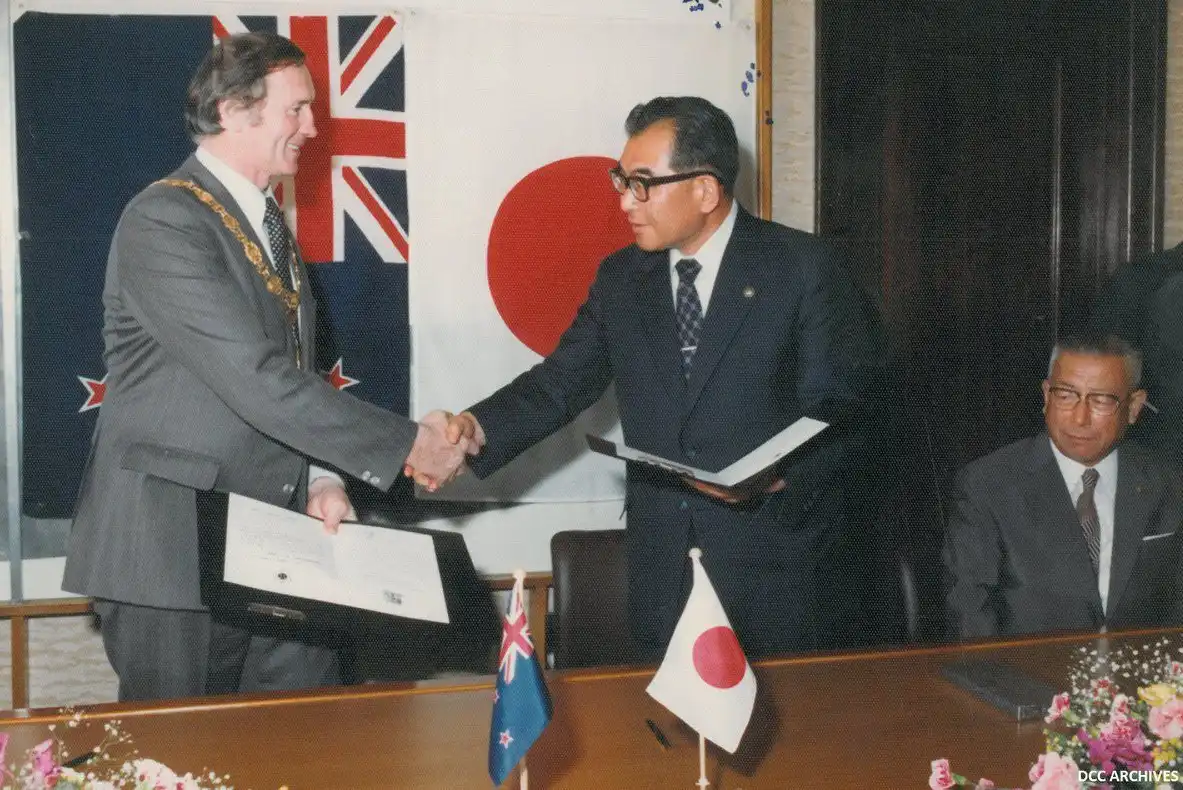
Kimono: A Japanese Story
To celebrate the 25th anniversary of the Dunedin Otaru Sister City relationship in 2005, Otaru Museum, offered to bring a collection of kimonos to the Tūhura Otago Museum. Many of the garments in the exhibition were from the private collections of the people of Otaru.
The exhibition at Tūhura Otago Museum, entitled Kimono: A Japanese Story was opened by the Mayor of Dunedin, Peter Chin, the Mayor of Otaru, Katsuma Yamada and the Japanese Ambassador to New Zealand, Mr Masaki Saito.
The exhibition was not like any other collection of kimonos seen in New Zealand. One of the most obvious points of difference was that many of garments were made in the twentieth century, and several were made of synthetic fibre. Many were relatively casual garments; they were essentially the formal and informal clothes of private citizens.
There were no geisha or kabuki theatre garments popularly associated with kimono. There were no imperial robes or samurai outfits known to western audiences through movies and television shows. The exhibition provided an everyday experience of Japanese clothing from a single population centre, Otaru in the north of Japan.
The strength of the relationship between Dunedin and Otaru led Otaru Museum to gift the entire collection to the people of Dunedin at the end exhibition. Overnight Tūhura Otago Museum became home to one of the largest collections of kimono in Australia and New Zealand. The Chief Executive of Tūhura Otago Museum at the time, Mr Shimrath Paul said. "It was just mind-blowing."
Otaru Museum & Tūhura Otago Museum
In 1984 with Toitū Otago Early Settlers Museum, Tūhura Otago Museum contributed to the Dunedin Pavilion at the Otaru Expo. This was the beginning of an ongoing relationship between the Sister City museums.
In 1995 Tūhura Otago Museum welcomed Mr Masahiro Ohara, a curator at Otaru Museum, to Dunedin on a staff exchange programme.
In 1998, in support of Otaru Japan Week, Tūhura Otago Museum mounted a special exhibition, Otaru Past to Present which included archaeological material of the Jomon and Satsumon people, material from the Ainu, and a section on modern Otaru. It was a joint undertaking between the staff of Otaru Museum and Tūhura Otago Museum. The design included a bridge, gateway, raked garden, and ceiling-hung banners. Community programmes included a Japanese film festival, martial arts demonstrations, and ikebana and bonsai workshops.
Four years later Tūhura Otago Museum curated an Otago exhibition, An Abundant Land, that opened in Otaru in July 2002.
Shuzo Tsuchiya san was a constant and crucial part of the relationship between the two institutions, and an important organiser of the group of respected Japanese curators who visited various Dunedin institutions to share their expertise.
Kimono: a Japanese story, was open for six months from late 2005.
Contemporary Traditions, Dunedin & Otaru celebrate 30 years, featuring works by Kāi Tahu and Ainu artists, was displayed in our Special Exhibitions Gallery from August to November in 2010. In that year, four Otago Museum staff members also had the privilege of visiting Otaru.
Otaru Teien
The Otaru Teien (Otaru Garden) at the Dunedin Botanic Garden was opened by Otaru Mayor Masaaki Araya, in 1998. The garden commemorates the Otago Province 150th Anniversary.
Mayor Araya, speaking through a translator said, the Teien met the criteria for a Japanese garden. He believed Japanese visitors to the Botanic Garden would first be surprised then delighted to see a Japanese Garden in Dunedin.
The garden was funded by personal donations from Otaru and Dunedin residents as well as the Otaru and Dunedin City Councils. The garden design and then development were jointly managed by specialists from both cities.
The Teien includes Japanese landscape features such as the stone lantern and the Azumaya (garden shelter) on the small island connected by a stone bridge. Plants chosen for the garden are native to Japan including iris, Japanese blood grass, maples, birch and azalea. Wisteria grows over the entranceway Pergola.
A second stone lantern was gifted in 2004. The photograph below shows Dunedin Mayor Sukhi Turner and Otaru Mayor Katsuma Yamada admiring the second lantern.
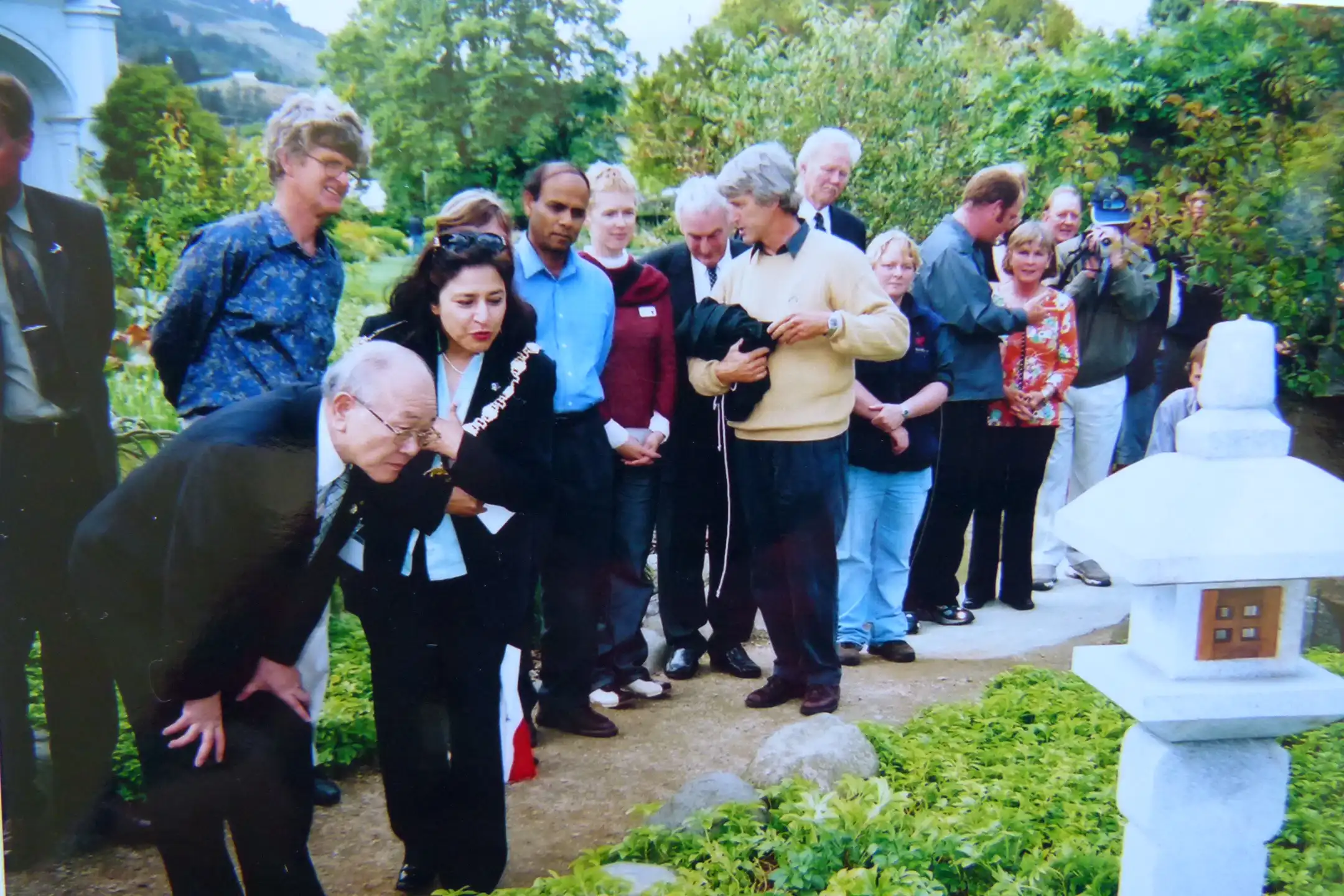
Good friends keep in touch
The Otaru delegation visit to Dunedin in 2024 is the first formal civic exchange since 2015. Prior to the Covid pandemic, civic exchanges occurred at least every three years in the respective cities.
Like the 2024 programme these typically include a busy itinerary of cultural, business, education and social events.
As well as the formal delegations annual youth exchanges built understanding and new friendships. Regular staff exchanges between Otaru and Dunedin City Council established lasting professional connections.
Numerous artists from each city have spent time working and exhibiting in the respective cities, often in conjunction with artists from other sister cities such Nakhodka city in Russia.
Children in both cities have sent their artworks back and forth for shared exhibitions.
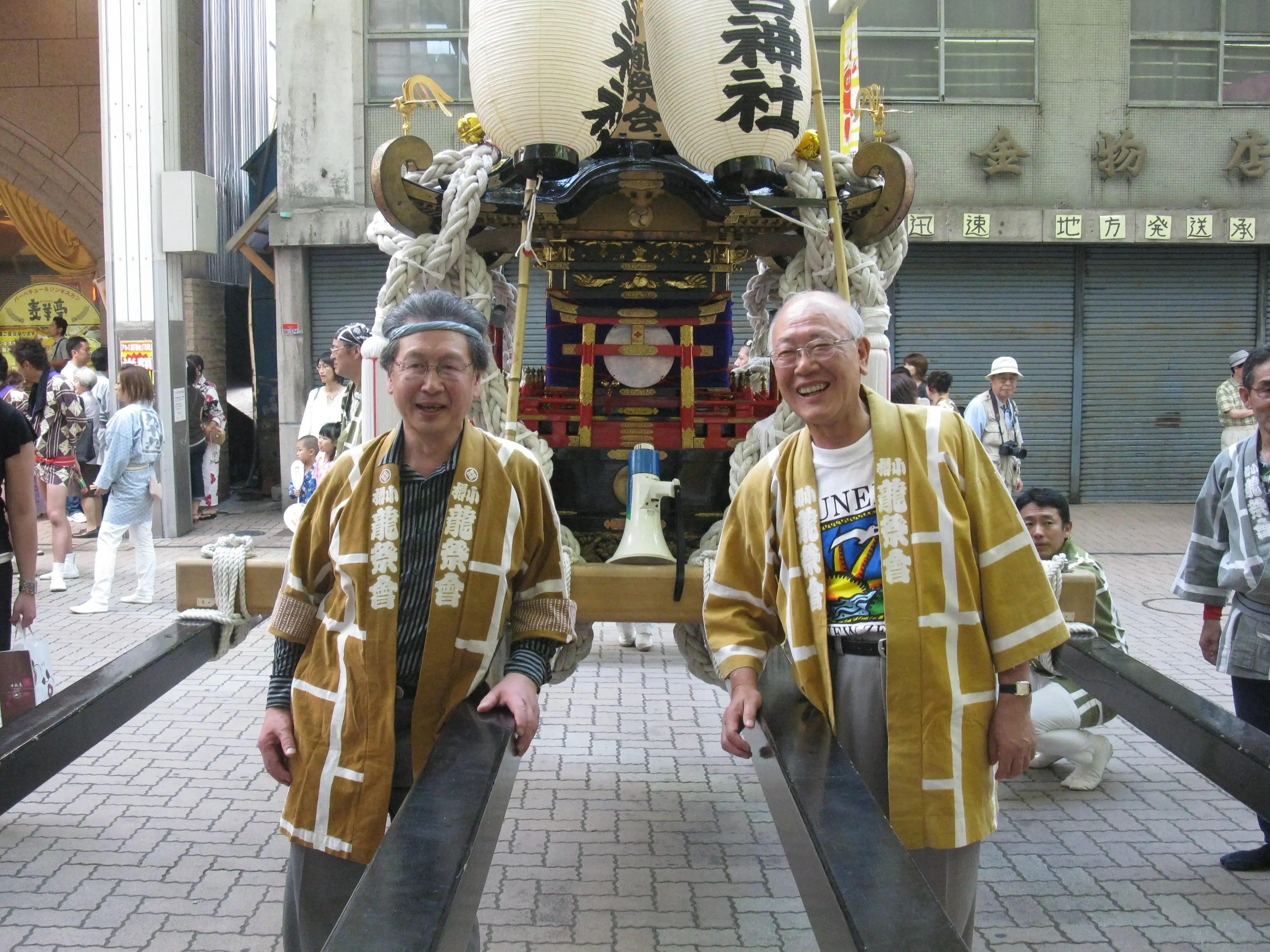
In the photo above Dunedin Mayor Peter Chin and Otaru Mayor Katsuma Yamada visit a festival in Otaru in 2010.
Dunedin Otaru Sister City Society
The Dunedin-Otaru Sister City Society was formed in 1986 and has a membership comprised of Dunedin people interested in Japanese culture, students and teachers of Japanese and Japanese nationals living in Dunedin. While the Society’s primary focus is the sister city relationship, it is involved in many other activities that link Dunedin and Japan.
The Society supports an annual programme of Japanese community events Many people have been influential and tireless in their work to maintain the warm friendships between Otaru and Dunedin. In addition to civic leaders and staff in both cities these people should be acknowledged.
Mr Russell Duff initiated the Dunedin – Otaru Sister City Society in 1986 and was the President of the society until he retired in 2006. Mr. Duff was also instrumental in organising Japan Week celebrations in Dunedin, featuring city-wide demonstrations of Japanese arts and culture.
Mr Duff was awarded the prestigious Order of the Rising Sun, Gold and Silver Rays decoration of Japan for his contributions to the promotion of mutual understanding and friendly relations between Japan and New Zealand in 2011.
Mr Fumiyuki Saijo was made an honorary member of the New Zealand Order of Merit in the King’s Birthday Honours in 2023 for his services to New Zealand-Japan relations, including being a ‘‘driving force’’ behind the sister city relationship between Dunedin and Otaru since 1984.
Mr Saijo was instrumental in the gifting of significant cultural gifts to Dunedin, including the Otaru Teien at the Dunedin Botanic Garden, and precious kimono seen here today at Tuhura Otago Museum.
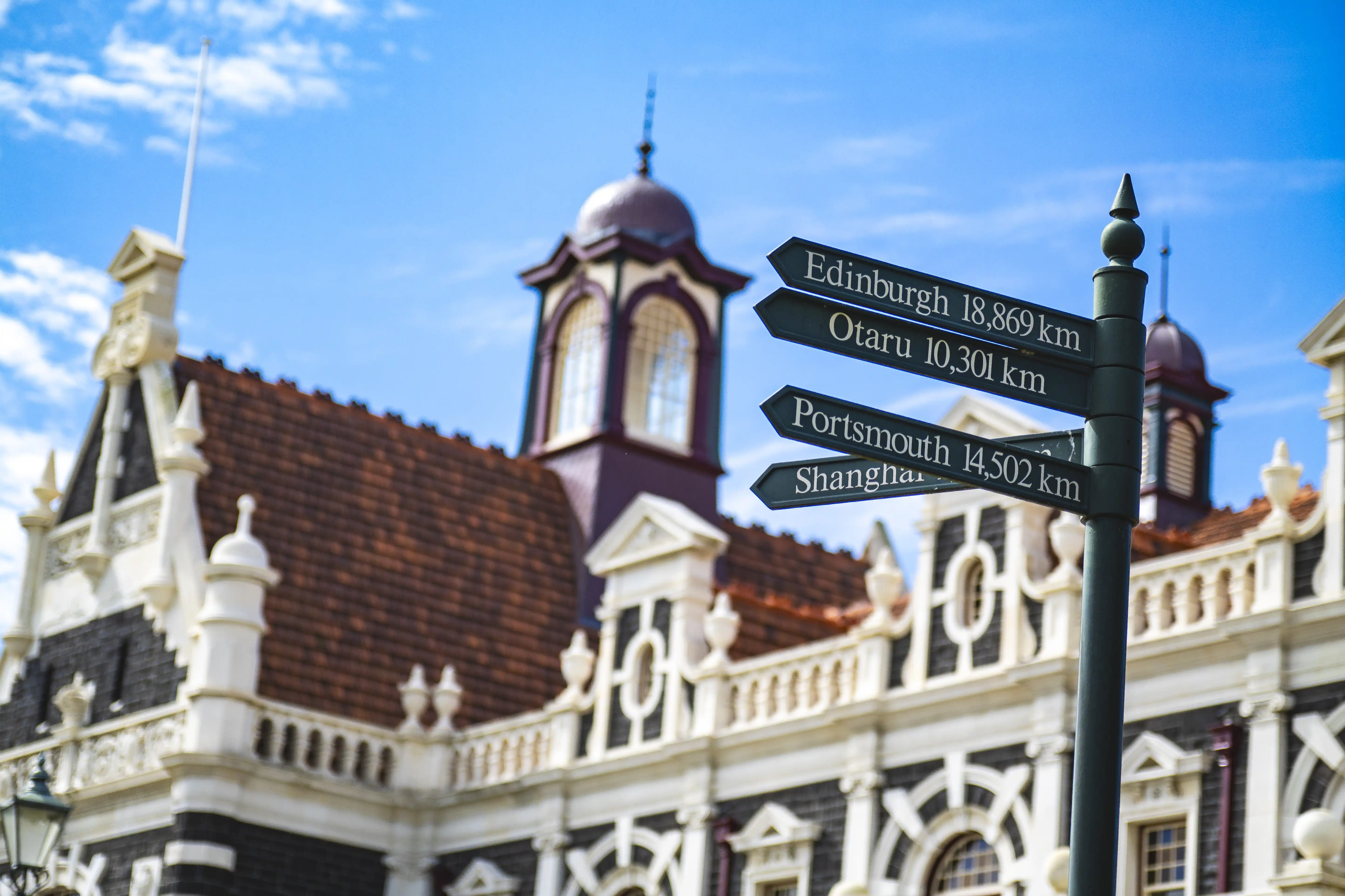
Japanese community events in Dunedin
January: Seijinshiki (成人式 - Coming of Age Ceremony) – A traditional Japanese national holiday to celebrate and welcome young people who have reached the legal age (20) of adulthood into society. Dunedin hosts Seijinshiki events annually, co-created by Japanese exchange students, University of Otago, Dunedin-Otaru Sister City Society and Dunedin City Council.
July: Annual Japanese Speech Competition – Hosted by Dunedin-Otaru Sister City Society, the speech competition provides a platform for local students and language learners to showcase their Japanese speaking and presentation skills.
September: Hanami (花見 - Cherry Blossom viewing) – The traditional Japanese custom of enjoying the transient beauty of cherry blossoms (Sakura), where people gather in parks, gardens and along rivers to admire the blooming sakura while sharing picnic with family, friends and colleagues under the trees. Dunedin’s annual Hanami event is hosted by the University of Otago’s Language and Cultures Department in accompanied by cultural performances such Taiko drumming and koto.
To follow the latest news and events about Dunedin-Otaru Sister Cities Society, please follow the Society's Facebook page and subscribe to the email newsletter.
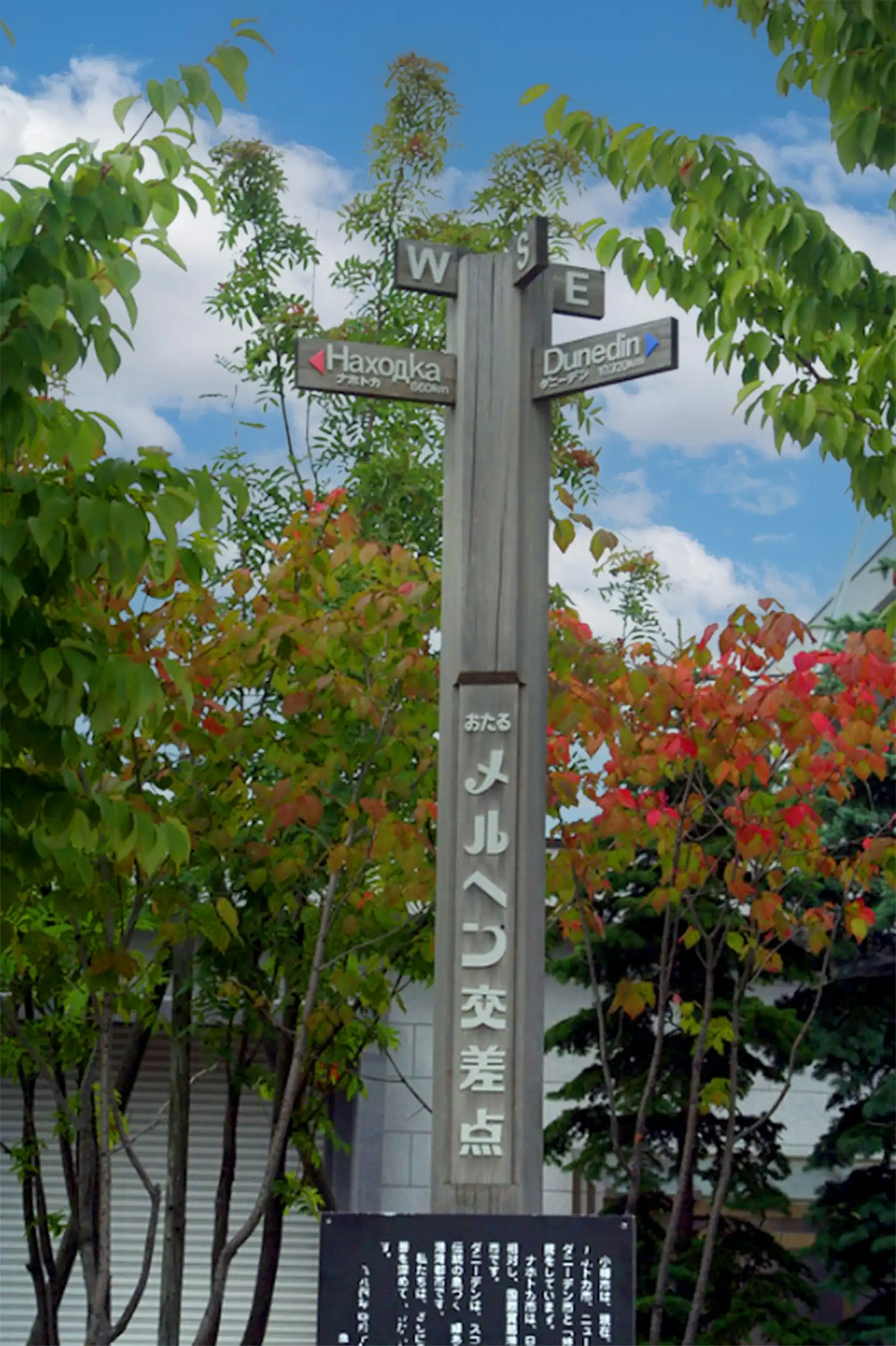
Education
Starting in 1988 and running for many years, Dunedin and Otaru secondary schools organised student exchanges. The students were immersed in local culture, home life, school, and recreation.
Following a 2006 exchange, one of the visiting Japanese students Mitsuto Mineo, reported to the Otaru Mayor Mr Katsuma Yamada that, “the people of New Zealand treated me like family, even when I met them for the first time. I had an experience that money can't buy.”
Aimie Taua, now working at Dunedin City Council recalls her student exchange to Otaru, “I look back at this trip with great fondness; it fostered my deep respect for Japanese people and culture, provided an opportunity to travel that would otherwise not be available to me, and facilitated important experiences that built up my confidence to be bold in my education and professional career.”
University of Otago and Otaru University of Commerce have facilitated student exchanges since 1997. The exchange programme for Otago students enables study in Japan using English. There is currently a student from Otago at Otaru University of Commerce and a student from Otaru will arrive at University of Otago in early 2025. In total 67 students have enjoyed the opportunity to study via the sister city relationship between the Universities.
Otago Polytechnic’s School of Art have hosted various Japanese artists in residence including Kan Shimada and Yoshi Takada. Japan is a valued partner across the education sector in Dunedin and regular student and staff exchanges are ongoing. It is recognised that the sister city relationship with Otaru strengthens the city’s reputation and informs diverse education connections between Dunedin and Japan.
Still didn't find what you were looking for?
